Открывается в новой вкладке
Инновационные решения в области качества воздуха
HisoAir-Logo
Запрос сейчас

Очиститель воздуха для 500 квадратных футов (Hisoair HA-139)

Технология очистителя воздуха HisoMedical HA139 удаляет 99,9% вирусов, бактерий и других загрязняющих веществ, находящихся в воздухе.

Технология Decibel Cancellation™
Наши воздухоочистители обеспечивают максимальную фильтрацию при минимальном уровне шума.

28 - 48 м² Функциональная зона
Применяемая площадь может достигать 28-48 кв. м, например, в школах, деловых помещениях.

400 м3/ч CADR
CADR, так называемая скорость подачи чистого воздуха, составляет 400 м3/ч.

99,9% H1N1 Тариф
Скорость удаления вирусов и H1N1 составляет 99,9%.

0.1um Medical Grade HEPA
Высокоэффективная система очистки воздуха от твердых частиц (HEPA) достигает медицинского класса 0,1um.

270-280 нм UVC свет
Очиститель воздуха HA139 с катализом 270-280 нм ультрафиолетовой лампой.

Поговорите с нашим экспертом

Лучший очиститель воздуха для 500 квадратных метров: технические характеристики

Товары HA-139
Размеры (Д х Ш х В) 250*250*510 мм
Вес продукта 3,6 кг
Потребление энергии 42 W
Выпуск воздуха Верхняя сторона
Воздухозаборник Передняя и задняя сторона
Интенсивность подачи чистого воздуха (CADR)-PM2.5 152м3/ч (89CFM), 234м3/ч (138CFM), 312м3/ч (184CFM), 408м3/ч (240CFM)
Коэффициент подачи чистого воздуха (CADR)-формальдегид 30 м3/ч
Технологии Фильтр предварительной очистки, антибактериальный фильтр, HEPA-фильтр H13 (H14 опционально), фильтр с активированным углем,
Анион (опционально), фотокатализатор (опционально), УФ-лампа (опционально)
Датчик Датчик PM2.5, датчик CO2 (опция)
WIFI (Tuya APP) Да (опционально)
Сертификаты CE-EMC, CE-LVD, ROHS, CADR & Noise, WIFI, EN1822, отчет о тестировании антибактериального фильтра
Размер коробки (Д х Ш х В) 310*300*580 мм
Вес брутто 4,6 кг
Количество загрузок (20ft/ 40ft/ 40hq) 500 единиц/ 1070 единиц/ 1220 единиц

Ваше оптимальное решение для бесшумной и высокоэффективной очистки воздуха
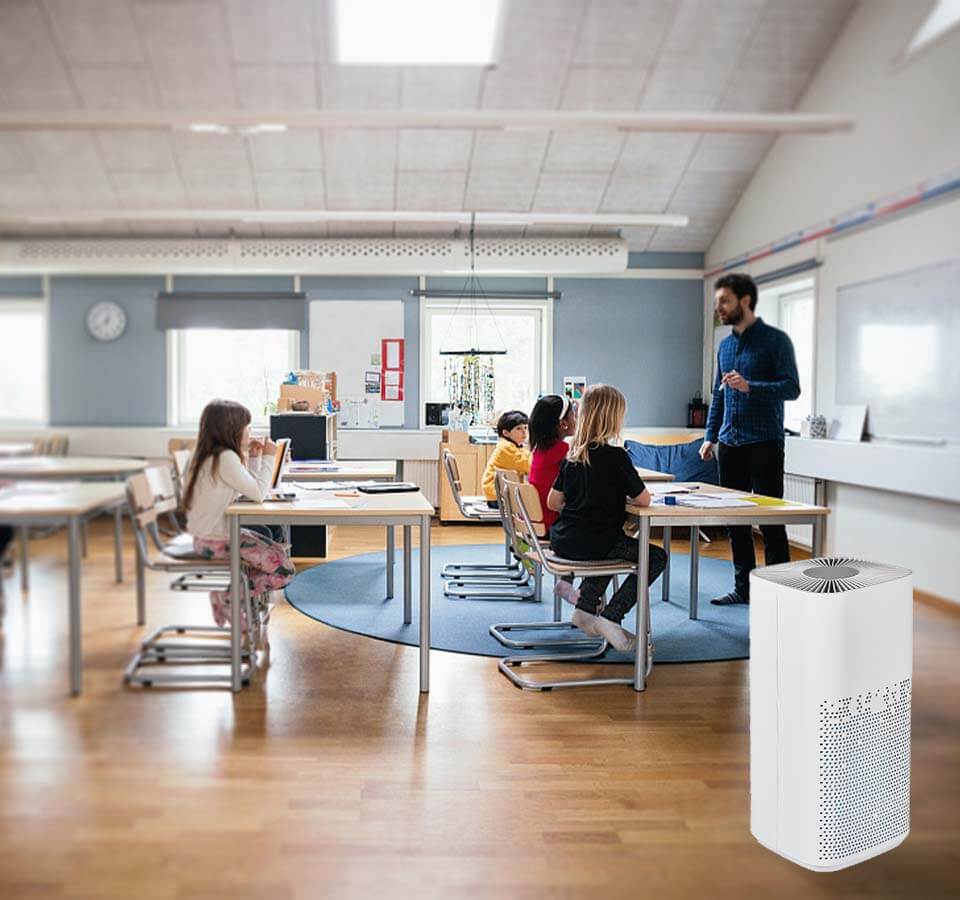
960x900px классная комната 139 2
  • Уникальный дизайн воздушного канала - обеспечивает беспрепятственную циркуляцию воздуха и контроль шума
  • Исключительно низкий уровень шума - на 5 -10 дБ ниже, чем у воздухоочистителей конкурентов
  • Большой CADR и большой воздушный поток - подходит для больших аудиторий или больших коммерческих помещений
  • Несколько датчиков - оснащен датчиком PM2.5, температуры и влажности.
  • Многослойная система фильтрации - антибактериальный фильтр, фильтр предварительной очистки,
  • Фильтр HEPA и фильтр с активированным углем
    Простое управление - работайте или управляйте изделием без каких-либо усилий

Почему стоит выбрать наши очистители воздуха?

Больничный класс
очистительная технология
Без вирусов
технология фильтрации
99.9% бактериальный
скорость удаления
Высокий CADR
(Коэффициент подачи чистого воздуха)
0.1um Медицинский класс
HEPA
270-280 нм
Стерилизация ультрафиолетовым светом
H14 H13 долгий час
пожизненные фильтры HEAP
Проверено
SGS и независимые лаборатории

Топ-3 OEM/ODM очиститель воздуха производитель в Китае

Частная маркировка фирменных очистителей воздуха на протяжении десятилетий

HisoAir предлагает услуги частной маркировки воздухоочистителей для клиентов, которые уже рассмотрели и согласились с дизайном и спецификациями воздухоочистителей HisoAir. После подписания соглашения выбранные продукты будут маркированы именем клиента.

Воздухоочистители OEM от начала и до конца

HisoAir предоставляет услуги по изготовлению воздухоочистителей OEM для партнеров, имеющих необходимые спецификации продукта. HisoAir обеспечивает исследования, дизайн, проектирование, создание макетов или модификаций, тестирование и серийное производство на основе окончательного дизайна клиента.

Более 50 проектов очистителей воздуха
Sed erat libero, porta sed quam sed, vulputate tincidunt tortor.
логотип

ТЕСТИМОНИАЛЫ

" Я нашел сайт Hisoair в Google и, честно говоря, сначала не был уверен в их надежности, но они выполнили требования моего проекта за полтора месяца. А когда в проект потребовалось срочно добавить датчик CO2, они изготовили новый образец в течение недели, что делает их самым профессиональным и клиентоориентированным производителем, с которым я когда-либо работал".
tms 1
Томас
Государственный поставщик из Германии
" Мы все знаем, что COVID был ужасным бедствием для всего мира, особенно для Индии. Я купил очиститель воздуха у HisoAir, он был очень полезен для меня и моего офиса, дома, семьи и друзей. Я работал с Алвеном в течение последних 7 лет, который является представителем HisoAir, я могу сказать, что он очень надежный человек, очень эффективный и очень профессиональный".
отзывы клиентов 2
Ранджит Бала
Импортер медицинских изделий из Индии
" Мы - компания с более чем 15-летним опытом работы с частными организациями и частным сектором, мы сотрудничаем с Hiso уже 3 года, и мы очень благодарны за работу, которую Hiso нам предоставила. Мы благодарны за сотрудничество с Cherry и Mr. Lee "
отзывы клиентов
Герина
Больницы и правительственные поставщики из Румынии

ЗАПРОСИТЬ ЦИТАТУ

отправьте сообщение ниже

Мы свяжемся с вами как можно скорее!

БУДЬТЕ НА СВЯЗИ

Контактная информация

Ваш запрос важен для нас.
Мы свяжемся с вами в ближайшее время, а ваши данные всегда остаются в безопасности.
sales@hisoair.com
+86 138 0961 9940

Офис в США2180 S WINEVILLE AVE ONTARIO, CA 91761

Офис: Комната 712~713, здание 1, № 4, Вторая дорога, парк озера Соншань, город Дунгуань, провинция Гуандун, 523429.

Фабрика: Китай | Вьетнам | Таиланд | Малайзия

Contaminant Engineering•3 min read

PFAS Water Filtration Technologies Explained: Carbon, Resin & RO

Key Takeaway:

PFAS reduction depends on the specific compounds present, treatment media, contact time, water chemistry, and system design. Activated carbon, ion exchange, and Reverse Osmosis address PFAS through different mechanisms.

PFAS are a large family of persistent fluorinated compounds that can occur in drinking-water supplies. Their treatment behavior varies significantly by molecular structure, chain length, functional group, concentration, and the chemistry of the source water.

Granular Activated Carbon (GAC) removes PFAS primarily through adsorption. It is generally more effective for many longer-chain PFAS, while shorter-chain compounds tend to break through more quickly. Carbon performance depends on media properties, Empty Bed Contact Time (EBCT), competing organic matter, loading, and replacement frequency.

Ion-exchange resins use charged functional sites to capture many PFAS compounds. Properly selected anion-exchange media can provide high capacity and may perform better than conventional activated carbon for some shorter-chain PFAS, although performance still depends on water chemistry and competing ions.

Reverse Osmosis (RO) uses membrane separation rather than adsorption. Properly designed RO systems can provide broad reduction across many PFAS compounds as well as dissolved salts and other contaminants. Unlike carbon or resin, however, RO also produces a concentrate stream that must be managed.

No single technology should be selected from a PFAS label alone. System design should consider which PFAS compounds are present, their concentrations, required reduction targets, flow rate, media life, and the applicable third-party certification or validation requirements.

HisoAir Water Technical Series
Product Discovery•3 min read

How to Choose an Under-Sink Water Purifier for Modern Kitchens

Key Takeaway:

Match the treatment technology to your water quality first, then evaluate cabinet space, faucet configuration, flow rate, drain and power requirements, and filter replacement needs.

Choosing an under-sink water purifier starts with water chemistry. Carbon filtration is well suited to chlorine, taste, odor, and many organic contaminants, while Reverse Osmosis is more appropriate when dissolved salts, fluoride, nitrates, or broader dissolved contaminants need to be reduced.

For compact kitchens, tankless RO systems eliminate the conventional storage tank and can significantly reduce the space required under the sink. However, membrane capacity stated in GPD does not directly equal faucet flow. When comparing systems, check the actual dispensing flow rate, inlet-pressure requirement, recovery ratio, and whether a booster pump is required.

Installation architecture also matters. Many RO systems require a drain connection, electrical power, and either a dedicated drinking-water faucet or a compatible multi-function faucet. High-flow carbon systems can often connect directly to the existing cold-water line with a simpler installation, but pressure drop and available faucet flow should still be verified.

RO also removes much of the naturally occurring dissolved mineral content. Where taste or mineral balance is a priority, a post-RO remineralization stage can be added. Filter life should be evaluated by both rated capacity and local water quality rather than replacement time alone.

The right system is therefore not simply the smallest or highest-GPD model. It is the configuration that matches the target contaminants, available cabinet space, desired faucet setup, peak dispensing demand, and maintenance expectations.

HisoAir Water Technical Series
Water Quality•2 min read

What Does TDS Mean in Drinking Water? Measurement vs Contaminant Reality

Key Takeaway:

A TDS meter estimates the overall concentration of dissolved ionic substances from electrical conductivity. It cannot identify specific contaminants or determine whether water is chemically safe.

Total Dissolved Solids (TDS) refers to the combined concentration of dissolved substances in water. Most handheld TDS meters do not measure TDS directly. Instead, they measure electrical conductivity (EC) and convert that reading into an estimated parts-per-million (ppm) value.

This means a TDS reading can indicate how much dissolved ionic material is present, but not what that material actually is. Calcium, magnesium, sodium, nitrates, and other dissolved ions can all contribute to conductivity, yet a simple TDS meter cannot distinguish between them.

TDS meters are also not suitable for detecting trace contaminants such as PFAS, many VOCs, pesticides, pharmaceuticals, or disinfection byproducts. These substances may be present at concentrations far below the level needed to noticeably change electrical conductivity.

A low TDS reading therefore does not guarantee safe drinking water, and a higher TDS reading does not automatically indicate contamination. Water-treatment decisions should be based on laboratory testing for specific contaminants of concern rather than TDS alone.

HisoAir Water Technical Series
Technology Selection•2 min read

RO vs UF Water Filtration: Understanding Pore Sizes & Dissolved Minerals

Key Takeaway:

Ultrafiltration can reduce bacteria, turbidity, and suspended particles while retaining most naturally occurring dissolved minerals. Reverse Osmosis provides much broader reduction of dissolved salts and smaller contaminants.

Ultrafiltration (UF) typically uses hollow-fiber membranes with pore sizes in the approximate 0.01–0.1 micron range. These membranes physically retain turbidity, suspended solids, colloids, and many microorganisms while allowing dissolved minerals and salts to remain in the water.

Reverse Osmosis (RO) operates at a much finer separation level. Unlike UF, RO can substantially reduce dissolved ions such as sodium, calcium, fluoride, nitrates, and other contributors to total dissolved solids (TDS). This makes RO more suitable when dissolved-salt reduction is a primary treatment objective.

UF generally requires less system pressure and produces little or no continuous concentrate stream in many point-of-use configurations. RO typically requires greater pressure and produces a reject-water stream, but delivers broader contaminant reduction.

For water with acceptable TDS and mineral content, UF can be a simpler mineral-retaining treatment option. Where dissolved salts, fluoride, nitrates, or broader dissolved contaminants are a concern, RO is generally the more appropriate technology.

HisoAir Water Technical Series
Technology Selection•4 min read

Carbon Block vs Reverse Osmosis: Which Fits Your Need?

Key Takeaway:

Choose RO for dissolved inorganic salts and heavy metals; choose Carbon Block for chemical taste/odor, no wastewater, and high line-pressure flow.

Reverse Osmosis (RO) and Carbon Block filtration represent two fundamentally different treatment methods: membrane separation and adsorption. Understanding these differences helps determine which technology is better suited to a specific water-quality requirement.

Reverse Osmosis uses a semi-permeable membrane with pore sizes of approximately 0.0001 microns. It can significantly reduce dissolved inorganic contaminants such as TDS, fluoride, nitrates, and certain heavy metals. Because water must be forced through the membrane, RO systems require sufficient pressure or a booster pump and generate a concentrated wastewater stream.

Carbon Block filtration relies primarily on adsorption through compressed activated carbon, commonly with nominal pore sizes around 0.5–5 microns. It is highly effective for chlorine, chloramines, VOCs, taste, and odor, while allowing substantially higher direct-flow rates without producing wastewater.

From an operating perspective, Carbon Block systems are generally simpler, require less energy, and avoid the water loss associated with RO. RO involves higher system complexity and operating cost, but provides substantially broader reduction of dissolved contaminants that Carbon Block alone cannot address.

HisoAir Water Technical Series

ЗАПРОСИТЬ ЦИТАТУ