

For an appliance, wellness or healthy-home brand preparing to launch a water purifier, the phrase “PFAS-ready” can sound reassuring.
The proposed system may use activated carbon, ion-exchange resin, a reverse-osmosis membrane or a combination of these technologies. The manufacturer may also have preliminary laboratory data, certified components or experience supporting previous water-treatment certifications.
However, none of these elements automatically makes the finished product PFAS-certified.
The difference is not simply a certification logo. It affects the product architecture, rated flow, filter capacity, test protocol, bill of materials, replacement cartridge, factory controls and the claims a brand can publish after launch.
Quick Answer
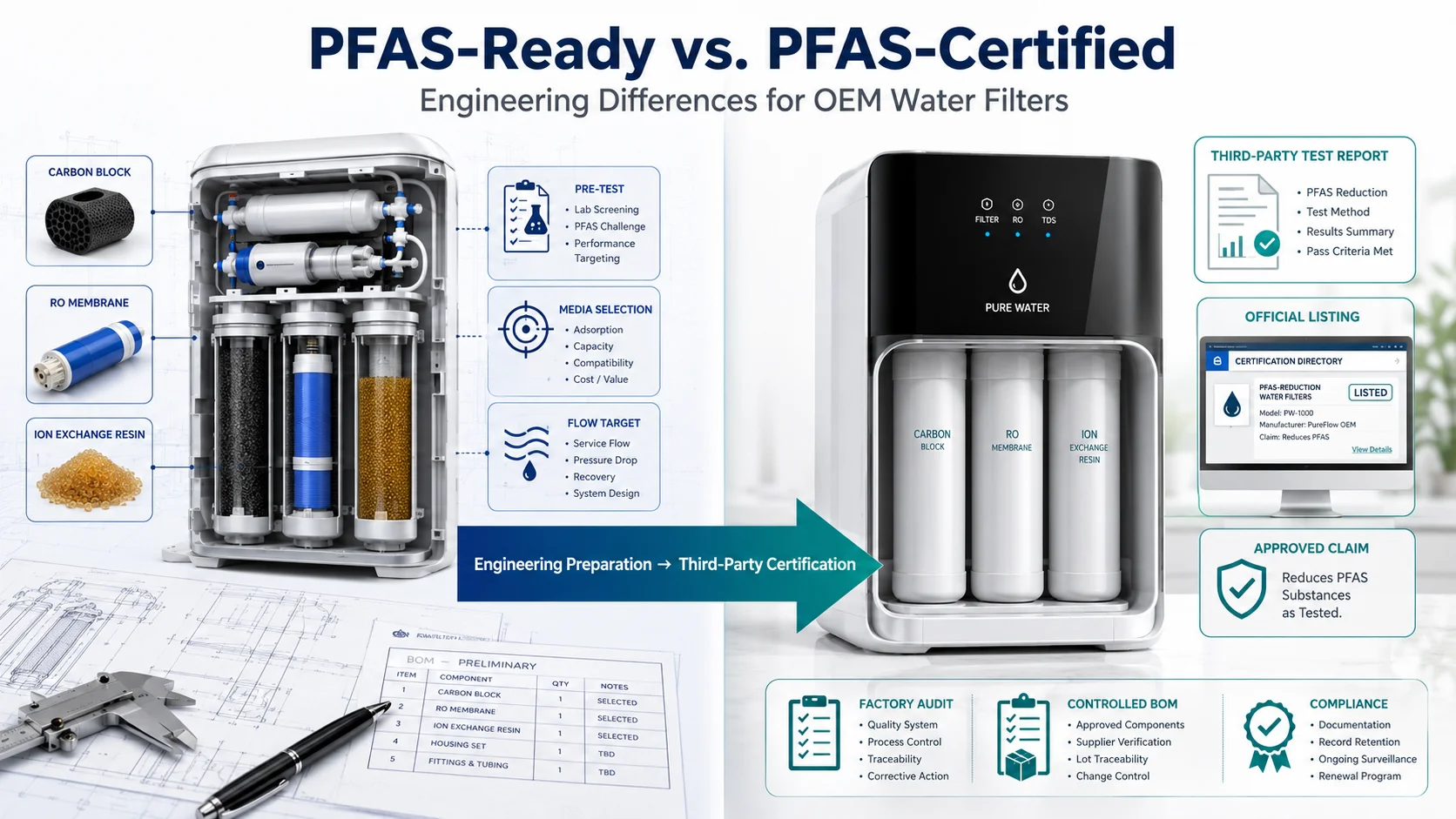
A PFAS-ready water purifier is an engineering platform prepared for product-specific PFAS testing and certification. A PFAS-certified water filter is an exact product configuration whose defined reduction claim has been independently evaluated, approved and normally connected to an official product listing and ongoing manufacturing controls. PFAS-ready describes preparation. PFAS-certified describes verified scope.
In this article, PFAS-ready is used as an engineering term rather than a certification category. It should not be interpreted as equivalent to certification under NSF/ANSI 53, NSF/ANSI 58 or another recognized conformity-assessment program.
This distinction is especially important for OEM and private-label projects, where a supplier’s existing platform may be modified for a new brand, faucet, housing, filter configuration, rated capacity or manufacturing location.
What Does PFAS-Ready Actually Mean?
PFAS-ready should describe the development status of a product platform—not an approved contaminant-reduction claim.
A responsible PFAS-ready program may already include:
- A defined target claim, such as PFOA/PFOS reduction or a specified Total PFAS reduction claim
- A selected filtration architecture using carbon, ion exchange, reverse osmosis or combined treatment stages
- Preliminary filter-media screening and engineering calculations
- A target flow rate and rated service capacity
- A controlled prototype bill of materials
- Initial material-safety and structural review
- Bench testing or pre-compliance testing
- Technical drawings and certification documentation
- A proposed certification pathway for the intended market
These activities can reduce development risk, but they do not prove that the commercial model has completed third-party certification.
PFAS-ready does not automatically mean that:
- The complete water purifier has passed a recognized PFAS reduction test
- The product appears in an official certification directory
- The brand may use a certification body’s mark
- The certified performance applies to every possible PFAS compound
- The same result applies after changing the filter, membrane, flow rate or housing
- The system has been certified to produce water below the current EPA limit for PFOA or PFOS
A filter-media supplier may provide adsorption data, a membrane manufacturer may publish rejection data, and a component may comply with a material-safety standard. These are useful inputs, but none of them independently establishes the finished system’s PFAS reduction claim.
PFAS-ready should mean ready to enter a controlled validation process—not ready to publish an unrestricted PFAS claim.
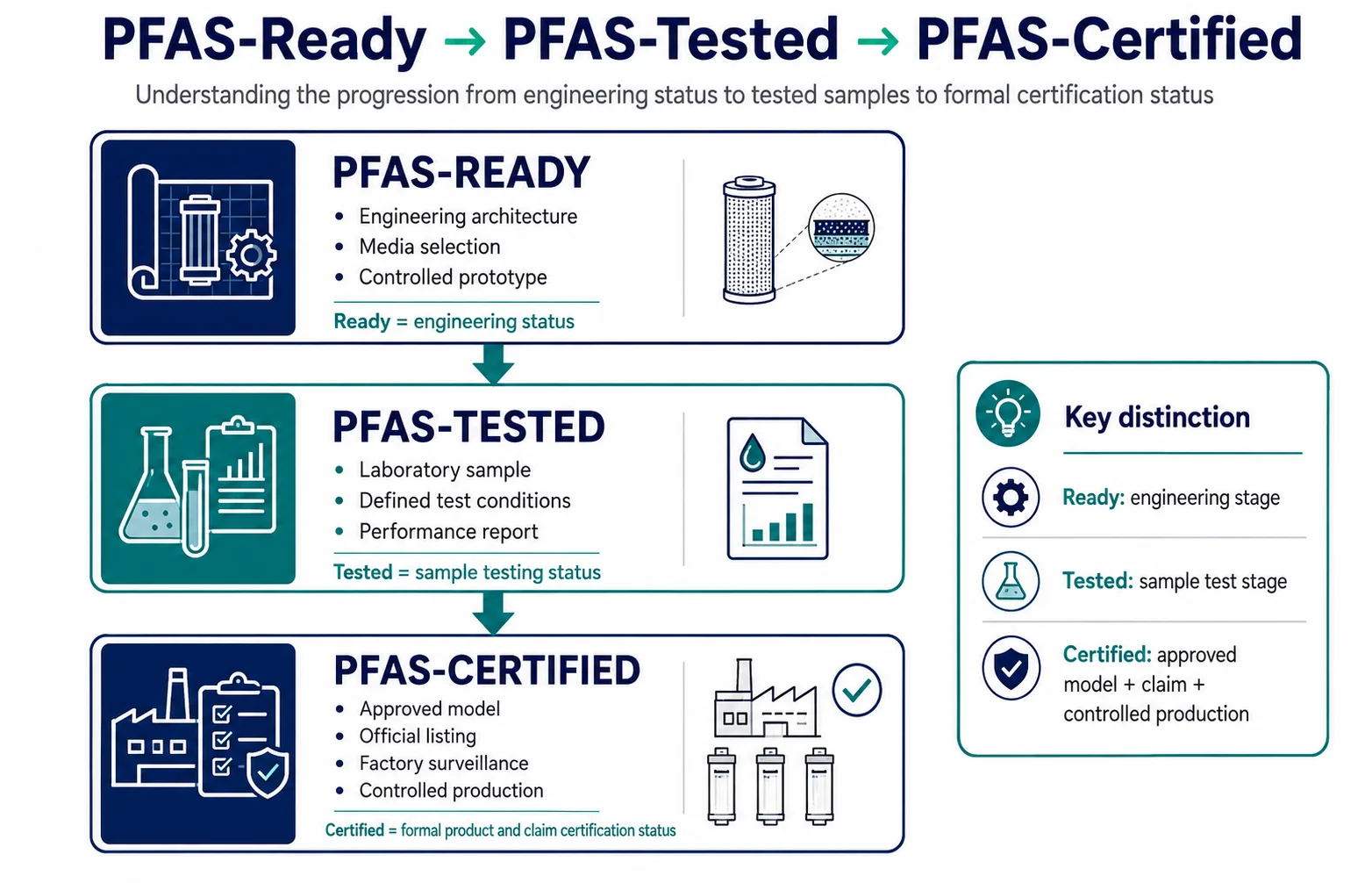
PFAS-ready, PFAS-tested and PFAS-certified are different stages
| Status | What It Normally Means | What It Does Not Automatically Mean |
|---|---|---|
| PFAS-Ready | The product architecture has been designed or selected with future PFAS testing and certification in mind. | The finished model has passed certification or may use an approved certification mark. |
| PFAS-Tested | A sample, component or finished system has been evaluated under stated laboratory conditions. | The product is certified, publicly listed or subject to ongoing factory surveillance. |
| PFAS-Certified | A defined product and reduction claim have been independently evaluated under an applicable certification program. | The system reduces every PFAS compound or meets every current and future regulatory limit. |
For B2B communication, PFAS-ready can be useful when it is accompanied by a precise explanation of the development stage. For consumer-facing packaging and advertising, the final wording should be limited to the evidence and certification status of the product actually being sold.
What Does PFAS-Certified Verify?
The phrase PFAS-certified is only meaningful when it identifies the certification body, applicable standard, product model and approved contaminant-reduction claim.
For residential point-of-use water-treatment products, PFAS reduction is commonly associated with:
- NSF/ANSI 53 for drinking-water treatment units making health-related reduction claims through adsorption, filtration or related treatment technologies
- NSF/ANSI 58 for point-of-use reverse-osmosis drinking-water treatment systems
Согласно NSF guidance on PFAS in drinking water, certification under the applicable standards provides third-party validation that the label’s PFAS reduction claim has been evaluated, while also addressing material safety, structural integrity and the accuracy of product literature.
NSF also states that certified products are periodically retested and manufacturing facilities are inspected annually.
A meaningful certification scope may identify:
- The certificate holder or listed manufacturer
- The brand or trade name
- The finished product model
- The approved replacement filter or membrane
- The applicable NSF/ANSI standard
- The specific reduction claim
- The rated flow rate
- The rated capacity or service cycle
- The production facility
- Conditions or footnotes attached to the listing
Сайт NSF Drinking Water Treatment Unit database allows users to search by manufacturer, brand, model, standard, facility location and individual reduction claim. This illustrates why certification is tied to an identifiable product scope rather than to a general statement that a factory “has NSF.”
“Total PFAS Reduction” does not mean every PFAS compound
PFAS is a large chemical family. A certified claim must therefore be understood according to the compounds and test protocol defined by the applicable standard and product listing.
Current NSF product-listing footnotes describe the listed Total PFAS Reduction claim as covering a defined group that includes:
- PFHpA
- PFHxS
- PFNA
- PFOA
- PFOS
- PFBS
- PFDA
This does not mean that the product has been evaluated for every PFAS substance that may exist in drinking water.
A brand should therefore avoid interpreting “Total PFAS Reduction” as “all PFAS removed.” The approved wording should follow the product listing, performance data sheet and certification body’s mark-use requirements.
PFAS certification and EPA drinking-water limits are not the same thing
Another common source of confusion is the relationship between public-water regulations and residential filter certification.
The EPA’s drinking-water Maximum Contaminant Levels apply to regulated public water systems. Certification standards for point-of-use filters evaluate products under their own defined challenge-water, test and pass/fail requirements.
NSF’s current consumer guidance states that a product making a PFAS reduction claim under the applicable standards must reduce PFAS to below 20 parts per trillion. NSF has also stated that its standards-development groups have been working on updates intended to align the standards more closely with EPA requirements.
As of August 2026, EPA has proposed retaining the 4-ppt Maximum Contaminant Levels for PFOA and PFOS while providing a possible compliance extension for public water systems. Because this regulatory process and the certification standards may continue to change, brands should verify the current requirements before fixing performance language on packaging or websites.
Important distinction
A product certified for PFAS reduction under a current filtration standard should not automatically be described as “certified to meet the EPA 4-ppt limit.” That statement requires evidence specifically supporting the claimed finished-water concentration and operating conditions.
Why Does Filter Media Alone Not Prove PFAS Performance?
Activated carbon, ion-exchange resin and reverse osmosis are recognized technologies for reducing PFAS. EPA research has found that point-of-use systems using these approaches can substantially reduce PFAS when the products are properly designed, operated and maintained.
However, the treatment technology is only one part of the finished-product result.
A claim such as “uses PFAS-removal carbon” does not explain:
- Which PFAS compounds were evaluated
- How much media is inside the filter
- How long the water remains in contact with the media
- What flow rate was used
- How the product performs near the end of filter life
- Whether the complete housing allows bypass
- Whether the mass-production cartridge matches the tested sample
Activated carbon and carbon-block engineering variables
Carbon-based performance can be affected by:
- Carbon source and activation process
- Pore-size distribution and surface characteristics
- Particle size
- Carbon mass
- Carbon-block density
- Binder selection and binder ratio
- Empty-bed contact time
- Flow distribution through the cartridge
- Channeling or incomplete packing
- Natural organic matter and other competing contaminants
- The chain length and chemistry of the PFAS being evaluated
For an extruded carbon block, increasing binder content may improve structural strength but can reduce the amount of active carbon available. Increasing density may improve contact but also increase pressure drop. Raising the rated flow may make the product more convenient while reducing contact time.
These trade-offs must be resolved at system level.
Ion-exchange engineering variables
Ion-exchange resin may provide strong affinity for selected PFAS, but its actual performance depends on:
- Resin chemistry and functional groups
- Resin-bed volume
- Flow rate and contact time
- Competing ions in the incoming water
- PFAS concentration and mixture
- Resin exhaustion behavior
- How the resin is retained and distributed inside the cartridge
A resin data sheet can support initial material selection, but a commercial product still needs finished-system validation.
Reverse-osmosis engineering variables
RO systems create a different engineering chain. Important variables may include:
- Membrane model and membrane condition
- Feed-water pressure and temperature
- Pretreatment configuration
- System recovery rate
- Concentrate ratio
- Membrane-housing sealing
- O-rings, connectors and potential bypass paths
- Storage tank or tankless configuration
- Post-carbon filtration
- Automatic flushing and shutdown logic
Even when the membrane material performs well, leakage around the membrane seal or mixing elsewhere in the water path can affect the final outlet result.
EPA’s guidance on filters certified to reduce PFAS also emphasizes that GAC, ion-exchange and RO systems remain effective only when their filters and membranes are maintained and replaced according to the manufacturer’s instructions.

PFAS performance is created by the complete treatment architecture—not by one material specification.
For more detailed technology selection, see our comparison of carbon block and reverse osmosis for PFAS reduction.
How Do Flow, Capacity and Water Chemistry Change the Result?
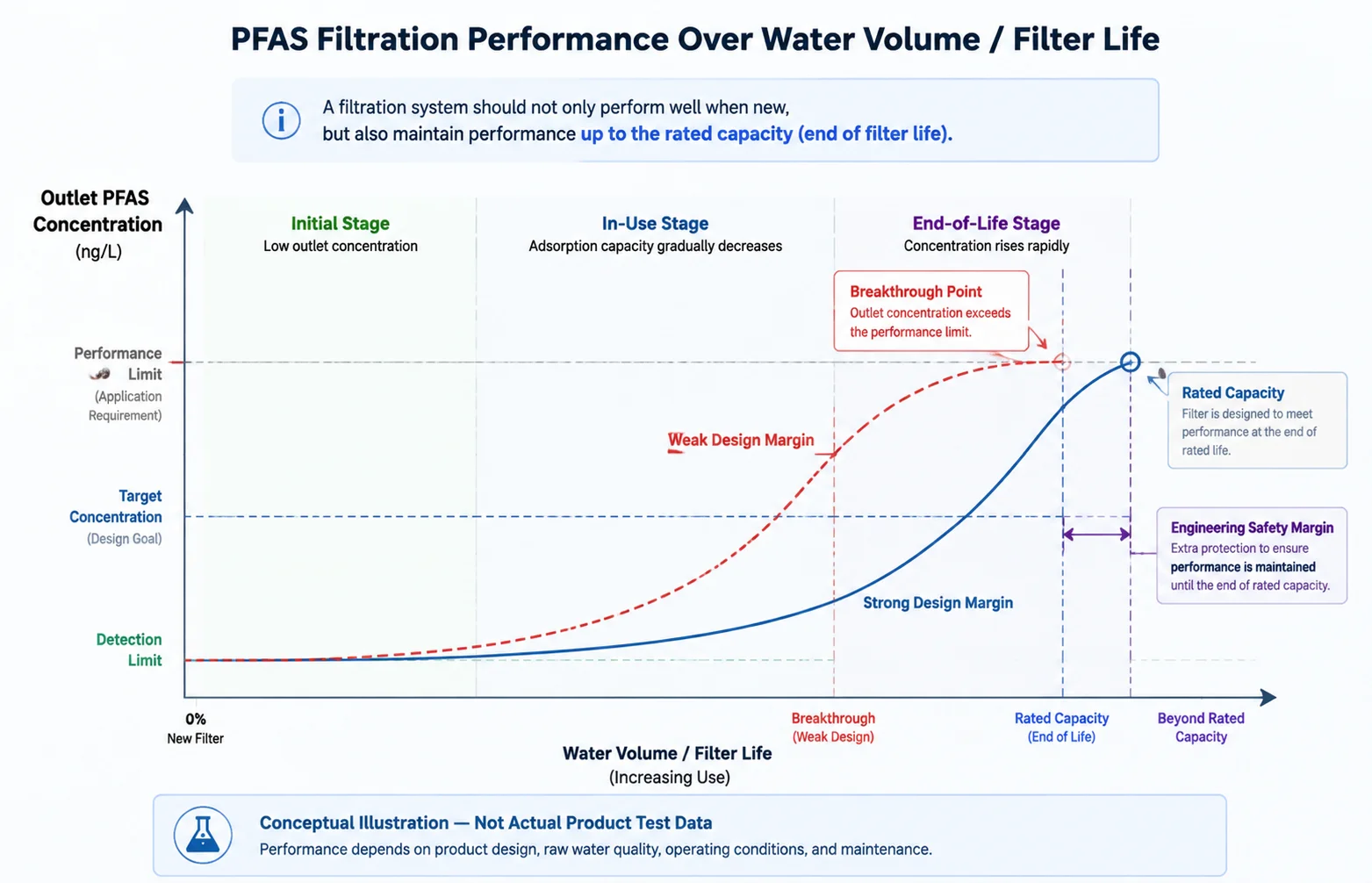
A new filter can produce an impressive initial test result. Certification-oriented engineering must also consider whether the product maintains the required performance throughout its claimed service life.
This is one of the most important differences between a promising PFAS-ready prototype and a certification-ready commercial system.
Rated flow controls contact time
For adsorption-based systems, water must remain in contact with the media long enough for the target compounds to be captured.
If an OEM project increases flow without changing filter size, media mass or architecture, contact time may decrease. A cartridge that performs well at 0.5 gallons per minute may not produce the same result at 1.0 gallon per minute.
The faucet, flow restrictor, tubing, filter head and pressure conditions therefore become part of the performance system.
Rated capacity defines how long the claim applies
A contaminant-reduction percentage measured with a new cartridge does not establish performance at the end of the claimed gallon capacity.
As the filter is used:
- Adsorption sites are consumed
- Competing contaminants accumulate
- Pressure drop may change
- Shorter-chain PFAS may break through earlier than longer-chain compounds
- Variations in incoming water may accelerate capacity consumption
A product marketed with a high gallon rating must have evidence that supports the claim through the applicable test endpoint—not only during the first portion of use.
Water chemistry can change performance
Laboratory and real-world results can be influenced by:
- Incoming PFAS concentration
- The mixture of PFAS compounds
- Natural organic matter
- Hardness and mineral content
- pH
- Температура
- Other ions and contaminants
- Continuous versus intermittent use
- Periods of stagnation
This does not mean that certification testing must reproduce every household water condition. It means the engineering team should understand the product’s performance margin and avoid assuming that one favorable bench result represents every field condition.
Certification-oriented design needs margin
A weak development target is:
The prototype achieved the minimum result once.
A stronger development target is:
The production-intent design repeatedly achieved the target result with sufficient margin across representative samples and at the intended rated capacity and flow.
Pre-compliance testing should therefore examine more than initial percentage reduction. Depending on the project, it may evaluate:
- Initial and end-of-life performance
- Multiple production-intent cartridges
- Flow variation
- Cartridge weight and density variation
- Pressure and temperature ranges
- Intermittent operating cycles
- Potential bypass and sealing failure
- Performance before and after transport or conditioning
What Manufacturing Controls Separate a Certified Product from a Prototype?
Certification does not end when a laboratory finishes testing.
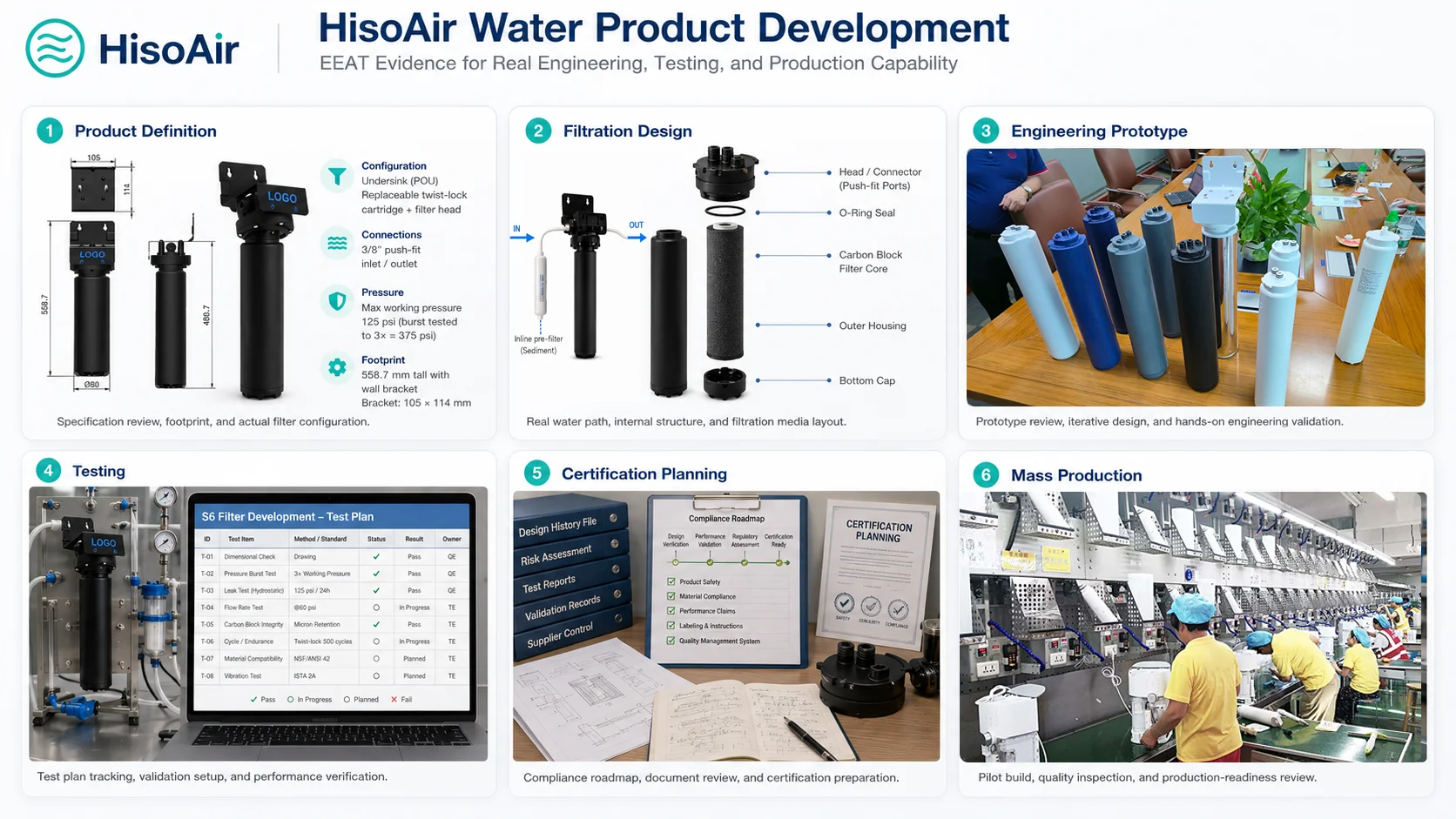
The commercial product must continue to match the approved configuration. If the production cartridge differs from the tested sample, the evidence chain supporting the claim may no longer be reliable.
Critical controlled items may include:
- Activated-carbon supplier and grade
- Ion-exchange resin supplier and formulation
- RO membrane manufacturer and model
- Media mass
- Carbon-block dimensions and density
- Binder type and percentage
- Filter housing material
- End caps, adhesive and potting material
- O-rings and sealing surfaces
- Flow-control components
- Pump and pressure settings
- Tubing and water-path design
- Post-filter configuration
- Replacement cartridge model
- Assembly factory
Not every change automatically requires complete retesting. However, changes that could affect material safety, structural integrity, contaminant reduction or the certified product description should be reviewed through the applicable certification-body change process before implementation.
Typical OEM production controls
A certification-oriented manufacturing program may include:
- A controlled bill of materials linked to the certified configuration
- An approved supplier list for critical media and components
- Incoming inspection of carbon, resin, membranes and wetted materials
- Lot numbers and supplier-batch traceability
- Cartridge weight verification
- Dimensional and density controls
- Flow-rate and pressure-drop testing
- Leakage and structural testing
- O-ring and seal verification
- Production sample retention
- Finished-product serial or batch traceability
- Documented engineering change control
- Periodic verification testing
- Factory-audit preparation and corrective-action records
The objective is repeatability. The filter shipped in month eighteen should remain within the approved technical scope of the filter that was originally evaluated.
Component certification is not finished-system certification
A project may use:
- NSF-certified activated carbon
- A membrane with third-party component certification
- NSF/ANSI/CAN 61-compliant wetted materials
- NSF/ANSI/CAN 372-compliant lead-free components
These elements can simplify technical review and reduce material risk, but they do not automatically transfer a PFAS reduction claim to the assembled purifier.
Material-safety certification answers a different question from contaminant-reduction certification.
| Evidence or Standard | Primary Question It Addresses | Does It Alone Prove Finished-System PFAS Reduction? |
|---|---|---|
| Media data sheet | What are the media’s stated physical or performance characteristics? | Нет |
| NSF/ANSI/CAN 61 | Do applicable materials or components meet health-effects requirements for drinking-water contact? | Нет |
| NSF/ANSI/CAN 372 | Does the product or component comply with applicable lead-content requirements? | Нет |
| Laboratory performance report | How did the submitted sample perform under the stated conditions? | Not necessarily |
| NSF/ANSI 53 or 58 certification with a PFAS claim | Has the defined finished product and claim been independently evaluated within the listed scope? | Yes, for the approved claim and listed configuration |
How Can an OEM Brand Move from PFAS-Ready to PFAS-Certified?
The transition from PFAS-ready to PFAS-certified should begin before the industrial design, packaging and launch schedule are finalized.
A claim-first development process is generally more reliable than selecting a finished purifier and attempting to add a PFAS message near the end of the project.
Step 1: Define the intended commercial claim
The brand and OEM should agree on:
- The compounds or defined claim to be evaluated
- The target market
- The applicable treatment standard
- The intended certification body
- The finished product type
- The target flow rate
- The rated filter capacity
- The intended replacement interval
- The desired consumer-facing wording
- Any internal performance target beyond the certification minimum
“PFAS reduction” is too broad to function as a complete engineering brief.
Step 2: Review the base platform
The team should determine whether the project will use:
- An existing certified base product
- An existing product that requires a new PFAS claim
- A PFAS-ready but uncertified platform
- A substantially new filtration architecture
This decision affects cost, schedule, testing responsibility and how much customization is possible.
Step 3: Freeze the production-intent architecture
Before formal testing, the project should control the items that materially affect performance:
- Media and membrane specifications
- Filter dimensions and media quantity
- Housing and seal design
- Flow-control strategy
- Pump and water-path configuration
- Rated flow and gallon capacity
- Replacement cartridge
- Critical suppliers
- Manufacturing site
Testing a prototype that will be redesigned after testing creates unnecessary certification risk.
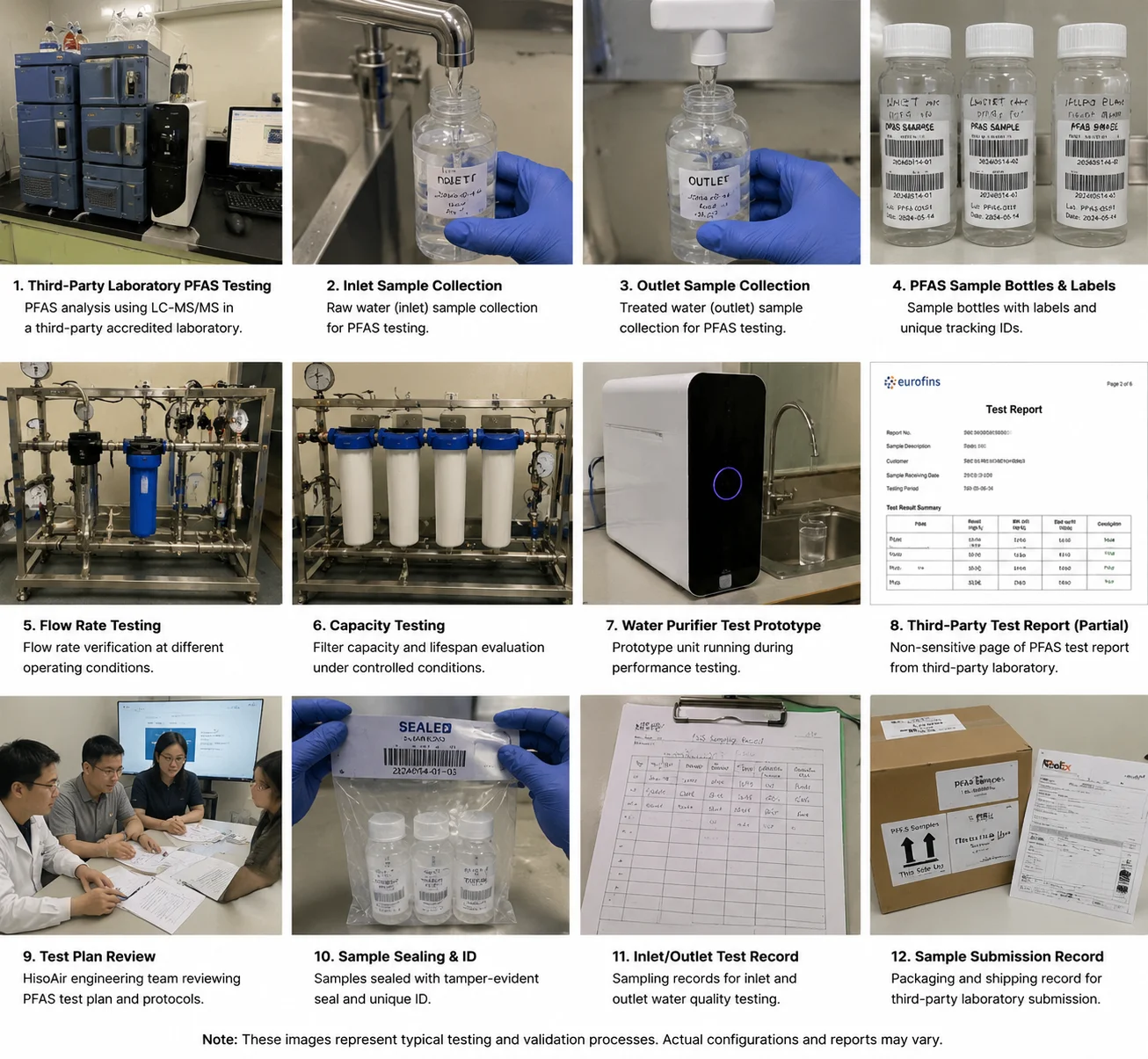
Step 4: Conduct pre-compliance testing
Pre-compliance testing can help identify:
- Insufficient media capacity
- Early contaminant breakthrough
- Excessive rated flow
- Cartridge-to-cartridge inconsistency
- RO membrane or seal bypass
- Pressure-drop problems
- Potential end-of-life failure
A pre-compliance report is not a certification. Its purpose is to improve the design before the formal certification samples are submitted.
Step 5: Select the certification ownership and listing path
OEM brands commonly consider two main structures.
Independent product certification
The brand or project obtains a certification for its defined commercial product.
This route may be more appropriate when:
- The filtration architecture is unique
- The brand needs greater control of the listing
- Substantial technical customization is required
- Multiple future product generations are planned
- The brand wants more flexibility in its long-term manufacturing strategy
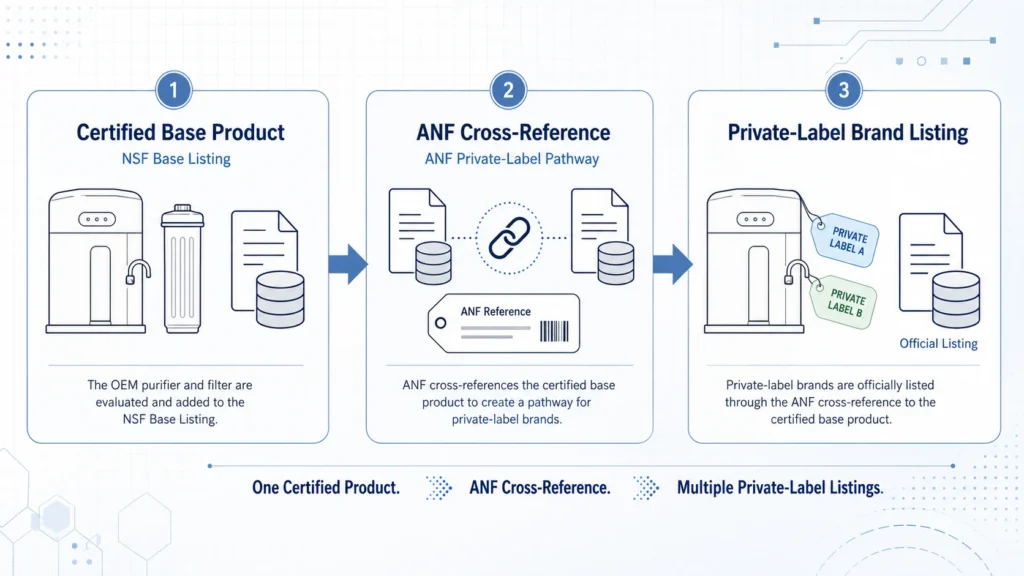
Private-label or ANF certification
NSF describes private-label certification for an existing NSF-certified water product as an “another name for,” or ANF, certification.
This route may be appropriate when:
- A suitable certified base product already exists
- The new brand accepts limited technical changes
- The commercial model remains within the approved base-product scope
- A faster private-label launch is required
- The base-listing owner will continue controlling the certified architecture
ANF certification does not give the private-label brand unrestricted permission to change the media, membrane, flow, capacity, water path or manufacturing site.
Before choosing this route, the parties should define:
- Who owns the base listing
- Which brand and model will appear publicly
- Which changes are permitted
- Who pays annual certification fees
- Who manages factory inspections
- What happens if the base product or listing is discontinued
- Whether the brand can move production in the future
For a detailed explanation of this relationship, see our guide: What Is an NSF Master Listing? A Guide to Base Listings, ANF Certification and OEM Water Filters.
Step 6: Complete formal testing, review and listing
The formal process may involve:
- Application and product-scope definition
- Technical-file submission
- Production-intent sample selection
- Performance testing
- Material-safety review
- Structural testing
- Label and literature review
- Initial factory assessment
- Model and brand-name approval
- Official listing publication
- Certification-mark authorization
The project should not publish the final certified wording before the approved scope, listing and mark-use conditions are confirmed.
Step 7: Maintain the certification after launch
After commercial production begins, the brand and OEM still need to manage:
- Supplier changes
- Media and membrane substitutions
- Engineering changes
- Factory transfers
- Periodic testing
- Factory surveillance
- Label and manual updates
- Replacement-filter continuity
- Complaint and corrective-action records
Building a PFAS-Oriented OEM Water Platform
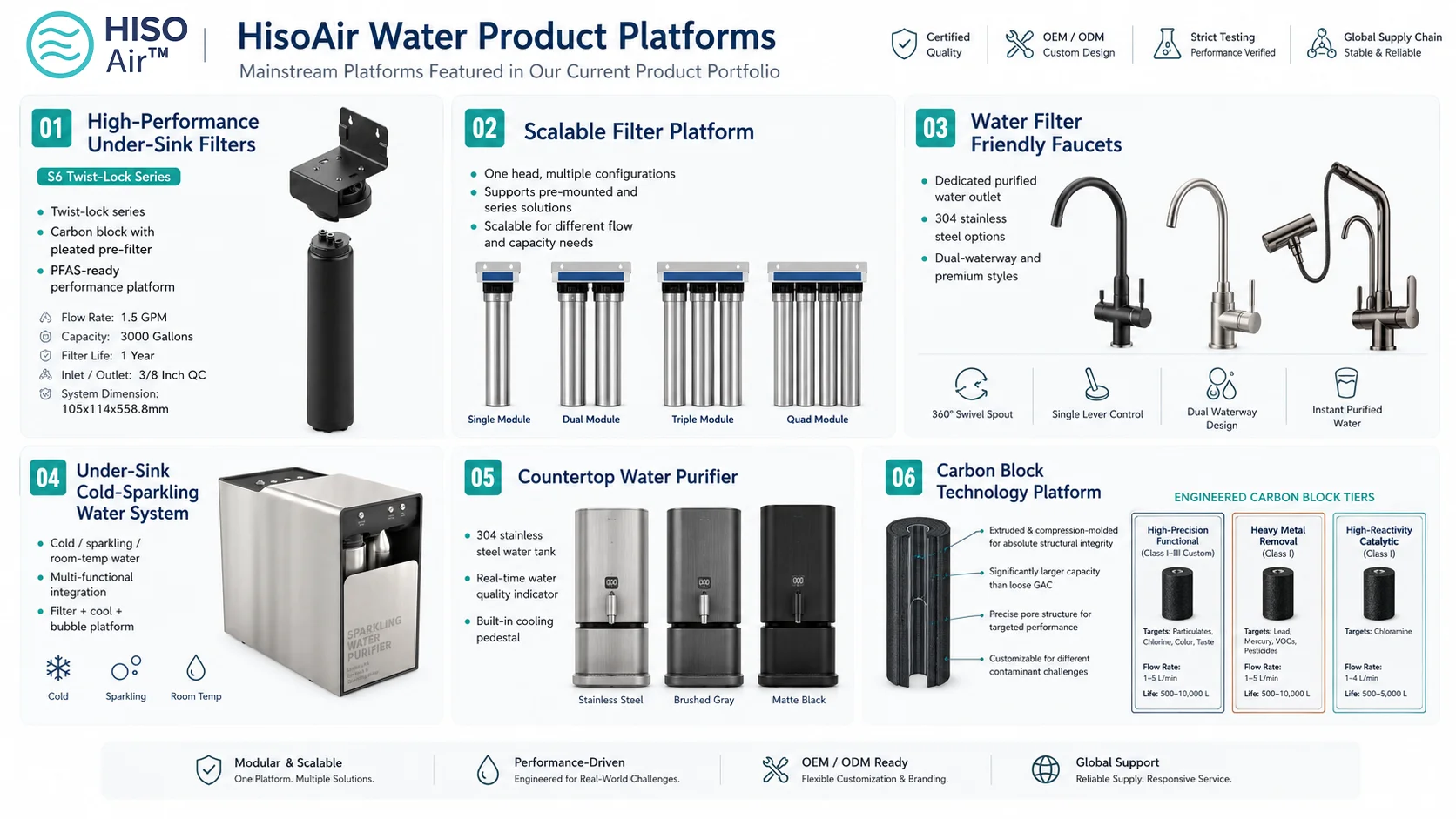
HisoAir supports B2B brands in defining contaminant targets, selecting filtration architectures, developing production-intent systems, coordinating testing and certification pathways, and maintaining controlled manufacturing configurations.
Conclusion: Readiness and Certification Serve Different Purposes
PFAS-ready and PFAS-certified should not be treated as interchangeable marketing terms.
PFAS-ready describes an engineering platform that has been prepared for a defined validation and certification process.
PFAS-certified describes an exact product configuration whose approved reduction claim is supported by third-party evaluation, defined test conditions, official certification scope and ongoing production controls.
The difference includes:
- The compounds included in the claim
- The complete filtration architecture
- The finished model and replacement cartridge
- The rated flow and service capacity
- The test protocol and pass criteria
- The certification body and official listing
- The manufacturing location
- The production bill of materials
- The change-control process
- The wording used in packaging and advertising
A supplier may begin with a capable membrane, carbon block or resin. A credible OEM program must connect that technology to the exact product sold in the market—and keep the connection intact from development through mass production.
The transition from PFAS-ready to PFAS-certified is therefore not one laboratory test. It is a controlled system linking engineering, validation, certification, manufacturing and product communication.
Часто задаваемые вопросы
Is PFAS-ready an official NSF certification category?
No. In this article, PFAS-ready is used as an engineering-development term. It means that the platform has been prepared for product-specific PFAS testing or certification. It should not be presented as equivalent to an NSF, WQA, IAPMO, UL or CSA certification.
Can a brand print “PFAS-ready” on consumer packaging?
The term may confuse consumers if it implies verified reduction performance. Consumer-facing language should clearly disclose the actual testing and certification status. A safer B2B description is “designed to support product-specific PFAS testing and certification.”
Does NSF/ANSI 42 certification include PFAS reduction?
NSF/ANSI 42 primarily addresses aesthetic effects such as chlorine, taste and odor. PFAS health-related reduction claims are generally associated with NSF/ANSI 53 for filtration systems or NSF/ANSI 58 for reverse-osmosis systems.
Is a third-party laboratory report the same as certification?
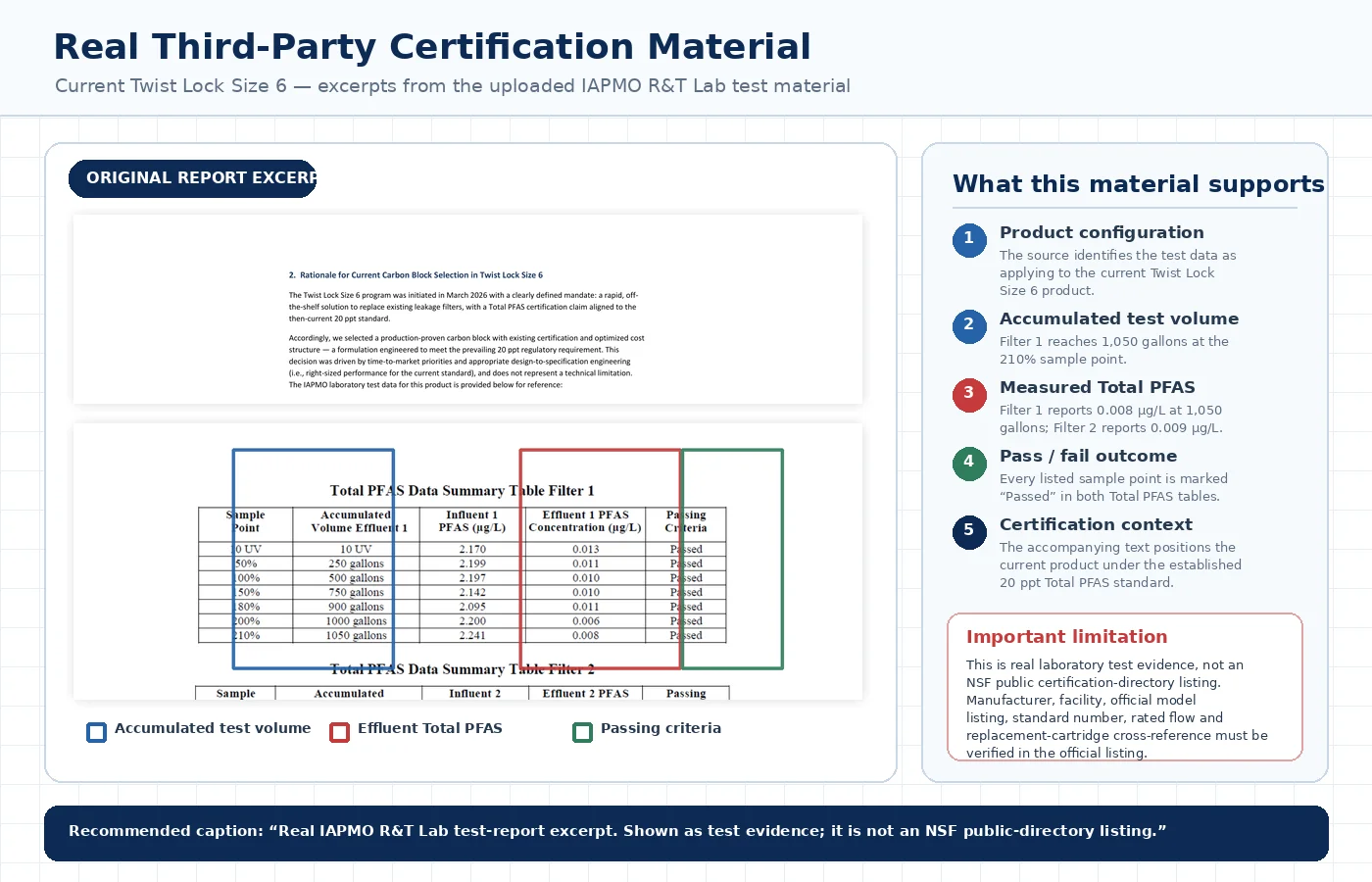
No. A laboratory report records the result obtained for a submitted sample under stated conditions. Certification generally adds technical review, approved claim language, a defined product scope, public listing, mark control and ongoing factory or production surveillance.
Does Total PFAS Reduction mean the filter removes every PFAS?
No. Total PFAS Reduction refers to a defined group of compounds in the applicable test and listing. Brands should identify the standard, listing and performance data rather than interpreting the claim as coverage of the entire PFAS family.
Does PFAS certification prove that outlet water will always be below 4 ppt?
Not automatically. EPA drinking-water limits for public systems and point-of-use filter certification requirements are different frameworks. A claim that a product produces water below 4 ppt requires evidence supporting that concentration for the exact product and stated operating conditions.
Can a certified filter cartridge be installed in any housing?
No. Housing geometry, seals, flow control, connection design and bypass paths can affect finished-system performance. The cartridge must be used within the product configuration and conditions covered by the applicable test or certification scope.
Can an OEM change the carbon or membrane after certification?
A potentially performance-related change should be reviewed through the certification body’s change-control process before implementation. Depending on the change, technical review, additional documentation or retesting may be required.
Is private-label ANF certification always better than independent certification?
No. ANF can support a faster launch when the brand accepts the certified base product and limited customization. Independent certification may provide more control for brands developing unique architectures, long-term product families or flexible manufacturing strategies.
Sources and References
- U.S. EPA: Per- and Polyfluoroalkyl Substances in Drinking Water
- U.S. EPA: Proposed PFOA and PFOS Compliance Extension Rule
- U.S. EPA: Identifying Drinking Water Filters Certified to Reduce PFAS
- U.S. EPA: Reducing PFAS in Drinking Water With Treatment Technologies
- NSF: PFAS in Drinking Water
- NSF: Forever Chemicals and the Advancement of Filtration Standards
- NSF: Standards for Water Treatment Systems
- NSF: NSF/ANSI 58 Reverse Osmosis Drinking Water Treatment Systems
- NSF Official Drinking Water Treatment Unit Listings
- NSF: Private-Label and ANF Certification
- Water Quality Association: PFAS Portal for Water Treatment Professionals
Regulations, standards, certification requirements and official product listings may change. Brands should verify the current standard edition, certification status, regulatory requirements and public listing before publishing product claims. Last reviewed: August 5, 2026.




 English
  Français
  Español
  Italiano
  Deutsch
  Português
  Русский
  العربية
  日本語
日本語  한국어
한국어  Tiếng Việt

