Se abre en una pestaña nueva
Soluciones innovadoras para la calidad del aire
Australia, Premium Residential Air Purification

Supporting a Premium Air Purifier Brand in Expanding into the Compact Desktop Purification Market
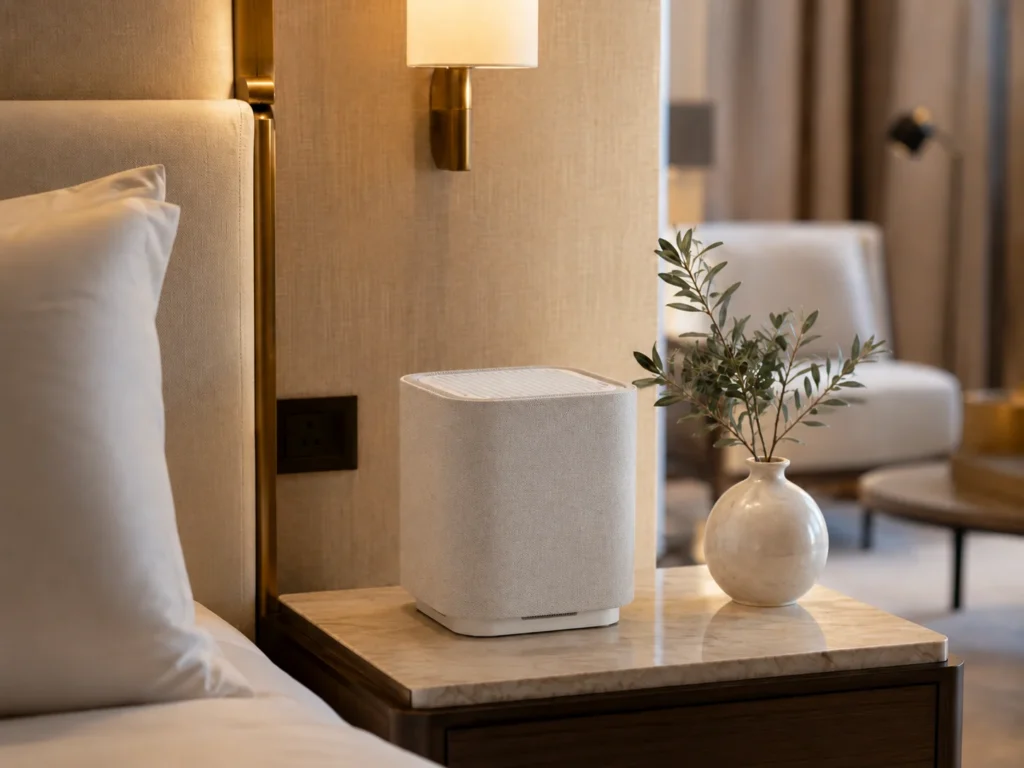
HisoAir helped an established Australian air purifier brand expand beyond large residential products with a compact, low-noise Air Lite desktop purifier customized for its premium brand identity and local market requirements.
A modern air purifier and a small decorative vase with green branches on a marble-topped nightstand in a well-lit bedroom.

TARGET AUDIENCE

Premium Air Purifier Brands

SOLUTION AREA

Compact Desktop Air Purification

KEY TECH

Compact High-Performance Design

PRODUCTION

Platform Customization & Batch Production

Our Involvement

Product Platform Supply

Product Specification Adjustment

Logo Customization

Product Body Color Customization

Australian Power Adapter Configuration

Sample Development

Noise and CADR Testing

Product Performance Validation

Certification Support

Packaging Design

Production Management

Control de calidad

Project Overview

Company

Confidential Premium Air Purifier Brand

Sede central

Australia

Market

Australia

Productos

Air Lite Compact Desktop Air Purifier

Background

The client is an established premium air purifier brand serving the Australian residential market.

Its existing portfolio primarily consisted of larger air purifiers designed for bedrooms, living rooms, and other medium-to-large indoor spaces. These products supported the brand’s premium positioning but did not fully address demand for personal and compact-space purification.

Many consumers were looking for smaller air purifiers suitable for desks, bedside tables, home offices, and other personal spaces. The client’s existing models were too large for these applications.

To close this portfolio gap, the company decided to introduce a compact desktop air purifier that could maintain the same performance, appearance, and quality standards expected from its larger products.

The client contacted HisoAir through a Google inquiry to identify a suitable product platform.

❞
"The client needed a compact purifier that could fill a new personal-space application without compromising performance, noise control, or premium brand consistency."

The Idea

The client wanted to expand its product range with a compact air purifier designed specifically for personal and small-space use.

The new product needed to:

  • Fit naturally on desks and bedside tables
  • Deliver meaningful purification performance within a compact footprint
  • Operate quietly at close range
  • Maintain a premium minimalist appearance
  • Provide simple and intuitive controls
  • Meet Australian market requirements
  • Retain an upgrade path for future smart connectivity

The client did not want to introduce a basic entry-level purifier simply to fill a portfolio gap. The new desktop product needed to remain consistent with the company’s established premium positioning.

After reviewing the requirements, HisoAir recommended the Air Lite platform as the foundation for the project

The Challenge

The central challenge was balancing compact size, meaningful purification performance, low operating noise, and premium design.

Compact Size and Strong Performance
Reducing purifier size limits the internal space available for the fan, airflow channel, filter, and other components. This can result in lower airflow, increased resistance, higher noise, and reduced filter area.

The product could not feel like a decorative mini appliance with limited practical value. It needed to function as a credible extension of the client’s larger premium air purifier range.

Low-Noise Operation
Because the purifier would be placed on desks and bedside tables, users would often sit or sleep close to the device. Noise performance was therefore especially important.

Premium Product Positioning
The new purifier needed to align visually with the client’s established high-end portfolio through a clean square form, customized body color, consistent branding, and premium packaging.

Australian Market Adaptation
The product also required an Australian power adapter, market-specific labeling, documentation, certification coordination, and packaging preparation.

The HisoAir Solution

HisoAir provided a platform-based development solution built around the Air Lite compact desktop air purifier.

Product Platform Selection

Based on the client’s existing portfolio and target applications, HisoAir recommended Air Lite as the most suitable platform.

The platform provided:

  • Compact desktop dimensions
  • Strong performance relative to its size
  • Funcionamiento silencioso
  • Minimalist square appearance
  • Multi-stage filtration
  • Future smart-connectivity potential

Using an established platform allowed the client to enter a new product category without the cost and extended timeline of developing an entirely new purifier from the ground up.

HisoAir provided a platform-based development solution built around the Air Lite compact desktop air purifier.

Product Platform Selection

Based on the client’s existing portfolio and target applications, HisoAir recommended Air Lite as the most suitable platform.

The platform provided:

  • Compact desktop dimensions
  • Strong performance relative to its size
  • Funcionamiento silencioso
  • Minimalist square appearance
  • Multi-stage filtration
  • Future smart-connectivity potential

Using an established platform allowed the client to enter a new product category without the cost and extended timeline of developing an entirely new purifier from the ground up.

Product Specification Adjustment

HisoAir adjusted the product configuration according to the client’s residential applications and premium market positioning.

The filtration system included:

  • Prefiltro
  • Filtro HEPA H13
  • Filtro de carbón activado

The engineering team also reviewed the operating parameters to balance airflow, filtration performance, and noise within the compact product structure.

Premium Appearance Customization

To align Air Lite with the client’s existing brand identity, HisoAir supported:

  • Customized brand logo
  • Customized product body color
  • Premium minimalist visual presentation
  • Market-specific packaging design

The compact square structure was retained as a central design feature, allowing the product to integrate naturally into desks, bedside tables, and modern residential interiors.

Australian Market Configuration

HisoAir configured the product specifically for the Australian market rather than adapting a generic international version after production.

Support included:

  • Australian-compatible power adapter
  • Product specification documentation
  • Certification coordination
  • Label preparation
  • Packaging preparation
  • Production documentation

    Sample Development and Testing

    HisoAir produced one round of customized samples for client evaluation.

    The validation covered:

    • Operating noise
    • CADR performance
    • Product appearance
    • User operation and experience
    • Product stability

    The client positively evaluated the product’s appearance, operating experience, and balance between compact size and purification performance.

    Future Wi-Fi Connectivity

    The first production version prioritizes core purification performance, low noise, and product design.

    However, the platform retains a future upgrade path for Wi-Fi connectivity, potentially supporting:

    • Remote control
    • Operating-status monitoring
    • Filter-life reminders
    • Smart scheduling
    • Integration with the client’s digital product ecosystem

    This allowed the client to launch a reliable first version while preserving room for future connected-product development.

    Production and Quality Management

    After sample approval, HisoAir supported the transition from development to batch production.

    The work included:

    • Production planning
    • Material coordination
    • Packaging preparation
    • Manufacturing management
    • In-process quality inspection
    • Final product quality control

    A structured project-management process coordinated the client, engineering team, suppliers, production team, and quality department.

The Results

Within approximately six months of the initial Google inquiry, the project progressed from product evaluation to a confirmed commercial production order.

The project is currently in the batch-production stage, with the order quantity remaining confidential.

The new Air Lite product allows the client to cover desktop, bedside, home-office, and personal-space applications that were not fully addressed by its larger residential purifier models.

It also allows the brand to enter the compact purification category without moving away from its premium market positioning.

Key Achievements Include:

☑ Successful selection of Air Lite as the compact purifier platform
☑ Expansion beyond large residential air purifiers
☑ Development of a product for desks and personal spaces
☑ Strong purification performance within a compact footprint
☑ Low-noise operation suitable for close-range use
☑ Customized logo and product body color
☑ Australian-compatible power adapter configuration
☑ Pre-filter, H13 HEPA, and activated carbon filtration
☑ Completion of one successful sample and testing round
☑ Positive evaluation of noise, CADR, appearance, operation, and stability
☑ Transition from Google inquiry to batch production within approximately six months
☑ Future development path for a Wi-Fi-connected version

Conclusión

This project demonstrates HisoAir’s ability to help established air purifier brands expand into compact, high-performance product categories.

For brands that already provide larger residential purifiers, developing a desktop model requires more than reducing product dimensions. Performance, noise, appearance, market compliance, and brand consistency must all be maintained within a smaller footprint.

By combining the Air Lite platform with specification adjustment, premium customization, product testing, Australian market preparation, packaging development, and production management, HisoAir helped the client progress from an initial inquiry to batch production within approximately six months.

This case highlights HisoAir’s capability to develop compact, high-performance air purifiers and customize them for established international brands.

Our Involvement

Product Platform Supply

Product Specification Adjustment

Logo Customization

Product Body Color Customization

Australian Power Adapter Configuration

Sample Development

Noise and CADR Testing

Product Performance Validation

Certification Support

Packaging Design

Production Management

Control de calidad

Looking to expand your product line?

Partner with HisoAir for proven platforms and end-to-end manufacturing excellence.
Póngase en contacto con nosotros
Contaminant Engineering•3 min read

PFAS Water Filtration Technologies Explained: Carbon, Resin & RO

Key Takeaway:

PFAS reduction depends on the specific compounds present, treatment media, contact time, water chemistry, and system design. Activated carbon, ion exchange, and Reverse Osmosis address PFAS through different mechanisms.

PFAS are a large family of persistent fluorinated compounds that can occur in drinking-water supplies. Their treatment behavior varies significantly by molecular structure, chain length, functional group, concentration, and the chemistry of the source water.

Granular Activated Carbon (GAC) removes PFAS primarily through adsorption. It is generally more effective for many longer-chain PFAS, while shorter-chain compounds tend to break through more quickly. Carbon performance depends on media properties, Empty Bed Contact Time (EBCT), competing organic matter, loading, and replacement frequency.

Ion-exchange resins use charged functional sites to capture many PFAS compounds. Properly selected anion-exchange media can provide high capacity and may perform better than conventional activated carbon for some shorter-chain PFAS, although performance still depends on water chemistry and competing ions.

Reverse Osmosis (RO) uses membrane separation rather than adsorption. Properly designed RO systems can provide broad reduction across many PFAS compounds as well as dissolved salts and other contaminants. Unlike carbon or resin, however, RO also produces a concentrate stream that must be managed.

No single technology should be selected from a PFAS label alone. System design should consider which PFAS compounds are present, their concentrations, required reduction targets, flow rate, media life, and the applicable third-party certification or validation requirements.

HisoAir Water Technical Series
Product Discovery•3 min read

How to Choose an Under-Sink Water Purifier for Modern Kitchens

Key Takeaway:

Match the treatment technology to your water quality first, then evaluate cabinet space, faucet configuration, flow rate, drain and power requirements, and filter replacement needs.

Choosing an under-sink water purifier starts with water chemistry. Carbon filtration is well suited to chlorine, taste, odor, and many organic contaminants, while Reverse Osmosis is more appropriate when dissolved salts, fluoride, nitrates, or broader dissolved contaminants need to be reduced.

For compact kitchens, tankless RO systems eliminate the conventional storage tank and can significantly reduce the space required under the sink. However, membrane capacity stated in GPD does not directly equal faucet flow. When comparing systems, check the actual dispensing flow rate, inlet-pressure requirement, recovery ratio, and whether a booster pump is required.

Installation architecture also matters. Many RO systems require a drain connection, electrical power, and either a dedicated drinking-water faucet or a compatible multi-function faucet. High-flow carbon systems can often connect directly to the existing cold-water line with a simpler installation, but pressure drop and available faucet flow should still be verified.

RO also removes much of the naturally occurring dissolved mineral content. Where taste or mineral balance is a priority, a post-RO remineralization stage can be added. Filter life should be evaluated by both rated capacity and local water quality rather than replacement time alone.

The right system is therefore not simply the smallest or highest-GPD model. It is the configuration that matches the target contaminants, available cabinet space, desired faucet setup, peak dispensing demand, and maintenance expectations.

HisoAir Water Technical Series
Water Quality•2 min read

What Does TDS Mean in Drinking Water? Measurement vs Contaminant Reality

Key Takeaway:

A TDS meter estimates the overall concentration of dissolved ionic substances from electrical conductivity. It cannot identify specific contaminants or determine whether water is chemically safe.

Total Dissolved Solids (TDS) refers to the combined concentration of dissolved substances in water. Most handheld TDS meters do not measure TDS directly. Instead, they measure electrical conductivity (EC) and convert that reading into an estimated parts-per-million (ppm) value.

This means a TDS reading can indicate how much dissolved ionic material is present, but not what that material actually is. Calcium, magnesium, sodium, nitrates, and other dissolved ions can all contribute to conductivity, yet a simple TDS meter cannot distinguish between them.

TDS meters are also not suitable for detecting trace contaminants such as PFAS, many VOCs, pesticides, pharmaceuticals, or disinfection byproducts. These substances may be present at concentrations far below the level needed to noticeably change electrical conductivity.

A low TDS reading therefore does not guarantee safe drinking water, and a higher TDS reading does not automatically indicate contamination. Water-treatment decisions should be based on laboratory testing for specific contaminants of concern rather than TDS alone.

HisoAir Water Technical Series
Technology Selection•2 min read

RO vs UF Water Filtration: Understanding Pore Sizes & Dissolved Minerals

Key Takeaway:

Ultrafiltration can reduce bacteria, turbidity, and suspended particles while retaining most naturally occurring dissolved minerals. Reverse Osmosis provides much broader reduction of dissolved salts and smaller contaminants.

Ultrafiltration (UF) typically uses hollow-fiber membranes with pore sizes in the approximate 0.01–0.1 micron range. These membranes physically retain turbidity, suspended solids, colloids, and many microorganisms while allowing dissolved minerals and salts to remain in the water.

Reverse Osmosis (RO) operates at a much finer separation level. Unlike UF, RO can substantially reduce dissolved ions such as sodium, calcium, fluoride, nitrates, and other contributors to total dissolved solids (TDS). This makes RO more suitable when dissolved-salt reduction is a primary treatment objective.

UF generally requires less system pressure and produces little or no continuous concentrate stream in many point-of-use configurations. RO typically requires greater pressure and produces a reject-water stream, but delivers broader contaminant reduction.

For water with acceptable TDS and mineral content, UF can be a simpler mineral-retaining treatment option. Where dissolved salts, fluoride, nitrates, or broader dissolved contaminants are a concern, RO is generally the more appropriate technology.

HisoAir Water Technical Series
Technology Selection•4 min read

Carbon Block vs Reverse Osmosis: Which Fits Your Need?

Key Takeaway:

Choose RO for dissolved inorganic salts and heavy metals; choose Carbon Block for chemical taste/odor, no wastewater, and high line-pressure flow.

Reverse Osmosis (RO) and Carbon Block filtration represent two fundamentally different treatment methods: membrane separation and adsorption. Understanding these differences helps determine which technology is better suited to a specific water-quality requirement.

Reverse Osmosis uses a semi-permeable membrane with pore sizes of approximately 0.0001 microns. It can significantly reduce dissolved inorganic contaminants such as TDS, fluoride, nitrates, and certain heavy metals. Because water must be forced through the membrane, RO systems require sufficient pressure or a booster pump and generate a concentrated wastewater stream.

Carbon Block filtration relies primarily on adsorption through compressed activated carbon, commonly with nominal pore sizes around 0.5–5 microns. It is highly effective for chlorine, chloramines, VOCs, taste, and odor, while allowing substantially higher direct-flow rates without producing wastewater.

From an operating perspective, Carbon Block systems are generally simpler, require less energy, and avoid the water loss associated with RO. RO involves higher system complexity and operating cost, but provides substantially broader reduction of dissolved contaminants that Carbon Block alone cannot address.

HisoAir Water Technical Series

SOLICITAR PRESUPUESTO