
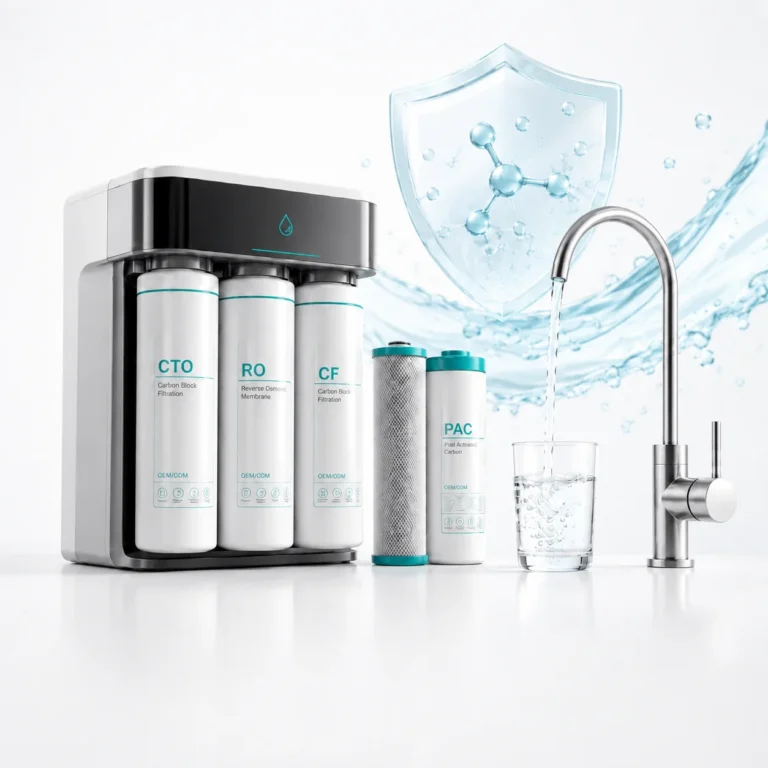
What established filtration brands reveal about PFAS technology — and how emerging brands can bring certified solutions to market through OEM/ODM partnerships.
Every month, brand owners ask me the same question in different words: who actually makes PFAS water filters that are certified, and what would it take for us to sell one?
The first half of that question has a clear answer. A handful of established companies have spent years building PFAS filtration products and putting them through independent certification. They have proven that the demand is real, from commercial kitchens to refrigerator doors to whole-house systems.
The second half is harder, and it is the one this article is really about. Finding a PFAS-certified product is only the first step. Finding a manufacturing partner who can turn certified technology into a commercially viable product under your own brand is the real challenge.
Below are five established brands with certified PFAS reduction products, each representing a different part of the market. Then I will explain what their certifications reveal, and where a company like ours fits for brands that want to take part.
How We Selected These Brands
Every company on this list has at least one specific model with a PFAS reduction claim that can be checked in an independent certification directory or on the manufacturer's own performance data sheet. That rule cost us two well-known names during research: one whose PFAS claim we could not confirm in a current listing, and one whose evidence conflicted between sources. Fame was not enough.
We applied four criteria:
- A verifiable PFAS claim on a named model, certified by NSF, IAPMO R&T or WQA under NSF/ANSI 53.
- Established market presence in the U.S.
- A distinct application, so the list covers five different ways PFAS filtration reaches people.
- Facts only. We describe certified claims as published; we do not score or rank performance.
The list is ordered by application, not by quality. HisoAir is not on it; we explain our own position separately at the end. All information is as of November 2026, and certifications change, so verify any model in the official directory before you rely on it.
The Five at a Glance

| Company | Aplicación | Example certified models | Certifier (PFAS claim) | PFAS claim |
|---|---|---|---|---|
| Pentair Everpure | Commercial foodservice | 2FC-P, 4FC-P, 7FC-P | IAPMO R&T | PFOA/PFOS |
| Whirlpool EveryDrop | Refrigerator filters | EveryDrop Filter 3 (EDR3RXD1) | NSF | PFOA/PFOS |
| Culligan | Pitchers and gravity filters | ZeroWater pitcher, MaxClear gravity filter | IAPMO R&T | Total PFAS |
| A. O. Smith / Aquasana | Under-sink and whole-house | Claryum; HomeShield AOS-HS-1200; HealthShield | NSF / WQA | PFOA/PFOS; five PFAS below 4 ng/L (whole-house) |
| Multipure | Under-sink carbon block | Aqualuxe, Aquaperform | NSF | PFOA/PFOS |
1. Pentair Everpure: Commercial PFAS Filtration
Everpure, Pentair's foodservice filtration brand, shows what PFAS filtration looks like at commercial volume. Its filters sit behind coffee machines, fountain beverage systems and drinking water stations in restaurants and offices, where cartridges are measured in thousands of gallons, not hundreds.
Certified PFAS products. Pentair's Everpure PFOA/PFOS reduction cartridges — including the 2FC-P, 4FC-P and 7FC-P and their scale-inhibiting "PS" versions — are certified by IAPMO R&T to NSF/ANSI 53 for PFOA and PFOS reduction. The same cartridges are certified by NSF to NSF/ANSI 42, 53 and 401 for chlorine, lead, cyst and microplastics reduction. They use Pentair's proprietary Fibredyne media.
Key specifications. Rated capacity runs from 1,000 gallons (2FC-P) to 4,000 gallons (4FC-P) and 10,000 gallons (7FC-P), at 1.5 to 1.67 gpm and 0.5 micron.
What it shows buyers. Commercial PFAS filtration is a capacity game. A claim that holds for 10,000 gallons at foodservice flow rates is a very different engineering problem from a 200-gallon cartridge. Brands moving into hospitality, offices or institutions should expect buyers to ask about rated capacity first.
2. Whirlpool EveryDrop: Appliance-Integrated PFAS Filtration
Whirlpool's EveryDrop line shows that PFAS filtration is moving inside appliances people already own. For many U.S. households, the refrigerator filter is the only water filter in the home, and it gets replaced on a schedule without much thought.
Certified PFAS products. EveryDrop Filter 3 (models EDR3RXD1B and EDR3RXD1R, among others) is listed by NSF under NSF/ANSI 53 for PFOA reduction and PFOS reduction.
Key specifications. Rated capacity of 200 gallons at 0.5 gpm, built for a refrigerator's dispenser and ice maker rather than a kitchen tap.
What it shows buyers. A small cartridge with a short life can still carry a health-effects PFAS claim. The constraint is space: every certified gallon has to come from a cartridge that fits a specific appliance. It is also a reminder that the same brand can carry PFAS claims on some filters and not on others, so certification has to be checked model by model.
3. Culligan: Consumer Drinking Water Filtration
Culligan represents the consumer end of the market, where PFAS filtration has to work without plumbing. Through its ZeroWater pitchers and MaxClear gravity filters, it brings certified PFAS reduction to people who cannot or will not install an under-sink system: renters, small households, anyone starting out.
Certified PFAS products. Según Culligan, the Culligan pitcher and dispenser with ZeroWater technology is certified by IAPMO to NSF/ANSI 53 for Total PFAS reduction at 99.7%, and the countertop gravity filter with MaxClear technology carries the same Total PFAS certification at 99.6%.
Key specifications. Pour-through and gravity formats, no installation and no electricity. Capacity per filter is far smaller than plumbed systems.
What it shows buyers. Two points matter. First, the claim is Total PFAS — a defined set of seven compounds — not just PFOA and PFOS, and consumers are learning to ask for it. Second, consumers now expect a certified PFAS claim even at an entry-level price, which raises the bar for every brand above that price point.
4. A. O. Smith / Aquasana: Residential Under-Sink and Whole-House Systems
A. O. Smith, which has owned Aquasana since 2016, offers the clearest view of where PFAS certification is heading. Between the two brands, the group covers under-sink drinking water filters and whole-house systems, and its newest products are certified to a level most of the market has not reached.
Certified PFAS products. At the kitchen tap, Aquasana's Claryum under-sink filters carry NSF/ANSI 53 PFOA/PFOS claims, which Aquasana says were tested down to 20 ppt under the updated NSF protocol. For the whole house, A. O. Smith's HomeShield Whole House Water Filter (AOS-HS-1200) is certified to NSF/ANSI 53 to reduce five PFAS — PFOA, PFOS, PFNA, PFHpA and PFHxS — to below 4 ng/L. Aquasana's HealthShield whole-house system is likewise certified to reduce PFAS to below 4 ppt.
Key specifications. HomeShield is a single-tank system certified at 5.7 gpm for 500,000 gallons, with no backwash and no wastewater. It is sold through water treatment professionals rather than at retail.
What it shows buyers. This is the most important technical signal on the list. In my earlier article on what the move to PFAS 4 ppt means for filter brands, I argued that certification is heading toward the EPA's 4 ppt limit. A. O. Smith shows it can be done today — in a whole-house system with a large media bed. That is not a like-for-like benchmark for an under-sink cartridge, and it should not be read as one. But it tells every brand where buyers' expectations will go next.
5. Multipure: Under-Sink Carbon Block Filtration
Multipure represents the technology that most under-sink PFAS filters are built on: solid carbon block. It is a long-established U.S. maker of drinking water systems, sold mainly through independent distributors, and its systems are built around carbon block cartridges certified to NSF standards.
Certified PFAS products. Según Multipure, its Aqualuxe and Aquaperform systems are certified by NSF to NSF/ANSI 53 for PFOA and PFOS reduction, alongside microplastics and a long list of other contaminants. Multipure's Aqualuxe performance data sheet reports more than 95.5% PFOA/PFOS reduction from a 1,500 ppt challenge.
Key specifications. Countertop and under-sink formats, solid carbon block media, certified across NSF/ANSI 42, 53 and 401.
What it shows buyers. Carbon block remains the workhorse of point-of-use PFAS reduction: no wastewater, no pump, full flow at the tap. It also shows how PFAS claims have layered over time. Many established carbon block products carry PFOA/PFOS claims from the original protocol, while newer products are certified to broader Total PFAS claims. Both are legitimate. They are simply not the same claim, and the data sheet tells you which one you are looking at.
What These Five Reveal About the PFAS Filtration Market
Put the five side by side and three things become clear.
The market is proven. PFAS filtration is no longer a niche claim. Certified products now exist in commercial foodservice, refrigerators, pitchers, under-sink systems and whole-house systems. Buyers in every one of those channels have learned to look for it.
Certification is model-specific, and claims differ. Not one of these companies has a blanket "PFAS certification." Each has specific models with specific claims: PFOA/PFOS on some, Total PFAS on others, and a five-compound, below-4 ng/L claim on two whole-house systems. Those claims were tested under different protocols and product formats, so they should not be lined up as a single ladder or compared as if they were the same test.
The technology is moving upward. From PFOA/PFOS claims, to Total PFAS, to whole-house systems certified below 4 ng/L, the direction is unmistakable. Brands entering the category now should plan for buyers asking which claim and which protocol — not just whether a product is "PFAS certified."
What Brands Should Evaluate Before Choosing a Manufacturing Partner
If you plan to launch a PFAS filter under your own brand, the questions that matter are about the partner, not just the product:
- Is there an existing certified platform? Starting from a product that already holds a PFAS listing can save a year or more compared with developing and certifying from scratch.
- Which claim, under which listing? Know whether it is PFOA/PFOS or Total PFAS, and who certified it.
- Can the listing carry your brand? Ask how private-label models are added to the certification listing and what that requires.
- What can be customized without re-certification? Housing color and packaging usually can; media, flow path and capacity usually cannot.
- Who handles certification work? Testing, listing updates and annual audits take time. A partner who coordinates them saves you that work.
- Can the partner manufacture at your volume? Certified media is only useful if supply is consistent.
For a deeper checklist on PFAS claims and the coming 4 ppt standard, see my earlier article on PFAS 4 ppt and what it means for filter brands. If you are weighing technologies for larger projects, our comparison of carbon block vs RO for PFAS reduction covers the trade-offs.
HisoAir: Making Certified PFAS Filtration More Accessible to Emerging Brands
The five companies above built their PFAS products for their own brands and their own channels. That is their business model, and it is a good one. Our business model is different: we build certified platforms that other brands can take to market under their own names.
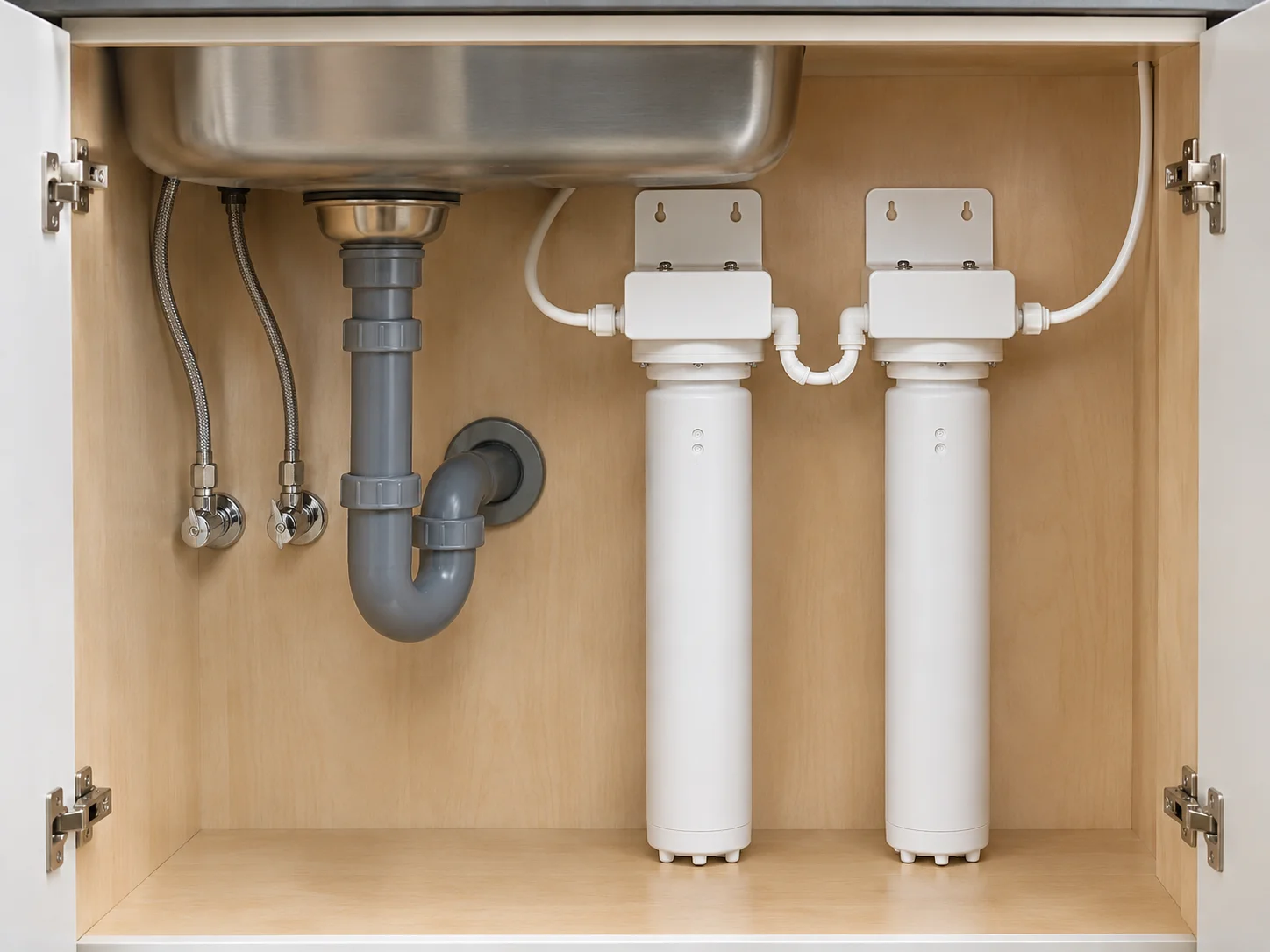
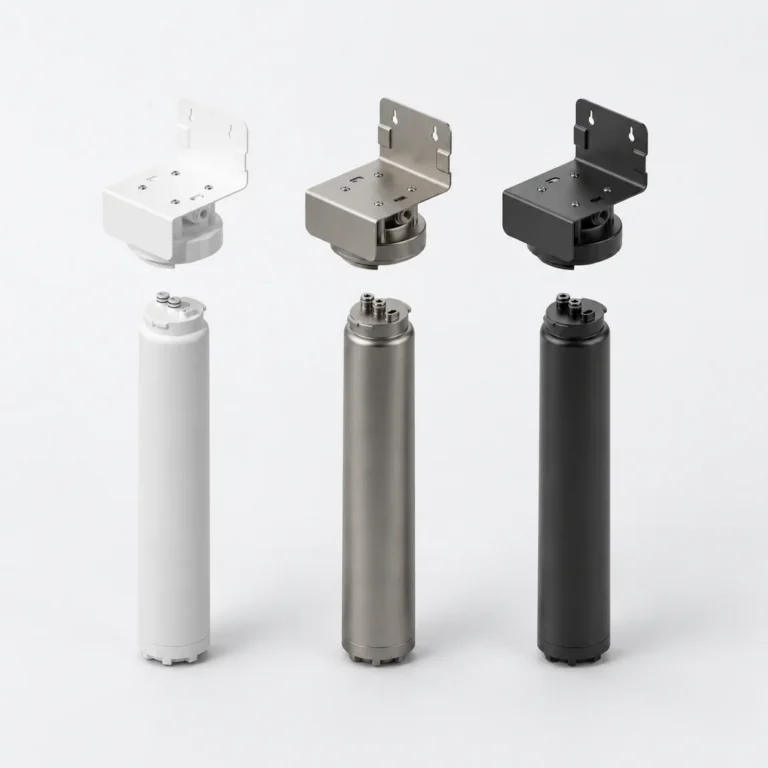
Our PFAS platform today is the WP3000(US) under-sink filter. Here is what it is certified for, stated the same way we stated everyone else's:
| Artículo | WP3000(US) |
|---|---|
| Product type | Plumbed-in under-sink carbon filtration, twist-lock cartridge (WP3000(US)-RF) |
| Certifier | IAPMO R&T (listings effective October 2026) |
| NSF/ANSI 53 | Total PFAS, lead, cyst, asbestos, turbidity |
| NSF/ANSI 42 | Chlorine, taste and odor, nominal particulate Class I |
| NSF/ANSI 401 | Microplastics |
| NSF/ANSI/CAN 372 | Lead free |
| Rated flow / capacity | 1.5 gpm / 3,000 gallons |
| PFAS test level | Total PFAS claim tested to the 20 ppt combined limit |
I want to be precise about that last line. Our Total PFAS claim was tested to 20 ppt combined. It is not a 4 ppt claim, and it should not be compared with whole-house systems certified below 4 ng/L. What it offers is something different: a Total PFAS-certified under-sink platform that a brand can build on, instead of starting from zero. You can check every listing in the IAPMO R&T Product Listing Directory or on our water filtration certifications page.
What we provide to brand partners:
- Private label on a certified platform, with your brand on the product and packaging.
- Filter and media customization for different water conditions and capacity targets.
- Structure, appearance and packaging design, from housing color to retail box.
- Certification coordination with the certifying body when your models are added or changed.
- Manufacturing and supply chain through our production network, from samples to volume orders.
For brands that need reverse osmosis, we also offer under-sink RO systems in the 600–800 GPD range, built with a manufacturing partner whose RO platform is already certified for Total PFAS reduction. When a customer or project requires it, we can obtain a HisoAir-held listing for that RO system under our partner's certification. Unlike WP3000(US), it is not listed under the HisoAir name today, so we treat it as a project-based option.
The point is not that we filter better than the companies on this list. It is that you do not need to become a large water filtration company to launch a certified PFAS product. You need the right manufacturing partner.
The Opportunity Beyond Established PFAS Filtration Brands
Pentair, Whirlpool, Culligan, A. O. Smith and Multipure have done the hard work of proving that PFAS filtration matters to buyers in every channel, and that certification is what earns trust. A. O. Smith has shown where the technology is heading.
Launching a differentiated PFAS filter does not require building that entire operation yourself, or competing head-on with these brands in their own channels. For emerging and mid-sized brands, the opportunity is to work with a manufacturing partner that already has a certified platform, the engineering to customize it, and the production to scale it.
Established brands have validated the market. We help emerging and mid-sized brands take part in it.
If you are planning a PFAS-certified filter under your own brand, explore our PFAS water purifier platforms or contact us with the questions in the checklist above. We will answer them for our side of the supply chain, line by line.
PREGUNTAS FRECUENTES
Which water filter brands have PFAS-certified products?
As of November 2026, established brands with PFAS reduction claims certified under NSF/ANSI 53 include Pentair Everpure (commercial), Whirlpool EveryDrop (refrigerator filters), Culligan (pitchers and gravity filters), A. O. Smith and Aquasana (under-sink and whole-house) and Multipure (under-sink carbon block). Certification applies to specific models, so check each model in the NSF, IAPMO R&T or WQA directory.
Is there such a thing as a "PFAS-certified manufacturer"?
No. Certification bodies certify specific products and claims, not companies. A manufacturer can have one certified PFAS model and many models without a PFAS claim.
What is the difference between a PFOA/PFOS claim and a Total PFAS claim?
A PFOA/PFOS claim covers two compounds. A Total PFAS claim under NSF/ANSI 53 covers a defined set of seven compounds with a combined effluent limit. Some newer whole-house systems are certified for five PFAS below 4 ng/L. These are different claims and should not be treated as equal.
Can a small brand sell a PFAS-certified water filter without its own factory?
Yes. Brands can work with an OEM/ODM manufacturer that has an existing certified platform and have their own models added to the certification listing. Ask the manufacturer which claim the platform carries and what customization is possible without re-certification.
Do any home water filters meet the EPA's 4 ppt limit?
Some whole-house systems, including A. O. Smith's HomeShield and Aquasana's HealthShield, are certified to reduce selected PFAS to below 4 ng/L. Most point-of-use filters on the market carry PFOA/PFOS or Total PFAS claims tested at higher levels.







 English
 Français
 Español
 Italiano
 Deutsch
 Português
 Русский
 العربية
 日本語
 한국어
 Tiếng Việt


