
For a brand preparing to launch an OEM water purifier, one of the most common supplier claims is:
“We already have an NSF master listing, so your brand can use our certification.”
That statement may describe a useful certification pathway, but it is not precise enough for a sourcing, compliance or product-development decision.
NSF does not normally use master listing as the formal name of its private-label structure. In its official water-product guidance, NSF refers to the certified manufacturer as the base company and the private-label pathway as an Another Name Foro ANF, certification listing.
The difference matters. A certified base product may support a faster private-label launch, but the certification is not a transferable document that can automatically cover any brand, model, filter cartridge, performance claim or manufacturing location.
Quick answer
An “NSF master listing” is an informal OEM-industry expression for the original product certification held by an NSF-certified manufacturer. To place a private-label brand and model into an official NSF listing, the brand normally works with the certified base company through the ANF process. NSF then cross-references the private-label product with the corresponding certified base product. The resulting claim is limited to the exact standards, models, components, manufacturing location and contaminant-reduction claims covered by the official listing.
This guide is written for water-filter brands, importers, healthy-home companies and sourcing teams evaluating certified OEM or ODM platforms.
Written by: Alwen Lee
Reviewed by: Water Filtration Engineering Team
Last reviewed: August 5, 2026
What Is an NSF Master Listing?
“NSF master listing” is not the main formal term used in NSF’s published private-label guidance. It is better understood as an informal way of describing the original certified product listing that supports other brand versions of the same product.
NSF officially uses the following terms:
- Base company: The NSF-certified manufacturer that holds the original certified product.
- Base product: The certified product to which the private-label version will be cross-referenced.
- ANF listing: The “Another Name For” certification listing created for the private-label company.
- Private labeler: The brand or company selling the corresponding product under its own name, trade name or model number.
According to NSF’s official ANF guidance, the private-label company works with the certified base company, and the base company applies the private-label identification at its NSF-certified manufacturing facility. NSF then cross-references the private-label model number or trade name with the corresponding certified base product.
The practical structure is:
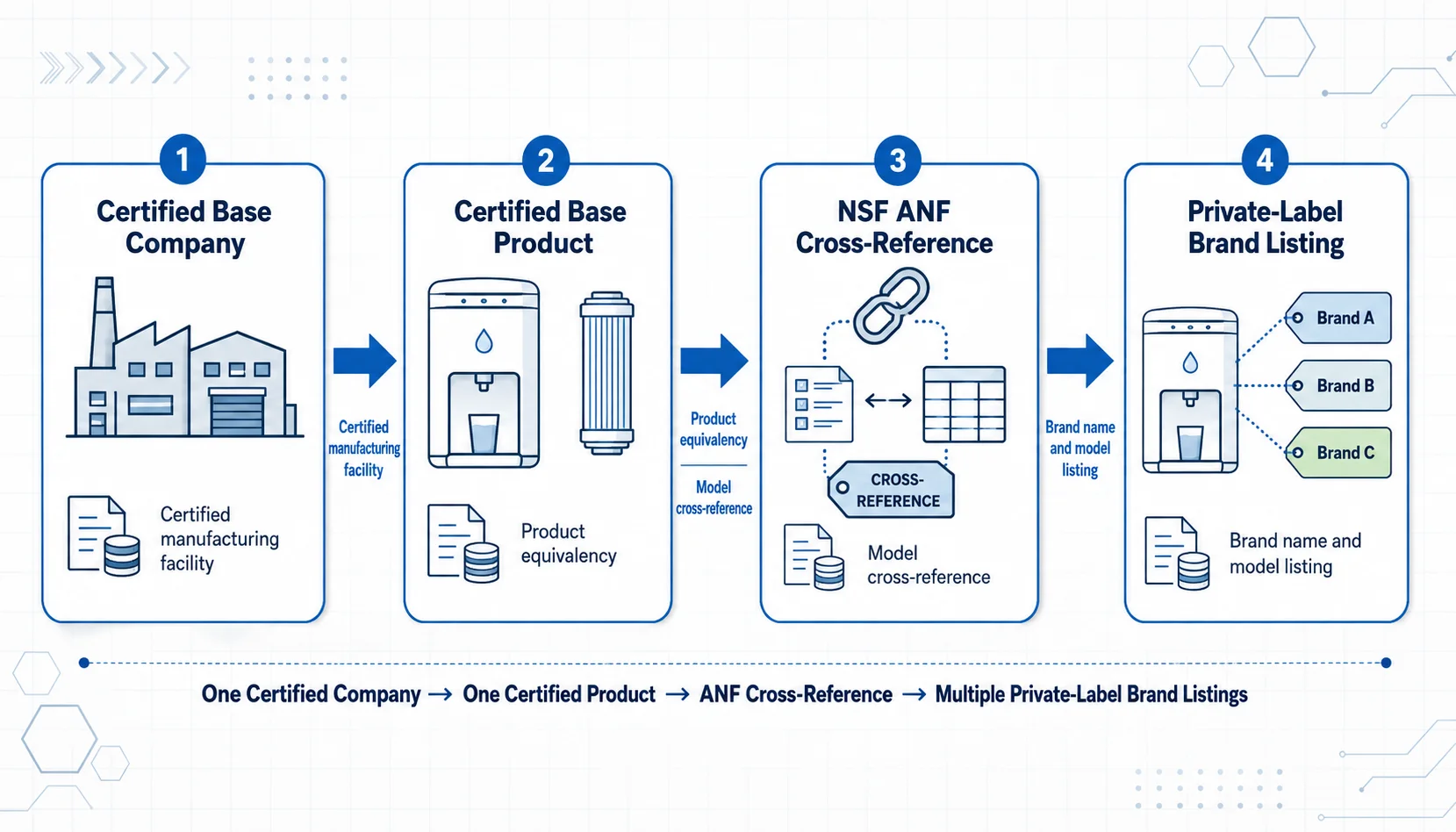
Certified base company → certified base product → ANF cross-reference → private-label brand listing
This structure can reduce duplicated work when the private-label product is genuinely equivalent to the certified base product. However, it does not mean that the certification can be copied to a substantially different purifier.
Why the word “master” can create confusion
The word “master” may imply that one certificate covers an entire product family or every purifier manufactured by the factory. That is not a safe assumption.
An official drinking-water treatment listing is product-specific. It may connect the certification to a defined manufacturer, facility, product category, model, replacement element, rated capacity, flow rate, standard and contaminant-reduction claim.
Therefore, the first question should not be:
Does the factory have NSF?
The better question is:
Which exact product is listed, under which standard, for which claim, at which capacity and flow rate, and can our private-label model be formally cross-referenced to it?
How Does an NSF ANF Private-Label Listing Work?
NSF describes ANF certification as a private-label route for products that correspond to an NSF-certified base product.
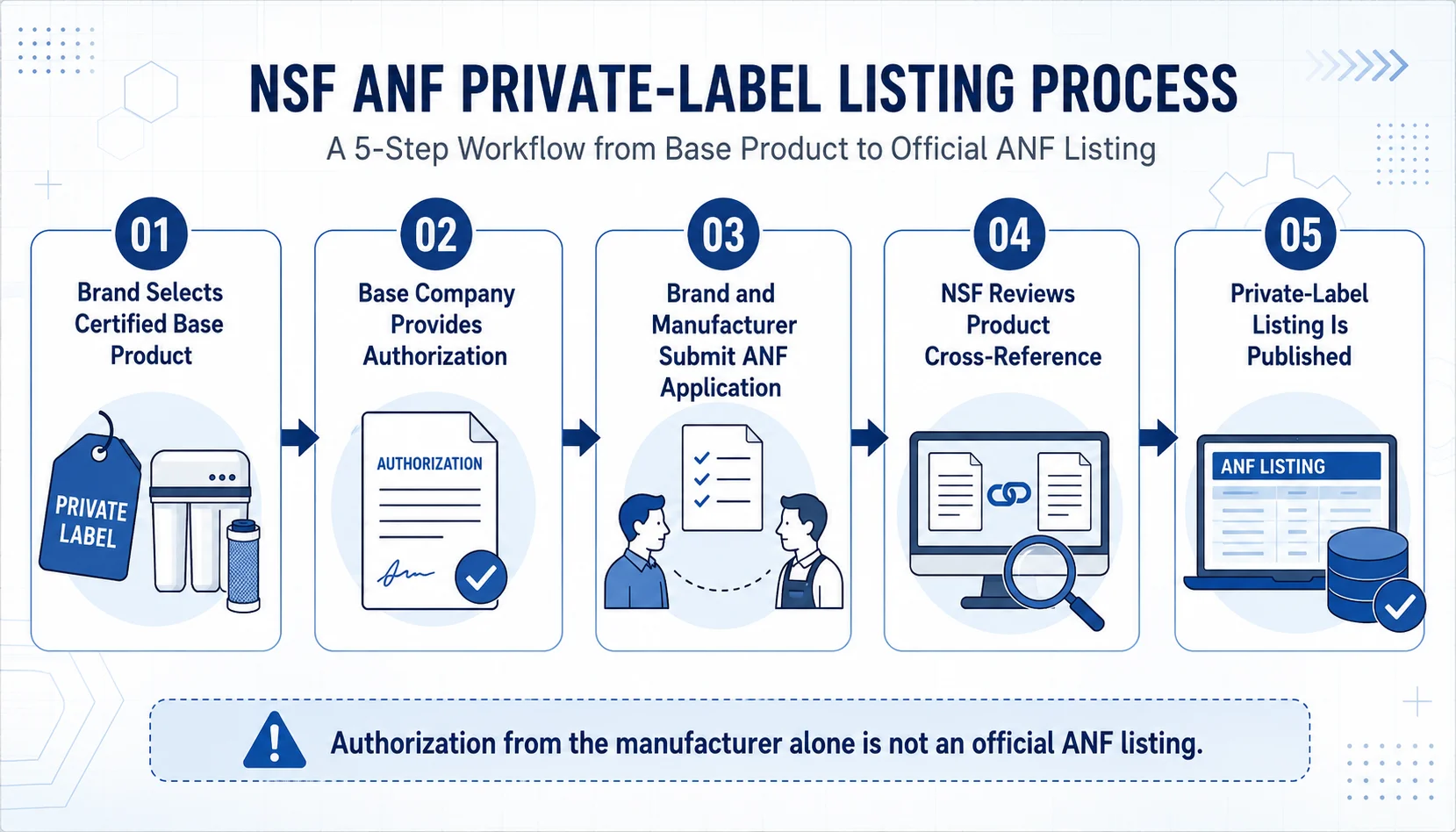
The official process can be summarized in four steps:
- The private-label company contacts the base company for authorization.
- The private-label company and base company submit an application for an official ANF listing.
- NSF reviews and cross-references the base-company product with the proposed private-label product.
- An official ANF listing is granted if the cross-reference review passes.
The ANF route is not created solely through a supplier authorization letter. It requires NSF review and an official listing.
What does the base company control?
Under the ANF structure described by NSF, the base company remains central to the certification relationship. It supplies the certified product information, supports the cross-reference application and applies the private-label identification at the certified manufacturing facility.
This means the brand should clarify several points before relying on the pathway:
- Who is the legal holder of the base certification?
- Which manufacturing facility is authorized?
- Which base model supports the private-label product?
- Who submits and maintains the ANF listing?
- Who pays initial and recurring certification fees?
- Who approves packaging, manuals and use of the NSF mark?
- Who controls engineering changes to the certified product?
- What happens if the base listing is suspended, changed or discontinued?
Does the ANF brand receive its own public listing?
NSF states that an ANF route allows a private-label version of an NSF-certified product to have its own listing. Its guidance also states that ANF listings are not visibly linked to base-company listings.
This can be commercially valuable because distributors, retailers and customers may be able to search for the private-label company, trade name or model rather than seeing only the OEM manufacturer.
However, the technical support for the ANF listing still comes from the certified base product. Operationally, the private-label brand remains dependent on the base company maintaining the underlying certified configuration.
What Does the Base Listing Actually Cover?
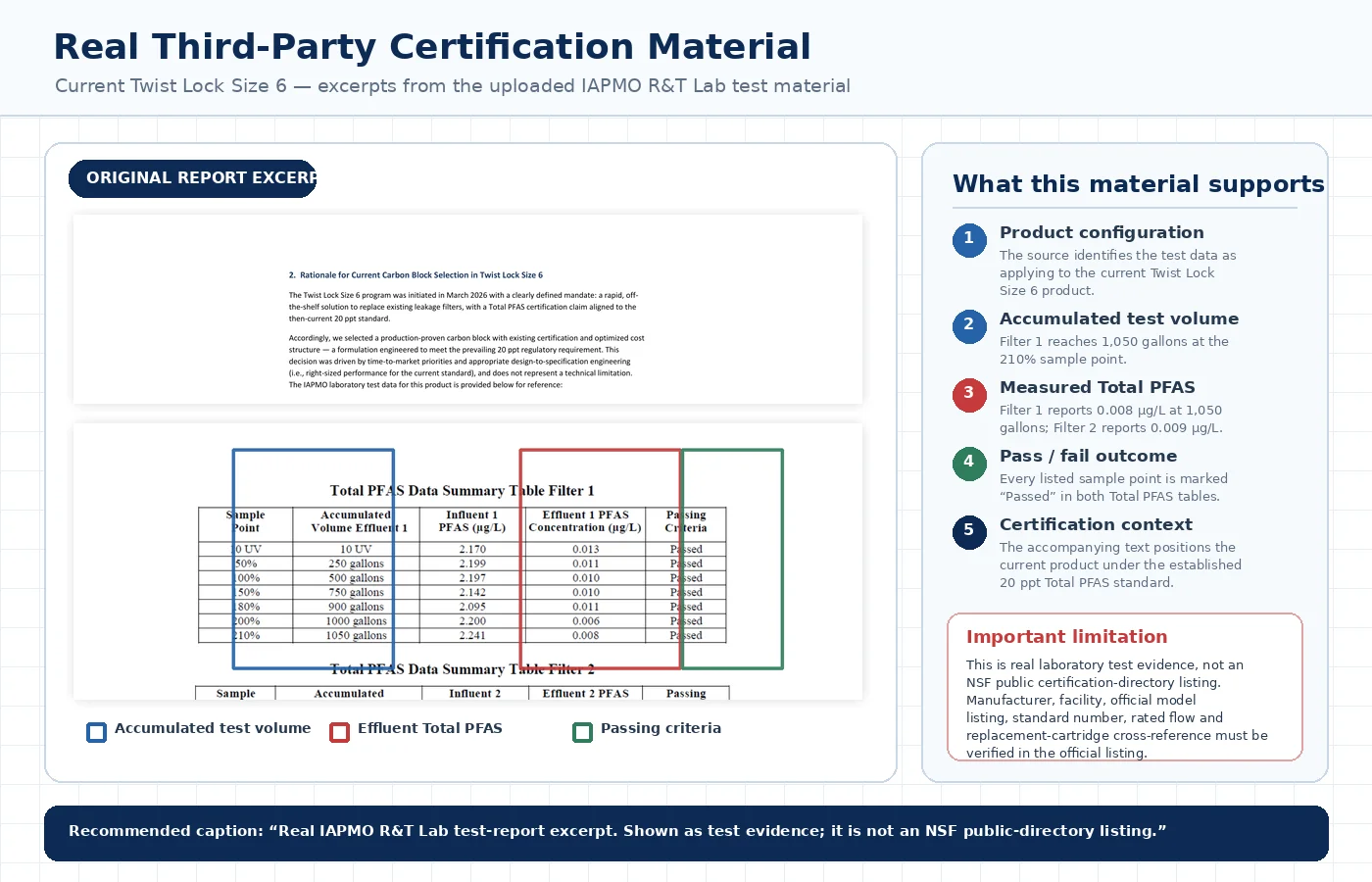
A certification listing should be evaluated by scope, not by logo.
NSF’s official Drinking Water Treatment Unit directory allows searches by manufacturer, brand name, trade name, model, product standard, product type, facility location and contaminant-reduction claim.
Depending on the product category and listing, the record may identify or connect:
- The certified manufacturer or listing company
- The authorized manufacturing facility
- The brand name, trade name or model number
- The drinking-water treatment product type
- The applicable NSF/ANSI standard
- The approved replacement cartridge or element
- The rated service cycle or gallon capacity
- The rated flow rate
- The exact contaminant-reduction claims
- Notes, suffix rules, approved variations or limitations
Certification is not automatically factory-wide
A factory may manufacture dozens of systems while holding certification for only a limited number of models or components.
The following statements are therefore incomplete without verification:
- “Our factory is NSF certified.”
- “All our filters use NSF materials.”
- “This system is similar to our certified model.”
- “The same filter is certified for another customer.”
- “We can share our NSF certificate.”
The official listing should be checked against the exact commercial product being proposed.
Which changes may affect the listing?
Changes that appear minor from a marketing or sourcing perspective may affect the certified configuration. Examples include:
- Changing the activated-carbon supplier or carbon formulation
- Changing an ion-exchange resin
- Changing the RO membrane model or supplier
- Changing filter-media weight, dimensions or compression
- Changing the cartridge shell, seals or O-rings
- Changing wetted plastics, metals, adhesives or tubing
- Changing the flow-control device
- Changing the rated flow or service capacity
- Changing the pump, pressure range or water-path architecture
- Changing the replacement element
- Changing the manufacturing facility
- Adding a new model whose structure is not equivalent to the certified base product
Whether a change requires document review, engineering evaluation, additional testing or a new certification decision should be confirmed with the certification body. It should not be decided only by the OEM supplier.
For an OEM project, the approved bill of materials and change-control process are therefore part of the certification strategy, not only part of manufacturing quality control.
NSF Base Listing vs. Certified Components, Test Reports and Full-System Certification
One of the largest sourcing risks is treating different levels of evidence as if they were equivalent.
| Evidence supplied | What it normally demonstrates | What it does not automatically demonstrate |
|---|---|---|
| NSF-certified filter media or material | A material or media product has been evaluated within its stated certification scope. | That the complete purifier is certified for contaminant reduction. |
| NSF-listed component or cartridge | A specified component or replacement element appears in an official listing. | That every system using the component receives the same certification claim. |
| Internal test report | The manufacturer tested a sample under stated internal conditions. | Independent verification or an authorized certification claim. |
| Third-party laboratory report | An external laboratory tested a defined sample and method. | An ongoing product-certification program, authorized mark or public listing. |
| Tested to an NSF/ANSI standard | Testing may have followed some or all requirements of the named standard. | Certification by NSF or another accredited certification body. |
| Certified base-product listing | The exact listed base product has been evaluated for the standards and claims shown in the directory. | Automatic coverage of another brand, model or modified configuration. |
| Official ANF listing | The private-label product has been cross-referenced to a certified base product and granted its own listing. | Freedom to make changes outside the approved base configuration. |
| Independent brand-owned certification | The brand holds a certification listing for its defined product and approved manufacturing arrangement. | Freedom to change certified components or facilities without review. |
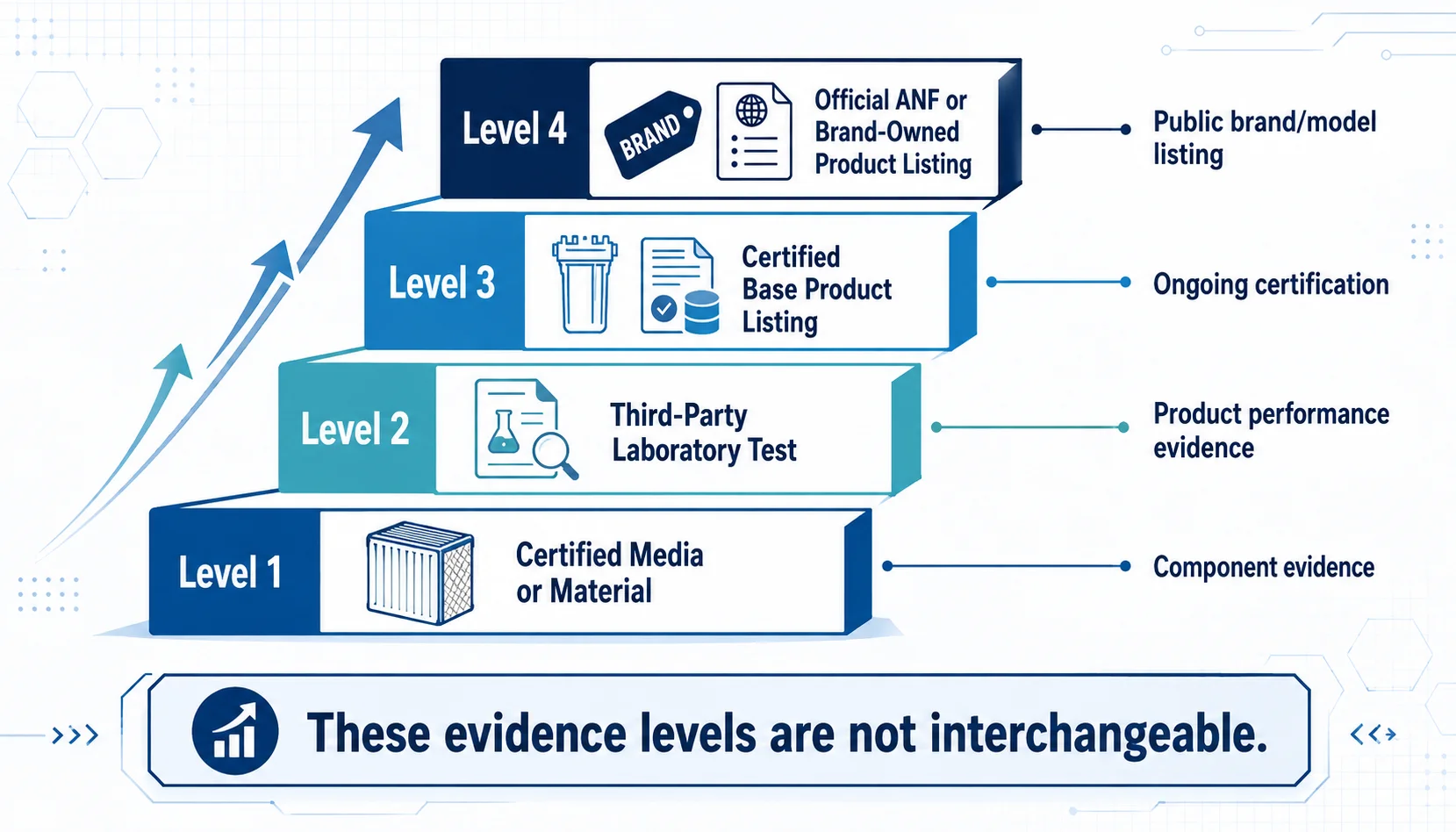
“NSF certified” must always be tied to a standard and claim
NSF explains that certification to one standard does not mean a product reduces every contaminant covered anywhere in the NSF system.
For example:
- NSF/ANSI 42 primarily addresses aesthetic effects such as chlorine, taste and odor.
- NSF/ANSI 53 addresses specified contaminants with health effects and is commonly relevant to adsorption or filtration systems.
- NSF/ANSI 58 applies to reverse-osmosis systems.
- NSF/ANSI 401 addresses specified emerging contaminants or incidental compounds.
- NSF/ANSI/CAN 372 addresses lead-content requirements for products and components in contact with drinking water.
A product certified to NSF/ANSI 53 is not automatically certified for every possible NSF/ANSI 53 reduction claim. The official listing must identify the exact approved contaminant claim.
A more defensible product statement is:
Certified to NSF/ANSI 53 for the specific reduction claims, rated capacity and flow rate shown in the official product listing.
A less useful statement is:
NSF approved filter.
How Do NSF Listings Apply to PFAS Reduction Claims?
PFAS is where precise listing language becomes especially important.
NSF identifies NSF/ANSI 53 and NSF/ANSI 58 as relevant certification standards for PFAS reduction in drinking-water treatment devices:
- NSF/ANSI 53: Commonly used for activated-carbon, adsorption, filtration and certain ion-exchange treatment systems.
- NSF/ANSI 58: Used for reverse-osmosis drinking-water treatment systems.
NSF previously used Protocol P473 for PFOA and PFOS reduction. NSF states that the P473 test methodology and claims were later incorporated into NSF/ANSI 53 and NSF/ANSI 58, and references to P473 were replaced by those standards.
A standard number alone does not prove a PFAS claim
A supplier may show an NSF/ANSI 53 or NSF/ANSI 58 listing that covers structural integrity, material safety or other contaminant claims but does not include PFAS.
For a PFAS-oriented product, the listing should be checked for the exact approved language, such as:
- PFOA Reduction
- PFOS Reduction
- Total PFAS Reduction
NSF’s current drinking-water treatment directory includes separate searchable fields for these claims.
What does “Total PFAS Reduction” mean?
“Total PFAS” does not mean every chemical that may be classified within the broad PFAS family.
Current NSF listing notes may define the claim through a specified mixture of named PFAS compounds. The directory should be checked for the exact note and standard edition applicable to the product. NSF’s published listing information has identified compounds including:
- PFHpA
- PFHxS
- PFNA
- PFOA
- PFOS
- PFBS
- PFDA
Brands should therefore avoid converting a defined certification claim into broad language such as:
- Removes all forever chemicals
- Produces PFAS-free water
- Eliminates every type of PFAS
The approved marketing statement should remain within the scope of the official listing and product performance data sheet.
Three different PFAS evidence levels
| Nivel | Meaning | Recommended marketing treatment |
|---|---|---|
| PFAS-ready | The product architecture uses media or treatment technologies selected for potential PFAS performance. | Describe it as a development platform, not a certified reduction claim. |
| PFAS-tested | A defined product or sample has completed laboratory testing under stated conditions. | State the test scope, laboratory, method, capacity and product configuration accurately. |
| Certified for PFAS reduction | The exact product appears in an official certification listing for a named PFAS claim. | Use the standard, certification body, model, rated conditions and approved claim shown in the listing. |
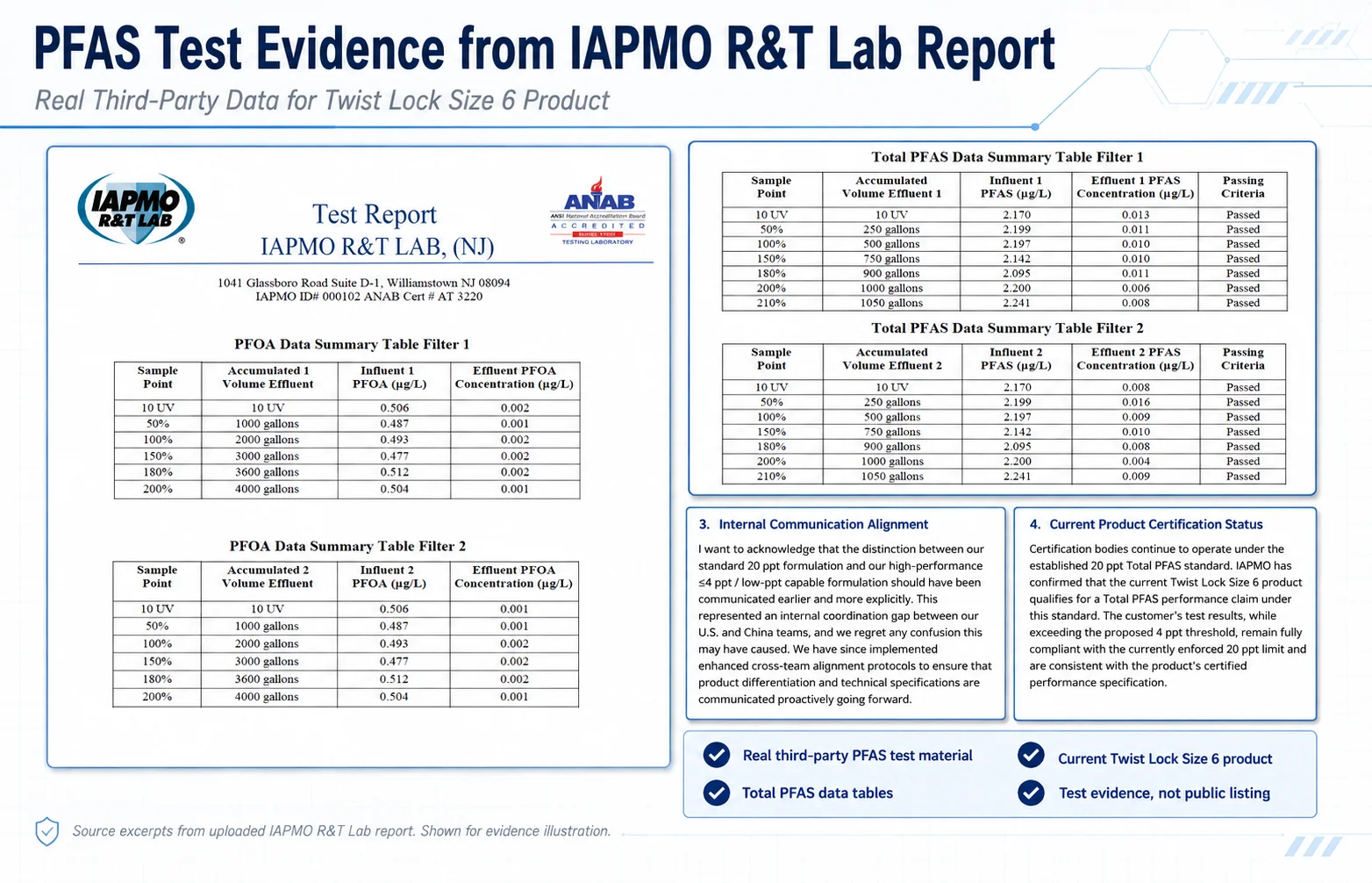
Why production control matters after certification
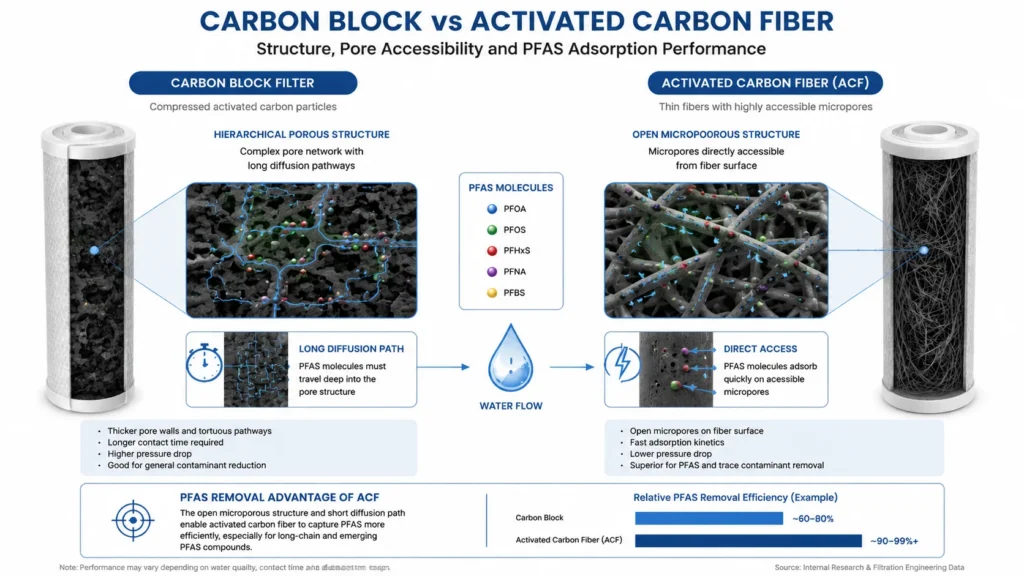
PFAS performance depends on more than selecting a carbon block, resin or RO membrane. It can also depend on:
- Media formulation and mass
- Cartridge geometry and contact time
- Flow rate and pressure
- Bypass prevention and seal integrity
- Prefiltration and competing contaminants
- Rated service capacity
- Replacement-filter consistency
- Production bill-of-material control
NSF states that certified products are periodically retested and that certified manufacturing facilities are inspected annually. The listing therefore represents an ongoing conformity system rather than only one laboratory result.
For additional context, read Entering the Water Category Is Easy. Building a Credible PFAS Claim Is Much Harder.
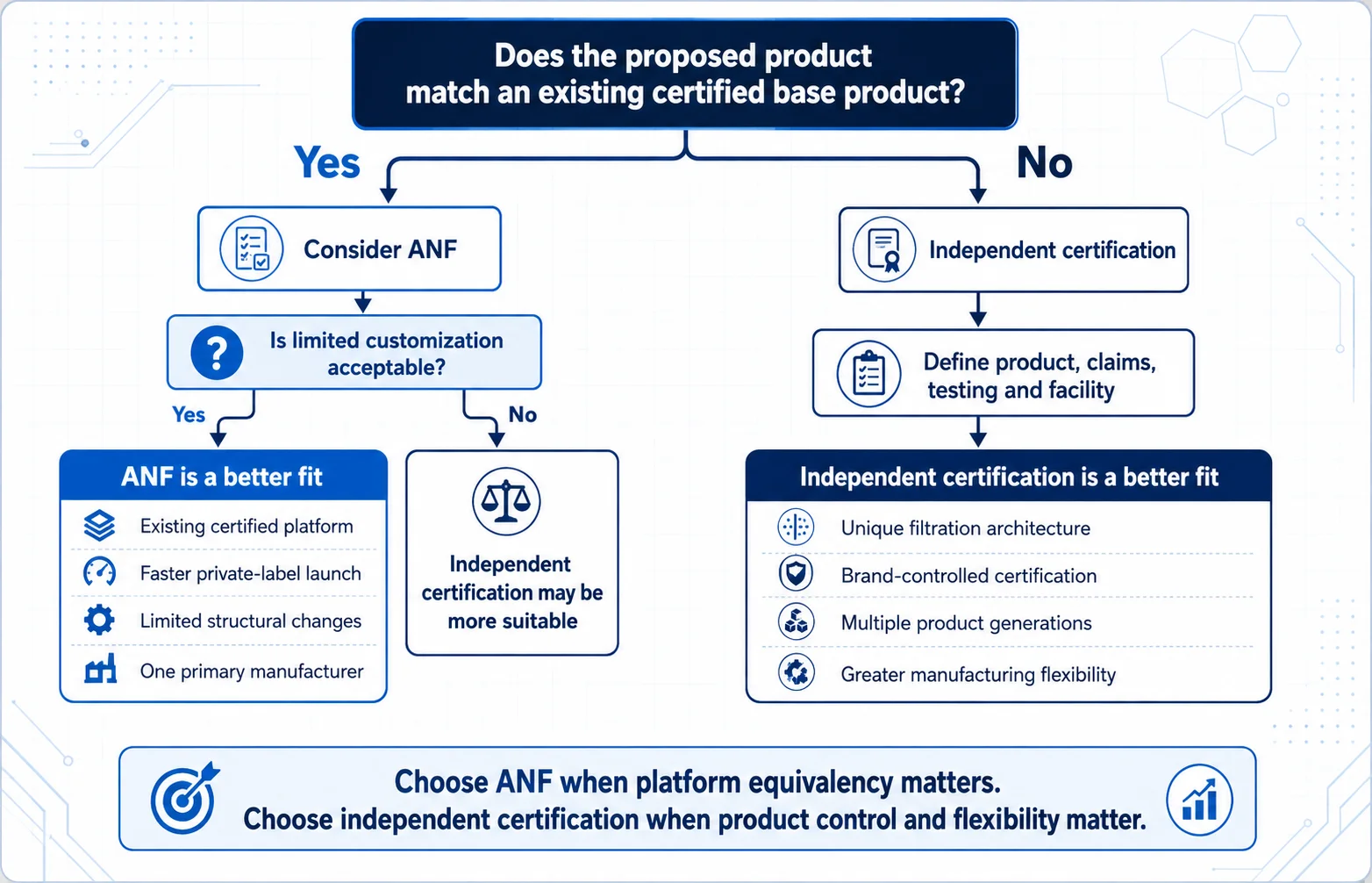
Should Your Brand Use an ANF Listing or Obtain Independent Certification?
The right route depends on the product strategy, level of customization, target market, expected volume and ownership requirements.
Path 1: Launch through an ANF private-label listing
An ANF route may be suitable when:
- The product will remain equivalent to an existing certified base product.
- The brand wants an official listing under its own trade name or model.
- Speed to market is more important than extensive structural customization.
- The brand is comfortable relying on one certified base company.
- The planned contaminant claims already exist within the base listing.
- The certified facility can apply the approved private-label identification.
Potential advantages include:
- Less duplicated product evaluation than a completely new certification project
- A defined route to an official private-label listing
- Use of an already evaluated base configuration
- A faster pathway when the cross-reference is straightforward
Potential limitations include:
- Dependence on the base company and base product
- Restricted freedom to change components or architecture
- Limited portability if the brand later changes manufacturers
- Possible impact if the base listing lapses or is modified
- Need for continuing alignment between the brand model and the certified base configuration
Path 2: Obtain an independent certification listing
Independent certification may be more appropriate when:
- The brand requires substantial ODM customization.
- The filtration architecture is unique.
- The desired reduction claims are not available in an existing base product.
- The brand wants greater control over the certification asset and technical file.
- The program may use more than one manufacturing facility.
- The brand expects to change manufacturers in the future.
- The product platform will expand into multiple models, capacities or replacement filters.
- The certification strategy is a long-term part of the company’s market value.
This route normally involves greater responsibility for:
- Product documentation
- Testing and certification fees
- Factory qualification and audits
- Approved materials and bill of materials
- Engineering change control
- Label, manual and marketing review
- Annual maintenance and listing fees
- Replacement-filter control
- Retesting when standards or products change
ANF vs. independent certification decision table
| Decision factor | ANF private-label listing | Independent certification |
|---|---|---|
| Product similarity | Best when the private-label product matches the certified base product. | Better for a substantially differentiated product. |
| Time to market | Can be faster when cross-referencing is straightforward. | Usually requires a broader evaluation and testing program. |
| Customization freedom | Limited by the certified base configuration. | Greater design ownership, subject to certification approval. |
| Certification control | Depends on the base company and underlying listing. | More direct brand control over the listing relationship. |
| Manufacturer portability | Usually limited because the ANF is supported by the base company’s certified product and facility. | Potentially stronger, but any facility transfer still requires certification-body review. |
| Best fit | Private-label launch using an established platform. | Strategic, differentiated or multi-generation product platform. |
Questions to ask before accepting an “NSF master listing” proposal
- What is the legal name of the NSF-listed base company?
- Can you provide the official public listing rather than only a certificate image?
- Which base model supports our proposed product?
- Which NSF/ANSI standards are listed?
- Which exact contaminant-reduction claims are listed?
- What replacement element, capacity and flow rate are approved?
- Which manufacturing facility is included?
- Can our brand and model receive an official ANF listing?
- Will NSF need to review our label, packaging and product literature?
- Which product changes require certification-body approval?
- Who pays the application, audit, listing and annual maintenance costs?
- What happens to our ANF listing if the base product is changed or discontinued?
- Can the certification relationship be transferred if we change factories?
- Who owns the product drawings, bill of materials, test data and certification documentation?
- How will production batches and replacement filters remain consistent with the approved configuration?
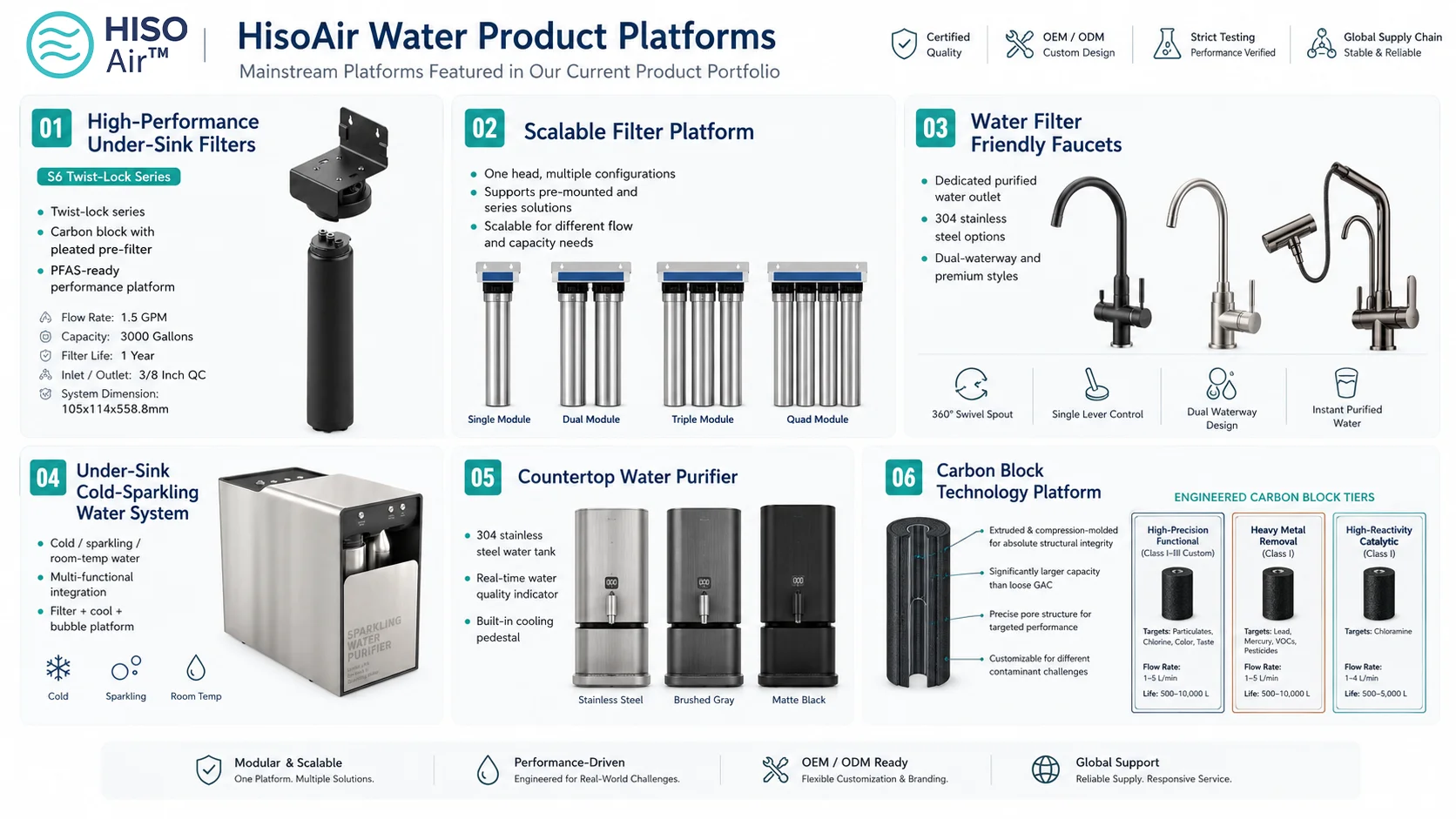
How HisoAir supports certified brand launches
For a B2B water-purifier project, the certification route should be selected before the final product, packaging and contaminant claims are fixed.
HisoAir’s role is to help partners connect the commercial goal with the technical and manufacturing pathway, including:
- Defining the target market and contaminant claims
- Evaluating whether an existing platform can support private-label certification
- Selecting carbon, ion-exchange or RO treatment architecture
- Planning the finished product, replacement cartridge, rated capacity and flow rate
- Coordinating third-party testing and certification activities
- Establishing bill-of-material and engineering change controls
- Aligning product labels, performance data and marketing language
- Building a long-term replacement-filter supply program
HisoAir does not treat a supplier certificate as a universal marketing license. Any final NSF or PFAS claim must correspond to the exact commercial model, certification listing and approved product configuration.
Conclusion: A Listing Is a Controlled Product Relationship
An NSF “master listing” can be a valuable foundation for a private-label water-filter launch, but only when the term is translated into the actual certification structure.
The brand should confirm:
- The certified base company
- The exact certified base product
- The applicable NSF/ANSI standard
- The listed contaminant-reduction claims
- The approved manufacturing facility
- The model, cartridge, flow and capacity
- The availability of an official ANF pathway
- The ownership and maintenance responsibilities
- The change-control rules protecting continued compliance
The central principle is simple:
A certification claim is only as strong as the official listing, exact product configuration and production controls supporting it.
Preguntas frecuentes
Is “NSF master listing” an official NSF term?
Not in NSF’s published private-label water-product guidance. NSF uses the terms “base company” and “Another Name For,” or ANF, certification. “Master listing” is better treated as an informal industry expression for the original certified base-product listing.
Can a factory simply give its NSF certificate to my brand?
No. A certificate or screenshot does not automatically authorize another company, brand or model to make an NSF certification claim. The proposed product must be covered by an official listing or approved private-label pathway.
Can an ANF listing cover a customized water purifier?
Only when the private-label product can be cross-referenced to the certified base product. Changes to the water path, materials, filter media, components, flow rate, capacity, replacement element or manufacturing location may require further review or testing.
Does using NSF-certified carbon make the complete purifier NSF certified?
No. Certified media or components can support development, but they do not automatically certify the complete finished system for contaminant reduction.
Can an ANF listing support a PFAS reduction claim?
Yes, when the certified base product carries the applicable PFAS reduction claim and NSF approves the private-label cross-reference. The ANF listing and product documentation must show the exact standard and claim.
Is NSF/ANSI 53 automatically a PFAS certification?
No. NSF/ANSI 53 includes many possible health-effect reduction claims. The official product listing must specifically include PFOA Reduction, PFOS Reduction, Total PFAS Reduction or other applicable approved wording.
Is an ANF listing less credible than independent certification?
Not necessarily. An official ANF listing is an NSF certification listing supported by a certified base product. The main strategic difference is control: the ANF brand depends on the base company and certified base configuration.
Who should own the certification in an OEM project?
The answer depends on the business model. ANF can be suitable for a faster private-label launch, while independent brand-owned certification may be better for a differentiated, long-term product platform. Ownership, fees, listing rights, technical documentation, change control and exit arrangements should be agreed before development begins.
Sources and References
- NSF: Private Label (ANF) Listings
- NSF: Private Label (ANF) Listings Process Guide
- NSF Official Drinking Water Treatment Unit Listings
- NSF Standards for Water Treatment Systems
- NSF: PFAS in Drinking Water
- NSF: Forever Chemicals and the Advancement of Filtration Standards
Certification standards, directory entries and program requirements may change. Brands should verify the latest standard edition, official listing and certification-body requirements before publishing claims or approving production. Last reviewed: August 5, 2026.




 English
  Français
  Español
  Italiano
  Deutsch
  Português
  Русский
  العربية
  日本語
日本語  한국어
한국어  Tiếng Việt

