Открывается в новой вкладке
Инновационные решения в области качества воздуха
HisoAir-Logo
Запрос сейчас

Лучшие мировые компании по производству очистителей воздуха

Related Products

В наше время воздухоочистители остаются самым необходимым элементом в жилых помещениях. Вирусы и болезнетворные вещества в воздухе могут быть удалены с помощью правильных воздухоочистителей. В этом блоге мы перечислили 4 наиболее надежные компании-производители воздухоочистителей.

HisoAir HA-1968
HisoAir HA-1968

Источник изображения: HisoAir

Очистители воздуха обычно бывают разных размеров и с разными функциями. Производитель сам решает, что включать и чему отдавать предпочтение при производстве таких решений. Но тип фильтров и шумоподавление - это два основных параметра, которые волнуют большинство потребителей.

Если вы ищете компанию-производителя, которая поставит вам отличные воздухоочистители, эта статья будет вам интересна. Ниже приведен список производителей, которые уже много лет занимают ведущие позиции в индустрии очистки воздуха. Ознакомьтесь с ними ниже, чтобы узнать больше.

Список лучших мировых компаний по производству очистителей воздуха

Ниже представлен список рекомендуемых нами очистителей воздуха в Малайзии. Эти модели тщательно изучены, начиная с их производителей и заканчивая их позицией на рынке. Названия моделей снабжены ссылками, чтобы помочь вам перейти непосредственно к соответствующим разделам. Эти пять воздухоочистителей были тщательно отобраны в соответствии с их общей производительностью в отрасли.

  1. HisoAir
  2. Olansi Healthcare Co., Ltd.
  3. Vesync

Лучшие мировые компании по производству очистителей воздуха

Мы прочитали отзывы об этих производителях, чтобы узнать об их опыте и известности на рынке воздухоочистителей. Продолжайте читать, чтобы узнать больше о каждом из них и решить, какой из них лучше всего соответствует вашим потребностям.

Бренд Расположение Сертификаты Преимущество
HisoAir Room 712, Building 1, No. 4 Headquarters 2nd Road, Songshan Lake Park, Dongguan, Guangdong, China EN 1822
RoHS
CE
Предлагает широкий выбор моделей воздухоочистителей для различных условий.
Активированный уголь и фильтры HEPA одобрены компанией SGS.
Оланси Здание 1, № 1, улица Хайи, город Ланьхэ, район Наньша, Гуанчжоу, Китай ISO 9001-2008
RoHS
CE
CQC
ССС
CB
SASO
Производству способствует хорошо развитая команда исследователей и разработчиков.
Известны различные решения по очистке воздуха и воды.
VeSync Здание C, Люкс A, Фаза I Anaheim Concourse, 1202 N. Miller Street, Anaheim, California 92806, США ISO 9001-2008
RoHS
CE
Производит продукцию в области высоких технологий.
Эксперт в области цифровых технологий и интеллектуальных устройств.

1. HisoAir

HisoAir-Logo
HisoAir-Logo

Источник изображения: HisoAir
Alt Text: Логотип HisoAir

Тип бизнеса: OE, OD, JD, производитель, поставщик
Основные рынки: Глобальная
Опыт работы: 11 лет
Расположение: Room 712, Building 1, No. 4 Headquarters 2nd Road, Songshan Lake Park, Dongguan, Guangdong, China
Сертификаты:

  • EN 1822
  • RoHS
  • CE

Преимущества:

  • Предлагает широкий выбор моделей воздухоочистителей для различных условий.
  • Активированный уголь и фильтры HEPA одобрены компанией SGS.

HisoAir - это то, что вам нужно, если вы любите компании, которые производят воздухоочистители медицинского класса и имеют сертификаты Standard Global Services и AHAM. Эта компания гордится своими высококачественными приборами для очистки воздуха.

Компания Shenzhen HisoAir Co., Ltd. производит воздухоочистители для коммерческих и жилых помещений. Компания работает в отрасли с 2011 года, и ее продукция уже известна тем, что устраняет 99,9% частиц и обеспечивает наиболее экологичную фильтрацию, поэтому ее используют в медицинских учреждениях. Их экспорт уже достиг ста стран, и они упорно работают над тем, чтобы стать ведущим мировым поставщиком оборудования для очистки воздуха.

Ключевые продукты

  • Воздухоочистители медицинского класса

2. Olansi Healthcare Co., Ltd.

 

Логотип Оланси
Логотип Оланси

Источник изображения: Olansi

Тип бизнеса: OE, OD, производитель
Основные рынки: Азия, Глобальный
Опыт работы: 15 лет
Расположение: Здание 1, № 1, улица Хайи, город Ланьхэ, район Наньша, Гуанчжоу, Китай
Сертификаты:

  • ISO 9001-2008
  • RoHS
  • CE
  • CQC
  • ССС
  • CB
  • SASO

Преимущества:

  • Производству способствует хорошо развитая команда исследователей и разработчиков.
  • Известны различные решения по очистке воздуха и воды.
  • Компания Olansi Healthcare Co., Ltd. - лидер рынка, обладатель многочисленных титулов и наград. Эта компания была названа
  • Высокотехнологичное предприятие в Гуандуне по производству товаров для здравоохранения и охраны окружающей среды. Прежде чем попасть на рынок, воздухоочистители Olansi проходят через 11 лабораторий, в которых работают более 30 инженеров.

Компания владеет заводом площадью 60 000 кв. м, на котором трудятся более 500 человек и выпускаются многочисленные варианты высококачественной техники для здоровья и дома.

Ключевые продукты

  • Воздухоочистители с генератором озона
  • Очиститель воды
  • Средства для кожи и косметика

3. VeSync Co., Ltd.

Логотип Vesync
Логотип Vesync

Источник изображения: Vesync

Тип бизнеса: Производитель
Основные рынки: Северная и Южная Америка, Европа, Азия
Опыт работы: 10 лет
Месторасположение: Здание C, Люкс A, Фаза I Anaheim Concourse, 1202 N. Miller Street, Anaheim, California 92806, США
Сертификаты:

  • ISO 9001-2008
  • RoHS
  • CE

Преимущества:

  • Производит продукцию в области высоких технологий.
  • Эксперт в области цифровых технологий и интеллектуальных устройств.

Компания Vesync Co., Ltd. была основана в 2012 году. Компания известна тремя собственными брендами: Cosori, Etekcity и Levoit. Эта производственная компания решила иметь эти три бренда для быстрого различения производимой продукции. Под Levoit выпускаются очистители воздуха, увлажнители, пылесосы и другие решения для очистки воздуха.

Ключевые продукты

  • Умная бытовая техника
  • Очистители воздуха
  • IoT

Наш лучший выбор компании Global's Air Purifier

Пока перечисляются названия компаний и их контактная информация, становится ясно, какая из них лучше всего подходит для любого бизнеса. HisoAir - самый известный производитель в мире, и это преимущество может помочь расширить ассортимент и вашей компании.

Если речь идет о высококачественных воздухоочистителях для предприятий, то, несомненно, эта компания - лучший вариант, который мы рекомендуем.

Заключение

Despite the fact that there are numerous options available, it is critical for businesses to focus on what is best rather than what appears to be "the trend." Air pollution is extremely common in today's world, and no one can predict whether you will be affected or not, or how severe the effects will be if you are. Choosing the best company to partner with should be a benefit, and HisoAir is just a perfect fit. Contact HisoAir right away!

Поделиться:
Основатель Hisoair мистер Ли
Alwen Lee, an air purification expert with over 10 years of experience, is a devoted father of two and a passionate traveler, having explored more than 30 countries. With a love for public speaking and swimming, he has dedicated his life to the indoor air quality industry. His mission is to ensure that people around the world enjoy the freedom to breathe clean air and lead happy, healthy lives.

Отправить нам сообщение

Related Products

Больше читать

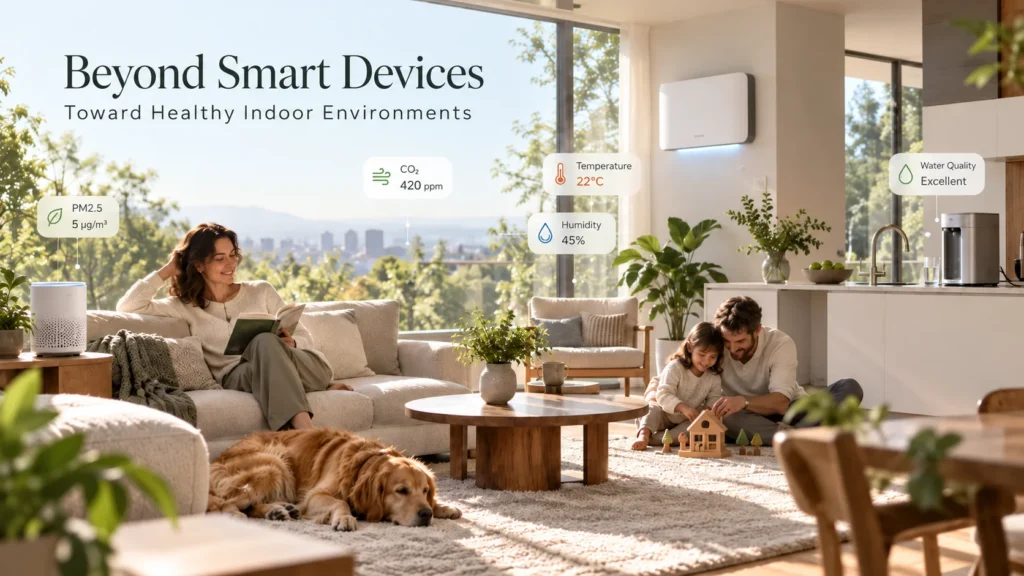
Modern living room with a family enjoying a healthy indoor environment monitored by smart devices, natural lighting, and greenery.

After IFA 2026: The Healthy Home Is Moving Beyond Smart Devices

In our previous IFA 2026 column, Air Purification Is Becoming Part of the Healthy-Home Platform, we argued that the next generation of indoor-health products would ...
Новости
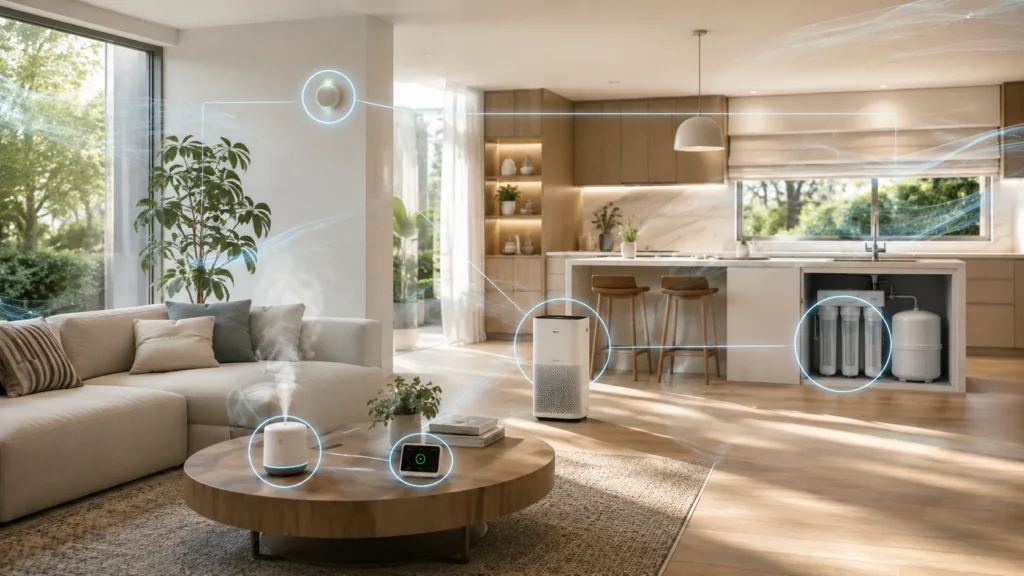
Modern living room and kitchen with smart home air quality devices including an air purifier, humidifier, and water filtration system, connected with visualized blue connectivity lines.

IFA 2026: Air Purification Is Becoming Part of the Healthy-Home Platform

Pre-IFA Industry Perspective | September 4, 2026 This article is based on official announcements and regulatory information available ahead of IFA 2026, which takes place ...
Новости
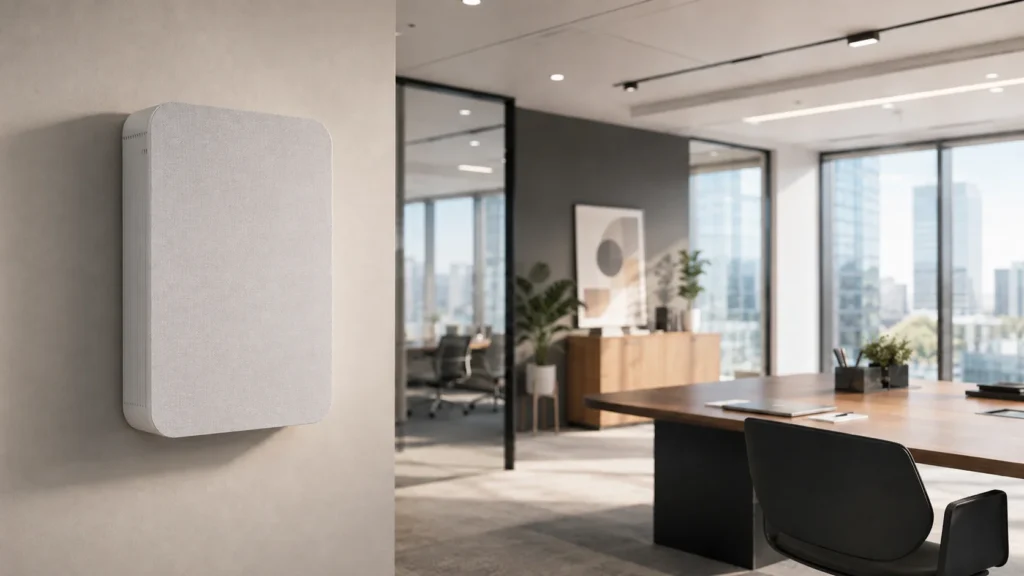
A modern office room with a gray wall-mounted air purifier, large wooden desk, office chairs, indoor plants, and glass windows offering a city view.

Luftreiniger gegen Staub: HEPA-Luftreinigung für Büro, Gewerbe und Industrie

Kurz gesagt: Ein Luftreiniger entfernt Staub aus der Luft – nicht vom Schreibtisch. Er reduziert die Konzentration schwebender Partikel und damit auch die Menge an ...
Air purifier, Filter
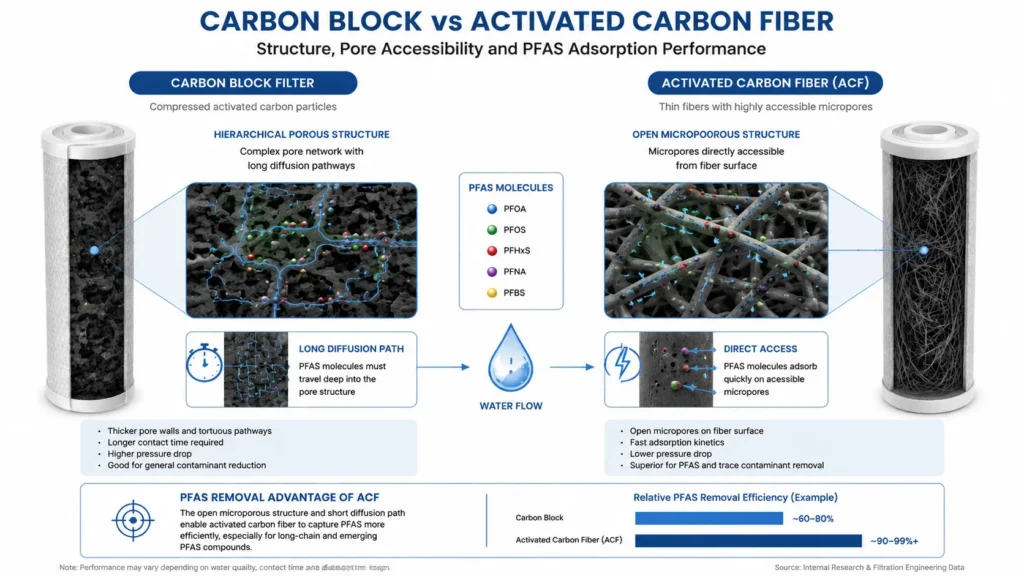
Comparison infographic showcasing the differences between carbon block filter and activated carbon fiber. Detailed diagrams illustrate the hierarchical porous structure of the carbon block with long diffusion paths and the open microporous structure of the activated carbon fiber with direct access for PFAS adsorption.

Carbon Block vs. Activated Carbon Fiber (ACF): Matching Media to Target Contaminants

Two carbon media. Same adsorption chemistry. Very different behaviour in a point-of-use cartridge. If you are specifying a water purifier platform for a PFAS-aware market, ...
Новости
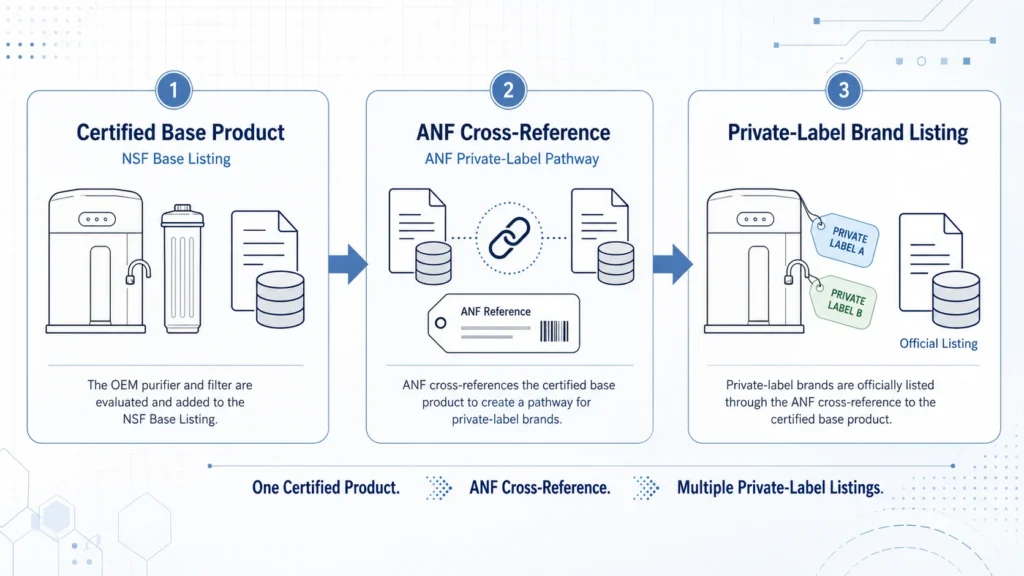
NSF base listing and ANF private-label certification pathway for OEM water filters

What Is an NSF Master Listing? A Guide to Base Listings, ANF Certification and OEM Water Filters

For a brand preparing to launch an OEM water purifier, one of the most common supplier claims is: “We already have an NSF master listing, ...
News, Water Purifiers
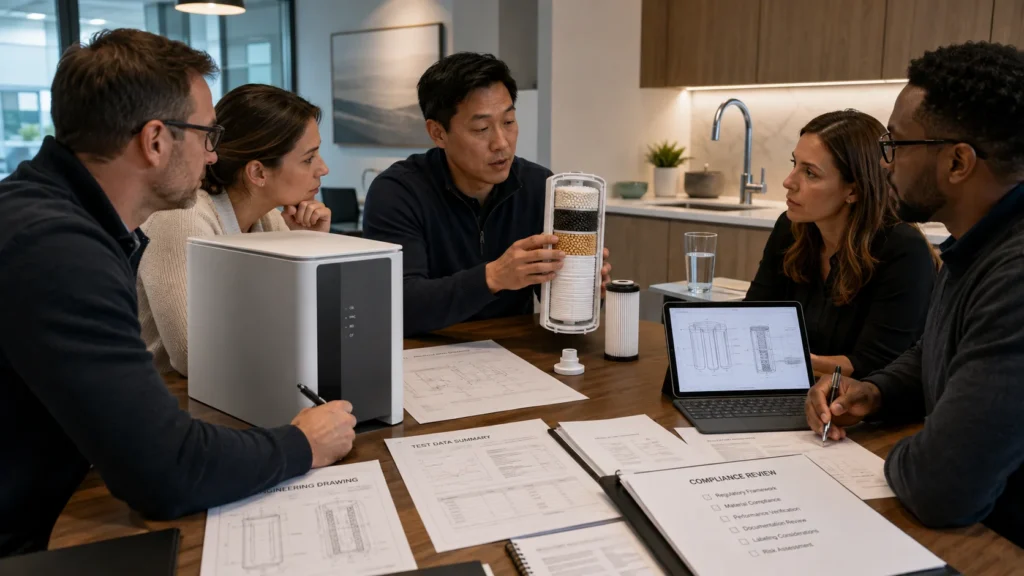
Healthy-home brand team reviewing PFAS water filter certification, test data and product engineering

Entering the Water Category Is Easy. Building a Credible PFAS Claim Is Much Harder

For air purification, appliance and healthy-home brands, entering the water category can look surprisingly easy. A company can select an existing undersink system, customize its ...
Новости
Contaminant Engineering•3 min read

PFAS Water Filtration Technologies Explained: Carbon, Resin & RO

Key Takeaway:

PFAS reduction depends on the specific compounds present, treatment media, contact time, water chemistry, and system design. Activated carbon, ion exchange, and Reverse Osmosis address PFAS through different mechanisms.

PFAS are a large family of persistent fluorinated compounds that can occur in drinking-water supplies. Their treatment behavior varies significantly by molecular structure, chain length, functional group, concentration, and the chemistry of the source water.

Granular Activated Carbon (GAC) removes PFAS primarily through adsorption. It is generally more effective for many longer-chain PFAS, while shorter-chain compounds tend to break through more quickly. Carbon performance depends on media properties, Empty Bed Contact Time (EBCT), competing organic matter, loading, and replacement frequency.

Ion-exchange resins use charged functional sites to capture many PFAS compounds. Properly selected anion-exchange media can provide high capacity and may perform better than conventional activated carbon for some shorter-chain PFAS, although performance still depends on water chemistry and competing ions.

Reverse Osmosis (RO) uses membrane separation rather than adsorption. Properly designed RO systems can provide broad reduction across many PFAS compounds as well as dissolved salts and other contaminants. Unlike carbon or resin, however, RO also produces a concentrate stream that must be managed.

No single technology should be selected from a PFAS label alone. System design should consider which PFAS compounds are present, their concentrations, required reduction targets, flow rate, media life, and the applicable third-party certification or validation requirements.

HisoAir Water Technical Series
Product Discovery•3 min read

How to Choose an Under-Sink Water Purifier for Modern Kitchens

Key Takeaway:

Match the treatment technology to your water quality first, then evaluate cabinet space, faucet configuration, flow rate, drain and power requirements, and filter replacement needs.

Choosing an under-sink water purifier starts with water chemistry. Carbon filtration is well suited to chlorine, taste, odor, and many organic contaminants, while Reverse Osmosis is more appropriate when dissolved salts, fluoride, nitrates, or broader dissolved contaminants need to be reduced.

For compact kitchens, tankless RO systems eliminate the conventional storage tank and can significantly reduce the space required under the sink. However, membrane capacity stated in GPD does not directly equal faucet flow. When comparing systems, check the actual dispensing flow rate, inlet-pressure requirement, recovery ratio, and whether a booster pump is required.

Installation architecture also matters. Many RO systems require a drain connection, electrical power, and either a dedicated drinking-water faucet or a compatible multi-function faucet. High-flow carbon systems can often connect directly to the existing cold-water line with a simpler installation, but pressure drop and available faucet flow should still be verified.

RO also removes much of the naturally occurring dissolved mineral content. Where taste or mineral balance is a priority, a post-RO remineralization stage can be added. Filter life should be evaluated by both rated capacity and local water quality rather than replacement time alone.

The right system is therefore not simply the smallest or highest-GPD model. It is the configuration that matches the target contaminants, available cabinet space, desired faucet setup, peak dispensing demand, and maintenance expectations.

HisoAir Water Technical Series
Water Quality•2 min read

What Does TDS Mean in Drinking Water? Measurement vs Contaminant Reality

Key Takeaway:

A TDS meter estimates the overall concentration of dissolved ionic substances from electrical conductivity. It cannot identify specific contaminants or determine whether water is chemically safe.

Total Dissolved Solids (TDS) refers to the combined concentration of dissolved substances in water. Most handheld TDS meters do not measure TDS directly. Instead, they measure electrical conductivity (EC) and convert that reading into an estimated parts-per-million (ppm) value.

This means a TDS reading can indicate how much dissolved ionic material is present, but not what that material actually is. Calcium, magnesium, sodium, nitrates, and other dissolved ions can all contribute to conductivity, yet a simple TDS meter cannot distinguish between them.

TDS meters are also not suitable for detecting trace contaminants such as PFAS, many VOCs, pesticides, pharmaceuticals, or disinfection byproducts. These substances may be present at concentrations far below the level needed to noticeably change electrical conductivity.

A low TDS reading therefore does not guarantee safe drinking water, and a higher TDS reading does not automatically indicate contamination. Water-treatment decisions should be based on laboratory testing for specific contaminants of concern rather than TDS alone.

HisoAir Water Technical Series
Technology Selection•2 min read

RO vs UF Water Filtration: Understanding Pore Sizes & Dissolved Minerals

Key Takeaway:

Ultrafiltration can reduce bacteria, turbidity, and suspended particles while retaining most naturally occurring dissolved minerals. Reverse Osmosis provides much broader reduction of dissolved salts and smaller contaminants.

Ultrafiltration (UF) typically uses hollow-fiber membranes with pore sizes in the approximate 0.01–0.1 micron range. These membranes physically retain turbidity, suspended solids, colloids, and many microorganisms while allowing dissolved minerals and salts to remain in the water.

Reverse Osmosis (RO) operates at a much finer separation level. Unlike UF, RO can substantially reduce dissolved ions such as sodium, calcium, fluoride, nitrates, and other contributors to total dissolved solids (TDS). This makes RO more suitable when dissolved-salt reduction is a primary treatment objective.

UF generally requires less system pressure and produces little or no continuous concentrate stream in many point-of-use configurations. RO typically requires greater pressure and produces a reject-water stream, but delivers broader contaminant reduction.

For water with acceptable TDS and mineral content, UF can be a simpler mineral-retaining treatment option. Where dissolved salts, fluoride, nitrates, or broader dissolved contaminants are a concern, RO is generally the more appropriate technology.

HisoAir Water Technical Series
Technology Selection•4 min read

Carbon Block vs Reverse Osmosis: Which Fits Your Need?

Key Takeaway:

Choose RO for dissolved inorganic salts and heavy metals; choose Carbon Block for chemical taste/odor, no wastewater, and high line-pressure flow.

Reverse Osmosis (RO) and Carbon Block filtration represent two fundamentally different treatment methods: membrane separation and adsorption. Understanding these differences helps determine which technology is better suited to a specific water-quality requirement.

Reverse Osmosis uses a semi-permeable membrane with pore sizes of approximately 0.0001 microns. It can significantly reduce dissolved inorganic contaminants such as TDS, fluoride, nitrates, and certain heavy metals. Because water must be forced through the membrane, RO systems require sufficient pressure or a booster pump and generate a concentrated wastewater stream.

Carbon Block filtration relies primarily on adsorption through compressed activated carbon, commonly with nominal pore sizes around 0.5–5 microns. It is highly effective for chlorine, chloramines, VOCs, taste, and odor, while allowing substantially higher direct-flow rates without producing wastewater.

From an operating perspective, Carbon Block systems are generally simpler, require less energy, and avoid the water loss associated with RO. RO involves higher system complexity and operating cost, but provides substantially broader reduction of dissolved contaminants that Carbon Block alone cannot address.

HisoAir Water Technical Series

ЗАПРОСИТЬ ЦИТАТУ