يفتح في علامة تبويب جديدة
حلول مبتكرة لجودة الهواء
شعار هيسو-أير-لوجو
استفسر الآن

أفضل شركات تنقية الهواء العالمية

Related Products

تظل أجهزة تنقية الهواء ضرورية للغاية في البيئات المعيشية في عصرنا الحالي. يمكن إزالة الفيروسات والمواد المسببة للأمراض في الهواء باستخدام أجهزة تنقية الهواء المناسبة. في هذه المدونة، قمنا بإدراج 4 من أكثر شركات تصنيع أجهزة تنقية الهواء الموثوق بها.

هيسو إير HA-1968
هيسو إير HA-1968

مصدر الصورة: هيسو إير

تأتي أجهزة تنقية الهواء عادةً بأحجام مختلفة ووظائف مختلفة. والأمر متروك للشركة المصنعة فيما يتعلق بما تتضمنه وتعطيه الأولوية في إنتاج مثل هذه الحلول. ولكن نوع المرشحات وتقليل الضوضاء هما من الأساسيات التي يهتم بها معظم المستهلكين.

إذا كنت تبحث عن شركة تصنيع لتزويدك بأجهزة تنقية هواء متميزة، فستكون هذه المقالة ذات أهمية بالنسبة لك. فيما يلي قائمة بالشركات المصنعة التي كانت من الأسماء الكبيرة في مجال تنقية الهواء لسنوات. تحقق منها أدناه لمعرفة المزيد.

قائمة بأفضل شركات تنقية الهواء العالمية

فيما يلي قائمة بأجهزة تنقية الهواء الموصى بها في ماليزيا. تمت مراجعة هذه الموديلات بدقة بدءًا من الشركات المصنعة لها وحتى موقف بيعها في السوق. تم ربط أسماء الموديلات لمساعدتك في الانتقال مباشرةً إلى الأقسام الخاصة بكل منها. تم اختيار أجهزة تنقية الهواء الخمسة هذه بعناية وفقًا لأدائها العام في الصناعة.

  1. هيسو إير
  2. شركة أولانسي للرعاية الصحية المحدودة
  3. فيسينك

أفضل شركات تنقية الهواء العالمية

لقد قرأنا مراجعات حول هذه الشركات المصنعة للتعرف على خبرتها وشهرتها في سوق تنقية الهواء. تابع القراءة لمعرفة المزيد عن كل منها وتحديد أي منها يلبي احتياجاتك على أفضل وجه.

العلامة التجارية الموقع الشهادات الميزة
هيسو إير Room 712, Building 1, No. 4 Headquarters 2nd Road, Songshan Lake Park, Dongguan, Guangdong, China EN 1822
RoHS
م
تقدم مجموعة كبيرة من موديلات أجهزة تنقية الهواء لمختلف الإعدادات.
تم اعتماد مرشحات الكربون المنشط ومرشحات HEPA من قبل SGS.
أولانسي المبنى رقم 1، رقم 1، شارع هايي، بلدة لانهيه، منطقة نانشا، قوانغتشو، الصين آيزو 9001-2008
RoHS
م
CQC
CCC
سي بي
الهيئة السعودية للمواصفات والمقاييس والجودة
يتم تسهيل الإنتاج من خلال فرق البحث والتطوير المتطورة.
معروف بمجموعة متنوعة من حلول تنقية الهواء والماء.
فيسنك المبنى C، الجناح A، المرحلة الأولى من مجمع أناهايم كونكورس، 1202 N. Miller Street, Anaheim, California 92806، الولايات المتحدة آيزو 9001-2008
RoHS
م
تصنع منتجات ذات تقنية عالية.
خبرة في الحكمة الرقمية والأجهزة الذكية.

1. هيسو إير

شعار هيسو-أير-لوجو
شعار هيسو-أير-لوجو

مصدر الصورة: هيسو إير
نص بديل: شعار هيسو إير

نوع العمل: OE، OD، OD، JD، الشركة المصنعة، المورد
الأسواق الرئيسية: عالمي
سنوات الخبرة: 11 سنة
الموقع: Room 712, Building 1, No. 4 Headquarters 2nd Road, Songshan Lake Park, Dongguan, Guangdong, China
الشهادات:

  • EN 1822
  • RoHS
  • م

المزايا:

  • تقدم مجموعة كبيرة من موديلات أجهزة تنقية الهواء لمختلف الإعدادات.
  • تم اعتماد مرشحات الكربون المنشط ومرشحات HEPA من قبل SGS.

إذا كنت من محبي الشركات التي تصنع أجهزة تنقية الهواء من الدرجة الطبية والمعتمدة من شركة HisoAir، فإنك ستجدها في متناول يدك إذا كنت من محبي الشركات التي تصنع أجهزة تنقية الهواء من الدرجة الطبية والمعتمدة من شركة Standard Global Services و AHAM. تفخر هذه الشركة بأجهزتها عالية الجودة لتنقية الهواء.

تقوم شركة Shenzhen HisoAir Co. Ltd. بتصنيع أجهزة تنقية الهواء للتطبيقات التجارية والسكنية. ولأنها تعمل في هذا المجال منذ عام 2011، فإن منتجاتها معروفة بالفعل بالتخلص من 99.91 تيرابايت في الثالثة من الجسيمات وتوفير أكثر الترشيحات صداقة للبيئة، ولهذا السبب تُستخدم في البيئات الطبية. وقد وصلت صادراتهم بالفعل إلى مائة دولة، وهم يعملون جاهدين ليصبحوا المورد الرائد في العالم لمعدات تنقية الهواء.

المنتجات الرئيسية

  • أجهزة تنقية هواء من الدرجة الطبية

2. Olansi Healthcare Co., Ltd.

 

شعار أولانسي
شعار أولانسي

مصدر الصورة: أولانسي

نوع العمل: OE، OD، الشركة المصنعة
الأسواق الرئيسية: آسيا، عالمي
سنوات الخبرة: 15 سنة
الموقع: المبنى رقم 1، رقم 1، شارع هايي، بلدة لانهيه، منطقة نانشا، قوانغتشو، الصين
الشهادات:

  • آيزو 9001-2008
  • RoHS
  • م
  • CQC
  • CCC
  • سي بي
  • الهيئة السعودية للمواصفات والمقاييس والجودة

المزايا:

  • يتم تسهيل الإنتاج من خلال فرق البحث والتطوير المتطورة.
  • معروف بمجموعة متنوعة من حلول تنقية الهواء والماء.
  • شركة أولانسي للرعاية الصحية المحدودة هي شركة رائدة في السوق وحصلت على العديد من الألقاب والجوائز. وقد حصلت هذه الشركة على لقب
  • شركة قوانغدونغ ذات التقنية العالية لإنتاج منتجات الرعاية الصحية والبيئية. تخضع أجهزة تنقية الهواء من أولانسي لـ 11 مختبرًا يشرف عليها أكثر من 30 مهندسًا قبل بيعها في السوق.

تمتلك الشركة مصنعاً تبلغ مساحته 60,000 متر مربع يعمل به أكثر من 500 موظف، ويعرض العديد من أنواع الأجهزة المنزلية وأجهزة الرعاية الصحية عالية الجودة.

المنتجات الرئيسية

  • أجهزة تنقية الهواء مولد الأوزون
  • جهاز تنقية المياه
  • منتجات البشرة ومستحضرات التجميل

3. VeSync Co., Ltd.

شعار فيسينك
شعار فيسينك

مصدر الصورة: فيسينك

نوع العمل: الشركة المصنعة
الأسواق الرئيسية: أمريكا الشمالية والجنوبية وأوروبا وآسيا
سنوات الخبرة: 10 سنوات
المواقع: المبنى C، الجناح A، المرحلة الأولى من مجمع أناهايم كونكورس، 1202 N. Miller Street, Anaheim, California 92806، الولايات المتحدة
الشهادات:

  • آيزو 9001-2008
  • RoHS
  • م

المزايا:

  • تصنع منتجات ذات تقنية عالية.
  • خبرة في الحكمة الرقمية والأجهزة الذكية.

تأسست شركة فيسينك المحدودة في عام 2012. وتشتهر الشركة بعلاماتها التجارية الثلاث التي تمتلكها: Cosori و Etekcity و Levoit. قررت شركة التصنيع هذه أن يكون لديها هذه العلامات التجارية الثلاث لتمييز سريع للمنتجات التي تنتجها. وتحت علامة Levoit توجد أجهزة تنقية الهواء، وأجهزة ترطيب الهواء، والمكانس الكهربائية، وغيرها من حلول تنظيف الهواء.

المنتجات الرئيسية

  • الأجهزة المنزلية الذكية
  • أجهزة تنقية الهواء
  • إنترنت الأشياء

أفضل اختيارنا لشركة تنقية الهواء العالمية

بينما تم سرد أسماء الشركات ومعلومات الاتصال الخاصة بها، فمن الواضح أي الشركات هي الأنسب لأي شركة. إن شركة HisoAir هي الشركة المصنعة الأكثر شهرة في العالم، وهذه الميزة قد تساعد شركتك على توسيع نطاقها أيضاً.

عندما يتعلق الأمر بأجهزة تنقية الهواء عالية الجودة للشركات، فلا شك أن هذه الشركة هي الخيار الأفضل الذي نوصي به.

الخاتمة

Despite the fact that there are numerous options available, it is critical for businesses to focus on what is best rather than what appears to be "the trend." Air pollution is extremely common in today's world, and no one can predict whether you will be affected or not, or how severe the effects will be if you are. Choosing the best company to partner with should be a benefit, and HisoAir is just a perfect fit. Contact HisoAir right away!


شارك:
السيد لي مؤسس شركة هيسواير
Alwen Lee, an air purification expert with over 10 years of experience, is a devoted father of two and a passionate traveler, having explored more than 30 countries. With a love for public speaking and swimming, he has dedicated his life to the indoor air quality industry. His mission is to ensure that people around the world enjoy the freedom to breathe clean air and lead happy, healthy lives.

أرسل لنا رسالة

Related Products

المزيد للقراءة

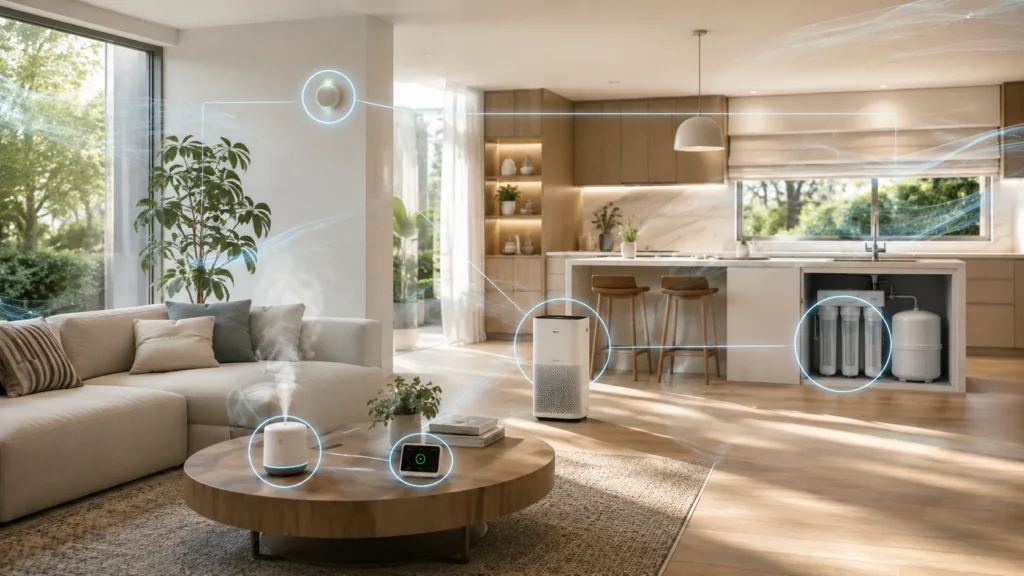
Modern living room with a family enjoying a healthy indoor environment monitored by smart devices, natural lighting, and greenery.

After IFA 2026: The Healthy Home Is Moving Beyond Smart Devices

In our previous IFA 2026 column, Air Purification Is Becoming Part of the Healthy-Home Platform, we argued that the next generation of indoor-health products would ...
الأخبار
Modern living room and kitchen with smart home air quality devices including an air purifier, humidifier, and water filtration system, connected with visualized blue connectivity lines.

IFA 2026: Air Purification Is Becoming Part of the Healthy-Home Platform

Pre-IFA Industry Perspective | September 4, 2026 This article is based on official announcements and regulatory information available ahead of IFA 2026, which takes place ...
الأخبار
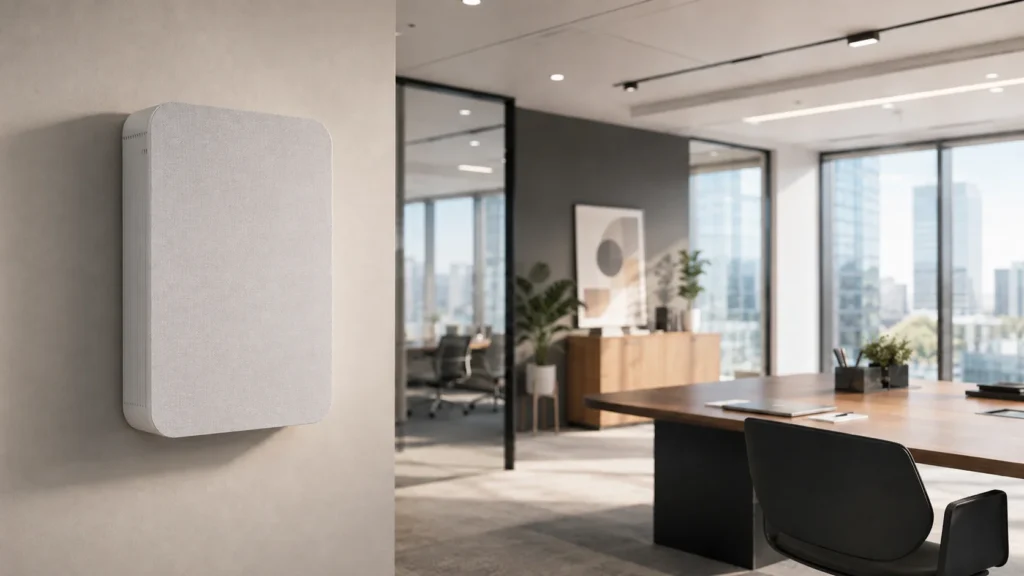
A modern office room with a gray wall-mounted air purifier, large wooden desk, office chairs, indoor plants, and glass windows offering a city view.

Luftreiniger gegen Staub: HEPA-Luftreinigung für Büro, Gewerbe und Industrie

Kurz gesagt: Ein Luftreiniger entfernt Staub aus der Luft – nicht vom Schreibtisch. Er reduziert die Konzentration schwebender Partikel und damit auch die Menge an ...
Air purifier, Filter
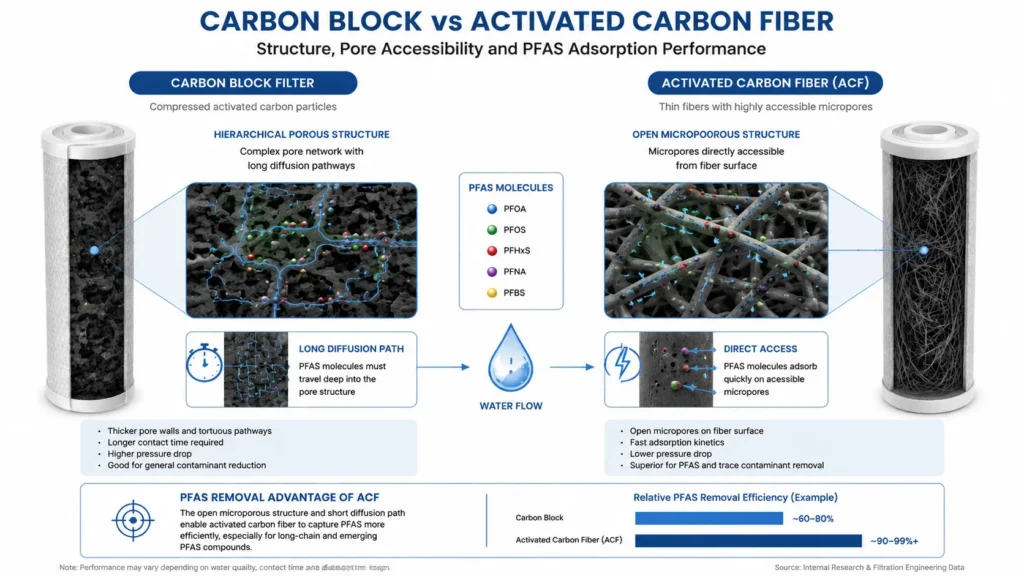
Comparison infographic showcasing the differences between carbon block filter and activated carbon fiber. Detailed diagrams illustrate the hierarchical porous structure of the carbon block with long diffusion paths and the open microporous structure of the activated carbon fiber with direct access for PFAS adsorption.

Carbon Block vs. Activated Carbon Fiber (ACF): Matching Media to Target Contaminants

Two carbon media. Same adsorption chemistry. Very different behaviour in a point-of-use cartridge. If you are specifying a water purifier platform for a PFAS-aware market, ...
الأخبار
NSF base listing and ANF private-label certification pathway for OEM water filters

What Is an NSF Master Listing? A Guide to Base Listings, ANF Certification and OEM Water Filters

For a brand preparing to launch an OEM water purifier, one of the most common supplier claims is: “We already have an NSF master listing, ...
News, Water Purifiers
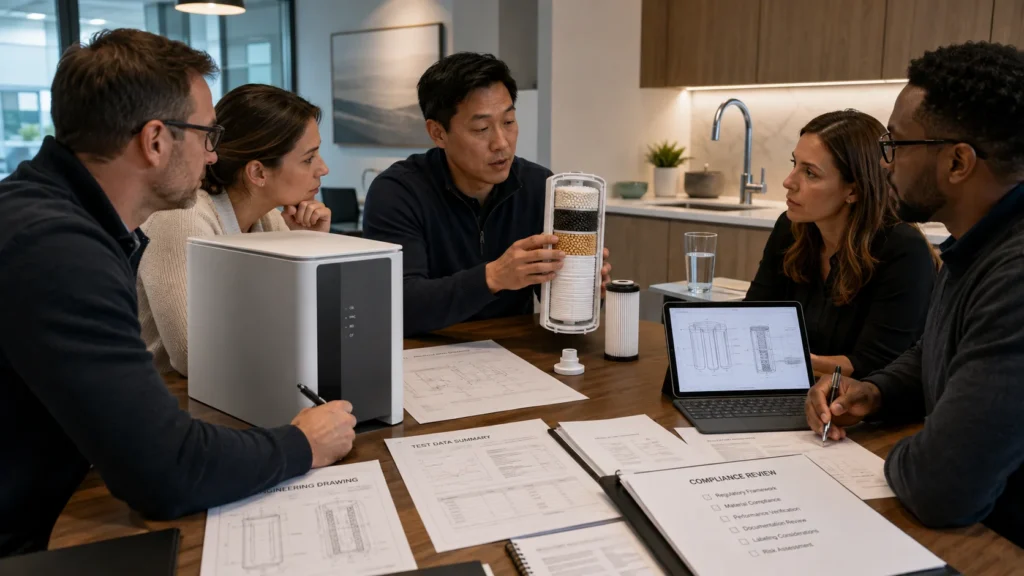
Healthy-home brand team reviewing PFAS water filter certification, test data and product engineering

Entering the Water Category Is Easy. Building a Credible PFAS Claim Is Much Harder

For air purification, appliance and healthy-home brands, entering the water category can look surprisingly easy. A company can select an existing undersink system, customize its ...
الأخبار
Contaminant Engineering•3 min read

PFAS Water Filtration Technologies Explained: Carbon, Resin & RO

Key Takeaway:

PFAS reduction depends on the specific compounds present, treatment media, contact time, water chemistry, and system design. Activated carbon, ion exchange, and Reverse Osmosis address PFAS through different mechanisms.

PFAS are a large family of persistent fluorinated compounds that can occur in drinking-water supplies. Their treatment behavior varies significantly by molecular structure, chain length, functional group, concentration, and the chemistry of the source water.

Granular Activated Carbon (GAC) removes PFAS primarily through adsorption. It is generally more effective for many longer-chain PFAS, while shorter-chain compounds tend to break through more quickly. Carbon performance depends on media properties, Empty Bed Contact Time (EBCT), competing organic matter, loading, and replacement frequency.

Ion-exchange resins use charged functional sites to capture many PFAS compounds. Properly selected anion-exchange media can provide high capacity and may perform better than conventional activated carbon for some shorter-chain PFAS, although performance still depends on water chemistry and competing ions.

Reverse Osmosis (RO) uses membrane separation rather than adsorption. Properly designed RO systems can provide broad reduction across many PFAS compounds as well as dissolved salts and other contaminants. Unlike carbon or resin, however, RO also produces a concentrate stream that must be managed.

No single technology should be selected from a PFAS label alone. System design should consider which PFAS compounds are present, their concentrations, required reduction targets, flow rate, media life, and the applicable third-party certification or validation requirements.

HisoAir Water Technical Series
Product Discovery•3 min read

How to Choose an Under-Sink Water Purifier for Modern Kitchens

Key Takeaway:

Match the treatment technology to your water quality first, then evaluate cabinet space, faucet configuration, flow rate, drain and power requirements, and filter replacement needs.

Choosing an under-sink water purifier starts with water chemistry. Carbon filtration is well suited to chlorine, taste, odor, and many organic contaminants, while Reverse Osmosis is more appropriate when dissolved salts, fluoride, nitrates, or broader dissolved contaminants need to be reduced.

For compact kitchens, tankless RO systems eliminate the conventional storage tank and can significantly reduce the space required under the sink. However, membrane capacity stated in GPD does not directly equal faucet flow. When comparing systems, check the actual dispensing flow rate, inlet-pressure requirement, recovery ratio, and whether a booster pump is required.

Installation architecture also matters. Many RO systems require a drain connection, electrical power, and either a dedicated drinking-water faucet or a compatible multi-function faucet. High-flow carbon systems can often connect directly to the existing cold-water line with a simpler installation, but pressure drop and available faucet flow should still be verified.

RO also removes much of the naturally occurring dissolved mineral content. Where taste or mineral balance is a priority, a post-RO remineralization stage can be added. Filter life should be evaluated by both rated capacity and local water quality rather than replacement time alone.

The right system is therefore not simply the smallest or highest-GPD model. It is the configuration that matches the target contaminants, available cabinet space, desired faucet setup, peak dispensing demand, and maintenance expectations.

HisoAir Water Technical Series
Water Quality•2 min read

What Does TDS Mean in Drinking Water? Measurement vs Contaminant Reality

Key Takeaway:

A TDS meter estimates the overall concentration of dissolved ionic substances from electrical conductivity. It cannot identify specific contaminants or determine whether water is chemically safe.

Total Dissolved Solids (TDS) refers to the combined concentration of dissolved substances in water. Most handheld TDS meters do not measure TDS directly. Instead, they measure electrical conductivity (EC) and convert that reading into an estimated parts-per-million (ppm) value.

This means a TDS reading can indicate how much dissolved ionic material is present, but not what that material actually is. Calcium, magnesium, sodium, nitrates, and other dissolved ions can all contribute to conductivity, yet a simple TDS meter cannot distinguish between them.

TDS meters are also not suitable for detecting trace contaminants such as PFAS, many VOCs, pesticides, pharmaceuticals, or disinfection byproducts. These substances may be present at concentrations far below the level needed to noticeably change electrical conductivity.

A low TDS reading therefore does not guarantee safe drinking water, and a higher TDS reading does not automatically indicate contamination. Water-treatment decisions should be based on laboratory testing for specific contaminants of concern rather than TDS alone.

HisoAir Water Technical Series
Technology Selection•2 min read

RO vs UF Water Filtration: Understanding Pore Sizes & Dissolved Minerals

Key Takeaway:

Ultrafiltration can reduce bacteria, turbidity, and suspended particles while retaining most naturally occurring dissolved minerals. Reverse Osmosis provides much broader reduction of dissolved salts and smaller contaminants.

Ultrafiltration (UF) typically uses hollow-fiber membranes with pore sizes in the approximate 0.01–0.1 micron range. These membranes physically retain turbidity, suspended solids, colloids, and many microorganisms while allowing dissolved minerals and salts to remain in the water.

Reverse Osmosis (RO) operates at a much finer separation level. Unlike UF, RO can substantially reduce dissolved ions such as sodium, calcium, fluoride, nitrates, and other contributors to total dissolved solids (TDS). This makes RO more suitable when dissolved-salt reduction is a primary treatment objective.

UF generally requires less system pressure and produces little or no continuous concentrate stream in many point-of-use configurations. RO typically requires greater pressure and produces a reject-water stream, but delivers broader contaminant reduction.

For water with acceptable TDS and mineral content, UF can be a simpler mineral-retaining treatment option. Where dissolved salts, fluoride, nitrates, or broader dissolved contaminants are a concern, RO is generally the more appropriate technology.

HisoAir Water Technical Series
Technology Selection•4 min read

Carbon Block vs Reverse Osmosis: Which Fits Your Need?

Key Takeaway:

Choose RO for dissolved inorganic salts and heavy metals; choose Carbon Block for chemical taste/odor, no wastewater, and high line-pressure flow.

Reverse Osmosis (RO) and Carbon Block filtration represent two fundamentally different treatment methods: membrane separation and adsorption. Understanding these differences helps determine which technology is better suited to a specific water-quality requirement.

Reverse Osmosis uses a semi-permeable membrane with pore sizes of approximately 0.0001 microns. It can significantly reduce dissolved inorganic contaminants such as TDS, fluoride, nitrates, and certain heavy metals. Because water must be forced through the membrane, RO systems require sufficient pressure or a booster pump and generate a concentrated wastewater stream.

Carbon Block filtration relies primarily on adsorption through compressed activated carbon, commonly with nominal pore sizes around 0.5–5 microns. It is highly effective for chlorine, chloramines, VOCs, taste, and odor, while allowing substantially higher direct-flow rates without producing wastewater.

From an operating perspective, Carbon Block systems are generally simpler, require less energy, and avoid the water loss associated with RO. RO involves higher system complexity and operating cost, but provides substantially broader reduction of dissolved contaminants that Carbon Block alone cannot address.

HisoAir Water Technical Series

طلب عرض أسعار