
Have you ever wondered why so many air filtration products manufacturers are suddenly looking beyond China's borders? As someone deeply embedded in the global air filtration industry, I've watched with fascination as the manufacturing landscape transforms before our eyes. The once-dominant Chinese manufacturing hub is now sharing the spotlight with emerging players in Vietnam, Thailand, and Mexico.
The catalyst? A perfect storm of geopolitical tensions, escalating tariffs, and supply chain vulnerabilities. With Section 301 duties at 25% and potential post-election escalations looming, more than 90% of North American buyers are now actively seeking non-Chinese origins for their HS-8421 air filtration products.
But is relocating manufacturing operations as simple as packing up and moving? Far from it. Each alternative location presents its own unique blend of advantages and hidden challenges. Let me walk you through the sweet spots and pitfalls of implementing a China+1 strategy for air filter manufacturing across Vietnam, Thailand, and Mexico.
Why Are Political Risks and Tariffs Reshaping air Filtration Products Manufacturing?
The implementation of Section 301 tariffs has fundamentally altered the economics of air filter manufacturing. Currently standing at 25% for products under HS code 8421, these tariffs have created an immediate cost pressure that's impossible to ignore.
What makes this particularly challenging is that air filtration products typically operate on margins of 15-20%. A 25% tariff essentially eliminates profitability unless manufacturers can either absorb the cost (rarely possible) or pass it on to consumers (increasingly difficult in a competitive market).
If current tariffs weren't concerning enough, proposals to increase tariffs to as high as 60% on Chinese imports would be catastrophic for companies without diversification strategies in place.
Perhaps the most telling statistic I've encountered is that over 90% of North American buyers are now actively demanding non-Chinese country of origin for their air filtration products. This isn't merely a preference it's becoming a hard requirement in RFPs and supply contracts.
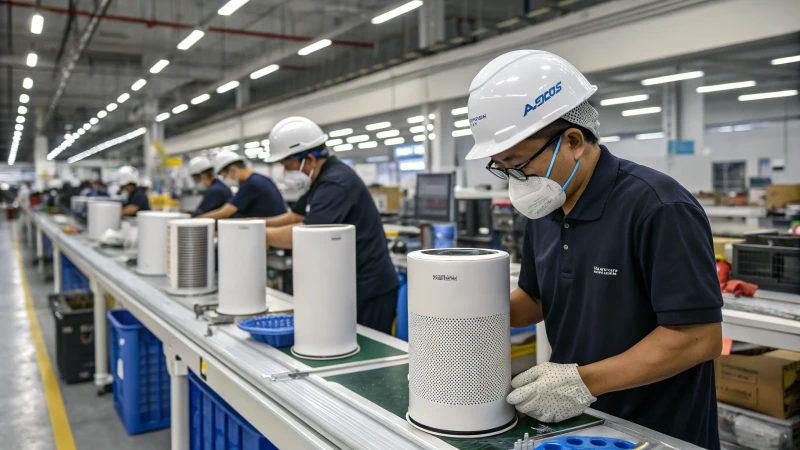
How Do Manufacturing Costs Compare Across Vietnam, Thailand, and Mexico?
On paper, Vietnam and Thailand present an attractive alternative with FOB costs typically running 10-15% higher than China. This premium primarily stems from several factors:
- Lower labor productivity: Despite lower hourly wages in some cases, output per worker hour typically lags behind China by 15-20%
- Infrastructure inefficiencies: Less developed transportation networks and utilities increase operational costs
- Supply chain fragmentation: The need to import components from China adds logistics costs and complexity
- Scale disadvantages: Smaller operations haven't yet achieved the economies of scale present in Chinese manufacturing
Mexico presents a different cost equation. While FOB costs typically run 15-20% higher than China, the USMCA provides a critical advantage: duty-free access to the North American market. This effectively claws back approximately 8-10% of the cost differential when compared to tariff-impacted Chinese imports.
The math becomes particularly compelling when considering total landed costs to North American customers:
| Manufacturing Location | Base FOB Cost (vs. China) | Applicable Tariff | Shipping Cost to US | Total Landed Cost Differential |
|---|---|---|---|---|
| China | Baseline | 25% | Baseline | +25% |
| Vietnam/Thailand | +10-15% | 0% | +5% | +15-20% |
| Mexico | +15-20% | 0% (USMCA) | -10% | +5-10% |
When making location decisions, focusing solely on production costs provides an incomplete picture. A true Total Cost of Ownership analysis must consider inventory carrying costs, quality management costs, risk mitigation expenses, compliance costs, and management bandwidth.
Why Does Component Dependency Create Only "Partial Decoupling" from China?
One of the most challenging realities I've encountered in implementing China+1 strategies is the persistent dependency on Chinese components. Despite best intentions to diversify manufacturing, the component supply chain remains stubbornly anchored to China.
The statistics are striking: 70-80% of critical components for air filters—including melt-blown filtration media, ABS housings, EC fans, and PCBs—continue to ship from China even when final assembly occurs elsewhere. This creates a supply chain that's less diversified than it appears on paper.
I recently toured a "Vietnam-made" air purifier assembly plant where the operations manager candidly admitted: "We're basically a screwdriver operation. Almost everything inside the unit still comes from China. We're assembling here primarily for tariff advantages."
There are several structural reasons why component manufacturing hasn't migrated alongside assembly operations:
- Scale Economics: Many specialized components require massive production volumes to justify the capital investment in manufacturing equipment
- Technical Expertise Clusters: China has developed deep technical expertise clusters for specific components
- Vertical Integration Advantages: Chinese component manufacturers often benefit from vertical integration
- Raw Material Access: China's established position in raw material supply chains gives its component manufacturers advantaged access to key inputs
Based on current trajectories, I estimate the following timeframes for meaningful localization of key components outside China:
| Component Type | Estimated Years to Significant Non-China Capacity | Key Barriers |
|---|---|---|
| Plastic Housings | 2-3 years | Tooling costs, quality consistency |
| PCBs (Basic) | 3-5 years | Technical expertise, chemical processes |
| Wiring Harnesses | 1-2 years | Labor training, quality systems |
| EC Fans | 5-7+ years | Magnet materials, precision manufacturing |
| Melt-Blown Media | 7-10+ years | Proprietary technology, scale requirements |
| Control Electronics | 4-6 years | Design expertise, testing capabilities |
When I first began advising manufacturers on China+1 strategies, I noticed a consistent blind spot in their financial projections: recertification costs. These expenses rarely appear in initial ROI calculations but can significantly impact both timeline and profitability.
One of the most sobering realities of relocating air filter manufacturing is the time required for product recertification. Moving production to a new facility—even when using identical equipment and processes—triggers a comprehensive recertification process with regulatory bodies like UL, FCC, and AHAM.
In my experience working with dozens of manufacturers, this process consistently takes 9-12 months from application to final approval. This creates a critical "certification gap" where companies face difficult choices:
- Delay market entry until certification is complete
- Continue production in China during the transition period (maintaining dual operations)
- Ship uncertified products (rarely viable due to retailer and regulatory requirements)
When reviewing manufacturing relocation proposals, I'm consistently struck by how often certification costs are minimized or entirely absent from ROI calculations. The comprehensive costs typically include:
| Certification Element | Typical Cost Range | Often Overlooked Aspects |
|---|---|---|
| UL 507 Safety Testing | $25,000-$45,000 | Preliminary testing, design modifications |
| FCC EMC Compliance | $15,000-$30,000 | Pre-compliance testing, shielding modifications |
| AHAM Performance Verification | $20,000-$35,000 | Performance optimization, retesting |
| Factory Audit & Qualification | $10,000-$20,000 | Pre-audit preparation, corrective actions |
| Engineering Support | $50,000-$100,000 | Staff time, travel expenses, consultant fees |
| Documentation Updates | $15,000-$25,000 | Technical file revisions, translation services |
| Total Direct Costs | $135,000-$255,000 | Per product family |
How Does Labor Flexibility Impact Production Capacity?
Labor flexibility might sound like a dry HR topic, but I've seen it make or break manufacturing operations during seasonal peaks and unexpected demand surges.
One of the most significant constraints I've encountered in Southeast Asian operations is the strict limitation on overtime hours. Both Vietnam and Thailand cap monthly overtime at approximately 40 hours per worker—a regulation that is increasingly enforced as these countries mature their labor practices.
To put this in perspective, during peak production periods in China, workers might put in 60-80 hours of overtime monthly. This difference creates a substantial capacity gap that catches many manufacturers by surprise.
In contrast to Southeast Asia's overtime limitations, Mexico offers significantly greater flexibility in shift arrangements. Mexican labor regulations permit various shift structures, including 4x10 hour shifts and rotating weekend coverage, providing nearly continuous production capability when needed.
However, Mexico's flexibility advantage comes with its own challenge: a persistent skill gap in certain technical operations that typically results in rework rates 2-3% higher than Chinese or Southeast Asian facilities.
Based on my experience with operations across these regions, here's how the key labor flexibility factors compare:
| Factor | China | Vietnam/Thailand | Mexico |
|---|---|---|---|
| Monthly OT Capacity | 60-80 hours | 30-40 hours | 60-70 hours |
| Shift Pattern Options | Highly flexible | Limited by regulations | Highly flexible |
| Weekend Production | Readily available | Limited availability | Available with premium |
| Technical Skill Level | High | Medium-High | Medium with variability |
| Rework Rates | Baseline | +0-1% vs. China | +2-3% vs. China |
What Does the Winning Playbook for China+1 Implementation Look Like?
After years of observing both successful and failed China+1 implementations, I've identified a clear pattern among the winners. The most effective approach isn't an either/or proposition between China and alternative locations—it's a strategic hybrid manufacturing model that leverages the strengths of multiple manufacturing bases while mitigating their respective weaknesses.
The winning formula I've seen repeatedly succeed combines three critical elements:
- Chinese component sourcing: Leveraging China's unmatched component ecosystem
- Strategic assembly operations: Establishing final assembly in tariff-advantaged locations
- Forward deployment: Positioning finished inventory close to end markets
This approach creates a manufacturing network that balances cost efficiency, tariff avoidance, and customer responsiveness.
One of the most compelling benefits of this hybrid model is the ability to achieve 5-7 day replenishment capabilities for North American customers—a significant improvement over the 30+ days typically required for direct shipments from Asia.
Beyond operational advantages, this hybrid model creates an effective tariff shield through country of origin qualification. By conducting final assembly and testing in locations like Vietnam, Thailand, or Mexico, products can generally qualify for non-Chinese origin status under most trade rules.
While the hybrid model offers compelling advantages, it requires sufficient scale to justify the investment in multiple facilities and more complex logistics. Based on numerous implementations I've observed, the economics typically become viable at production volumes of 500,000+ units annually.
Charting Your Path Forward: Making China+1 Work for Air Filter Manufacturing
As we've explored throughout this analysis, implementing a successful China+1 strategy for air filter manufacturing requires careful navigation of complex trade-offs between cost, risk, and operational flexibility. The landscape is nuanced, with each alternative location—Vietnam, Thailand, and Mexico—offering distinct advantages alongside significant challenges.
What's become increasingly clear is that the most successful approach isn't about completely abandoning Chinese manufacturing, but rather developing a strategic hybrid model that leverages the strengths of multiple locations. The winning playbook emerging from industry leaders combines Chinese components with local assembly operations and U.S. forward warehousing to achieve the optimal balance of cost efficiency, tariff avoidance, and supply chain responsiveness.
This hybrid approach delivers impressive results: 5-7 day replenishment capabilities, effective tariff shields, and the flexibility to adapt country of origin based on evolving trade policies. However, the economics only make sense at scale—typically requiring volumes of 500,000+ units annually to justify the investment in multiple manufacturing locations and logistics infrastructure.
Looking ahead, manufacturers must remain vigilant as the geopolitical landscape continues to evolve. What works today may need adjustment tomorrow as trade policies shift, labor markets develop, and technology transforms production processes. The most resilient operations will be those that maintain flexibility and continuously reassess their manufacturing footprint against changing market conditions.
For air filter manufacturers navigating this complex terrain, the key takeaway is clear: success lies not in choosing between China or alternative locations, but in thoughtfully integrating both into a cohesive strategy that balances cost, risk, and operational performance. By embracing this nuanced approach to global manufacturing, forward-thinking companies can turn today's supply chain challenges into tomorrow's competitive advantage.






 English
 Français
 Español
 Italiano
 Deutsch
 Português
 Русский
 العربية
 日本語
 한국어
 Tiếng Việt


