يفتح في علامة تبويب جديدة
حلول مبتكرة لجودة الهواء
شعار هيسو-أير-لوجو
استفسر الآن

أين تُصنّع أجهزة تنقية الهواء iDer

Related Products

على الأرجح أنك لم تسمع من قبل عن العلامة التجارية iDer لأجهزة تنقية الهواء. لكن أولئك الذين استخدموا أجهزة تنقية الهواء هذه ذكروا أنها تقوم بعمل جيد في تنظيف الهواء الداخلي. إذاً، ما مدى جودة أجهزة تنقية الهواء هذه حقاً، وأين يتم تصنيعها؟

العديد من الشركات المصنعة لأجهزة تنقية الهواء موجودة اليوم. ولا يخفى عليك أن هذا المجال بالتحديد مليء بالخيارات التي يمكنك اتخاذها. وبالطبع، قد يجعل ذلك بحثك عن أفضل جهاز لتنقية الهواء مربكاً ومحيراً بعض الشيء. ومع ذلك، قد ترغب حقًا في الحصول على جهاز لتنقية الهواء يمكن أن يساعدك في تحسين جودة الهواء الداخلي. 
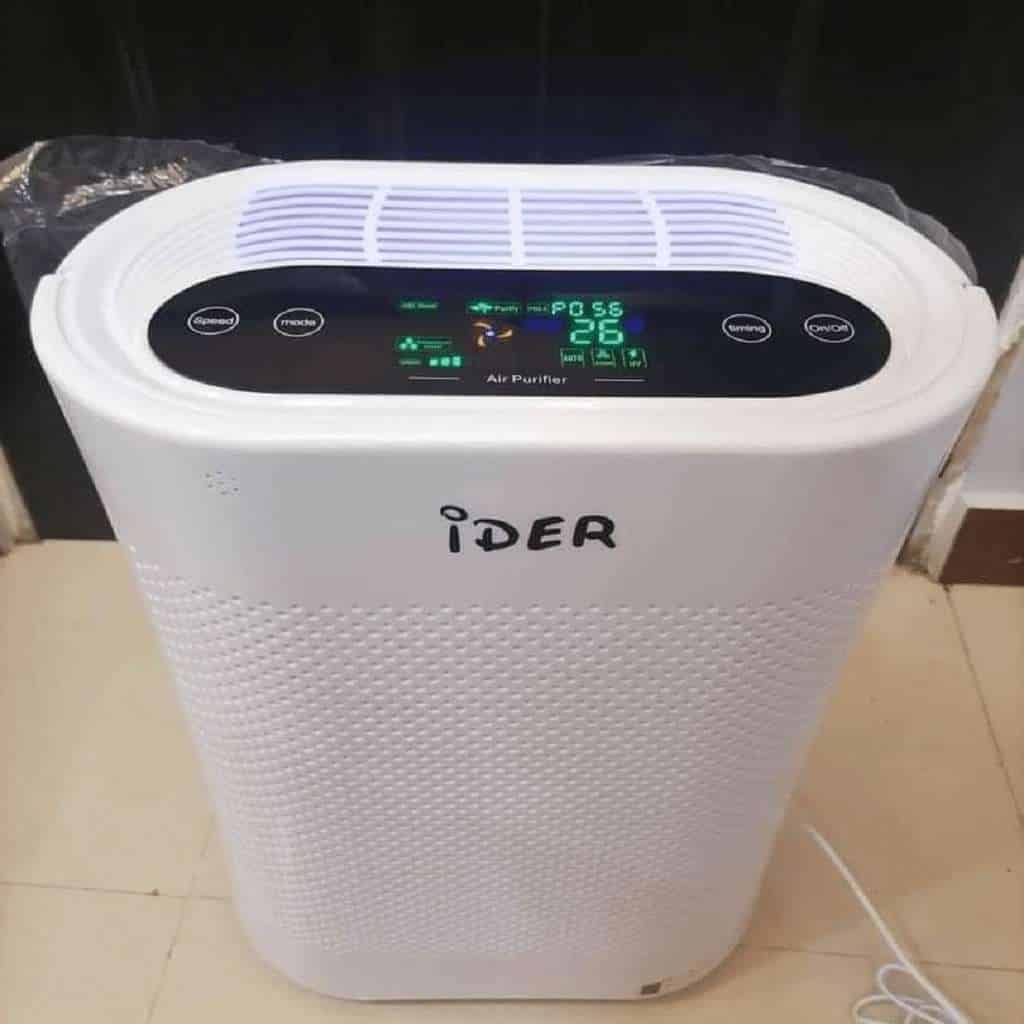
مثال لجهاز تنقية الهواء iDer

مصدر الصورة: iDer 

من بين ماركات أجهزة تنقية الهواء الموجودة في السوق، هناك خيار واحد باقٍ قد ترغب في التفكير فيه، وهو iDer. بالطبع، هناك احتمال كبير أن تكون قد سمعت عن هذه العلامة التجارية حتى الآن. لذا فإن السؤال الذي يطرح نفسه دائماً هو ما إذا كانت تلبي توقعاتك أم لا. 

أين يتم تصنيع أجهزة تنقية الهواء هذه؟ ما مدى جودة أدائها؟ تابع القراءة لاكتشاف قدرات هذه العلامة التجارية. 

أين تُصنع أجهزة تنقية الهواء iDer؟

لقد تم تسليط الضوء بالفعل على أن iDer ليست علامة تجارية مشهورة في مجال أجهزة تنقية الهواء أو الإلكترونيات الاستهلاكية. وبالتالي، ليس من المستغرب أن يتشكك الناس في أصولها، فضلاً عن أدائها العام. ففي النهاية، يمكنك الإشارة إلى الجودة الشاملة لعلامة تجارية معينة من خلال معرفة مكان تجميع منتجاتها. 

بصراحة، ليس من السهل تحديد أصل العلامة التجارية iDer. لا يوجد الكثير من المعلومات عن هذه العلامة التجارية أو الشركة المصنعة لها في السوق. ولكن استنادًا إلى نتائج بحثنا، هناك احتمال أن تكون هذه العلامة التجارية من أجهزة تنقية الهواء إما مشتقة من الفلبين أو شركات تصنيع أجهزة تنقية الهواء في الصين. 

ومع ذلك، فإننا نعتقد على الأرجح أن جهاز تنقية الهواء هذا مصنوع في الفلبين. فقد اكتشفنا أن العديد من منصات البيع بالتجزئة عبر الإنترنت في البلد المذكور تبيع هذا المنتج بدون الشحن الدولي الرسوم أو التكاليف. وهذا يشير إلى أن العناصر متوفرة بسهولة على المستوى المحلي. علاوة على ذلك، لم نر أي تلميح إلى أنه تم الاستعانة بمصادر خارجية من الشركات المصنعة المعروفة لأجهزة تنقية الهواء في الصين. 

فماذا يعني ذلك بالنسبة للمستهلكين؟ حسنًا، يتردد بعض الأشخاص في شراء أجهزة تنقية الهواء أو غيرها من الأجهزة الإلكترونية التي لا الشركات المصنعة لأجهزة تنقية الهواء في الولايات المتحدة- أو صينية الصنع. هناك فكرة أن هذه المنتجات لا تفي بمعايير الجودة والسلامة في إنتاجها. وهذا أحد أسباب عدم انتشار أجهزة تنقية الهواء من iDer. فوصولها إلى السوق مخصص للاستهلاك المحلي فقط. 

ومع ذلك، يمكننا التأكد من أن أجهزة تنقية الهواء هذه ليست رديئة. فبناءً على بنيتها، قد تلتقط الملوثات في الهواء وتساعدك على التنفس بشكل أفضل. 

الأسئلة المتداولة حول أجهزة تنقية الهواء iDer Air Purifier

نظرًا لأن iDer ليست علامة تجارية مشهورة، فإن العديد من الأشخاص لديهم أسئلة حولها. فيما يلي بعض الاستفسارات السائدة بشأن أجهزة تنقية الهواء iDer:
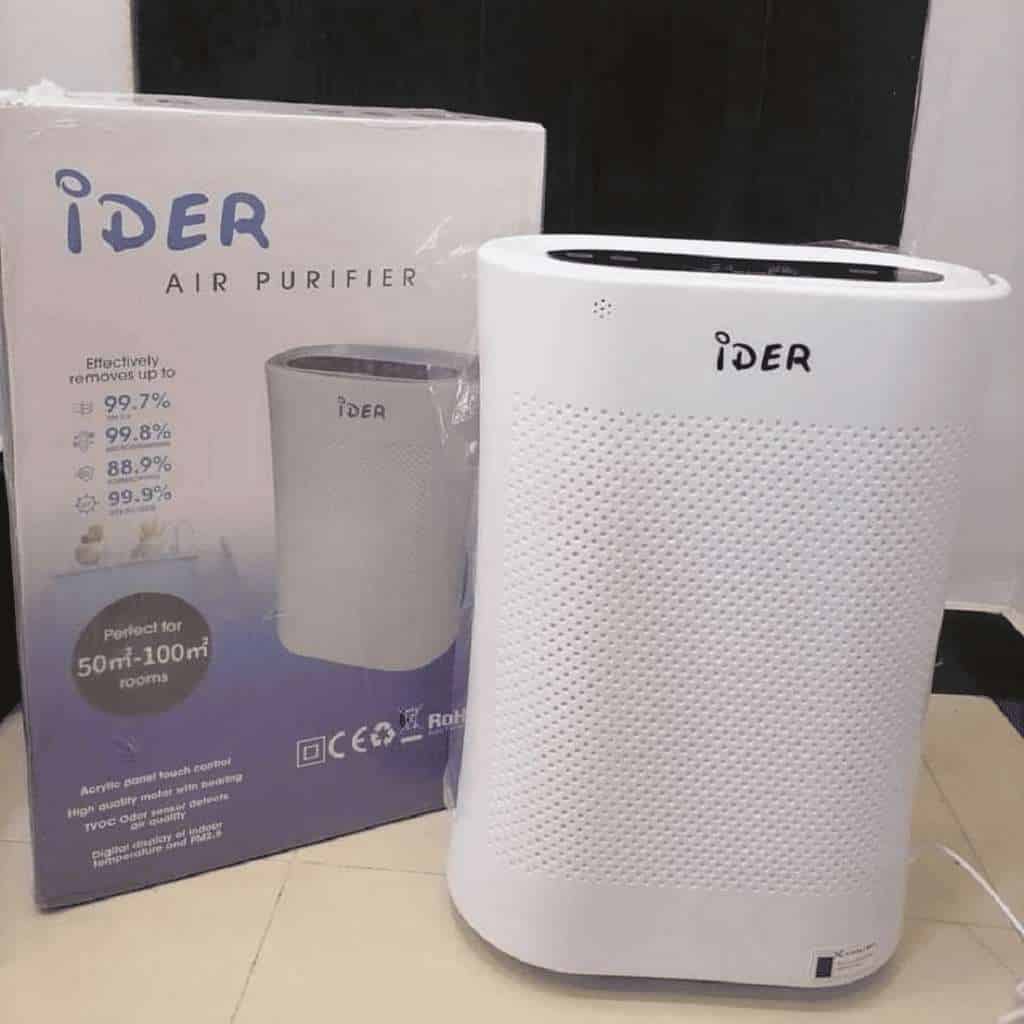
جهاز تنقية هواء iDer مع عبوته

مصدر الصورة: iDer

كيفية استخدام أجهزة تنقية الهواء iDer Air Purifier؟

ومن المثير للاهتمام أن أجهزة تنقية الهواء iDer هي نفسها أجهزة تنقية الهواء الأخرى التي يمكنك رؤيتها في السوق اليوم، خاصةً في جانب كيفية عمل منظفات الهواء هذه. لذلك، يمكنك التأكد من أن هذه العناصر ليست صعبة الاستخدام. 

هناك أنواع مختلفة لجهاز تنقية الهواء هذا. ولكن جميعها تحتوي على لوحات تحكم موضوعة في الجزء العلوي منها. وبهذه الطريقة، ستتمكن من الوصول إليها بسهولة. تحتوي أجهزة تنقية الهواء هذه على هيكل قابل للتوصيل والتشغيل. ما عليك سوى الضغط على زر الطاقة الخاص بها، وستعمل من تلقاء نفسها. 

لا يزال بإمكانك ضبط سرعة المروحة لتلبية احتياجات تنقية الهواء التي تريدها. ومع ذلك، يجب أن نذكرك أن أجهزة تنقية الهواء هذه ليست قوية مثل نظيراتها. فتدفق الهواء فيها ليس بهذه الكفاءة، لذا نوصيك بوضعها فقط أجهزة تنقية الهواء الصغيرة.

لسنا متأكدين مما إذا كانت أجهزة تنقية الهواء هذه مزوّدة بوظيفة المؤقت. لذلك قد تحتاج إلى التحكم في تشغيلها، خاصةً إذا كنت تريد التوفير في فواتير الطاقة. 

هل أجهزة تنقية الهواء iDer فعالة؟

كما ذكرنا سابقاً، فإن أجهزة تنقية الهواء هذه ليست بجودة تلك الخيارات الرائدة التي تأتي من العلامات التجارية الرائدة في مجال تنقية الهواء. لذلك، من المفهوم تمامًا إذا كان الناس مترددين في شرائها. 

ولكن، يجب أن تكون أجهزة تنقية الهواء هذه قادرة على التقاط الملوثات في الهواء. فهي مزودة بمعيار فلاتر HEPA التي تمكنها من احتجاز الملوثات المجهرية في الهواء. يمكن لمرشحات HEPA هذه أن تحبس مسببات الحساسية ووبر الحيوانات الأليفة والملوثات الصغيرة الأخرى. ومع ذلك، لسنا متأكدين من قدرتها على التعامل مع مسببات الأمراض، مثل البكتيريا والفيروسات. 

نظرًا لأن أسعارها معقولة، فمن المسلم به أن أجهزة تنقية الهواء هذه لا تحتوي على نفس الميزات التي تتمتع بها العلامات التجارية الأخرى الأغلى ثمناً. ولكن للاستخدام الشخصي، يجب أن تكون أجهزة تنقية الهواء هذه قادرة على إرضائك.

أفضل مصنع لأجهزة تنقية الهواء في الصين

إذا كنت تبحث عن علامة تجارية مرموقة في مجال أجهزة تنقية الهواء، فعليك التحقق من شركة هيسو إير على الفور. هذه الشركة المصنعة هي الشركة الرائدة في الصين في إنتاج أجهزة تنقية الهواء عالية الجودة التي تستخدم في التطبيقات السكنية والتجارية والصناعية. 

تابع القراءة لمعرفة المزيد عن هيسو إير. 

هيسو إير
شعار هيسو إير
شعار هيسو إير

مصدر الصورة: هيسو إير

  • نوع العمل: مُصنِّع المعدات الأصلية/صانع المعدات الأصلية/صانع المعدات المملوكة للغير، المورد
  • المقر الرئيسي: معلومات الجيل الجديد. تيك. Industrial Park, BaoAn District, Shenzhen, الصين
  • الأسواق الرئيسية: عالمي
  • سنوات الخبرة: 11 سنة
  • الشهادات: سي، روهز، إن 1822

بخبرة 11 عاماً من الخبرة الواسعة في إنتاج أجهزة تنقية الهواء الطبية, هيسو إير تفخر الشركة بأنها المصدر الأول لأدوات تنقية الهواء في السوق الصينية. ومع ذلك، فقد وسّعت نطاق انتشارها تدريجياً في السوق الدولية، حيث تتنافس بشكل فعال مع شركات مثل هانيويل وبلو إير وليفويت. كما أن أسعار منتجاتها تنافسية أيضاً، خاصةً في الطلبات بالجملة.

إن جودة أجهزة تنقية الهواء من هيسو إير مذهلة. فقد تم اختبارها بشكل مستقل لتكون فعالة ضد الملوثات المختلفة المحمولة في الهواء، مثل مسببات الحساسية ومسببات الأمراض. علاوة على ذلك، قام قسم البحث والتطوير في هذه الشركة بتصميم أجهزة تنقية الهواء هذه لتكون موفرة للطاقة وخالية من الضوضاء. ويمكنك تشغيلها داخل منزلك وفي أي بيئة شديدة الازدحام. كما أنها متينة أيضاً، مما يضمن جودة سعرها مقابل قيمتها. 


المنتجات الرئيسية

  • أجهزة تنقية هواء من الدرجة الطبية

الخاتمة

هنا، يمكننا أن نرى أن iDer هي علامة تجارية لائقة لأجهزة تنقية الهواء. إن أجهزة تنقية الهواء الخاصة بها قادرة إلى حد ما على تحسين جودة الهواء بشكل عام في مساحتك. وغني عن القول أن أجهزة تنقية الهواء هذه ليست استثنائية مثل العلامات التجارية الرائدة الأخرى. ولكن بالنسبة للمناطق ذات المساحات المحدودة، يجب أن تعمل بشكل جيد. 

لتلبية احتياجات تنظيف الهواء على نطاق واسع، يجب عليك استخدام العلامات التجارية ذات السمعة الطيبة مثل HisoAir. فهي التي يمكنها ضمان نتائج شاملة في إزالة أنواع مختلفة من الملوثات. في هذا السياق، يجب عليك التحقق من أحكام هيسو إير. كما ذكرنا، فهي مصدر رائع لأجهزة تنقية الهواء عالية الأداء التي يمكن أن تساعد في تحسين جودة الهواء الداخلي في مساحتك. تفضل بزيارة HisoAir وتعرف على المزيد عن منتجاتها. 

راجع هذه المدونات المفيدة أيضاً

شارك:
السيد لي مؤسس شركة هيسواير
Alwen Lee, an air purification expert with over 10 years of experience, is a devoted father of two and a passionate traveler, having explored more than 30 countries. With a love for public speaking and swimming, he has dedicated his life to the indoor air quality industry. His mission is to ensure that people around the world enjoy the freedom to breathe clean air and lead happy, healthy lives.

أرسل لنا رسالة

Related Products

المزيد للقراءة

Modern living room with a family enjoying a healthy indoor environment monitored by smart devices, natural lighting, and greenery.

After IFA 2026: The Healthy Home Is Moving Beyond Smart Devices

In our previous IFA 2026 column, Air Purification Is Becoming Part of the Healthy-Home Platform, we argued that the next generation of indoor-health products would ...
الأخبار
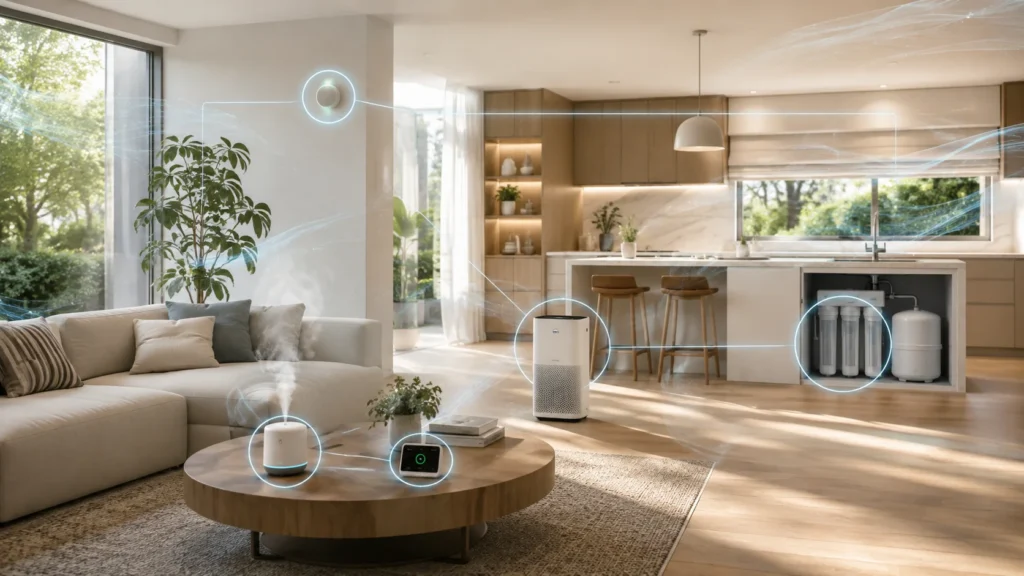
Modern living room and kitchen with smart home air quality devices including an air purifier, humidifier, and water filtration system, connected with visualized blue connectivity lines.

IFA 2026: Air Purification Is Becoming Part of the Healthy-Home Platform

Pre-IFA Industry Perspective | September 4, 2026 This article is based on official announcements and regulatory information available ahead of IFA 2026, which takes place ...
الأخبار
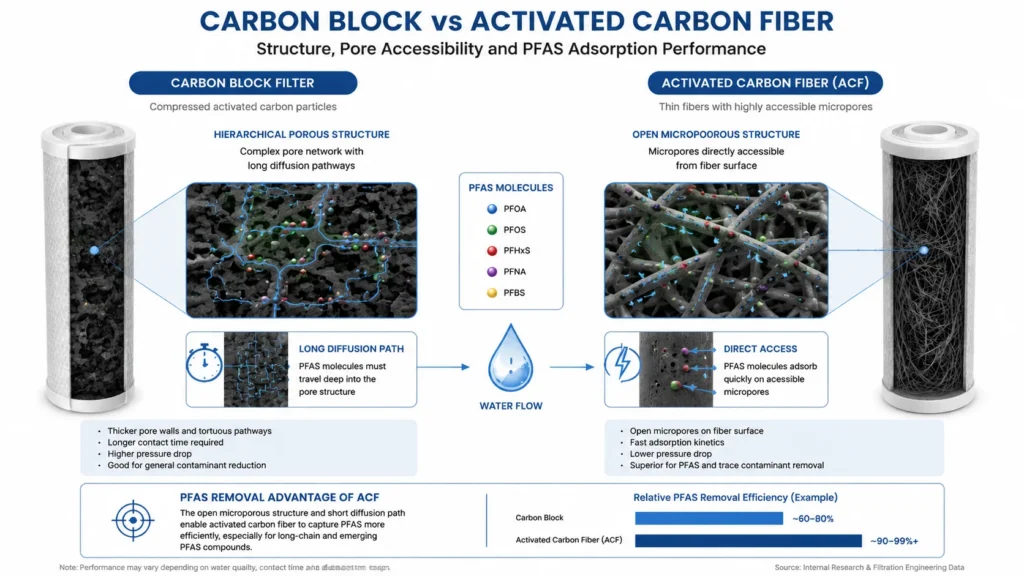
Comparison infographic showcasing the differences between carbon block filter and activated carbon fiber. Detailed diagrams illustrate the hierarchical porous structure of the carbon block with long diffusion paths and the open microporous structure of the activated carbon fiber with direct access for PFAS adsorption.

Carbon Block vs. Activated Carbon Fiber (ACF): Matching Media to Target Contaminants

Two carbon media. Same adsorption chemistry. Very different behaviour in a point-of-use cartridge. If you are specifying a water purifier platform for a PFAS-aware market, ...
الأخبار
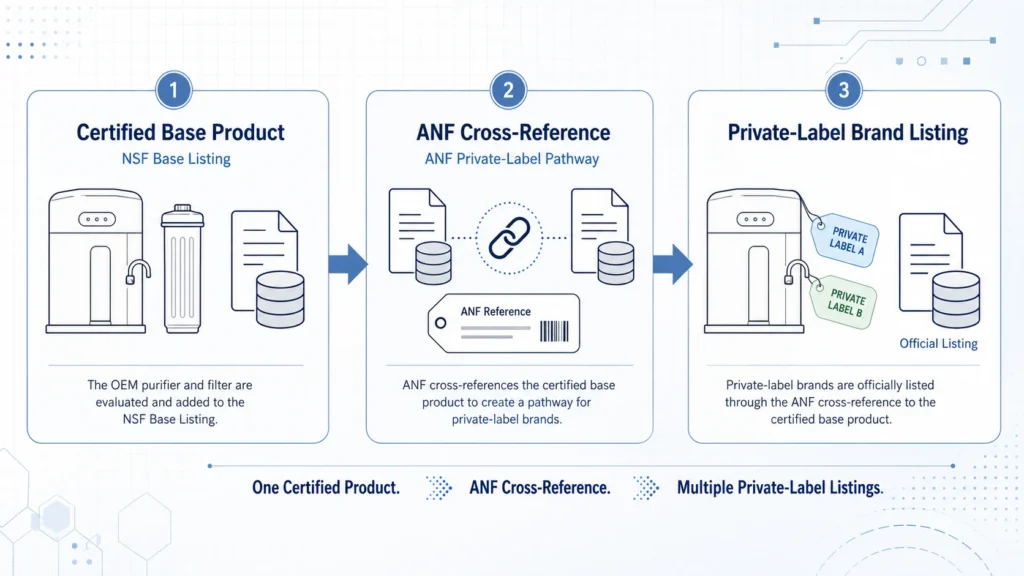
NSF base listing and ANF private-label certification pathway for OEM water filters

What Is an NSF Master Listing? A Guide to Base Listings, ANF Certification and OEM Water Filters

For a brand preparing to launch an OEM water purifier, one of the most common supplier claims is: “We already have an NSF master listing, ...
News, Water Purifiers
Healthy-home brand team reviewing PFAS water filter certification, test data and product engineering

Entering the Water Category Is Easy. Building a Credible PFAS Claim Is Much Harder

For air purification, appliance and healthy-home brands, entering the water category can look surprisingly easy. A company can select an existing undersink system, customize its ...
الأخبار
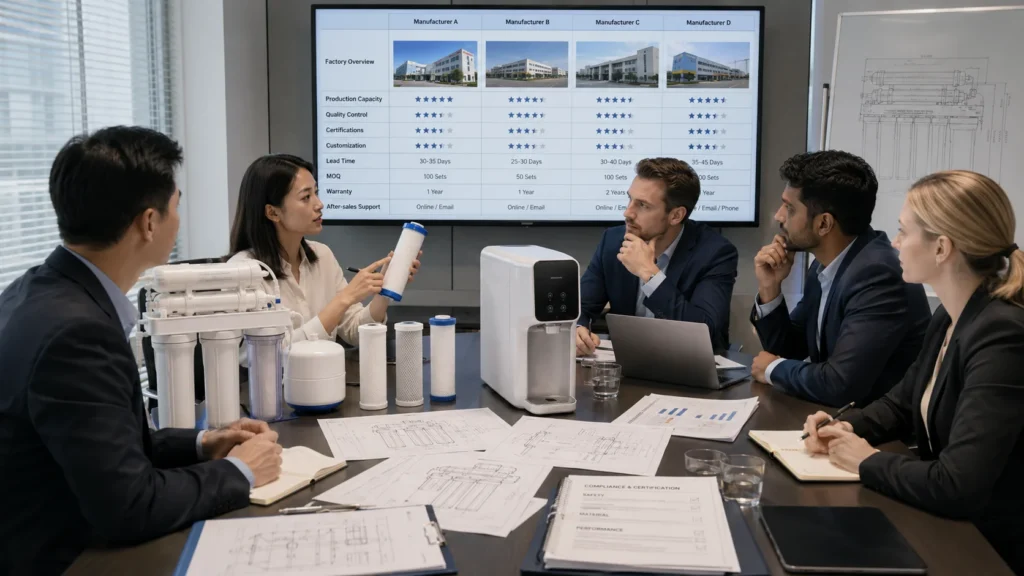
Team in a business meeting discussing a water filtration system with product components and a comparison table displayed on a screen.

5 Leading OEM Water Purifier Manufacturers in China for Private Label Brands

China has thousands of companies selling water filters, reverse osmosis systems and drinking-water appliances. However, only a portion of them are suitable for private-label, OEM ...
الأخبار
Contaminant Engineering•3 min read

PFAS Water Filtration Technologies Explained: Carbon, Resin & RO

Key Takeaway:

PFAS reduction depends on the specific compounds present, treatment media, contact time, water chemistry, and system design. Activated carbon, ion exchange, and Reverse Osmosis address PFAS through different mechanisms.

PFAS are a large family of persistent fluorinated compounds that can occur in drinking-water supplies. Their treatment behavior varies significantly by molecular structure, chain length, functional group, concentration, and the chemistry of the source water.

Granular Activated Carbon (GAC) removes PFAS primarily through adsorption. It is generally more effective for many longer-chain PFAS, while shorter-chain compounds tend to break through more quickly. Carbon performance depends on media properties, Empty Bed Contact Time (EBCT), competing organic matter, loading, and replacement frequency.

Ion-exchange resins use charged functional sites to capture many PFAS compounds. Properly selected anion-exchange media can provide high capacity and may perform better than conventional activated carbon for some shorter-chain PFAS, although performance still depends on water chemistry and competing ions.

Reverse Osmosis (RO) uses membrane separation rather than adsorption. Properly designed RO systems can provide broad reduction across many PFAS compounds as well as dissolved salts and other contaminants. Unlike carbon or resin, however, RO also produces a concentrate stream that must be managed.

No single technology should be selected from a PFAS label alone. System design should consider which PFAS compounds are present, their concentrations, required reduction targets, flow rate, media life, and the applicable third-party certification or validation requirements.

HisoAir Water Technical Series
Product Discovery•3 min read

How to Choose an Under-Sink Water Purifier for Modern Kitchens

Key Takeaway:

Match the treatment technology to your water quality first, then evaluate cabinet space, faucet configuration, flow rate, drain and power requirements, and filter replacement needs.

Choosing an under-sink water purifier starts with water chemistry. Carbon filtration is well suited to chlorine, taste, odor, and many organic contaminants, while Reverse Osmosis is more appropriate when dissolved salts, fluoride, nitrates, or broader dissolved contaminants need to be reduced.

For compact kitchens, tankless RO systems eliminate the conventional storage tank and can significantly reduce the space required under the sink. However, membrane capacity stated in GPD does not directly equal faucet flow. When comparing systems, check the actual dispensing flow rate, inlet-pressure requirement, recovery ratio, and whether a booster pump is required.

Installation architecture also matters. Many RO systems require a drain connection, electrical power, and either a dedicated drinking-water faucet or a compatible multi-function faucet. High-flow carbon systems can often connect directly to the existing cold-water line with a simpler installation, but pressure drop and available faucet flow should still be verified.

RO also removes much of the naturally occurring dissolved mineral content. Where taste or mineral balance is a priority, a post-RO remineralization stage can be added. Filter life should be evaluated by both rated capacity and local water quality rather than replacement time alone.

The right system is therefore not simply the smallest or highest-GPD model. It is the configuration that matches the target contaminants, available cabinet space, desired faucet setup, peak dispensing demand, and maintenance expectations.

HisoAir Water Technical Series
Water Quality•2 min read

What Does TDS Mean in Drinking Water? Measurement vs Contaminant Reality

Key Takeaway:

A TDS meter estimates the overall concentration of dissolved ionic substances from electrical conductivity. It cannot identify specific contaminants or determine whether water is chemically safe.

Total Dissolved Solids (TDS) refers to the combined concentration of dissolved substances in water. Most handheld TDS meters do not measure TDS directly. Instead, they measure electrical conductivity (EC) and convert that reading into an estimated parts-per-million (ppm) value.

This means a TDS reading can indicate how much dissolved ionic material is present, but not what that material actually is. Calcium, magnesium, sodium, nitrates, and other dissolved ions can all contribute to conductivity, yet a simple TDS meter cannot distinguish between them.

TDS meters are also not suitable for detecting trace contaminants such as PFAS, many VOCs, pesticides, pharmaceuticals, or disinfection byproducts. These substances may be present at concentrations far below the level needed to noticeably change electrical conductivity.

A low TDS reading therefore does not guarantee safe drinking water, and a higher TDS reading does not automatically indicate contamination. Water-treatment decisions should be based on laboratory testing for specific contaminants of concern rather than TDS alone.

HisoAir Water Technical Series
Technology Selection•2 min read

RO vs UF Water Filtration: Understanding Pore Sizes & Dissolved Minerals

Key Takeaway:

Ultrafiltration can reduce bacteria, turbidity, and suspended particles while retaining most naturally occurring dissolved minerals. Reverse Osmosis provides much broader reduction of dissolved salts and smaller contaminants.

Ultrafiltration (UF) typically uses hollow-fiber membranes with pore sizes in the approximate 0.01–0.1 micron range. These membranes physically retain turbidity, suspended solids, colloids, and many microorganisms while allowing dissolved minerals and salts to remain in the water.

Reverse Osmosis (RO) operates at a much finer separation level. Unlike UF, RO can substantially reduce dissolved ions such as sodium, calcium, fluoride, nitrates, and other contributors to total dissolved solids (TDS). This makes RO more suitable when dissolved-salt reduction is a primary treatment objective.

UF generally requires less system pressure and produces little or no continuous concentrate stream in many point-of-use configurations. RO typically requires greater pressure and produces a reject-water stream, but delivers broader contaminant reduction.

For water with acceptable TDS and mineral content, UF can be a simpler mineral-retaining treatment option. Where dissolved salts, fluoride, nitrates, or broader dissolved contaminants are a concern, RO is generally the more appropriate technology.

HisoAir Water Technical Series
Technology Selection•4 min read

Carbon Block vs Reverse Osmosis: Which Fits Your Need?

Key Takeaway:

Choose RO for dissolved inorganic salts and heavy metals; choose Carbon Block for chemical taste/odor, no wastewater, and high line-pressure flow.

Reverse Osmosis (RO) and Carbon Block filtration represent two fundamentally different treatment methods: membrane separation and adsorption. Understanding these differences helps determine which technology is better suited to a specific water-quality requirement.

Reverse Osmosis uses a semi-permeable membrane with pore sizes of approximately 0.0001 microns. It can significantly reduce dissolved inorganic contaminants such as TDS, fluoride, nitrates, and certain heavy metals. Because water must be forced through the membrane, RO systems require sufficient pressure or a booster pump and generate a concentrated wastewater stream.

Carbon Block filtration relies primarily on adsorption through compressed activated carbon, commonly with nominal pore sizes around 0.5–5 microns. It is highly effective for chlorine, chloramines, VOCs, taste, and odor, while allowing substantially higher direct-flow rates without producing wastewater.

From an operating perspective, Carbon Block systems are generally simpler, require less energy, and avoid the water loss associated with RO. RO involves higher system complexity and operating cost, but provides substantially broader reduction of dissolved contaminants that Carbon Block alone cannot address.

HisoAir Water Technical Series

طلب عرض أسعار