Öffnet in einem neuen Tab
Innovative Lösungen für die Luftqualität
Europe, Indoor Air Quality & Product Innovation

Helping a European Innovation Brand Develop a More Sustainable and Better-Sealed Air Purifier Filter System
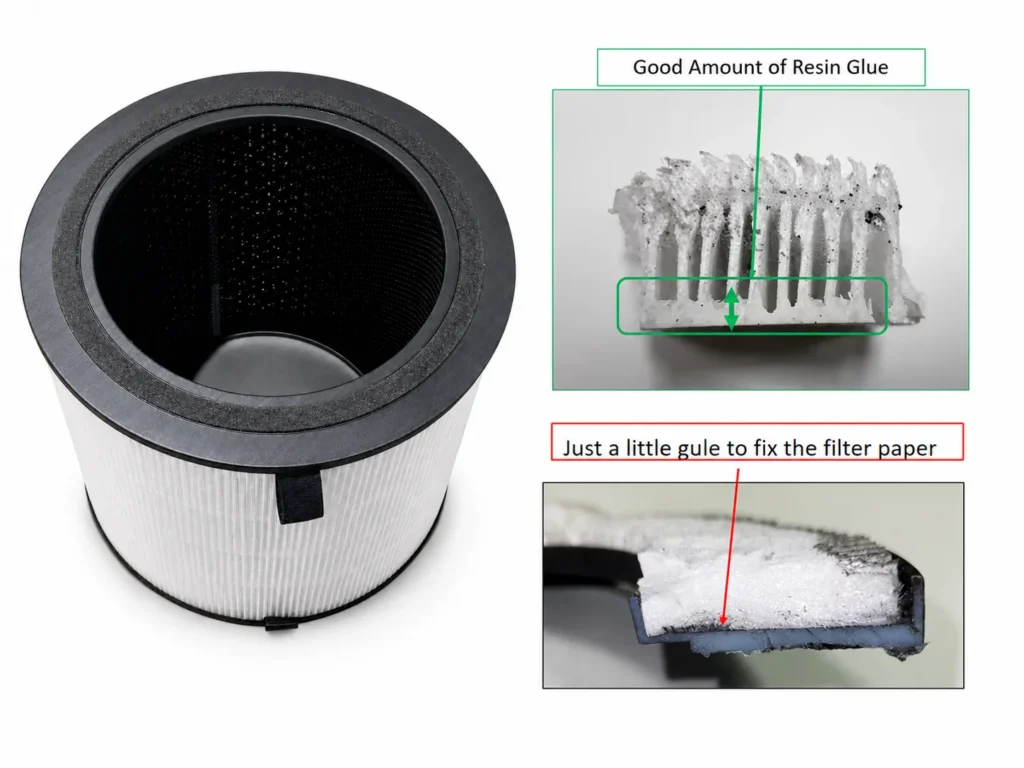
HisoAir is supporting a European indoor air quality brand in developing a cylindrical replacement filter with a paper-based frame, flexible branding, and glue potting technology designed to improve sealing consistency while reducing plastic use and tooling investment.
Air filter with close-ups showing resin glue application and attachment of filter paper for structural analysis.

TARGET AUDIENCE

Innovative IAQ Brands

SOLUTION AREA

Sustainable Filter Engineering

KEY TECH

Glue Potting Sealing

PRODUCTION

Product Innovation Development

Our Involvement

Luftreiniger Produktentwicklung

Filter Structural Engineering

Sustainable Material Selection

Filter Cost Optimization

Glue Potting Sealing Technology

Branding and Printing Adaptation

Prototyping and Sampling

Manufacturing Feasibility Support

Project Management and Quality Control

Project Overview

Company

Confidential European Innovation Brand

Hauptsitz

Europe

Market

Europe

Produkte

Air Quality Monitor, Air Purifier Under Development, Cylindrical Replacement Filter

Background

The client is an emerging European indoor air quality brand known for developing innovative products.

Before entering the air purification category, the company had successfully introduced an air quality monitor through crowdfunding, generating considerable market interest. This response demonstrated demand for products that help consumers understand and manage indoor air quality.

Building on this foundation, the client decided to expand from monitoring indoor air conditions to actively improving them through air purification.

The objective was not to introduce another conventional purifier. The new product needed to reflect the brand’s identity around thoughtful design, environmental responsibility, measurable performance, and product innovation.

To transform this concept into a manufacturable solution, the client partnered with HisoAir.

❞
"The filter needed to deliver more than particle capture—it also had to balance sealing performance, reduced plastic use, branding flexibility, replacement cost, and manufacturing feasibility."

The Idea

The client’s existing monitor helps users understand indoor air quality conditions. The next logical step was to introduce a product capable of responding to those conditions and actively improving indoor air.

The new purifier needed to combine:

  • Distinctive product design
  • Reliable filtration performance
  • More responsible material choices
  • Controllable manufacturing cost
  • A practical replacement-filter structure
  • Future integration with the client’s indoor air quality ecosystem

Because the replacement filter is both a critical performance component and a recurring point of customer interaction, HisoAir and the client focused particularly on its structure, sealing method, environmental impact, cost, and branding flexibility.

The Challenge

Developing an innovative air purifier required balancing performance, sustainability, cost, and manufacturing feasibility.

Reducing Plastic in the Filter Structure
Many cylindrical filters use injection-molded plastic rings or end caps. These components increase plastic consumption, require dedicated tooling, extend development lead times, and make future dimensional changes more difficult.

For an emerging brand, dedicated plastic tooling would also increase initial investment and commercial risk.

Preventing Air Bypass
Filter performance depends not only on the media grade, but also on how effectively the media is sealed to the surrounding structure.

Limited or intermittent glue application may leave gaps around the filter media, creating a potential path for untreated air to bypass the intended filtration layers.

Balancing Sustainability and Cost
The new structure needed to reduce unnecessary material use without producing an excessively expensive replacement filter.

Supporting Future Product Changes
As the purifier was still under development, the filter structure needed enough flexibility to support dimensional, branding, and information changes without repeated tooling modification.

The HisoAir Solution

HisoAir developed a more sustainable and manufacturing-friendly cylindrical filter structure for the client’s new air purifier.

Paper-Based Filter Frame

Instead of conventional injection-molded plastic rings, HisoAir designed the cylindrical filter with a paper-based frame.

The proposed structure can:

  • Reduce the use of molded plastic components
  • Avoid dedicated plastic end-cap tooling
  • Lower initial development investment
  • Shorten preparation time for new filter versions
  • Support easier dimensional adjustment during development
  • Simplify end-of-life material handling
  • Strengthen the product’s environmental design story

Because the paper structure can be adjusted without modifying a plastic mold, it also provides greater flexibility during prototyping and engineering refinement.

Flexible Branding and Product Information

The paper frame also provides a printable surface for customized product and service information.

Depending on the client’s requirements, the filter can display:

  • Brand identity
  • Filter model
  • Replacement instructions
  • Installation direction
  • Filtration information
  • Recycling or disposal guidance
  • QR codes
  • Digital service information

This allows the replacement filter to become part of the branded customer experience rather than remaining a generic internal component.

Glue Potting Sealing Technology

HisoAir applied glue potting technology around the filter media.

Rather than using only small or discontinuous glue points, the potting process creates a more complete interface between the filtration media and its supporting frame.

The design is intended to:

  • Reduce potential gaps around the media
  • Minimize the risk of unfiltered air bypass
  • Improve sealing consistency
  • Support more stable filtration performance
  • Strengthen the connection between the media and frame

This ensures that filter performance is considered as part of a complete sealed airflow path, rather than relying only on the specification of the filtration media.

Design for Cost and Manufacturing

HisoAir evaluated the filter from both environmental and mass-production perspectives.

By reducing unnecessary molded parts and selecting a production-friendly sealing process, the proposed structure helps control:

  • Tooling investment
  • Component cost
  • Assembly complexity
  • Development lead time
  • Future replacement-filter cost

This balance is especially important for an emerging brand that needs product differentiation without sacrificing future commercial scalability.

Prototyping and Engineering Refinement

The purifier and filter system remain under development.

HisoAir continues to support:

  • Filter prototype development
  • Structural validation
  • Sealing-process refinement
  • Manufacturing feasibility review
  • Cost optimization
  • Preparation for future production


The Results

The project has progressed from an air quality monitoring concept toward an integrated air purification product under development.

The current development work has established a differentiated cylindrical replacement-filter direction that combines reduced plastic use, flexible branding, more complete sealing, cost control, and manufacturing feasibility.

The purifier remains under development, with HisoAir continuing to support validation, prototyping, engineering refinement, and preparation for future production.

Key Achievements Include:

☑ Development of a cylindrical filter with a paper-based frame
☑ Reduction of unnecessary molded plastic components
☑ Avoidance of dedicated plastic end-cap tooling
☑ More flexible printing of branding and product information
☑ Application of glue potting technology for a more complete sealing interface
☑ Reduced potential risk of air bypass around the filter media
☑ Improved balance between sustainability, cost, and manufacturability
☑ Continued prototyping and preparation for future production

Schlussfolgerung

This project demonstrates that filter innovation is not limited to selecting higher-grade filtration media.

A well-developed filter must also consider structural sealing, material selection, replacement cost, branding, manufacturing feasibility, and end-of-life handling.

By combining a paper-based frame with glue potting sealing technology, HisoAir is helping the client develop a filter solution that is more flexible, manufacturing-friendly, and environmentally considered.

The project also highlights HisoAir’s role as an engineering partner for innovative indoor air quality brands, supporting their transition from monitoring air quality to actively improving it through differentiated purification products.

Our Involvement

Luftreiniger Produktentwicklung

Filter Structural Engineering

Sustainable Material Selection

Filter Cost Optimization

Glue Potting Sealing Technology

Branding and Printing Adaptation

Prototyping and Sampling

Manufacturing Feasibility Support

Project Management and Quality Control

Looking to expand your product line?

Partner with HisoAir for proven platforms and end-to-end manufacturing excellence.
Kontakt
Contaminant Engineering•3 min read

PFAS Water Filtration Technologies Explained: Carbon, Resin & RO

Key Takeaway:

PFAS reduction depends on the specific compounds present, treatment media, contact time, water chemistry, and system design. Activated carbon, ion exchange, and Reverse Osmosis address PFAS through different mechanisms.

PFAS are a large family of persistent fluorinated compounds that can occur in drinking-water supplies. Their treatment behavior varies significantly by molecular structure, chain length, functional group, concentration, and the chemistry of the source water.

Granular Activated Carbon (GAC) removes PFAS primarily through adsorption. It is generally more effective for many longer-chain PFAS, while shorter-chain compounds tend to break through more quickly. Carbon performance depends on media properties, Empty Bed Contact Time (EBCT), competing organic matter, loading, and replacement frequency.

Ion-exchange resins use charged functional sites to capture many PFAS compounds. Properly selected anion-exchange media can provide high capacity and may perform better than conventional activated carbon for some shorter-chain PFAS, although performance still depends on water chemistry and competing ions.

Reverse Osmosis (RO) uses membrane separation rather than adsorption. Properly designed RO systems can provide broad reduction across many PFAS compounds as well as dissolved salts and other contaminants. Unlike carbon or resin, however, RO also produces a concentrate stream that must be managed.

No single technology should be selected from a PFAS label alone. System design should consider which PFAS compounds are present, their concentrations, required reduction targets, flow rate, media life, and the applicable third-party certification or validation requirements.

HisoAir Water Technical Series
Product Discovery•3 min read

How to Choose an Under-Sink Water Purifier for Modern Kitchens

Key Takeaway:

Match the treatment technology to your water quality first, then evaluate cabinet space, faucet configuration, flow rate, drain and power requirements, and filter replacement needs.

Choosing an under-sink water purifier starts with water chemistry. Carbon filtration is well suited to chlorine, taste, odor, and many organic contaminants, while Reverse Osmosis is more appropriate when dissolved salts, fluoride, nitrates, or broader dissolved contaminants need to be reduced.

For compact kitchens, tankless RO systems eliminate the conventional storage tank and can significantly reduce the space required under the sink. However, membrane capacity stated in GPD does not directly equal faucet flow. When comparing systems, check the actual dispensing flow rate, inlet-pressure requirement, recovery ratio, and whether a booster pump is required.

Installation architecture also matters. Many RO systems require a drain connection, electrical power, and either a dedicated drinking-water faucet or a compatible multi-function faucet. High-flow carbon systems can often connect directly to the existing cold-water line with a simpler installation, but pressure drop and available faucet flow should still be verified.

RO also removes much of the naturally occurring dissolved mineral content. Where taste or mineral balance is a priority, a post-RO remineralization stage can be added. Filter life should be evaluated by both rated capacity and local water quality rather than replacement time alone.

The right system is therefore not simply the smallest or highest-GPD model. It is the configuration that matches the target contaminants, available cabinet space, desired faucet setup, peak dispensing demand, and maintenance expectations.

HisoAir Water Technical Series
Water Quality•2 min read

What Does TDS Mean in Drinking Water? Measurement vs Contaminant Reality

Key Takeaway:

A TDS meter estimates the overall concentration of dissolved ionic substances from electrical conductivity. It cannot identify specific contaminants or determine whether water is chemically safe.

Total Dissolved Solids (TDS) refers to the combined concentration of dissolved substances in water. Most handheld TDS meters do not measure TDS directly. Instead, they measure electrical conductivity (EC) and convert that reading into an estimated parts-per-million (ppm) value.

This means a TDS reading can indicate how much dissolved ionic material is present, but not what that material actually is. Calcium, magnesium, sodium, nitrates, and other dissolved ions can all contribute to conductivity, yet a simple TDS meter cannot distinguish between them.

TDS meters are also not suitable for detecting trace contaminants such as PFAS, many VOCs, pesticides, pharmaceuticals, or disinfection byproducts. These substances may be present at concentrations far below the level needed to noticeably change electrical conductivity.

A low TDS reading therefore does not guarantee safe drinking water, and a higher TDS reading does not automatically indicate contamination. Water-treatment decisions should be based on laboratory testing for specific contaminants of concern rather than TDS alone.

HisoAir Water Technical Series
Technology Selection•2 min read

RO vs UF Water Filtration: Understanding Pore Sizes & Dissolved Minerals

Key Takeaway:

Ultrafiltration can reduce bacteria, turbidity, and suspended particles while retaining most naturally occurring dissolved minerals. Reverse Osmosis provides much broader reduction of dissolved salts and smaller contaminants.

Ultrafiltration (UF) typically uses hollow-fiber membranes with pore sizes in the approximate 0.01–0.1 micron range. These membranes physically retain turbidity, suspended solids, colloids, and many microorganisms while allowing dissolved minerals and salts to remain in the water.

Reverse Osmosis (RO) operates at a much finer separation level. Unlike UF, RO can substantially reduce dissolved ions such as sodium, calcium, fluoride, nitrates, and other contributors to total dissolved solids (TDS). This makes RO more suitable when dissolved-salt reduction is a primary treatment objective.

UF generally requires less system pressure and produces little or no continuous concentrate stream in many point-of-use configurations. RO typically requires greater pressure and produces a reject-water stream, but delivers broader contaminant reduction.

For water with acceptable TDS and mineral content, UF can be a simpler mineral-retaining treatment option. Where dissolved salts, fluoride, nitrates, or broader dissolved contaminants are a concern, RO is generally the more appropriate technology.

HisoAir Water Technical Series
Technology Selection•4 min read

Carbon Block vs Reverse Osmosis: Which Fits Your Need?

Key Takeaway:

Choose RO for dissolved inorganic salts and heavy metals; choose Carbon Block for chemical taste/odor, no wastewater, and high line-pressure flow.

Reverse Osmosis (RO) and Carbon Block filtration represent two fundamentally different treatment methods: membrane separation and adsorption. Understanding these differences helps determine which technology is better suited to a specific water-quality requirement.

Reverse Osmosis uses a semi-permeable membrane with pore sizes of approximately 0.0001 microns. It can significantly reduce dissolved inorganic contaminants such as TDS, fluoride, nitrates, and certain heavy metals. Because water must be forced through the membrane, RO systems require sufficient pressure or a booster pump and generate a concentrated wastewater stream.

Carbon Block filtration relies primarily on adsorption through compressed activated carbon, commonly with nominal pore sizes around 0.5–5 microns. It is highly effective for chlorine, chloramines, VOCs, taste, and odor, while allowing substantially higher direct-flow rates without producing wastewater.

From an operating perspective, Carbon Block systems are generally simpler, require less energy, and avoid the water loss associated with RO. RO involves higher system complexity and operating cost, but provides substantially broader reduction of dissolved contaminants that Carbon Block alone cannot address.

HisoAir Water Technical Series

EIN ANGEBOT ANFORDERN