

Se abre en una pestaña nueva
Soluciones innovadoras para la calidad del aire

From Design Sketch to Retail Shelf: Inside a Successful OEM Project

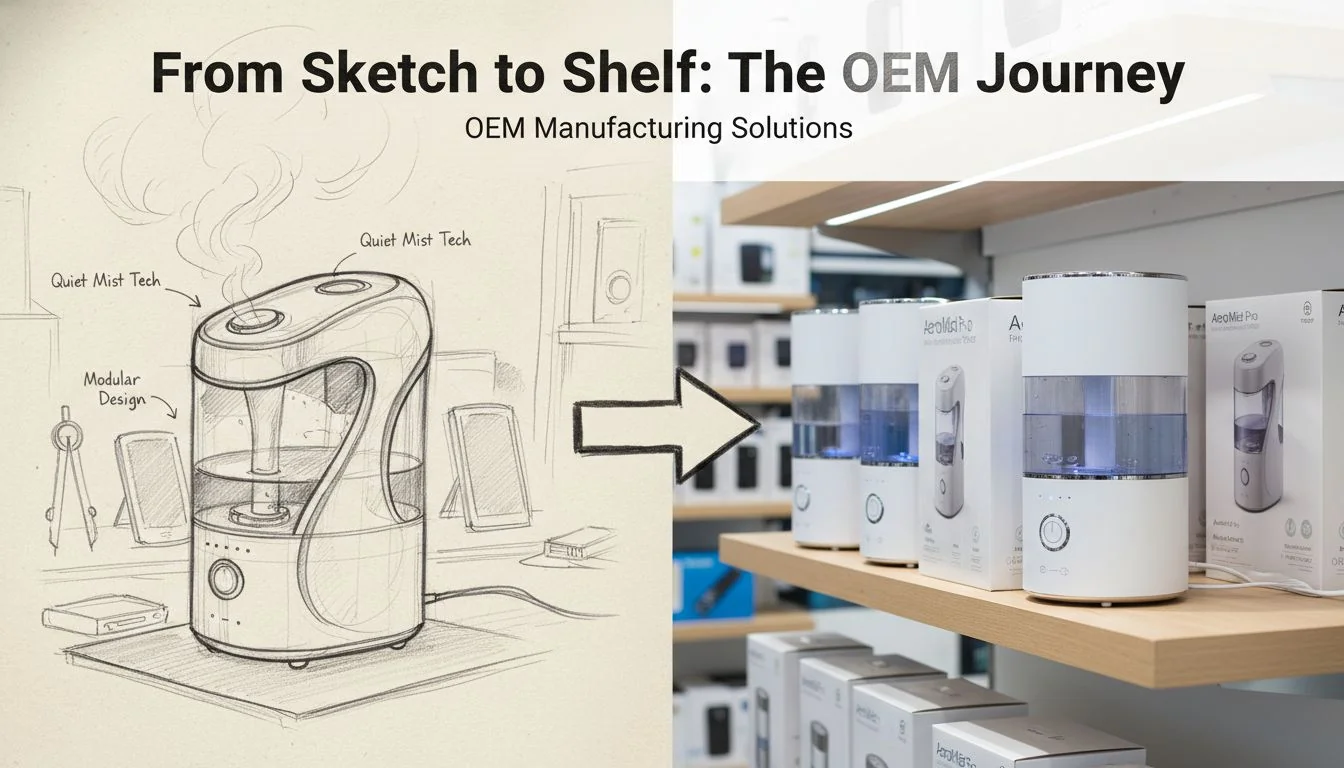
A design sketch of a humidifier transforming into a physical product on a retail shelf.

Dreaming of launching a unique hardware product but terrified of the OEM nightmare1? Endless delays, surprise costs, and compliance hurdles can kill your dream before it even starts.

A successful OEM project today isn't about starting from scratch. It's about "Platform Co-Development2." This smart strategy uses a pre-certified core, letting you focus on unique design and branding. It's the fastest, safest, and most affordable path from sketch to shelf.
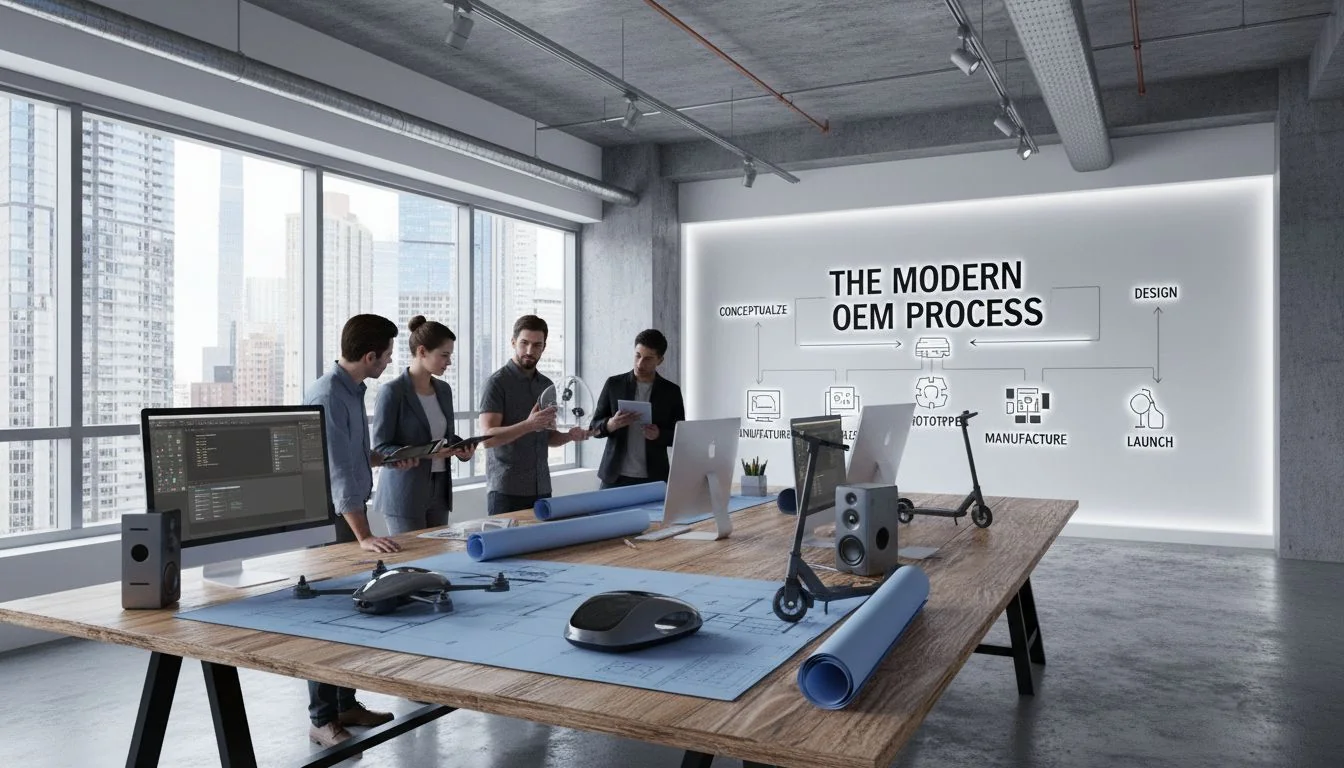
A modern design studio with blueprints and product prototypes.

I've seen too many great ideas die in the "valley of death" of traditional manufacturing. They get bogged down in the technical details, the certifications, the endless back-and-forth. But there is a better way. A smarter way. Let's walk through how a fictional brand, "Aura Wellness," turned their hardware dream into a reality, not a nightmare. This story will show you the new rules for winning in hardware.

Starting a new hardware product from scratch typically takes 6-9 months.Falso

A completely new, certified electronic product often takes 18-24 months or more due to R&D, tooling, and extensive compliance testing.

ETL and CARB certifications can cost over $50,000 and take a year to secure.Verdadero

These certifications involve rigorous testing for safety and emissions. The process is lengthy and expensive, representing a major hurdle for new products.

How Does a Simple Sketch Become a Market-Ready Product?

You have a brilliant design sketch for a new product. But turning that drawing into a physical, sellable item feels like an impossible mountain to climb. Let's meet "Aura Wellness."

A sketch becomes a product by first identifying a core, pre-certified "engine" or platform. This separates the complex internal engineering from the unique external design. This allows the brand to focus on aesthetics and user experience3, while the manufacturing partner handles the proven, compliant core technology.
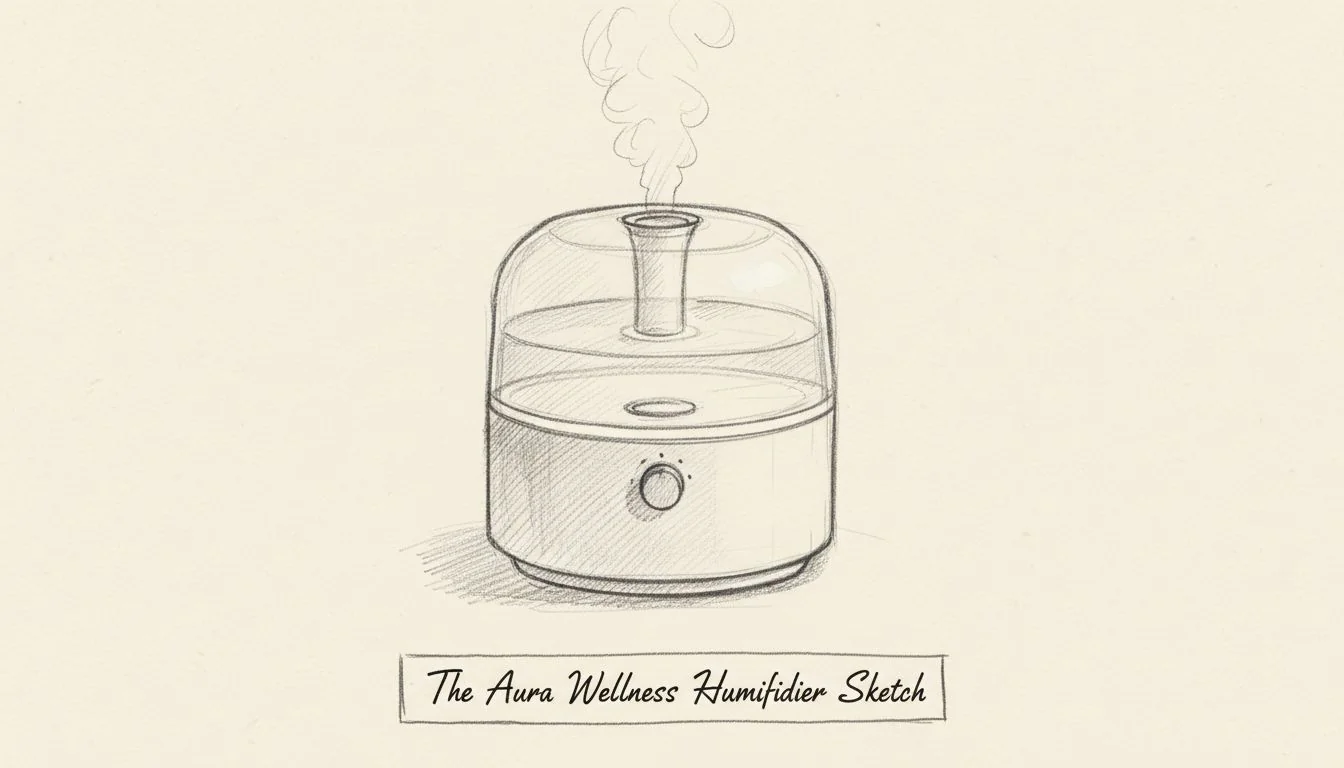
A beautiful hand-drawn sketch of a modern, minimalist humidifier.

Let's imagine our client, "Aura Wellness." They are a direct-to-consumer (D2C) brand focused on home wellness. They have a strong brand identity and a loyal following, but no hardware experience. Their dream was a premium, stainless steel humidifier that looked like a piece of art.

The Initial "Sketch"

Aura came to us with a beautiful concept. It was a sleek, minimalist cylinder with a unique wood-grain finish. They knew exactly what they wanted it to look like and how they wanted their customers to feel when using it.

The Common Pitfall

The traditional path would be to start from zero. This means designing the electronics, the water tank, the ultrasonic nebulizer, everything. This is the "OEM Nightmare." It involves:

Traditional OEM Step Estimated Time Estimated Cost
R&D and Prototyping 6-9 meses $50,000+
Mold & Tooling 3-4 months $30,000+
Compliance (ETL/CARB) 12+ months $50,000 - $100,000
Total ~2 years ~$150,000+

Aura, like most D2C brands, couldn't afford to wait two years or risk that much capital. They needed a smarter path.

Most D2C brands have in-house hardware engineering teams.Falso

Many D2C brands excel at marketing and branding but lack the specialized engineering expertise for hardware development, making partnership essential.

A product's external design is often what drives the initial purchase decision for consumers.Verdadero

In a crowded market, visual appeal and design are key differentiators that attract customers and communicate brand value.

What is the "Platform Co-Development" Model?

Traditional OEM is too slow, expensive, and risky for your new product. You risk burning through your budget and missing your market window4. The "Smart OEM" strategy changes the game.

Platform Co-Development is a partnership model. We provide a pre-engineered, pre-certified "accelerator platform"—the core technology. You, the brand, then co-develop a unique external shell and user experience on top of this proven foundation. It's collaboration, not just supply.
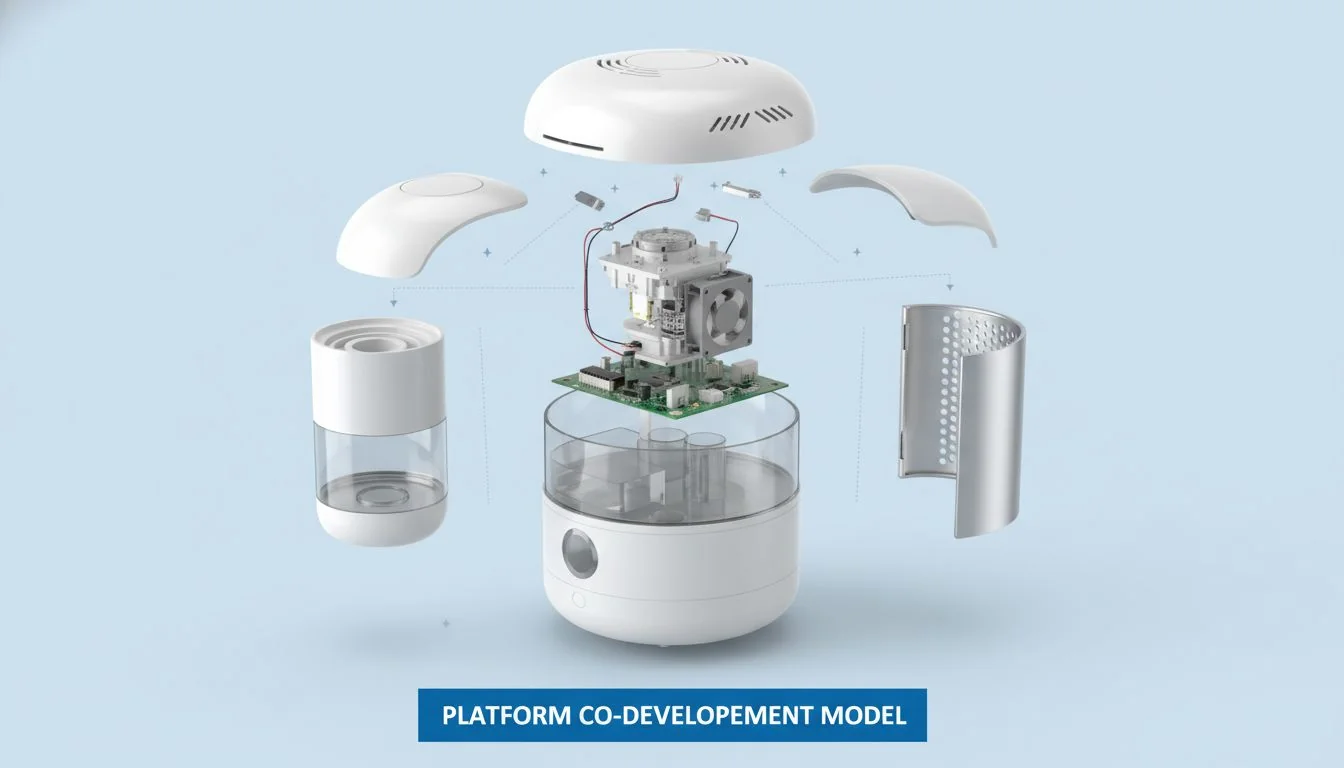
Exploded view of a humidifier showing the internal core platform and the external design shell.

I always tell my clients to stop thinking of us as a simple supplier. We are a Co-Development Partner. The key to this relationship is our "Accelerator Platform." In the case of Aura's humidifier, our platform is a high-performance, stainless steel humidifier engine.

The "Chassis" and the "Car"

Think of it like building a custom car. You wouldn't start by inventing a new engine and transmission. You'd start with a proven, high-performance chassis.

  • Our Accelerator Platform (The Chassis): This is the core. It includes the stainless steel tank, the ultrasonic unit, the power supply, and all the electronics. Crucially, this entire platform is already ETL and CARB certified.
  • Your Unique Product (The Car Body): This is where the brand's vision comes to life. Aura designed their unique outer shell, chose their custom wood-grain finish, and designed the packaging and user experience.

This model redefines "OEM." It's not about us making your product from scratch. It's about us co-developing your product on our proven platform. This shifts the focus from risky R&D to creative design and speed to market.

Platform-based development is a new concept invented in the 2020s.Falso

This model has been used in the automotive and computer industries for decades. Think of how many different car models are built on a single shared platform.

Using a pre-certified platform bypasses the need for the final product to be certified.Falso

While the core is certified, the final assembled product still requires some level of verification. However, the process is vastly simplified, faster, and cheaper because the most complex components are already approved.

How Can You Really Launch a Product in Just 6 Months?

The typical 18-24 month product development cycle is a death sentence for agile brands5. Competitors can launch and dominate while you're still stuck in prototyping. A focused sprint is possible.

You launch in 6 months by skipping the 12+ months of core R&D and compliance testing6. With a pre-certified platform, the project immediately jumps to the design and tooling phase for the external shell. This parallel process makes the timeline achievable.
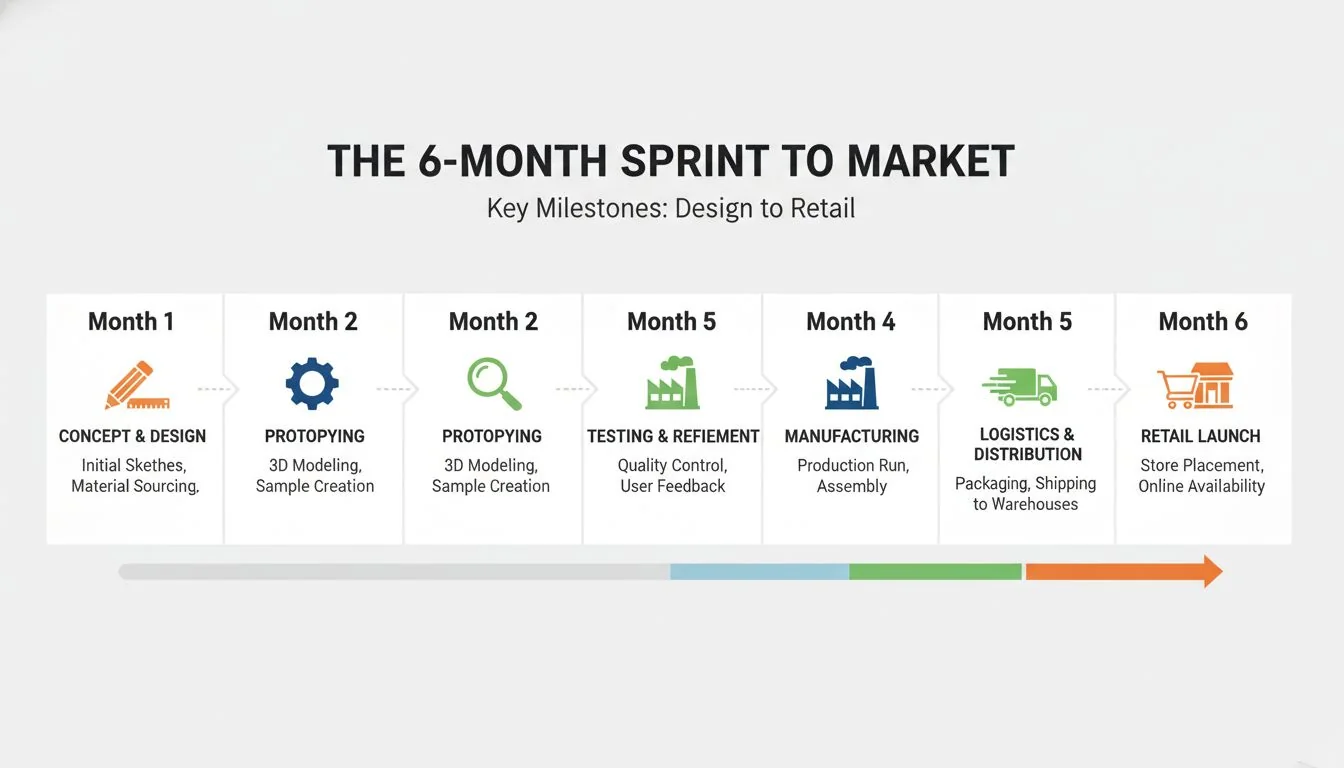
A 6-month timeline graphic showing key milestones from design to retail.

When I told Aura we could go from their sketch to a retail-ready product in six months, they were skeptical. I've been in this business a long time, and I've seen the delays. But the Platform Co-Development model changes the entire timeline. Here’s how we did it.

The Sprint Breakdown

We broke the project into clear, parallel-pathed phases. The key is that we've already done the hardest part.

Month Aura Wellness (Brand) Focus Moldle (Partner) Focus
1-2 Finalize 3D CAD for the outer shell. Select colors, materials, and finishes. Review CAD for manufacturability (DFM). Begin mold design for the shell.
3-4 Approve mold design. Review first-shot samples (T1). Fabricate the injection molds. Produce T1 samples.
5 Finalize packaging design. Plan marketing launch. Make mold adjustments. Begin pilot production run.
6 Place the first mass production order. Mass production and assembly. Ship final product.

This aggressive timeline is only possible because the 12+ months of electronic engineering and certification for the core platform were already complete before Aura even contacted us. We weaponized compliance and cost to give them an unbeatable advantage.

Design for Manufacturability (DFM) analysis is an optional step to save time.Falso

DFM is a critical step. Skipping it leads to costly mold rework, production delays, and poor product quality. It actually saves time and money in the long run.

The longest phase in traditional hardware development is often compliance and certification.Verdadero

Certifications like FCC, CE, ETL, and CARB require extensive testing and documentation, often creating a bottleneck that can last over a year.

What Does a "Hero Product" Without the "OEM Nightmare" Look Like?

You fear your finished product will be a compromise, plagued by factory errors. The "OEM nightmare" ends with a product that doesn't match your vision. A smart partnership avoids this.

A "hero product7" launched this way is a high-quality, compliant device that perfectly matches the brand's unique design. It gets to market fast, on budget, and without engineering headaches, allowing the brand to focus on what it does best: marketing and selling.
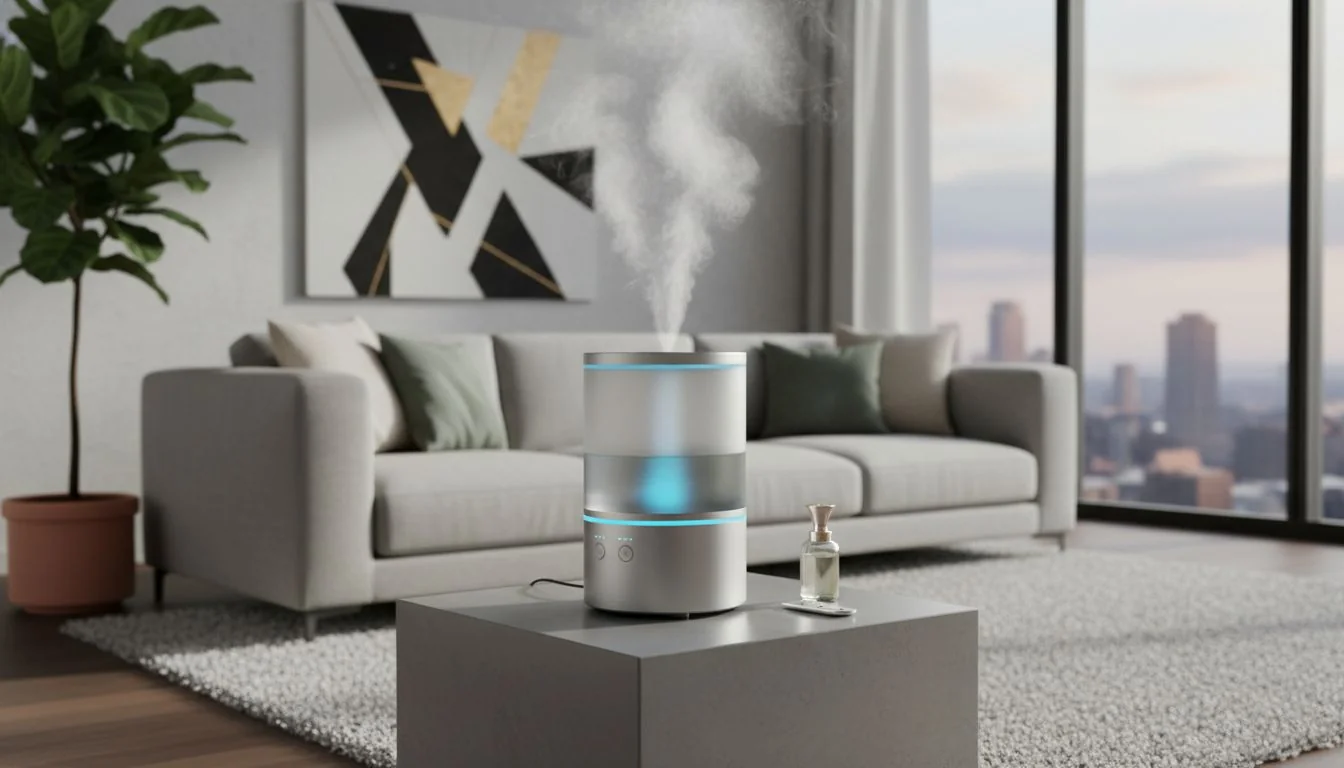
Lifestyle photo of the Aura Wellness humidifier in a stylish, modern living room.

Six months after our first meeting, the "Aura Humidifier" was a reality. It was featured on design blogs and quickly became their top-selling item—a true "hero product."

The Win-Win Outcome

This success wasn't an accident. It was the direct result of the "Smart OEM" strategy. Let's compare the outcome to the traditional path.

  • Velocidad de comercialización: Aura launched in 6 months, capturing the peak winter season. The traditional path would have missed this window by over a year.
  • Budget Control: The project costs were predictable. The biggest variable, R&D and certification, was a fixed, known quantity from day one. They avoided the $50k-$100k certification gamble.
  • Enfoque de marca: Aura's team didn't get bogged down in circuit board design. They focused their energy on creating a beautiful product, a compelling story, and a killer marketing campaign.
  • Reduced Risk: By using a proven, reliable platform, the risk of product failure, recalls, or performance issues was dramatically lowered.

This is what a successful OEM project looks like today. It's not about finding the cheapest supplier. It's about finding a true co-development partner who de-risks the journey.

A 'hero product' is simply a company's best-selling item.Falso

A hero product is more than that. It's an item that strongly defines the brand, attracts new customers, and often has higher profit margins.

Predictable costs are a major advantage of the platform co-development model.Verdadero

By eliminating the unpredictable R&D and certification phases, brands can budget far more accurately, reducing financial risk significantly.

Conclusión

Don't start from scratch. The smartest way to bring a hardware product to life is to find a co-development partner with a proven platform and build your dream on it.


References


  1. Learn about the pitfalls of traditional OEM processes and how to avoid them. ↩

  2. Explore how Platform Co-Development can streamline your product launch and reduce risks. ↩

  3. Understand the importance of user experience in creating successful products. ↩

  4. Learn how to identify and capitalize on market windows for product launches. ↩

  5. Explore the strategies that agile brands use to stay competitive in the market. ↩

  6. Find out why compliance testing is crucial for product safety and market readiness. ↩

  7. Learn how a hero product can elevate your brand and drive sales. ↩

Comparte:
fundador de hisoair, sr. lee
Alwen Lee, an air purification expert with over 10 years of experience, is a devoted father of two and a passionate traveler, having explored more than 30 countries. With a love for public speaking and swimming, he has dedicated his life to the indoor air quality industry. His mission is to ensure that people around the world enjoy the freedom to breathe clean air and lead happy, healthy lives.

Envíenos un mensaje

Más que leer

Modern living room with a family enjoying a healthy indoor environment monitored by smart devices, natural lighting, and greenery.

After IFA 2026: The Healthy Home Is Moving Beyond Smart Devices

In our previous IFA 2026 column, Air Purification Is Becoming Part of the Healthy-Home Platform, we argued that the next generation of indoor-health products would ...
Noticias
Modern living room and kitchen with smart home air quality devices including an air purifier, humidifier, and water filtration system, connected with visualized blue connectivity lines.

IFA 2026: Air Purification Is Becoming Part of the Healthy-Home Platform

Pre-IFA Industry Perspective | September 4, 2026 This article is based on official announcements and regulatory information available ahead of IFA 2026, which takes place ...
Noticias
Comparison infographic showcasing the differences between carbon block filter and activated carbon fiber. Detailed diagrams illustrate the hierarchical porous structure of the carbon block with long diffusion paths and the open microporous structure of the activated carbon fiber with direct access for PFAS adsorption.

Carbon Block vs. Activated Carbon Fiber (ACF): Matching Media to Target Contaminants

Two carbon media. Same adsorption chemistry. Very different behaviour in a point-of-use cartridge. If you are specifying a water purifier platform for a PFAS-aware market, ...
Noticias
NSF base listing and ANF private-label certification pathway for OEM water filters

What Is an NSF Master Listing? A Guide to Base Listings, ANF Certification and OEM Water Filters

For a brand preparing to launch an OEM water purifier, one of the most common supplier claims is: “We already have an NSF master listing, ...
News, Water Purifiers
Healthy-home brand team reviewing PFAS water filter certification, test data and product engineering

Entering the Water Category Is Easy. Building a Credible PFAS Claim Is Much Harder

For air purification, appliance and healthy-home brands, entering the water category can look surprisingly easy. A company can select an existing undersink system, customize its ...
Noticias
Team in a business meeting discussing a water filtration system with product components and a comparison table displayed on a screen.

5 Leading OEM Water Purifier Manufacturers in China for Private Label Brands

China has thousands of companies selling water filters, reverse osmosis systems and drinking-water appliances. However, only a portion of them are suitable for private-label, OEM ...
Noticias
Contaminant Engineering•3 min read

PFAS Water Filtration Technologies Explained: Carbon, Resin & RO

Key Takeaway:

PFAS reduction depends on the specific compounds present, treatment media, contact time, water chemistry, and system design. Activated carbon, ion exchange, and Reverse Osmosis address PFAS through different mechanisms.

PFAS are a large family of persistent fluorinated compounds that can occur in drinking-water supplies. Their treatment behavior varies significantly by molecular structure, chain length, functional group, concentration, and the chemistry of the source water.

Granular Activated Carbon (GAC) removes PFAS primarily through adsorption. It is generally more effective for many longer-chain PFAS, while shorter-chain compounds tend to break through more quickly. Carbon performance depends on media properties, Empty Bed Contact Time (EBCT), competing organic matter, loading, and replacement frequency.

Ion-exchange resins use charged functional sites to capture many PFAS compounds. Properly selected anion-exchange media can provide high capacity and may perform better than conventional activated carbon for some shorter-chain PFAS, although performance still depends on water chemistry and competing ions.

Reverse Osmosis (RO) uses membrane separation rather than adsorption. Properly designed RO systems can provide broad reduction across many PFAS compounds as well as dissolved salts and other contaminants. Unlike carbon or resin, however, RO also produces a concentrate stream that must be managed.

No single technology should be selected from a PFAS label alone. System design should consider which PFAS compounds are present, their concentrations, required reduction targets, flow rate, media life, and the applicable third-party certification or validation requirements.

HisoAir Water Technical Series
Product Discovery•3 min read

How to Choose an Under-Sink Water Purifier for Modern Kitchens

Key Takeaway:

Match the treatment technology to your water quality first, then evaluate cabinet space, faucet configuration, flow rate, drain and power requirements, and filter replacement needs.

Choosing an under-sink water purifier starts with water chemistry. Carbon filtration is well suited to chlorine, taste, odor, and many organic contaminants, while Reverse Osmosis is more appropriate when dissolved salts, fluoride, nitrates, or broader dissolved contaminants need to be reduced.

For compact kitchens, tankless RO systems eliminate the conventional storage tank and can significantly reduce the space required under the sink. However, membrane capacity stated in GPD does not directly equal faucet flow. When comparing systems, check the actual dispensing flow rate, inlet-pressure requirement, recovery ratio, and whether a booster pump is required.

Installation architecture also matters. Many RO systems require a drain connection, electrical power, and either a dedicated drinking-water faucet or a compatible multi-function faucet. High-flow carbon systems can often connect directly to the existing cold-water line with a simpler installation, but pressure drop and available faucet flow should still be verified.

RO also removes much of the naturally occurring dissolved mineral content. Where taste or mineral balance is a priority, a post-RO remineralization stage can be added. Filter life should be evaluated by both rated capacity and local water quality rather than replacement time alone.

The right system is therefore not simply the smallest or highest-GPD model. It is the configuration that matches the target contaminants, available cabinet space, desired faucet setup, peak dispensing demand, and maintenance expectations.

HisoAir Water Technical Series
Water Quality•2 min read

What Does TDS Mean in Drinking Water? Measurement vs Contaminant Reality

Key Takeaway:

A TDS meter estimates the overall concentration of dissolved ionic substances from electrical conductivity. It cannot identify specific contaminants or determine whether water is chemically safe.

Total Dissolved Solids (TDS) refers to the combined concentration of dissolved substances in water. Most handheld TDS meters do not measure TDS directly. Instead, they measure electrical conductivity (EC) and convert that reading into an estimated parts-per-million (ppm) value.

This means a TDS reading can indicate how much dissolved ionic material is present, but not what that material actually is. Calcium, magnesium, sodium, nitrates, and other dissolved ions can all contribute to conductivity, yet a simple TDS meter cannot distinguish between them.

TDS meters are also not suitable for detecting trace contaminants such as PFAS, many VOCs, pesticides, pharmaceuticals, or disinfection byproducts. These substances may be present at concentrations far below the level needed to noticeably change electrical conductivity.

A low TDS reading therefore does not guarantee safe drinking water, and a higher TDS reading does not automatically indicate contamination. Water-treatment decisions should be based on laboratory testing for specific contaminants of concern rather than TDS alone.

HisoAir Water Technical Series
Technology Selection•2 min read

RO vs UF Water Filtration: Understanding Pore Sizes & Dissolved Minerals

Key Takeaway:

Ultrafiltration can reduce bacteria, turbidity, and suspended particles while retaining most naturally occurring dissolved minerals. Reverse Osmosis provides much broader reduction of dissolved salts and smaller contaminants.

Ultrafiltration (UF) typically uses hollow-fiber membranes with pore sizes in the approximate 0.01–0.1 micron range. These membranes physically retain turbidity, suspended solids, colloids, and many microorganisms while allowing dissolved minerals and salts to remain in the water.

Reverse Osmosis (RO) operates at a much finer separation level. Unlike UF, RO can substantially reduce dissolved ions such as sodium, calcium, fluoride, nitrates, and other contributors to total dissolved solids (TDS). This makes RO more suitable when dissolved-salt reduction is a primary treatment objective.

UF generally requires less system pressure and produces little or no continuous concentrate stream in many point-of-use configurations. RO typically requires greater pressure and produces a reject-water stream, but delivers broader contaminant reduction.

For water with acceptable TDS and mineral content, UF can be a simpler mineral-retaining treatment option. Where dissolved salts, fluoride, nitrates, or broader dissolved contaminants are a concern, RO is generally the more appropriate technology.

HisoAir Water Technical Series
Technology Selection•4 min read

Carbon Block vs Reverse Osmosis: Which Fits Your Need?

Key Takeaway:

Choose RO for dissolved inorganic salts and heavy metals; choose Carbon Block for chemical taste/odor, no wastewater, and high line-pressure flow.

Reverse Osmosis (RO) and Carbon Block filtration represent two fundamentally different treatment methods: membrane separation and adsorption. Understanding these differences helps determine which technology is better suited to a specific water-quality requirement.

Reverse Osmosis uses a semi-permeable membrane with pore sizes of approximately 0.0001 microns. It can significantly reduce dissolved inorganic contaminants such as TDS, fluoride, nitrates, and certain heavy metals. Because water must be forced through the membrane, RO systems require sufficient pressure or a booster pump and generate a concentrated wastewater stream.

Carbon Block filtration relies primarily on adsorption through compressed activated carbon, commonly with nominal pore sizes around 0.5–5 microns. It is highly effective for chlorine, chloramines, VOCs, taste, and odor, while allowing substantially higher direct-flow rates without producing wastewater.

From an operating perspective, Carbon Block systems are generally simpler, require less energy, and avoid the water loss associated with RO. RO involves higher system complexity and operating cost, but provides substantially broader reduction of dissolved contaminants that Carbon Block alone cannot address.

HisoAir Water Technical Series

SOLICITAR PRESUPUESTO



















