Se abre en una pestaña nueva
Soluciones innovadoras para la calidad del aire

Where Are MUJI Aroma Diffusers Manufactured?

Related Products

MUJI Aroma Diffusers are celebrated for their minimalist design and calming presence, but where do these iconic products truly come from? The answer to this question reveals a sophisticated global production system and a deliberate business strategy that has propelled MUJI to international acclaim. This article delves into the manufacturing and supply chain strategy of MUJI Aroma Diffusers, revealing their production in China as a result of MUJI's sophisticated global production system and asset-light business model. We will explore the evidence confirming their manufacturing locus, the principles that guide their production, and the ethical framework that underpins their entire supply chain. For businesses in the home appliance and wellness sectors, understanding MUJI's approach offers valuable insights into effective global supply chain management and brand building.

Where is the MUJI Aroma Diffuser Manufactured?

For consumers and businesses alike, a fundamental question often arises regarding the origin of popular products: where are MUJI Aroma Diffusers manufactured? The answer, consistently and explicitly identified across multiple international markets and for various models, is China. This fact is not merely anecdotal but is confirmed through official product pages on MUJI’s regional websites, third-party retail listings, and information contained within product user manuals. The consistency of this data across different sources and product variations provides irrefutable evidence of the primary manufacturing location for this product category. MUJI Aroma Diffusers are consistently manufactured in China, a fact confirmed across various official product documentations and retail listings.

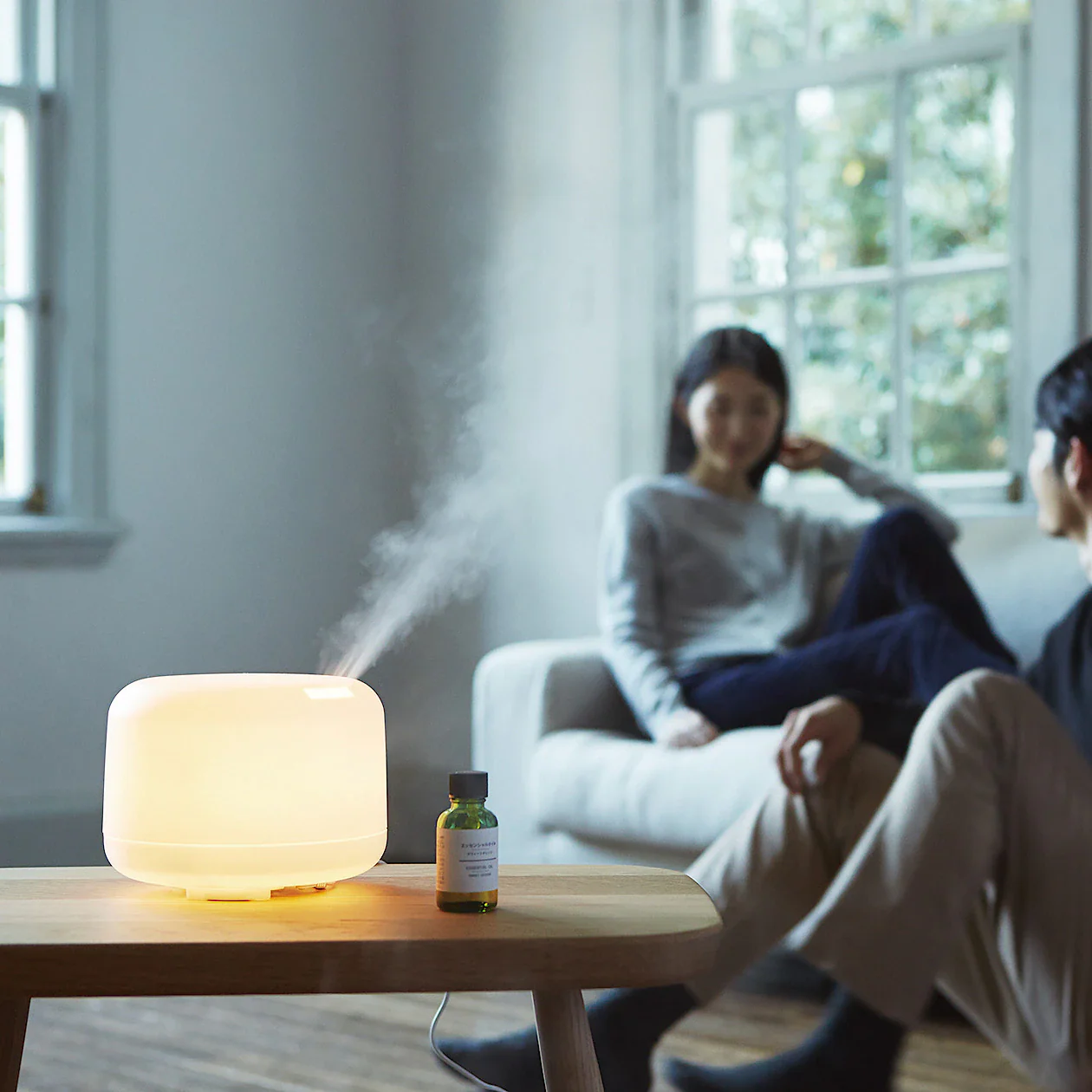
To further understand this choice, it's crucial to examine the materials specified for the Aroma Diffuser’s construction:

Componente Material Reason for Use
Main Body Polypropylene (PP) Resin Chemical resistance, durability, heat resistance
AC Adapter Acrylonitrile Butadiene Styrene (ABS) Resin Rigidity, impact strength, high-quality surface finish

These are not arbitrary choices; PP and ABS are high-grade thermoplastic polymers that are industry standards for consumer electronics and household appliances. The decision to manufacture the diffuser there is therefore a decision to tap into a mature supply chain with deep expertise, immense scale, and cost efficiencies in producing high-quality goods from these exact materials. It is a choice driven by industrial capability as much as by cost.
aroma diffuser large 2

How Does MUJI's "No-Factory" Model Influence Production?

The decision to manufacture the Aroma Diffuser in China is not an isolated choice but a direct consequence of the fundamental production doctrine of its parent company, Ryohin Keikaku. Understanding this corporate-level strategy is essential to comprehending the logic behind the location of any single MUJI product. The most critical element of Ryohin Keikaku’s operational model is that the company does not own any of its own production plants or manufacturing facilities. All products bearing the MUJI brand are produced by a global network of external contract manufacturers. MUJI operates on an "asset-light" or "fabless" model, outsourcing manufacturing to a global network of specialized contract partners, which allows for operational flexibility and reduced capital expenditure.

This model confers several significant advantages:

  • Operational Flexibility: Allows the company to select manufacturing partners based on specific expertise
  • Reduced Capital Expenditure: Avoids cost of building and maintaining factories
  • Risk Mitigation: Enables agile response to shifting market demands and disruptions

In essence, Ryohin Keikaku functions as the central nervous system of a vast production body, directing design and quality standards while outsourcing the physical manufacturing to specialized partners who can execute its vision most effectively.
aroma diffuser large 4

What Are MUJI's Core Manufacturing Principles and Their Impact?

The foundation of MUJI’s product development and manufacturing management rests on three unwavering principles, established at the brand’s inception in 1980:

  1. Selection of Materials
  2. Streamlining of Processes
  3. Simplification of Packaging

MUJI's manufacturing is guided by these three principles—selection of materials, streamlining of processes, and simplification of packaging—which ensure quality and consistency across its decentralized global supply chain.

  • Selection of Materials: Focuses on high-quality, functional, cost-effective materials sourced globally. The use of PP and ABS resins for the Aroma Diffuser exemplifies this.
  • Streamlining of Processes: Eliminates unnecessary steps in production. The minimalist diffuser design avoids complex molding and finishes, optimizing efficiency.
  • Simplification of Packaging: Prioritizes essential function and environmental sustainability. MUJI uses plain, often recycled, materials for packaging.

These principles act as an internal control mechanism that supports the asset-light model by creating a universal "manufacturing language" for replication and quality control.
aroma diffuser large

How Does MUJI Ensure Ethical Governance in its Supply Chain?

Ryohin Keikaku’s relationship with its contract manufacturers is governed by a robust and comprehensive framework of ethical standards, monitoring systems, and overarching sustainability commitments. At the heart of MUJI’s supply chain governance is the "Code of Conduct for Production Partners of Ryohin Keikaku." This is a mandatory condition of doing business with the company.

MUJI enforces a stringent Code of Conduct based on international human rights and labor standards, monitored through independent third-party audits, to ensure ethical manufacturing practices.

Key governance features include:

  • Foundations: Based on ILO Declaration, UN Global Compact, and UN Guiding Principles on Business and Human Rights
  • Prohibitions: Strict bans on child labor, forced labor, and discrimination
  • Monitoring: Conducted via independent third-party factory audits
  • Enforcement: Business relationships are terminated if violations are confirmed
  • Support Systems: Includes a confidential Supplier Hotline for grievance reporting

These efforts are embedded in MUJI's broader Environmental, Social, and Governance (ESG) strategy:

  • Integration of ESG into business strategy
  • Commitment to a circular, sustainable society
  • Greenhouse gas reduction goals
  • Human rights due diligence

Thus, the selection of a Chinese manufacturing partner is contingent not only on technical and economic criteria but also on their alignment with MUJI's ethical and ESG standards.

aroma diffuser large 3

Conclusión

The MUJI Aroma Diffuser, a product celebrated for its profound simplicity and calming presence, embodies a central paradox: its effortless aesthetic is enabled by a system of immense operational complexity, rigorous ethical governance, and sophisticated global strategy. While factually straightforward in its manufacturing location, the choice of China is a calculated decision by Ryohin Keikaku, driven by the convergence of unparalleled manufacturing ecosystems, scalability, supply chain maturity, alignment with MUJI’s core principles, and the willingness of partners to comply with stringent ethical and ESG requirements. MUJI’s asset-light model, coupled with its three manufacturing principles selection of materials, streamlining of processes, and simplification of packaging allows it to leverage global industrial efficiency while maintaining its brand promise of simple, high-quality, and ethically produced goods. The company’s robust Code of Conduct and broader ESG mandate further ensure that its supply chain operates with integrity and responsibility. For businesses seeking insights into global supply chain management and ethical manufacturing, MUJI’s model offers valuable lessons in how to achieve both efficiency and integrity on a global scale. Its future success will depend on its agility to navigate geopolitical shifts, meet escalating demands for transparency, and continuously elevate the performance of its supply chain against evolving ESG benchmarks.

📩 Interested in Aroma Diffusers or OEM/ODM Solutions?
While we explore MUJI’s global supply chain strategies, HisoAir also specializes in designing and manufacturing high-quality aroma diffusers. If you're looking for reliable OEM/ODM partners or want to learn more about our product capabilities, feel free to Contacto. We’re here to help bring your ideas to life with expertise and care.


Comparte:
fundador de hisoair, sr. lee
Alwen Lee, an air purification expert with over 10 years of experience, is a devoted father of two and a passionate traveler, having explored more than 30 countries. With a love for public speaking and swimming, he has dedicated his life to the indoor air quality industry. His mission is to ensure that people around the world enjoy the freedom to breathe clean air and lead happy, healthy lives.

Envíenos un mensaje

Related Products

Más que leer

Modern living room with a family enjoying a healthy indoor environment monitored by smart devices, natural lighting, and greenery.

After IFA 2026: The Healthy Home Is Moving Beyond Smart Devices

In our previous IFA 2026 column, Air Purification Is Becoming Part of the Healthy-Home Platform, we argued that the next generation of indoor-health products would ...
Noticias
Modern living room and kitchen with smart home air quality devices including an air purifier, humidifier, and water filtration system, connected with visualized blue connectivity lines.

IFA 2026: Air Purification Is Becoming Part of the Healthy-Home Platform

Pre-IFA Industry Perspective | September 4, 2026 This article is based on official announcements and regulatory information available ahead of IFA 2026, which takes place ...
Noticias
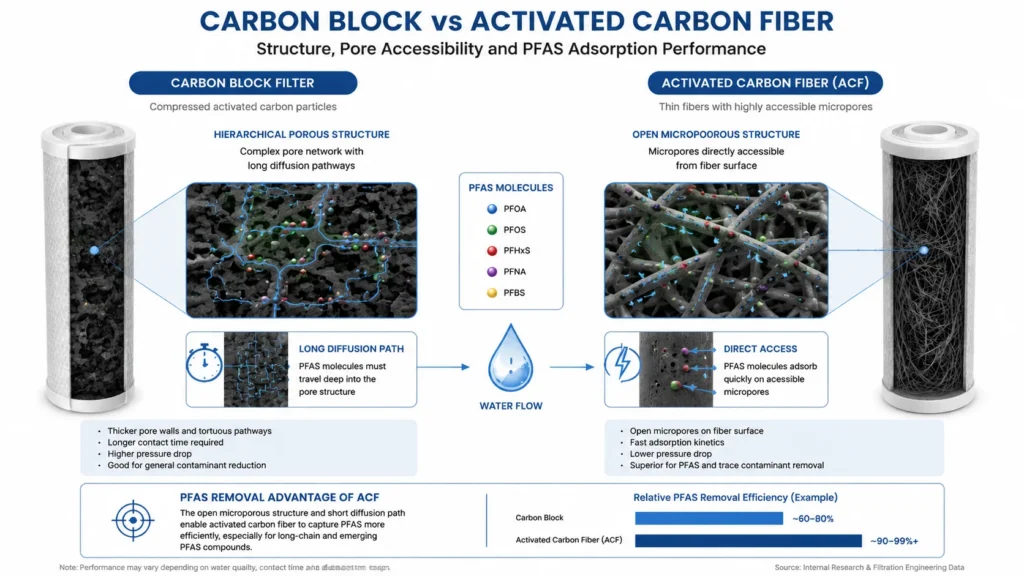
Comparison infographic showcasing the differences between carbon block filter and activated carbon fiber. Detailed diagrams illustrate the hierarchical porous structure of the carbon block with long diffusion paths and the open microporous structure of the activated carbon fiber with direct access for PFAS adsorption.

Carbon Block vs. Activated Carbon Fiber (ACF): Matching Media to Target Contaminants

Two carbon media. Same adsorption chemistry. Very different behaviour in a point-of-use cartridge. If you are specifying a water purifier platform for a PFAS-aware market, ...
Noticias
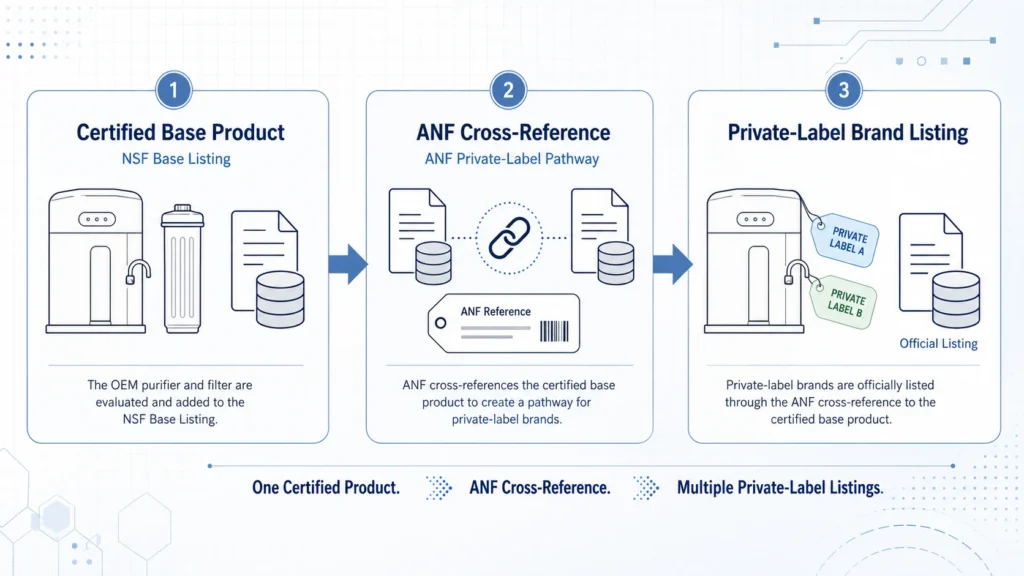
NSF base listing and ANF private-label certification pathway for OEM water filters

What Is an NSF Master Listing? A Guide to Base Listings, ANF Certification and OEM Water Filters

For a brand preparing to launch an OEM water purifier, one of the most common supplier claims is: “We already have an NSF master listing, ...
News, Water Purifiers
Healthy-home brand team reviewing PFAS water filter certification, test data and product engineering

Entering the Water Category Is Easy. Building a Credible PFAS Claim Is Much Harder

For air purification, appliance and healthy-home brands, entering the water category can look surprisingly easy. A company can select an existing undersink system, customize its ...
Noticias
Team in a business meeting discussing a water filtration system with product components and a comparison table displayed on a screen.

5 Leading OEM Water Purifier Manufacturers in China for Private Label Brands

China has thousands of companies selling water filters, reverse osmosis systems and drinking-water appliances. However, only a portion of them are suitable for private-label, OEM ...
Noticias
Contaminant Engineering•3 min read

PFAS Water Filtration Technologies Explained: Carbon, Resin & RO

Key Takeaway:

PFAS reduction depends on the specific compounds present, treatment media, contact time, water chemistry, and system design. Activated carbon, ion exchange, and Reverse Osmosis address PFAS through different mechanisms.

PFAS are a large family of persistent fluorinated compounds that can occur in drinking-water supplies. Their treatment behavior varies significantly by molecular structure, chain length, functional group, concentration, and the chemistry of the source water.

Granular Activated Carbon (GAC) removes PFAS primarily through adsorption. It is generally more effective for many longer-chain PFAS, while shorter-chain compounds tend to break through more quickly. Carbon performance depends on media properties, Empty Bed Contact Time (EBCT), competing organic matter, loading, and replacement frequency.

Ion-exchange resins use charged functional sites to capture many PFAS compounds. Properly selected anion-exchange media can provide high capacity and may perform better than conventional activated carbon for some shorter-chain PFAS, although performance still depends on water chemistry and competing ions.

Reverse Osmosis (RO) uses membrane separation rather than adsorption. Properly designed RO systems can provide broad reduction across many PFAS compounds as well as dissolved salts and other contaminants. Unlike carbon or resin, however, RO also produces a concentrate stream that must be managed.

No single technology should be selected from a PFAS label alone. System design should consider which PFAS compounds are present, their concentrations, required reduction targets, flow rate, media life, and the applicable third-party certification or validation requirements.

HisoAir Water Technical Series
Product Discovery•3 min read

How to Choose an Under-Sink Water Purifier for Modern Kitchens

Key Takeaway:

Match the treatment technology to your water quality first, then evaluate cabinet space, faucet configuration, flow rate, drain and power requirements, and filter replacement needs.

Choosing an under-sink water purifier starts with water chemistry. Carbon filtration is well suited to chlorine, taste, odor, and many organic contaminants, while Reverse Osmosis is more appropriate when dissolved salts, fluoride, nitrates, or broader dissolved contaminants need to be reduced.

For compact kitchens, tankless RO systems eliminate the conventional storage tank and can significantly reduce the space required under the sink. However, membrane capacity stated in GPD does not directly equal faucet flow. When comparing systems, check the actual dispensing flow rate, inlet-pressure requirement, recovery ratio, and whether a booster pump is required.

Installation architecture also matters. Many RO systems require a drain connection, electrical power, and either a dedicated drinking-water faucet or a compatible multi-function faucet. High-flow carbon systems can often connect directly to the existing cold-water line with a simpler installation, but pressure drop and available faucet flow should still be verified.

RO also removes much of the naturally occurring dissolved mineral content. Where taste or mineral balance is a priority, a post-RO remineralization stage can be added. Filter life should be evaluated by both rated capacity and local water quality rather than replacement time alone.

The right system is therefore not simply the smallest or highest-GPD model. It is the configuration that matches the target contaminants, available cabinet space, desired faucet setup, peak dispensing demand, and maintenance expectations.

HisoAir Water Technical Series
Water Quality•2 min read

What Does TDS Mean in Drinking Water? Measurement vs Contaminant Reality

Key Takeaway:

A TDS meter estimates the overall concentration of dissolved ionic substances from electrical conductivity. It cannot identify specific contaminants or determine whether water is chemically safe.

Total Dissolved Solids (TDS) refers to the combined concentration of dissolved substances in water. Most handheld TDS meters do not measure TDS directly. Instead, they measure electrical conductivity (EC) and convert that reading into an estimated parts-per-million (ppm) value.

This means a TDS reading can indicate how much dissolved ionic material is present, but not what that material actually is. Calcium, magnesium, sodium, nitrates, and other dissolved ions can all contribute to conductivity, yet a simple TDS meter cannot distinguish between them.

TDS meters are also not suitable for detecting trace contaminants such as PFAS, many VOCs, pesticides, pharmaceuticals, or disinfection byproducts. These substances may be present at concentrations far below the level needed to noticeably change electrical conductivity.

A low TDS reading therefore does not guarantee safe drinking water, and a higher TDS reading does not automatically indicate contamination. Water-treatment decisions should be based on laboratory testing for specific contaminants of concern rather than TDS alone.

HisoAir Water Technical Series
Technology Selection•2 min read

RO vs UF Water Filtration: Understanding Pore Sizes & Dissolved Minerals

Key Takeaway:

Ultrafiltration can reduce bacteria, turbidity, and suspended particles while retaining most naturally occurring dissolved minerals. Reverse Osmosis provides much broader reduction of dissolved salts and smaller contaminants.

Ultrafiltration (UF) typically uses hollow-fiber membranes with pore sizes in the approximate 0.01–0.1 micron range. These membranes physically retain turbidity, suspended solids, colloids, and many microorganisms while allowing dissolved minerals and salts to remain in the water.

Reverse Osmosis (RO) operates at a much finer separation level. Unlike UF, RO can substantially reduce dissolved ions such as sodium, calcium, fluoride, nitrates, and other contributors to total dissolved solids (TDS). This makes RO more suitable when dissolved-salt reduction is a primary treatment objective.

UF generally requires less system pressure and produces little or no continuous concentrate stream in many point-of-use configurations. RO typically requires greater pressure and produces a reject-water stream, but delivers broader contaminant reduction.

For water with acceptable TDS and mineral content, UF can be a simpler mineral-retaining treatment option. Where dissolved salts, fluoride, nitrates, or broader dissolved contaminants are a concern, RO is generally the more appropriate technology.

HisoAir Water Technical Series
Technology Selection•4 min read

Carbon Block vs Reverse Osmosis: Which Fits Your Need?

Key Takeaway:

Choose RO for dissolved inorganic salts and heavy metals; choose Carbon Block for chemical taste/odor, no wastewater, and high line-pressure flow.

Reverse Osmosis (RO) and Carbon Block filtration represent two fundamentally different treatment methods: membrane separation and adsorption. Understanding these differences helps determine which technology is better suited to a specific water-quality requirement.

Reverse Osmosis uses a semi-permeable membrane with pore sizes of approximately 0.0001 microns. It can significantly reduce dissolved inorganic contaminants such as TDS, fluoride, nitrates, and certain heavy metals. Because water must be forced through the membrane, RO systems require sufficient pressure or a booster pump and generate a concentrated wastewater stream.

Carbon Block filtration relies primarily on adsorption through compressed activated carbon, commonly with nominal pore sizes around 0.5–5 microns. It is highly effective for chlorine, chloramines, VOCs, taste, and odor, while allowing substantially higher direct-flow rates without producing wastewater.

From an operating perspective, Carbon Block systems are generally simpler, require less energy, and avoid the water loss associated with RO. RO involves higher system complexity and operating cost, but provides substantially broader reduction of dissolved contaminants that Carbon Block alone cannot address.

HisoAir Water Technical Series

SOLICITAR PRESUPUESTO