Si apre in una nuova scheda
Soluzioni innovative per la qualità dell'aria

Air Purifier vs Dehumidifier – Which One Does Your Home Really Need?

Related Products

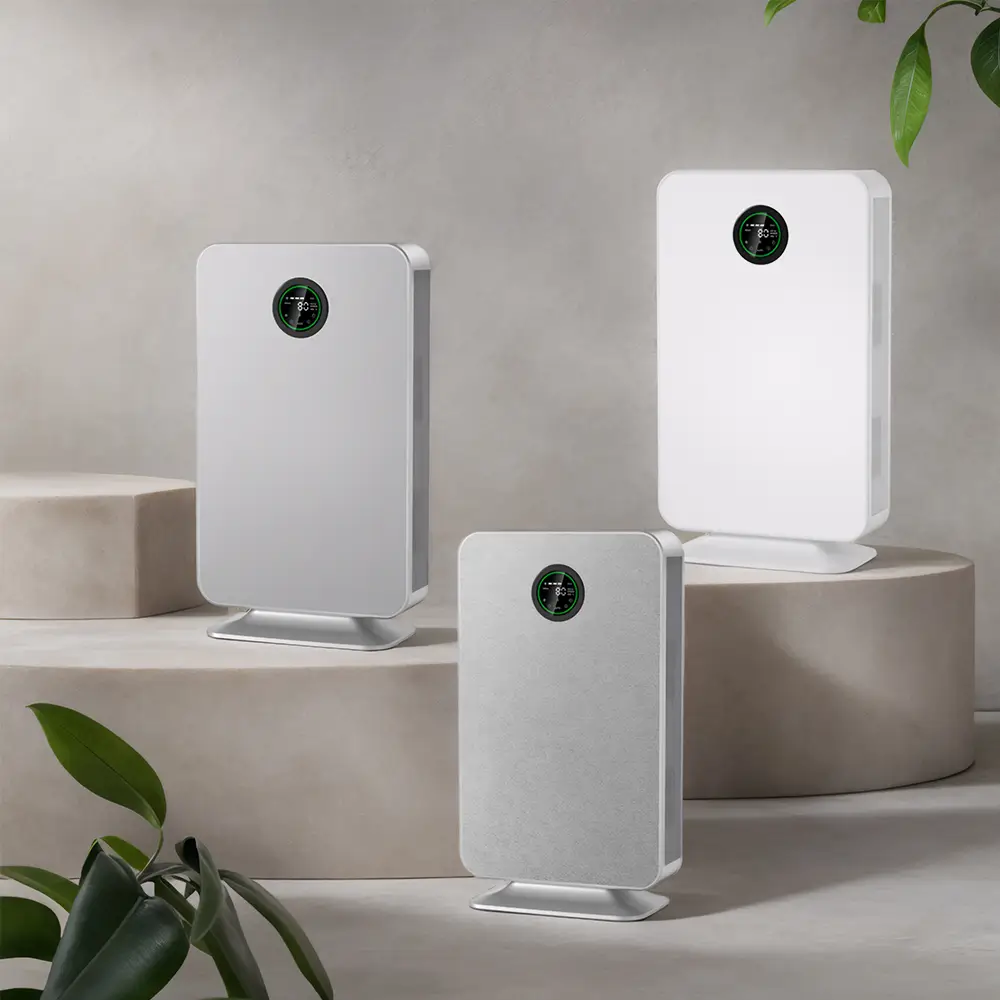
purificatore d'aria a parete ha380 (2)

Stale, dusty air and sticky indoor humidity are two sides of the same problem: poor indoor air quality. An purificatore d'aria e un deumidificatore both promise relief, but they solve very different issues. Below is a practical, no-nonsense guide that compares the two appliances head-to-head so you can decide which makes more sense for your space—or whether running both is the smartest move.

1. How They Work

ApplianceCore FunctionHow It WorksImpact on Humidity
Purificatore d'ariaRemoves airborne pollutants (dust, pollen, smoke, pet dander, viruses).A fan draws air through filters (usually a pre-filter, a HEPA filter, and sometimes activated carbon or UV/ion modules).None. It cleans the air but does not change moisture levels.
DeumidificatoreRemoves excess moisture to prevent dampness, mold, and musty odours.Warm coils condense water vapour into liquid, which drips into a tank or out a drain hose; the dried air is reheated and blown back into the room.Lowers relative humidity, typically aiming for 40–60 %.

2. Key Benefits at a Glance

Purificatore d'aria

  • Captures particles down to 0.3 µm (true HEPA) – pollen, fine dust, wildfire smoke.
  • Reduces allergy and asthma triggers.
  • Activated-carbon stages neutralise odours and many volatile organic compounds (VOCs).
  • Helpful year-round and in any climate.

Deumidificatore

  • Stops mold and dust-mite growth by keeping RH under ~60 %.
  • Eliminates that clammy, “tropical” feeling in summer.
  • Protects furniture, books, instruments, and electronics from moisture damage.
  • Helps laundry dry faster indoors and prevents window condensation in winter.

hv600 banner 一修

3. Air Purifier vs Dehumidifier: Typical Use Cases & Best Scenarios

ScenarioBetter ChoicePerché
Seasonal allergies, pet dander, wildfire smokePurificatore d'ariaRemoves microscopic particles you would otherwise breathe.
Damp basement, visible mold, “wet” smellDeumidificatoreMold spores need moisture ≥ 60 % RH to thrive.
Newly painted room or new furniture off-gassing VOCsPurificatore d'aria (with carbon)Carbon adsorbs chemical vapours; humidity control alone will not.
High-humidity climate (tropical / monsoon) causing constant clamminessDeumidificatoreDirectly lowers RH; purifier can’t do this.
Someone in household has both dust allergies e recurrent mold problemsBothEach tackles a separate trigger—run them in different corners of the room.

4. Maintenance Requirements

TaskPurificatore d'ariaDeumidificatore
Filter / tank careReplace HEPA 6–12 mo; carbon 3–6 mo (depends on pollution).Empty and rinse bucket daily o attach drain hose; clean evaporator coils quarterly.
Energy use20 – 60 W on low; 80 – 120 W on high (room models).200 – 800 W depending on size and ambient RH/temperature.
Rumore30–60 dB (fan hum).35–55 dB (fan + compressor buzz).
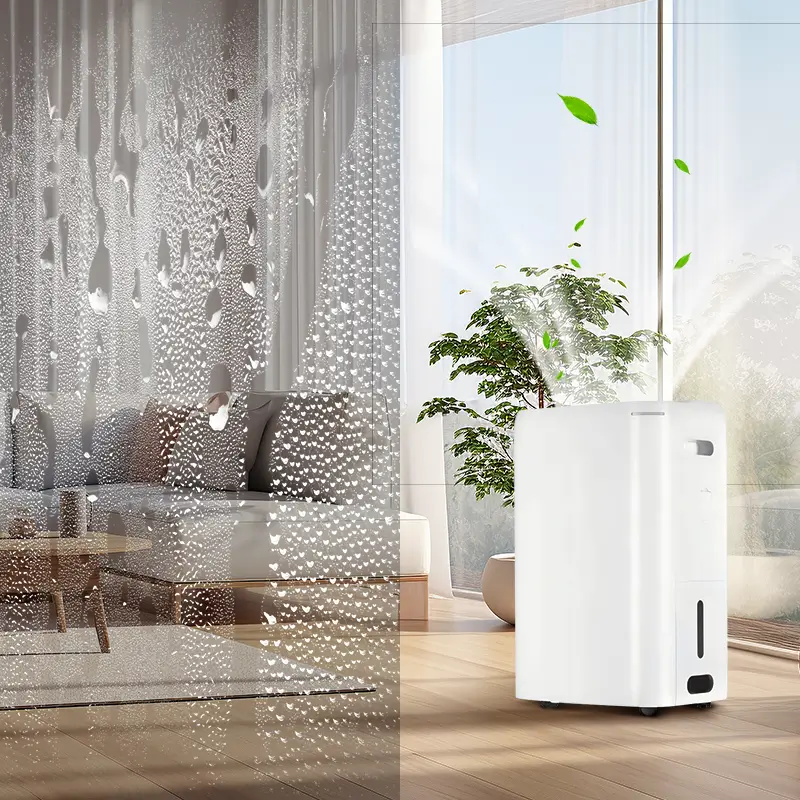
deumidificatore ad alte prestazioni dm a212

5. Ideal Humidity Targets

  • Too damp (> 60 % RH): bacteria, mold, dust mites explode; paper warps, electronics corrode.
  • Too dry (< 30 % RH): static shocks, cracked skin, sore throats—this is where a umidificatore (not dehumidifier) would help.
  • Sweet spot: 40 – 50 % RH for comfort e reduced pathogen survival.

An air purifier helps regardless of RH, while a dehumidifier is only useful when levels are high.

6. Lifespan

Well-cared-for purifiers and dehumidifiers last 8 – 12 years; compressors in dehumidifiers can reach 15 years if kept clean and drained.

7. Health Questions People Ask

Health ConcernWhat Helps MostNotes
Seasonal allergies & asthmaPurificatore d'ariaHEPA removes pollen and dust; keeping RH < 50 % with a dehumidifier also cuts dust-mite load.
Mold-related allergiesDeumidificatore (plus purifier to trap spores)Without drying the air, spores keep germinating.
COVID-19 & other airborne virusesPurificatore d'ariaCDC and WHO recommend HEPA filtration + ventilation; humidity control does not remove viruses.
Eczema aggravated by sweat & moldDeumidificatoreDrier rooms reduce itching; purifier tackles mold spores.
Chronic sinus congestion in humid climatesDeumidificatoreExcess moisture thickens mucus. (In dry climates, a umidificatore would help instead.)
ha m800d

8. Thinking of Combining Both? — Meet HisoAir’s 2-in-1 Line

Traditional advice says “buy two boxes.” HisoAir shrinks that to one sleek chassis with the DM-A216 e DM-A212 purifier-dehumidifier combos.

ModelloBest ForDehumid. CapacityHEPA GradeTankRumoreSmart Extras
DM-A216Basements, large living areas16 L/day (30 °C / 80 % RH) H115 L + hose< 50 dB PM2.5 sensor, Child-lock, Red-Dot-Award design, optional Tuya Wi-Fi
DM-A212Bedrooms, apartments12 L/day (27 °C / 60 % RH) H113.7 L + hose< 48 dB PM2.5 sensor, Inner-Dry mould prevention, optional Tuya Wi-Fi

*Industry-standard test conditions.

Why a combo often wins

  1. One footprint, one plug—free up floor space.
  2. Unified sensors—HisoAir’s integrated PM2.5 + RH array auto-balances filtration e drying.
  3. Lower total wattage—shared fan streamlines airflow instead of running two separate motors/compressors.
  4. Simpler upkeep—swap a single HEPA filter and empty one tank (or connect one drain hose).
  5. Cleaner aesthetics—no jumble of boxes and cords.

9. Placement & Maintenance Tips for Combos

  • Leave 20 cm clearance around vents for best CADR and drying rate.
  • Auto-mode: let onboard sensors manage fan/compressor speed minute-by-minute.
  • Replace the H11 filter every 6–12 months; a clogged filter throttles both air flow and dehumidification.
  • If humidity stays high all year, attach the continuous-drain hose to skip bucket runs.
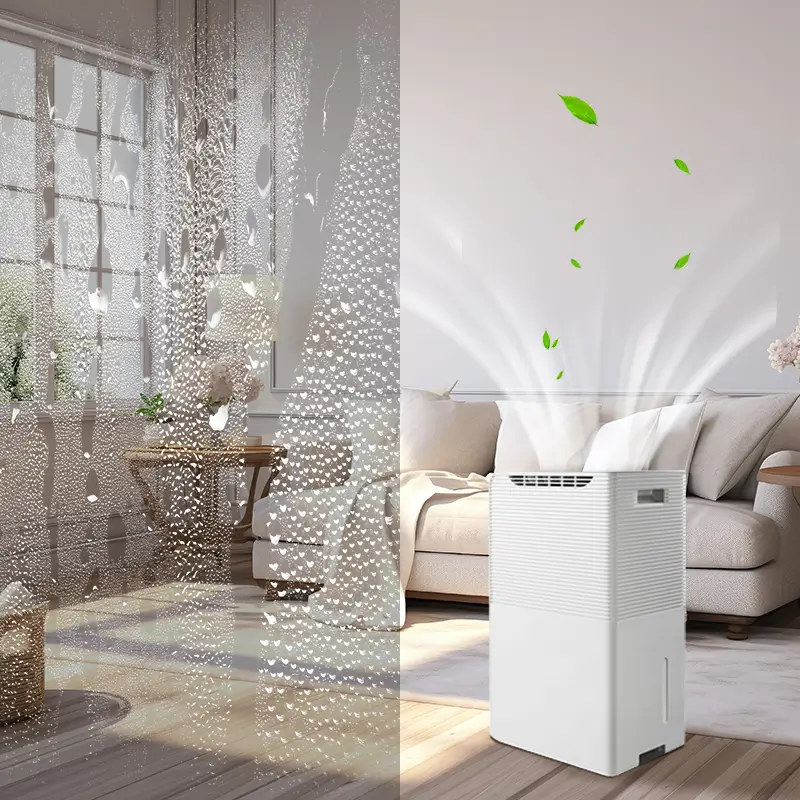
deumidificatore ad alta capacità dm a216

10. Decision Cheat-Sheet

Main ComplaintStart With…HisoAir Option
Allergies, smoke, odours onlyStand-alone air purifier-
Musty smell, visible mould onlyStand-alone dehumidifier-
Both issues e limited space/outlets2-in-1 comboDM-A212 (< 35 m²) or DM-A216 (> 35 m²)

11. Conclusion

  • Purificatori d'aria are particle specialists—vital for allergy, asthma, and smoke relief.
  • Deumidificatori are moisture managers—essential wherever RH creeps above 60 %.
  • HisoAir’s DM-A216 and DM-A212 wrap both jobs into a single, sensor-driven unit, trimming energy use and floor-space while keeping indoor air cleaner e drier all year round.

If your home battles both pollutants and humidity, the combo approach—especially one built on HisoAir’s medical-grade filtration heritage—may be the smartest indoor-air upgrade you make this year.

Condividi:
il fondatore di hisoair, il signor lee
Alwen Lee, an air purification expert with over 10 years of experience, is a devoted father of two and a passionate traveler, having explored more than 30 countries. With a love for public speaking and swimming, he has dedicated his life to the indoor air quality industry. His mission is to ensure that people around the world enjoy the freedom to breathe clean air and lead happy, healthy lives.

Inviaci un messaggio

Related Products

Altro da leggere

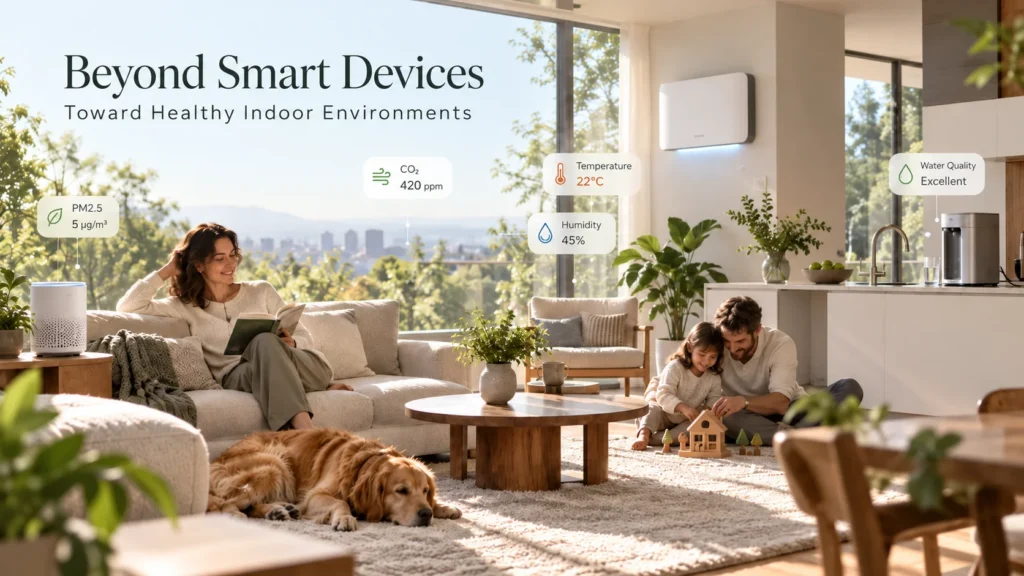
Modern living room with a family enjoying a healthy indoor environment monitored by smart devices, natural lighting, and greenery.

After IFA 2026: The Healthy Home Is Moving Beyond Smart Devices

In our previous IFA 2026 column, Air Purification Is Becoming Part of the Healthy-Home Platform, we argued that the next generation of indoor-health products would ...
Notizie
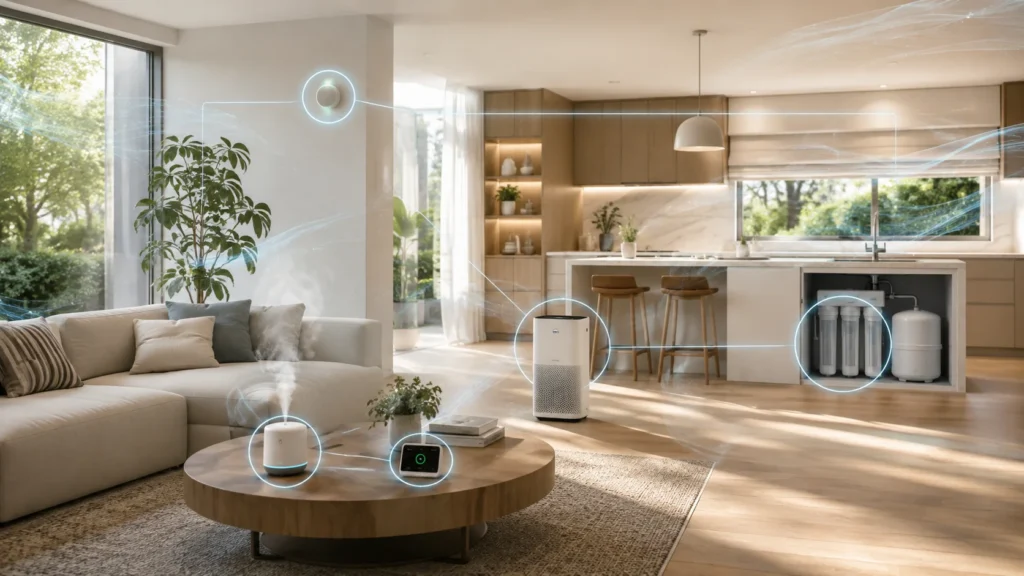
Modern living room and kitchen with smart home air quality devices including an air purifier, humidifier, and water filtration system, connected with visualized blue connectivity lines.

IFA 2026: Air Purification Is Becoming Part of the Healthy-Home Platform

Pre-IFA Industry Perspective | September 4, 2026 This article is based on official announcements and regulatory information available ahead of IFA 2026, which takes place ...
Notizie
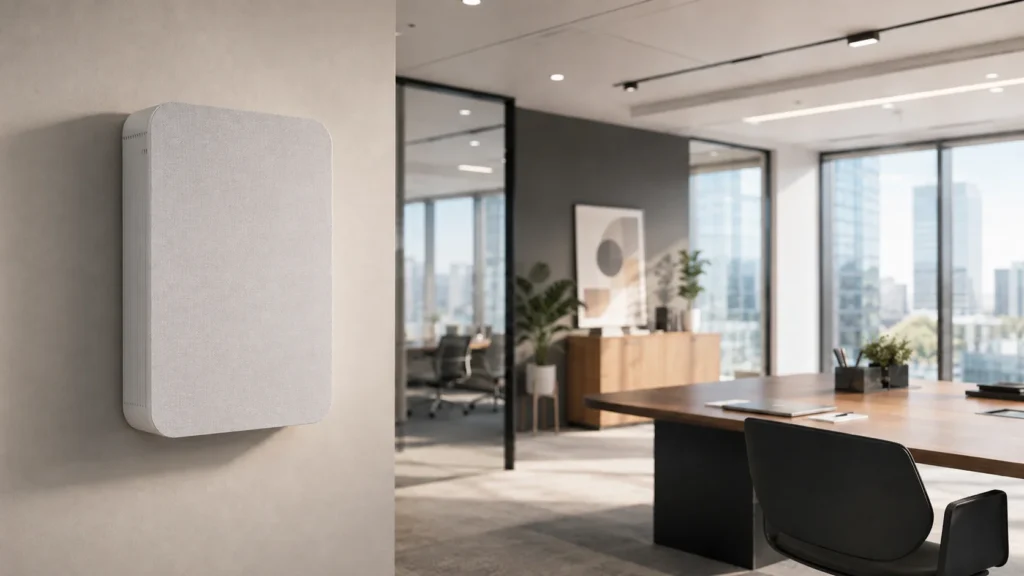
A modern office room with a gray wall-mounted air purifier, large wooden desk, office chairs, indoor plants, and glass windows offering a city view.

Luftreiniger gegen Staub: HEPA-Luftreinigung für Büro, Gewerbe und Industrie

Kurz gesagt: Ein Luftreiniger entfernt Staub aus der Luft – nicht vom Schreibtisch. Er reduziert die Konzentration schwebender Partikel und damit auch die Menge an ...
Air purifier, Filter
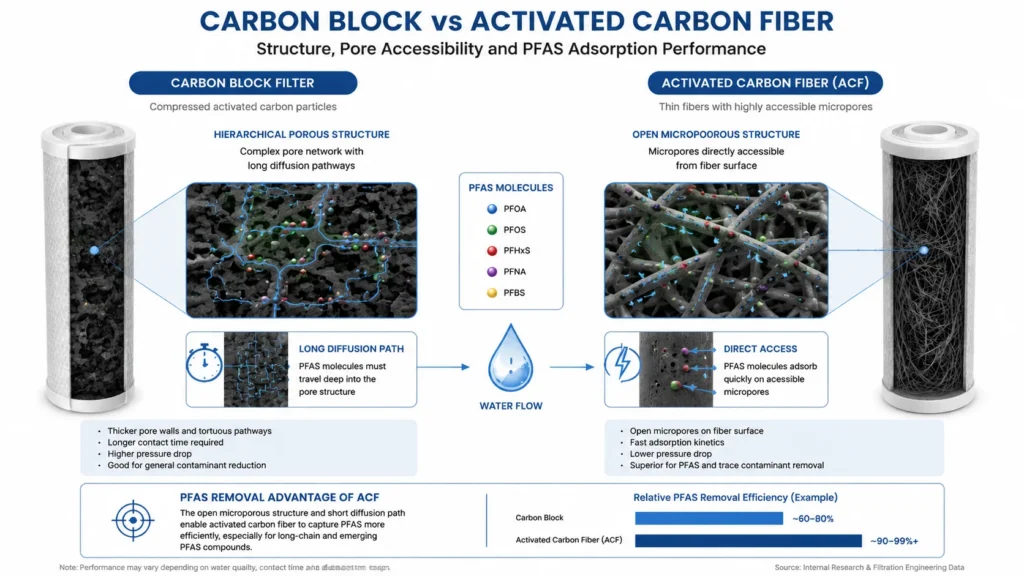
Comparison infographic showcasing the differences between carbon block filter and activated carbon fiber. Detailed diagrams illustrate the hierarchical porous structure of the carbon block with long diffusion paths and the open microporous structure of the activated carbon fiber with direct access for PFAS adsorption.

Carbon Block vs. Activated Carbon Fiber (ACF): Matching Media to Target Contaminants

Two carbon media. Same adsorption chemistry. Very different behaviour in a point-of-use cartridge. If you are specifying a water purifier platform for a PFAS-aware market, ...
Notizie
NSF base listing and ANF private-label certification pathway for OEM water filters

What Is an NSF Master Listing? A Guide to Base Listings, ANF Certification and OEM Water Filters

For a brand preparing to launch an OEM water purifier, one of the most common supplier claims is: “We already have an NSF master listing, ...
News, Water Purifiers
Healthy-home brand team reviewing PFAS water filter certification, test data and product engineering

Entering the Water Category Is Easy. Building a Credible PFAS Claim Is Much Harder

For air purification, appliance and healthy-home brands, entering the water category can look surprisingly easy. A company can select an existing undersink system, customize its ...
Notizie
Contaminant Engineering•3 min read

PFAS Water Filtration Technologies Explained: Carbon, Resin & RO

Key Takeaway:

PFAS reduction depends on the specific compounds present, treatment media, contact time, water chemistry, and system design. Activated carbon, ion exchange, and Reverse Osmosis address PFAS through different mechanisms.

PFAS are a large family of persistent fluorinated compounds that can occur in drinking-water supplies. Their treatment behavior varies significantly by molecular structure, chain length, functional group, concentration, and the chemistry of the source water.

Granular Activated Carbon (GAC) removes PFAS primarily through adsorption. It is generally more effective for many longer-chain PFAS, while shorter-chain compounds tend to break through more quickly. Carbon performance depends on media properties, Empty Bed Contact Time (EBCT), competing organic matter, loading, and replacement frequency.

Ion-exchange resins use charged functional sites to capture many PFAS compounds. Properly selected anion-exchange media can provide high capacity and may perform better than conventional activated carbon for some shorter-chain PFAS, although performance still depends on water chemistry and competing ions.

Reverse Osmosis (RO) uses membrane separation rather than adsorption. Properly designed RO systems can provide broad reduction across many PFAS compounds as well as dissolved salts and other contaminants. Unlike carbon or resin, however, RO also produces a concentrate stream that must be managed.

No single technology should be selected from a PFAS label alone. System design should consider which PFAS compounds are present, their concentrations, required reduction targets, flow rate, media life, and the applicable third-party certification or validation requirements.

HisoAir Water Technical Series
Product Discovery•3 min read

How to Choose an Under-Sink Water Purifier for Modern Kitchens

Key Takeaway:

Match the treatment technology to your water quality first, then evaluate cabinet space, faucet configuration, flow rate, drain and power requirements, and filter replacement needs.

Choosing an under-sink water purifier starts with water chemistry. Carbon filtration is well suited to chlorine, taste, odor, and many organic contaminants, while Reverse Osmosis is more appropriate when dissolved salts, fluoride, nitrates, or broader dissolved contaminants need to be reduced.

For compact kitchens, tankless RO systems eliminate the conventional storage tank and can significantly reduce the space required under the sink. However, membrane capacity stated in GPD does not directly equal faucet flow. When comparing systems, check the actual dispensing flow rate, inlet-pressure requirement, recovery ratio, and whether a booster pump is required.

Installation architecture also matters. Many RO systems require a drain connection, electrical power, and either a dedicated drinking-water faucet or a compatible multi-function faucet. High-flow carbon systems can often connect directly to the existing cold-water line with a simpler installation, but pressure drop and available faucet flow should still be verified.

RO also removes much of the naturally occurring dissolved mineral content. Where taste or mineral balance is a priority, a post-RO remineralization stage can be added. Filter life should be evaluated by both rated capacity and local water quality rather than replacement time alone.

The right system is therefore not simply the smallest or highest-GPD model. It is the configuration that matches the target contaminants, available cabinet space, desired faucet setup, peak dispensing demand, and maintenance expectations.

HisoAir Water Technical Series
Water Quality•2 min read

What Does TDS Mean in Drinking Water? Measurement vs Contaminant Reality

Key Takeaway:

A TDS meter estimates the overall concentration of dissolved ionic substances from electrical conductivity. It cannot identify specific contaminants or determine whether water is chemically safe.

Total Dissolved Solids (TDS) refers to the combined concentration of dissolved substances in water. Most handheld TDS meters do not measure TDS directly. Instead, they measure electrical conductivity (EC) and convert that reading into an estimated parts-per-million (ppm) value.

This means a TDS reading can indicate how much dissolved ionic material is present, but not what that material actually is. Calcium, magnesium, sodium, nitrates, and other dissolved ions can all contribute to conductivity, yet a simple TDS meter cannot distinguish between them.

TDS meters are also not suitable for detecting trace contaminants such as PFAS, many VOCs, pesticides, pharmaceuticals, or disinfection byproducts. These substances may be present at concentrations far below the level needed to noticeably change electrical conductivity.

A low TDS reading therefore does not guarantee safe drinking water, and a higher TDS reading does not automatically indicate contamination. Water-treatment decisions should be based on laboratory testing for specific contaminants of concern rather than TDS alone.

HisoAir Water Technical Series
Technology Selection•2 min read

RO vs UF Water Filtration: Understanding Pore Sizes & Dissolved Minerals

Key Takeaway:

Ultrafiltration can reduce bacteria, turbidity, and suspended particles while retaining most naturally occurring dissolved minerals. Reverse Osmosis provides much broader reduction of dissolved salts and smaller contaminants.

Ultrafiltration (UF) typically uses hollow-fiber membranes with pore sizes in the approximate 0.01–0.1 micron range. These membranes physically retain turbidity, suspended solids, colloids, and many microorganisms while allowing dissolved minerals and salts to remain in the water.

Reverse Osmosis (RO) operates at a much finer separation level. Unlike UF, RO can substantially reduce dissolved ions such as sodium, calcium, fluoride, nitrates, and other contributors to total dissolved solids (TDS). This makes RO more suitable when dissolved-salt reduction is a primary treatment objective.

UF generally requires less system pressure and produces little or no continuous concentrate stream in many point-of-use configurations. RO typically requires greater pressure and produces a reject-water stream, but delivers broader contaminant reduction.

For water with acceptable TDS and mineral content, UF can be a simpler mineral-retaining treatment option. Where dissolved salts, fluoride, nitrates, or broader dissolved contaminants are a concern, RO is generally the more appropriate technology.

HisoAir Water Technical Series
Technology Selection•4 min read

Carbon Block vs Reverse Osmosis: Which Fits Your Need?

Key Takeaway:

Choose RO for dissolved inorganic salts and heavy metals; choose Carbon Block for chemical taste/odor, no wastewater, and high line-pressure flow.

Reverse Osmosis (RO) and Carbon Block filtration represent two fundamentally different treatment methods: membrane separation and adsorption. Understanding these differences helps determine which technology is better suited to a specific water-quality requirement.

Reverse Osmosis uses a semi-permeable membrane with pore sizes of approximately 0.0001 microns. It can significantly reduce dissolved inorganic contaminants such as TDS, fluoride, nitrates, and certain heavy metals. Because water must be forced through the membrane, RO systems require sufficient pressure or a booster pump and generate a concentrated wastewater stream.

Carbon Block filtration relies primarily on adsorption through compressed activated carbon, commonly with nominal pore sizes around 0.5–5 microns. It is highly effective for chlorine, chloramines, VOCs, taste, and odor, while allowing substantially higher direct-flow rates without producing wastewater.

From an operating perspective, Carbon Block systems are generally simpler, require less energy, and avoid the water loss associated with RO. RO involves higher system complexity and operating cost, but provides substantially broader reduction of dissolved contaminants that Carbon Block alone cannot address.

HisoAir Water Technical Series

RICHIEDI UN PREVENTIVO