Si apre in una nuova scheda
Soluzioni innovative per la qualità dell'aria
  For Wellness, Hospitality & Smart Living Brands. 

AI-Ready Desktop
Air Purifier Platform.

Launch a premium desktop purifier that goes beyond HEPA filtration — combining ultra-quiet purification, multi-sensor IAQ monitoring, Matter over Thread connectivity, and private-label manufacturing for the next generation of wellness products.
Perfectly scaled for luxury hotel suites, executive offices, residential bedrooms, and connected living spaces.
Copertura
10 m² in ~15 mins
Sensori
PM2.5, CO2, Radar+
Customise Your Brand
32dB(A)
Ultra-Quiet
120m³/h
CADR (~70 CFM)
H13
Medical Grade
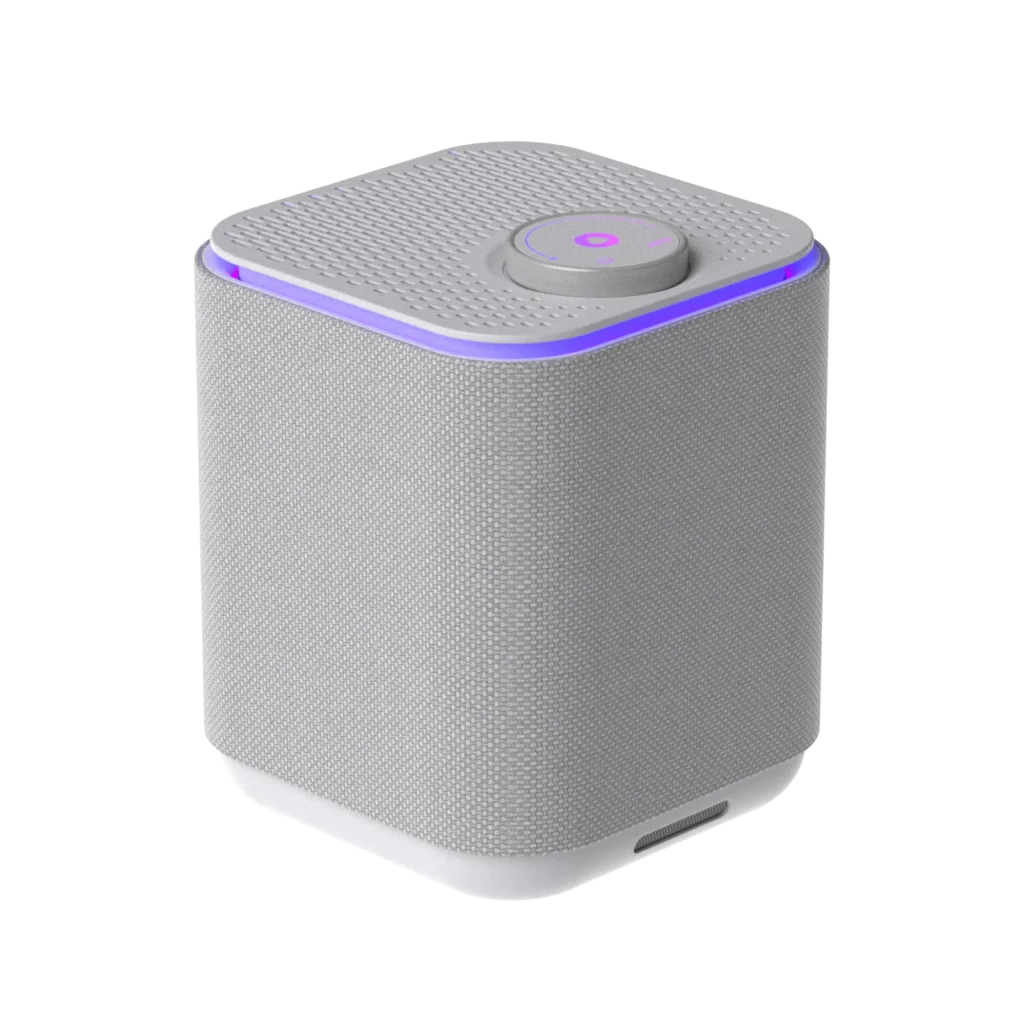
Premium desktop air purifier with fabric cover for modern indoor spaces
Product Advantages

Built for Wellness, Hospitality
& Smart Living.

Engineered for premium commercial and residential environments. We combine AI-ready environment sensing with whisper-quiet performance to power the next generation of wellness products.

AI-Ready Intelligence & 8-Sensor Array Pro Model

Feed rich environmental data into your brand's AI models or wellness app. Upgrade from a standard purifier to a Personal Air Quality Station that understands exactly what is happening in the room.

PM2,5 CO2 TVOC Temp & Humidity Rumore Luce Radar/Occupancy

Cancellazione dei decibel

Operating at an extraordinary 32 dB(A) via HisoAir's proprietary acoustics. Enjoy a 120 m³/h CADR without disturbing rest or focus.

Matter Over Thread

Future-proof your brand. Native compatibility with Apple HomeKit, Google Home, and Amazon Alexa. Thread ensures low-latency and stable connections.

Premium Fabric CMF

We ditched generic plastics. Wrapped in a customizable premium fabric sleeve, it seamlessly blends into boutique hotel suites, executive workspaces, and residential nightstands.

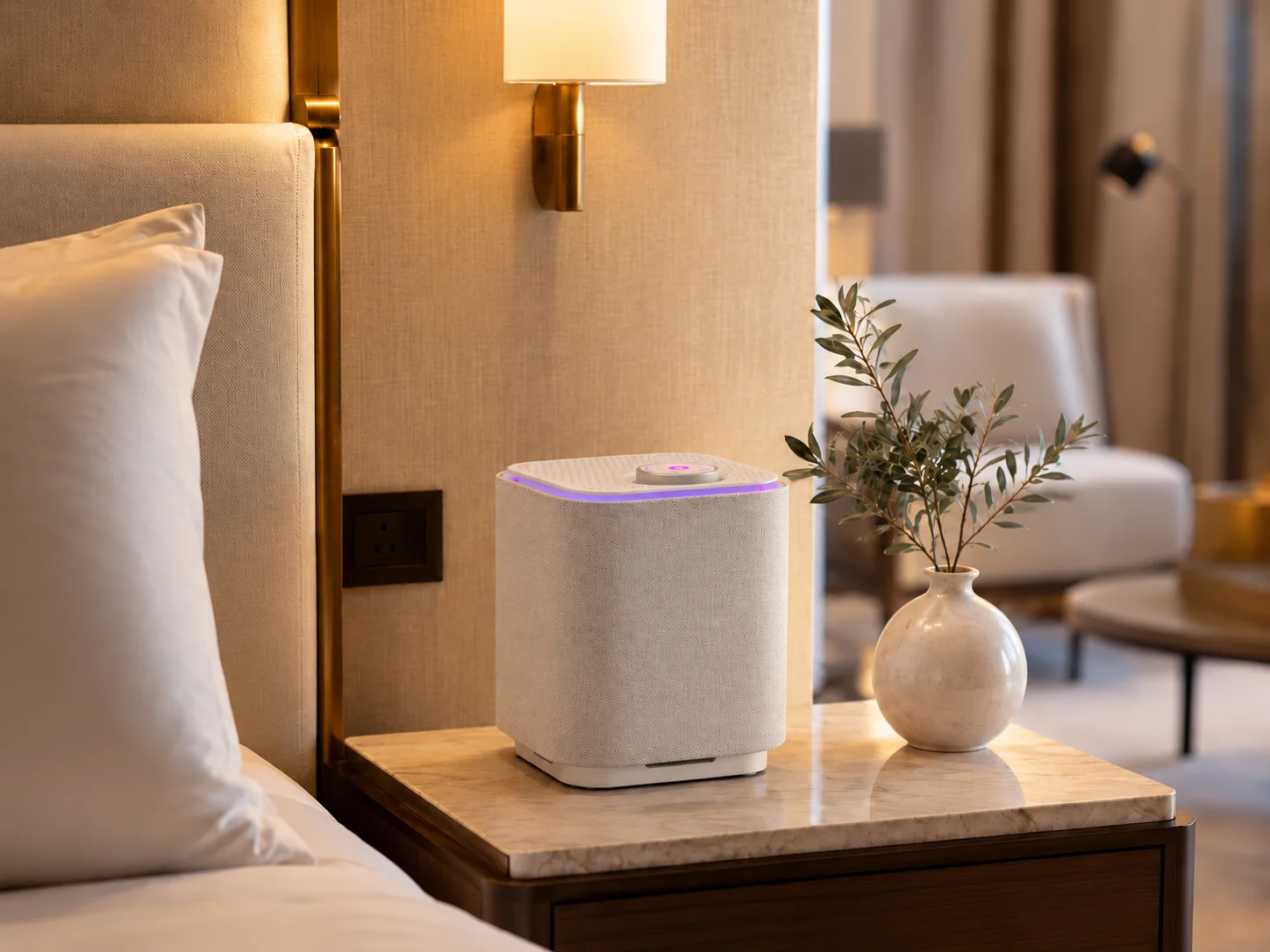
Bedroom air purifier and vase lifestyle scene
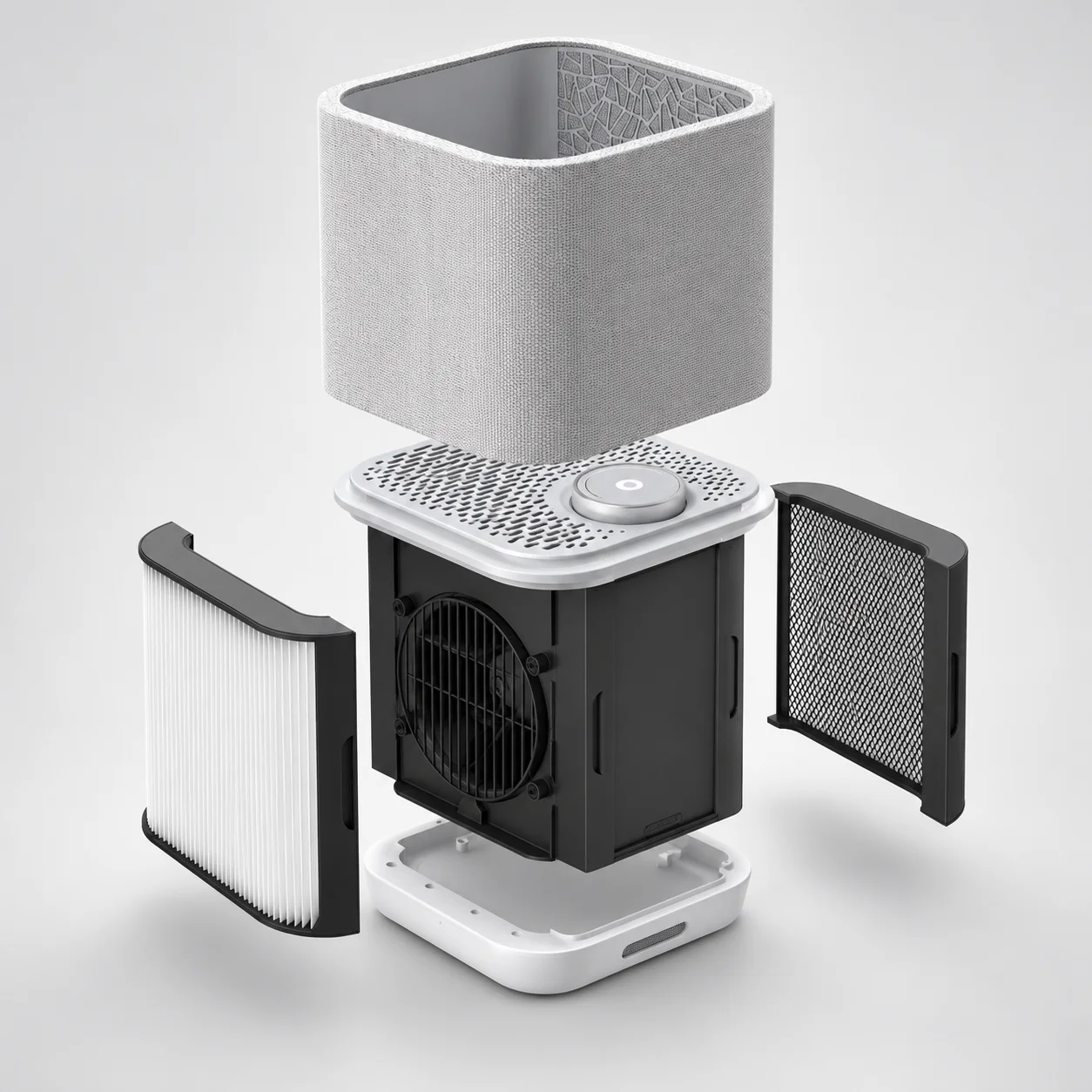
Air purifier exploded view showing filter cartridge and internal layers

Filtrazione di grado medico

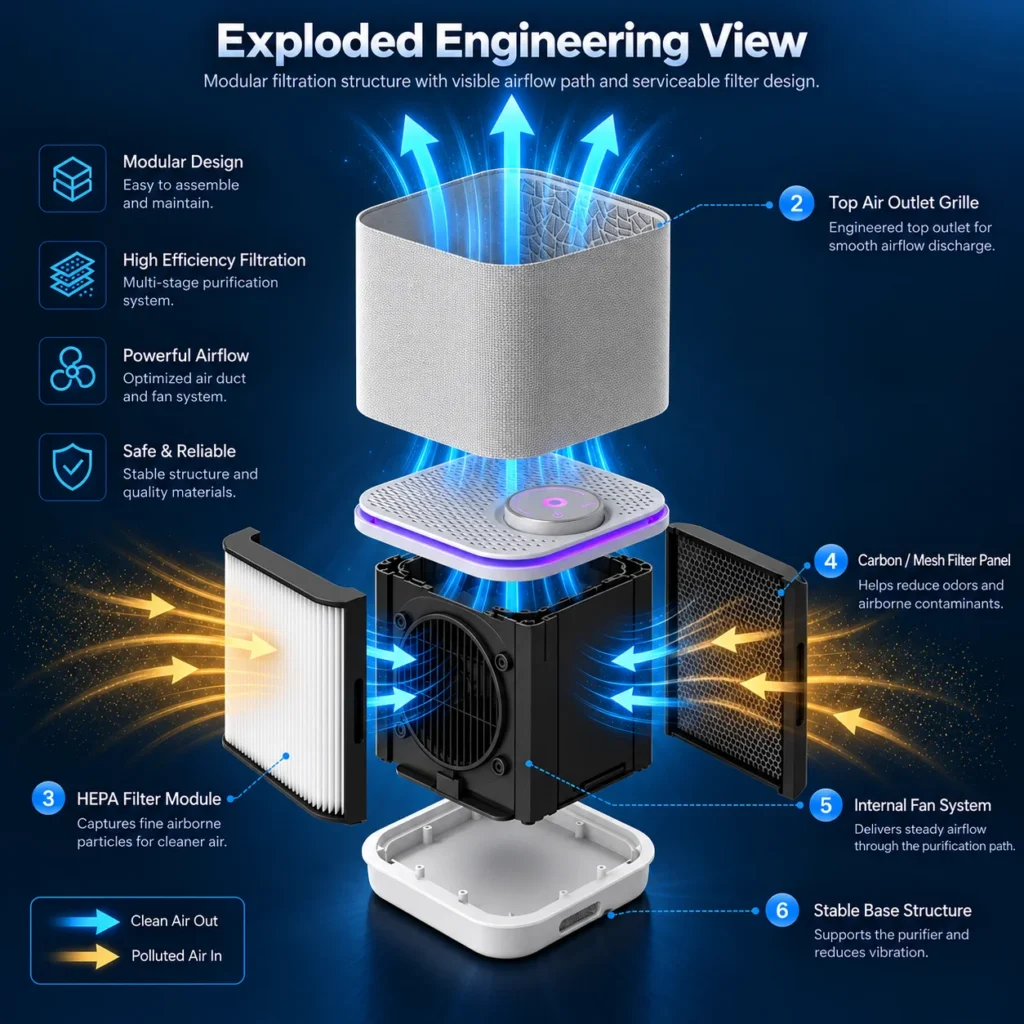
A robust 3-stage architecture: High-quality Fabric Pre-filter + HEPA H13 (99.97% @ 0.3 μm) + Activated Carbon. Employs low-resistance HEPA technology.

Hidden Matrix Display

Critical IAQ data gently shines through the acoustic fabric, remaining virtually invisible when not in use to preserve the device's furniture-like aesthetic.

Core Hardware Architecture

The Science of Silence.
The Power of AI.

How we achieved 120 m³/h CADR at an imperceptible 32 dB(A)—while actively feeding rich environmental data arrays to your smart home ecosystem.
Exploded schematic of an air purifier with labeled components, including fabric pre-filter, HEPA filter, carbon mesh panel, internal fan system, and base.

Edge Sensor Matrix

An advanced MCU processing data from 8 dedicated IAQ sensors simultaneously, providing high-frequency, reliable data inputs for connected AI applications.

Cancellazione dei decibel

Proprietary acoustic engineering tailored specifically for premium bedroom and nightstand scenarios. Eradicates high-frequency motor whine.

Design silenzioso del condotto d'aria

Dual-side air intake with a single-side outlet. This advanced aerodynamics maximizes airflow and relieves motor pressure, achieving higher CADR at lower RPMs.

Noise Reduction Materials

Strategic placement of specialized sound-dampening materials surrounding the motor chamber to absorb mechanical vibrations before they escape.

Tecnologia delle turbine eoliche

A custom forward-inclined centrifugal fan. Miniaturized for desktop formats while delivering high-efficiency airflow with minimal acoustic turbulence.

Low D/P HEPA Array

Low wind-resistance HEPA media. Strikes the perfect balance between aggressively high CADR throughput and uncompromising H13 filtration efficiency.
Usage & Maintenance

Frictionless Returns. Endless Subscriptions.

For B2B brands, an air purifier is only as good as its filter repurchase rate. We engineered the HA100D Pro replacement process to be so intuitive that it requires zero tools and zero frustration.

High D2C Subscription Rate

Easy replacement drives recurring revenue.

Zero-Tool E-Commerce Friendly

Reduces after-sales confusion and customer support tickets.

Modular Flexibility

Easily upsell users to specialized filters (e.g., Pet, Toxin).

4-Step Filter Replacement Flow

Open Cover

Magnetically aligned back cover detaches instantly.

Remove Old

Pull out the dual-side main filter modules.

Unwrap & Insert

Drop the new filters into the guided slots.

Snap & Go

Reattach the washable pre-filter and snap the cover shut.
DETAILED PARAMETERS

Hardware Specifications.

Final specs subject to customization.
Model Series
wellcube Air Lite (HA100D)
Dimensioni
185 × 185 × 200 mm
Peso netto
1.7 kg
CADR
120 m³/h (~70 CFM)
Max Coverage Area
10-15 m² (Refreshes 10m² in ~15 mins)
Livello di rumore
32 - 52 dB(A)
Sistema di filtrazione
Fabric Pre-filter + HEPA H13 + Activated Carbon
HEPA Efficiency
99.97% @ 0.3 μm (Low Wind Resistance)
HA100D Pro Sensors
PM2.5, CO2, TVOC, Temp, Humidity, Noise, Light, Radar/Occupancy
Connettività
Matter over Thread (Apple HomeKit, Google Home, Alexa)
Voltage & Power
220-240V, 4-12W
Certificazioni
ETL, FCC/IC, CARB, CE-EMC, CE-LVD, EN1822, AHAM CADR
CUSTOMER QUESTION

Is it quiet enough for bedrooms and hotel suites?

Extremely quiet. Operating as low as 32 dBA, it leverages our proprietary Decibel Cancellation™ technology. At its lowest setting, the airflow is nearly imperceptible, making it ideal for luxury hospitality, executive private offices, and residential bedrooms.

CUSTOMER QUESTION

How does the CADR cover the room?

With a maximum CADR of 120 m³/h, the Air Lite is designed as a personal clean-air zone. It actively refreshes the air in a standard 10–15 m² space (like a hotel suite, personal office, or bedroom) in approximately 15 minutes.

OEM / ODM Platform

Your Blueprint for Premium Near-Human Purification.

Don't build from scratch. Leverage our globally certified platform. Choose from three flexible B2B partnership paths tailored to your speed-to-market and brand differentiation goals.
CNAS-approved in-house testing laboratory
Minimum Order Quantity (MOQ) from 500 units
Full CMF (Color, Fabric, Finish) Customization
Matter over Thread / Ecosystem integration
Discuss Customization Options

Customer Question Do you protect IP and offer exclusivity?

Absolutely. All our engagements begin with a strict NDA. Through our Exclusive Version path, we lock your exterior designs and specific core configurations to your brand within your target territories.

Premium White Label

Standard housing, customized fabric sleeve colors, logo placement, and packaging. Fast 6-week turnaround for market entry.

Joint Development (JD)

Add custom sensor arrays (e.g. Radar/CO2), unique firmware app flows, and specialized regional certifications.

Exclusive Version

Design entirely unique exterior shell geometries mapped to our proven internal acoustic and air-path core. Contractual exclusivity.
Global Supply Chain

China + 1 Strategy Ready.

Mitigate tariff risks and build a resilient supply chain. With extensive manufacturing footprints outside of China, we provide reliable global delivery for North American and European brands.

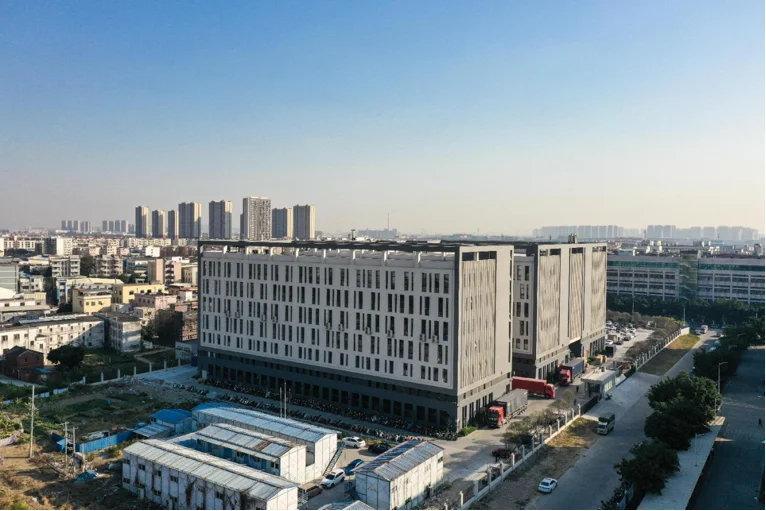
Modern industrial manufacturing facility

Vietnam Manufacturing Facility

20,000㎡
Facility Size
400+
Employees
7
Assembly Lines
2M
Annual Capacity
Cina Vietnam Thailandia Malesia

Private Label Differentiation

Fast to market doesn't mean generic. We offer deep CMF customization—logos, fabric colors, surface materials, finishing, and bespoke packaging to lock in your brand identity.

Rapid Market Entry

Leverage mature platforms like the wellcube Air Lite to dramatically cut R&D cycles. Launch premium products in weeks, not years, with full global delivery support.

Testing & Compliance

CNAS-Approved Testing Laboratory.

Every purifier platform is rigorously tested in our in-house facility before mass production. From acoustic tuning to strict safety validation, we ensure your product meets global standards without relying solely on third-party labs.

CADR & Airflow Testing

Precise measurement of clean air delivery rate.

Acoustic Chamber

Anechoic noise testing per AHAM standards.

Filter Life Analysis

Durability and saturation testing for HEPA media.

Sensor Calibration

Precision tuning for PM2.5, CO2, and TVOC sensors.

Platform Certifications

Supported and available compliance standards varies by target region and specific hardware configuration:

ETL (North America) FCC / IC CARB (California) DOE AHAM CADR CE-EMC / CE-LVD RoHS

Partner Question What is the standard MOQ and lead time?

For wellcube Air Lite Premium White Label, MOQ starts at 500 units with an average lead time of 6 weeks. Certification transfers and Joint Development timelines scale based on specific regional lab validation requirements.

Posizionamento sul mercato

Not Your Standard OEM.

See how the HA100D Pro platform separates your brand from commoditized generic purifiers.

Feature Category
Generic Desktop Purifier
HA100D Pro
Premium Platform
Data & AI Readiness
Closed System (No Data Access)
8-Sensor Streaming for Brand AI Models
Exterior & CMF
Generic Injection Plastic
Premium Woven Fabric Sleeve / Custom CMF
Acoustic Profile
Turbulent Engine Whine (>50 dBA)
Decibel Cancellation™ (32 dBA whisper)
Smart Ecosystem
Bolt-on Wi-Fi (App Only)
Native Matter Over Thread
Sensor Array
Infrared PM2.5 (Basic)
8-Sensor IAQ Hub (Laser PM2.5, CO2, Radar)
Airflow Design
High Resistance / Loud
Dual-side intake / Low Resistance HEPA
B2B Customization
Logo Printing Only
Premium White Label, Joint Dev & Exclusive Models
Commercial Grade Heritage

Trusted by J.P. Morgan &
WELL Certified Spaces. For luxury hospitality, offices & residential.

★★★★★
Based on B2B Partner Reviews
★★★★★

"We were looking for a desktop purifier that didn't look like a generic appliance. HisoAir's fabric CMF options and whisper-quiet operation perfectly fit our nightstand collection. The white-label onboarding was smooth, and we launched in under 8 weeks."

Tommaso

Founder, Premium Lifestyle Brand, DE

★★★★★

"The ability to run Matter over Thread natively without patching firmware ourselves saved us 4 months of R&D. The HA100D Pro feels like a true consumer electronics piece. The 8-sensor IAQ hub gives us so much data to build automation rules."

Sarah L.

Product Manager, Smart Home Brand, US

★★★★★

"We tested 8 different desktop purifiers for our hotel suite deployment. The Decibel Cancellation™ technology on the HA100D is unmatched. It is the only unit that can run effectively without generating complaints from guests trying to sleep."

Jin W.

Hardware Director, Luxury Hotel Group, APAC

Partner Brands / Client Logos Placeholder
Questions & Answers

Frequently Asked.

For wellcube Air Lite (HA100D Pro) Premium White Label orders, MOQ starts at 500 units. For Joint Development and Exclusive Version programs, the MOQ scales with the level of customization. Sample and pilot quantities are available before committing to a full production run.

Yes, wellcube Air Lite is built on Matter over Thread, the cross-ecosystem smart home standard. It works natively with Apple Home, Google Home, and Amazon Alexa. It uses Thread mesh networking for local, low-latency control without burdening Wi-Fi bandwidth.

The HA100D Pro operates at 32–52 dBA — whisper-quiet at the low end, comparable to a quiet library. This is enabled by HisoAir’s Decibel Cancellation™ Technology, optimized air-path engineering, and a premium woven fabric exterior that softens sound. It is specifically designed for hotel suites, executive workspaces, and residential nightstands.

Maximum CADR is 120 m³/h (≈ 70 CFM), with an effective coverage of 10–15 m². It is engineered as a personal clean-air zone for hotel suites, personal offices, or bedside use. (For larger spaces, we offer wall-mounted HA180/HA380 and floor-standing HA-B800 platforms).

Yes. wellcube Air Lite is designed as a customization platform. Fabric sleeve color and texture, packaging, logo placement, app experience flows, and replacement-filter programs are all configurable under our Premium White Label path.

Premium White Label orders typically ship 6 weeks after PO and CMF sign-off. Joint Development programs add 4–8 weeks for custom sensor, firmware, or app integration. Exclusive Version programs are scoped per individual project. Sample units are available within 1–2 weeks.

Standard certifications include ETL (North America), FCC/IC, CARB (California air resources), CE-EMC and CE-LVD (Europe), EN1822 (HEPA standard), AHAM CADR, and antibacterial filter certification. Regional marks can be added through Joint Development.

It utilizes four layers: (1) Fabric pre-filter for large dust/hair, (2) HEPA H13 media capturing 99.97% of 0.3-micron particles, (3) VOC activated carbon for odors and household gases, and (4) an intelligent sensor array (up to 8 sensors in the Pro model) for real-time monitoring.

Absolutely. All client engagements begin with an NDA. The Exclusive Version partnership path locks visible design and component-level differentiation to a single brand in a defined territory, backed by contractual exclusivity windows.

RICHIEDI UN PREVENTIVO

lasciate un messaggio qui sotto

Vi risponderemo al più presto!

TENERSI IN CONTATTO

Informazioni di contatto

La vostra domanda è importante per noi.
Ci collegheremo a breve e i vostri dati rimarranno sempre al sicuro.
sales@hisoair.com
+86 138 0961 9940

Ufficio USA: 2180 S WINEVILLE AVE ONTARIO, CA 91761

Ufficio: Stanza 712~713, Edificio 1, No. 4, Seconda Strada, Parco del Lago Songshan, Città di Dongguan, Provincia di Guangdong, 523429.

Fabbrica: Cina | Vietnam | Thailandia | Malesia

Contaminant Engineering•3 min read

PFAS Water Filtration Technologies Explained: Carbon, Resin & RO

Key Takeaway:

PFAS reduction depends on the specific compounds present, treatment media, contact time, water chemistry, and system design. Activated carbon, ion exchange, and Reverse Osmosis address PFAS through different mechanisms.

PFAS are a large family of persistent fluorinated compounds that can occur in drinking-water supplies. Their treatment behavior varies significantly by molecular structure, chain length, functional group, concentration, and the chemistry of the source water.

Granular Activated Carbon (GAC) removes PFAS primarily through adsorption. It is generally more effective for many longer-chain PFAS, while shorter-chain compounds tend to break through more quickly. Carbon performance depends on media properties, Empty Bed Contact Time (EBCT), competing organic matter, loading, and replacement frequency.

Ion-exchange resins use charged functional sites to capture many PFAS compounds. Properly selected anion-exchange media can provide high capacity and may perform better than conventional activated carbon for some shorter-chain PFAS, although performance still depends on water chemistry and competing ions.

Reverse Osmosis (RO) uses membrane separation rather than adsorption. Properly designed RO systems can provide broad reduction across many PFAS compounds as well as dissolved salts and other contaminants. Unlike carbon or resin, however, RO also produces a concentrate stream that must be managed.

No single technology should be selected from a PFAS label alone. System design should consider which PFAS compounds are present, their concentrations, required reduction targets, flow rate, media life, and the applicable third-party certification or validation requirements.

HisoAir Water Technical Series
Product Discovery•3 min read

How to Choose an Under-Sink Water Purifier for Modern Kitchens

Key Takeaway:

Match the treatment technology to your water quality first, then evaluate cabinet space, faucet configuration, flow rate, drain and power requirements, and filter replacement needs.

Choosing an under-sink water purifier starts with water chemistry. Carbon filtration is well suited to chlorine, taste, odor, and many organic contaminants, while Reverse Osmosis is more appropriate when dissolved salts, fluoride, nitrates, or broader dissolved contaminants need to be reduced.

For compact kitchens, tankless RO systems eliminate the conventional storage tank and can significantly reduce the space required under the sink. However, membrane capacity stated in GPD does not directly equal faucet flow. When comparing systems, check the actual dispensing flow rate, inlet-pressure requirement, recovery ratio, and whether a booster pump is required.

Installation architecture also matters. Many RO systems require a drain connection, electrical power, and either a dedicated drinking-water faucet or a compatible multi-function faucet. High-flow carbon systems can often connect directly to the existing cold-water line with a simpler installation, but pressure drop and available faucet flow should still be verified.

RO also removes much of the naturally occurring dissolved mineral content. Where taste or mineral balance is a priority, a post-RO remineralization stage can be added. Filter life should be evaluated by both rated capacity and local water quality rather than replacement time alone.

The right system is therefore not simply the smallest or highest-GPD model. It is the configuration that matches the target contaminants, available cabinet space, desired faucet setup, peak dispensing demand, and maintenance expectations.

HisoAir Water Technical Series
Water Quality•2 min read

What Does TDS Mean in Drinking Water? Measurement vs Contaminant Reality

Key Takeaway:

A TDS meter estimates the overall concentration of dissolved ionic substances from electrical conductivity. It cannot identify specific contaminants or determine whether water is chemically safe.

Total Dissolved Solids (TDS) refers to the combined concentration of dissolved substances in water. Most handheld TDS meters do not measure TDS directly. Instead, they measure electrical conductivity (EC) and convert that reading into an estimated parts-per-million (ppm) value.

This means a TDS reading can indicate how much dissolved ionic material is present, but not what that material actually is. Calcium, magnesium, sodium, nitrates, and other dissolved ions can all contribute to conductivity, yet a simple TDS meter cannot distinguish between them.

TDS meters are also not suitable for detecting trace contaminants such as PFAS, many VOCs, pesticides, pharmaceuticals, or disinfection byproducts. These substances may be present at concentrations far below the level needed to noticeably change electrical conductivity.

A low TDS reading therefore does not guarantee safe drinking water, and a higher TDS reading does not automatically indicate contamination. Water-treatment decisions should be based on laboratory testing for specific contaminants of concern rather than TDS alone.

HisoAir Water Technical Series
Technology Selection•2 min read

RO vs UF Water Filtration: Understanding Pore Sizes & Dissolved Minerals

Key Takeaway:

Ultrafiltration can reduce bacteria, turbidity, and suspended particles while retaining most naturally occurring dissolved minerals. Reverse Osmosis provides much broader reduction of dissolved salts and smaller contaminants.

Ultrafiltration (UF) typically uses hollow-fiber membranes with pore sizes in the approximate 0.01–0.1 micron range. These membranes physically retain turbidity, suspended solids, colloids, and many microorganisms while allowing dissolved minerals and salts to remain in the water.

Reverse Osmosis (RO) operates at a much finer separation level. Unlike UF, RO can substantially reduce dissolved ions such as sodium, calcium, fluoride, nitrates, and other contributors to total dissolved solids (TDS). This makes RO more suitable when dissolved-salt reduction is a primary treatment objective.

UF generally requires less system pressure and produces little or no continuous concentrate stream in many point-of-use configurations. RO typically requires greater pressure and produces a reject-water stream, but delivers broader contaminant reduction.

For water with acceptable TDS and mineral content, UF can be a simpler mineral-retaining treatment option. Where dissolved salts, fluoride, nitrates, or broader dissolved contaminants are a concern, RO is generally the more appropriate technology.

HisoAir Water Technical Series
Technology Selection•4 min read

Carbon Block vs Reverse Osmosis: Which Fits Your Need?

Key Takeaway:

Choose RO for dissolved inorganic salts and heavy metals; choose Carbon Block for chemical taste/odor, no wastewater, and high line-pressure flow.

Reverse Osmosis (RO) and Carbon Block filtration represent two fundamentally different treatment methods: membrane separation and adsorption. Understanding these differences helps determine which technology is better suited to a specific water-quality requirement.

Reverse Osmosis uses a semi-permeable membrane with pore sizes of approximately 0.0001 microns. It can significantly reduce dissolved inorganic contaminants such as TDS, fluoride, nitrates, and certain heavy metals. Because water must be forced through the membrane, RO systems require sufficient pressure or a booster pump and generate a concentrated wastewater stream.

Carbon Block filtration relies primarily on adsorption through compressed activated carbon, commonly with nominal pore sizes around 0.5–5 microns. It is highly effective for chlorine, chloramines, VOCs, taste, and odor, while allowing substantially higher direct-flow rates without producing wastewater.

From an operating perspective, Carbon Block systems are generally simpler, require less energy, and avoid the water loss associated with RO. RO involves higher system complexity and operating cost, but provides substantially broader reduction of dissolved contaminants that Carbon Block alone cannot address.

HisoAir Water Technical Series

RICHIEDI UN PREVENTIVO