

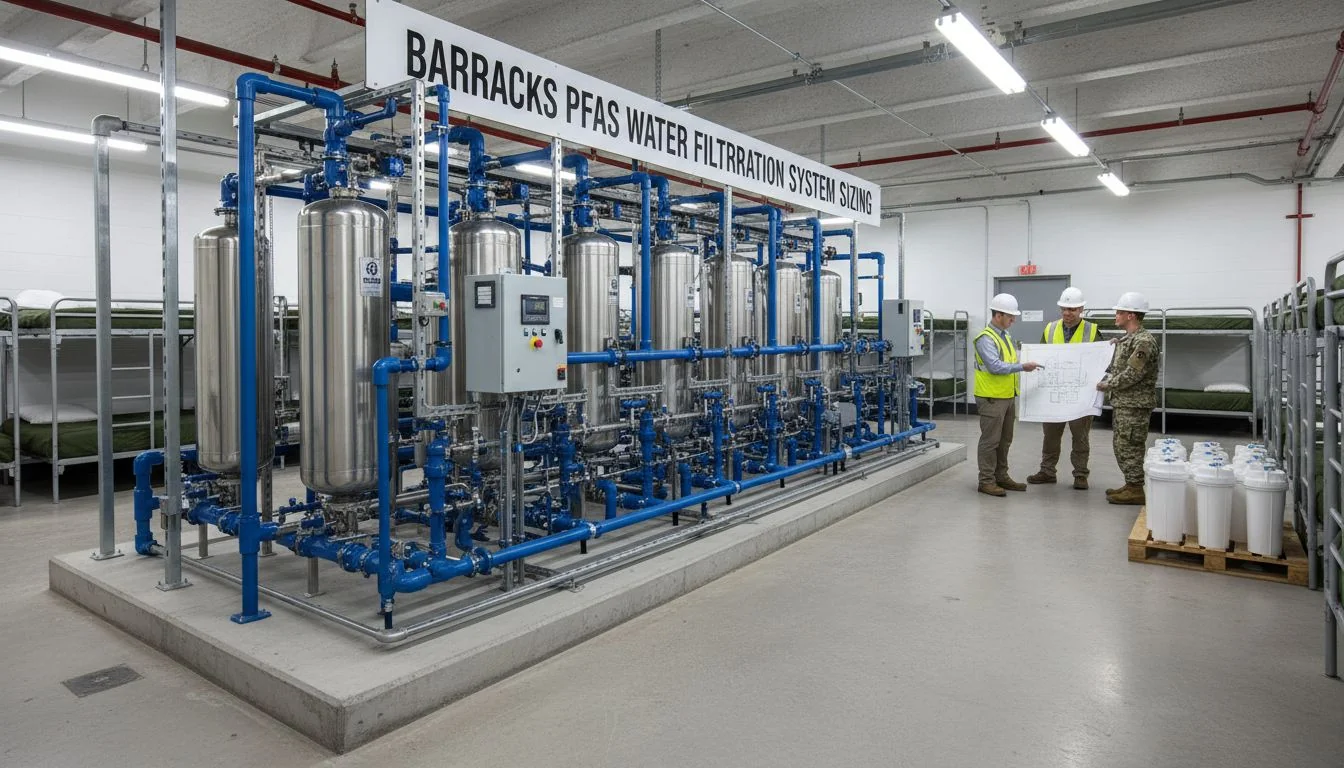
You manage a barracks facility. You need to remove PFAS from the water. A small system fails. A large system wastes money. I will show you the exact math.
To size a 1,500–5,000 GPD PFAS water filtration system1 for barracks, you must calculate daily water demand based on occupancy. You then determine peak flow rates for morning showers. You finally select filter vessels that handle the peak flow and maintain the required contact time.
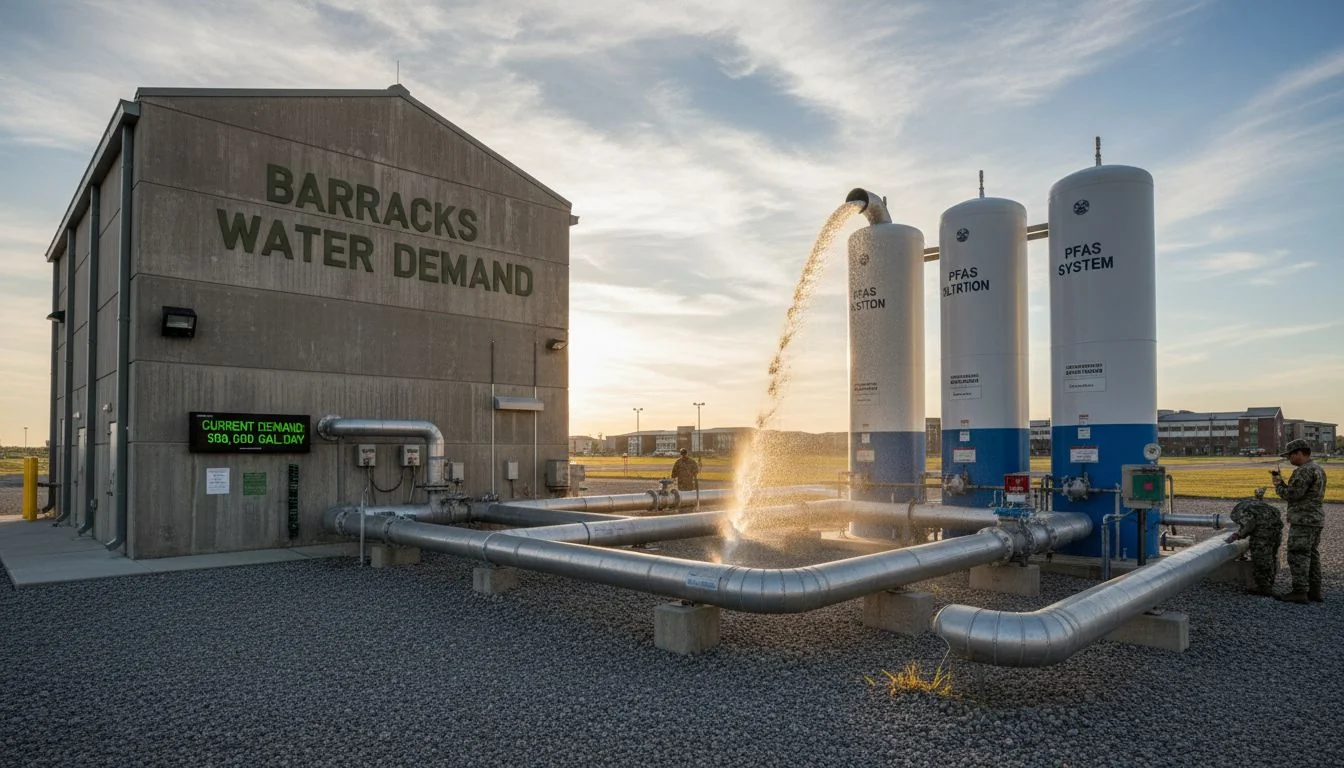
I learned early in my engineering career to avoid guessing. A tiny error in mold design ruins a plastic part. A bad flow estimate ruins a water filter. You need hard facts. We will break down the exact steps to size this system correctly.
A 1,500 GPD system can support a barracks with 1,000 soldiers.Falso
A 1,500 GPD system is too small for 1,000 soldiers, as each person typically uses 50 to 100 gallons per day.
Empty bed contact time is a critical factor in PFAS removal.Vero
PFAS media requires a specific contact time with the water to effectively adsorb the chemicals.
Why Does Correct Sizing Drive Cost and Performance?
You might want to buy the biggest filter. This choice wastes your budget. A small filter clogs fast. It lets PFAS slip through.
Correct sizing keeps the water inside the media long enough to remove PFAS. A large system wastes your money on unused media. A small system pushes water too fast. The fast water pushes PFAS through the filter. You then fail your water quality tests.

The Balance of Flow and Contact Time
I always tell my clients to balance their designs. You must match the flow rate to the filter size. PFAS removal needs a specific Empty Bed Contact Time (EBCT). The water must touch the media for several minutes. Fast water prevents the media from catching the PFAS.
Pressure Drop Issues
You must also watch the water pressure2. Too much water in a small pipe drops the pressure. The barracks loses water pressure during morning showers. The soldiers complain. You must size the pipes to keep the pressure steady.
| Sizing Mistake | Performance Impact | Cost Impact |
|---|---|---|
| Undersized System | Low water pressure, PFAS breakthrough | High maintenance costs, frequent media changes |
| Oversized System | Water stagnation, channeling | High upfront capital cost, wasted floor space |
| Correct Sizing | Steady pressure, zero PFAS | Optimized budget, predictable maintenance |
You must look at the data. You cannot guess the flow rate. You need to measure it. You can also calculate it based on strict engineering rules.
Faster water flow improves PFAS removal.Falso
Faster flow reduces contact time, which decreases the effectiveness of PFAS removal.
Oversized systems increase upfront capital costs.Vero
Larger vessels and more media cost more money to purchase and install.
How Do You Estimate Daily Water Demand for Barracks Occupancy?
You do not know the exact water usage. You risk buying the wrong equipment. You must calculate the daily demand based on the exact number of people.
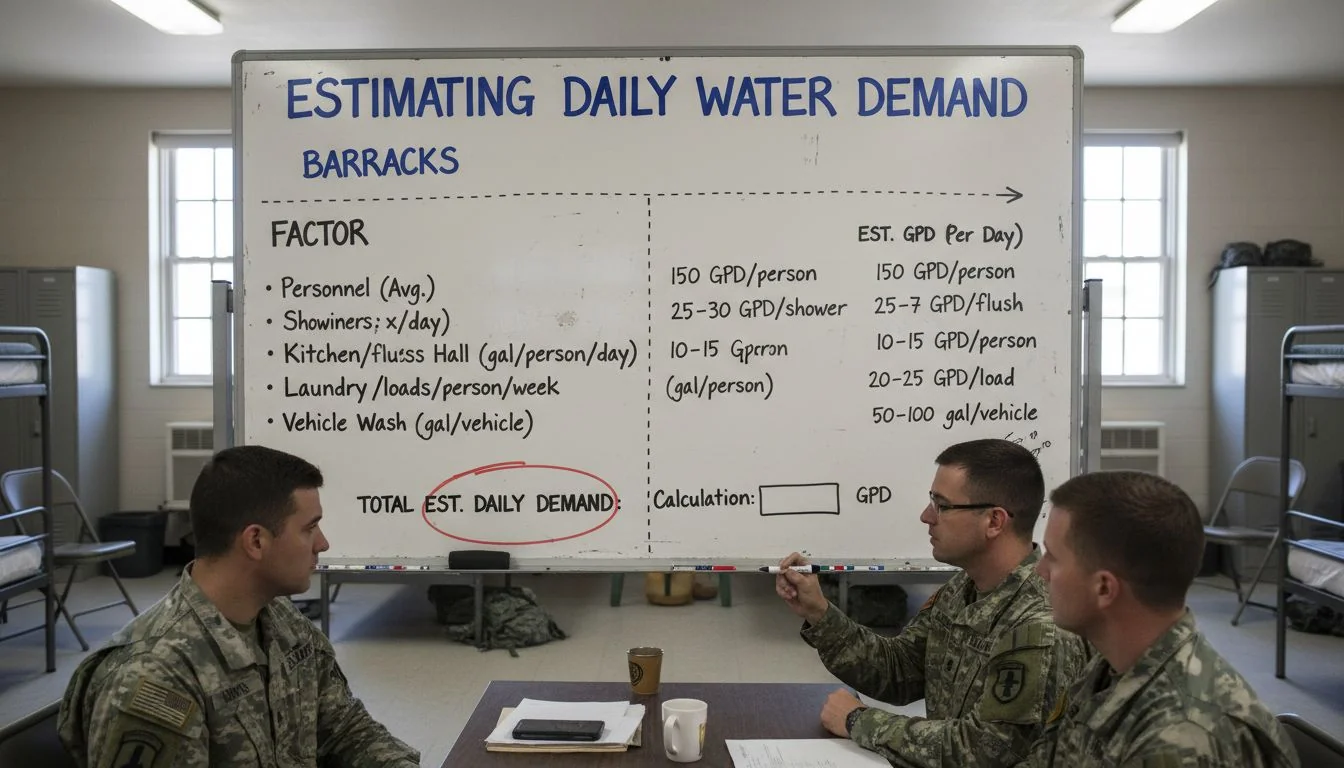
You estimate daily water demand3 by multiplying the number of occupants by the average daily water use per person. A typical barracks uses 50 to 80 gallons per person per day. A 50-person barracks needs 2,500 to 4,000 gallons per day (GPD).
Counting the Occupants
You must start with the maximum occupancy. I remember a past project. The client only counted the permanent staff. They forgot the temporary trainees. The system failed in the first month. You must count every single person in that building.
Calculating the Gallons Per Day
Military barracks have specific water use patterns. Soldiers take showers. They use toilets. They wash clothes. You can use standard engineering tables to find the daily use per person. Most engineers use 50 to 80 gallons per day for a barracks resident.
| Occupancy Level | 50 Gallons/Person (Low) | 80 Gallons/Person (High) |
|---|---|---|
| 20 People | 1,000 GPD | 1,600 GPD |
| 40 People | 2,000 GPD | 3,200 GPD |
| 60 People | 3,000 GPD | 4,800 GPD |
Adding a Safety Factor
You should always add a safety factor4. I usually add 10% to 15% to the final number. This extra water covers leaks. It covers extra cleaning. It covers unexpected guests. Your math might show 3,000 GPD. You should design for 3,450 GPD. This safety factor protects your system.
A barracks resident uses 500 gallons of water per day.Falso
A typical barracks resident uses between 50 and 80 gallons of water per day.
Adding a safety factor helps cover unexpected water usage.Vero
A 10% to 15% safety factor accounts for leaks or temporary increases in occupancy.
Peak Flow vs Average Flow: What Should You Design Around?
You calculate the average daily flow. You think you are done. You are wrong. Morning showers create a massive spike in water demand. This spike breaks your system.
You must design the physical filter vessels around the peak flow rate. Average flow determines your total media life. Peak flow determines the size of your pipes and tanks. This sizing prevents pressure loss during high-demand times like morning showers.
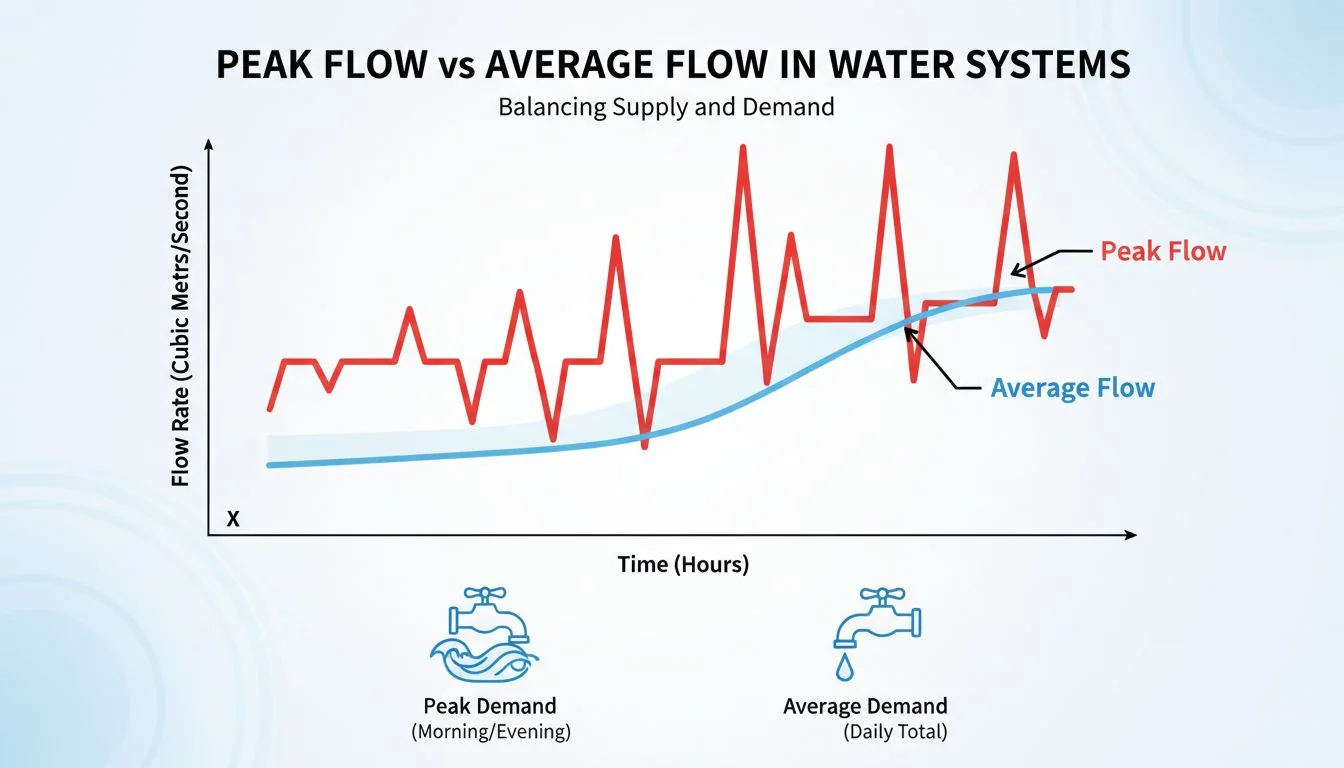
The Morning Shower Spike
I see this mistake all the time. Engineers take 3,000 GPD. They divide it by 24 hours. They get 125 gallons per hour. They size the filter for 2 gallons per minute. Soldiers do not shower at 2 AM. They all shower at 6 AM. The water demand spikes to 30 gallons per minute. Your small filter chokes.
Sizing for the Peak
You must calculate the peak flow rate in gallons per minute (GPM). You count the number of showerheads and toilets. You assume a percentage of them run at the same time.
| Flow Type | Calculation Method | What It Sizes |
|---|---|---|
| Average Flow | Total GPD / 24 hours | Total media volume, maintenance schedule |
| Peak Flow | Fixture count method (GPM) | Pipe diameter, vessel size, pump size |
Using Storage Tanks
Sometimes the peak flow is too high for a small filter. You can use a storage tank. The filter runs slowly all day. It fills the tank. The barracks pulls water from the tank during the morning rush. This tank saves money on filter vessels.
You should size your filter vessels based on the average hourly flow.Falso
Filter vessels must be sized for peak flow to handle sudden spikes in water demand.
A storage tank can help manage high peak flow demands.Vero
A storage tank stores filtered water, allowing a smaller filter to run continuously and meet sudden high demands.
Which Influent Water Quality Factors Affect Sizing?
You only look at the PFAS levels. You ignore the other chemicals in the water. Iron and dirt clog your expensive PFAS media in a few weeks.
influent water quality5 directly affects your system size. High levels of iron or dirt require pre-filtration tanks. High levels of competing organic compounds exhaust the PFAS media faster. You must buy larger vessels to hold more media.
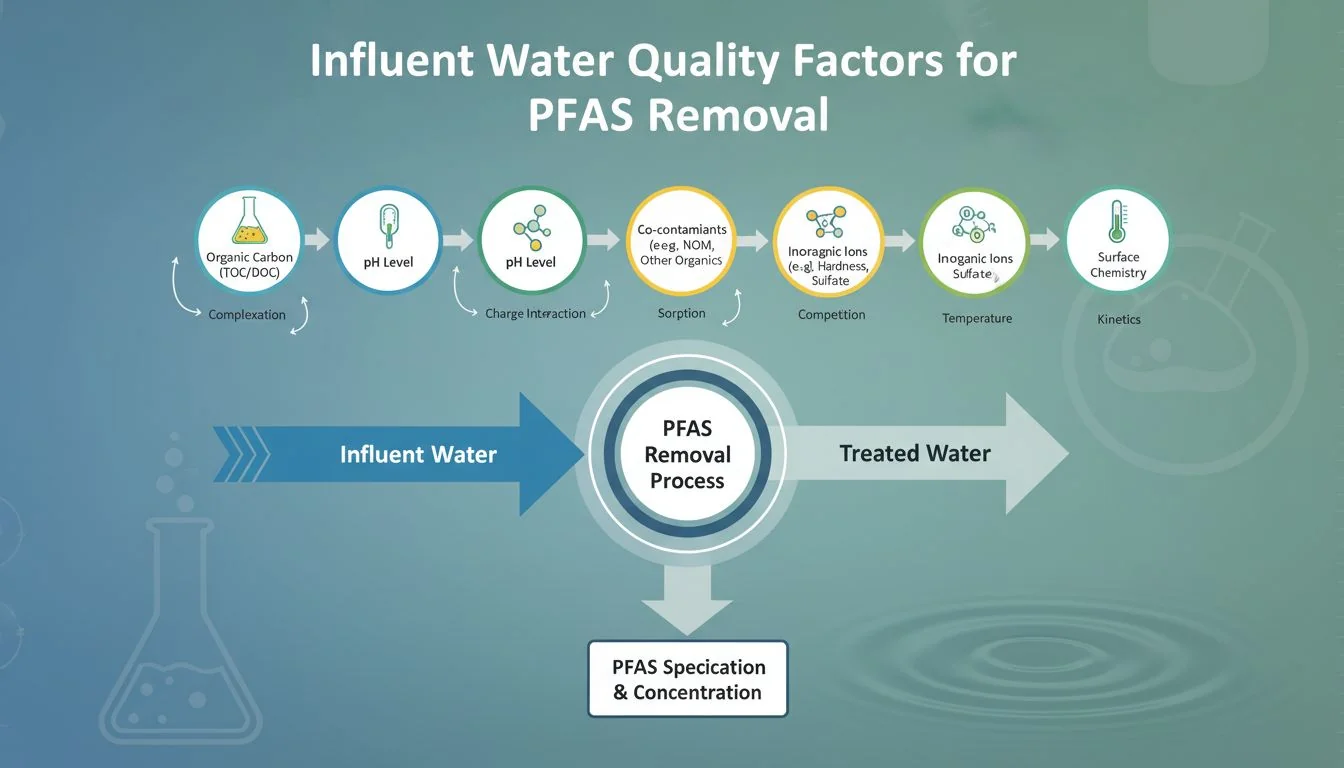
The Danger of Iron and Dirt
You must test the raw well water. I once helped a client. They ruined a $10,000 carbon bed. They had high iron in the water. The iron coated the carbon. The carbon could not catch the PFAS anymore. You must install a pre-filter. This pre-filter catches dirt and iron before the PFAS media.
Competing Organics
PFAS media acts like a sponge. It absorbs PFAS. It also absorbs other organic matter. Total Organic Carbon (TOC) steals space from the PFAS. Your water might have high TOC. You need more media to handle it.
| Water Contaminant | Effect on PFAS System | Required Action |
|---|---|---|
| Iron / Manganese | Coats media, blocks pores | Add iron removal pre-filter |
| Suspended Solids | Clogs vessels, drops pressure | Add sediment pre-filter |
| High TOC | Exhausts media quickly | Increase vessel size, add more media |
Redundancy and Lead-Lag Setup
You should always use a lead-lag setup6. You put two filters in a row. The first filter catches the PFAS. It gets full. The second filter then catches any leaks. This setup keeps the soldiers safe. You can change the media safely.
Iron in the water helps the PFAS media work better.Falso
Iron coats the media and blocks the pores, preventing it from absorbing PFAS.
A lead-lag setup uses two filters in series for safety.Vero
A lead-lag setup ensures that if the first filter fails, the second filter catches the contaminants.
How Does a Sizing Worked Example Look for the 1,500–5,000 GPD Range?
You have all the theory. You now need to see the math in action. I will walk you through a real calculation for a 3,000 GPD barracks system.
A 40-person barracks uses 75 gallons per person. The daily demand is 3,000 GPD. The peak flow is 25 GPM. You need a 10-minute empty bed contact time at 25 GPM. You need 33 cubic feet of media spread across two vessels.

Step 1: Calculate Daily Demand
Let us do the math together. You have a barracks with 40 soldiers. Each soldier uses 75 gallons per day. You multiply 40 people by 75 gallons. You get 3,000 GPD. We add a 10% safety factor. The new total is 3,300 GPD.
Step 2: Determine Peak Flow
We count the showers and sinks. We use standard plumbing codes. We find the peak flow. The peak flow is 25 Gallons Per Minute (GPM) during the morning rush.
Step 3: Calculate Media Volume
We need a 10-minute Empty Bed Contact Time (EBCT). You multiply Peak Flow by EBCT. You multiply 25 GPM by 10 minutes. You get 250 gallons of media. We convert gallons to cubic feet. One cubic foot is 7.48 gallons. You divide 250 by 7.48. You get 33.4 cubic feet of media.
| Calculation Step | Formula | Result for this Example |
|---|---|---|
| Daily Demand | Occupants x Usage | 3,300 GPD (with safety factor) |
| Peak Flow | Fixture count estimate | 25 GPM |
| Media Volume | Peak Flow x EBCT / 7.48 | 33.4 Cubic Feet |
You split this media into two vessels. Each vessel holds about 17 cubic feet. This split gives you a perfect lead-lag system.
You calculate media volume by multiplying peak flow by empty bed contact time.Vero
This formula ensures the water stays in the media long enough to remove contaminants.
One cubic foot of filter media equals 20 gallons.Falso
One cubic foot equals approximately 7.48 gallons.
What Sizing Information Should You Provide Your Supplier or Engineer?
You are ready to buy a system. You call a supplier. You do not give them the right numbers. They give you a bad quote.
You must provide your supplier with the maximum barracks occupancy. You must provide your daily water-demand assumptions and the peak flow rate. You also need to share a recent water quality test and your available floor space.
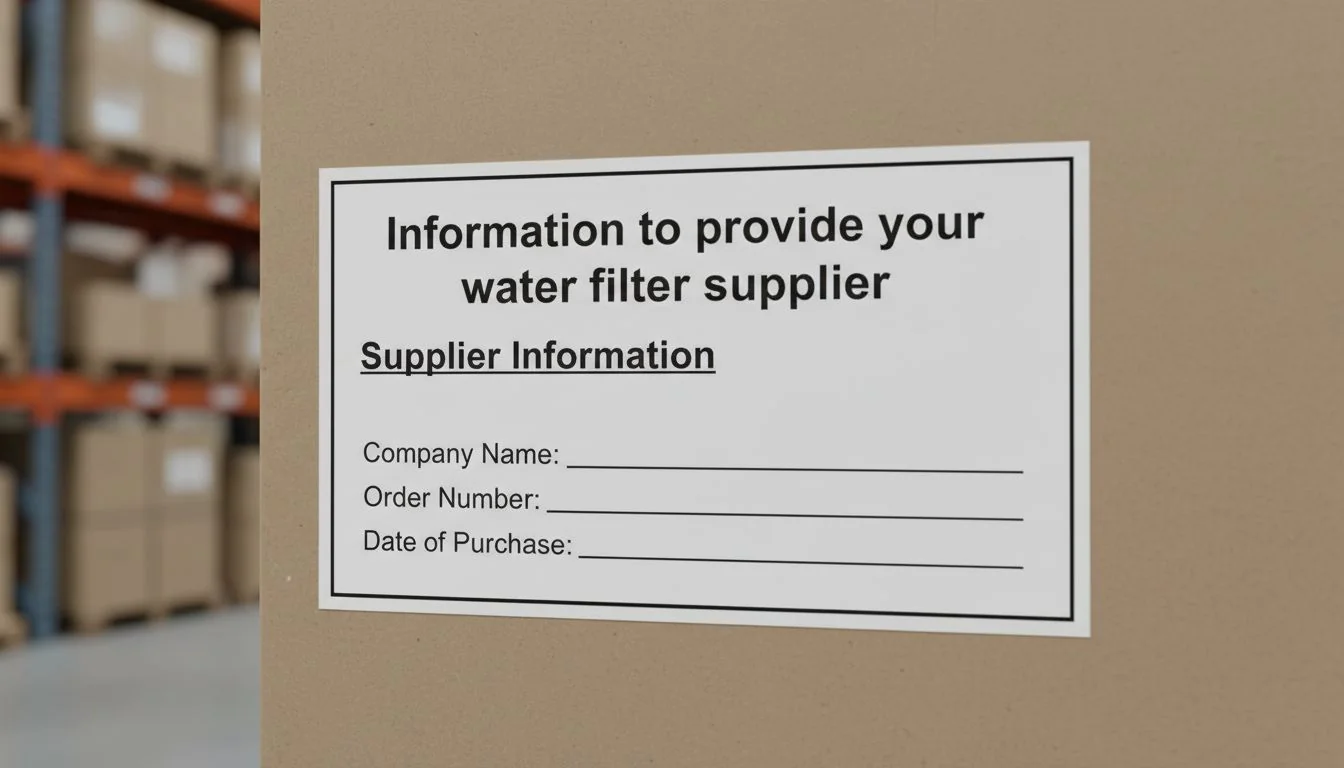
The Sizing Worksheet
I always ask my clients to fill out a sizing worksheet7. It saves time. It prevents mistakes. You can download our sizing worksheet. You use it to gather your data. You write down the exact number of beds in the barracks. You list the number of showers.
Water Quality Report
You must send a full water lab report. Do not just send the PFAS numbers. The engineer needs to see the pH. The engineer needs to see the iron and the dirt. This report tells the engineer about pre-filtration needs.
| Information Needed | Why the Engineer Needs It |
|---|---|
| Max Occupancy | To calculate total daily gallons (GPD) |
| Fixture Count | To calculate peak flow (GPM) |
| Full Water Lab Report | To select the right media and pre-filters |
| Site Dimensions | To ensure the tanks fit through the door |
Call to Action
You need to gather your occupancy numbers. You need your daily water-demand assumptions. You need your site conditions. Send this data to us for a preliminary sizing discussion. We will help you design a perfect system.
Suppliers only need to know the PFAS levels to size a system.Falso
Suppliers need flow rates, occupancy, and a full water quality report to size a system correctly.
Providing site dimensions ensures the equipment will fit in your facility.Vero
Engineers need to know door sizes and ceiling heights to select the right vessel dimensions.
Conclusione
You must calculate occupancy, peak flow, and water quality to size a barracks PFAS system correctly. Gather your data. Use a sizing worksheet. Consult an engineer for perfect results.
References
-
Understanding PFAS filtration systems is crucial for effective water treatment and safety. ↩
-
Maintaining proper water pressure is essential for optimal filter performance. ↩
-
Calculating daily water demand ensures adequate supply and prevents system failures. ↩
-
Adding a safety factor protects against unexpected increases in water usage. ↩
-
Understanding influent quality is key to selecting appropriate filtration methods. ↩
-
A lead-lag setup enhances reliability and safety in filtration processes. ↩
-
A comprehensive sizing worksheet prevents errors and ensures accurate system design. ↩





 English
  Français
  Español
  Italiano
  Deutsch
  Português
  Русский
  العربية
  日本語
日本語  한국어
한국어  Tiếng Việt

