Si apre in una nuova scheda
Soluzioni innovative per la qualità dell'aria

I 6 principali produttori di depuratori d'aria portatili

Related Products

Il mercato dei purificatori d'aria portatili ha un'enorme valutazione di oltre 8,27 dollari USA nel 2019 e si prevede un aumento ancora maggiore nei prossimi anni. Scoprite i sei maggiori produttori di purificatori d'aria portatili in questo articolo.
I purificatori d'aria sono tra i prodotti più richiesti negli ultimi anni a causa dell'aumento delle preoccupazioni per la salute legate ai virus e all'inquinamento atmosferico. Attraverso il utilizzo di tecniche di filtrazione e altre tecnologie, i depuratori d'aria sono in grado di rimuovere dall'aria respirata particolato, allergeni e microrganismi nocivi.
Nel corso degli anni, i depuratori d'aria portatili hanno guadagnato popolarità perché consentono una grande versatilità d'uso per molti. Un mercato così vasto può promettere buoni profitti e voi potreste essere interessati ad avviare un'attività imprenditoriale con questi prodotti. In questo articolo abbiamo elencato i sei principali produttori di depuratori d'aria portatili in tutto il mondo. Scopriteli nelle sezioni seguenti!

Elenco dei 6 principali produttori di depuratori d'aria portatili

Di seguito è riportata una panoramica delle varie aziende che abbiamo inserito in questo elenco. Se volete conoscere subito le loro informazioni, potete cliccare sul nome del produttore che volete controllare. D'altra parte, il nostro team consiglia vivamente di leggere tutte le informazioni di ciascun produttore per un migliore confronto.

  1. LG
  2. HOKO
  3. Honeywell International Inc.
  4. Smart Air
  5. Camfil
  6. Field Controls LLC

I 6 principali produttori di depuratori d'aria portatili

Nel selezionare le varie aziende incluse in questo articolo, abbiamo considerato le tecnologie, i risultati, le certificazioni e altri fattori simili che possono essere indicativi delle loro prestazioni nel settore. Il nostro team ha anche compilato un breve profilo per ogni produttore, contenente i suoi dettagli di base.

1. LG

Logo LG
Logo LG

Fonte dell'immagine: LG

Tipo di attività: Produttore
Sede centrale: LG Twin Tower 128 Yeoui-daero, Yeongdeungpo-gu Seoul, Seoul, 07336, Repubblica di Corea
Mercati principali: Globale
Anni di esperienza: 75 anni
Certificati: ISO 14001, ISO 45001, ISO 50001, ISO 9001
LG è un marchio di apparecchiature elettroniche noto in tutto il mondo. Frigoriferi, televisori e radio sono solo alcuni dei suoi noti gadget elettrici. Esiste dal 1947 e oggi vanta una linea di prodotti molto ampia, che comprende purificatori d'aria, elettrodomestici da cucina e molti altri prodotti. LG ha diversi Certificazioni ISO, rivelando che i suoi sistemi di gestione per il controllo della qualità, la gestione ambientale, la sicurezza sul lavoro e altre aree sono ben sviluppati.

Prodotti chiave

  • Prodotti elettronici
  • TV
  • Frigoriferi
  • Purificatori d'aria

2. HOKO

Logo HOKO
Logo HOKO

Fonte dell'immagine: HOKO

Tipo di attività: Produttore OE/OD
Sede centrale: No.613 Tainan Rd, Dongchong Town, Nansha District, Guangzhou, Cina
Mercati principali: Cina
Anni di esperienza: 17 anni
Certificati: ISO 9001: 2015, ISO 14001: 2015, CE, ROHS
Se siete alla ricerca di un partner in grado di fornirvi un'ampia gamma di dispositivi per la purificazione dell'aria, HOKO, originariamente conosciuta come Guangzhou Haike Electronics Technology Co. Questa azienda è nota non solo per i suoi numerosi modelli di purificatori d'aria, ma anche per la sua presenza nei mercati di altri articoli per la casa.
HOKO vanta diverse certificazioni internazionali in termini di controllo della qualità ed effetto ambientale. L'azienda ha anche una grande esperienza nella progettazione e nella produzione di purificatori d'aria, essendo in attività dal 2005. Lo dimostra il fatto che i suoi prodotti hanno un tasso di rimozione delle particelle del 99,97%.

Prodotti chiave

  • Purificatore d'aria
  • Umidificatore d'aria
  • Smaltitore di rifiuti alimentari
  • Termometro per la fronte
  • Altri prodotti per la casa

3. Honeywell International Inc.

Logo Honeywell International Inc.

Fonte dell'immagine: Honeywell International Inc.

Tipo di attività: Produttore
Sede centrale: 300 South Tryon Street Charlotte, NC, Stati Uniti
Mercati principali: Globale
Anni di esperienza: 116 anni
Honeywell International Inc. è indiscutibilmente competitiva quando si tratta di anni di attività. È stata fondata nel 1906 e opera in diverse discipline, tra cui il software, la sanità e la produzione di articoli per la casa. Honeywell possiede circa 35.000 brevetti, con un'ampia gamma di prodotti, la maggior parte dei quali sono filtri e purificatori d'aria.

Prodotti chiave

  • Purificatori d'aria
  • I fan
  • Riscaldatori
  • Filtri
  • Umidificatori

4. Aria intelligente

Logo Smart Air
Logo Smart Air

Fonte dell'immagine: Smart Air

Tipo di attività: Produttore
Sede centrale: Medical Plaza Ortigas, 25 San Miguel Avenue Ortigas Center, Brgy. San Antonio, Ortigas Center, Pasig City, 1605 Filippine
Mercati principali: Asia
Anni di esperienza: 9 anni
Smart Air è un B-corp certificata fondata di recente, nel 2013, nelle Filippine. Il principio fondamentale di questa azienda è sviluppare e produrre depuratori d'aria a prezzi accessibili, rendendo l'aria pulita accessibile ai più. Finora ha consegnato più di 85.000 prodotti in oltre 51 Paesi, soprattutto in Asia.

Prodotti chiave

  • Purificatori d'aria

5. Camfil

Logo Camfil
Logo Camfil

Fonte dell'immagine: Camfil

Tipo di attività: Produttore
Sede centrale: Stoccolma, Svezia
Mercati principali: Globale
Anni di esperienza: 59 anni
Camfil è in attività dal 1963 e oggi vanta 31 impianti di produzione e sei siti di ricerca e sviluppo in tutto il mondo. L'azienda ha un fatturato netto di circa 1,03 miliardi di dollari, che deriva principalmente dalle sue tecnologie di filtrazione dell'aria, applicabili a diversi settori.

Prodotti chiave

  • Filtri dell'aria
  • Purificatori d'aria
  • Collettori di polvere

6. Field Controls LLC
Logo Field Controls LLC

Fonte dell'immagine: Field Controls LLC

Tipo di attività: Produttore
Sede centrale: 2630 Airport Road, Kinston, NC 28504, Stati Uniti d'America
Mercati principali: gli Stati Uniti
Anni di esperienza: 95 anni
Certificato: ISO 9001: 2008
Field Controls LLC è un'impresa a conduzione femminile di lunga data, fondata nel 1927. È specializzata nella produzione di prodotti che generalmente hanno lo scopo di migliorare la qualità dell'aria interna. Attualmente, Field Controls LLC ha stabilito una solida presenza in tutti gli Stati Uniti con oltre 6.000 distributori nel paese.

Prodotti chiave

  • Purificatori d'aria
  • Ammortizzatori di ventilazione
  • Termostato
  • Umidificatori

Il miglior depuratore d'aria in Cina

La Cina è la centrale produttiva del mondo e fornisce quasi un terzo dei prodotti presenti sul globo. Se siete interessati a entrare in contatto con il miglior produttore di purificatori d'aria di questo paese, lavorate con HisoAir oggi stesso!

HisoAir

Logo HisoAir
Logo HisoAir

Fonte dell'immagine: HisoAir

Tipo di attività: Produttore, fornitore di OE/OD/JD
Sede centrale: Room 712, Building 1, No. 4, Second Road, Songshan Lake Park, Dongguan City, Guangdong Province, China
Mercati principali: Globale
Anni di esperienza: 19 years
Certificati: CE, ROHS, EN1822

HisoAir specializes in manufacturing air purifiers that can be used in a medical setting. It was founded in 2003. It had achieved phenomenal success over its short eleven years in the industry with its more than a hundred accomplished projects all over the globe.

L'azienda ha brevettato più di 50 progetti e sviluppato sistemi di purificazione dell'aria in grado di rimuovere il 99,99% delle particelle presenti nell'aria. L'SGS ha inoltre verificato che i suoi prodotti sono in grado di filtrare il 99,8% della famiglia dei coronavirus, il che sarebbe vantaggioso nella società attuale in cui imperversa la pandemia COVID-19.

Prodotti chiave

  • Purificatori d'aria di livello medico

Conclusione

I purificatori d'aria sono alcuni dei prodotti più richiesti nella società odierna. Con l'aumento delle preoccupazioni globali relative ai virus e alla qualità dell'aria, il mercato dei purificatori d'aria ha registrato un'enorme crescita. Anche i purificatori d'aria portatili, un tipo di depuratore d'aria, sono prodotti popolari, acquistati principalmente per la facilità d'uso e la convenienza.
In questo blog abbiamo elencato i sei principali produttori di purificatori d'aria portatili. Se siete interessati a lavorare con i migliori produttori ed esportatori cinesi di purificatori d'aria, contattate oggi stesso il team di HisoAir per ottenere un preventivo gratuito!
Anche i seguenti articoli possono esservi utili:

Condividi:
il fondatore di hisoair, il signor lee
Alwen Lee, an air purification expert with over 10 years of experience, is a devoted father of two and a passionate traveler, having explored more than 30 countries. With a love for public speaking and swimming, he has dedicated his life to the indoor air quality industry. His mission is to ensure that people around the world enjoy the freedom to breathe clean air and lead happy, healthy lives.

Inviaci un messaggio

Related Products

Altro da leggere

Modern living room with a family enjoying a healthy indoor environment monitored by smart devices, natural lighting, and greenery.

After IFA 2026: The Healthy Home Is Moving Beyond Smart Devices

In our previous IFA 2026 column, Air Purification Is Becoming Part of the Healthy-Home Platform, we argued that the next generation of indoor-health products would ...
Notizie
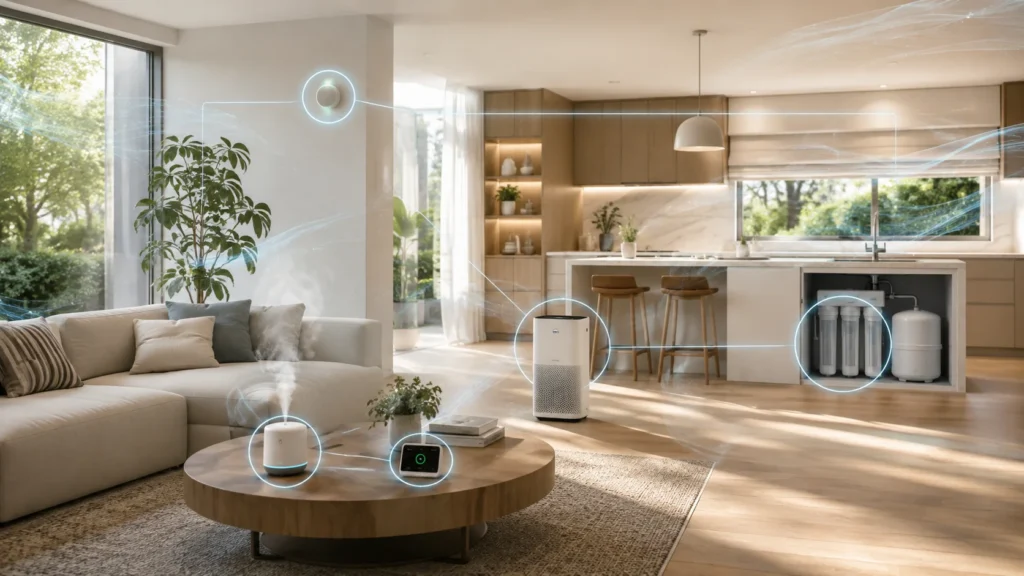
Modern living room and kitchen with smart home air quality devices including an air purifier, humidifier, and water filtration system, connected with visualized blue connectivity lines.

IFA 2026: Air Purification Is Becoming Part of the Healthy-Home Platform

Pre-IFA Industry Perspective | September 4, 2026 This article is based on official announcements and regulatory information available ahead of IFA 2026, which takes place ...
Notizie
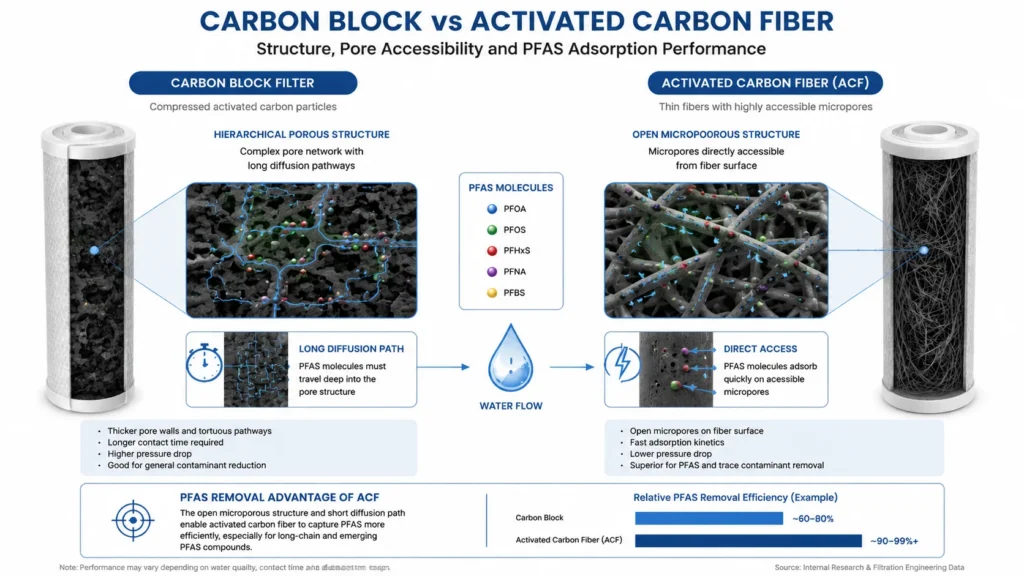
Comparison infographic showcasing the differences between carbon block filter and activated carbon fiber. Detailed diagrams illustrate the hierarchical porous structure of the carbon block with long diffusion paths and the open microporous structure of the activated carbon fiber with direct access for PFAS adsorption.

Carbon Block vs. Activated Carbon Fiber (ACF): Matching Media to Target Contaminants

Two carbon media. Same adsorption chemistry. Very different behaviour in a point-of-use cartridge. If you are specifying a water purifier platform for a PFAS-aware market, ...
Notizie
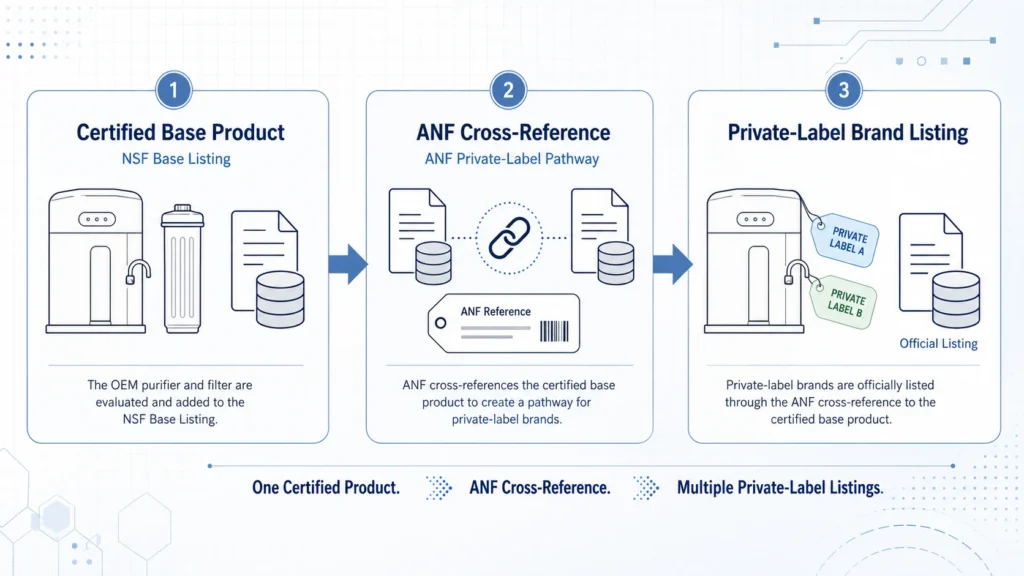
NSF base listing and ANF private-label certification pathway for OEM water filters

What Is an NSF Master Listing? A Guide to Base Listings, ANF Certification and OEM Water Filters

For a brand preparing to launch an OEM water purifier, one of the most common supplier claims is: “We already have an NSF master listing, ...
News, Water Purifiers
Healthy-home brand team reviewing PFAS water filter certification, test data and product engineering

Entering the Water Category Is Easy. Building a Credible PFAS Claim Is Much Harder

For air purification, appliance and healthy-home brands, entering the water category can look surprisingly easy. A company can select an existing undersink system, customize its ...
Notizie
Team in a business meeting discussing a water filtration system with product components and a comparison table displayed on a screen.

5 Leading OEM Water Purifier Manufacturers in China for Private Label Brands

China has thousands of companies selling water filters, reverse osmosis systems and drinking-water appliances. However, only a portion of them are suitable for private-label, OEM ...
Notizie
Contaminant Engineering•3 min read

PFAS Water Filtration Technologies Explained: Carbon, Resin & RO

Key Takeaway:

PFAS reduction depends on the specific compounds present, treatment media, contact time, water chemistry, and system design. Activated carbon, ion exchange, and Reverse Osmosis address PFAS through different mechanisms.

PFAS are a large family of persistent fluorinated compounds that can occur in drinking-water supplies. Their treatment behavior varies significantly by molecular structure, chain length, functional group, concentration, and the chemistry of the source water.

Granular Activated Carbon (GAC) removes PFAS primarily through adsorption. It is generally more effective for many longer-chain PFAS, while shorter-chain compounds tend to break through more quickly. Carbon performance depends on media properties, Empty Bed Contact Time (EBCT), competing organic matter, loading, and replacement frequency.

Ion-exchange resins use charged functional sites to capture many PFAS compounds. Properly selected anion-exchange media can provide high capacity and may perform better than conventional activated carbon for some shorter-chain PFAS, although performance still depends on water chemistry and competing ions.

Reverse Osmosis (RO) uses membrane separation rather than adsorption. Properly designed RO systems can provide broad reduction across many PFAS compounds as well as dissolved salts and other contaminants. Unlike carbon or resin, however, RO also produces a concentrate stream that must be managed.

No single technology should be selected from a PFAS label alone. System design should consider which PFAS compounds are present, their concentrations, required reduction targets, flow rate, media life, and the applicable third-party certification or validation requirements.

HisoAir Water Technical Series
Product Discovery•3 min read

How to Choose an Under-Sink Water Purifier for Modern Kitchens

Key Takeaway:

Match the treatment technology to your water quality first, then evaluate cabinet space, faucet configuration, flow rate, drain and power requirements, and filter replacement needs.

Choosing an under-sink water purifier starts with water chemistry. Carbon filtration is well suited to chlorine, taste, odor, and many organic contaminants, while Reverse Osmosis is more appropriate when dissolved salts, fluoride, nitrates, or broader dissolved contaminants need to be reduced.

For compact kitchens, tankless RO systems eliminate the conventional storage tank and can significantly reduce the space required under the sink. However, membrane capacity stated in GPD does not directly equal faucet flow. When comparing systems, check the actual dispensing flow rate, inlet-pressure requirement, recovery ratio, and whether a booster pump is required.

Installation architecture also matters. Many RO systems require a drain connection, electrical power, and either a dedicated drinking-water faucet or a compatible multi-function faucet. High-flow carbon systems can often connect directly to the existing cold-water line with a simpler installation, but pressure drop and available faucet flow should still be verified.

RO also removes much of the naturally occurring dissolved mineral content. Where taste or mineral balance is a priority, a post-RO remineralization stage can be added. Filter life should be evaluated by both rated capacity and local water quality rather than replacement time alone.

The right system is therefore not simply the smallest or highest-GPD model. It is the configuration that matches the target contaminants, available cabinet space, desired faucet setup, peak dispensing demand, and maintenance expectations.

HisoAir Water Technical Series
Water Quality•2 min read

What Does TDS Mean in Drinking Water? Measurement vs Contaminant Reality

Key Takeaway:

A TDS meter estimates the overall concentration of dissolved ionic substances from electrical conductivity. It cannot identify specific contaminants or determine whether water is chemically safe.

Total Dissolved Solids (TDS) refers to the combined concentration of dissolved substances in water. Most handheld TDS meters do not measure TDS directly. Instead, they measure electrical conductivity (EC) and convert that reading into an estimated parts-per-million (ppm) value.

This means a TDS reading can indicate how much dissolved ionic material is present, but not what that material actually is. Calcium, magnesium, sodium, nitrates, and other dissolved ions can all contribute to conductivity, yet a simple TDS meter cannot distinguish between them.

TDS meters are also not suitable for detecting trace contaminants such as PFAS, many VOCs, pesticides, pharmaceuticals, or disinfection byproducts. These substances may be present at concentrations far below the level needed to noticeably change electrical conductivity.

A low TDS reading therefore does not guarantee safe drinking water, and a higher TDS reading does not automatically indicate contamination. Water-treatment decisions should be based on laboratory testing for specific contaminants of concern rather than TDS alone.

HisoAir Water Technical Series
Technology Selection•2 min read

RO vs UF Water Filtration: Understanding Pore Sizes & Dissolved Minerals

Key Takeaway:

Ultrafiltration can reduce bacteria, turbidity, and suspended particles while retaining most naturally occurring dissolved minerals. Reverse Osmosis provides much broader reduction of dissolved salts and smaller contaminants.

Ultrafiltration (UF) typically uses hollow-fiber membranes with pore sizes in the approximate 0.01–0.1 micron range. These membranes physically retain turbidity, suspended solids, colloids, and many microorganisms while allowing dissolved minerals and salts to remain in the water.

Reverse Osmosis (RO) operates at a much finer separation level. Unlike UF, RO can substantially reduce dissolved ions such as sodium, calcium, fluoride, nitrates, and other contributors to total dissolved solids (TDS). This makes RO more suitable when dissolved-salt reduction is a primary treatment objective.

UF generally requires less system pressure and produces little or no continuous concentrate stream in many point-of-use configurations. RO typically requires greater pressure and produces a reject-water stream, but delivers broader contaminant reduction.

For water with acceptable TDS and mineral content, UF can be a simpler mineral-retaining treatment option. Where dissolved salts, fluoride, nitrates, or broader dissolved contaminants are a concern, RO is generally the more appropriate technology.

HisoAir Water Technical Series
Technology Selection•4 min read

Carbon Block vs Reverse Osmosis: Which Fits Your Need?

Key Takeaway:

Choose RO for dissolved inorganic salts and heavy metals; choose Carbon Block for chemical taste/odor, no wastewater, and high line-pressure flow.

Reverse Osmosis (RO) and Carbon Block filtration represent two fundamentally different treatment methods: membrane separation and adsorption. Understanding these differences helps determine which technology is better suited to a specific water-quality requirement.

Reverse Osmosis uses a semi-permeable membrane with pore sizes of approximately 0.0001 microns. It can significantly reduce dissolved inorganic contaminants such as TDS, fluoride, nitrates, and certain heavy metals. Because water must be forced through the membrane, RO systems require sufficient pressure or a booster pump and generate a concentrated wastewater stream.

Carbon Block filtration relies primarily on adsorption through compressed activated carbon, commonly with nominal pore sizes around 0.5–5 microns. It is highly effective for chlorine, chloramines, VOCs, taste, and odor, while allowing substantially higher direct-flow rates without producing wastewater.

From an operating perspective, Carbon Block systems are generally simpler, require less energy, and avoid the water loss associated with RO. RO involves higher system complexity and operating cost, but provides substantially broader reduction of dissolved contaminants that Carbon Block alone cannot address.

HisoAir Water Technical Series

RICHIEDI UN PREVENTIVO