

Si apre in una nuova scheda
Soluzioni innovative per la qualità dell'aria

Why Wall-Mounted Air Purifiers Fit Bedrooms and Home Offices Better

wall mounted air purifier in modern home office

Spring pollen can make indoor environments feel uncomfortable, especially in bedrooms and home offices where people spend long periods of time. Many people notice the impact of seasonal particles when working or resting indoors. Purificatori d'aria a parete can be a practical option for bedrooms and home offices where floor space is limited.

Wall-mounted air purifiers work better because they capture floating pollen at breathing height before it settles. They free up floor space, avoid sucking up heavy floor dust, and create a clean air pocket right where you sleep or design molds, without overworking your main HVAC system.

clean air pocket in bedroom

Central HVAC systems and room air purifiers serve different purposes. HVAC filtration supports the broader home system, while a room purifier is usually chosen for a specific room such as a bedroom or home office.Understanding placement can help explain why wall-mounted units are often chosen for compact rooms.

Standard HVAC filters are designed primarily to protect the heating and cooling machinery, not to purify indoor air of fine allergens.Vero

Standard fiberglass HVAC filters catch large dust particles to keep the system clean, but they allow ultra-fine particles like pollen to pass through.

A central AC unit alone is enough to remove all spring pollen from a home office.Falso

Central AC units do not run constantly, and their standard filters cannot trap fine pollen effectively. Targeted air purifiers are needed for clean air.

What Are The Hidden Airflow Challenges in Bedrooms and Home Offices?

In bedrooms and home offices, furniture can influence how air moves through the room.Wall-mounted units operate above many common obstacles and may allow a more open airflow path in compact rooms.

Bedrooms and home offices have hidden airflow challenges because bulky furniture blocks floor-level air circulation. Wall-mounted purifiers sit above these obstacles, ensuring clean air reaches your breathing zone directly.

airflow diagram showing blocked floor purifier

Room-Level Air Purification and HVAC Systems

You might think your central AC unit handles all indoor air quality needs. This is a common misconception. Standard HVAC filters protect the machinery. They do not capture ultra-fine spring pollen. A wall-mounted air purifier acts as a targeted supplement. You place it in your bedroom or home office. This creates a localized clean air pocket where you need it most. It does this without overworking your home’s main heating and cooling system. I see many designers put floor purifiers behind their desks. The desk blocks the clean air. The purifier just cleans the back of the desk. A wall-mounted unit sits high up. It blows clean air over your monitors.

System Type Primary Purpose Airflow Obstacles
Central HVAC Temperature control and machine protection Ducts and closed doors
Floor Purifier General room cleaning Desks, beds, and chairs
Wall Purifier Targeted clean air pocket None (mounted high)

Furniture can block the airflow of floor-standing air purifiers.Vero

Solid objects like beds and desks disrupt the intake and exhaust of air purifiers placed on the floor, reducing their efficiency.

Wall-mounted air purifiers replace the need for a central HVAC system.Falso

Wall-mounted purifiers supplement the HVAC system by targeting specific rooms. They do not provide heating or cooling.

Why Installation Height Can Influence Airflow Paths

Small airborne particles can remain suspended in indoor air for extended periods depending on air movement. Floor units miss these light particles. Mounting your purifier higher catches pollen right where you breathe.

Placement height matters because ultra-fine pollen floats at breathing level. A wall-mounted purifier captures these light particles before they fall, while floor units mostly suck up heavy dust near the ground.

particle physics diagram showing floating pollen

Targeting the Breathing Zone

Physics plays a big role in air quality. Heavy particles fall to the floor quickly. Light particles float in the air for a long time. Spring pollen is very light. It floats right at the height of your nose and mouth. A floor purifier pulls air from the ground. It misses the floating pollen. A wall-mounted purifier typically operates higher on the wall, which may help avoid some of the airflow obstruction found near the floor.I learned about particle physics when I worked in a mold factory. Dust behaves the same way. You want the exhaust fans near the dust source. The same rule applies to your home office. You want the purifier near your breathing zone. It helps you design better plastic components.

Tipo di particelle Peso Settling Location Best Purifier Placement
Pet Hair Heavy Piano Piano
Large Dust Medio Floor and Furniture Floor or Wall
Spring Pollen Very Light Floating in Air Wall (Breathing Height)

Ultra-fine particles like pollen can remain suspended in the air for hours.Vero

Due to their low mass, fine allergens are easily kept aloft by normal indoor air currents and take a long time to settle.

Floor purifiers are the best choice for catching floating pollen.Falso

Floor purifiers primarily draw air from the lower part of the room, making them less effective at catching light particles suspended higher up.

How Do You Get Unrestricted Circulation for Maximum CADR Efficiency?

Even a purifier with strong specifications may perform differently depending on room layout and placement.Wall mounting can provide a more open placement area in some room layouts.

You get maximum CADR efficiency by placing the purifier high on a wall. This position provides unrestricted 360-degree air circulation, allowing the machine to cycle the room's air much faster.

purifier CADR efficiency chart

Leveraging IoT for Hands-Free Air Management

CADR stands for Clean Air Delivery Rate. It measures how fast a purifier cleans the air. A blocked purifier has a low CADR. A wall-mounted purifier has a high CADR because nothing blocks it. Modern filtration technologies have evolved far beyond manual dials. You can integrate your wall-mounted unit with smart home ecosystems. This is called IoT. IoT ensures your environment is ready before you even enter the room. You can set schedules on your phone. Users may schedule operating times through app or smart control features if available. You can turn it up .This ensures the air is fully cycled. You do not have to interrupt your routine to adjust settings. You can keep working on your CAD tools.

Metodo di controllo User Effort Efficienza
Manual Dials Alto Low (often forgotten)
Telecomando Medio Medio
IoT Scheduling Zero High (always ready)

Placing an air purifier in a tight corner reduces its Clean Air Delivery Rate (CADR).Vero

Air purifiers need open space around their intakes and exhausts to move air efficiently. Corners restrict this airflow.

IoT integration makes the physical filter inside the purifier last longer.Falso

IoT integration allows for smart scheduling and convenience, but it does not change the physical capacity or lifespan of the filter media.

Extending Filter Life: How Do You Avoid the Floor-Level "Vacuum Effect"?

Floor-level placement can expose a purifier to pet hair, lint, and heavier dust near the ground. Your expensive HEPA filter clogs fast. Mounting the unit higher may reduce contact with heavier floor-level debris.

You avoid the floor-level vacuum effect by mounting the purifier on the wall. This keeps the unit away from heavy floor dust and hair, which extends the life of your HEPA filter.

clogged filter vs clean filter comparison

Reducing Maintenance Costs

I know you want to reduce costs in your manufacturing projects. You should reduce costs at home, too. HEPA filters are expensive. Floor purifiers act like vacuum cleaners. They suck up dog hair, shoe dirt, and heavy dust. This clogs the filter very quickly. You have to buy a new filter every few months. A wall-mounted purifier avoids this problem. It sits high above the heavy dirt. It only catches the fine particles like pollen and smoke. This extends the life of your filter. You also save time because you change the filter less often for large-scale production. You should optimize your home office for long-term efficiency. A wall-mounted purifier is a smart investment.

Purifier Placement Main Contaminants Caught Durata del filtro Replacement Cost
Piano Hair, heavy dust, dirt 3 to 6 months Alto
Wall Pollen, smoke, fine dust 8 to 12 months Basso

Floor-standing air purifiers tend to draw in heavier floor debris like pet hair.Vero

Because their intakes are close to the ground, floor models easily pull in heavy particles that settle on the floor.

HEPA filters can be washed and reused indefinitely.Falso

True HEPA filters are made of delicate fibers that get damaged by water. They must be replaced when clogged.

Minimalist Design: How Do You Achieve Zero Floor Clutter for Compact Spaces?

Floor purifiers take up valuable space. In compact rooms, floor appliances can compete with existing furniture and cables. Wall-mounted units help keep the floor area available for movement and furniture.

You achieve zero floor clutter by hanging your air purifier on the wall like a picture frame. This minimalist design frees up floor space and removes tripping hazards in compact rooms.

minimalist home office with wall purifier

Installation Quality and Noise Perception

Space is important in a home office. You need room for your chair and your reference materials. A wall-mounted purifier gives you that space back. But there is another hidden benefit. When you transition from a floor model to a wall-mounted unit, sound dynamics change. Floor units send vibrations directly into the floorboards. This creates a low-frequency hum. It can distract you from your work. It can keep you awake at night. Wall-mounted purifiers produce a more dispersed, ambient white noise. You must anchor them securely to the wall studs. For a more comfortable room setup, mount the unit a few feet away from your headboard or desk chair. This optimizes the balance between airflow efficiency and whisper-quiet operation. You get a quiet room and clean air.

Posizionamento Vibration Transfer Noise Type Impact on Focus
Piano High (into floorboards) Low-frequency hum Distracting
Wall (on drywall) Medio Rattle Annoying
Wall (on stud) Basso Ambient white noise Calming

Mounting an appliance directly to a wall stud reduces vibration noise compared to mounting it only on drywall.Vero

Wall studs provide a solid anchor that absorbs vibrations, whereas hollow drywall can act like a drum and amplify sound.

Wall-mounted air purifiers produce zero noise.Falso

All air purifiers use fans to move air, which generates some level of noise, though wall mounting can change the acoustic profile to a more pleasant white noise.

Conclusione

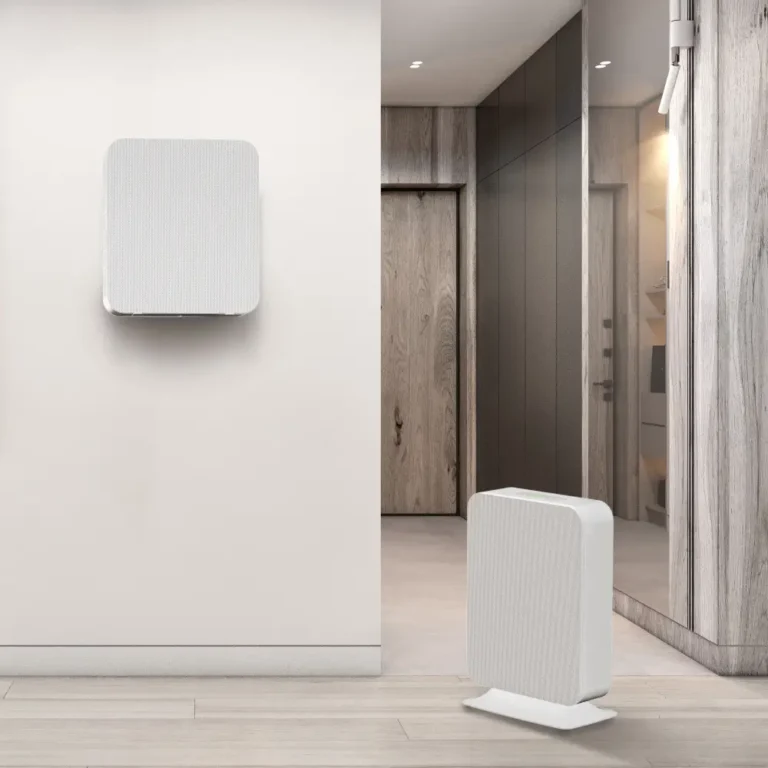
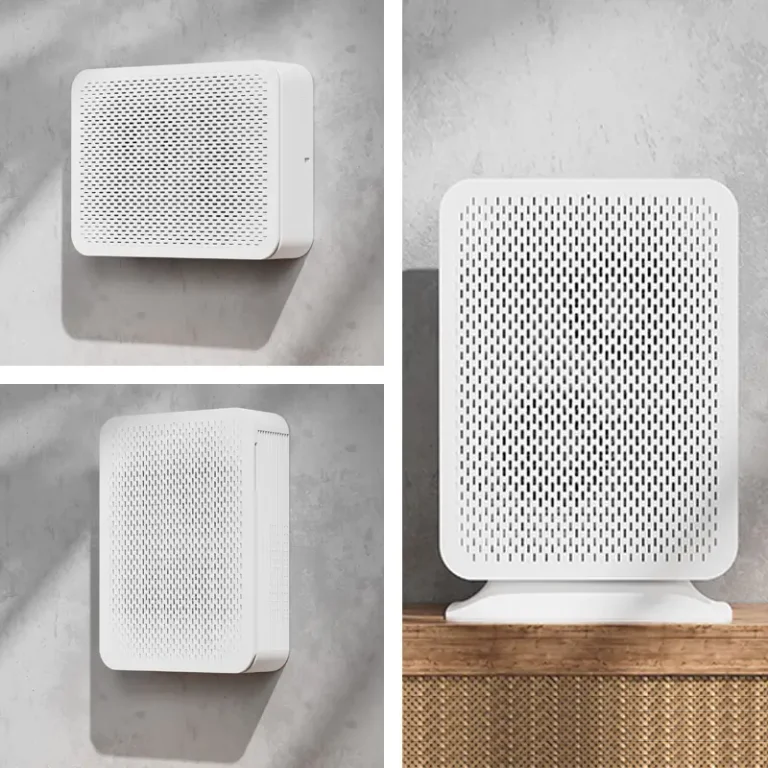
Wall-mounted air purifiers optimize airflow, save floor space, and reduce noise. They help create a cleaner airflow path, reduce floor clutter, and fit naturally into compact bedrooms and home office layouts.

References


Condividi:
il fondatore di hisoair, il signor lee
Alwen Lee, an air purification expert with over 10 years of experience, is a devoted father of two and a passionate traveler, having explored more than 30 countries. With a love for public speaking and swimming, he has dedicated his life to the indoor air quality industry. His mission is to ensure that people around the world enjoy the freedom to breathe clean air and lead happy, healthy lives.

Inviaci un messaggio

Altro da leggere

Modern living room with a family enjoying a healthy indoor environment monitored by smart devices, natural lighting, and greenery.

After IFA 2026: The Healthy Home Is Moving Beyond Smart Devices

In our previous IFA 2026 column, Air Purification Is Becoming Part of the Healthy-Home Platform, we argued that the next generation of indoor-health products would ...
Notizie
Modern living room and kitchen with smart home air quality devices including an air purifier, humidifier, and water filtration system, connected with visualized blue connectivity lines.

IFA 2026: Air Purification Is Becoming Part of the Healthy-Home Platform

Pre-IFA Industry Perspective | September 4, 2026 This article is based on official announcements and regulatory information available ahead of IFA 2026, which takes place ...
Notizie
Comparison infographic showcasing the differences between carbon block filter and activated carbon fiber. Detailed diagrams illustrate the hierarchical porous structure of the carbon block with long diffusion paths and the open microporous structure of the activated carbon fiber with direct access for PFAS adsorption.

Carbon Block vs. Activated Carbon Fiber (ACF): Matching Media to Target Contaminants

Two carbon media. Same adsorption chemistry. Very different behaviour in a point-of-use cartridge. If you are specifying a water purifier platform for a PFAS-aware market, ...
Notizie
NSF base listing and ANF private-label certification pathway for OEM water filters

What Is an NSF Master Listing? A Guide to Base Listings, ANF Certification and OEM Water Filters

For a brand preparing to launch an OEM water purifier, one of the most common supplier claims is: “We already have an NSF master listing, ...
News, Water Purifiers
Healthy-home brand team reviewing PFAS water filter certification, test data and product engineering

Entering the Water Category Is Easy. Building a Credible PFAS Claim Is Much Harder

For air purification, appliance and healthy-home brands, entering the water category can look surprisingly easy. A company can select an existing undersink system, customize its ...
Notizie
Team in a business meeting discussing a water filtration system with product components and a comparison table displayed on a screen.

5 Leading OEM Water Purifier Manufacturers in China for Private Label Brands

China has thousands of companies selling water filters, reverse osmosis systems and drinking-water appliances. However, only a portion of them are suitable for private-label, OEM ...
Notizie
Contaminant Engineering•3 min read

PFAS Water Filtration Technologies Explained: Carbon, Resin & RO

Key Takeaway:

PFAS reduction depends on the specific compounds present, treatment media, contact time, water chemistry, and system design. Activated carbon, ion exchange, and Reverse Osmosis address PFAS through different mechanisms.

PFAS are a large family of persistent fluorinated compounds that can occur in drinking-water supplies. Their treatment behavior varies significantly by molecular structure, chain length, functional group, concentration, and the chemistry of the source water.

Granular Activated Carbon (GAC) removes PFAS primarily through adsorption. It is generally more effective for many longer-chain PFAS, while shorter-chain compounds tend to break through more quickly. Carbon performance depends on media properties, Empty Bed Contact Time (EBCT), competing organic matter, loading, and replacement frequency.

Ion-exchange resins use charged functional sites to capture many PFAS compounds. Properly selected anion-exchange media can provide high capacity and may perform better than conventional activated carbon for some shorter-chain PFAS, although performance still depends on water chemistry and competing ions.

Reverse Osmosis (RO) uses membrane separation rather than adsorption. Properly designed RO systems can provide broad reduction across many PFAS compounds as well as dissolved salts and other contaminants. Unlike carbon or resin, however, RO also produces a concentrate stream that must be managed.

No single technology should be selected from a PFAS label alone. System design should consider which PFAS compounds are present, their concentrations, required reduction targets, flow rate, media life, and the applicable third-party certification or validation requirements.

HisoAir Water Technical Series
Product Discovery•3 min read

How to Choose an Under-Sink Water Purifier for Modern Kitchens

Key Takeaway:

Match the treatment technology to your water quality first, then evaluate cabinet space, faucet configuration, flow rate, drain and power requirements, and filter replacement needs.

Choosing an under-sink water purifier starts with water chemistry. Carbon filtration is well suited to chlorine, taste, odor, and many organic contaminants, while Reverse Osmosis is more appropriate when dissolved salts, fluoride, nitrates, or broader dissolved contaminants need to be reduced.

For compact kitchens, tankless RO systems eliminate the conventional storage tank and can significantly reduce the space required under the sink. However, membrane capacity stated in GPD does not directly equal faucet flow. When comparing systems, check the actual dispensing flow rate, inlet-pressure requirement, recovery ratio, and whether a booster pump is required.

Installation architecture also matters. Many RO systems require a drain connection, electrical power, and either a dedicated drinking-water faucet or a compatible multi-function faucet. High-flow carbon systems can often connect directly to the existing cold-water line with a simpler installation, but pressure drop and available faucet flow should still be verified.

RO also removes much of the naturally occurring dissolved mineral content. Where taste or mineral balance is a priority, a post-RO remineralization stage can be added. Filter life should be evaluated by both rated capacity and local water quality rather than replacement time alone.

The right system is therefore not simply the smallest or highest-GPD model. It is the configuration that matches the target contaminants, available cabinet space, desired faucet setup, peak dispensing demand, and maintenance expectations.

HisoAir Water Technical Series
Water Quality•2 min read

What Does TDS Mean in Drinking Water? Measurement vs Contaminant Reality

Key Takeaway:

A TDS meter estimates the overall concentration of dissolved ionic substances from electrical conductivity. It cannot identify specific contaminants or determine whether water is chemically safe.

Total Dissolved Solids (TDS) refers to the combined concentration of dissolved substances in water. Most handheld TDS meters do not measure TDS directly. Instead, they measure electrical conductivity (EC) and convert that reading into an estimated parts-per-million (ppm) value.

This means a TDS reading can indicate how much dissolved ionic material is present, but not what that material actually is. Calcium, magnesium, sodium, nitrates, and other dissolved ions can all contribute to conductivity, yet a simple TDS meter cannot distinguish between them.

TDS meters are also not suitable for detecting trace contaminants such as PFAS, many VOCs, pesticides, pharmaceuticals, or disinfection byproducts. These substances may be present at concentrations far below the level needed to noticeably change electrical conductivity.

A low TDS reading therefore does not guarantee safe drinking water, and a higher TDS reading does not automatically indicate contamination. Water-treatment decisions should be based on laboratory testing for specific contaminants of concern rather than TDS alone.

HisoAir Water Technical Series
Technology Selection•2 min read

RO vs UF Water Filtration: Understanding Pore Sizes & Dissolved Minerals

Key Takeaway:

Ultrafiltration can reduce bacteria, turbidity, and suspended particles while retaining most naturally occurring dissolved minerals. Reverse Osmosis provides much broader reduction of dissolved salts and smaller contaminants.

Ultrafiltration (UF) typically uses hollow-fiber membranes with pore sizes in the approximate 0.01–0.1 micron range. These membranes physically retain turbidity, suspended solids, colloids, and many microorganisms while allowing dissolved minerals and salts to remain in the water.

Reverse Osmosis (RO) operates at a much finer separation level. Unlike UF, RO can substantially reduce dissolved ions such as sodium, calcium, fluoride, nitrates, and other contributors to total dissolved solids (TDS). This makes RO more suitable when dissolved-salt reduction is a primary treatment objective.

UF generally requires less system pressure and produces little or no continuous concentrate stream in many point-of-use configurations. RO typically requires greater pressure and produces a reject-water stream, but delivers broader contaminant reduction.

For water with acceptable TDS and mineral content, UF can be a simpler mineral-retaining treatment option. Where dissolved salts, fluoride, nitrates, or broader dissolved contaminants are a concern, RO is generally the more appropriate technology.

HisoAir Water Technical Series
Technology Selection•4 min read

Carbon Block vs Reverse Osmosis: Which Fits Your Need?

Key Takeaway:

Choose RO for dissolved inorganic salts and heavy metals; choose Carbon Block for chemical taste/odor, no wastewater, and high line-pressure flow.

Reverse Osmosis (RO) and Carbon Block filtration represent two fundamentally different treatment methods: membrane separation and adsorption. Understanding these differences helps determine which technology is better suited to a specific water-quality requirement.

Reverse Osmosis uses a semi-permeable membrane with pore sizes of approximately 0.0001 microns. It can significantly reduce dissolved inorganic contaminants such as TDS, fluoride, nitrates, and certain heavy metals. Because water must be forced through the membrane, RO systems require sufficient pressure or a booster pump and generate a concentrated wastewater stream.

Carbon Block filtration relies primarily on adsorption through compressed activated carbon, commonly with nominal pore sizes around 0.5–5 microns. It is highly effective for chlorine, chloramines, VOCs, taste, and odor, while allowing substantially higher direct-flow rates without producing wastewater.

From an operating perspective, Carbon Block systems are generally simpler, require less energy, and avoid the water loss associated with RO. RO involves higher system complexity and operating cost, but provides substantially broader reduction of dissolved contaminants that Carbon Block alone cannot address.

HisoAir Water Technical Series

RICHIEDI UN PREVENTIVO





