

Si apre in una nuova scheda
Soluzioni innovative per la qualità dell'aria

Understanding NSF Certification for Water Purifiers: A Guide for D2C Startups

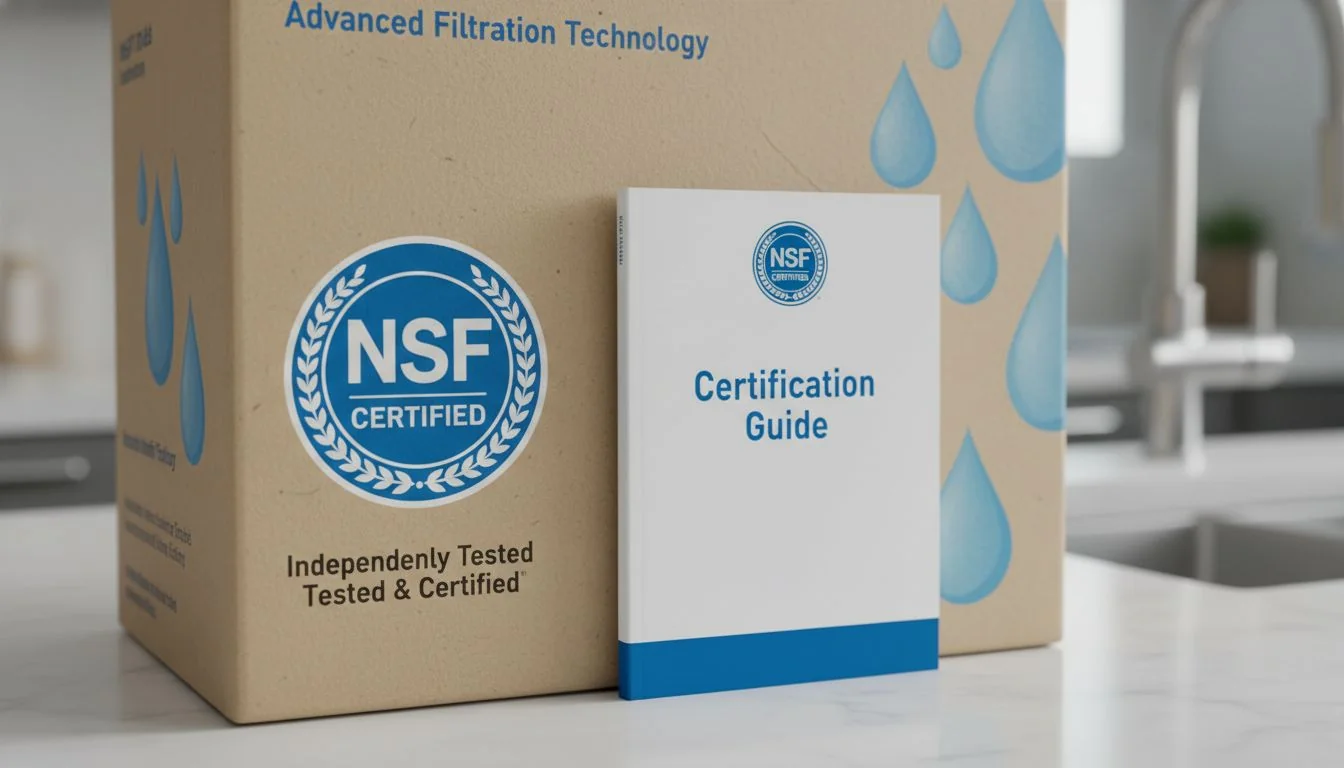
NSF certification seal on water purifier packaging

You design a beautiful water purifier, but customers hesitate to buy it. They worry about safety and contaminants. Without proof of performance, your sleek design is just another plastic box.

NSF Certification1 is the validation that your water treatment product meets strict public health standards. It proves your device removes specific contaminants like lead or chlorine. For startups, this certification is not just a safety badge; it is the primary tool to build trust and justify a premium price point.
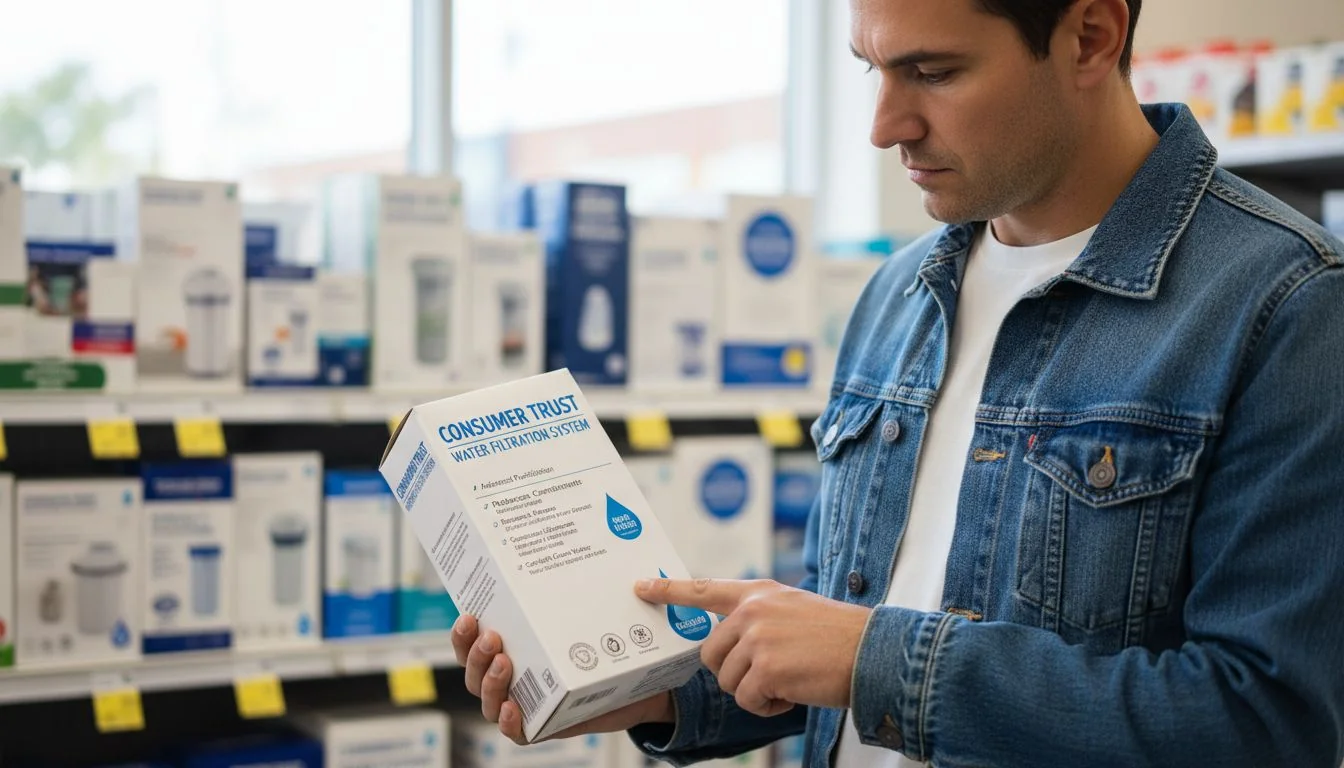
Consumer checking water filter label in store

I have seen many talented designers like you create amazing enclosures, only to fail in the market because they ignored the filtration science. I want to help you avoid that mistake.

NSF International is an independent organization that develops public health standards.Vero

NSF is a globally recognized third-party organization.

NSF certification is mandatory for all water purifiers sold in North America.Falso

It is voluntary, though highly recommended for market acceptance and some state regulations.

Why is Trust Your Most Expensive Asset?

Startups often focus heavily on aesthetics and mold design. However, a single report of bad water quality can destroy your brand overnight. You need a shield against liability.

Trust is the currency of the water industry. If a customer drinks water from your device, they are trusting you with their health. Certification acts as a "Compliance Shield2," protecting your company from liability and assuring customers that the water is safe to consume.
Shield icon protecting a water drop

In my years working with mold design and manufacturing, I have learned that function must precede form in the water industry. You can have the most ergonomic handle or the glossiest finish, but if the water tastes bad or contains lead, you fail. Startups are terrified of liability. They worry about making people sick. This is a valid fear.

By providing certified technology3, you are acting as a "Compliance Shield" for your brand. When you use certified components, you take the technical burden of performance off your shoulders. You allow your team to focus on branding and user experience. Think of certification as an insurance policy. It tells the customer that a third party has verified your claims. It shifts the conversation from "Does this work?" to "How does this fit my lifestyle?" This trust allows you to charge more and retain customers longer. Without it, you are fighting an uphill battle against established giants.

Certified products reduce the liability risk for manufacturers.Vero

Third-party validation proves due diligence in safety and performance.

Consumers trust uncertified brands as much as certified ones.Falso

Studies show consumers prefer products with independent verification of safety claims.

What is NSF and Why is it the Gold Standard?

You see many logos on packaging, but most mean nothing. NSF is different. It is the benchmark that separates professional equipment from cheap gadgets.

NSF International is an accredited, independent organization that tests and certifies products to verify they meet public health and safety standards. It is considered the "Gold Standard4" because it involves rigorous testing of materials, structural integrity, and contaminant reduction performance.
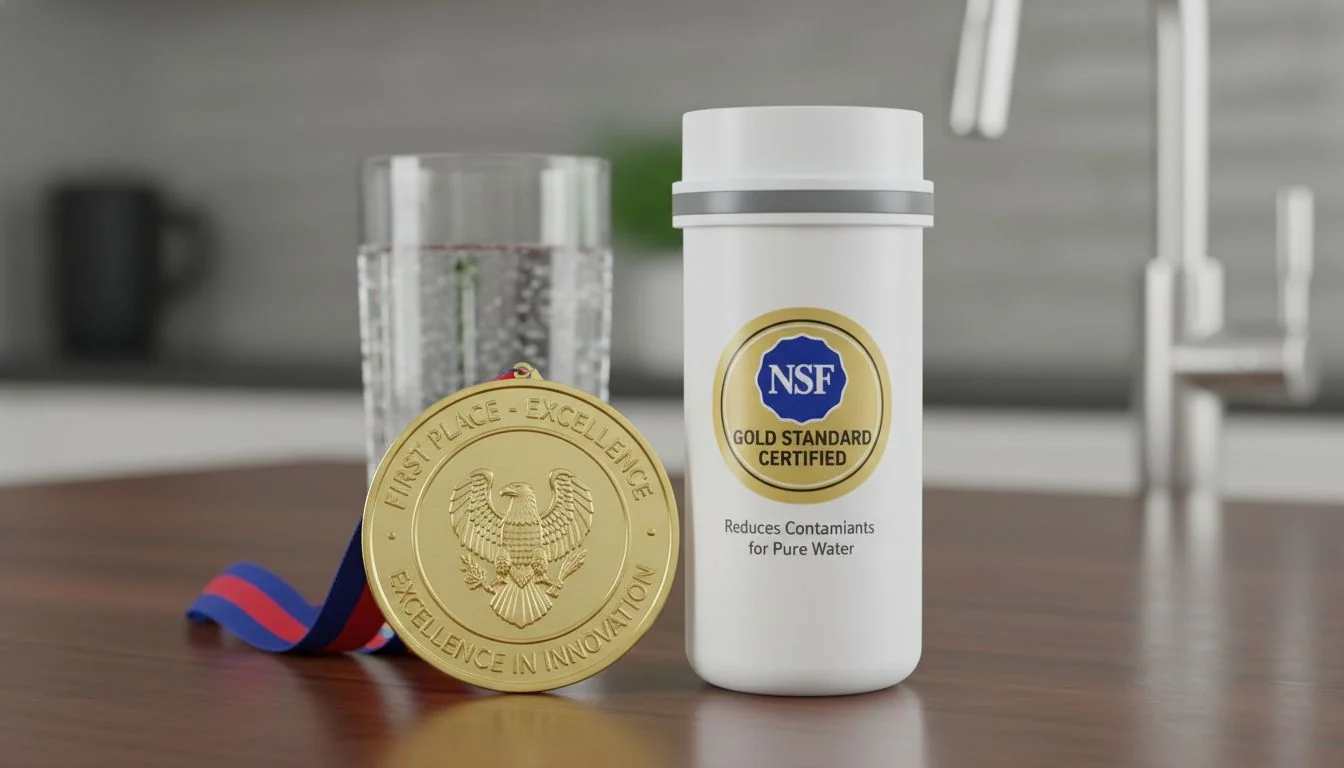
Gold medal next to a water filter cartridge

Let's get technical for a moment. As a designer, you know that materials matter. NSF certification goes beyond just testing the water. It tests the device itself. They check for material safety to ensure your plastic housing doesn't leach harmful chemicals into the water. They check structural integrity to ensure the housing won't burst under pressure.

There is a critical nuance here: "System" vs. "Component" certification. This is where I see many people get confused. You might buy an "NSF Certified Carbon Block" from a supplier. That is great. However, putting that block into your machine does not automatically make your whole machine certified. The housing, the tubing, and the flow rate all affect performance. To truly win, you need to navigate the path to full system compliance. This shows deep expertise. It proves that your entire engineering assembly works together to deliver safe water, not just one part of it.

NSF tests for material safety and structural integrity.Vero

Certification includes extraction testing and hydrostatic pressure testing.

Using a certified filter cartridge guarantees the whole system is certified.Falso

The entire system must be tested to ensure the housing and flow rate do not compromise performance.

How Do You Decode NSF 42, 53, and 58?

Numbers on a spec sheet can look boring. But in this industry, these numbers define your market positioning. Knowing the difference is your competitive advantage.

NSF 425 certifies the reduction of aesthetic impurities like chlorine taste and odor. NSF 53 certifies the reduction of health-related contaminants like lead and cysts. NSF 58 is specifically for Reverse Osmosis systems reducing total dissolved solids.
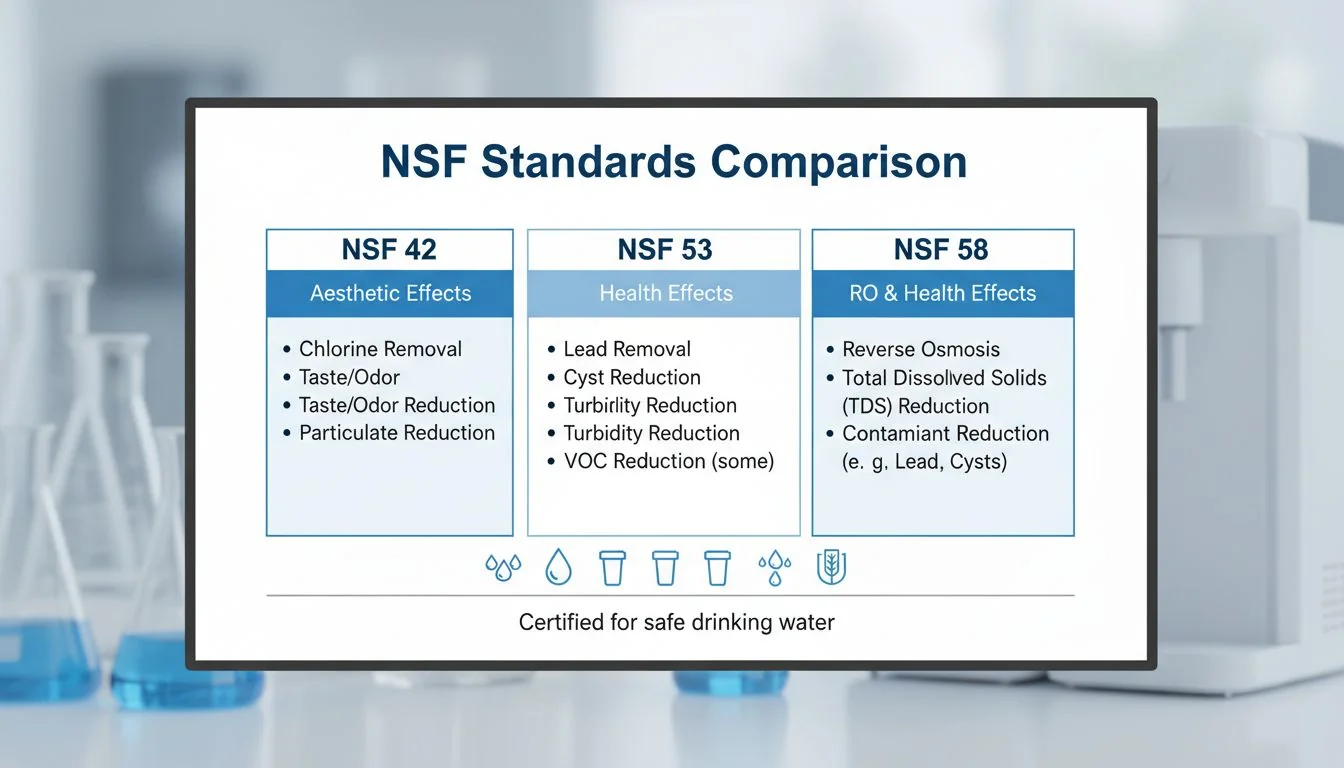
Comparison chart of NSF 42 53 and 58 standards

This is your most powerful upsell tool. You need to differentiate between "Taste" and "Health." Most cheap water pitchers you see at the grocery store only have NSF 42. This means they make the water taste better by removing chlorine. That is a "Lifestyle" product. It is nice to have, but not essential.

If you offer a product with NSF 536, you change the game. NSF 53 deals with health hazards like lead, volatile organic compounds (VOCs), and cysts. By meeting this standard, you immediately position your brand as "Medical-Grade." You are no longer competing with the cheap pitcher; you are competing with high-end health appliances. I always guide my clients to aim for NSF 53. It justifies a higher price tag.

Standard Focus Key Contaminants Posizionamento sul mercato
NSF 42 Estetica Chlorine, Taste, Odor Lifestyle / Basic
NSF 53 Health Effects Lead, Cysts, VOCs Medical-Grade / Premium
NSF 58 Reverse Osmosis Arsenic, Fluoride, TDS High-Performance

NSF 42 covers health-related contaminants like lead.Falso

NSF 42 is strictly for aesthetic effects like taste and odor.

NSF 53 is required for claims regarding lead reduction.Vero

Lead is a health contaminant covered under the NSF 53 standard.

Why Can't You Just Say "Removes Lead"?

Marketing teams love bold headlines. Legal teams hate them. If you make a claim without the data to back it up, you are walking into a trap.

You cannot legally claim a water filter "removes lead" without specific certification data to prove it. This is the "Claim Trap7." NSF certification allows you to use specific, provable headlines like "Certified to Remove 99% of Lead," which convert much better than vague promises.

Warning sign over a marketing claim

I treat NSF certification as a marketing weapon. Many startups make the mistake of using vague language. They say things like "Pure Water" or "Fresh Taste." These words are weak. They do not convince a mother who is worried about lead in her pipes.

When you have certification, you can use specific numbers. "Certified to Remove 99% of Lead" is a headline that stops people scrolling. It is a fact, not an opinion. This specific, provable claim converts customers at a much higher rate. It also keeps you safe from lawsuits. If you say you remove lead, and you don't have the NSF 53 badge, you are opening yourself up to false advertising claims. Do not test your luck. Use the certification to write your marketing copy for you. It turns your technical specs into your strongest sales pitch.

Specific claims like '99% lead removal' increase conversion rates.Vero

Specific, verifiable claims build higher trust than vague marketing terms.

You can claim lead removal based on internal testing alone.Falso

Regulatory bodies and retailers often require third-party certification for health claims.

Why is "Pre-Certified" Your Best Strategy?

Time is your most scarce resource. Developing a filter from scratch takes a year. You do not have that kind of time.

"Pre-Certified" filters are components that have already passed NSF testing. For a startup, using these is like a "Time Machine." It saves you 12 months of R&D and testing, allowing you to launch faster and generate revenue sooner.
Stopwatch showing time saved

For a startup, Time equals Money. Getting your own certification from scratch is a slow death. It involves months of back-and-forth with laboratories, failed tests, and re-engineering. It burns through your cash flow before you even sell a single unit.

This is where the "Pre-Certified" value proposition comes in. Position suppliers like Hisoair as your partner. Their Pre-Certified filters8 are a shortcut. You are not just buying a filter; you are buying speed. You are buying a year of development time. You can take their certified technology, wrap it in your beautiful design, and launch immediately. You get the "Medical-Grade" claims without the "Medical-Grade" wait time. This strategy allows you to test the market quickly. If the product succeeds, you can invest in custom filtration later. But to start, you must move fast.

Developing a custom certified filter can take over a year.Vero

The R&D, testing, and certification process is lengthy and iterative.

Using pre-certified components prevents you from branding the product.Falso

You can use pre-certified internal components inside your own branded housing design.

Conclusione

Don't gamble with health claims. Use NSF certification to build trust, justify premium pricing, and protect your brand. Leverage pre-certified tech to launch fast and dominate the market.


References


  1. Understanding NSF Certification is crucial for ensuring your water purifier meets safety standards and builds consumer trust. ↩

  2. Learn how a Compliance Shield can safeguard your brand against liability and enhance customer trust. ↩

  3. Exploring certified technology can help you leverage existing solutions to enhance your product's credibility and performance. ↩

  4. Discover why NSF's rigorous testing makes it the benchmark for quality and safety in water treatment. ↩

  5. Understanding NSF 42 helps you position your product effectively in the market by focusing on aesthetic improvements. ↩

  6. NSF 53 certification is vital for ensuring your product addresses serious health risks, enhancing its market appeal. ↩

  7. Avoiding the Claim Trap is essential for legal compliance and effective marketing of your water purification claims. ↩

  8. Pre-Certified filters can significantly reduce time to market, allowing startups to launch faster and more efficiently. ↩

Condividi:
il fondatore di hisoair, il signor lee
Alwen Lee, an air purification expert with over 10 years of experience, is a devoted father of two and a passionate traveler, having explored more than 30 countries. With a love for public speaking and swimming, he has dedicated his life to the indoor air quality industry. His mission is to ensure that people around the world enjoy the freedom to breathe clean air and lead happy, healthy lives.

Inviaci un messaggio

Altro da leggere

Modern living room with a family enjoying a healthy indoor environment monitored by smart devices, natural lighting, and greenery.

After IFA 2026: The Healthy Home Is Moving Beyond Smart Devices

In our previous IFA 2026 column, Air Purification Is Becoming Part of the Healthy-Home Platform, we argued that the next generation of indoor-health products would ...
Notizie
Modern living room and kitchen with smart home air quality devices including an air purifier, humidifier, and water filtration system, connected with visualized blue connectivity lines.

IFA 2026: Air Purification Is Becoming Part of the Healthy-Home Platform

Pre-IFA Industry Perspective | September 4, 2026 This article is based on official announcements and regulatory information available ahead of IFA 2026, which takes place ...
Notizie
Comparison infographic showcasing the differences between carbon block filter and activated carbon fiber. Detailed diagrams illustrate the hierarchical porous structure of the carbon block with long diffusion paths and the open microporous structure of the activated carbon fiber with direct access for PFAS adsorption.

Carbon Block vs. Activated Carbon Fiber (ACF): Matching Media to Target Contaminants

Two carbon media. Same adsorption chemistry. Very different behaviour in a point-of-use cartridge. If you are specifying a water purifier platform for a PFAS-aware market, ...
Notizie
Comparison between PFAS-ready and PFAS-certified water filters, showing internal filter components and certification steps.

PFAS-Ready vs. PFAS-Certified Water Filters: Engineering Differences for OEM Brands

For an appliance, wellness or healthy-home brand preparing to launch a water purifier, the phrase “PFAS-ready” can sound reassuring. The proposed system may use activated ...
Water Purifiers
NSF base listing and ANF private-label certification pathway for OEM water filters

What Is an NSF Master Listing? A Guide to Base Listings, ANF Certification and OEM Water Filters

For a brand preparing to launch an OEM water purifier, one of the most common supplier claims is: “We already have an NSF master listing, ...
News, Water Purifiers
Healthy-home brand team reviewing PFAS water filter certification, test data and product engineering

Entering the Water Category Is Easy. Building a Credible PFAS Claim Is Much Harder

For air purification, appliance and healthy-home brands, entering the water category can look surprisingly easy. A company can select an existing undersink system, customize its ...
Notizie
Contaminant Engineering•3 min read

PFAS Water Filtration Technologies Explained: Carbon, Resin & RO

Key Takeaway:

PFAS reduction depends on the specific compounds present, treatment media, contact time, water chemistry, and system design. Activated carbon, ion exchange, and Reverse Osmosis address PFAS through different mechanisms.

PFAS are a large family of persistent fluorinated compounds that can occur in drinking-water supplies. Their treatment behavior varies significantly by molecular structure, chain length, functional group, concentration, and the chemistry of the source water.

Granular Activated Carbon (GAC) removes PFAS primarily through adsorption. It is generally more effective for many longer-chain PFAS, while shorter-chain compounds tend to break through more quickly. Carbon performance depends on media properties, Empty Bed Contact Time (EBCT), competing organic matter, loading, and replacement frequency.

Ion-exchange resins use charged functional sites to capture many PFAS compounds. Properly selected anion-exchange media can provide high capacity and may perform better than conventional activated carbon for some shorter-chain PFAS, although performance still depends on water chemistry and competing ions.

Reverse Osmosis (RO) uses membrane separation rather than adsorption. Properly designed RO systems can provide broad reduction across many PFAS compounds as well as dissolved salts and other contaminants. Unlike carbon or resin, however, RO also produces a concentrate stream that must be managed.

No single technology should be selected from a PFAS label alone. System design should consider which PFAS compounds are present, their concentrations, required reduction targets, flow rate, media life, and the applicable third-party certification or validation requirements.

HisoAir Water Technical Series
Product Discovery•3 min read

How to Choose an Under-Sink Water Purifier for Modern Kitchens

Key Takeaway:

Match the treatment technology to your water quality first, then evaluate cabinet space, faucet configuration, flow rate, drain and power requirements, and filter replacement needs.

Choosing an under-sink water purifier starts with water chemistry. Carbon filtration is well suited to chlorine, taste, odor, and many organic contaminants, while Reverse Osmosis is more appropriate when dissolved salts, fluoride, nitrates, or broader dissolved contaminants need to be reduced.

For compact kitchens, tankless RO systems eliminate the conventional storage tank and can significantly reduce the space required under the sink. However, membrane capacity stated in GPD does not directly equal faucet flow. When comparing systems, check the actual dispensing flow rate, inlet-pressure requirement, recovery ratio, and whether a booster pump is required.

Installation architecture also matters. Many RO systems require a drain connection, electrical power, and either a dedicated drinking-water faucet or a compatible multi-function faucet. High-flow carbon systems can often connect directly to the existing cold-water line with a simpler installation, but pressure drop and available faucet flow should still be verified.

RO also removes much of the naturally occurring dissolved mineral content. Where taste or mineral balance is a priority, a post-RO remineralization stage can be added. Filter life should be evaluated by both rated capacity and local water quality rather than replacement time alone.

The right system is therefore not simply the smallest or highest-GPD model. It is the configuration that matches the target contaminants, available cabinet space, desired faucet setup, peak dispensing demand, and maintenance expectations.

HisoAir Water Technical Series
Water Quality•2 min read

What Does TDS Mean in Drinking Water? Measurement vs Contaminant Reality

Key Takeaway:

A TDS meter estimates the overall concentration of dissolved ionic substances from electrical conductivity. It cannot identify specific contaminants or determine whether water is chemically safe.

Total Dissolved Solids (TDS) refers to the combined concentration of dissolved substances in water. Most handheld TDS meters do not measure TDS directly. Instead, they measure electrical conductivity (EC) and convert that reading into an estimated parts-per-million (ppm) value.

This means a TDS reading can indicate how much dissolved ionic material is present, but not what that material actually is. Calcium, magnesium, sodium, nitrates, and other dissolved ions can all contribute to conductivity, yet a simple TDS meter cannot distinguish between them.

TDS meters are also not suitable for detecting trace contaminants such as PFAS, many VOCs, pesticides, pharmaceuticals, or disinfection byproducts. These substances may be present at concentrations far below the level needed to noticeably change electrical conductivity.

A low TDS reading therefore does not guarantee safe drinking water, and a higher TDS reading does not automatically indicate contamination. Water-treatment decisions should be based on laboratory testing for specific contaminants of concern rather than TDS alone.

HisoAir Water Technical Series
Technology Selection•2 min read

RO vs UF Water Filtration: Understanding Pore Sizes & Dissolved Minerals

Key Takeaway:

Ultrafiltration can reduce bacteria, turbidity, and suspended particles while retaining most naturally occurring dissolved minerals. Reverse Osmosis provides much broader reduction of dissolved salts and smaller contaminants.

Ultrafiltration (UF) typically uses hollow-fiber membranes with pore sizes in the approximate 0.01–0.1 micron range. These membranes physically retain turbidity, suspended solids, colloids, and many microorganisms while allowing dissolved minerals and salts to remain in the water.

Reverse Osmosis (RO) operates at a much finer separation level. Unlike UF, RO can substantially reduce dissolved ions such as sodium, calcium, fluoride, nitrates, and other contributors to total dissolved solids (TDS). This makes RO more suitable when dissolved-salt reduction is a primary treatment objective.

UF generally requires less system pressure and produces little or no continuous concentrate stream in many point-of-use configurations. RO typically requires greater pressure and produces a reject-water stream, but delivers broader contaminant reduction.

For water with acceptable TDS and mineral content, UF can be a simpler mineral-retaining treatment option. Where dissolved salts, fluoride, nitrates, or broader dissolved contaminants are a concern, RO is generally the more appropriate technology.

HisoAir Water Technical Series
Technology Selection•4 min read

Carbon Block vs Reverse Osmosis: Which Fits Your Need?

Key Takeaway:

Choose RO for dissolved inorganic salts and heavy metals; choose Carbon Block for chemical taste/odor, no wastewater, and high line-pressure flow.

Reverse Osmosis (RO) and Carbon Block filtration represent two fundamentally different treatment methods: membrane separation and adsorption. Understanding these differences helps determine which technology is better suited to a specific water-quality requirement.

Reverse Osmosis uses a semi-permeable membrane with pore sizes of approximately 0.0001 microns. It can significantly reduce dissolved inorganic contaminants such as TDS, fluoride, nitrates, and certain heavy metals. Because water must be forced through the membrane, RO systems require sufficient pressure or a booster pump and generate a concentrated wastewater stream.

Carbon Block filtration relies primarily on adsorption through compressed activated carbon, commonly with nominal pore sizes around 0.5–5 microns. It is highly effective for chlorine, chloramines, VOCs, taste, and odor, while allowing substantially higher direct-flow rates without producing wastewater.

From an operating perspective, Carbon Block systems are generally simpler, require less energy, and avoid the water loss associated with RO. RO involves higher system complexity and operating cost, but provides substantially broader reduction of dissolved contaminants that Carbon Block alone cannot address.

HisoAir Water Technical Series

RICHIEDI UN PREVENTIVO

















