
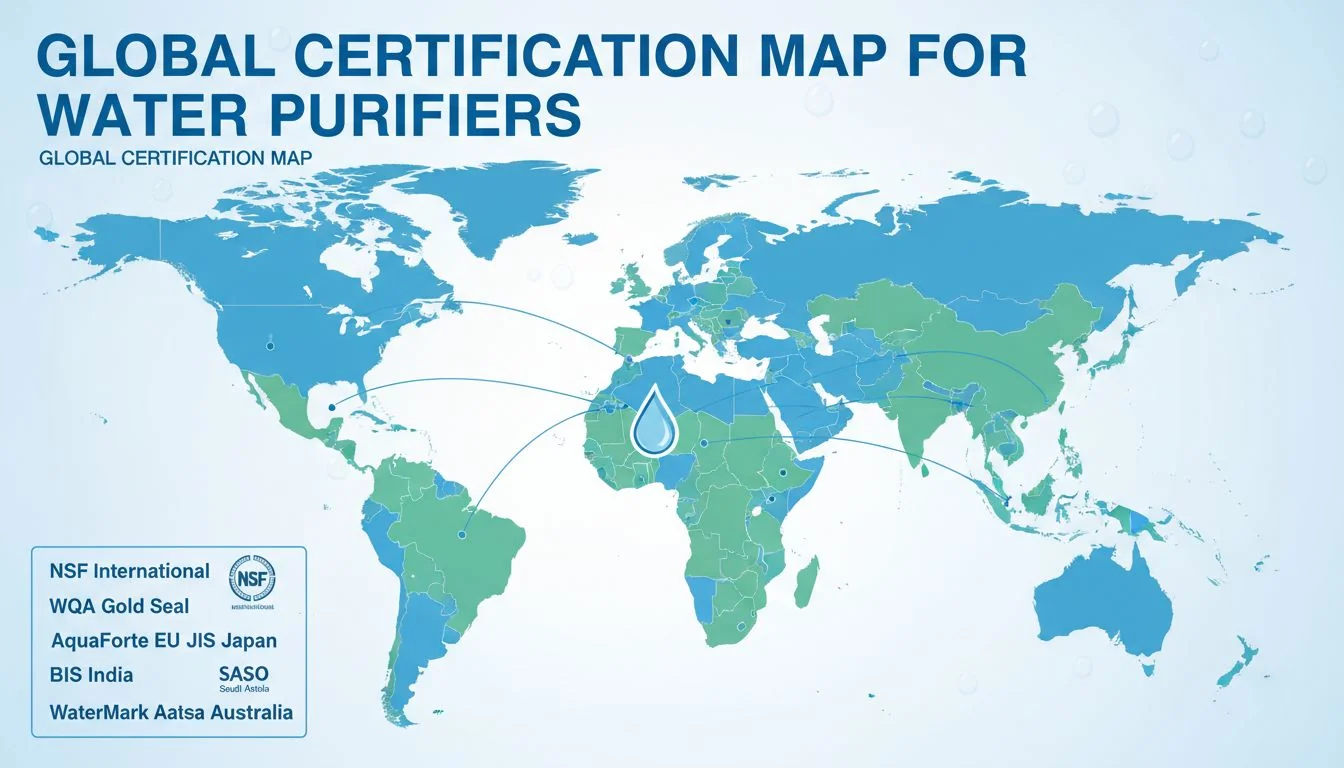
Exporting water purifiers is hard. You lose months and thousands of dollars if you treat global certs as one big project. Here is how you map them out.
The global certification map requires a step-by-step plan. You must pass WRAS in the UK, KTW in Germany, ACS in France, JIS in Japan, SASO in the Gulf, and WaterMark in Australia. Each region has unique rules. A smart OEM partner1 helps you reuse test data and save money.
I remember my early days in the mold factory. We thought making a good product was enough. But when we tried to sell overseas, the rules hit us hard. Let us look at how you can beat this system.
You can use one global certification for all countries.Falso
Each region has its own independent regulatory regime with distinct test scopes and formats.
A good OEM partner can shorten your certification learning curve.Vero
Experienced partners can reduce the timeline from 12-18 months to 6-9 months by leveraging existing material approvals.
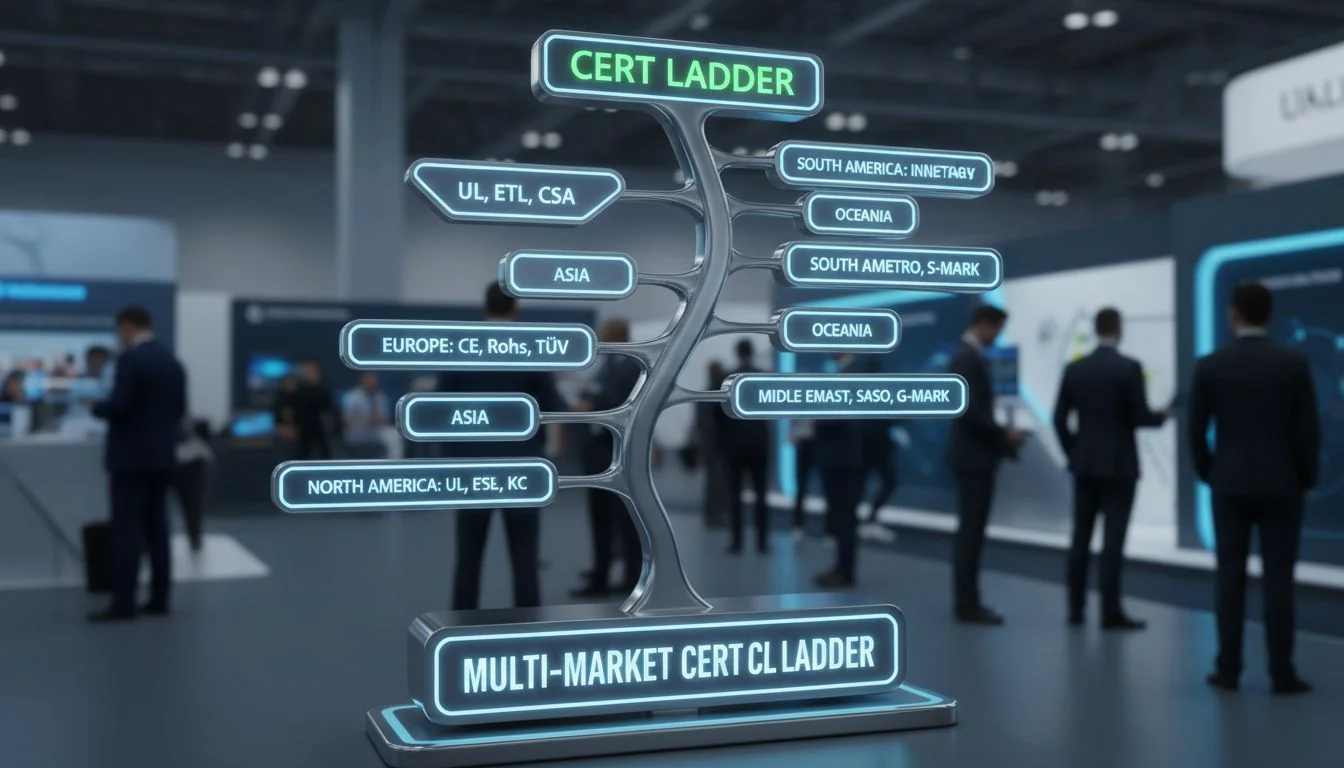
What Is the Multi-Market Cert Ladder Every Export Brand Climbs?
You want to sell everywhere. But testing costs2 pile up fast. If you pick the wrong country first, you waste money. You need a clear ladder to climb.
You should sequence your market entry by cost and revenue. Tier 1 includes the UK, Australia, and the Gulf. These are easy to access. Tier 2 includes Germany and Japan. They cost more but pay well. Tier 3 includes France. You enter there when you have guaranteed sales.
Breaking Down the Regional Rules
When I started my trading company, I saw many brands fail because they did not know the local rules. The water purifier cert framework outside the US is very broken up. Each region works alone. They ask for different tests. They want papers in different formats.
The Role of Your OEM Partner
Your OEM partner is very important here. A partner with a good material library3 can save you time. They already have approvals for WRAS, KTW, ACS, JWWA, and SASO. They do not need to test every material again. This cuts your wait time and your costs. You must check your partner's international cert skills, not just their US NSF skills.
Regional Certification Overview
Here is a simple look at the main regions:
| Regione | Certificazione | Focus Area | Time Needed | Cost Estimate |
|---|---|---|---|---|
| UK | WRAS | material safety4 | 8-16 weeks | £8K-£25K |
| Germania | KTW/DVGW | Plastics and microbes | 12-20 weeks | €10K-€40K |
| France | ACS | Formulation specific | 16-24 weeks | €15K-€35K |
| Giappone | JIS/JWWA | Docs and durability | 16-32 weeks | ¥1.5M-¥5M |
| Gulf | SASO/ESMA | Fast regional access | 8-16 weeks | $5K-$20K |
| Aus/NZ | WaterMark | Plumbing code | 12-20 weeks | AUD $15K-$40K |
You must plan your steps using this data. Do not rush into the hardest market first.
The UK WRAS certification is mainly for marketing claims.Falso
WRAS is a gating function for installation in UK-regulated water systems, focusing on material safety.
The Gulf region is a fast-growing export market for premium brands.Vero
SASO and ESMA certifications are accessible and take only 8-16 weeks, making it a great early target.
Why Is the European Cert Stack Material-First, Not System-First?
You design a great system. Then Europe rejects it because of one plastic part. This ruins your launch. You must understand their material-first rules to survive.
Europe checks every single material before they look at the whole system. WRAS in the UK and KTW in Germany need exact details. A simple color change in a plastic part means you need a new test. You must control your Bill of Materials very strictly.
The Strict Rules of WRAS and KTW
The European system is very different from the US NSF system. In Europe, every plastic, metal, and rubber part must pass its own test. WRAS needs to know your exact plastic type, color, and maker. If you change the color of a plastic housing from red to blue, you must do a new test.
Why BOM Discipline Matters
As a mold designer, you know how often suppliers change things. But in Europe, you cannot do this. You need strict Bill of Materials (BOM) discipline. You must track every part. You must track the maker, the color, and the factory. If you change a supplier without telling the cert body, you lose your approval. You might only find out a year later when a buyer asks for your papers.
OEM Partner Needs for Europe
You need a factory partner who understands this. They must have these skills:
| Capability | Why You Need It |
|---|---|
| Material Library | To reuse old test data for new parts. |
| supplier control5 | To stop secret changes in your plastic parts. |
| Change Tracking | To check how a change affects your certs. |
| Local Consultants | To talk to WRAS and KTW for you. |
If your partner lacks these, you will pay for their mistakes.
Changing the color of a plastic part does not affect WRAS certification.Falso
WRAS is formulation-specific. A color change alters the migration profile and requires a new submission.
KTW uses a positive list for polymers and additives.Vero
Only substances on the BfR positive list can be used in materials contacting drinking water in Germany.
How Do ACS, JIS, and SASO Reward Different OEM Capabilities?
You want to sell in France, Japan, and the Gulf. But the rules are totally different. If you use the same plan for all, you will fail.
France needs strict material tracking for five years. Japan needs heavy paperwork in Japanese and local agents6. The Gulf needs fast testing and local agents. You must check if your factory partner can handle all three different systems at the same time.
France: The ACS System
France uses the ACS system. The Ministry of Health runs it. It is very strict about materials. Your approval lasts for five years, but only if you do not change anything. You need a partner who can keep the same suppliers for five years. You also need papers in French.
Japan: The JIS and JWWA System
Japan is very hard to enter. They want a lot of papers. You must write everything in Japanese. You also need a local agent in Japan. The tests take a long time. Sometimes they test a product for months. Your partner must be able to make perfect papers and wait a long time.
The Gulf: SASO and ESMA
The Gulf is much faster. It only takes a few weeks. But you still need a local agent. You also need to put your product in their safety database.
Comparing the Three Regions
Here is how they differ:
| Regione | Main Challenge | Partner Skill Needed |
|---|---|---|
| France (ACS) | Strict material rules | 5-year supplier lock |
| Japan (JIS) | Heavy paperwork | Japanese language skills |
| Gulf (SASO) | Fast local rules | Local agent network |
Do not assume a good US partner is good in these regions.
ACS approval in France is valid forever once granted.Falso
ACS approval is valid for 5 years and requires the material formulation to remain completely unchanged.
Japan requires a local agent for many certification pathways.Vero
You need a Japanese-based agent or distributor of record to handle submissions and compliance.
Why Do Most Export Brands Misread the WaterMark Certification?
You ship your product to Australia. Then the plumbers refuse to install it. Your sales drop to zero. You misunderstood what WaterMark really means.
WaterMark is not just a marketing tool. It is a strict plumbing code rule. If you do not have it, plumbers cannot legally install your product in Australia or New Zealand. You must pass both material tests and plumbing tests to sell there.
The Plumbing Code Trap
Many US brands make a big mistake here. They think WaterMark is like NSF. They think it just helps them sell more. This is wrong. WaterMark is part of the law. It is tied to the Plumbing Code of Australia. If a plumber installs a product without WaterMark, they break the law. The government can fine them.
What WaterMark Tests
WaterMark tests two main things. First, it tests the materials. This is like the NSF 61 test. It checks for bad tastes or bad chemicals. Second, it tests the plumbing parts. It checks the water pressure and the pipes. You must pass both to get the mark.
How to Win in Australia
You cannot compete on price alone in Australia. You must pay for the cert. It costs a lot, but it keeps cheap competitors out.
| Test Type | Standard | What It Checks |
|---|---|---|
| I materiali | AS/NZS 4020 | Safe drinking water contact |
| Plumbing | AS/NZS 3500 | Safe pipe connections |
| Prestazioni | AS/NZS 3497 | Filter claims and strength |
Your partner must know these rules well. They must work with local test labs to get this done right.
WaterMark is only used for marketing purposes in Australia.Falso
WaterMark is a legal requirement for installation under the Plumbing Code of Australia.
New Zealand recognizes the WaterMark certification.Vero
Australia and New Zealand share the JAS-ANZ testing framework, allowing cross-recognition.
How Do You Sequence Market Entry to Reuse Test Data?
You pay for the same test three times. You waste money and lose a whole year. You need a smart plan to reuse your test data everywhere.
You must plan your certs together. Many tests overlap. A plastic approved in the US can get a fast pass in the UK or Germany. You just need to share the data. This saves you up to half the cost and cuts months off your wait time.
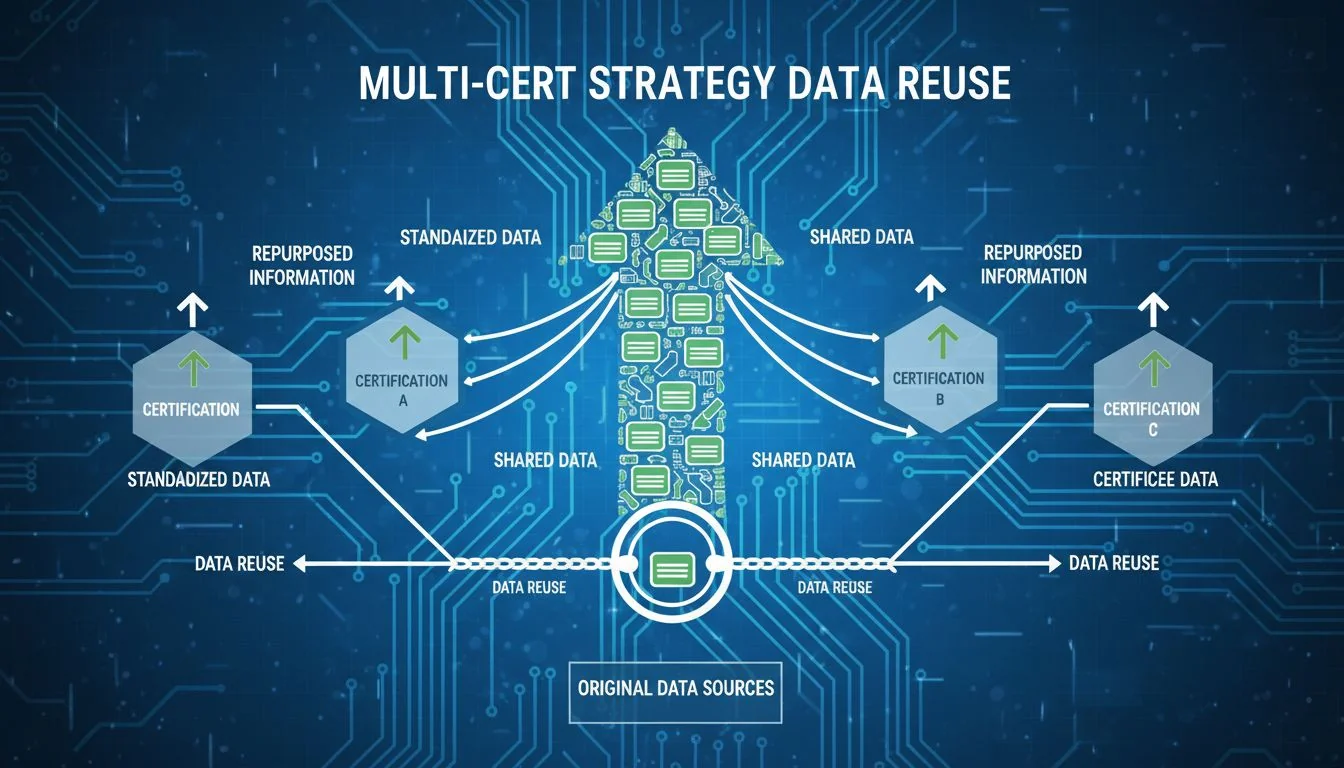
The Power of Data Reuse
Do not run each country as a new project. That is a huge waste. The big cert bodies look for the same things. They all test for safe materials. They all test for clean water. If you pass NSF in the US, you have good data. You can show this data to WRAS in the UK or KTW in Germany. They might give you a fast pass. They call this a data review.
Building a Master File
You should build one big master file. Put all your material details in it. Put all your test results in it. Then, use this file for every country. This cuts your paperwork time by a lot.
A Smart Three-Year Plan
Here is how a smart brand does it:
| Anno | Target Markets | Strategia | Cost Impact |
|---|---|---|---|
| Year 1 | US (NSF) | Build base data | Full cost |
| Year 2 | UK, Gulf, Aus | Reuse US data | Save 50% |
| Year 3 | Germany, France, Japan | Use all past data | Save 30% |
You must ask your factory partner if they can do this. Ask them to show you real papers from other countries. If they cannot, find a new partner.
You must start from scratch for every new country certification.Falso
Many certifications share overlapping test methods, allowing you to reuse data and save money.
A master documentation file reduces paperwork overhead.Vero
Creating one central technical file cuts documentation overhead by 50-70% across different regions.
Conclusione
Global water purifier certification is complex. You must plan your steps, control your materials, and pick a smart OEM partner. This saves you time, cuts costs, and opens new markets.
References
-
Understanding the importance of an OEM partner can help you navigate complex certification processes effectively. ↩
-
Knowing the costs involved can aid in budgeting and financial planning for exports. ↩
-
A material library can streamline the certification process and save time and resources. ↩
-
Material safety is a key factor in ensuring product compliance and consumer trust. ↩
-
Effective supplier control is essential for maintaining compliance and avoiding certification issues. ↩
-
Local agents can facilitate smoother certification processes in foreign markets. ↩



 English
  Français
  Español
  Italiano
  Deutsch
  Português
  Русский
  العربية
  日本語
日本語  한국어
한국어  Tiếng Việt
