
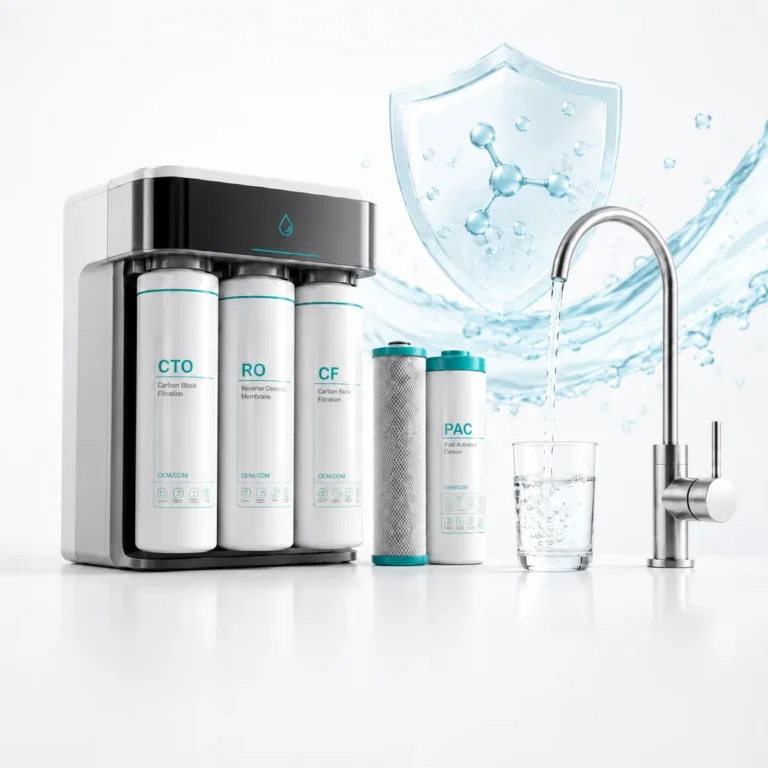

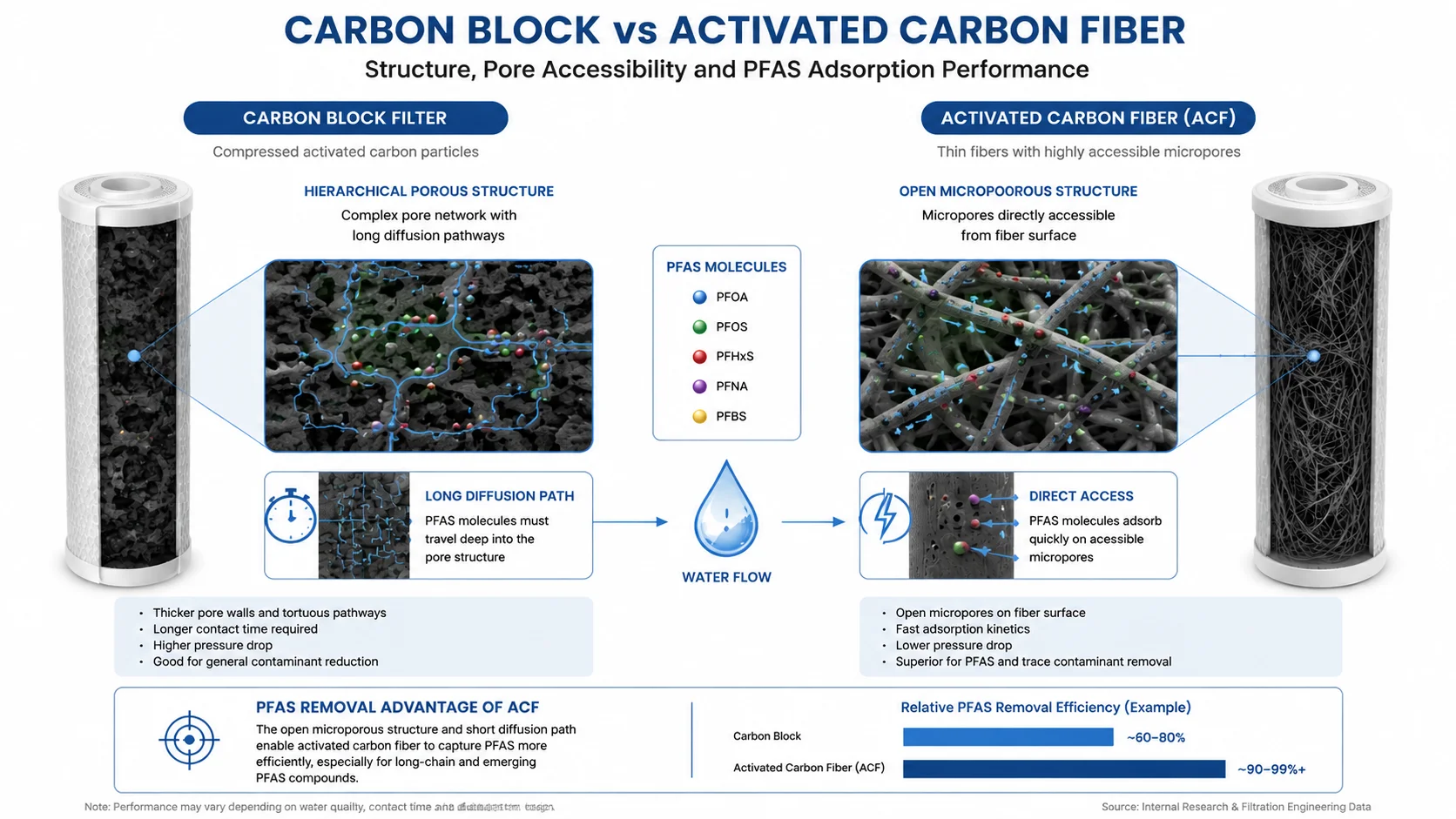
Two carbon media. Same adsorption chemistry. Very different behaviour in a point-of-use cartridge. If you are specifying a water purifier platform for a PFAS-aware market, the choice between a carbon block and an activated carbon fiber (ACF) element is not a materials preference — it decides your contact-time budget, your certification pathway, your cartridge cost, and how honestly you can talk about short-chain PFAS on the box.
Most published comparisons treat this as a winner-takes-all question. It is not. Each medium wins on a different list of target contaminants, and the list that matters is the one in your product claim. This guide walks through the pore-level science, then translates it into the three decisions a brand actually has to make: which contaminants to claim, which certification to pursue, and which cartridge architecture to tool.
Key Takeaways
- Carbon block and ACF share the same adsorption mechanism. The real difference is diffusion path length and pore size distribution — not capacity.
- ACF wins on kinetics and compactness. Its micropores are reachable directly from the fiber surface, so it performs at contact times where granular and blocked carbon underperform.
- Carbon block wins on structure and certification precedent. Sub-micron particulate, cyst reduction, and lead reduction all depend on a formulated, structurally rigid block. Almost every certified point-of-use PFAS claim in the market today sits on one.
- Neither medium solves short-chain PFAS on its own. PFBA, PFBS, and PFHxA break through carbon far earlier than PFOA and PFOS. Honest platforms pair carbon with anion exchange or reverse osmosis.
- Certification is granted to a system, not a medium. Changing the carbon after certification triggers retesting, and certified manufacturing sites face annual inspection. Media selection is a launch-timeline decision, not just a BOM decision.

Same Chemistry, Different Geometry: What Actually Separates Carbon Block from ACF
Both media remove contaminants by adsorption — molecules adhering to the internal pore surface of activated carbon, not being absorbed into it. NSF describes this plainly in its overview of drinking water treatment standards: adsorption occurs when dissolved or suspended matter adheres to the surface of, or in the pores of, an adsorbent medium, and carbon filters are the canonical example. Both media are typically made from coconut shell, bituminous coal, pitch, or a polymer precursor. What separates them is how far a contaminant molecule has to travel before it reaches a site where it can be held.
Carbon block: a formulated, load-bearing structure
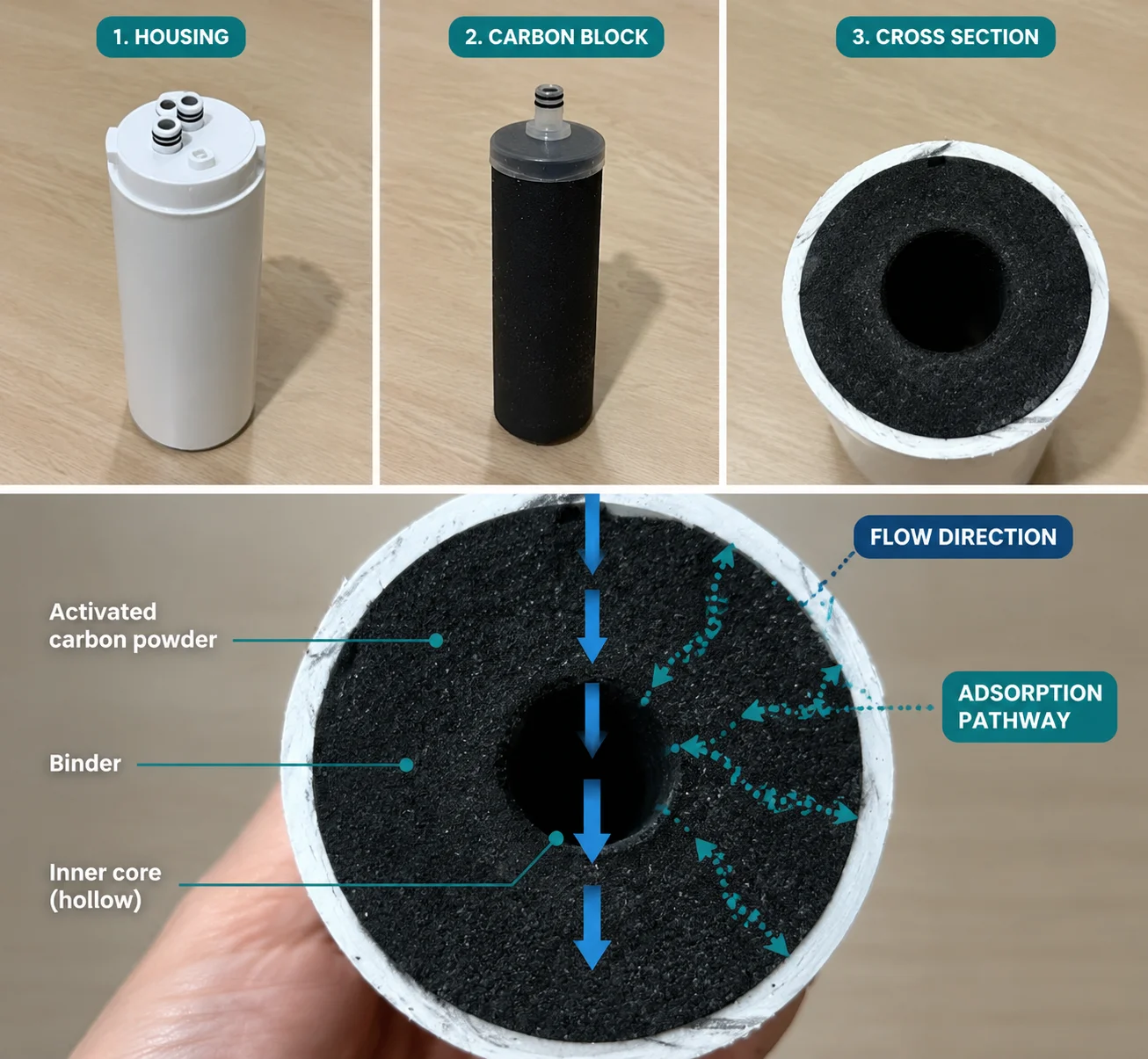
A carbon block is powdered activated carbon bound with a thermoplastic binder and formed under heat and pressure. There are two production routes. In compression moulding, the blend is loaded into a fixed mould, compressed, heated to sinter, then cooled and trimmed. In extrusion, the same blend is conveyed by a screw auger through a heated die as a continuous cylinder, then cut to length. Extrusion runs faster; moulding allows more shapes and, importantly, tends to require less binder to achieve a cohesive block — which means more of the carbon surface stays available for adsorption and unit-to-unit consistency improves.
That binder is the most underrated variable in carbon block engineering. Binder that masks the carbon surface removes adsorption sites permanently. Two cartridges with identical carbon, identical micron ratings, and identical dimensions can differ by a factor of two in service life purely on binder formulation and cure profile. It is one of the main reasons a block that performs beautifully as a supplier sample is not the block you receive at volume.
Inside the block, adsorption follows a hierarchical route: macropores branch to mesopores, which branch to micropores. Every contaminant molecule has to negotiate that cascade.
ACF: micropores on the outside

Activated carbon fiber is spun — from pitch, PAN, rayon, or phenolic resin — then carbonised and activated. The result is a fibre typically 5–20 µm in diameter whose micropores open directly onto the fibre surface. There is no macropore-to-mesopore-to-micropore cascade to traverse, which produces markedly faster adsorption kinetics than granular activated carbon. Peer-reviewed characterisation of ACFs reports specific surface areas reaching up to 3,000 m²/g with uniform microporosity, and adsorption capacities for micropollutants that exceed granular activated carbon because of the far smaller fibre diameter.
The correction worth making
A great deal of ACF marketing content claims the medium simply "holds more." That is not the defensible claim. ACF's advantage is per unit of time, not per unit of mass. Where it genuinely outperforms is in systems that cannot afford long contact — which, as we will see, describes almost every point-of-use faucet.
Contaminant by Contaminant: Where Each Medium Actually Wins
This is the section that matters for a product spec. "Better carbon" is not a claim you can print. "Reduces chloramine, lead, and Class I particulate" is.
| Target contaminant | Carbon block | ACF | What decides it |
|---|---|---|---|
| Free chlorine | Forte | Forte | Catalytic reduction, not adsorption. The reaction is fast; both media clear it easily. Choose on cost. |
| Chloramine | Forte with catalytic carbon | Weak without modification | Chloramine needs catalytically active carbon and substantially more contact time. A formulated block is the practical route. |
| VOCs / THMs | Good | Very strong | Small, mobile organics are exactly where ACF's kinetic advantage shows up at short contact times. |
| Taste & odour (geosmin, MIB) | Forte | Forte | Both perform. Block is cheaper per litre treated. |
| Lead (soluble and particulate) | Only with dedicated media | Not on its own | Lead reduction requires ion-exchange or specialty media blended into the block. Plain carbon of either format does not do it. |
| Cysts & particulate | Forte | Requires a partner stage | Mechanical separation depends on a dense, rigid structure. ACF needs a UF membrane or separate sediment stage. |
| Long-chain PFAS (PFOA, PFOS) | Achievable | Achievable, with a competition advantage | Micropore width and surface chemistry decide this, not format. See the next section. |
| Short-chain PFAS (PFBA, PFBS, PFHxA) | Limitada | Limitada | Neither medium is a standalone answer. Anion exchange or reverse osmosis is required. |

Three of these rows quietly eliminate an ACF-only architecture for most residential platforms: chloramine, lead, and cysts. If your target market is North American municipal water, at least one of the three is almost certainly on your claim list. That does not make ACF the wrong choice — it makes ACF a polishing stage rather than a primary stage.
The PFAS Layer: Chain Length, Micropore Width, and NOM Competition

PFAS is where the pore-level differences stop being academic.
Total surface area is the wrong specification
BET surface area is the number every carbon supplier leads with, and it is close to useless for predicting PFAS performance. What predicts performance is where the pore volume sits. Research on tailored activated carbons has shown that ultra-micropores below 1.2 nm and small mesopores in the 2.0–3.0 nm range contribute most to PFOA adsorption. Surface chemistry compounds the effect: PFAS affinity correlates negatively with surface acidity, and basic, hydrophobic carbon surfaces adsorb PFAS considerably better.
For coconut-shell granular carbon aimed at PFAS duty, the industry working specification is micropore volume above roughly 0.45 cm³/g, iodine number above 1,000 mg/g, and BET above 1,100 m²/g. Ask any supplier for the pore size distribution curve, not just the headline BET figure.
Where ACF has a genuine, under-reported edge
ACF's pore size distribution is unusually narrow — almost entirely within the micropore range, with PFOA and PFOS uptake correlating to the 1–2 nm narrow micropore fraction. The same study reports the more commercially interesting finding: microporous ACFs showed only minor competition from natural organic matter, apparently because NOM macromolecules are size-excluded from those pores.
That matters enormously in real water. NOM is present at concentrations millions of times higher than PFAS, and it is a primary reason field performance falls short of laboratory performance. Competitive adsorption studies confirm that NOM competition reduces adsorption of the less hydrophobic PFAS far more severely than the strongly adsorbing ones. A medium that resists NOM competition holds its rated performance longer in a real kitchen.
The short-chain problem nobody should market around
Short-chain PFAS behave badly in every carbon system. They initially adsorb to outer surfaces, then get outcompeted and displaced by longer-chain PFAS with higher sorption affinity, while also showing weaker resistance to interference from co-existing ions — producing early breakthrough. Typical industry breakthrough ranges illustrate the gap: roughly 15,000–40,000 bed volumes for short-chain compounds such as PFBS, against 40,000–100,000+ bed volumes for PFOA and PFOS.
The engineering conclusion is uncomfortable but commercially valuable: if your claim includes short-chain PFAS, carbon alone will not deliver it. You need anion exchange resin, reverse osmosis, or both. Brands that state this openly do better in technical due diligence than brands that blur it.
Contact Time Is the Real Constraint: EBCT, Flow Rate, and Pressure Drop
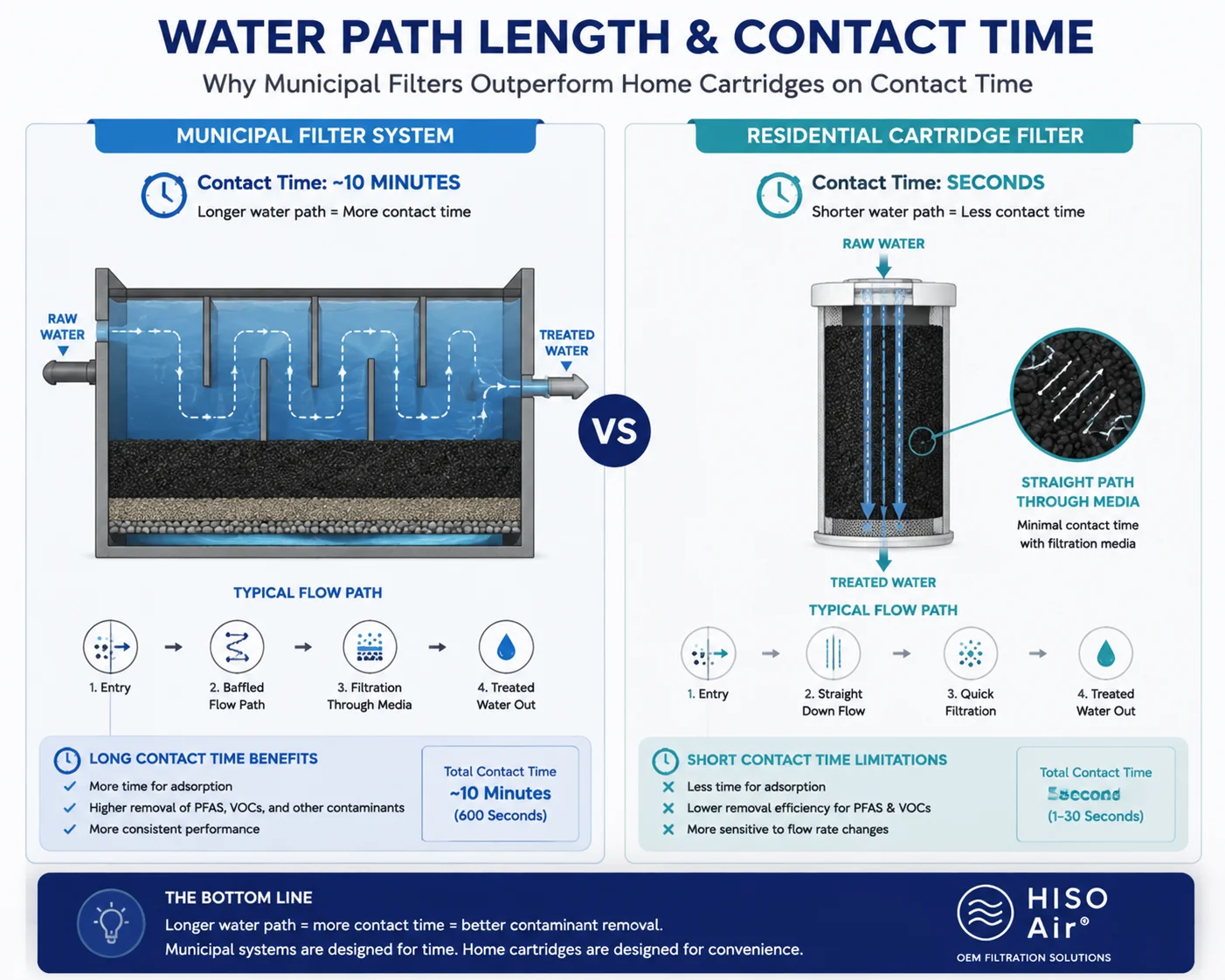
Municipal treatment designs around empty bed contact time — the volume of the empty media bed divided by the flow rate — measured in minutes: roughly two minutes for dechlorination, and ten minutes or more for perfluorinated compounds. A residential under-sink cartridge at a 1.5 GPM rated flow gives the water a few seconds.
This is the single most consequential constraint in point-of-use media selection, and it is where a marketing decision silently kills an engineering one. The rated flow rate on the spec sheet — the number the brand team chose because consumers dislike slow faucets — sets the contact-time budget that every downstream media decision has to fit inside.
Within that budget, each medium has a different lever:
- Carbon block buys contact time through wall thickness and radial path length. The cost is pressure drop and cartridge volume. Doubling the wall improves adsorption but reduces flow and enlarges the housing.
- ACF buys performance through kinetics rather than residence time, at low pressure loss and in a smaller envelope. That is precisely its design case: adequate removal where residence time is scarce.
- Channeling penalises loose media most, blocks less, and fibrous structures least. It is a manufacturing-consistency problem as much as a media problem.
The practical takeaway for a product brief: fix the flow rate and cartridge envelope before you choose the media, not after. Reversing that order is the most common cause of a platform that fails certification testing at rated flow after passing at reduced flow.
What NSF/ANSI 53 Actually Rewards — and Why It Favours Carbon Block Today
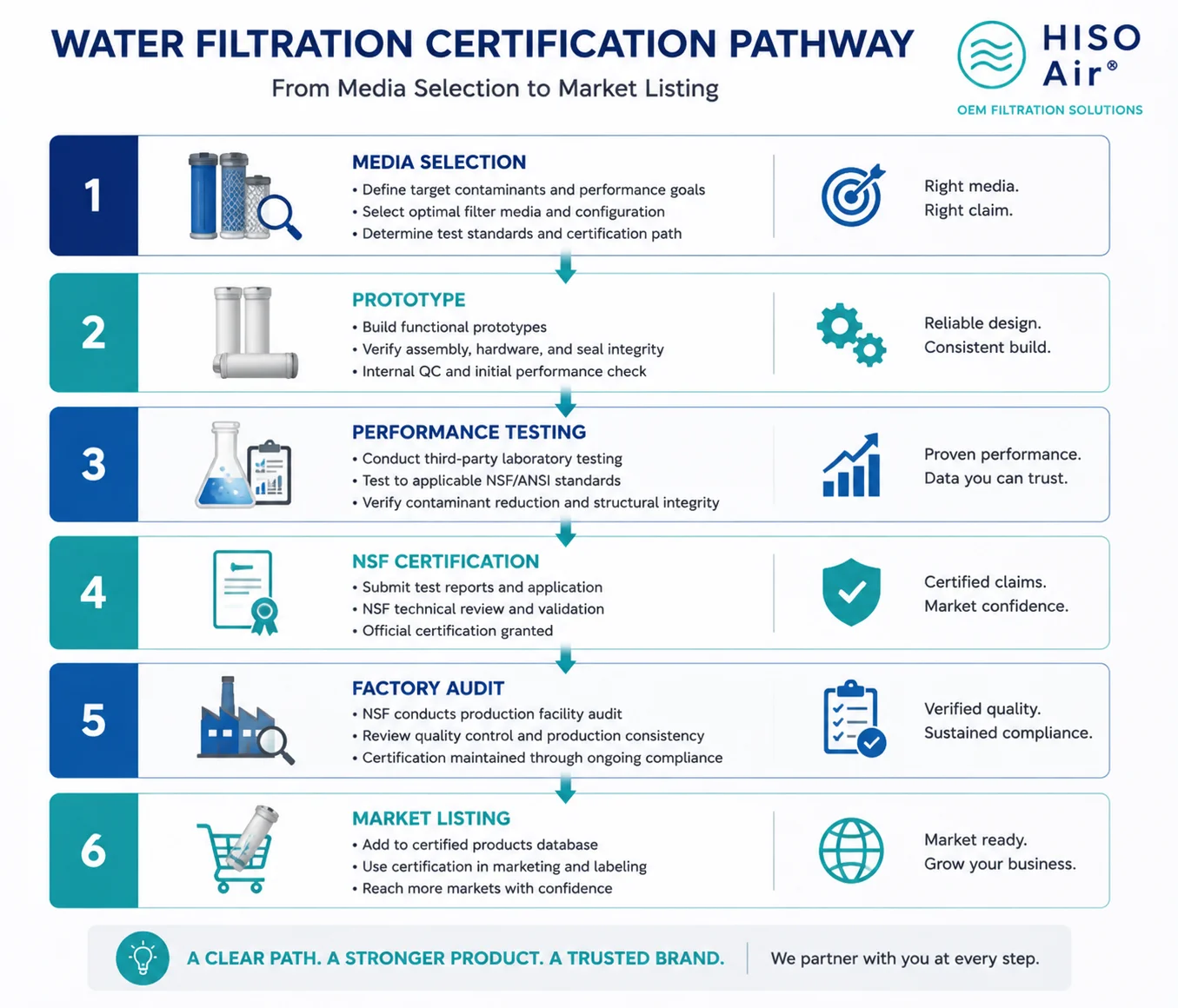
There is a structural reason carbon block dominates certified point-of-use PFAS products, and it has less to do with performance than with how certification works.
There are two PFAS claim tiers, and most people know only one
PFAS testing for point-of-use devices began as NSF Protocol P473, developed in 2016 in response to the EPA health advisory of the time, and was subsequently folded into the main standards. As NSF describes it, the 2022 updates to NSF/ANSI 53 and 58 added PFHpA, PFHxS, PFNA and PFBS to create a "Total PFAS" reduction claim, and lowered the combined PFAS limit from 70 ppt to 20 ppt.
In practice this leaves two tiers. PFOA/PFOS reduction is the mainstream claim and covers those two compounds only. Total PFAS reduction is the broader claim, created only in the 2022 edition, and the certified base remains small. NSF states the threshold directly: to make a PFAS reduction claim, a water filter must reduce PFAS to below 20 parts per trillion.
For a brand that wants "Total PFAS" on the shelf, the qualified supply base is therefore narrow — which is worth raising early in an OEM conversation rather than late. The standard continues to be revised annually, with further PFAS compounds added to the chemical reduction claims in the 2023 edition, so the target is moving.
Certification attaches to the system, not the medium
This is the point that reshapes the media decision. A listing covers a specific model and cartridge combination. Swapping the carbon after listing — a different supplier, a different precursor, a reformulated binder — triggers retesting. NSF also notes that certified products must be retested periodically and manufacturing facilities inspected annually. Media selection is therefore inseparable from your factory qualification plan.
The standard also imposes structural demands well beyond adsorption. For lead, systems are challenged with water containing 150 ppb of lead — ten times the US EPA action level — for beyond the filter's claimed service life, and since a 2019 revision the pass/fail criterion has been an effluent concentration of 5 ppb, tightened from the previous 10 ppb. Cyst claims under NSF/ANSI 53 require at least 99.95% reduction of parasitic cysts, which depends on a dense, mechanically rigid medium.
Carbon block's dominance in certified PFAS listings therefore reflects an accumulated advantage: it can carry adsorption, particulate, cyst and lead claims in a single certifiable component. Whatever media you choose, verify the exact model number against the certifier's public directory rather than a marketing page — this is also the EPA's own guidance to consumers evaluating home PFAS filters.
The regulatory picture as of mid-2026
The federal framework moved this year. On 18 May 2026 the EPA issued two proposed rules: one upholding the PFOA and PFOS national primary drinking water regulation while offering systems an option to request two additional years to comply, to 2031; the other proposing to rescind the drinking water regulations for PFHxS, PFNA, HFPO-DA (GenX) and the Hazard Index mixture. The proposed extension does not change the MCLs themselves, which remain 4.0 ppt each for PFOA and PFOS; monitoring and reporting timeframes under the 2024 rule also stay in force for systems granted an exemption.
Read commercially, the federal scope is narrowing while state requirements continue to expand. For a consumer brand, that widens rather than narrows the differentiation opportunity — what regulators stop mandating becomes voluntary certification that brands can own.
Media Selection as a Manufacturing Decision: Cost, Supply Chain, and Hybrid Architectures
Everything above is settled long before tooling. These are the constraints that decide whether a media choice survives contact with a production schedule.
| Dimensão | Carbon block | ACF |
|---|---|---|
| Raw material cost | Granular activated carbon in the low single digits USD/kg | Roughly an order of magnitude higher |
| Supply base | Highly distributed, globally sourceable | Concentrated in a small number of Japanese, Taiwanese and eastern-Chinese producers |
| Forming process | Compression moulding or extrusion; both produce comparable performance | No sintering; wound, pleated or layered, and dependent on structural support |
| Particulate / cyst rating | Typically 0.5 / 5 / 10 micron nominal; supports cyst claims at 99.95% | Essentially none; requires a UF or sediment partner stage |
| Metais pesados | Achievable with blended specialty media | Not achievable unaided |
| Certification precedent | Extensivo | Very limited |
Two sourcing notes worth acting on. First, the cost gap between ACF and granular carbon is roughly an order of magnitude, which places ACF firmly in premium positioning rather than volume positioning. Second, PAN-based ACF production outside Japan has matured substantially in recent years and now meets international BET specifications at meaningfully lower cost — which changes the arithmetic for mid-market platforms that were previously priced out.
The architecture most PFAS platforms should actually build
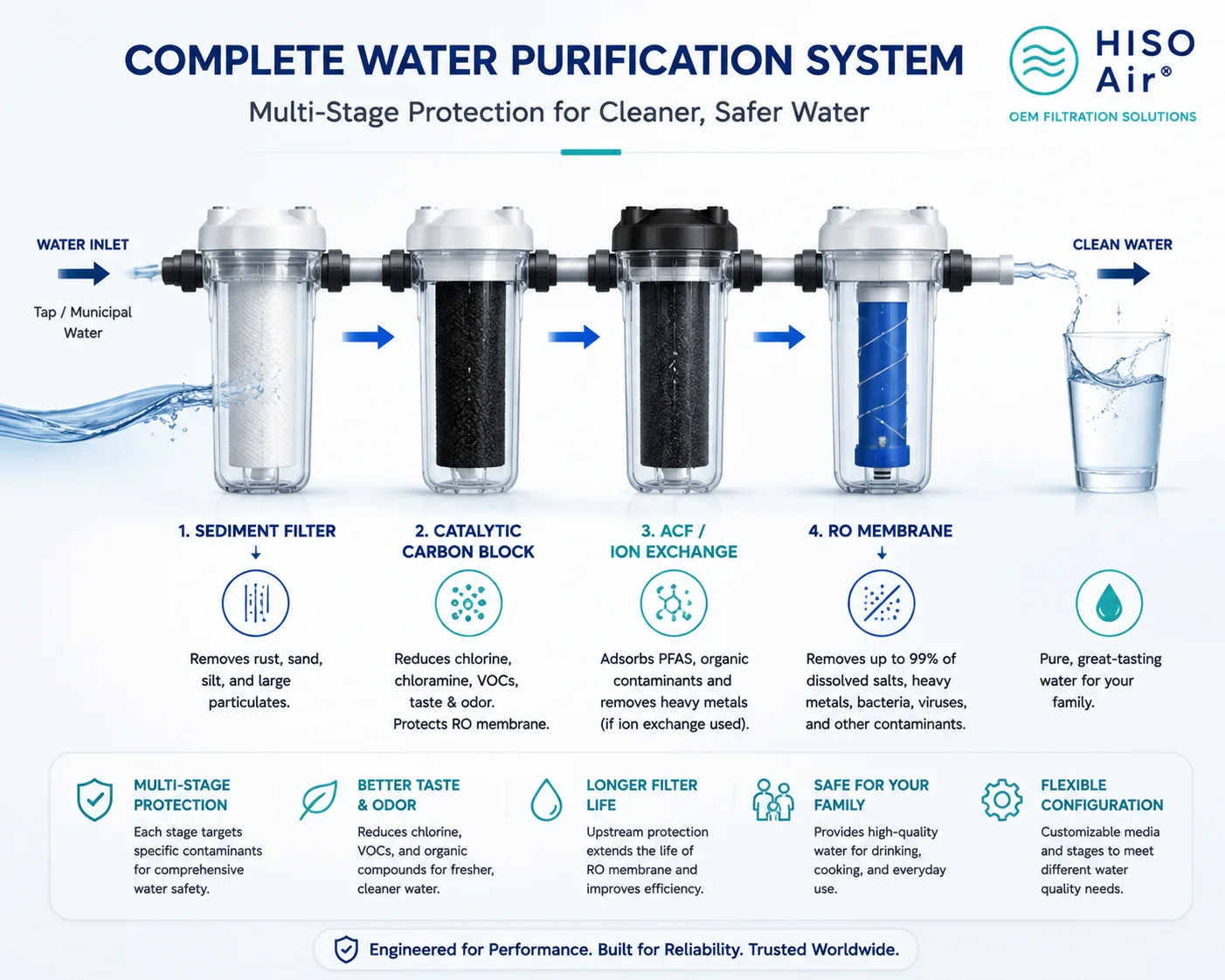
Framed as a single choice, this comparison has no good answer. Framed as a sequence, it does:
- Sediment pre-filter — protects downstream media and preserves rated flow.
- Catalytic carbon block — chlorine, chloramine, taste and odour, VOCs, lead with blended media, cyst and particulate. This is the certification-bearing stage.
- ACF or anion exchange polishing stage — fast-kinetics finishing at low pressure drop, with ACF's NOM resistance protecting late-life performance.
- Reverse osmosis — required where the claim extends to short-chain PFAS or dissolved solids.
Each stage earns its cost by doing something the others cannot. That is a defensible bill of materials, and it is a story a brand can tell a sceptical retail buyer without overstating anything.
Perguntas mais frequentes
Is ACF better than carbon block for PFAS removal?
Not categorically. ACF has a narrow micropore distribution that correlates well with PFOA and PFOS uptake and resists competition from natural organic matter, which helps sustained performance. Carbon block carries almost all existing certified point-of-use PFAS claims because it also delivers the structural, particulate and lead performance NSF/ANSI 53 requires. The stronger platform usually uses both.
Can a carbon filter remove short-chain PFAS such as PFBS or PFBA?
Only partially, and not durably. Short-chain compounds break through carbon far earlier than PFOA and PFOS, and are displaced by longer-chain PFAS as the medium loads. Claims covering short-chain PFAS should be supported by anion exchange or reverse osmosis.
Does NSF/ANSI 53 certification for PFAS cover all PFAS compounds?
No. The mainstream claim covers PFOA and PFOS. A separate Total PFAS claim, created in the 2022 edition of the standard, adds PFHpA, PFHxS, PFNA and PFBS, with a combined limit of 20 ppt. Always verify the exact model number and the exact claim in the certifier's public listing directory.
What happens to our certification if we change carbon suppliers?
Certification is granted to a specific system and cartridge configuration. Changing the carbon precursor, supplier or binder formulation generally requires retesting, and certified manufacturing sites are also subject to annual inspection. Media selection should be locked before certification testing begins, with second-source qualification planned into the original test programme rather than added later.
How much contact time does a point-of-use cartridge actually have?
Seconds, not minutes. Municipal designs use empty bed contact times of around two minutes for dechlorination and ten minutes or more for perfluorinated compounds. A residential under-sink cartridge at typical rated flow offers a small fraction of that, which is why rated flow rate should be fixed before media selection.
Which is more cost-effective for a mid-market product line?
Carbon block, by a wide margin on raw material cost. ACF makes commercial sense as a targeted polishing stage in premium platforms, or where cartridge envelope and pressure drop are hard constraints — not as a wholesale replacement for a blocked primary stage.
Specifying Your Media Architecture
The right media architecture depends on three inputs that are specific to your launch: the contaminant claims you intend to print, the certification tier you are targeting, and the flow rate and cartridge envelope your industrial design allows. Get those three fixed, and the media decision largely makes itself.
HisoAir develops OEM and ODM water purification platforms for brands entering PFAS-aware markets, covering media selection, cartridge architecture, certification planning and volume manufacturing. If you are scoping a platform, send us your target claim list, rated flow and market, and our engineering team will come back with a media architecture and a realistic certification pathway.
Explore our PFAS water purifier platforms →
Sources and Further Reading
Regulatory and standards sources
- US EPA — Per- and Polyfluoroalkyl Substances (PFAS) drinking water regulations
- US EPA — Proposed PFOA and PFOS Compliance Extension Rule
- Federal Register — Extending the Compliance Deadline for the PFOA and PFOS Maximum Contaminant Levels
- US EPA — Reducing PFAS in Your Drinking Water with a Home Filter
- NSF — PFAS in Drinking Water
- NSF — Forever Chemicals and the Advancement of Filtration Standards
- NSF — NSF/ANSI 42, 53 and 401: Filtration Systems Standards
- NSF — Certified Product Listings for Lead Reduction
- NSF — Stricter Requirements for NSF/ANSI Lead Reduction Certification
- ANSI — NSF/ANSI 53-2023: Drinking Water Treatment Units, Health Effects
- ITRC — Empty Bed Contact Time (EBCT)
Peer-reviewed research
- Chemical Engineering Journal — Carbon surface chemistry and PFAS adsorption on activated carbon fibers
- Journal of Environmental Chemical Engineering — Removal of PFOA from water by activated carbon adsorption: influence of pore structure
- Separation and Purification Technology — Adsorption dynamics of PFAS on activated carbon: surface chemistry and structural properties
- Journal of Hazardous Materials — Competitive adsorption of PFAS on activated carbon
- npj Clean Water — Perfluoroalkyl chain-length-dependent environmental fate and treatment outcomes of PFAS in water
- Annals of Work Exposures and Health (via NIH PMC) — Adsorption characteristics of activated carbon fibers
- Nanomaterials (via NIH PMC) — Viscose-derived activated carbon fibers as adsorbents for water treatment






 English
  Français
  Español
  Italiano
  Deutsch
  Português
  Русский
  العربية
  日本語
日本語  한국어
한국어  Tiếng Việt

