Abre num novo separador
Soluções inovadoras para a qualidade do ar

HA-1968

Air purifier for 2000 square feet (Hisoair HA1968)

O purificador de ar Hisoair HA1968 remove 99,9% de vírus, bactérias e outros poluentes transportados pelo ar.

Tecnologia Decibel Cancellation™
Os nossos purificadores de ar proporcionam a máxima filtragem com o mínimo de ruído.

170m² Área funcional
A área aplicável pode chegar a 170m² metros quadrados, como escolas, estabelecimentos comerciais.

1500m3/h CADR
A CADR, designada por Clean Air Delivery Rate, é de 1500m3/h.

99,9% H1N1 Taxa
A taxa de remoção de vírus e a taxa de H1N1 são todas de 99,9%.

HEPA de grau médico de 0,1um
O ar particulado de alta eficiência (HEPA) atinge 0,1um de grau médico.

99.9% Remoção de bactérias
O purificador de ar HisoAir tem uma taxa de remoção de bactérias de 99,9%.

Fale com o nosso especialista

O melhor purificador de ar para 2000 pés quadrados: especificações

Artigos HA-1968
Dimensões (C x L x A) 398*398*850mm
Peso do produto 24,2 kg
Consumo de energia 135 W
Saída de ar Lados esquerdo e direito
Entrada de ar Frente e verso
Taxa de fornecimento de ar limpo (CADR)-PM2.5 230m3/h (135CFM), 675m3/h (397CFM), 815m3/h (479CFM), 975m3/h (574CFM), 1512m3/h (889CFM)
Tecnologias Pré-filtro, filtro antibacteriano, filtro HEPA H13 (H14 opcional), filtro de carvão ativado,
Anião (facultativo), Fotocatalisador (facultativo), Lâmpada UVC (facultativo)
Sensor Sensor PM2.5, sensor de CO2 (opcional), temperatura e humidade (opcional)
WIFI (Tuya APP) Sim
Certificados CE-EMC, CE-LVD, ROHS, CADR e ruído, fuga de ozono e UVC, WIFI, EN1822, relatório de teste do filtro antibacteriano
Tamanho da caixa de cartão (C x L x A) 515*505*970mm
Peso bruto 28,5 kg
Quantidade de carga (20ft/ 40ft/ 40hq) 110unidades/ 220unidades/ 250unidades

A sua solução definitiva para uma purificação do ar silenciosa e de elevado desempenho
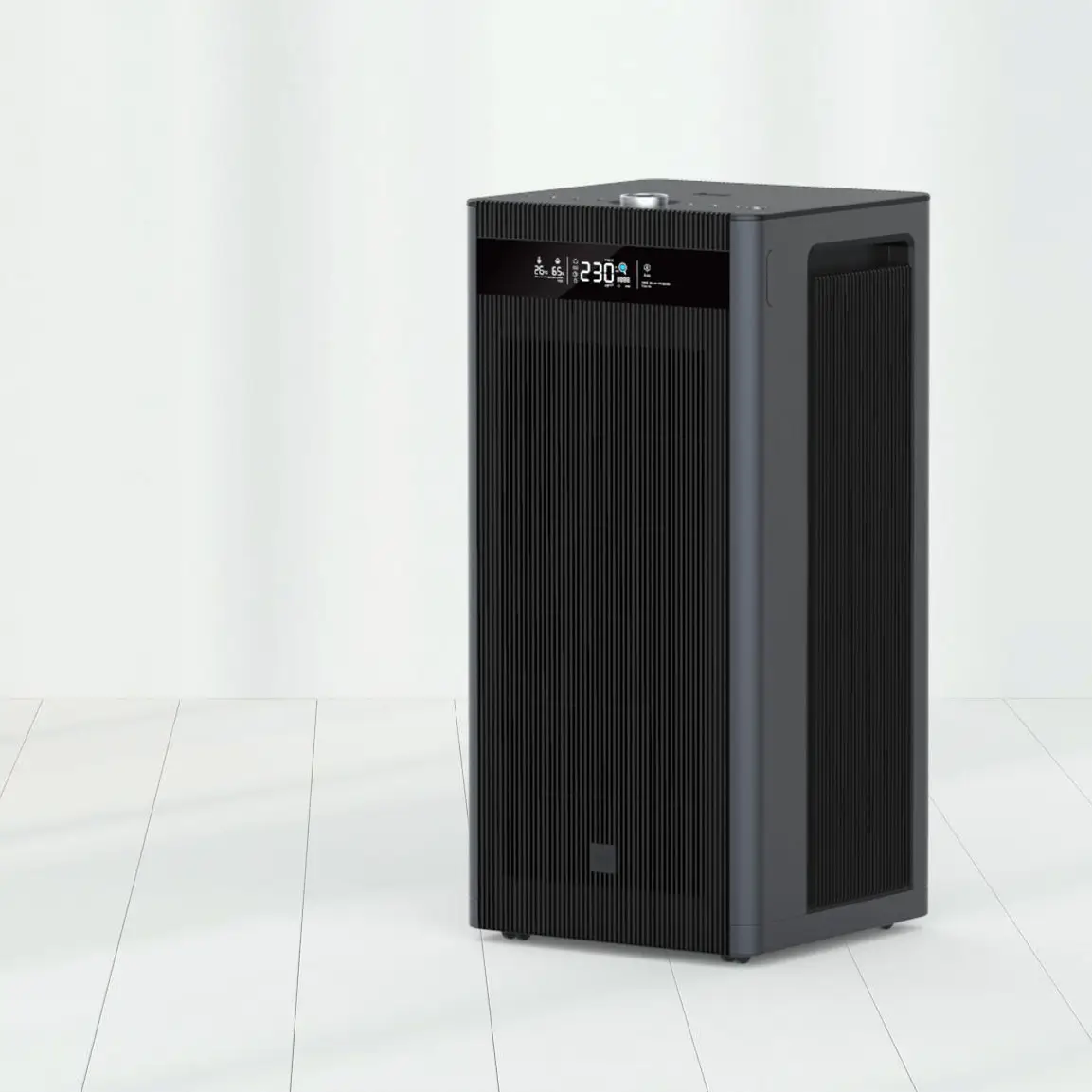
ha1968 3
  • Conceção única da conduta de ar - Ideal para uma circulação de ar suave e controlo do ruído
  • Ruído excecionalmente baixo - 5 -10dB mais baixo do que o purificador de ar da concorrência
  • Grande CADR e grande caudal de ar - Aplicável a grandes salas de aula ou grandes espaços comerciais
  • Sensores múltiplos - Equipado com sensor PM2.5, temperatura e humidade
  • Sistema de filtragem de várias camadas - Filtro anti-bacteriano, Pré-filtro,
  • Filtro HEPA e filtro de carvão ativado
    Operação fácil - Operar ou controlar o produto sem qualquer esforço

Porquê escolher os nossos purificadores de ar?

De nível hospitalar
tecnologia de purificação
Sem vírus
tecnologia de filtragem
99.9% bacteriana
taxa de remoção
CADR elevado
(Taxa de fornecimento de ar limpo)
0,1um Grau médico
HEPA
270-280nm
Esterilização por luz UVC
H14 H13 longo horário
vida útil dos filtros HEAP
Testado por
SGS e laboratórios independentes

Os 3 principais fabricantes de purificadores de ar OEM/ODM na China

Etiquetagem privada para purificadores de ar de marca há décadas

A HisoAir oferece serviços de etiquetagem privada de purificadores de ar a clientes que já tenham revisto e concordado com o desenho e as especificações dos purificadores de ar da HisoAir. Uma vez assinado o acordo, os produtos selecionados serão etiquetados com o nome do cliente.

Purificadores de ar OEM do princípio ao fim

A HisoAir fornece serviços de purificadores de ar OEM a parceiros que têm as especificações necessárias num produto. A HisoAir fornece investigação, design, engenharia, maquetas ou modificações, testes e produções em massa com base no design finalizado do cliente.

Mais de 50 projectos de purificadores de ar

Sed erat libero, porta sed quam sed, vulputate tincidunt tortor.
logótipo

TESTEMUNHOS

" Encontrei o sítio Web da hisoair no Google e, para ser sincero, não tinha a certeza de que fossem fiáveis no início, mas concluíram os requisitos do meu projeto em mês e meio. E quando o projeto exigiu a adição urgente de um sensor de CO2, tiveram uma nova amostra concluída no espaço de uma semana, o que faz deles o fabricante mais profissional e centrado no cliente com quem já trabalhei "
tms 1
Tomás
Fornecedor público da Alemanha
" Todos sabemos que a COVID-19 foi um desastre terrível para todo o mundo, especialmente para a Índia. Comprei um purificador de ar da HisoAir, que tem sido muito útil para mim e para o meu escritório, casa, família e amigos. Tenho trabalhado com Alwen nos últimos 7 anos, que é da HisoAir, e posso dizer que ele é uma pessoa muito confiável, muito eficiente e muito profissional "
testemunhos de clientes 2
Ranjith Bala
Importador de produtos médicos da Índia
" Somos uma empresa com mais de 15 anos de experiência no trabalho com instituições privadas e sectores privados, colaboramos com a Hiso há 3 anos e estamos muito gratos pelos trabalhos que a Hiso nos proporcionou. Estamos gratos pela colaboração com Cherry e Sr. Lee "
testemunhos de clientes
Herina
Hospitais e fornecedores governamentais da Roménia

SOLICITAR UM ORÇAMENTO

enviar uma mensagem abaixo

Entraremos em contacto consigo o mais rapidamente possível!

MANTER-SE EM CONTACTO

Informações de contacto

A sua consulta é importante para nós.
Estabeleceremos uma ligação em breve e os seus dados permanecerão sempre seguros.
sales@hisoair.com
+86 138 0961 9940

Escritório nos EUA: 2180 S WINEVILLE AVE ONTARIO, CA 91761

Escritório: Room 712~713, Building 1, No. 4, Second Road, Songshan Lake Park, Dongguan City, Guangdong Province, 523429.

Fábrica: China | Vietname | Tailândia | Malásia

Contaminant Engineering•3 min read

PFAS Water Filtration Technologies Explained: Carbon, Resin & RO

Key Takeaway:

PFAS reduction depends on the specific compounds present, treatment media, contact time, water chemistry, and system design. Activated carbon, ion exchange, and Reverse Osmosis address PFAS through different mechanisms.

PFAS are a large family of persistent fluorinated compounds that can occur in drinking-water supplies. Their treatment behavior varies significantly by molecular structure, chain length, functional group, concentration, and the chemistry of the source water.

Granular Activated Carbon (GAC) removes PFAS primarily through adsorption. It is generally more effective for many longer-chain PFAS, while shorter-chain compounds tend to break through more quickly. Carbon performance depends on media properties, Empty Bed Contact Time (EBCT), competing organic matter, loading, and replacement frequency.

Ion-exchange resins use charged functional sites to capture many PFAS compounds. Properly selected anion-exchange media can provide high capacity and may perform better than conventional activated carbon for some shorter-chain PFAS, although performance still depends on water chemistry and competing ions.

Reverse Osmosis (RO) uses membrane separation rather than adsorption. Properly designed RO systems can provide broad reduction across many PFAS compounds as well as dissolved salts and other contaminants. Unlike carbon or resin, however, RO also produces a concentrate stream that must be managed.

No single technology should be selected from a PFAS label alone. System design should consider which PFAS compounds are present, their concentrations, required reduction targets, flow rate, media life, and the applicable third-party certification or validation requirements.

HisoAir Water Technical Series
Product Discovery•3 min read

How to Choose an Under-Sink Water Purifier for Modern Kitchens

Key Takeaway:

Match the treatment technology to your water quality first, then evaluate cabinet space, faucet configuration, flow rate, drain and power requirements, and filter replacement needs.

Choosing an under-sink water purifier starts with water chemistry. Carbon filtration is well suited to chlorine, taste, odor, and many organic contaminants, while Reverse Osmosis is more appropriate when dissolved salts, fluoride, nitrates, or broader dissolved contaminants need to be reduced.

For compact kitchens, tankless RO systems eliminate the conventional storage tank and can significantly reduce the space required under the sink. However, membrane capacity stated in GPD does not directly equal faucet flow. When comparing systems, check the actual dispensing flow rate, inlet-pressure requirement, recovery ratio, and whether a booster pump is required.

Installation architecture also matters. Many RO systems require a drain connection, electrical power, and either a dedicated drinking-water faucet or a compatible multi-function faucet. High-flow carbon systems can often connect directly to the existing cold-water line with a simpler installation, but pressure drop and available faucet flow should still be verified.

RO also removes much of the naturally occurring dissolved mineral content. Where taste or mineral balance is a priority, a post-RO remineralization stage can be added. Filter life should be evaluated by both rated capacity and local water quality rather than replacement time alone.

The right system is therefore not simply the smallest or highest-GPD model. It is the configuration that matches the target contaminants, available cabinet space, desired faucet setup, peak dispensing demand, and maintenance expectations.

HisoAir Water Technical Series
Water Quality•2 min read

What Does TDS Mean in Drinking Water? Measurement vs Contaminant Reality

Key Takeaway:

A TDS meter estimates the overall concentration of dissolved ionic substances from electrical conductivity. It cannot identify specific contaminants or determine whether water is chemically safe.

Total Dissolved Solids (TDS) refers to the combined concentration of dissolved substances in water. Most handheld TDS meters do not measure TDS directly. Instead, they measure electrical conductivity (EC) and convert that reading into an estimated parts-per-million (ppm) value.

This means a TDS reading can indicate how much dissolved ionic material is present, but not what that material actually is. Calcium, magnesium, sodium, nitrates, and other dissolved ions can all contribute to conductivity, yet a simple TDS meter cannot distinguish between them.

TDS meters are also not suitable for detecting trace contaminants such as PFAS, many VOCs, pesticides, pharmaceuticals, or disinfection byproducts. These substances may be present at concentrations far below the level needed to noticeably change electrical conductivity.

A low TDS reading therefore does not guarantee safe drinking water, and a higher TDS reading does not automatically indicate contamination. Water-treatment decisions should be based on laboratory testing for specific contaminants of concern rather than TDS alone.

HisoAir Water Technical Series
Technology Selection•2 min read

RO vs UF Water Filtration: Understanding Pore Sizes & Dissolved Minerals

Key Takeaway:

Ultrafiltration can reduce bacteria, turbidity, and suspended particles while retaining most naturally occurring dissolved minerals. Reverse Osmosis provides much broader reduction of dissolved salts and smaller contaminants.

Ultrafiltration (UF) typically uses hollow-fiber membranes with pore sizes in the approximate 0.01–0.1 micron range. These membranes physically retain turbidity, suspended solids, colloids, and many microorganisms while allowing dissolved minerals and salts to remain in the water.

Reverse Osmosis (RO) operates at a much finer separation level. Unlike UF, RO can substantially reduce dissolved ions such as sodium, calcium, fluoride, nitrates, and other contributors to total dissolved solids (TDS). This makes RO more suitable when dissolved-salt reduction is a primary treatment objective.

UF generally requires less system pressure and produces little or no continuous concentrate stream in many point-of-use configurations. RO typically requires greater pressure and produces a reject-water stream, but delivers broader contaminant reduction.

For water with acceptable TDS and mineral content, UF can be a simpler mineral-retaining treatment option. Where dissolved salts, fluoride, nitrates, or broader dissolved contaminants are a concern, RO is generally the more appropriate technology.

HisoAir Water Technical Series
Technology Selection•4 min read

Carbon Block vs Reverse Osmosis: Which Fits Your Need?

Key Takeaway:

Choose RO for dissolved inorganic salts and heavy metals; choose Carbon Block for chemical taste/odor, no wastewater, and high line-pressure flow.

Reverse Osmosis (RO) and Carbon Block filtration represent two fundamentally different treatment methods: membrane separation and adsorption. Understanding these differences helps determine which technology is better suited to a specific water-quality requirement.

Reverse Osmosis uses a semi-permeable membrane with pore sizes of approximately 0.0001 microns. It can significantly reduce dissolved inorganic contaminants such as TDS, fluoride, nitrates, and certain heavy metals. Because water must be forced through the membrane, RO systems require sufficient pressure or a booster pump and generate a concentrated wastewater stream.

Carbon Block filtration relies primarily on adsorption through compressed activated carbon, commonly with nominal pore sizes around 0.5–5 microns. It is highly effective for chlorine, chloramines, VOCs, taste, and odor, while allowing substantially higher direct-flow rates without producing wastewater.

From an operating perspective, Carbon Block systems are generally simpler, require less energy, and avoid the water loss associated with RO. RO involves higher system complexity and operating cost, but provides substantially broader reduction of dissolved contaminants that Carbon Block alone cannot address.

HisoAir Water Technical Series

SOLICITAR UM ORÇAMENTO