Abre num novo separador
Soluções inovadoras para a qualidade do ar

Where Are LG Water Purifiers Manufactured?

Related Products

For discerning consumers and business clients alike, the question “Where is it made?” goes far beyond geography. It speaks to quality, innovation, supply chain resilience, and the strategic vision of a global brand.

When it comes to LG water purifiers, the answer is not one single location but a sophisticated global manufacturing strategy. By balancing premium Korean innovation with cost-effective international production, LG ensures that every product from flagship PuriCare™ models to accessible, mass-market units delivers reliability, safety, and trust.

This article takes you on a journey through LG’s global manufacturing footprint, from cutting-edge facilities in South Korea to cost-efficient hubs in Asia and the Americas, to show you how and where your LG water purifier is made.

The South Korean Nexus: The Heart of Innovation and Premium Quality

South Korea is the undisputed epicenter of LG's technological prowess. It is here that the company's most advanced research, development, and manufacturing processes converge to create the premium products that define the brand. For water purifiers, this Korean nexus has historically involved two key facilities, each with a distinct but vital role in the value chain.
lg water purifier 2

Cheongju: The Core of Filter Technology

The single most critical component in an advanced water purifier is its filter. For years, the heart of LG's premium purifiers the Reverse Osmosis (RO) membrane was manufactured by its affiliate, LG Chem, at a specialized plant in Cheongju. This facility was not just an assembly line; it was a hub of material science innovation. After strategically acquiring the US-based water treatment startup NanoH2O in 2014, LG Chem gained crucial patents for Thin-Film Nanocomposite (TFN) technology, allowing it to produce RO membranes with world-class performance.

The Cheongju plant produced filters with a salt rejection rate of 99.89%, a figure that set a new industry benchmark. This superior performance, driven by deep technological expertise, created immense global demand, with the plant often running at full capacity to supply markets in Asia, the Middle East, and for domestic use. This vertical integration was a key competitive advantage, giving LG Electronics exclusive access to a proprietary, high-performance component for its flagship purifiers.

However, in a significant strategic shift, LG Chem recently agreed to sell its water solutions business, including the Cheongju plant and its patents, to the Seoul-based firm Glenwood Private Equity. This move, designed to allow LG Chem to focus on future growth areas like battery materials, transforms a secure internal supply chain into a more traditional supplier relationship. While LG Electronics will undoubtedly maintain a supply agreement, this divestment marks a new chapter in how its most critical component is sourced.

Changwon: The Smart Park Assembly Hub

Once the advanced filter is produced, it is sent to be integrated into the final product at one of the world's most advanced factories: the LG Smart Park in Changwon. This facility, which assembles refrigerators and water purifiers, is the command center for LG's global home appliance business. Its prestige is confirmed by its designation as a "Lighthouse Factory" by the World Economic Forum, an honor reserved for pioneers of the Fourth Industrial Revolution in manufacturing.

The Changwon plant is a showcase of intelligent automation, using 5G-networked logistics robots and AI-powered quality control systems that can predict defects before they happen. Assembling the premium LG PuriCare™ water purifiers here is a deliberate choice. It physically embeds the brand's promise of innovation and quality into the product itself, reinforcing the value and prestige associated with a "Made in Korea" appliance.
lg water purifier 3

Global Hubs: Manufacturing for Scale and Market Proximity

While South Korea handles the premium end of the spectrum, LG's global success relies on a network of regional manufacturing hubs designed for scale, efficiency, and market responsiveness. This is where the strategy for producing accessible, high-volume models comes into play.

China: The Engine of Cost-Effective Production

China plays a pivotal role in LG's global strategy as a hub for large-scale, cost-effective manufacturing. While no public documents explicitly state that final water purifier assembly occurs in China, the operational template for the closely related air purifier category provides a clear and logical precedent. For air purifiers, LG uses its Chinese facilities to produce mass-market models for global distribution, leveraging the country's lower production costs and incredibly robust supply chains.

It is crucial to understand that "cost-effective" does not mean "low quality." The primary advantage of manufacturing in China is not just cheaper labor, but access to a deep and efficient ecosystem of component suppliers. This allows LG to source high-quality parts quickly and affordably, enabling them to build feature-rich purifiers at a competitive price point without sacrificing quality. LG Chem has also maintained a significant manufacturing presence in China for decades, producing a wide range of materials and giving the corporation deep operational expertise in the country. This makes China an ideal location for producing the high-volume water purifier models that serve the global mass market.

India: The Next Frontier for Growth and Localization

India represents a cornerstone of LG's future strategy. The company has operated in the country since 1997, with established manufacturing plants in Greater Noida and Pune producing a wide range of appliances for the domestic market. One supplier on the business platform IndiaMart even lists LG Electronics India Private Limited in Greater Noida as a manufacturer of an "LG 8L RO+UV+Mineral Booster Water Purifier".

LG is now dramatically scaling up its Indian operations with a new $600 million manufacturing plant in Sri City, Andhra Pradesh. This massive investment signals a strategic shift, elevating India from a market to be served into a comprehensive manufacturing and export hub. The Sri City plant is designed to:

  • Focus on Premium Products: Unlike the existing Noida facility, the new plant will manufacture premium appliances like French-door refrigerators and front-loading washing machines to cater to India's growing middle class.
  • Serve as an Export Hub: Its strategic coastal location is ideal for exporting to neighboring countries in South Asia and key markets in the Middle East, positioning India as a hub for the "Global South".
  • Achieve Massive Scale: When fully operational, the plant will have an annual production capacity of 800,000 refrigerators, 850,000 washing machines, and 1.5 million air conditioners. While water purifiers are not listed in the initial phase, their inclusion is highly probable as LG continues to localize its full product portfolio.

This investment is paired with a deep localization strategy, with LG already sourcing over 50% of its components from Indian suppliers and encouraging its Korean partners to set up local facilities.
lg water purifier

The Americas and Europe: Serving Mature Markets

Completing the global picture are facilities strategically positioned to serve key mature markets.

  • Mexico: LG operates plants in Mexico with the primary goal of efficiently serving the large North American market. This nearshoring strategy reduces shipping times and costs, allowing LG to be more responsive to demand in the U.S. and Canada.
  • United States: To further solidify its North American presence, LG opened a major factory in Clarksville, Tennessee, in 2019, which primarily produces washing machines and other home appliances directly for the U.S. market.
  • Other Regions: LG also maintains facilities in countries like Vietnam, Poland, and Russia, which typically produce appliances tailored to the specific needs and regulations of their local and regional markets.

Conclusão

So, where is your LG water purifier made? The answer reflects LG’s global ambition and smart supply chain design.

If you buy a flagship LG PuriCare™: It likely carries a Korean-made filter and was assembled at the state-of-the-art Changwon Smart Park.

If you buy a mass-market model: It may come from China or India, delivering reliable performance at scale.

If you’re in North America or Europe: It may be locally assembled to ensure fast delivery and regional compliance.

This global-local balance allows LG to maintain innovation leadership while making clean water accessible worldwide. Whether it’s a premium Lighthouse Factory unit or a high-volume global hub model, LG’s promise remains the same:

Life’s Good powered by trust, quality, and innovation.

Partilhar:
o fundador da hisoair, sr. lee
Alwen Lee, an air purification expert with over 10 years of experience, is a devoted father of two and a passionate traveler, having explored more than 30 countries. With a love for public speaking and swimming, he has dedicated his life to the indoor air quality industry. His mission is to ensure that people around the world enjoy the freedom to breathe clean air and lead happy, healthy lives.

Envie-nos uma mensagem

Mais para ler

Comparison between PFAS-ready and PFAS-certified water filters, showing internal filter components and certification steps.

PFAS-Ready vs. PFAS-Certified Water Filters: Engineering Differences for OEM Brands

For an appliance, wellness or healthy-home brand preparing to launch a water purifier, the phrase “PFAS-ready” can sound reassuring. The proposed system may use activated ...
Water Purifiers
NSF base listing and ANF private-label certification pathway for OEM water filters

What Is an NSF Master Listing? A Guide to Base Listings, ANF Certification and OEM Water Filters

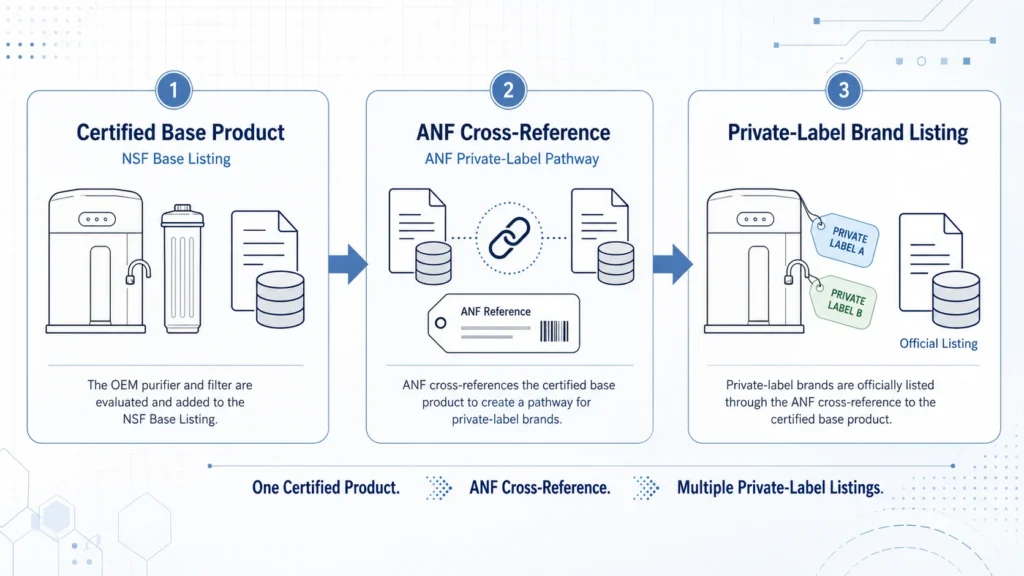
For a brand preparing to launch an OEM water purifier, one of the most common supplier claims is: “We already have an NSF master listing, ...
News, Water Purifiers
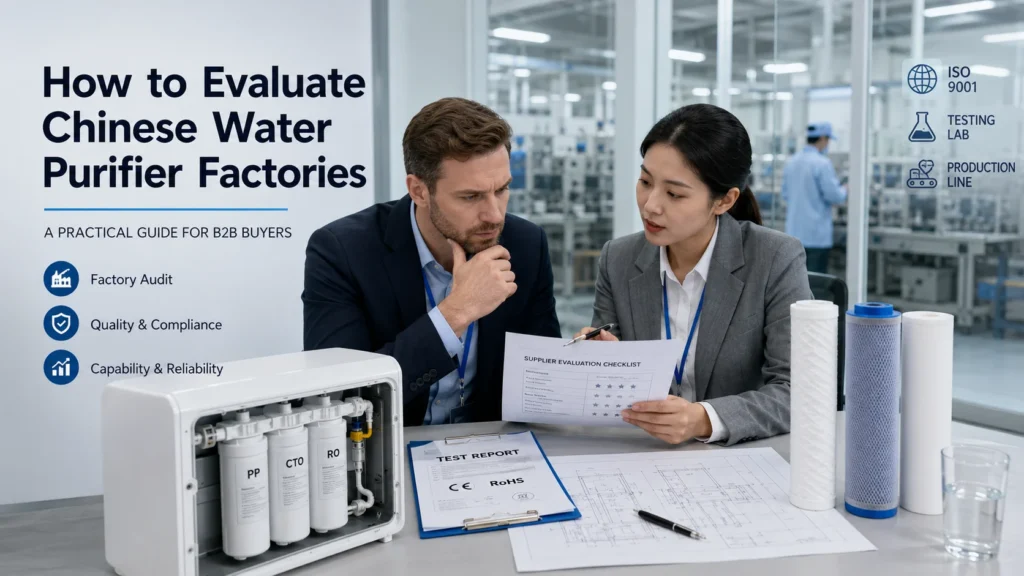
Two professionals discussing a supplier evaluation checklist at a table with water purifier parts, documents, and technical drawings in a factory setting.

Water Purifier Manufacturer in China: 12 Questions B2B Buyers Should Ask

Finding a water purifier manufacturer in China is easy. Finding a factory that can support your target contaminants, certification pathway, product positioning and long-term replacement-filter ...
News, Water Purifiers
Featured image for Why Stainless Steel Water Purifiers Are Becoming the Premium Choice for Wellness Brands

Why Stainless Steel Water Purifiers Are Becoming the Premium Choice for Wellness Brands

Choose stainless steel purifiers for purity, aesthetics, and sustainability. Elevate your wellness brand with premium quality today!
News, Water Purifiers
Featured image for What Biohacking & Longevity Consumers Want in a Water Purification System

What Biohacking & Longevity Consumers Want in a Water Purification System

Discover pure, re-mineralized water systems. No plastics, complete RO, perfect for biohacking longevity. Upgrade your hydration now!
News, Water Purifiers
Featured image for How Premium Water Appliances Improve Sleep, Skin, and Daily Energy

How Premium Water Appliances Improve Sleep, Skin, and Daily Energy

Unlock better sleep, radiant skin, and energy with mineral-rich water. Discover the power of premium appliances for your ultimate wellness boost.
News, Water Purifiers
Contaminant Engineering•3 min read

PFAS Water Filtration Technologies Explained: Carbon, Resin & RO

Key Takeaway:

PFAS reduction depends on the specific compounds present, treatment media, contact time, water chemistry, and system design. Activated carbon, ion exchange, and Reverse Osmosis address PFAS through different mechanisms.

PFAS are a large family of persistent fluorinated compounds that can occur in drinking-water supplies. Their treatment behavior varies significantly by molecular structure, chain length, functional group, concentration, and the chemistry of the source water.

Granular Activated Carbon (GAC) removes PFAS primarily through adsorption. It is generally more effective for many longer-chain PFAS, while shorter-chain compounds tend to break through more quickly. Carbon performance depends on media properties, Empty Bed Contact Time (EBCT), competing organic matter, loading, and replacement frequency.

Ion-exchange resins use charged functional sites to capture many PFAS compounds. Properly selected anion-exchange media can provide high capacity and may perform better than conventional activated carbon for some shorter-chain PFAS, although performance still depends on water chemistry and competing ions.

Reverse Osmosis (RO) uses membrane separation rather than adsorption. Properly designed RO systems can provide broad reduction across many PFAS compounds as well as dissolved salts and other contaminants. Unlike carbon or resin, however, RO also produces a concentrate stream that must be managed.

No single technology should be selected from a PFAS label alone. System design should consider which PFAS compounds are present, their concentrations, required reduction targets, flow rate, media life, and the applicable third-party certification or validation requirements.

HisoAir Water Technical Series
Product Discovery•3 min read

How to Choose an Under-Sink Water Purifier for Modern Kitchens

Key Takeaway:

Match the treatment technology to your water quality first, then evaluate cabinet space, faucet configuration, flow rate, drain and power requirements, and filter replacement needs.

Choosing an under-sink water purifier starts with water chemistry. Carbon filtration is well suited to chlorine, taste, odor, and many organic contaminants, while Reverse Osmosis is more appropriate when dissolved salts, fluoride, nitrates, or broader dissolved contaminants need to be reduced.

For compact kitchens, tankless RO systems eliminate the conventional storage tank and can significantly reduce the space required under the sink. However, membrane capacity stated in GPD does not directly equal faucet flow. When comparing systems, check the actual dispensing flow rate, inlet-pressure requirement, recovery ratio, and whether a booster pump is required.

Installation architecture also matters. Many RO systems require a drain connection, electrical power, and either a dedicated drinking-water faucet or a compatible multi-function faucet. High-flow carbon systems can often connect directly to the existing cold-water line with a simpler installation, but pressure drop and available faucet flow should still be verified.

RO also removes much of the naturally occurring dissolved mineral content. Where taste or mineral balance is a priority, a post-RO remineralization stage can be added. Filter life should be evaluated by both rated capacity and local water quality rather than replacement time alone.

The right system is therefore not simply the smallest or highest-GPD model. It is the configuration that matches the target contaminants, available cabinet space, desired faucet setup, peak dispensing demand, and maintenance expectations.

HisoAir Water Technical Series
Water Quality•2 min read

What Does TDS Mean in Drinking Water? Measurement vs Contaminant Reality

Key Takeaway:

A TDS meter estimates the overall concentration of dissolved ionic substances from electrical conductivity. It cannot identify specific contaminants or determine whether water is chemically safe.

Total Dissolved Solids (TDS) refers to the combined concentration of dissolved substances in water. Most handheld TDS meters do not measure TDS directly. Instead, they measure electrical conductivity (EC) and convert that reading into an estimated parts-per-million (ppm) value.

This means a TDS reading can indicate how much dissolved ionic material is present, but not what that material actually is. Calcium, magnesium, sodium, nitrates, and other dissolved ions can all contribute to conductivity, yet a simple TDS meter cannot distinguish between them.

TDS meters are also not suitable for detecting trace contaminants such as PFAS, many VOCs, pesticides, pharmaceuticals, or disinfection byproducts. These substances may be present at concentrations far below the level needed to noticeably change electrical conductivity.

A low TDS reading therefore does not guarantee safe drinking water, and a higher TDS reading does not automatically indicate contamination. Water-treatment decisions should be based on laboratory testing for specific contaminants of concern rather than TDS alone.

HisoAir Water Technical Series
Technology Selection•2 min read

RO vs UF Water Filtration: Understanding Pore Sizes & Dissolved Minerals

Key Takeaway:

Ultrafiltration can reduce bacteria, turbidity, and suspended particles while retaining most naturally occurring dissolved minerals. Reverse Osmosis provides much broader reduction of dissolved salts and smaller contaminants.

Ultrafiltration (UF) typically uses hollow-fiber membranes with pore sizes in the approximate 0.01–0.1 micron range. These membranes physically retain turbidity, suspended solids, colloids, and many microorganisms while allowing dissolved minerals and salts to remain in the water.

Reverse Osmosis (RO) operates at a much finer separation level. Unlike UF, RO can substantially reduce dissolved ions such as sodium, calcium, fluoride, nitrates, and other contributors to total dissolved solids (TDS). This makes RO more suitable when dissolved-salt reduction is a primary treatment objective.

UF generally requires less system pressure and produces little or no continuous concentrate stream in many point-of-use configurations. RO typically requires greater pressure and produces a reject-water stream, but delivers broader contaminant reduction.

For water with acceptable TDS and mineral content, UF can be a simpler mineral-retaining treatment option. Where dissolved salts, fluoride, nitrates, or broader dissolved contaminants are a concern, RO is generally the more appropriate technology.

HisoAir Water Technical Series
Technology Selection•4 min read

Carbon Block vs Reverse Osmosis: Which Fits Your Need?

Key Takeaway:

Choose RO for dissolved inorganic salts and heavy metals; choose Carbon Block for chemical taste/odor, no wastewater, and high line-pressure flow.

Reverse Osmosis (RO) and Carbon Block filtration represent two fundamentally different treatment methods: membrane separation and adsorption. Understanding these differences helps determine which technology is better suited to a specific water-quality requirement.

Reverse Osmosis uses a semi-permeable membrane with pore sizes of approximately 0.0001 microns. It can significantly reduce dissolved inorganic contaminants such as TDS, fluoride, nitrates, and certain heavy metals. Because water must be forced through the membrane, RO systems require sufficient pressure or a booster pump and generate a concentrated wastewater stream.

Carbon Block filtration relies primarily on adsorption through compressed activated carbon, commonly with nominal pore sizes around 0.5–5 microns. It is highly effective for chlorine, chloramines, VOCs, taste, and odor, while allowing substantially higher direct-flow rates without producing wastewater.

From an operating perspective, Carbon Block systems are generally simpler, require less energy, and avoid the water loss associated with RO. RO involves higher system complexity and operating cost, but provides substantially broader reduction of dissolved contaminants that Carbon Block alone cannot address.

HisoAir Water Technical Series

SOLICITAR UM ORÇAMENTO