
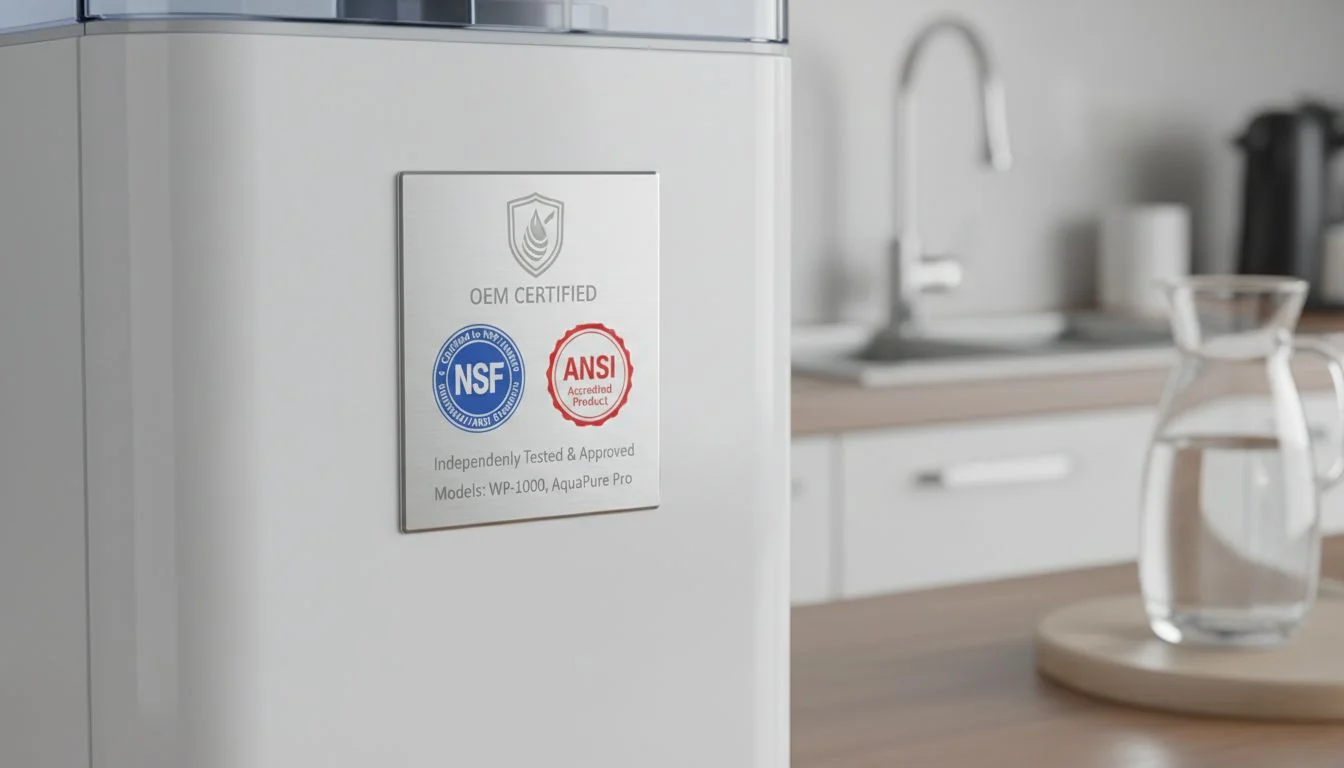
Picking the wrong certification wastes your money. You might face FTC fines1 or costly product recalls. Let us decode the exact NSF/ANSI certifications you actually need for your product.
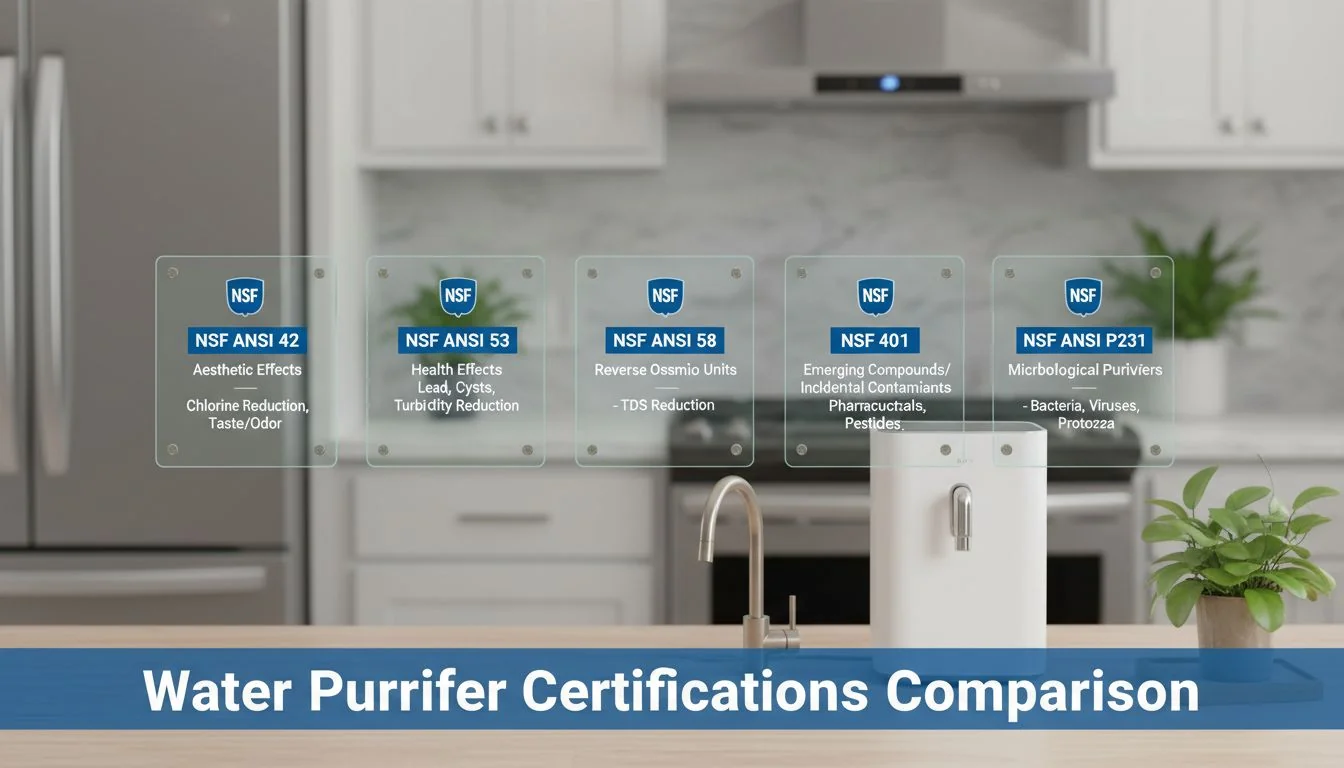
The five main NSF/ANSI water purifier certifications—42, 53, 58, 401, and P231—define your product's testing scope, cost, and legal marketing claims2. Choosing the right stack prevents overspending on unnecessary tests while protecting your brand from compliance failures.
Navigating these standards feels like walking through a minefield. One wrong step in your BOM or marketing copy can blow up your entire launch timeline. Let us break down exactly how to build a defensible, cost-effective certification strategy3.
NSF/ANSI 42 is a health claim certification that proves a filter removes dangerous contaminants like lead.False
NSF/ANSI 42 only covers aesthetic effects like chlorine, taste, and odor. It is not a health claim certification.
NSF/ANSI 53 covers health contaminants like lead, VOCs, and cysts.True
NSF/ANSI 53 is the standard for health-related contaminant reduction, including lead, which is highly relevant for premium product positioning.
What Are the Five Cert Tracks That Define Every US Water Purifier OEM Program?
Confused by all the NSF numbers? Guessing wrong costs hundreds of thousands of dollars. Here is exactly what each standard covers and costs for your OEM program.
NSF/42 covers aesthetics like taste. NSF/53 handles health contaminants like lead. NSF/58 is for RO systems. NSF/401 targets emerging chemicals like PFAS. P231 is for microbiological purification. Your product strategy dictates your stack, not maximum certification.
Breaking Down the Five Standards
As a product designer, I know you look at a water purifier and see plastic housings, molds, and filters. But regulators see a list of claims. You must match your design to the right standard. If you over-certify, you waste money. If you under-certify, you face legal trouble.
Let us look at the five main tracks. NSF/42 is your baseline. It covers taste and odor. It takes about 8 to 12 weeks. NSF/53 is the big one for health. It covers lead and VOCs. This is what consumers want to see. NSF/58 is strictly for Reverse Osmosis (RO) systems. It tests the whole system, including your membranes and tanks. NSF/401 is becoming very popular. It covers emerging threats like PFAS and pesticides. Many US states now demand this. Finally, P231 is for extreme purification. It covers bacteria and viruses. Most home products do not need P231.
Certification Comparison Table
| Standard | Focus Area | Typical Cost | Timeline |
|---|---|---|---|
| NSF/ANSI 42 | Aesthetic (Taste, Odor, Chlorine) | $25K – $50K | 8 – 12 weeks |
| NSF/ANSI 53 | Health (Lead, VOCs, Cysts) | $40K – $80K | 12 – 20 weeks |
| NSF/ANSI 58 | RO Systems (TDS, Heavy Metals) | $50K – $100K | 16 – 24 weeks |
| NSF/ANSI 401 | Emerging (PFAS, Pharmaceuticals) | $60K – $120K | 16 – 24 weeks |
| NSF/ANSI P231 | Microbiological (Bacteria, Viruses) | $80K – $200K | 6 – 12 months |
You do not need all five. A standard home RO system usually needs 42, 53, and 58. If you want a premium label, add 401. Work with your OEM partner to pick the right stack.
NSF/ANSI 401 is the certification track that covers emerging contaminants like PFAS and pharmaceuticals.True
NSF/ANSI 401 specifically targets emerging contaminants, including PFAS, which many US states now require.
Every residential water purifier must have NSF/ANSI P231 certification to be sold in the US.False
P231 is for microbiological purification and is usually reserved for emergency, deep-well, or military use. Most consumer brands do not need it.
Why Does the Distinction Between Component and System Certification Trigger Full Recertifications?
Swapping a simple cartridge? If you have the wrong certification type, that small change triggers a massive recertification bill. Let us fix your architecture.
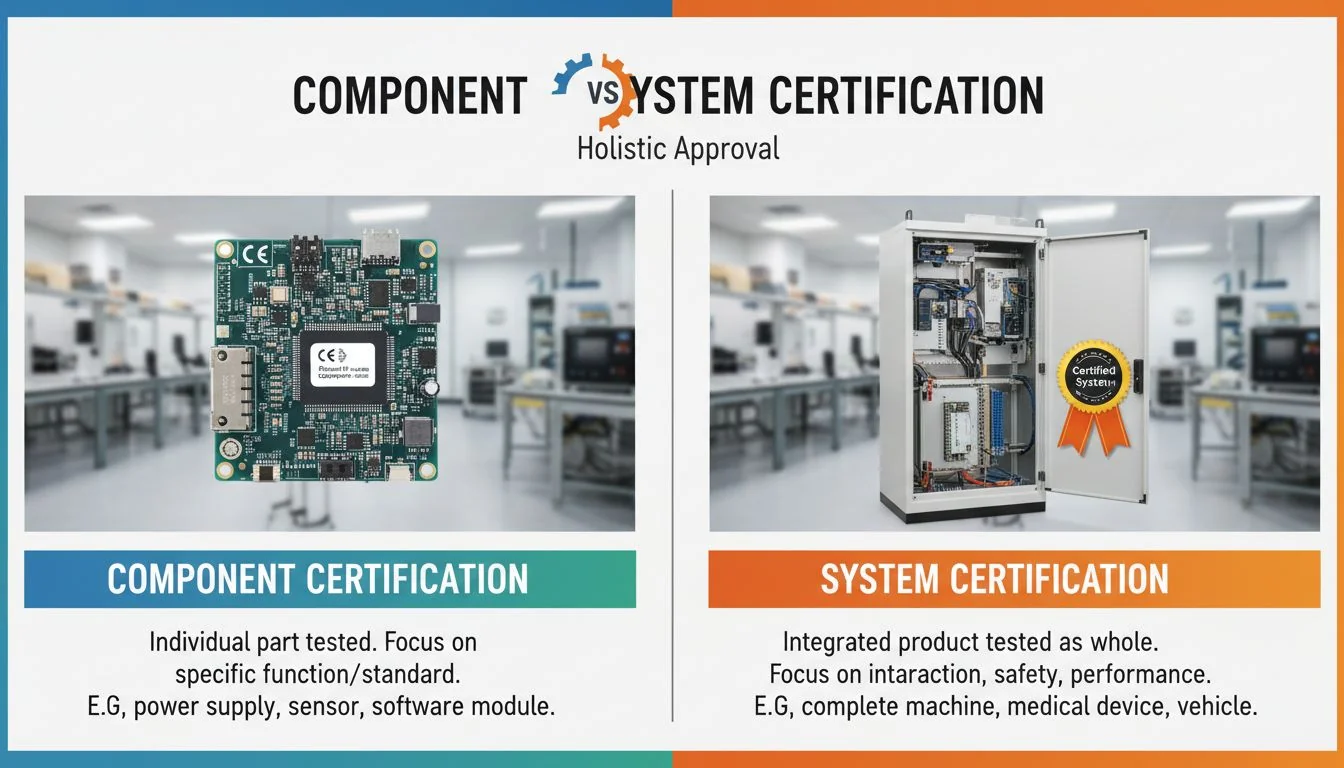
System-level certification locks your entire product configuration. If you change one part, you lose the cert. component-level certification4 tests individual parts. This lets you swap cartridges or move to new manufacturing partners without paying for a full system retest.
The Danger of System-Level Locks
I see many designers make a huge mistake here. They design a beautiful product. They get a system-level certification5. Then, 18 months later, they want to change the carbon block supplier to save money. Boom. The certification drops. They have to pay $60,000 and wait 16 weeks to recertify the whole machine.
System-level certification means the testing lab approved your exact assembly. They approved the specific pump, the specific housing, and the specific filter. If you change any wetted part, the cert is void.
Component-level certification is much smarter. You certify the cartridge itself. You certify the plastic housing itself (usually under NSF/61). Then, you build your system using these pre-certified blocks. If you want to offer a special PFAS filter for a new market, you just swap the cartridge. You do not have to retest the whole machine.
Component vs. System Impact
| Feature | System-Level Certification | Component-Level Certification |
|---|---|---|
| Flexibility | Very low. Locked to one BOM. | High. Can swap certified parts. |
| Recertification Risk | High. Any change triggers a retest. | Low. Only the changed part needs review. |
| Partner Changes | Hard. Moving factories voids the cert. | Easier. You own the component certs. |
| Aftermarket Control | Weak. Hard to defend against fakes. | Strong. Proprietary certs protect margins. |
Smart brands demand component-level certs from their OEM partners. They also make sure they own the documentation. Do not let a factory lock you into their specific parts forever.
Changing a membrane brand in a system-level certified RO unit invalidates the certification.True
System-level certifications cover a specific configuration. Substituting a key component like a membrane technically lapses the certification.
Component-level certification requires you to retest the entire water purifier if you change the outer plastic shell.False
Component-level certification applies to individual parts. Changing a non-wetted part like an outer shell does not require a full system retest.
How Does "Tested To" vs "Certified To" Cross the Line Between Defensible and Misleading?
Using "Tested To" on your packaging? You might be inviting an FTC lawsuit. Learn the legal difference before your product gets pulled from shelves.
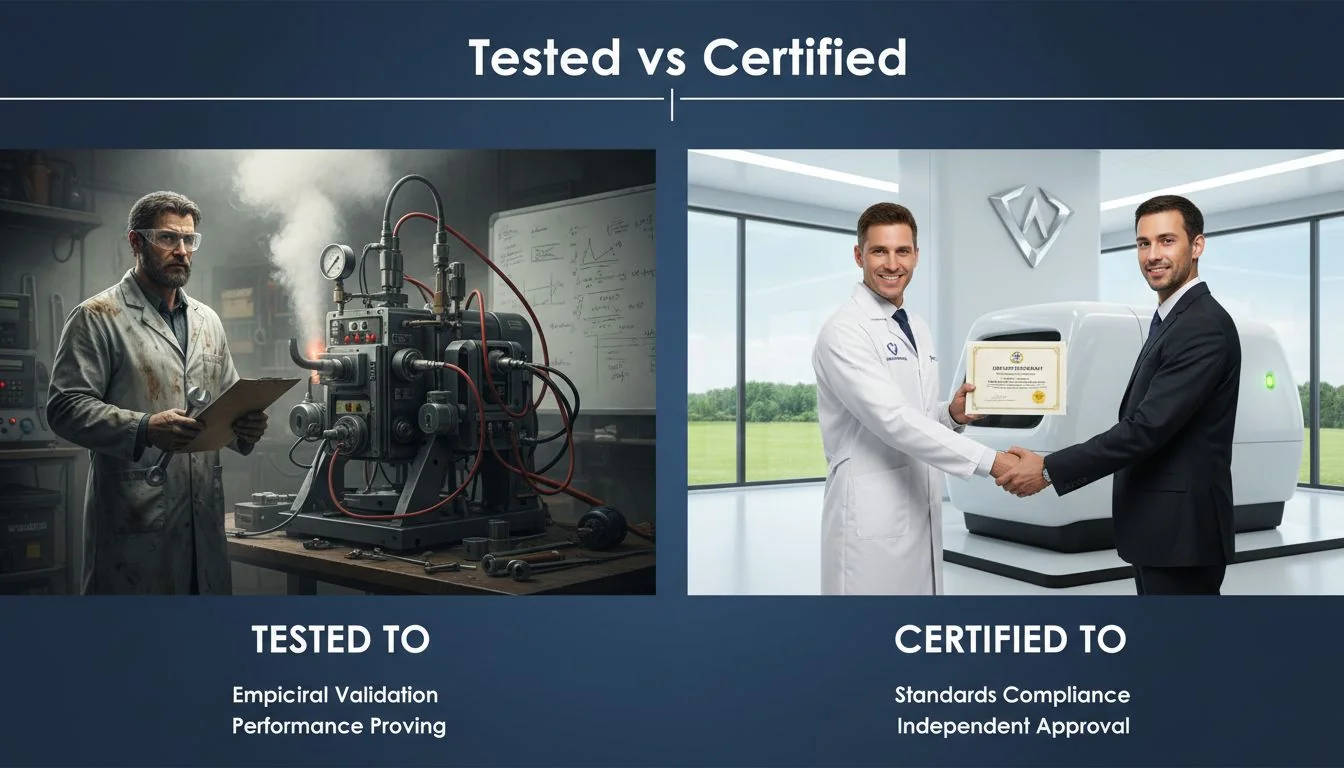
"Certified to" means an accredited third party tested your product, issued an active document, and runs annual audits6. "Tested to" often means unverified in-house testing. Using "Tested to" to imply official certification exposes your brand to FTC fines and retailer delisting.
The Legal Trap of Marketing Claims
When I talk to new brand owners, they often try to save money. They do a quick lab test and print "Tested to NSF Standards" on the box. They think this is a clever marketing hack. It is actually a massive legal risk.
The FTC watches water purifier claims very closely. "Certified to" is a protected status. It means a recognized body like NSF or WQA tested your exact product. It means they audit your factory every year. It means you have a piece of paper proving your claims.
"Tested to" means almost nothing legally. It could mean you tested it once in your own factory. It could mean you tested a prototype that is different from the final product. If you use this language to trick buyers, the FTC will fine you. Retailers like Amazon and Costco will delete your product listings. Plaintiff lawyers will hit you with class-action lawsuits.
Claim Language Risks
| Claim Language | Meaning | Legal Risk Level |
|---|---|---|
| "Certified to NSF/ANSI 53" | Official third-party approval with audits. | Low. Fully defensible. |
| "Tested to NSF Standards" | Unofficial testing, no ongoing audits. | High. FTC and retailer target. |
| "NSF Certified" (Generic) | Vague. Does not list the specific standard. | Medium. Can mislead consumers. |
| "Engineered to meet NSF" | Marketing fluff. No proof required. | High. Often triggers lawsuits. |
You must use the exact language from your certification document. If your OEM partner pushes you to use "Tested to" to save time, find a new partner. They are selling you a future lawsuit.
Using the phrase 'Tested to NSF standards' provides the same legal protection as 'Certified to NSF standards'.False
The FTC views 'Tested to' as insufficient substantiation for health claims. Only 'Certified to' implies active, third-party audited compliance.
Major retailers like Amazon and Costco will delist products that claim to be NSF certified without providing an active certification document.True
Retailers maintain strict compliance teams. If a product claims certification without proof, it faces immediate delisting.
What Do Cert Cost and Timeline Benchmarks Actually Buy You in OEM Programs?
Think certification takes 12 weeks and $30K? You are likely under-budgeting. A full premium stack takes much longer and costs much more.
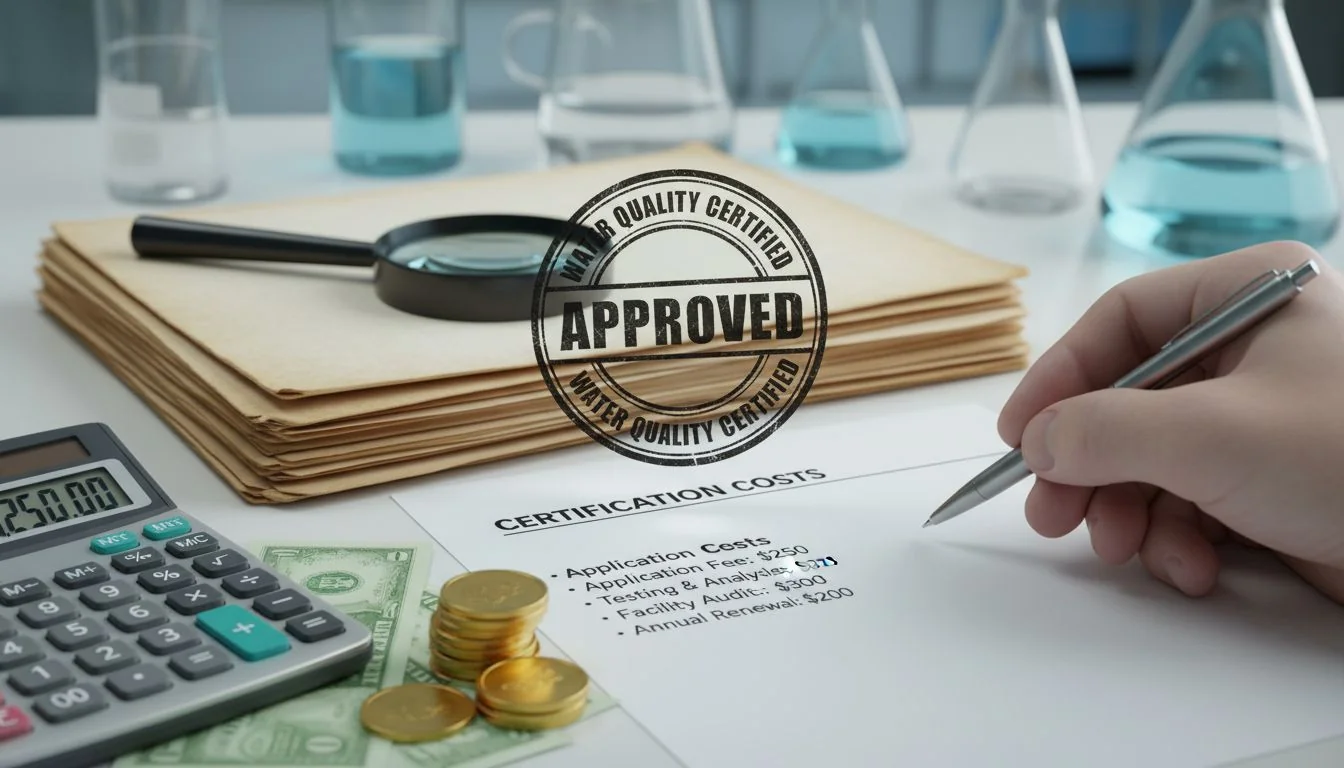
A premium US-market cert stack costs between $200K and $400K and takes 12 to 18 months. Costs include lab fees, cert body reviews, and annual audits. Failing a test or changing a part adds massive delays and fees.
The Real Cost of Launching
I always tell designers to budget for certification early. Do not treat it as an afterthought. A single NSF/42 test might cost $30,000. But a real product needs more than that. If you want to sell a premium RO system in the US, you need NSF/42, 53, 58, and 401.
This stack will cost you up to $400,000. It will take over a year. Why does it cost so much? First, you pay the lab fees. Testing for lead and PFAS requires very expensive equipment. Second, you pay the certification body for their review. Third, you pay for the first year of factory audits.
The timeline is also tricky. You have to wait in line at the lab. Sometimes the queue is 16 weeks long before testing even starts. Then the test takes another 16 weeks. If your product fails the test, you start over. You pay the fee again. You wait in line again.
Budgeting for Certification
| Expense Category | Percentage of Cert Budget | Description |
|---|---|---|
| Initial Lab Fees | 60% - 70% | The actual cost of running water through the filters. |
| Pre-test Work | 15% - 20% | In-house testing to ensure you pass the real test. |
| Annual Surveillance | 10% - 15% | Factory audits and retail product pulls. |
| Documentation | 5% - 10% | Managing the paperwork for retailers and regulators. |
A good OEM partner saves you money here. If they have a good in-house lab, they can pre-test your design. This ensures you pass the official test on the first try.
A full premium US-market certification stack (NSF 42, 53, 58, 401) can be completed in 8 weeks for under $50,000.False
A full premium stack typically costs $200K–$400K and takes 12–18 months due to extensive lab work and queue times.
Failing an NSF certification test requires you to pay the full testing fee again for a retest.True
First-submission failures require a complete retest, which means paying the $30K–$80K fee again and facing another 12–16 week delay.
How Do Re-Certification Triggers and Annual Audits Keep Your Product on the Shelf?
Treating certification as a one-time launch event? You will lose your retail spot. Ongoing maintenance is what keeps your product legally compliant.
Active NSF certs require annual factory audits and unannounced retail product tests. Changing a wetted component, moving a factory line, or missing a standard update triggers a recertification. You must budget $50K to $150K yearly for maintenance.
The Daily Grind of Compliance
Certification does not end on launch day. It is a living process. The certification body will visit your factory every year. They will pull your product off a store shelf and test it without warning. If it fails, they suspend your certification.
As a designer, you must control the Bill of Materials (BOM). If your factory cannot find the right O-ring and uses a different rubber, that is a material change. If they move the injection molding machine to a new building, that is a material change. These changes trigger a review.
You have to document everything. You need a budget for this. A brand with five active certifications will spend up to $150,000 a year just to maintain them. If you ignore this, you will fail an audit. Your product will be pulled from the shelf.
Common Recertification Triggers
| Trigger Event | Example | Action Required |
|---|---|---|
| BOM Change | Swapping a tubing supplier. | Let-through review or partial retest. |
| Process Change | Changing injection molding pressure. | Factory audit review. |
| Standard Update | NSF adds new PFAS chemicals to 401. | Full retest against the new standard. |
| SKU Extension | Launching a new color with a new filter. | Entirely new certification track. |
You must force your OEM partner to sign a strict contract. They must tell you before they change any part. They must help pay for retests if they cause the change. Good compliance keeps your product alive in year three.
Changing the supplier of an internal wetted O-ring is considered a material change and requires certification review.True
Any change to a wetted component, even a functionally equivalent part from a new supplier, is a material change that triggers a review.
Once a product receives NSF certification, the brand never has to pay maintenance fees or undergo further testing.False
Active certifications require annual surveillance audits, unannounced retail pulls, and ongoing maintenance fees ranging from $5K–$15K per cert per year.
Conclusion
Choosing the right NSF/ANSI certification stack protects your brand and budget. Master component-level certs, avoid misleading claims, and fund ongoing maintenance to secure your long-term retail success.
References
-
Learn about the risks of misleading claims to protect your business from legal issues. ↩
-
Explore the legal landscape to protect your brand from potential lawsuits and fines. ↩
-
A well-planned certification strategy can prevent costly mistakes and ensure product success. ↩
-
Learn how component-level certification can provide flexibility and reduce recertification costs. ↩
-
Understanding the risks can help you avoid costly recertification and maintain compliance. ↩
-
Understanding the audit process is crucial for maintaining your product's certification. ↩

 English
  Français
  Español
  Italiano
  Deutsch
  Português
  Русский
  العربية
  日本語
日本語  한국어
한국어  Tiếng Việt
