
Se abre en una pestaña nueva
Soluciones innovadoras para la calidad del aire

Plasma vs. HEPA Air Purifiers: Which is better

In the world of air purification technology, Plasma and HEPA filters are two of the most talked-about systems. At HisoAir, we're committed to providing you with clear insights to choose the most suitable air purifier technology for your needs.

In this guide, we'll break down both Plasma and HEPA technologies, explaining how each works, their strengths and weaknesses, and ultimately help you decide which is best for your home or workplace.


Understanding Plasma Air Purifiers

How Plasma Technology Works

Plasma air purifiers utilize active air purification, a method distinctively different from traditional filter-based systems. Instead of passively waiting for polluted air to pass through a filter, Plasma purifiers actively release charged ions (plasma ions) into the air. These ions interact with airborne pollutants, neutralizing and decomposing them effectively.

At HisoAir, our advanced Plasma air purifiers leverage cutting-edge piezoelectric plasma technology. This innovative process generates high-density plasma without releasing ozone, ensuring safe and comprehensive air purification.

plasma ions

Pros of Plasma Air Purifiers:

  • Active Purification: Plasma ions proactively neutralize contaminants throughout the room, providing full coverage without blind spots.
  • No Filter Replacement: They don't rely on disposable filters, saving ongoing replacement costs.
  • Low Maintenance: Easy-to-maintain design due to minimal consumable components.
  • Effective on Multiple Pollutants: Breaks down VOCs, bacteria, viruses, and odors.

Cons of Plasma Air Purifiers:

  • Ozone Risk: Poorly designed Plasma systems may emit ozone; at HisoAir, we utilize patented ozone-free technology to eliminate this concern.
  • Limited Effectiveness on Heavy Particulates: Less effective at removing large dust particles compared to HEPA systems.

Understanding HEPA Air Purifiers

How HEPA Technology Works

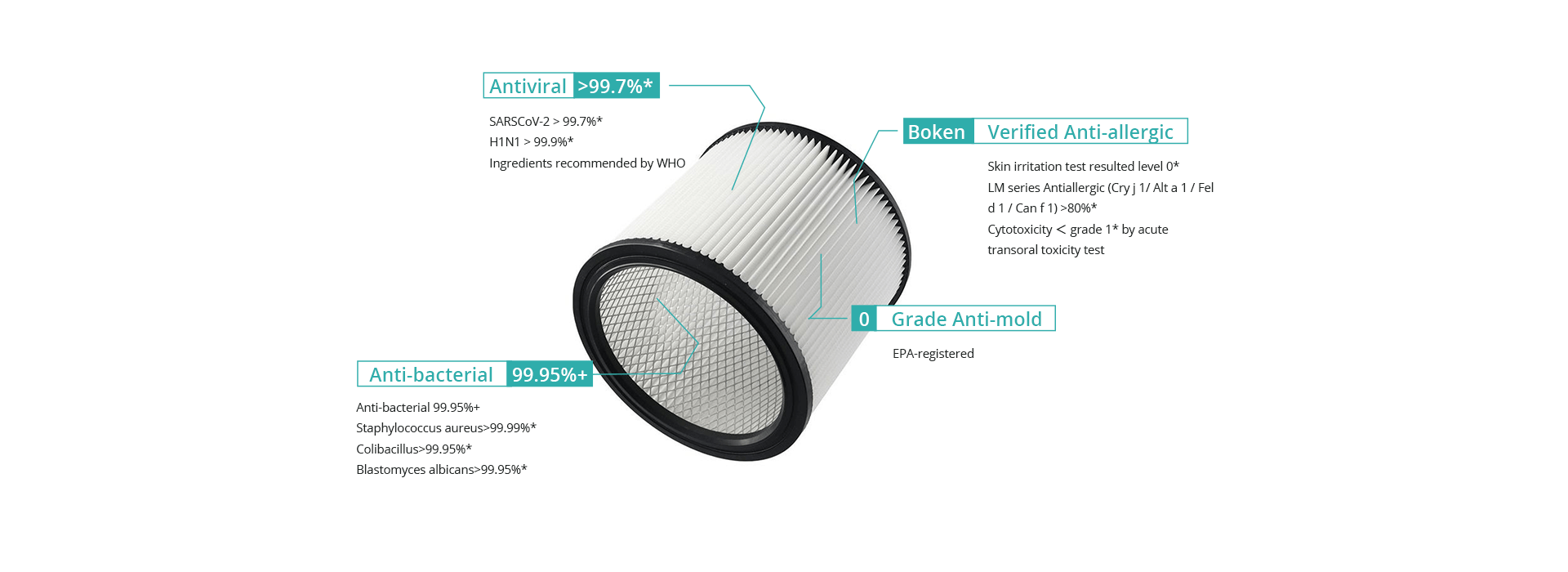
HEPA, or High-Efficiency Particulate Air filters, are designed to trap airborne particles mechanically. Air is pulled through a dense web of fibers by an internal fan, capturing particulates such as dust, pollen, bacteria, and even ultrafine particles down to 0.3 microns with an efficiency exceeding 99.97% (HEPA H13 grade).

At HisoAir, our HEPA systems often feature multiple layers, including pre-filters (like washable nylon or polypropylene filters) and activated carbon layers for enhanced removal of gases and odors.
Pros of HEPA Air Purifiers:

  • Highly Effective Filtration: Exceptional at capturing particles as small as 0.3 microns and even smaller.
  • Rendimiento fiable: Consistent and dependable filtration performance with standardized ratings.
  • Reduced Allergy and Asthma Symptoms: Ideal for individuals with respiratory issues due to its robust particle-trapping capabilities.

Cons of HEPA Air Purifiers:

  • Passive Filtration: Air must be drawn into the purifier, meaning placement and room layout significantly impact performance.
  • Regular Filter Replacement: Filters require frequent changes, leading to ongoing costs.
  • Limited Effect on VOCs and Odors: HEPA alone doesn’t efficiently capture gaseous pollutants without an activated carbon layer.

Plasma vs. HEPA: Direct Comparison

Características Plasma Air Purifier HEPA Air Purifier
Purification Method Active (ionization, decomposition) Passive (physical filtration)
Eliminación de partículas Effective for fine particles, less for heavy dust Excellent for all particulate matter
VOCs & Odors Highly effective Limited without additional activated carbon
Mantenimiento Minimal (cleaning only, no filter replacements) Regular filter replacements required
Consumo de energía Typically lower Typically higher due to fans
Ozone Emission Risk Potential (eliminated in HisoAir’s models) Ninguno

Which Purifier Should You Choose?

Choosing between Plasma and HEPA largely depends on your specific air quality concerns and practical considerations.

Choose Plasma if you:

  • Want comprehensive room coverage without relying on airflow placement.
  • Prefer minimal maintenance and lower long-term operational costs.
  • Need to effectively manage odors, VOCs, bacteria, and viruses.

Choose HEPA if you:

  • Prioritize removal of particulate pollutants like allergens, pollen, and dust.
  • Have allergies, asthma, or respiratory sensitivities.
  • Prefer proven filtration performance backed by extensive scientific validation.
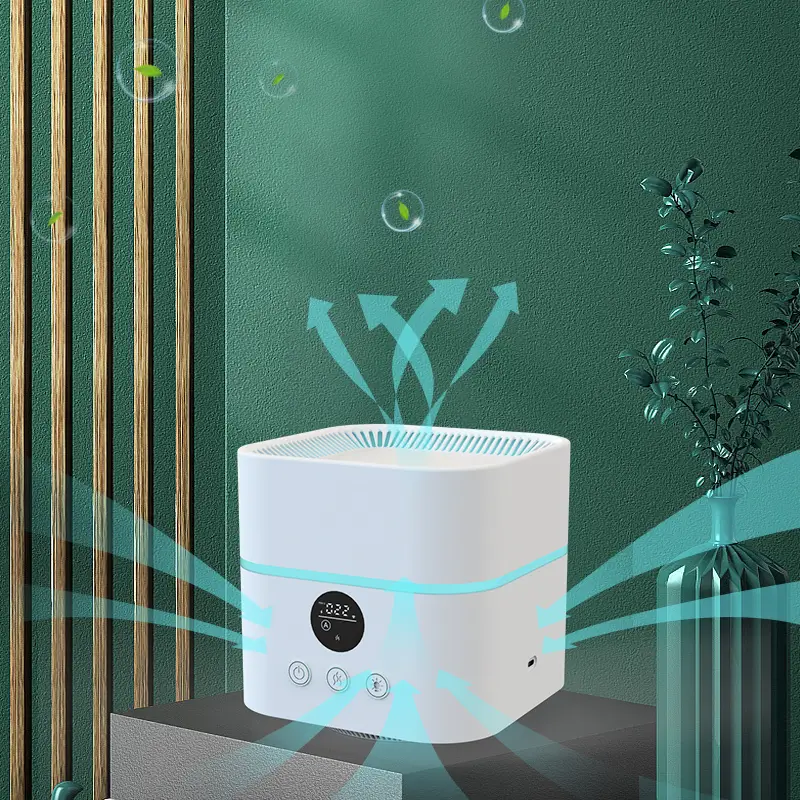
3 in 1 air purifier & humidifier & diffuser ha m18d

HisoAir’s Hybrid Solution – The Best of Both Worlds

Recognizing that each technology offers unique strengths, at HisoAir, we've engineered hybrid air purifiers that combine Plasma technology with HEPA filtration. This innovative dual system provides the ultimate air purification solution:

  • Active and Passive Filtration: Plasma ions eliminate VOCs and pathogens actively, while HEPA filters effectively capture particulate pollutants.
  • Ozone-Free Assurance: HisoAir’s advanced Plasma technology ensures zero ozone emission.
  • Cost-effective Maintenance: Our hybrid systems offer prolonged filter life due to Plasma technology reducing particulate load on HEPA filters.

Conclusión

At HisoAir, we're committed to providing you with innovative, safe, and efficient air purification solutions tailored to your specific needs. Whether you choose Plasma, HEPA, or our advanced hybrid system, our mission remains clear: creating healthier indoor environments for you and your loved ones.

Explore our diverse range of air purification solutions at HisoAir.com and discover how we can help you breathe easier, live healthier, and achieve cleaner air today!

Comparte:
fundador de hisoair, sr. lee
Alwen Lee, an air purification expert with over 10 years of experience, is a devoted father of two and a passionate traveler, having explored more than 30 countries. With a love for public speaking and swimming, he has dedicated his life to the indoor air quality industry. His mission is to ensure that people around the world enjoy the freedom to breathe clean air and lead happy, healthy lives.

Envíenos un mensaje

Más que leer

Modern living room with a family enjoying a healthy indoor environment monitored by smart devices, natural lighting, and greenery.

After IFA 2026: The Healthy Home Is Moving Beyond Smart Devices

In our previous IFA 2026 column, Air Purification Is Becoming Part of the Healthy-Home Platform, we argued that the next generation of indoor-health products would ...
Noticias
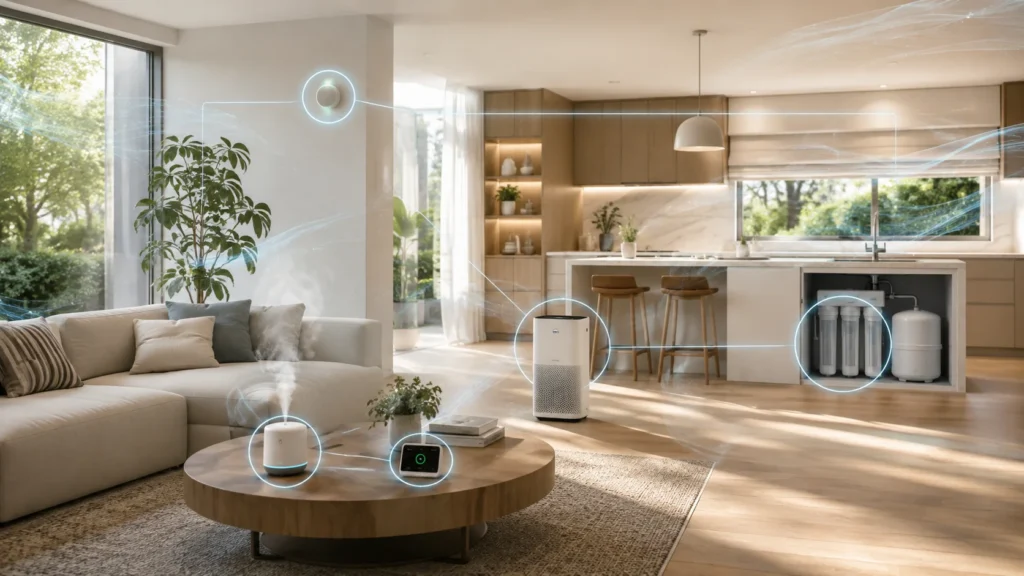
Modern living room and kitchen with smart home air quality devices including an air purifier, humidifier, and water filtration system, connected with visualized blue connectivity lines.

IFA 2026: Air Purification Is Becoming Part of the Healthy-Home Platform

Pre-IFA Industry Perspective | September 4, 2026 This article is based on official announcements and regulatory information available ahead of IFA 2026, which takes place ...
Noticias
A modern office room with a gray wall-mounted air purifier, large wooden desk, office chairs, indoor plants, and glass windows offering a city view.

Luftreiniger gegen Staub: HEPA-Luftreinigung für Büro, Gewerbe und Industrie

Kurz gesagt: Ein Luftreiniger entfernt Staub aus der Luft – nicht vom Schreibtisch. Er reduziert die Konzentration schwebender Partikel und damit auch die Menge an ...
Air purifier, Filter
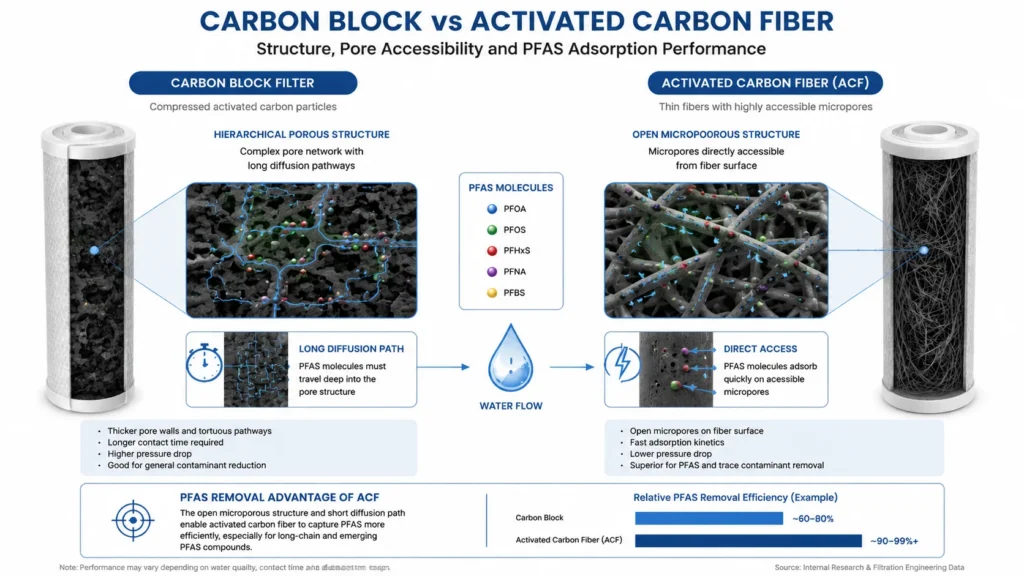
Comparison infographic showcasing the differences between carbon block filter and activated carbon fiber. Detailed diagrams illustrate the hierarchical porous structure of the carbon block with long diffusion paths and the open microporous structure of the activated carbon fiber with direct access for PFAS adsorption.

Carbon Block vs. Activated Carbon Fiber (ACF): Matching Media to Target Contaminants

Two carbon media. Same adsorption chemistry. Very different behaviour in a point-of-use cartridge. If you are specifying a water purifier platform for a PFAS-aware market, ...
Noticias
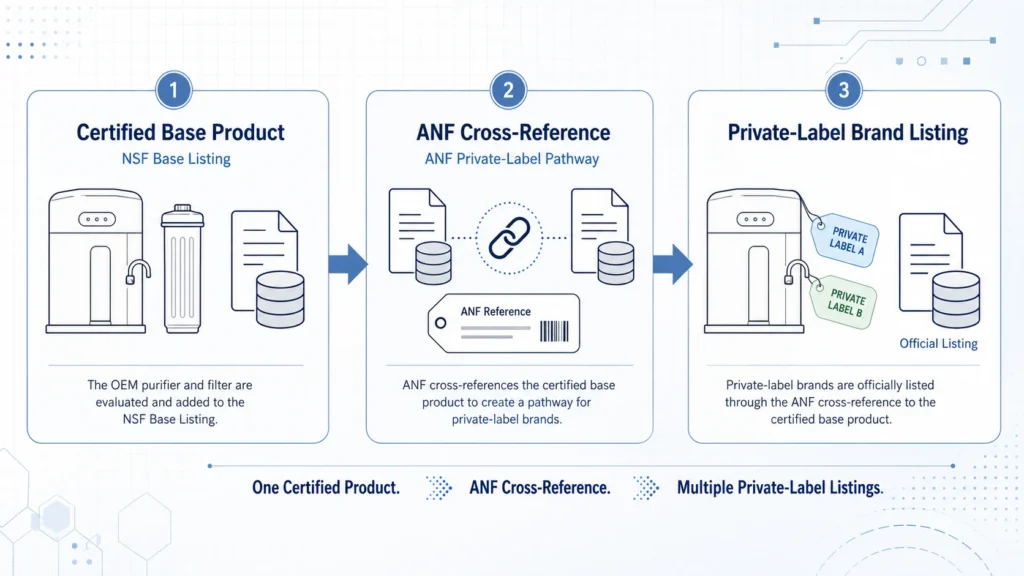
NSF base listing and ANF private-label certification pathway for OEM water filters

What Is an NSF Master Listing? A Guide to Base Listings, ANF Certification and OEM Water Filters

For a brand preparing to launch an OEM water purifier, one of the most common supplier claims is: “We already have an NSF master listing, ...
News, Water Purifiers
Healthy-home brand team reviewing PFAS water filter certification, test data and product engineering

Entering the Water Category Is Easy. Building a Credible PFAS Claim Is Much Harder

For air purification, appliance and healthy-home brands, entering the water category can look surprisingly easy. A company can select an existing undersink system, customize its ...
Noticias
Contaminant Engineering•3 min read

PFAS Water Filtration Technologies Explained: Carbon, Resin & RO

Key Takeaway:

PFAS reduction depends on the specific compounds present, treatment media, contact time, water chemistry, and system design. Activated carbon, ion exchange, and Reverse Osmosis address PFAS through different mechanisms.

PFAS are a large family of persistent fluorinated compounds that can occur in drinking-water supplies. Their treatment behavior varies significantly by molecular structure, chain length, functional group, concentration, and the chemistry of the source water.

Granular Activated Carbon (GAC) removes PFAS primarily through adsorption. It is generally more effective for many longer-chain PFAS, while shorter-chain compounds tend to break through more quickly. Carbon performance depends on media properties, Empty Bed Contact Time (EBCT), competing organic matter, loading, and replacement frequency.

Ion-exchange resins use charged functional sites to capture many PFAS compounds. Properly selected anion-exchange media can provide high capacity and may perform better than conventional activated carbon for some shorter-chain PFAS, although performance still depends on water chemistry and competing ions.

Reverse Osmosis (RO) uses membrane separation rather than adsorption. Properly designed RO systems can provide broad reduction across many PFAS compounds as well as dissolved salts and other contaminants. Unlike carbon or resin, however, RO also produces a concentrate stream that must be managed.

No single technology should be selected from a PFAS label alone. System design should consider which PFAS compounds are present, their concentrations, required reduction targets, flow rate, media life, and the applicable third-party certification or validation requirements.

HisoAir Water Technical Series
Product Discovery•3 min read

How to Choose an Under-Sink Water Purifier for Modern Kitchens

Key Takeaway:

Match the treatment technology to your water quality first, then evaluate cabinet space, faucet configuration, flow rate, drain and power requirements, and filter replacement needs.

Choosing an under-sink water purifier starts with water chemistry. Carbon filtration is well suited to chlorine, taste, odor, and many organic contaminants, while Reverse Osmosis is more appropriate when dissolved salts, fluoride, nitrates, or broader dissolved contaminants need to be reduced.

For compact kitchens, tankless RO systems eliminate the conventional storage tank and can significantly reduce the space required under the sink. However, membrane capacity stated in GPD does not directly equal faucet flow. When comparing systems, check the actual dispensing flow rate, inlet-pressure requirement, recovery ratio, and whether a booster pump is required.

Installation architecture also matters. Many RO systems require a drain connection, electrical power, and either a dedicated drinking-water faucet or a compatible multi-function faucet. High-flow carbon systems can often connect directly to the existing cold-water line with a simpler installation, but pressure drop and available faucet flow should still be verified.

RO also removes much of the naturally occurring dissolved mineral content. Where taste or mineral balance is a priority, a post-RO remineralization stage can be added. Filter life should be evaluated by both rated capacity and local water quality rather than replacement time alone.

The right system is therefore not simply the smallest or highest-GPD model. It is the configuration that matches the target contaminants, available cabinet space, desired faucet setup, peak dispensing demand, and maintenance expectations.

HisoAir Water Technical Series
Water Quality•2 min read

What Does TDS Mean in Drinking Water? Measurement vs Contaminant Reality

Key Takeaway:

A TDS meter estimates the overall concentration of dissolved ionic substances from electrical conductivity. It cannot identify specific contaminants or determine whether water is chemically safe.

Total Dissolved Solids (TDS) refers to the combined concentration of dissolved substances in water. Most handheld TDS meters do not measure TDS directly. Instead, they measure electrical conductivity (EC) and convert that reading into an estimated parts-per-million (ppm) value.

This means a TDS reading can indicate how much dissolved ionic material is present, but not what that material actually is. Calcium, magnesium, sodium, nitrates, and other dissolved ions can all contribute to conductivity, yet a simple TDS meter cannot distinguish between them.

TDS meters are also not suitable for detecting trace contaminants such as PFAS, many VOCs, pesticides, pharmaceuticals, or disinfection byproducts. These substances may be present at concentrations far below the level needed to noticeably change electrical conductivity.

A low TDS reading therefore does not guarantee safe drinking water, and a higher TDS reading does not automatically indicate contamination. Water-treatment decisions should be based on laboratory testing for specific contaminants of concern rather than TDS alone.

HisoAir Water Technical Series
Technology Selection•2 min read

RO vs UF Water Filtration: Understanding Pore Sizes & Dissolved Minerals

Key Takeaway:

Ultrafiltration can reduce bacteria, turbidity, and suspended particles while retaining most naturally occurring dissolved minerals. Reverse Osmosis provides much broader reduction of dissolved salts and smaller contaminants.

Ultrafiltration (UF) typically uses hollow-fiber membranes with pore sizes in the approximate 0.01–0.1 micron range. These membranes physically retain turbidity, suspended solids, colloids, and many microorganisms while allowing dissolved minerals and salts to remain in the water.

Reverse Osmosis (RO) operates at a much finer separation level. Unlike UF, RO can substantially reduce dissolved ions such as sodium, calcium, fluoride, nitrates, and other contributors to total dissolved solids (TDS). This makes RO more suitable when dissolved-salt reduction is a primary treatment objective.

UF generally requires less system pressure and produces little or no continuous concentrate stream in many point-of-use configurations. RO typically requires greater pressure and produces a reject-water stream, but delivers broader contaminant reduction.

For water with acceptable TDS and mineral content, UF can be a simpler mineral-retaining treatment option. Where dissolved salts, fluoride, nitrates, or broader dissolved contaminants are a concern, RO is generally the more appropriate technology.

HisoAir Water Technical Series
Technology Selection•4 min read

Carbon Block vs Reverse Osmosis: Which Fits Your Need?

Key Takeaway:

Choose RO for dissolved inorganic salts and heavy metals; choose Carbon Block for chemical taste/odor, no wastewater, and high line-pressure flow.

Reverse Osmosis (RO) and Carbon Block filtration represent two fundamentally different treatment methods: membrane separation and adsorption. Understanding these differences helps determine which technology is better suited to a specific water-quality requirement.

Reverse Osmosis uses a semi-permeable membrane with pore sizes of approximately 0.0001 microns. It can significantly reduce dissolved inorganic contaminants such as TDS, fluoride, nitrates, and certain heavy metals. Because water must be forced through the membrane, RO systems require sufficient pressure or a booster pump and generate a concentrated wastewater stream.

Carbon Block filtration relies primarily on adsorption through compressed activated carbon, commonly with nominal pore sizes around 0.5–5 microns. It is highly effective for chlorine, chloramines, VOCs, taste, and odor, while allowing substantially higher direct-flow rates without producing wastewater.

From an operating perspective, Carbon Block systems are generally simpler, require less energy, and avoid the water loss associated with RO. RO involves higher system complexity and operating cost, but provides substantially broader reduction of dissolved contaminants that Carbon Block alone cannot address.

HisoAir Water Technical Series

SOLICITAR PRESUPUESTO