
Developing a Premium Non-RO Water Purification Brand for a German Home Solutions Provider
TARGET AUDIENCE
Premium Home Appliance Brands, Home Service Providers & Installers
SOLUTION AREA
Premium Non-RO Under-Sink Water Filtration ODM
KEY TECH
Activated Carbon Fiber (ACF) | Mineral-Retaining Non-RO Concept | Smart Monitoring
PRODUCTION
Customized Product Concept & Engineering Development
Our Involvement
Premium Water Product Strategy & Positioning
Non-RO ACF Filtration Concept Development
Mineral-Retention Design Evaluation
Stainless-Steel Housing & Industrial Design
Premium Faucet Option Selection
Performance Monitoring & Sensor Integration Planning
Leak-Protection Feature Planning
Professional Installation & Sales-Channel Fit Review
Commercialization & Validation Planning
Project Overview
Company
Sede centrale
Market
Prodotti
Background
Background
The client is a German home equipment and professional installation provider with an established business in heat pumps and related residential solutions. According to the project brief, its nationwide direct-sales organization includes approximately 1,200 sales representatives.
The company saw an opportunity to extend its existing homeowner relationships into the premium drinking-water category. Unlike a conventional online water-filter brand, its selling process involved direct customer consultation and professional installation. A new product therefore had to work on several levels: technically credible filtration, compelling in-home presentation, refined kitchen aesthetics and a clear explanation of its value at the point of sale.
The client’s intended retail positioning was approximately €1,600–€3,500, a target that required more than an off-the-shelf under-sink purifier. The brief called for a product concept that could support premium brand identity and sufficient commercial flexibility for a service-led sales channel.
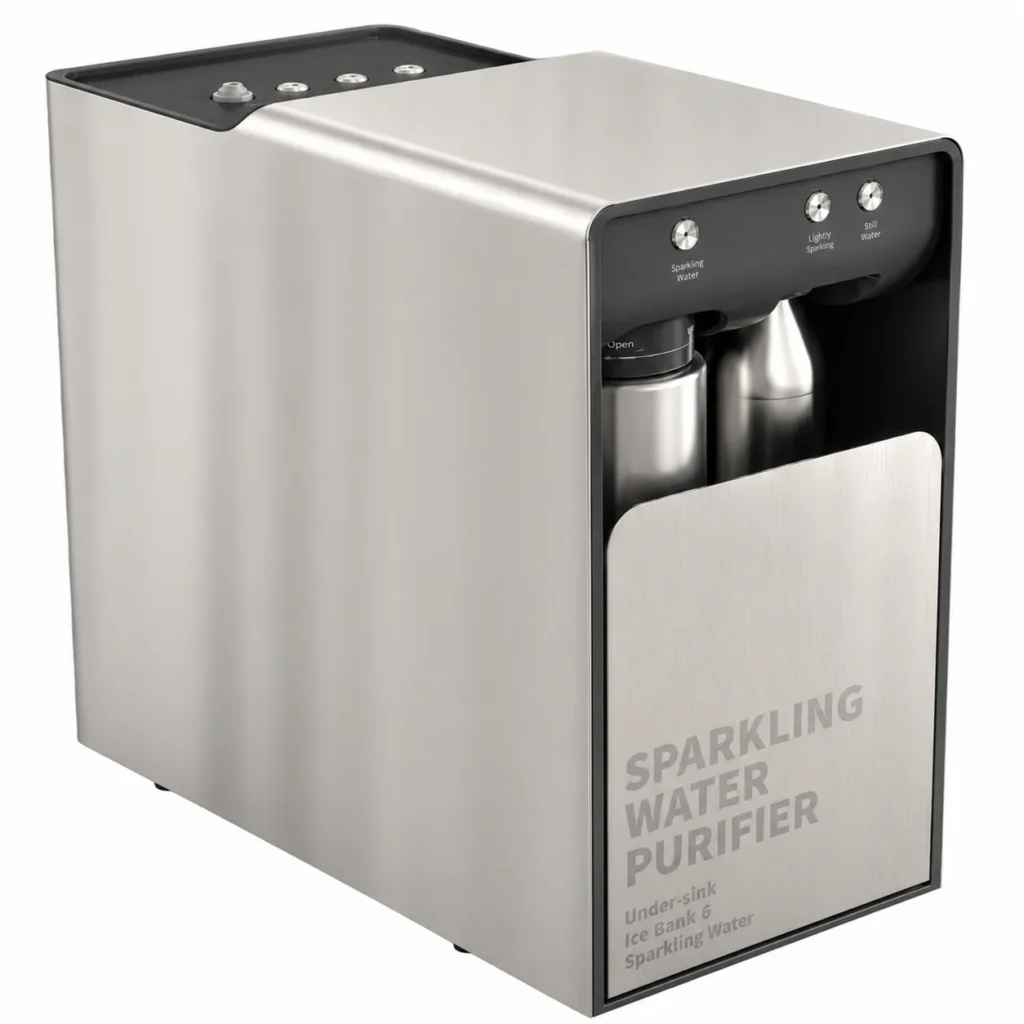
The initial discussion considered standard under-sink platforms, including HisoAir’s existing S6 reference solution. As the concept developed, both parties identified the need for a more distinctive system combining filtration media selection, visible industrial design and service-oriented features.
The Idea
The idea was to turn water purification into a natural extension of the client’s premium home services offering, rather than introduce a generic filter as another appliance SKU.
The product would be positioned for homeowners seeking a professionally installed drinking-water solution that combines functional performance, refined appearance and an understandable long-term maintenance experience.
A key design choice was to explore a non-reverse-osmosis (non-RO) filtration pathway. The client did not want every sales conversation to revolve around the same conventional RO configuration offered by competing brands. ACF-based filtration was therefore evaluated as an alternative media approach for selected drinking-water treatment objectives, subject to contaminant-specific testing and system validation.
The proposed product concept combined five elements:
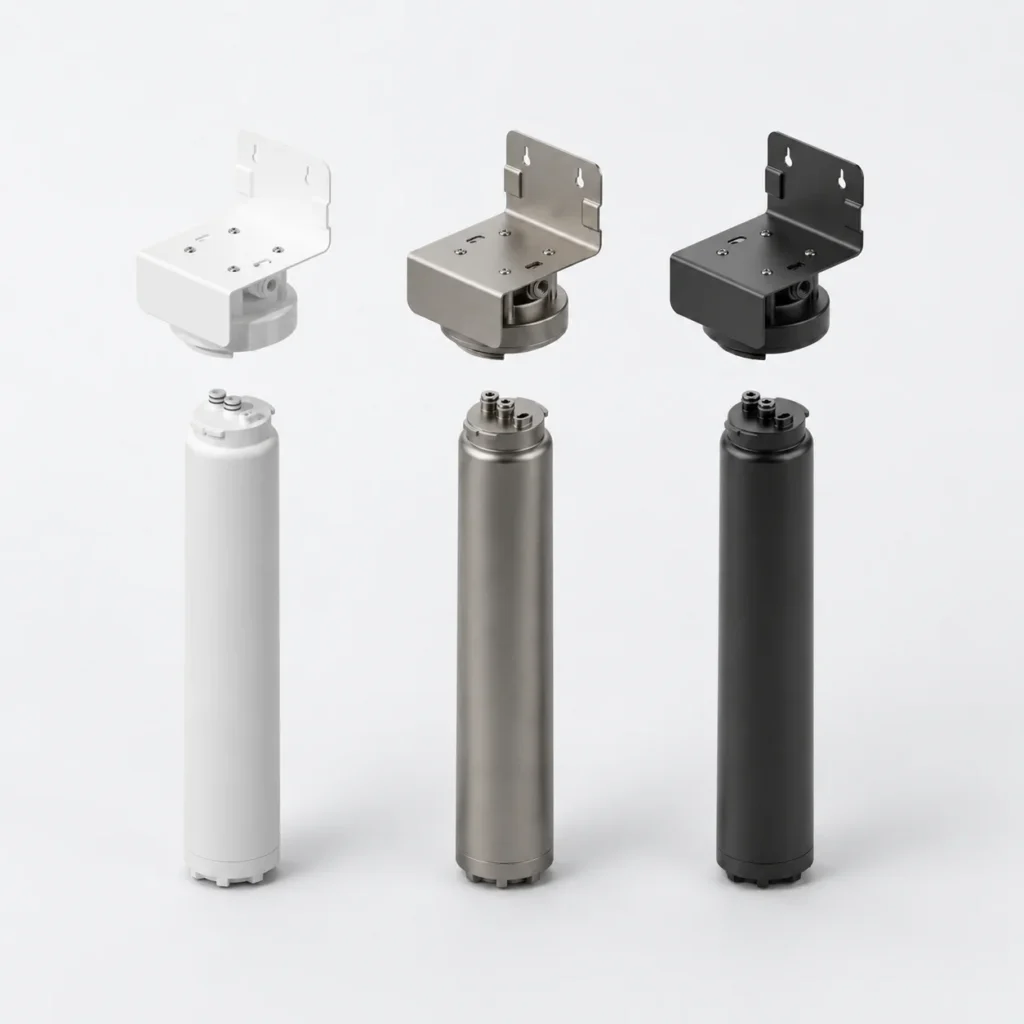
ACF filtration architecture: Evaluate activated carbon fiber media and cartridge design for the intended treatment goals and service life.
Mineral-retaining non-RO approach: Explore filtration that does not deliberately demineralize water in the way typical RO membranes do; avoid implying unverified health benefits.
Premium kitchen presentation: Develop a stainless-steel visual language and differentiated faucet choices suitable for high-value kitchen installations.
Connected product experience: Consider filter-status indication, sensor integration and leak-protection functions to make service requirements more visible.
Professional sales and installation fit: Create a product story and service proposition that a nationwide in-home sales team can explain consistently.
HisoAir’s role was to connect these ideas to a practical ODM product development direction, balancing filtration engineering, industrial design, component selection and future test requirements. The intended result was not simply a higher-priced filter but a differentiated, serviceable premium water product concept.
The Challenge
Differentiating Beyond Standard Under-Sink and RO Products
The client had already reviewed established water purification suppliers. Many available systems were technically capable but offered familiar product configurations with limited differentiation. For this project, selecting a filter technology was only the starting point; the final system also needed a distinctive reason to exist in the German premium market.
Justifying a €1,600–€3,500 Target Retail Position
The target price range created requirements for industrial design, faucet selection, installation experience and customer-facing functions. The initial S6 reference platform was useful for evaluating filtration, but its standard presentation was not sufficient on its own for the proposed premium brand proposition.
Balancing Mineral Retention with Contaminant Reduction
A non-RO concept can retain more of the source water’s dissolved mineral content than a typical RO system, but mineral retention is not proof of contaminant reduction or better health outcomes. The engineering challenge was to establish which contaminants the proposed ACF system could reduce, under what flow and capacity conditions, and how claims would be substantiated.
Validating a Long-Service-Life Filtration Target
The concept brief considered approximately 8,000 gallons as a target service-capacity objective for a proposed configuration. That figure was not accompanied by a verified test report or certification listing. Media design, contact time, flow rate, actual feedwater conditions and performance testing would determine any publishable capacity claim.
Making Smart Features Useful, Not Decorative
The client wanted intelligent status monitoring, sensor support and leak protection. These features needed clear functional definitions, integration planning, reliable user communication and installation considerations before they could become validated product claims.
Fitting the Professional Direct-Sales Model
A direct-sales organization needs a consistent product explanation, attractive demonstration features, appropriate service processes and a viable commercial model. The challenge was to create a premium proposition without relying on unsupported margin or conversion-rate promises.
The HisoAir Solution
HisoAir collaborated with the client to move beyond a standard under-sink product toward a differentiated premium water purification concept suited to the German home services market.
1. Activated Carbon Fiber (ACF) Filtration Direction
HisoAir proposed an ACF-based filtration route as an alternative to a conventional RO-led proposition. The objective was to explore selected contaminant-reduction performance within a compact, serviceable under-sink architecture while supporting the client’s distinctive product positioning.
The project brief identified approximately 8,000 gallons as a target service-capacity design objective for a potential configuration. This is not a certified rating or a verified filter-life claim. Any final capacity, reduction performance and replacement interval must be established by tests on the production-intent configuration at defined operating conditions.
ACF material selection alone does not establish a product-level contaminant claim. Cartridge architecture, media quantity, water chemistry, flow and service conditions remain critical to validation.
2. Non-RO, Mineral-Retaining Filtration Concept
The proposed system was designed around a non-RO filtration philosophy rather than the deliberate demineralization associated with typical RO membranes. This gave the client a differentiated way to describe the water-treatment approach and consumer experience.
The product story should focus on the intended filtration process, measured water-quality results and user convenience. It should not claim that retained minerals make the water healthier or that the ACF configuration removes specific substances without appropriate test evidence.
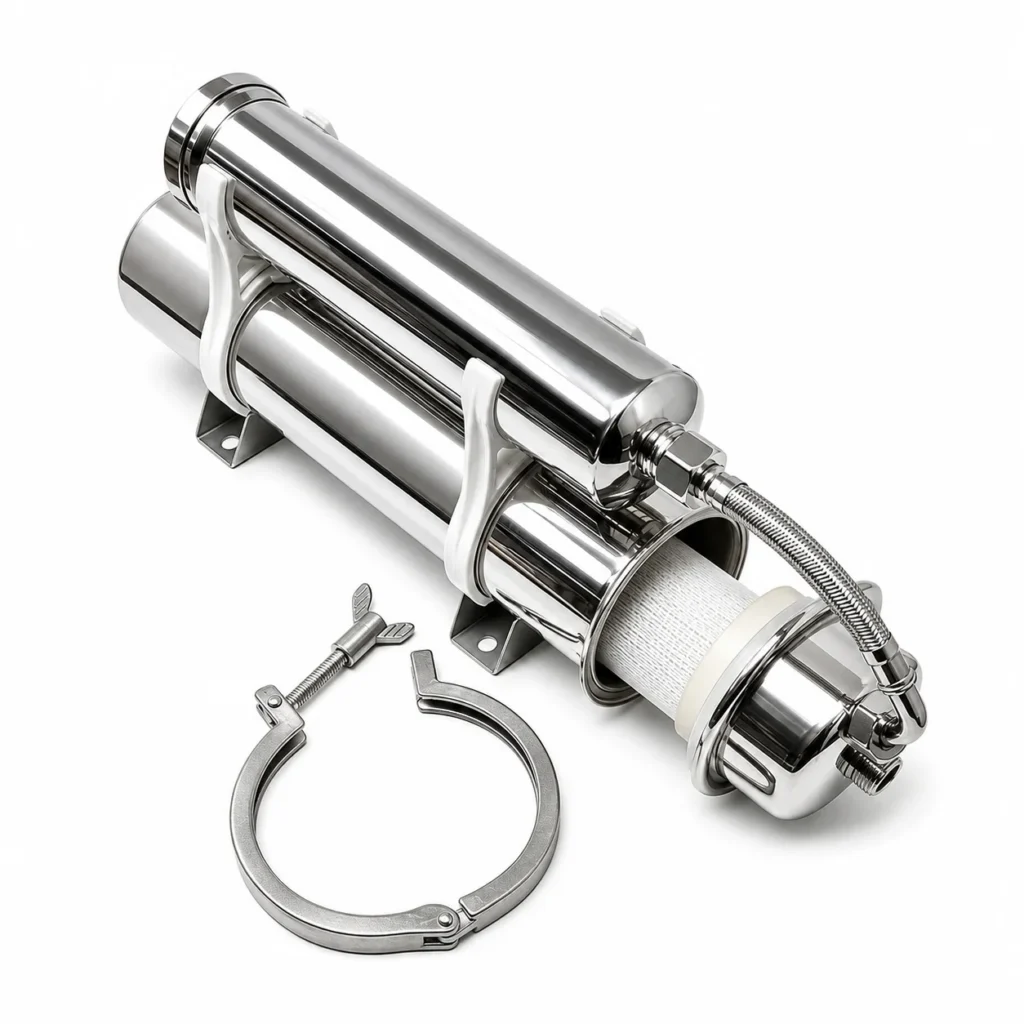
3. Stainless-Steel Premium Product Design
To better align with the client’s intended premium price band, HisoAir worked on a stainless-steel housing direction and more refined external presentation. The proposed design considered the visual quality of the unit, compatibility with premium kitchen interiors and the expectations of a professionally installed product.
The stainless-steel housing is a design specification in the brief; it must not be interpreted as proof that every wetted component is stainless steel or that the product has a plastic-free water path.
4. Premium Faucet Selection and Configuration Options
HisoAir presented upgraded faucet choices as part of a coordinated premium water-system experience. These options could allow the client to align the product with different kitchen styles and offer meaningful configuration choices during an in-home sales presentation.
Faucet material suitability, connection interfaces and drinking-water-contact compliance would need to be verified for the selected final components.
5. Performance Monitoring, Sensors and Leak Protection
The proposed smart-feature package considered filter condition or replacement indication, system status visibility and leakage protection for residential installation.
These functions can provide a clearer ownership and maintenance experience when their sensor inputs, alert thresholds and user interfaces are properly specified and tested. The source describes a development direction and potential functions, not evidence of a finalized connected product or field-validated leak-prevention system.
6. Design and ODM Support for a Service-Led Sales Channel
HisoAir combined filtration concept development with housing design, faucet options, smart-function planning and professional installation considerations. This integrated approach gave the client a more coherent basis for explaining the system through its existing in-home sales network.
Before any commercial launch in Germany, the final system would require a defined verification plan covering contaminant reduction, capacity, hydraulic safety, electronics where applicable, and the hygienic suitability of materials in contact with drinking water. EU/German requirements would need to be assessed for the actual product configuration.
The value of the collaboration was therefore a more differentiated product direction and an actionable development framework, rather than an unsupported claim of completed certification, achieved retail sales or mass production.
The Results
The collaboration helped the client advance from reviewing conventional under-sink water filters toward a more distinctive premium product strategy.
A Sharper Premium Product Direction
The project moved beyond an off-the-shelf RO comparison and established a non-RO, ACF-based concept designed around the client’s intended premium water category.
A More Coherent Design and Feature Package
The proposed product direction brought together stainless-steel styling, premium faucet options, filter status or performance indication and leak-protection planning. This gave the client a clearer basis for subsequent engineering and customer-facing product presentation.
Closer Alignment with Existing Sales Channels
The concept was tailored to the needs of a nationwide professional, in-home selling and installation model. Distinctive visible features and a structured maintenance story create potential discussion points for sales representatives and technicians.
Development Targets Defined for Further Validation
The technical direction included a proposed ACF filtration architecture and an approximately 8,000-gallon design-capacity objective, which still requires confirmation through appropriate performance testing. German/EU drinking-water-contact compliance and final product safety also remain subject to review for the intended configuration.
Commercial Potential, Not a Claimed Market Outcome
The project established a stronger premium product proposal and possible future margin opportunities for the client’s channel. The source brief does not provide confirmed mass-production orders, certification of the customized configuration, retail launch dates, measured conversion improvements or realized sales margins.
Current Project Status: Premium Product Concept and Development Direction Established; Final Validation and Commercial Rollout Not Confirmed.
Key Achievements Include:
Conclusione
This project shows how a home solutions provider can approach a new premium drinking-water category through integrated product strategy, filtration engineering and industrial design.
The German client brought a broad homeowner-facing sales organization, professional installation experience and a clear high-end retail ambition. HisoAir helped translate those requirements into a more distinctive water-treatment direction built around non-RO ACF filtration, mineral-retaining positioning, stainless-steel aesthetics, premium faucet choices and proposed intelligent service features.
The collaboration established a product concept better aligned with the client’s business model than a standard off-the-shelf under-sink purifier. Its commercial success, contaminant-reduction claims, long-life filter capacity and Germany-market compliance still depend on product-specific testing, final engineering decisions and subsequent launch validation.
For premium home appliance brands, professional installers and water-treatment distributors, the case illustrates HisoAir’s value as an ODM product-development partner—not simply a supplier of standard filtration hardware.
Related Products
Related Applications
Related Factory
Our Involvement
Premium Water Product Strategy & Positioning
Non-RO ACF Filtration Concept Development
Mineral-Retention Design Evaluation
Stainless-Steel Housing & Industrial Design
Premium Faucet Option Selection
Performance Monitoring & Sensor Integration Planning
Leak-Protection Feature Planning
Professional Installation & Sales-Channel Fit Review
Commercialization & Validation Planning
 English
 Français
 Español
 Italiano
 Deutsch
 Português
 Русский
 العربية
 日本語
 한국어
 Tiếng Việt