Si apre in una nuova scheda
Soluzioni innovative per la qualità dell'aria
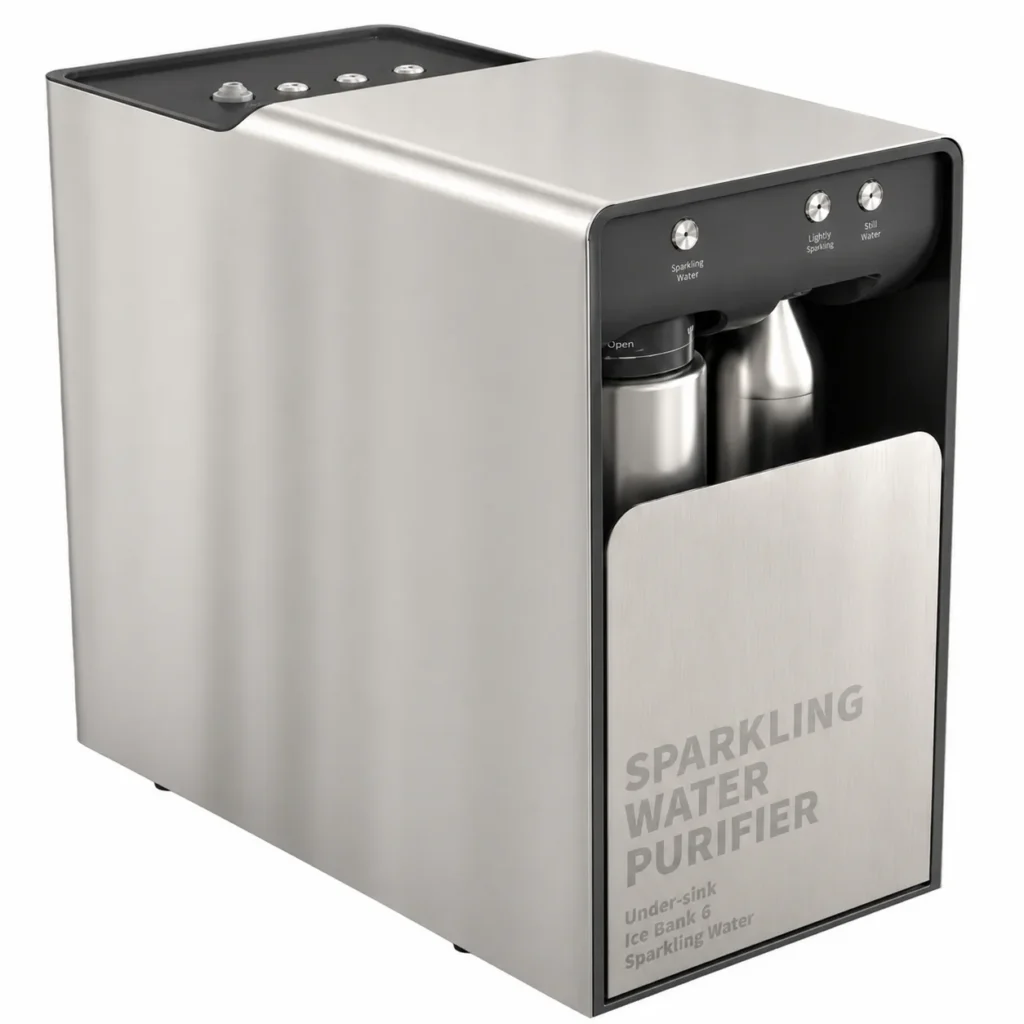
Stainless steel sparkling water purifier with labeled front panel and dispenser for sparkling, lightly sparkling, and still water options.

HW-CS01 Under-Sink Cold & Sparkling Water System

An integrated under-sink platform that delivers ambient, chilled and sparkling water through one smart multi-function faucet.

  • Three water options: ambient, chilled and sparkling
  • Compressor cooling with up to 1 gallon per hour rated capacity
  • Smart multi-function faucet with light-ring indication
  • Quick-change composite filter with automatic water shutoff
  • Modular configurations for different product requirements
Richiesta di preventivo

Descrizione del prodotto

More Than Filtration: A Complete Under-Sink Water Experience

The HisoAir Under-Sink Cold & Sparkling Water System integrates water filtration, compressor cooling and carbonation into one compact product platform.

Users can access ambient, chilled or sparkling water through one multi-function faucet, while the main appliance remains installed beneath the sink to help keep the countertop clear.

The modular architecture can be adapted for residential kitchens, premium apartments, office beverage areas, hospitality projects and branded healthy-home product portfolios.
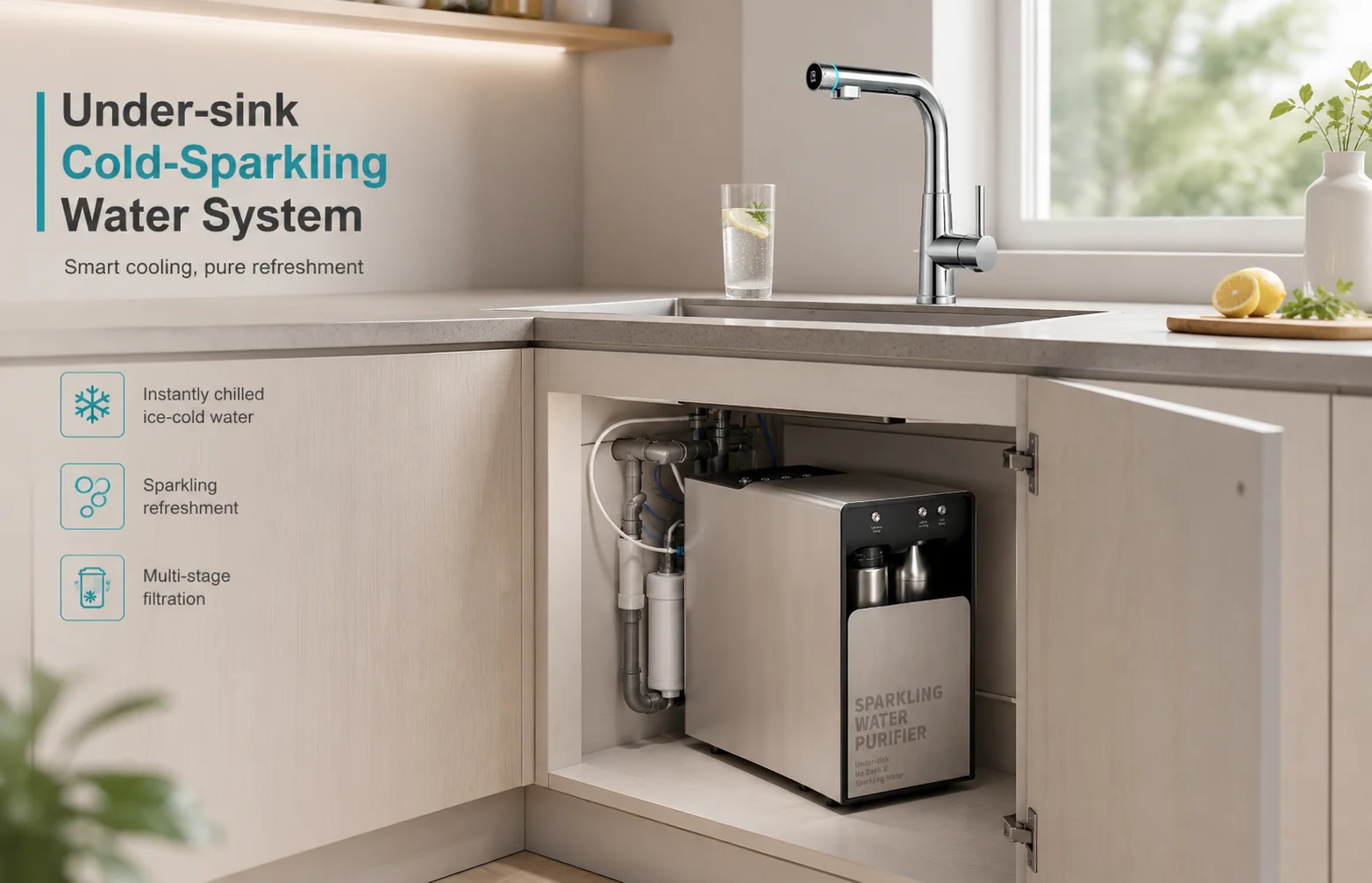
Under-sink cold and sparkling water system installed inside a kitchen cabinet

Three Water Options from One Smart Faucet

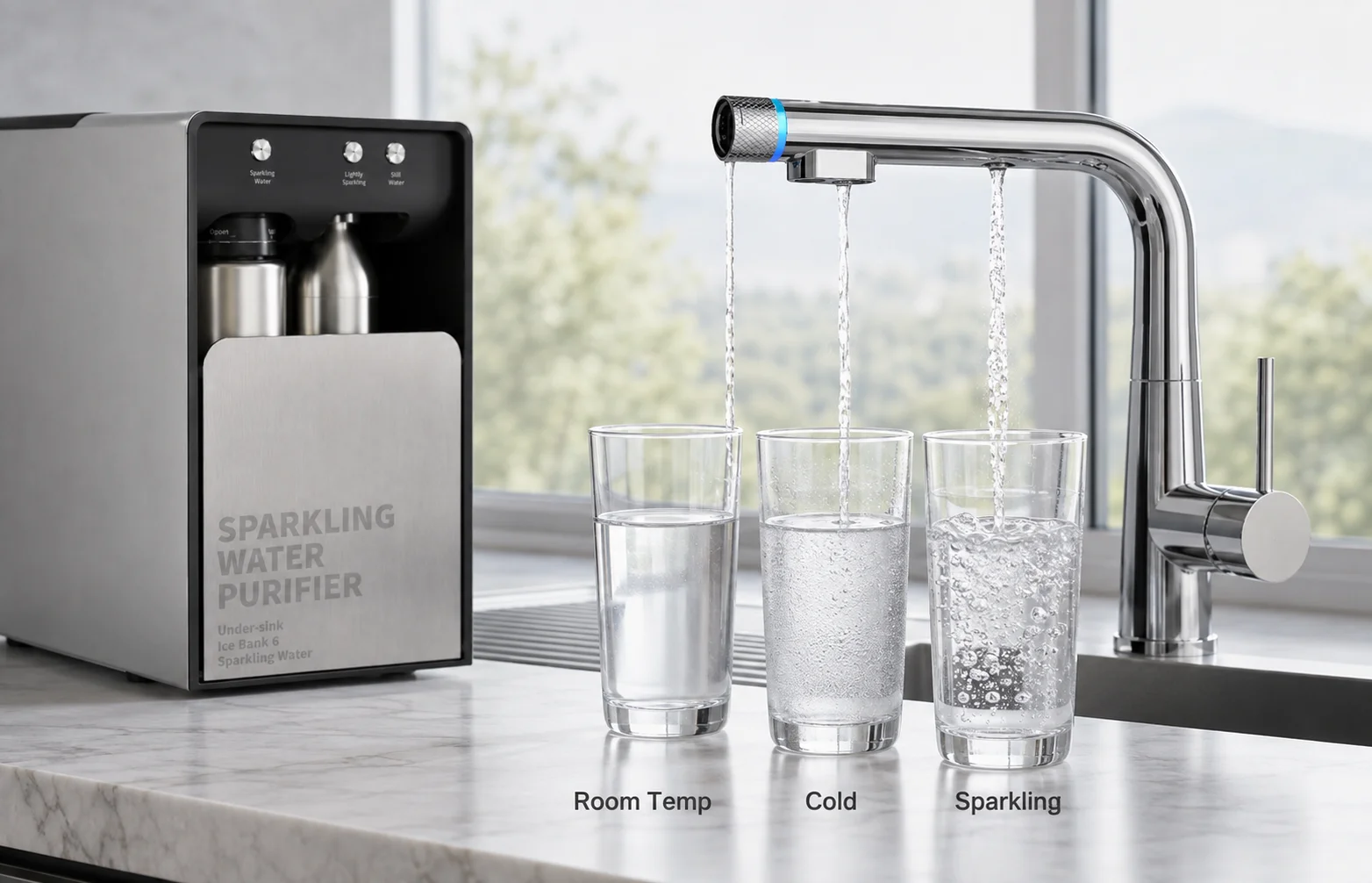
Users can select ambient, chilled or sparkling water through the integrated faucet interface. The light-ring display provides visual feedback for the selected dispensing mode.
◇
Ambient Water Everyday drinking and cooking
❄
Chilled Water Cooled water on demand
○○
Sparkling Water Optional carbonated water
Smart faucet dispensing ambient chilled and sparkling water

Compressor Cooling for Consistent Chilled Water

The system uses compressor refrigeration to provide faster cooling and more stable chilled-water performance for regular household and light-commercial use.

  • Rated refrigeration capacity of approximately 1 gallon per hour
  • Approximately 0.75-gallon chilled-water storage tank
  • Target chilled-water temperature of approximately 3°C
  • Approximately 0.75 gallon of continuous water below 7°C under specified conditions
  • Automatic cooling activation according to detected water temperature

Actual performance depends on inlet-water temperature, ambient conditions, dispensing frequency and final product configuration.
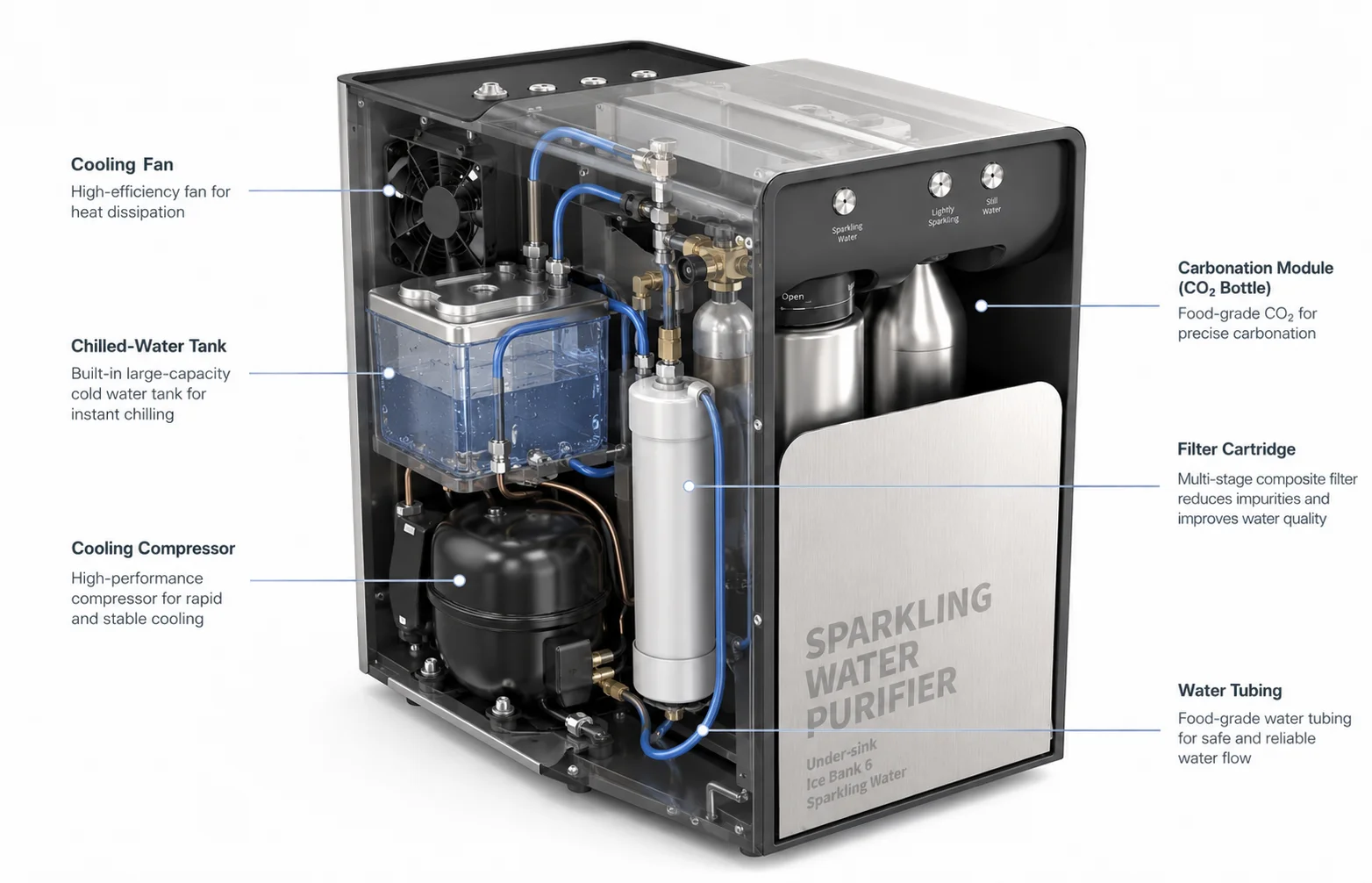
Internal compressor cooling components of an under-sink sparkling water purifier

Integrated Sparkling Water Module

The carbonation module is integrated into the under-sink platform, eliminating the need for a separate countertop sparkling-water appliance. Water can be chilled before carbonation to support a more consistent dispensing experience.
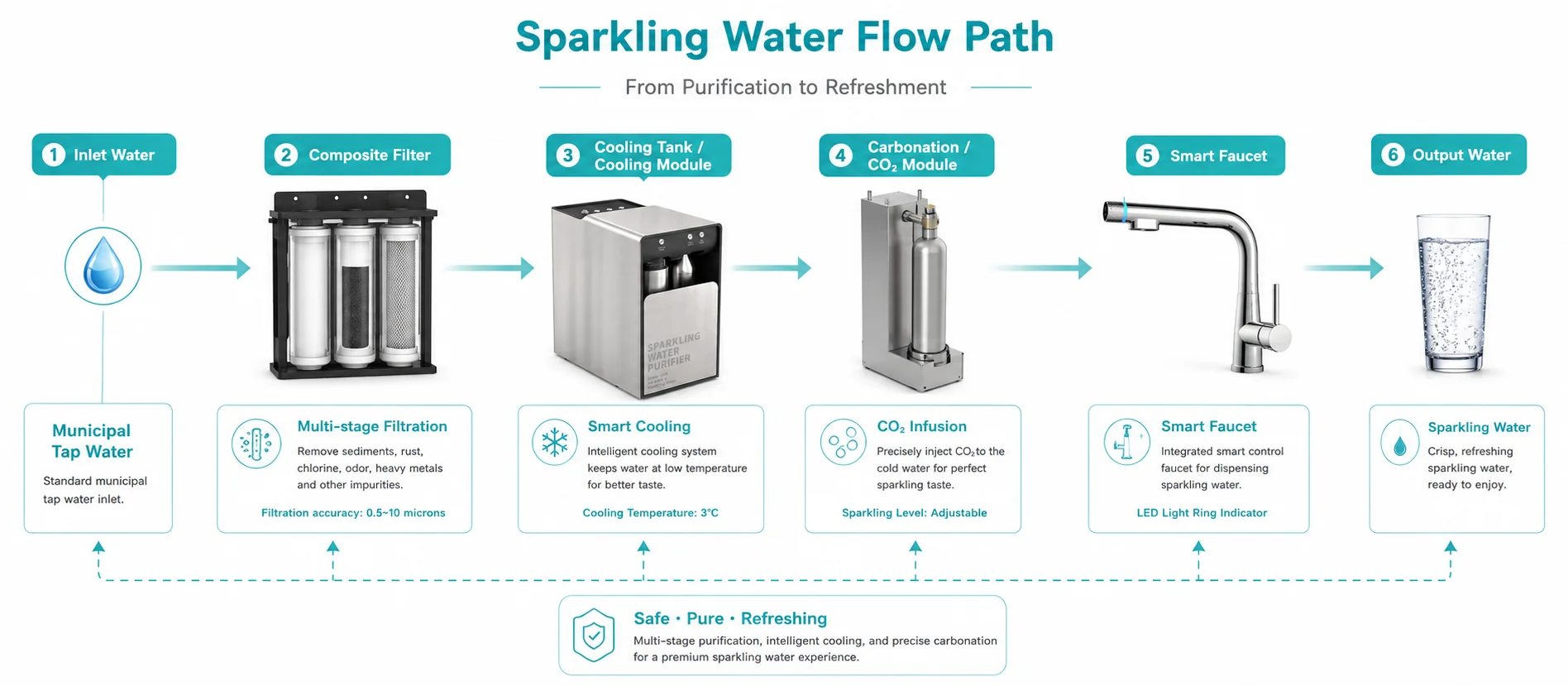
Water flow process through filtration cooling carbonation and smart faucet modules
Integrated Architecture Cooling and carbonation modules are contained beneath the sink.
Chilled Before Carbonation The water path can be configured to cool water before adding carbonation.
Configurable Modules Product combinations can be selected according to market positioning.

Multi-Layer Composite Filtration

The quick-change cartridge combines several filtration materials in one compact structure to reduce sediment, residual chlorine, unwanted odors and compounds that may affect water taste.

1. Pleated Pre-Filter Layer Reference filtration accuracy: 10–15 microns
2. Charged Membrane Layer Reference filtration accuracy: 1–5 microns
3. Carbon Block Layer Reference filtration accuracy: 0.5–1 micron

Final contaminant-reduction claims must be supported by test reports or certifications applicable to the exact cartridge and final product model.

Single-stage composite water filter cartridge with pleated membrane and carbon block layers

Water-Break Quick-Change Cartridge

The cartridge uses a twist-lock replacement structure with an integrated water-stop mechanism. When the cartridge is rotated and removed, the internal valves are designed to close the water path and help reduce uncontrolled water discharge.

Water-break quick-change cartridge with automatic water shutoff during filter replacement
01 Rotate the cartridge approximately 90 degrees.
02 Unlock and remove the used cartridge.
03 Insert and lock the replacement cartridge.
04 Flush according to the operating instructions.

Modular Architecture for Different Product Strategies

Brands can select different combinations of cooling, filtration and carbonation according to their intended market, price positioning and user requirements.
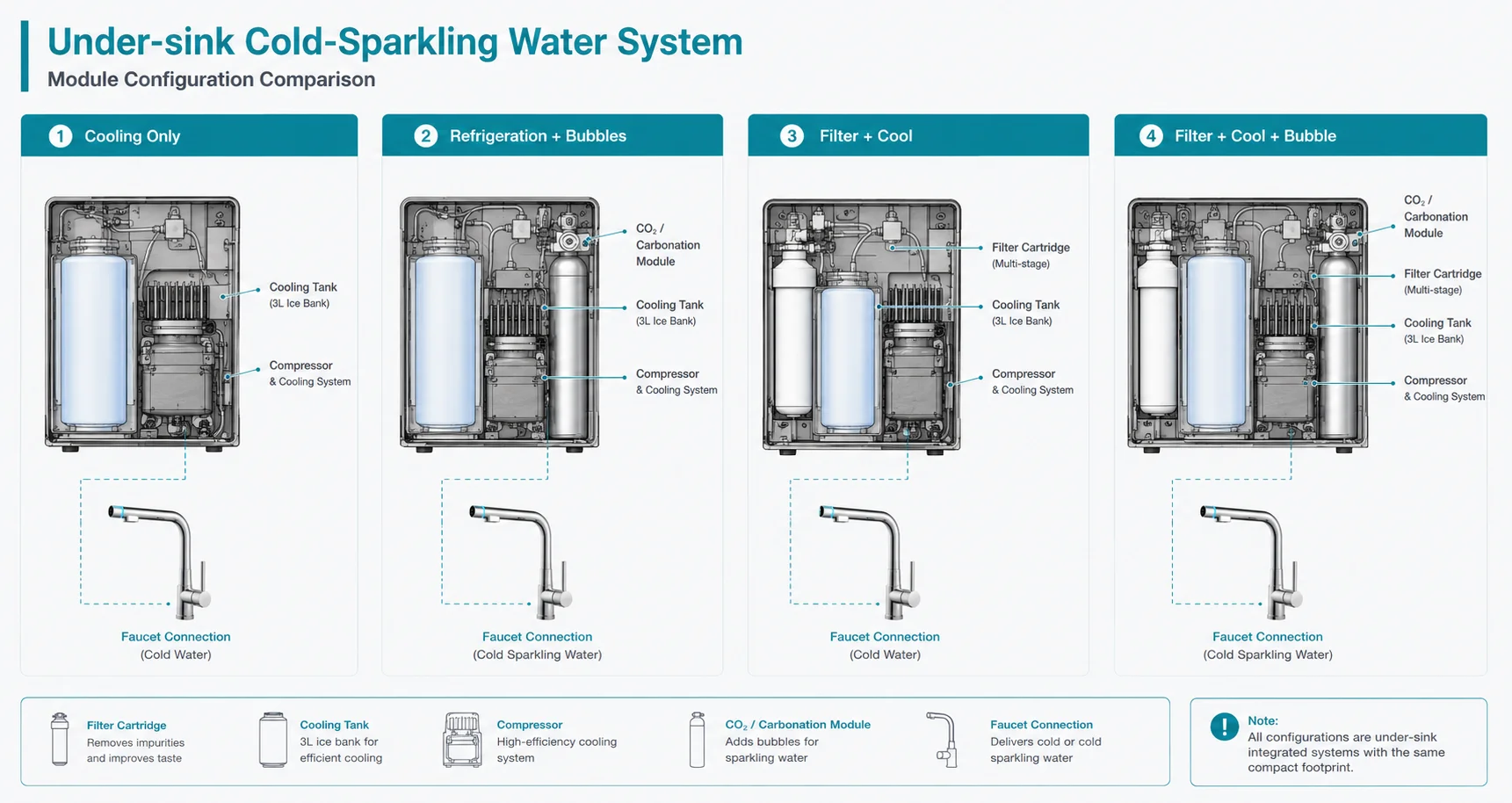
Comparison of modular under-sink cooling filtration and sparkling water configurations
Cooling
Cooling + Sparkling
Filtration + Cooling
Filtration + Cooling + Sparkling

Final module selection affects product dimensions, water-path design, installation requirements, electrical configuration and certification scope.

Designed for OEM and ODM Water Projects

HisoAir works with brands and solution providers to evaluate product configuration, filtration architecture, installation requirements and market-specific compliance.

✓ Product branding and exterior finish
✓ Faucet design and surface treatment
✓ User-interface and light-ring logic
✓ Filter-media configuration
✓ Cooling and carbonation capacity
✓ Pipe and fitting layout
✓ Electrical configuration
✓ Packaging and documentation
✓ Installation kits
✓ Certification planning support

Specifications, functions and compliance claims are confirmed through the final approved sample, engineering specification and applicable test documentation.

Specifiche tecniche

HW-CS01 Specifications
Dimensioni
Dimensioni del prodotto
W × D × H
211 × 475 × 400 mm
465 × 230 × 410 mm
System Specifications
Tensione nominale 230 V / 50 Hz
Refrigeration Power 100 W
Cooling Method Compressor refrigeration
Water Outlet Modes Ambient water, chilled water and sparkling water
Water Flow Rate Ambient water:
More than 0.5 gal/min at 0.24 MPa

Chilled water:
More than 0.5 gal/min at 0.24 MPa

Sparkling water:
Approximately 0.2 gal/min

Main Unit Display Light indication
Smart Faucet 6-in-1 smart faucet with light-ring indication
Water Pipe Connections Water inlet: 1/4 inch
Ambient-water outlet: 1/4 inch
Chilled-water outlet: 1/4 inch
Sparkling-water outlet: 1/4 inch
Filtration Performance
Filter Configuration Pleated filter + charged membrane + carbon block
Reference Filter Capacity 4 T
Suggested Replacement Cycle 4 T or 1 year, whichever comes first
Chilled-Water Performance
Refrigeration Capacity 1 gal/hour
Target Chilled-Water Temperature 3°C
Chilled-Water Tank Volume 0.75 gal
Continuous Chilled-Water Dispensing 0.75 gal at below 7°C
Sparkling-Water Performance
Carbonation Tank Volume 0.17 gal
Sparkling-Water Volume 0.04 gal
Sparkling-Water Concentration >21 g/G

Specifications are based on the current HW-CS01 product configuration and may be adjusted according to the final OEM or ODM project requirements.

Download di documenti correlati

Nessun download disponibile.

Articoli relativi a HW-CS01 Under-Sink Cold & Sparkling Water System

Non sono disponibili articoli correlati.

Perché scegliere i nostri depuratori d'aria?

High-Performance Air Purification
Advanced Filtration Options
99,9% batterico
tasso di rimozione
CADR alto
(Tasso di erogazione di aria pulita)
H13/H14 HEPA Filtration Options
Optional 270–280 nm UVC Module
H14 H13 extended filter life
lifespan HEPA filters
Third-Party Tested Filtration Performance

I 3 principali produttori di purificatori d'aria OEM/ODM in Cina

Etichettatura privata per i depuratori d'aria di marca da decenni

HisoAir offre servizi di etichettatura privata dei purificatori d'aria ai clienti che hanno già esaminato e approvato il design e le specifiche dei purificatori d'aria HisoAir. Una volta firmato il contratto, i prodotti selezionati saranno etichettati con il nome del cliente.

Purificatori d'aria OEM dall'inizio alla fine

HisoAir fornisce servizi di purificatori d'aria OEM ai partner che dispongono delle specifiche necessarie per un prodotto. HisoAir fornisce ricerca, progettazione, ingegnerizzazione, simulazioni o modifiche, test e produzioni di massa basate sul progetto definitivo del cliente.

Logo aziendale 3M in rosso.
logo del vettore
logo haier
Logo Alen - La fiducia nella purificazione dell'aria
logo tcl 0
Logo Honeywell - Leader nelle soluzioni di purificazione e filtrazione dell'aria
Logo LG - Innovatore negli elettrodomestici intelligenti e nelle soluzioni di purificazione dell'aria
Logo Philips - Leader nelle tecnologie sanitarie e nelle soluzioni di purificazione dell'aria

Fiducia da parte di rinomati marchi globali

Con oltre 20 anni di esperienza, siamo specializzati nella fornitura di soluzioni IAQ che si integrano perfettamente con le esigenze dei marchi più conosciuti al mondo. Collaborate con noi per ottenere prestazioni eccezionali, su misura per il vostro mercato.

TESTIMONIANZE

" Ho trovato il sito web di Hisoair su Google e, ad essere sincero, all'inizio non ero sicuro che fossero affidabili, ma hanno completato i requisiti del mio progetto in un mese e mezzo. E quando il progetto ha richiesto l'aggiunta urgente di un sensore di CO2, hanno completato un nuovo campione entro una settimana, rendendoli il produttore più professionale e attento al cliente con cui abbia mai lavorato".
tms 1
Tommaso
Fornitore governativo dalla Germania
" Sappiamo tutti che il COVID è stato un terribile disastro per tutto il mondo, specialmente per l'India, ho acquistato un purificatore d'aria da HisoAir, che è stato molto utile per me e per il mio ufficio, la mia casa, le mie famiglie e i miei amici. Ho lavorato con Alwen negli ultimi 7 anni, che è di HisoAir, posso dire che è una persona molto affidabile, molto efficiente e molto professionale".
testimonianze dei clienti 2
Ranjith Bala
Importatore di prodotti medici dall'India
" Siamo un'azienda con oltre 15 anni di esperienza nel lavoro con istituzioni private e settori privati, abbiamo collaborato con Hiso per 3 anni e siamo davvero grati per i lavori che Hiso ci ha fornito. Siamo grati per la collaborazione con Cherry e Mr. Lee "
testimonianze dei clienti
Herina
Ospedali e fornitori governativi dalla Romania

Unitevi ai leader mondiali che si affidano alla nostra esperienza nelle soluzioni di filtrazione dell'aria.

La vostra richiesta è importante per noi. Ci collegheremo al più presto e i vostri dati rimarranno sempre al sicuro.
Abbiamo collaborato con Hiso per 3 anni e siamo davvero grati per i lavori che Hiso ci ha fornito. Siamo grati per la collaborazione con Cherry e il signor Lee.
tms 1
Tommaso
Fornitore governativo dalla Germania
Contaminant Engineering•3 min read

PFAS Water Filtration Technologies Explained: Carbon, Resin & RO

Key Takeaway:

PFAS reduction depends on the specific compounds present, treatment media, contact time, water chemistry, and system design. Activated carbon, ion exchange, and Reverse Osmosis address PFAS through different mechanisms.

PFAS are a large family of persistent fluorinated compounds that can occur in drinking-water supplies. Their treatment behavior varies significantly by molecular structure, chain length, functional group, concentration, and the chemistry of the source water.

Granular Activated Carbon (GAC) removes PFAS primarily through adsorption. It is generally more effective for many longer-chain PFAS, while shorter-chain compounds tend to break through more quickly. Carbon performance depends on media properties, Empty Bed Contact Time (EBCT), competing organic matter, loading, and replacement frequency.

Ion-exchange resins use charged functional sites to capture many PFAS compounds. Properly selected anion-exchange media can provide high capacity and may perform better than conventional activated carbon for some shorter-chain PFAS, although performance still depends on water chemistry and competing ions.

Reverse Osmosis (RO) uses membrane separation rather than adsorption. Properly designed RO systems can provide broad reduction across many PFAS compounds as well as dissolved salts and other contaminants. Unlike carbon or resin, however, RO also produces a concentrate stream that must be managed.

No single technology should be selected from a PFAS label alone. System design should consider which PFAS compounds are present, their concentrations, required reduction targets, flow rate, media life, and the applicable third-party certification or validation requirements.

HisoAir Water Technical Series
Product Discovery•3 min read

How to Choose an Under-Sink Water Purifier for Modern Kitchens

Key Takeaway:

Match the treatment technology to your water quality first, then evaluate cabinet space, faucet configuration, flow rate, drain and power requirements, and filter replacement needs.

Choosing an under-sink water purifier starts with water chemistry. Carbon filtration is well suited to chlorine, taste, odor, and many organic contaminants, while Reverse Osmosis is more appropriate when dissolved salts, fluoride, nitrates, or broader dissolved contaminants need to be reduced.

For compact kitchens, tankless RO systems eliminate the conventional storage tank and can significantly reduce the space required under the sink. However, membrane capacity stated in GPD does not directly equal faucet flow. When comparing systems, check the actual dispensing flow rate, inlet-pressure requirement, recovery ratio, and whether a booster pump is required.

Installation architecture also matters. Many RO systems require a drain connection, electrical power, and either a dedicated drinking-water faucet or a compatible multi-function faucet. High-flow carbon systems can often connect directly to the existing cold-water line with a simpler installation, but pressure drop and available faucet flow should still be verified.

RO also removes much of the naturally occurring dissolved mineral content. Where taste or mineral balance is a priority, a post-RO remineralization stage can be added. Filter life should be evaluated by both rated capacity and local water quality rather than replacement time alone.

The right system is therefore not simply the smallest or highest-GPD model. It is the configuration that matches the target contaminants, available cabinet space, desired faucet setup, peak dispensing demand, and maintenance expectations.

HisoAir Water Technical Series
Water Quality•2 min read

What Does TDS Mean in Drinking Water? Measurement vs Contaminant Reality

Key Takeaway:

A TDS meter estimates the overall concentration of dissolved ionic substances from electrical conductivity. It cannot identify specific contaminants or determine whether water is chemically safe.

Total Dissolved Solids (TDS) refers to the combined concentration of dissolved substances in water. Most handheld TDS meters do not measure TDS directly. Instead, they measure electrical conductivity (EC) and convert that reading into an estimated parts-per-million (ppm) value.

This means a TDS reading can indicate how much dissolved ionic material is present, but not what that material actually is. Calcium, magnesium, sodium, nitrates, and other dissolved ions can all contribute to conductivity, yet a simple TDS meter cannot distinguish between them.

TDS meters are also not suitable for detecting trace contaminants such as PFAS, many VOCs, pesticides, pharmaceuticals, or disinfection byproducts. These substances may be present at concentrations far below the level needed to noticeably change electrical conductivity.

A low TDS reading therefore does not guarantee safe drinking water, and a higher TDS reading does not automatically indicate contamination. Water-treatment decisions should be based on laboratory testing for specific contaminants of concern rather than TDS alone.

HisoAir Water Technical Series
Technology Selection•2 min read

RO vs UF Water Filtration: Understanding Pore Sizes & Dissolved Minerals

Key Takeaway:

Ultrafiltration can reduce bacteria, turbidity, and suspended particles while retaining most naturally occurring dissolved minerals. Reverse Osmosis provides much broader reduction of dissolved salts and smaller contaminants.

Ultrafiltration (UF) typically uses hollow-fiber membranes with pore sizes in the approximate 0.01–0.1 micron range. These membranes physically retain turbidity, suspended solids, colloids, and many microorganisms while allowing dissolved minerals and salts to remain in the water.

Reverse Osmosis (RO) operates at a much finer separation level. Unlike UF, RO can substantially reduce dissolved ions such as sodium, calcium, fluoride, nitrates, and other contributors to total dissolved solids (TDS). This makes RO more suitable when dissolved-salt reduction is a primary treatment objective.

UF generally requires less system pressure and produces little or no continuous concentrate stream in many point-of-use configurations. RO typically requires greater pressure and produces a reject-water stream, but delivers broader contaminant reduction.

For water with acceptable TDS and mineral content, UF can be a simpler mineral-retaining treatment option. Where dissolved salts, fluoride, nitrates, or broader dissolved contaminants are a concern, RO is generally the more appropriate technology.

HisoAir Water Technical Series
Technology Selection•4 min read

Carbon Block vs Reverse Osmosis: Which Fits Your Need?

Key Takeaway:

Choose RO for dissolved inorganic salts and heavy metals; choose Carbon Block for chemical taste/odor, no wastewater, and high line-pressure flow.

Reverse Osmosis (RO) and Carbon Block filtration represent two fundamentally different treatment methods: membrane separation and adsorption. Understanding these differences helps determine which technology is better suited to a specific water-quality requirement.

Reverse Osmosis uses a semi-permeable membrane with pore sizes of approximately 0.0001 microns. It can significantly reduce dissolved inorganic contaminants such as TDS, fluoride, nitrates, and certain heavy metals. Because water must be forced through the membrane, RO systems require sufficient pressure or a booster pump and generate a concentrated wastewater stream.

Carbon Block filtration relies primarily on adsorption through compressed activated carbon, commonly with nominal pore sizes around 0.5–5 microns. It is highly effective for chlorine, chloramines, VOCs, taste, and odor, while allowing substantially higher direct-flow rates without producing wastewater.

From an operating perspective, Carbon Block systems are generally simpler, require less energy, and avoid the water loss associated with RO. RO involves higher system complexity and operating cost, but provides substantially broader reduction of dissolved contaminants that Carbon Block alone cannot address.

HisoAir Water Technical Series

RICHIEDI UN PREVENTIVO