Sẽ mở trong thẻ mới
Innovative Air Quality Solutions

Air purifier vs Air humidifier: Which is better?

Related Products

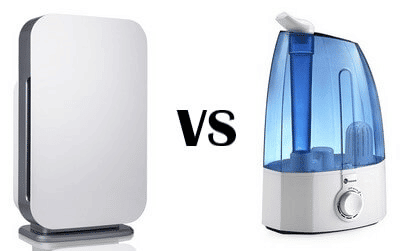
Air purifier vs Humidifier in 2022

Image Source: Home Air Advisor

Air purifiers and humidifiers are typical household items today. Both appliances have practical applications, and improve indoor air quality. But an air purifier is not the same as a humidifier. Humidifiers add moisture; air purifiers remove harmful pollutants. Air purifiers aid persons with respiratory disorders caused by dry air more than humidifiers. We debunk misunderstandings and compare both appliances.

Air purifier vs Humidifier Features
.

Air Purifier Air Humidifier
Suggested Size An air purifier is only as effective as its filter, including its surface area and filter quality. The size of the room should be taken into consideration when choosing a humidifier.
Noise level Standard air purifier: 36 dB Quietest humidifier: 30 dB
Types HEPA Technology, ACT, UV Technology, Negative ion, Ozone Central, ultrasonic, impeller, evaporators, steam vaporizers
Application Beneficial to individuals who seek clean air. Also helpful for those who have allergies or asthma. Advantageous for persons with asthma and respiratory tract irritation brought on by dry air
Feature Filters are used to capture and get rid of airborne pollutants. Increases atmospheric moisture to reduce discomfort brought by by dry conditions

Air Purifier vs Humidifier Benefits

Air Purifier:

  • Filters airborne impurities.
  • Ideal for asthmatics and allergists.
  • Usable year-round.
  • Expensive

Air Humidifier:

  • Moisturizing the air reduces dryness-induced irritation.
  • For stuffy noses and illness.
  • Use only in dry conditions.
  • Cheap

More than only moisture that keeps your skin elastic, moisturized, and soft, humidity also helps you sleep better by relaxing your mind to restore peace at the cost of providing coolness when indoors during excessive heat, highlighting the fact that humidity reduces rashly allergic reactions. Like humidifiers, it takes a few days to work.

Difference between air purifier and air humidifier

What is the difference between air purifier and humidifier? Differs on how they are used.

Air Purifier

  • Protection from viruses/bacteria
  • Removes odors
  • Filter, HEPA

Air Humidifier

  • Antibacterial Qualities.
  • Quiet operation
  • Durable Quality

Air Purifier vs Air Humidifier Maintenance

Filters are the most crucial air purifier maintenance. This maintains and prolongs your air purifier. Clean and dry the base and tank daily for the air humidifier. Weekly, remove mineral buildup with vinegar or similar manufacturer-recommended solution and disinfect the humidifier with 10% bleach.

Air Purifier vs. Air Humidifier Humidity Level

Humidity changes with the season, the weather, and the location of your residence. In general, summer humidity levels are higher than winter humidity levels. Ideal indoor humidity levels range between 30% to 50%. Too little or too much humidity might be problematic. (https://www.mayoclinic.org/diseases-conditions/common-cold/in-depth/humidifiers/art-20048021)

Air Purifier vs. Air Humidifier Functions and Usages

How does an air purifier work? Purifiers clean air. Air purifiers remove mold, allergies, and odors. Allergic and asthmatic children and adults may benefit. Humidifiers? No. Air Humidifiers release hot or cold-water vapor. Humidification helps congested kids and adults. Humidity may help winter-dry skin and nasal passages. Air purifiers eliminate dust, smoke, odors, bacteria, and viruses. Air purifiers can treat and prevent illnesses like asthmatics, allergy sufferers, and those who want to reduce pollutants and odors. A humidifier prevents dryness that can irritate numerous body regions. Humidifiers help heal dry skin, nose, throat, and lips. They also reduce flu and cold symptoms. Both devices can be used together during allergy season, mostly early spring in February up to early summer in June. Whether it be in your room or in your living space.

Air Purifier vs. Air Humidifier Lifespan

Air Humidifiers last 10-15 years, depending on maintenance and water quality. Hisoair filters should be replaced every 6-12 months, depending on air quality and ambient conditions. Depending on air quality and surroundings, change carbon pre-filters every three months.

Air Purifier vs. Air Humidifier Costs

Air purifiers are relatively costly. However, air humidifiers are easily affordable. A quality air purifier can cost hundreds or even thousands of dollars, whereas a humidifier is often priced at less than $100.

Air purifier or humidifier: which is better for health concerns?

Air purifiers fight allergies best. Air humidifiers only increase air moisture, not dust, pollen, or other allergens. Air Humidifiers can be used with air purifiers.

Is an air purifier or humidifier better for babies?

Portable air purifiers aid nurseries. Choose an air purifier with a high CADR to clean an ample space faster. High-efficiency device-mounted air filters collect 99.97% of airborne particles. Change the filter according to its packaging. Electronic filter life indicator lights help change filters in our devices.

What is better for allergies: a humidifier or an air purifier?

They both have advantages; an effective air purifier is the best choice regarding allergies. Air purifier vs. humidifier for allergies, air humidifiers can help your body manage and reduce symptoms. On the other hand, air purifiers can actively eliminate allergies from the air you breathe at home.

Which is better for asthma, a humidifier or an air purifier?

Asthma humidifier or air purifier? Purifiers help asthmatics. Manage asthma triggers at home since air pollution causes asthma. Air Humidifiers ease breathing but don't treat allergies or asthma. Use a humidifier sparingly to avoid mold and dust mites. These worsen asthma.

Air Purifier vs. Humidifier for eczema: Which is better?

Eczema is caused by skin dryness, further worsened by dry air. Air humidifier is the most effective way to keep the air in your environment "wet" and prevent your skin from drying out.

Air Purifier vs. Humidifier for sinus: Which is better?

Air Humidifiers can relieve winter-induced sinus problems. Mucus production can be affected by dry air. Dry throat, nose, and mouth follow. Using a humidifier will assist our gorgeous nose systems to function correctly. Air humidifier may help your sinuses more than an air purifier.

Air Purifier vs Humidifier for covid 19: Which is better?

Air purifiers can minimize airborne pollutants in homes and tight spaces, including viruses. A portable air cleaner alone cannot prevent COVID-19. Air cleaners can help protect you and your family when used with other CDC-recommended precautions.

Air Purifier vs. Humidifier for pneumonia: Which is better?

Air humidifier's purpose is to add moisture to the air, facilitating easy breathing and hydrating the nasal passages. It can significantly lessen your symptoms of pneumonia, such as coughing, nausea, and vomiting.

Can I use air purifiers and humidifiers together?

Keep them far apart. This prevents air humidifier water droplets from damaging the air purifier filter. To maximize unit functionality, place them on opposite sides of a room.

Can I use a humidifier and air purifier in the same room?

Where is the best place to pur the air purifier? You may have the same question about the air humidifier. Use an air humidifier and air purifier together to serve distinct purposes and complement one another. However, positioning them too near to one another might lead to issues because the humidifier's moisture can clog the air purifier's filter and reduce its efficiency.

Can I use an air purifier and humidifier at the same time?

Yes, you can use air purifier on 7/24, same as air humidifier simultaneously. Air humidifier will raise the room's humidity levels. At the same time, the air purifier operates as a cleaner to remove impurities from the air, improving the indoor air quality in your home and making it a more excellent place to live.

Air purifier vs. humidifier: which one is better?

Do i need an air purifier or air humidifier? Air purifiers improve indoor air quality year-round. Unlike a humidifier, an air purifier can be used daily to eliminate allergies and other pollutants. If you decide to buy an air purifier, end users recommend you choose among these air purifier brands. For professionals, you can go to www.hisoair.com an air purifier manufacturer from china to get consultation and inquiries.

Share:
hisoair founder mr lee
Alwen Lee, an air purification expert with over 10 years of experience, is a devoted father of two and a passionate traveler, having explored more than 30 countries. With a love for public speaking and swimming, he has dedicated his life to the indoor air quality industry. His mission is to ensure that people around the world enjoy the freedom to breathe clean air and lead happy, healthy lives.

Send Us A Message

Related Products

More to Read

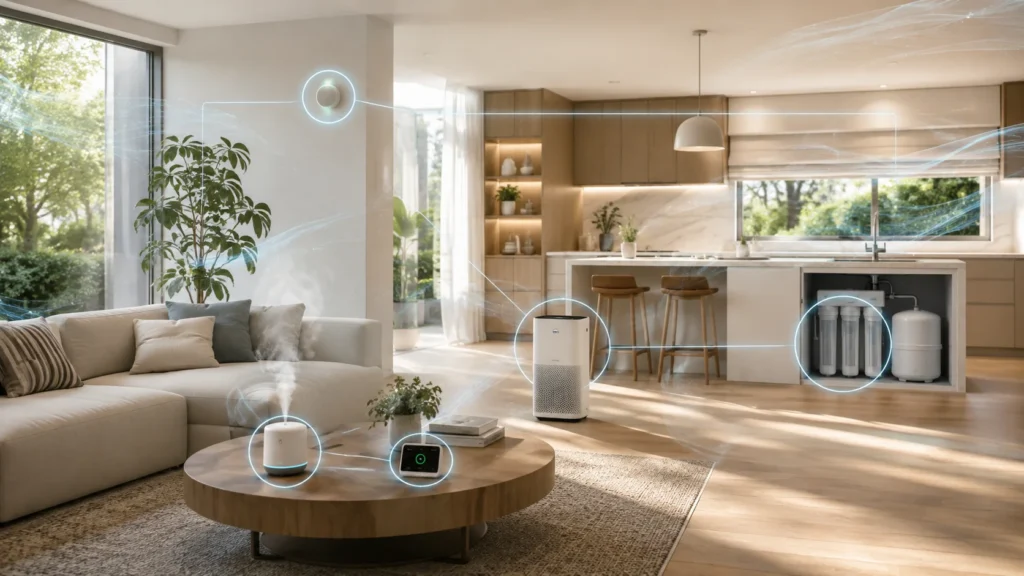
Modern living room with a family enjoying a healthy indoor environment monitored by smart devices, natural lighting, and greenery.

After IFA 2026: The Healthy Home Is Moving Beyond Smart Devices

In our previous IFA 2026 column, Air Purification Is Becoming Part of the Healthy-Home Platform, we argued that the next generation of indoor-health products would ...
News
Modern living room and kitchen with smart home air quality devices including an air purifier, humidifier, and water filtration system, connected with visualized blue connectivity lines.

IFA 2026: Air Purification Is Becoming Part of the Healthy-Home Platform

Pre-IFA Industry Perspective | September 4, 2026 This article is based on official announcements and regulatory information available ahead of IFA 2026, which takes place ...
News
A modern office room with a gray wall-mounted air purifier, large wooden desk, office chairs, indoor plants, and glass windows offering a city view.

Luftreiniger gegen Staub: HEPA-Luftreinigung für Büro, Gewerbe und Industrie

Kurz gesagt: Ein Luftreiniger entfernt Staub aus der Luft – nicht vom Schreibtisch. Er reduziert die Konzentration schwebender Partikel und damit auch die Menge an ...
Air purifier, Filter
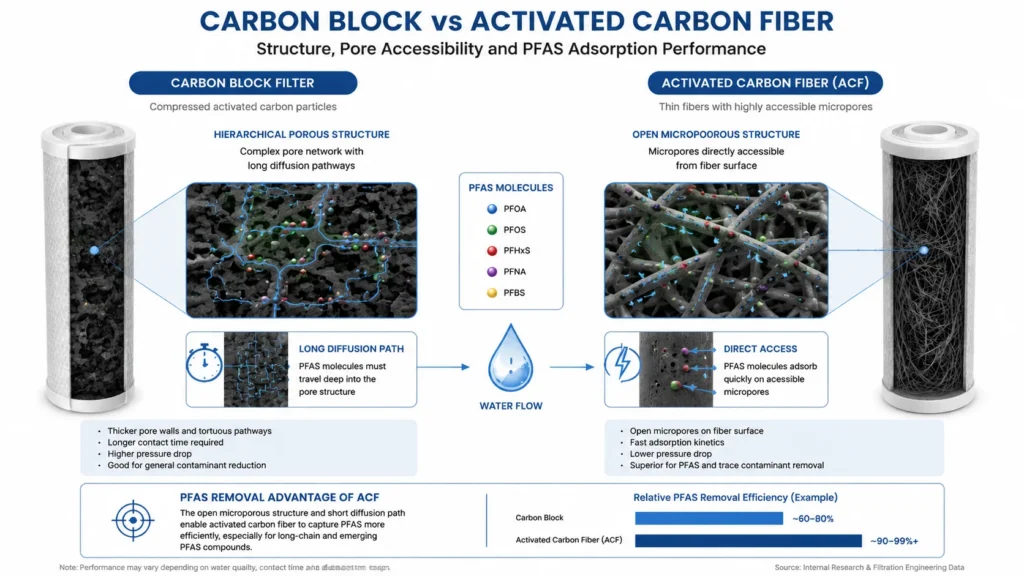
Comparison infographic showcasing the differences between carbon block filter and activated carbon fiber. Detailed diagrams illustrate the hierarchical porous structure of the carbon block with long diffusion paths and the open microporous structure of the activated carbon fiber with direct access for PFAS adsorption.

Carbon Block vs. Activated Carbon Fiber (ACF): Matching Media to Target Contaminants

Two carbon media. Same adsorption chemistry. Very different behaviour in a point-of-use cartridge. If you are specifying a water purifier platform for a PFAS-aware market, ...
News
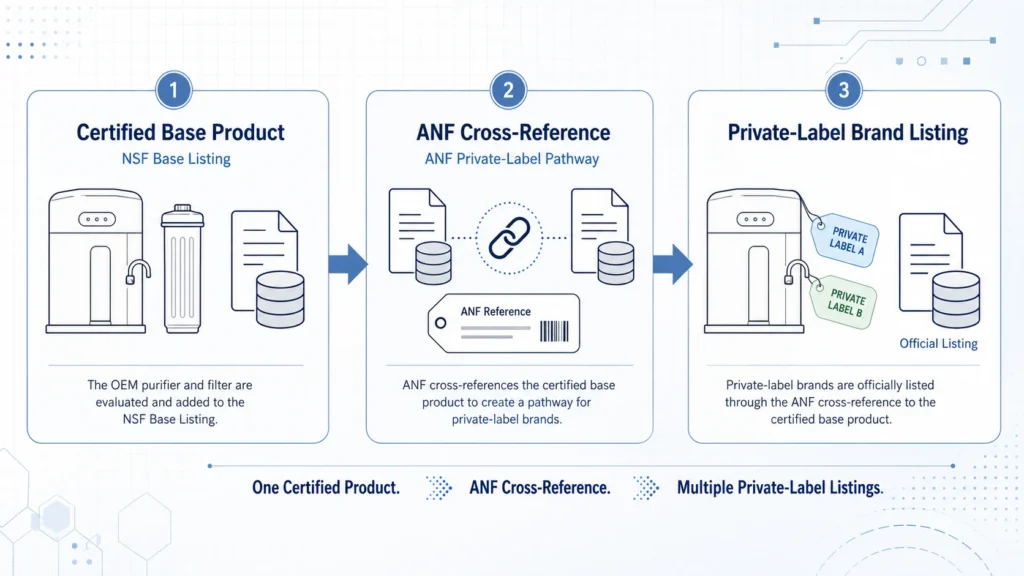
NSF base listing and ANF private-label certification pathway for OEM water filters

What Is an NSF Master Listing? A Guide to Base Listings, ANF Certification and OEM Water Filters

For a brand preparing to launch an OEM water purifier, one of the most common supplier claims is: “We already have an NSF master listing, ...
News, Water Purifiers
Healthy-home brand team reviewing PFAS water filter certification, test data and product engineering

Entering the Water Category Is Easy. Building a Credible PFAS Claim Is Much Harder

For air purification, appliance and healthy-home brands, entering the water category can look surprisingly easy. A company can select an existing undersink system, customize its ...
News
Contaminant Engineering•3 min read

PFAS Water Filtration Technologies Explained: Carbon, Resin & RO

Key Takeaway:

PFAS reduction depends on the specific compounds present, treatment media, contact time, water chemistry, and system design. Activated carbon, ion exchange, and Reverse Osmosis address PFAS through different mechanisms.

PFAS are a large family of persistent fluorinated compounds that can occur in drinking-water supplies. Their treatment behavior varies significantly by molecular structure, chain length, functional group, concentration, and the chemistry of the source water.

Granular Activated Carbon (GAC) removes PFAS primarily through adsorption. It is generally more effective for many longer-chain PFAS, while shorter-chain compounds tend to break through more quickly. Carbon performance depends on media properties, Empty Bed Contact Time (EBCT), competing organic matter, loading, and replacement frequency.

Ion-exchange resins use charged functional sites to capture many PFAS compounds. Properly selected anion-exchange media can provide high capacity and may perform better than conventional activated carbon for some shorter-chain PFAS, although performance still depends on water chemistry and competing ions.

Reverse Osmosis (RO) uses membrane separation rather than adsorption. Properly designed RO systems can provide broad reduction across many PFAS compounds as well as dissolved salts and other contaminants. Unlike carbon or resin, however, RO also produces a concentrate stream that must be managed.

No single technology should be selected from a PFAS label alone. System design should consider which PFAS compounds are present, their concentrations, required reduction targets, flow rate, media life, and the applicable third-party certification or validation requirements.

HisoAir Water Technical Series
Product Discovery•3 min read

How to Choose an Under-Sink Water Purifier for Modern Kitchens

Key Takeaway:

Match the treatment technology to your water quality first, then evaluate cabinet space, faucet configuration, flow rate, drain and power requirements, and filter replacement needs.

Choosing an under-sink water purifier starts with water chemistry. Carbon filtration is well suited to chlorine, taste, odor, and many organic contaminants, while Reverse Osmosis is more appropriate when dissolved salts, fluoride, nitrates, or broader dissolved contaminants need to be reduced.

For compact kitchens, tankless RO systems eliminate the conventional storage tank and can significantly reduce the space required under the sink. However, membrane capacity stated in GPD does not directly equal faucet flow. When comparing systems, check the actual dispensing flow rate, inlet-pressure requirement, recovery ratio, and whether a booster pump is required.

Installation architecture also matters. Many RO systems require a drain connection, electrical power, and either a dedicated drinking-water faucet or a compatible multi-function faucet. High-flow carbon systems can often connect directly to the existing cold-water line with a simpler installation, but pressure drop and available faucet flow should still be verified.

RO also removes much of the naturally occurring dissolved mineral content. Where taste or mineral balance is a priority, a post-RO remineralization stage can be added. Filter life should be evaluated by both rated capacity and local water quality rather than replacement time alone.

The right system is therefore not simply the smallest or highest-GPD model. It is the configuration that matches the target contaminants, available cabinet space, desired faucet setup, peak dispensing demand, and maintenance expectations.

HisoAir Water Technical Series
Water Quality•2 min read

What Does TDS Mean in Drinking Water? Measurement vs Contaminant Reality

Key Takeaway:

A TDS meter estimates the overall concentration of dissolved ionic substances from electrical conductivity. It cannot identify specific contaminants or determine whether water is chemically safe.

Total Dissolved Solids (TDS) refers to the combined concentration of dissolved substances in water. Most handheld TDS meters do not measure TDS directly. Instead, they measure electrical conductivity (EC) and convert that reading into an estimated parts-per-million (ppm) value.

This means a TDS reading can indicate how much dissolved ionic material is present, but not what that material actually is. Calcium, magnesium, sodium, nitrates, and other dissolved ions can all contribute to conductivity, yet a simple TDS meter cannot distinguish between them.

TDS meters are also not suitable for detecting trace contaminants such as PFAS, many VOCs, pesticides, pharmaceuticals, or disinfection byproducts. These substances may be present at concentrations far below the level needed to noticeably change electrical conductivity.

A low TDS reading therefore does not guarantee safe drinking water, and a higher TDS reading does not automatically indicate contamination. Water-treatment decisions should be based on laboratory testing for specific contaminants of concern rather than TDS alone.

HisoAir Water Technical Series
Technology Selection•2 min read

RO vs UF Water Filtration: Understanding Pore Sizes & Dissolved Minerals

Key Takeaway:

Ultrafiltration can reduce bacteria, turbidity, and suspended particles while retaining most naturally occurring dissolved minerals. Reverse Osmosis provides much broader reduction of dissolved salts and smaller contaminants.

Ultrafiltration (UF) typically uses hollow-fiber membranes with pore sizes in the approximate 0.01–0.1 micron range. These membranes physically retain turbidity, suspended solids, colloids, and many microorganisms while allowing dissolved minerals and salts to remain in the water.

Reverse Osmosis (RO) operates at a much finer separation level. Unlike UF, RO can substantially reduce dissolved ions such as sodium, calcium, fluoride, nitrates, and other contributors to total dissolved solids (TDS). This makes RO more suitable when dissolved-salt reduction is a primary treatment objective.

UF generally requires less system pressure and produces little or no continuous concentrate stream in many point-of-use configurations. RO typically requires greater pressure and produces a reject-water stream, but delivers broader contaminant reduction.

For water with acceptable TDS and mineral content, UF can be a simpler mineral-retaining treatment option. Where dissolved salts, fluoride, nitrates, or broader dissolved contaminants are a concern, RO is generally the more appropriate technology.

HisoAir Water Technical Series
Technology Selection•4 min read

Carbon Block vs Reverse Osmosis: Which Fits Your Need?

Key Takeaway:

Choose RO for dissolved inorganic salts and heavy metals; choose Carbon Block for chemical taste/odor, no wastewater, and high line-pressure flow.

Reverse Osmosis (RO) and Carbon Block filtration represent two fundamentally different treatment methods: membrane separation and adsorption. Understanding these differences helps determine which technology is better suited to a specific water-quality requirement.

Reverse Osmosis uses a semi-permeable membrane with pore sizes of approximately 0.0001 microns. It can significantly reduce dissolved inorganic contaminants such as TDS, fluoride, nitrates, and certain heavy metals. Because water must be forced through the membrane, RO systems require sufficient pressure or a booster pump and generate a concentrated wastewater stream.

Carbon Block filtration relies primarily on adsorption through compressed activated carbon, commonly with nominal pore sizes around 0.5–5 microns. It is highly effective for chlorine, chloramines, VOCs, taste, and odor, while allowing substantially higher direct-flow rates without producing wastewater.

From an operating perspective, Carbon Block systems are generally simpler, require less energy, and avoid the water loss associated with RO. RO involves higher system complexity and operating cost, but provides substantially broader reduction of dissolved contaminants that Carbon Block alone cannot address.

HisoAir Water Technical Series

REQUEST A QUOTE