Öffnet in einem neuen Tab
Innovative Lösungen für die Luftqualität

Die besten Hersteller elektrostatischer Luftfilter in der Welt

Related Products

Looking for electrostatic air filter manufacturers for buying electrostatic air filters? Learn more about this filter and see which manufacturer today excels in making these filters. 

Liste der Hersteller elektrostatischer Luftfilter in der Welt

Wie bereits erwähnt, sind elektrostatische Luftfilter ein effizientes Medium zum Abfangen von Allergene und andere Schadstoffe. Gleichzeitig müssen wir aber auch darauf hinweisen, dass nicht alle gleich sind. Daher können einige von ihnen bessere Ergebnisse liefern als andere. Eine Möglichkeit, um sicherzustellen, dass diese elektrostatischen Filter funktionieren, besteht darin, sie von seriösen Herstellern zu erwerben. 

Die nachstehend aufgeführten Unternehmen gehören zu den kompetentesten Herstellern von hochwertigen elektrostatischen Luftfiltern. Sie sind bekannt für die Zuverlässigkeit ihrer Produkte und die darin enthaltene Technologie. 

  1. HisoAir
  2. Gutes Filterunternehmen
  3. All-Filter, Inc.
  4. Die PNF-Gruppe

Die 4 besten Hersteller elektrostatischer Luftfilter in der Welt

Hier finden Sie ein kurzes Firmenprofil für jedes der oben aufgeführten Unternehmen. Sie sollten jedes dieser Unternehmen prüfen, um festzustellen, ob es eine gute Wahl für einen Anbieter von elektrostatischen Luftfiltern ist oder nicht. 

1. Electrostatic filter manufacturers HisoAir

HisoAir-Logo
HisoAir-Logo

Bildquelle: HisoAir

  • Geschäftsart: OE/OD/JD Hersteller, Lieferant
  • Hauptsitz: Room 712, Building B1-1, No. 4, Second Road, Songshan Lake Park, Dongguan City, Guangdong Province, China
  • Wichtigste Märkte: Global
  • Jahre der Erfahrung: 19 years
  • Bescheinigungen: CE, ROHS, EN1822

When it comes to air purifiers and their accessories, you should really check HisoAir. This is a China-based company that specializes in the creation of medical-grade residential air purifiers and commercial air purifiers. Over a decade in the industry, HisoAir has provided fully effective air purifiers for various institutions. At the same time, it has a tested-and-tried rapport within and outside China. 

HisoAir stellt auch hochwertige Filter her, wie z. B. Faltenfilter und elektrostatische Filter. Das Unternehmen hat auch ein eigenes Design für seine HEPA-Filter, um sicherzustellen, dass seine Luftreiniger so funktionieren, wie Sie es erwarten. Aus diesem Grund, HisoAir bietet die Garantie, dass seine Produkte die Luftqualität in Ihren Innenräumen verbessern können. Außerdem nimmt dieses internationale Unternehmen auch Großbestellungen zu einem sehr günstigen Preis entgegen. Der Versand ist ebenfalls sehr schnell.

Wichtige Produkte

  • Luftreiniger in medizinischer Qualität
  • Filter

2. Electrostatic filter manufacturers Good Filter Company
Good Filter Firmenlogo

Bildquelle: Gutes Filterunternehmen

  • Geschäftsart: OEM, Hersteller, Lieferant
  • Hauptsitz: P.O. Box 1206, Spring Branch, TX 78070, Vereinigte Staaten
  • Wichtigste Märkte: Vereinigte Staaten, Global
  • Jahre der Erfahrung: 32 Jahre

Die Good Filter Company begann bei ihrer Gründung im Jahr 1990 zunächst als Partnerunternehmen einer Luftreinigerfirma. Seitdem hat sich das Unternehmen zu einem Dienstleister für verschiedene Luftreiniger, insbesondere für Luftfilter, entwickelt. Eines der ersten Angebote auf dem Markt sind Holzkohle-/Kohlefilter, die sich als wirksam gegen flüchtige organische Verbindungen und andere Haushaltsgerüche erwiesen haben.

Heute ist die Good Filter Company ein angesehener Hersteller von hochwertigen Filtern. Ihr Elektrostatische Filter aus Polypropylen gelten als die besten in der Branche. Sie können diese Filter auf die Bedürfnisse ihrer Kunden abstimmen. Darüber hinaus ist dieses Unternehmen auch in anderen Luftreiniger-Filter, wie die haltbarere Edelstahl-Filter und Ablenkplatte Fettfilter gewagt. Erwarten Sie, dass es bietet schnellen Versand, als gut. 

Wichtige Produkte

  • Elektrostatische Filter aus Polypropylen
  • Filter aus Streckmetall
  • Aktivkohle-Luftreiniger 
  • Prallplatten-Fettfilter
  • Filter aus rostfreiem Stahl

3. Electrostatic filter manufacturers All-Filter, Inc.
Good Filter Firmenlogo

Bildquelle: All-Filter, Inc.

  • Geschäftsart: Hersteller, Lieferant
  • Hauptsitz: PO BOX 19144 Reno, NV 89511, Vereinigte Staaten
  • Wichtigste Märkte: Vereinigte Staaten, Global
  • Jahre der Erfahrung: 32 Jahre
  • Zertifizierungen: WQA/NSF 42, US Klasse II

Die All-Filter, Inc. wurde 1990 als Familienunternehmen gegründet. Im Laufe seiner Tätigkeit konnte es dank seiner kompetenten Dienstleistungen und Produkte einen großen Kundenstamm gewinnen. Das Unternehmen hat seine Filtrationsprodukte für die Medien Luft und Wasser kontinuierlich weiterentwickelt. Daher ist es nicht verwunderlich, dass das Unternehmen über ein umfangreiches Sortiment an verschiedenen Filtern verfügt, die Ihren Bedürfnissen und Anforderungen entsprechen. 

Darüber hinaus nimmt All-Filter auch kundenspezifische Aufträge an. Mit Hilfe von Kostenvoranschlägen kann das Unternehmen auf die Bedürfnisse und Anforderungen seiner Kunden eingehen. Eines der wichtigsten Merkmale dieses Unternehmens ist seine wettbewerbsfähige Preisgestaltung. Trotz des Vorsprungs, den es gegenüber seinen Konkurrenten hat, hält es seinen Preis im Rahmen - nicht zu teuer, aber auch nicht zu billig. Die Qualität der Filter ist ziemlich beeindruckend, da sie langlebig sind und besser funktionieren als ihre Gegenstücke. 

Wichtige Produkte

  • Persönliche Luftreinigungsfilter
  • HVAC-Luftfilter für den Einmalgebrauch
  • Dauerhafte HVAC-Luftfilter
  • Umkehrosmose-Wasserfilter

4. Electrostatic filter manufacturers Le Groupe PNF
Das Logo der PNF-Gruppe

Bildquelle: Die PNF-Gruppe

  • Geschäftsart: Hersteller, Lieferant
  • Hauptsitz: St-Leonard D'aston, QC, Kanada
  • Wichtigste Märkte: Kanada
  • Jahre der Erfahrung: 40 Jahre

Die Groupe P.N.F. Inc. ist ein weiterer tadelloser Hersteller von hochwertigen Filtern für verschiedene Luftfiltersysteme. Seit ihrer Gründung ist sie führend in der Herstellung von auswaschbaren Luftfiltern. Das Unternehmen setzt bei seinen Filtern innovative Designs und Technologien ein, um deren Langlebigkeit auch nach wiederholtem Waschen zu verlängern. Darüber hinaus geht sein Know-how über die herkömmliche Herstellung von Filtern hinaus. Es konnte auch die notwendigen Mechanismen und Ausrüstungen für die Herstellung seiner Filter entwickeln. 

Dieses Unternehmen beschäftigt auch erfahrene und geschulte Mitarbeiter im Bereich der Lüftung. Seine Experten sind es, die sich um die Anfragen und Wünsche seiner Kunden kümmern. Die Groupe P.N.F. Inc. ist in Kanada tätig und bedient sowohl Wohnhäuser als auch industrielle und gewerbliche Anwendungen. Sie versicherte auch, dass ihr Betrieb mit verschiedenen Umweltstandards konform ist.

Wichtige Produkte

  • HEPA-Filter
  • Aluminium-Filter
  • Polyurethanschaum-Filter
  • Elektrostatischer Filter
  • Filterrahmen

Ist ein elektrostatischer Luftfilter lohnenswert?

Es gibt einige Dinge, die elektrostatische Luftfilter leisten können, die herkömmliche Luftfilter nicht können. Kurz gesagt, elektrostatische Luftfilter werden durch die Integration von Polypropylen- und Polyurethanschichten in einem Filtermedium maßgeschneidert. Durch das Zusammenspiel dieser Schichten wird statische Elektrizität erzeugt. Dies geschieht insbesondere dann, wenn Luft durch sie hindurchströmt, was zu Reibung führt. 

Was bewirkt nun diese statische Elektrizität? Durch Reibung werden positive und negative Ionen erzeugt, die wiederum ein Magnetfeld erzeugen. Dieses Magnetfeld zieht verschiedene Partikel in der Luft an, wenn sie durch den Filter strömen. Das bedeutet, dass der Filter mehr Schadstoffe zurückhält und die Atmungsaktivität in Ihren Wohnräumen verbessert. 

Die Anschaffung eines elektrostatischen Luftfilters ist ein Muss. Zum Glück gibt es zahlreiche Hersteller von Luftreinigern zeichnen sich durch die Erstellung dieser speziellen Filter aus. 

Schlussfolgerung

Insgesamt bieten elektrostatische Luftfilter einen zusätzlichen Nutzen für Luftreiniger. Mit diesen Filtern ist der Luftreiniger in der Lage, mindestens 90 Prozent der Tierhaare, Pollen, Staub, Bakterien und Rauch in der Luft aufzufangen. Diese Fähigkeit ist sogar weitaus höher als bei herkömmlichen Glasfaser- und Faltenfiltern. Daher sind sie eine großartige Ergänzung für Wohnräume von Allergikern. 

Wenn Sie auf der Suche nach hochwertigen Luftreinigern mit innovativen Filtern wie diesem sind, sollten Sie bei HisoAir vorbeischauen. Dieses Unternehmen bietet eine Fülle von medizinischen Geräten für die Luftreinigung an. Es verfügt über umfangreiche Erfahrungen in der Branche und erfüllt die entsprechenden Qualitätsstandards. Besuchen Sie www.hisoair.com und erfahren Sie mehr darüber!

Lesen Sie auch die folgenden Blogs!

Teilen:
hisoair-gründer herr lee
Alwen Lee, an air purification expert with over 10 years of experience, is a devoted father of two and a passionate traveler, having explored more than 30 countries. With a love for public speaking and swimming, he has dedicated his life to the indoor air quality industry. His mission is to ensure that people around the world enjoy the freedom to breathe clean air and lead happy, healthy lives.

Senden Sie uns eine Nachricht

Related Products

Mehr zum Lesen

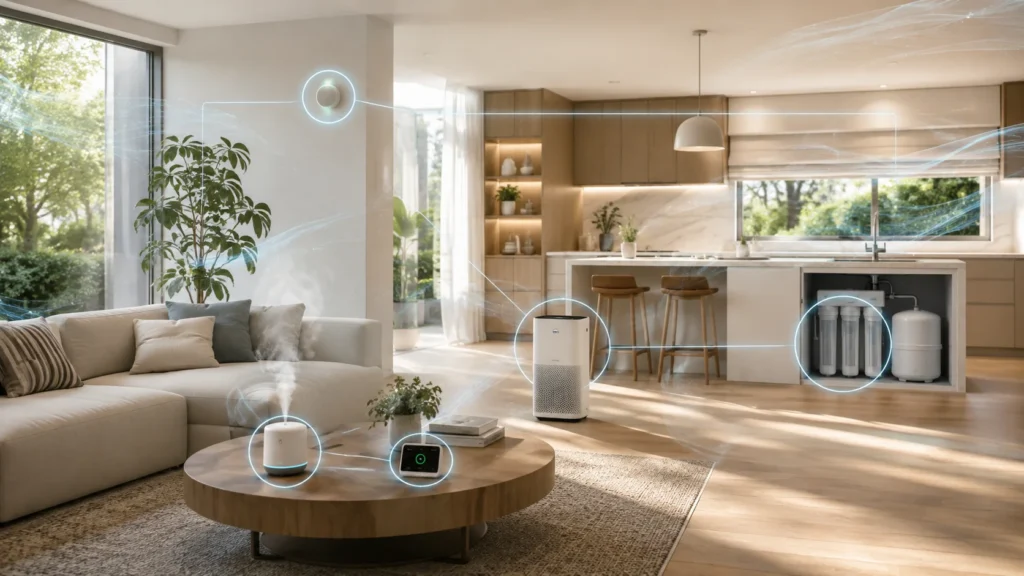
Modern living room with a family enjoying a healthy indoor environment monitored by smart devices, natural lighting, and greenery.

After IFA 2026: The Healthy Home Is Moving Beyond Smart Devices

In our previous IFA 2026 column, Air Purification Is Becoming Part of the Healthy-Home Platform, we argued that the next generation of indoor-health products would ...
Nachrichten
Modern living room and kitchen with smart home air quality devices including an air purifier, humidifier, and water filtration system, connected with visualized blue connectivity lines.

IFA 2026: Air Purification Is Becoming Part of the Healthy-Home Platform

Pre-IFA Industry Perspective | September 4, 2026 This article is based on official announcements and regulatory information available ahead of IFA 2026, which takes place ...
Nachrichten
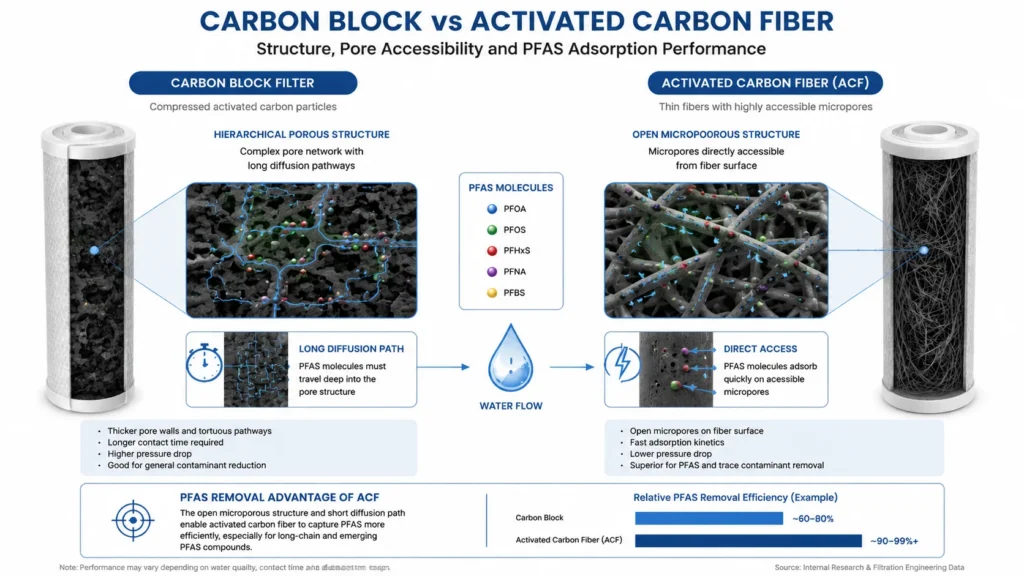
Comparison infographic showcasing the differences between carbon block filter and activated carbon fiber. Detailed diagrams illustrate the hierarchical porous structure of the carbon block with long diffusion paths and the open microporous structure of the activated carbon fiber with direct access for PFAS adsorption.

Carbon Block vs. Activated Carbon Fiber (ACF): Matching Media to Target Contaminants

Two carbon media. Same adsorption chemistry. Very different behaviour in a point-of-use cartridge. If you are specifying a water purifier platform for a PFAS-aware market, ...
Nachrichten
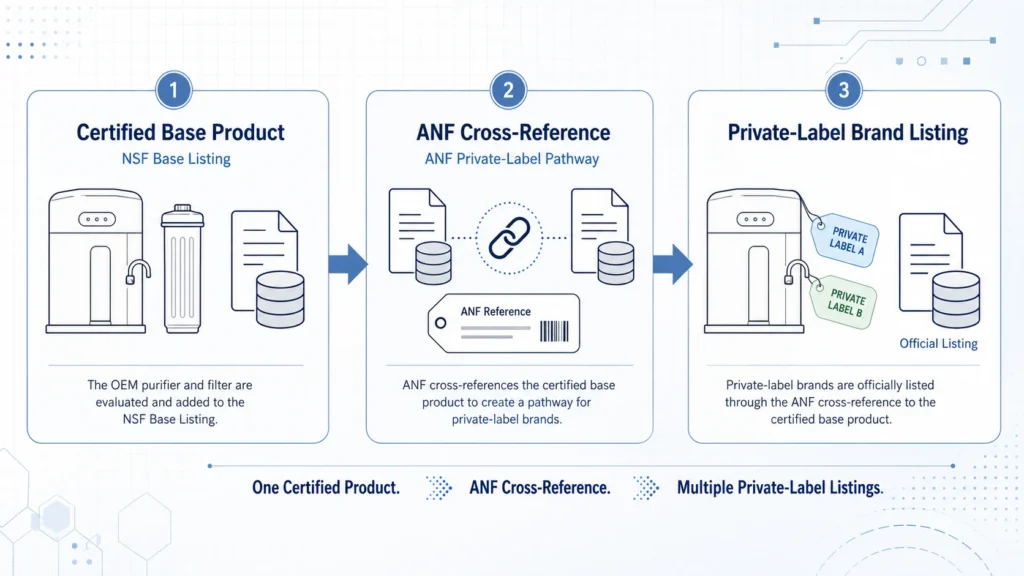
NSF base listing and ANF private-label certification pathway for OEM water filters

What Is an NSF Master Listing? A Guide to Base Listings, ANF Certification and OEM Water Filters

For a brand preparing to launch an OEM water purifier, one of the most common supplier claims is: “We already have an NSF master listing, ...
News, Water Purifiers
Healthy-home brand team reviewing PFAS water filter certification, test data and product engineering

Entering the Water Category Is Easy. Building a Credible PFAS Claim Is Much Harder

For air purification, appliance and healthy-home brands, entering the water category can look surprisingly easy. A company can select an existing undersink system, customize its ...
Nachrichten
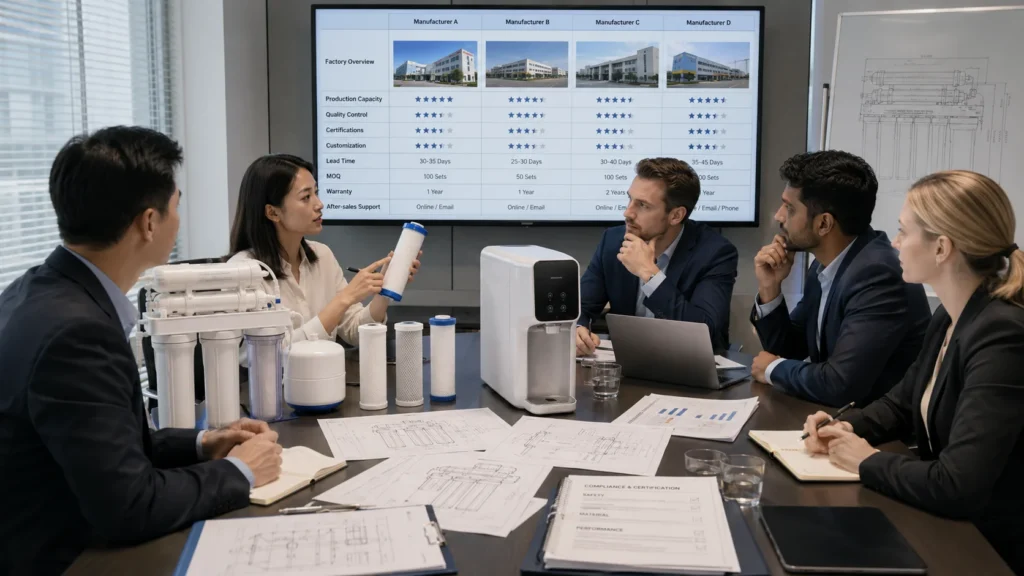
Team in a business meeting discussing a water filtration system with product components and a comparison table displayed on a screen.

5 Leading OEM Water Purifier Manufacturers in China for Private Label Brands

China has thousands of companies selling water filters, reverse osmosis systems and drinking-water appliances. However, only a portion of them are suitable for private-label, OEM ...
Nachrichten
Contaminant Engineering•3 min read

PFAS Water Filtration Technologies Explained: Carbon, Resin & RO

Key Takeaway:

PFAS reduction depends on the specific compounds present, treatment media, contact time, water chemistry, and system design. Activated carbon, ion exchange, and Reverse Osmosis address PFAS through different mechanisms.

PFAS are a large family of persistent fluorinated compounds that can occur in drinking-water supplies. Their treatment behavior varies significantly by molecular structure, chain length, functional group, concentration, and the chemistry of the source water.

Granular Activated Carbon (GAC) removes PFAS primarily through adsorption. It is generally more effective for many longer-chain PFAS, while shorter-chain compounds tend to break through more quickly. Carbon performance depends on media properties, Empty Bed Contact Time (EBCT), competing organic matter, loading, and replacement frequency.

Ion-exchange resins use charged functional sites to capture many PFAS compounds. Properly selected anion-exchange media can provide high capacity and may perform better than conventional activated carbon for some shorter-chain PFAS, although performance still depends on water chemistry and competing ions.

Reverse Osmosis (RO) uses membrane separation rather than adsorption. Properly designed RO systems can provide broad reduction across many PFAS compounds as well as dissolved salts and other contaminants. Unlike carbon or resin, however, RO also produces a concentrate stream that must be managed.

No single technology should be selected from a PFAS label alone. System design should consider which PFAS compounds are present, their concentrations, required reduction targets, flow rate, media life, and the applicable third-party certification or validation requirements.

HisoAir Water Technical Series
Product Discovery•3 min read

How to Choose an Under-Sink Water Purifier for Modern Kitchens

Key Takeaway:

Match the treatment technology to your water quality first, then evaluate cabinet space, faucet configuration, flow rate, drain and power requirements, and filter replacement needs.

Choosing an under-sink water purifier starts with water chemistry. Carbon filtration is well suited to chlorine, taste, odor, and many organic contaminants, while Reverse Osmosis is more appropriate when dissolved salts, fluoride, nitrates, or broader dissolved contaminants need to be reduced.

For compact kitchens, tankless RO systems eliminate the conventional storage tank and can significantly reduce the space required under the sink. However, membrane capacity stated in GPD does not directly equal faucet flow. When comparing systems, check the actual dispensing flow rate, inlet-pressure requirement, recovery ratio, and whether a booster pump is required.

Installation architecture also matters. Many RO systems require a drain connection, electrical power, and either a dedicated drinking-water faucet or a compatible multi-function faucet. High-flow carbon systems can often connect directly to the existing cold-water line with a simpler installation, but pressure drop and available faucet flow should still be verified.

RO also removes much of the naturally occurring dissolved mineral content. Where taste or mineral balance is a priority, a post-RO remineralization stage can be added. Filter life should be evaluated by both rated capacity and local water quality rather than replacement time alone.

The right system is therefore not simply the smallest or highest-GPD model. It is the configuration that matches the target contaminants, available cabinet space, desired faucet setup, peak dispensing demand, and maintenance expectations.

HisoAir Water Technical Series
Water Quality•2 min read

What Does TDS Mean in Drinking Water? Measurement vs Contaminant Reality

Key Takeaway:

A TDS meter estimates the overall concentration of dissolved ionic substances from electrical conductivity. It cannot identify specific contaminants or determine whether water is chemically safe.

Total Dissolved Solids (TDS) refers to the combined concentration of dissolved substances in water. Most handheld TDS meters do not measure TDS directly. Instead, they measure electrical conductivity (EC) and convert that reading into an estimated parts-per-million (ppm) value.

This means a TDS reading can indicate how much dissolved ionic material is present, but not what that material actually is. Calcium, magnesium, sodium, nitrates, and other dissolved ions can all contribute to conductivity, yet a simple TDS meter cannot distinguish between them.

TDS meters are also not suitable for detecting trace contaminants such as PFAS, many VOCs, pesticides, pharmaceuticals, or disinfection byproducts. These substances may be present at concentrations far below the level needed to noticeably change electrical conductivity.

A low TDS reading therefore does not guarantee safe drinking water, and a higher TDS reading does not automatically indicate contamination. Water-treatment decisions should be based on laboratory testing for specific contaminants of concern rather than TDS alone.

HisoAir Water Technical Series
Technology Selection•2 min read

RO vs UF Water Filtration: Understanding Pore Sizes & Dissolved Minerals

Key Takeaway:

Ultrafiltration can reduce bacteria, turbidity, and suspended particles while retaining most naturally occurring dissolved minerals. Reverse Osmosis provides much broader reduction of dissolved salts and smaller contaminants.

Ultrafiltration (UF) typically uses hollow-fiber membranes with pore sizes in the approximate 0.01–0.1 micron range. These membranes physically retain turbidity, suspended solids, colloids, and many microorganisms while allowing dissolved minerals and salts to remain in the water.

Reverse Osmosis (RO) operates at a much finer separation level. Unlike UF, RO can substantially reduce dissolved ions such as sodium, calcium, fluoride, nitrates, and other contributors to total dissolved solids (TDS). This makes RO more suitable when dissolved-salt reduction is a primary treatment objective.

UF generally requires less system pressure and produces little or no continuous concentrate stream in many point-of-use configurations. RO typically requires greater pressure and produces a reject-water stream, but delivers broader contaminant reduction.

For water with acceptable TDS and mineral content, UF can be a simpler mineral-retaining treatment option. Where dissolved salts, fluoride, nitrates, or broader dissolved contaminants are a concern, RO is generally the more appropriate technology.

HisoAir Water Technical Series
Technology Selection•4 min read

Carbon Block vs Reverse Osmosis: Which Fits Your Need?

Key Takeaway:

Choose RO for dissolved inorganic salts and heavy metals; choose Carbon Block for chemical taste/odor, no wastewater, and high line-pressure flow.

Reverse Osmosis (RO) and Carbon Block filtration represent two fundamentally different treatment methods: membrane separation and adsorption. Understanding these differences helps determine which technology is better suited to a specific water-quality requirement.

Reverse Osmosis uses a semi-permeable membrane with pore sizes of approximately 0.0001 microns. It can significantly reduce dissolved inorganic contaminants such as TDS, fluoride, nitrates, and certain heavy metals. Because water must be forced through the membrane, RO systems require sufficient pressure or a booster pump and generate a concentrated wastewater stream.

Carbon Block filtration relies primarily on adsorption through compressed activated carbon, commonly with nominal pore sizes around 0.5–5 microns. It is highly effective for chlorine, chloramines, VOCs, taste, and odor, while allowing substantially higher direct-flow rates without producing wastewater.

From an operating perspective, Carbon Block systems are generally simpler, require less energy, and avoid the water loss associated with RO. RO involves higher system complexity and operating cost, but provides substantially broader reduction of dissolved contaminants that Carbon Block alone cannot address.

HisoAir Water Technical Series

EIN ANGEBOT ANFORDERN