
In our previous IFA 2026 column, Air Purification Is Becoming Part of the Healthy-Home Platform, we argued that the next generation of indoor-health products would not be defined by one smarter appliance.
Instead, we saw a broader architecture beginning to emerge around clean air, environmental sensing, humidity, connectivity and water.
Now that IFA 2026 has concluded, that direction looks even clearer.
The most important takeaway was not simply that home appliances are becoming more connected or that more products now use AI.
It was that the definition of the smart home itself is changing.
The industry is gradually moving from a collection of connected devices toward something more ambitious:
an indoor environment that can sense what is happening, interpret changing conditions and respond in ways that improve everyday comfort and wellbeing.
That shift has implications not only for consumer electronics brands.
It may also change how the next generation of healthy-home products needs to be designed, engineered and manufactured.
“Smart” Is Becoming the Baseline
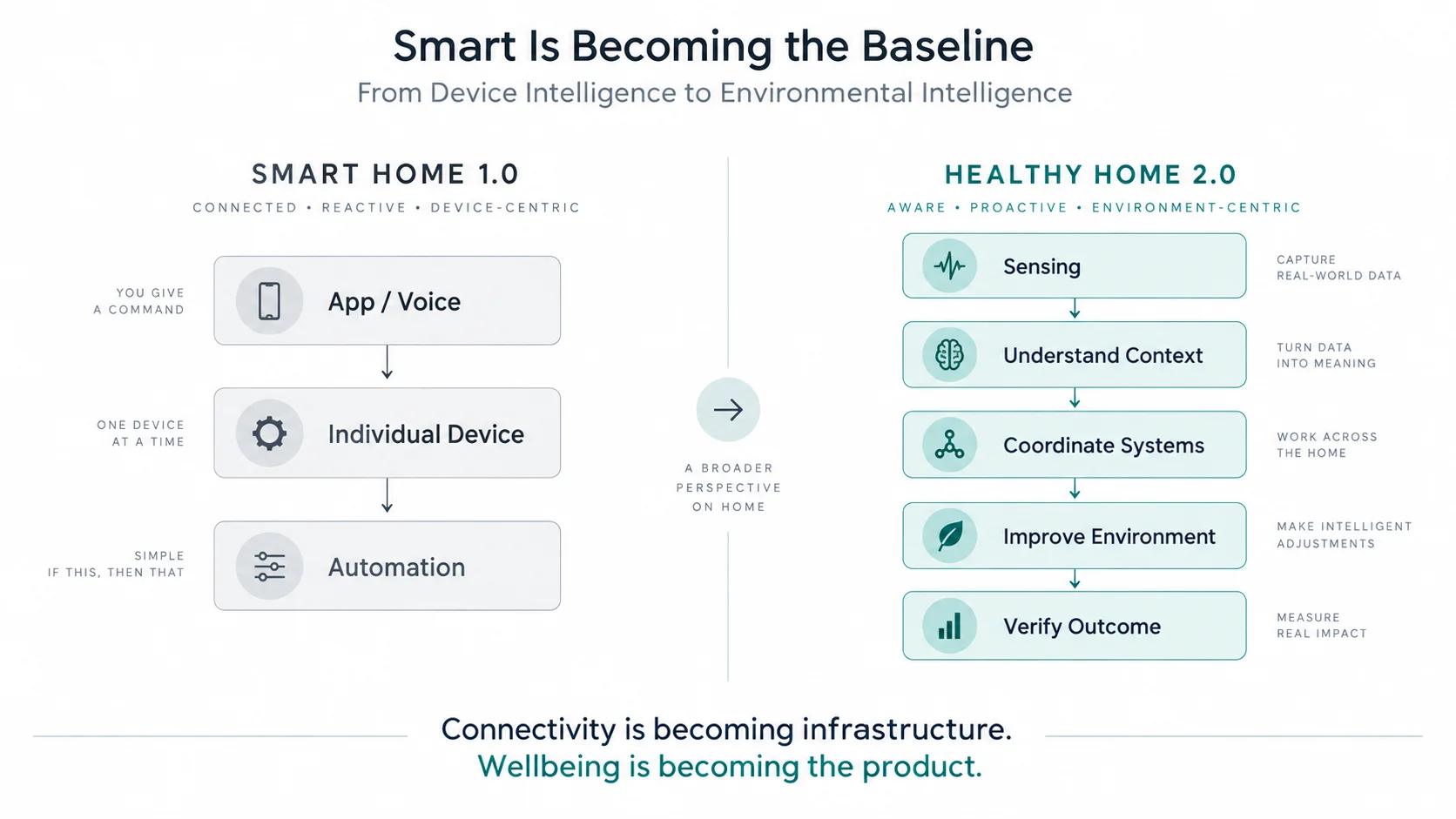
For much of the last decade, making a home product “smart” meant adding connectivity.
A conventional appliance gained Wi-Fi.
Then came an app, voice control, schedules, cloud services and ecosystem integration.
Those capabilities still matter, but IFA 2026 suggested that connectivity alone is becoming less of a differentiator.
IFA Berlin's own post-show coverage described AI as evolving from an isolated feature into an integrating layer of everyday life. Companies including Haier, TCL and Hisense presented ecosystems in which intelligence increasingly connects products, services and user experiences rather than operating as a feature inside one appliance.
One of the clearest examples came from an IFA panel titled How Air, Connectivity and Intelligence Bridge the Last Mile of Home Wellness.
The discussion focused on a simple but important question: once homes can connect devices and automate routines, how does that technology translate into improvements people can actually feel?
The panel framed air, sensing, connectivity and intelligence as parts of a more responsive home environment rather than isolated technologies.
This suggests an important change in product strategy:
Connectivity is becoming infrastructure. Wellbeing is becoming the product.
The question is no longer only:
“Can I control this appliance from my phone?”
It is increasingly:
“Can the environment understand what is happening and respond appropriately?”
From Device Intelligence to Environmental Intelligence
This distinction matters.
A smart air purifier can measure PM2.5 and automatically change fan speed.
That is useful device intelligence.
But consider a different architecture.
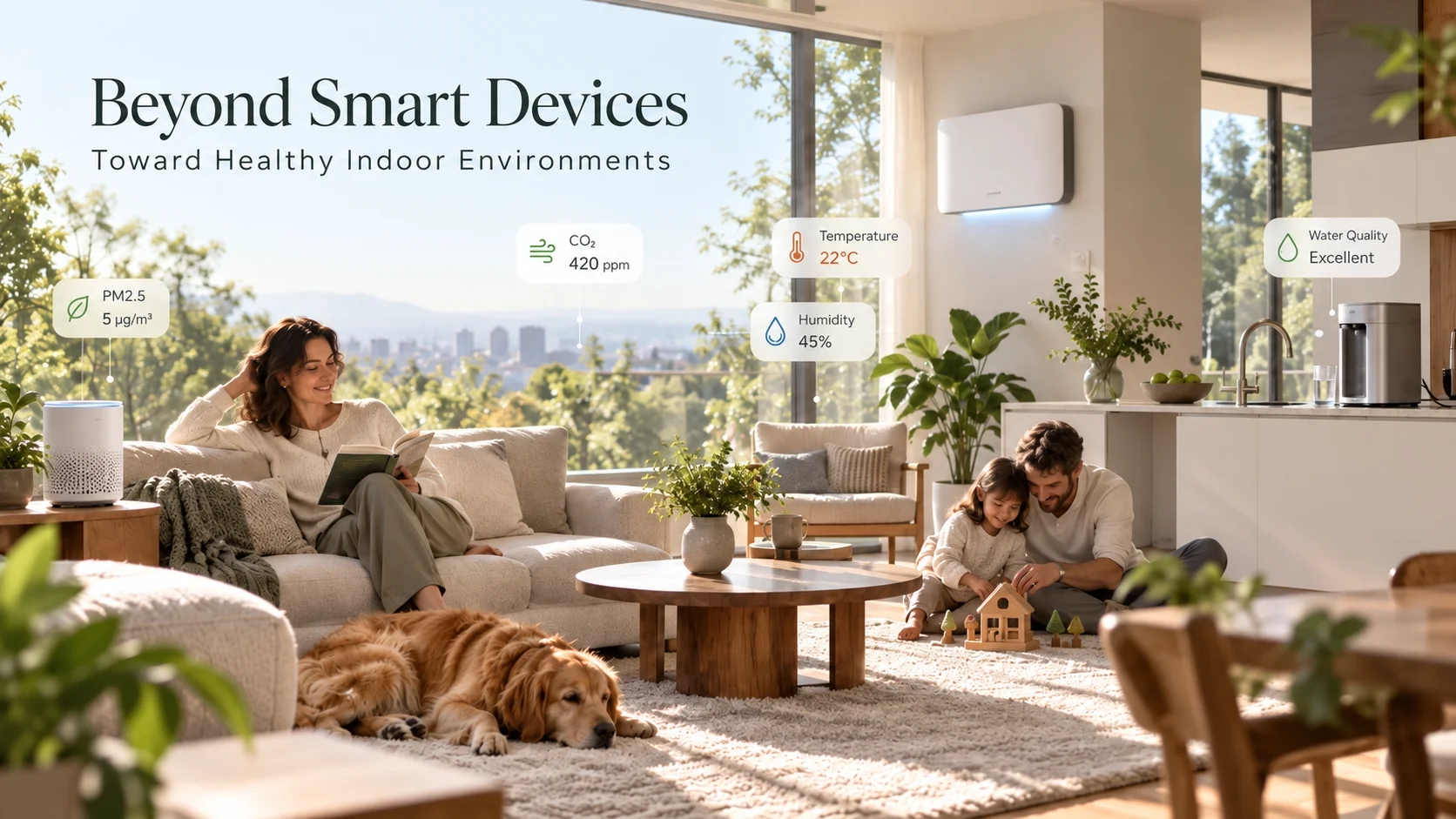
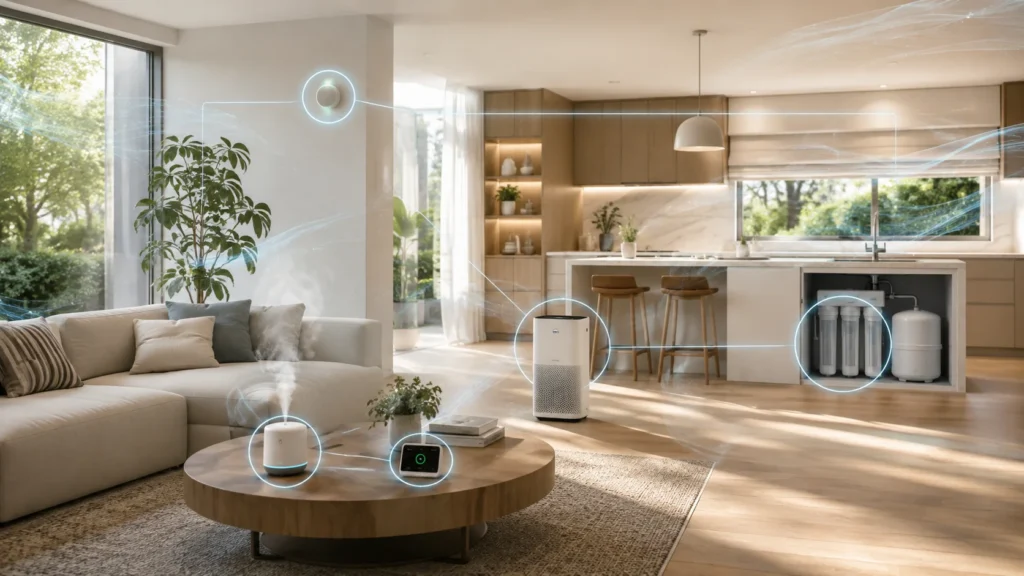
A room-level sensing system detects changes in particulate matter, CO₂, temperature, humidity or occupancy.
Those signals are interpreted together.
The system then determines whether the appropriate response should come from an air purifier, ventilation system, humidifier, HVAC equipment or another environmental device.
After action is taken, sensing verifies whether conditions actually improved.
That is closer to environmental intelligence.
It changes the fundamental product-development question.
Instead of asking:
How do we add more smart features to this appliance?
Product teams can begin asking:
What indoor condition are we trying to improve, what information do we need to understand it, and which hardware should respond?
That is a very different starting point.
Matter is moving in the same general direction. Matter 1.6, released by the Connectivity Standards Alliance in June 2026, focused not simply on adding more connected device categories, but on improving multi-ecosystem experiences and more context-aware device control.
The long-term implication is that products do not necessarily need to live inside completely isolated ecosystems.
They increasingly need to become useful participants in a broader environmental system.
The Healthy Home Needs More Than One Type of Hardware
Once we think about the home as an environment rather than a collection of appliances, another point becomes obvious:
one device format cannot solve every indoor environmental problem.
This is particularly visible in air treatment.
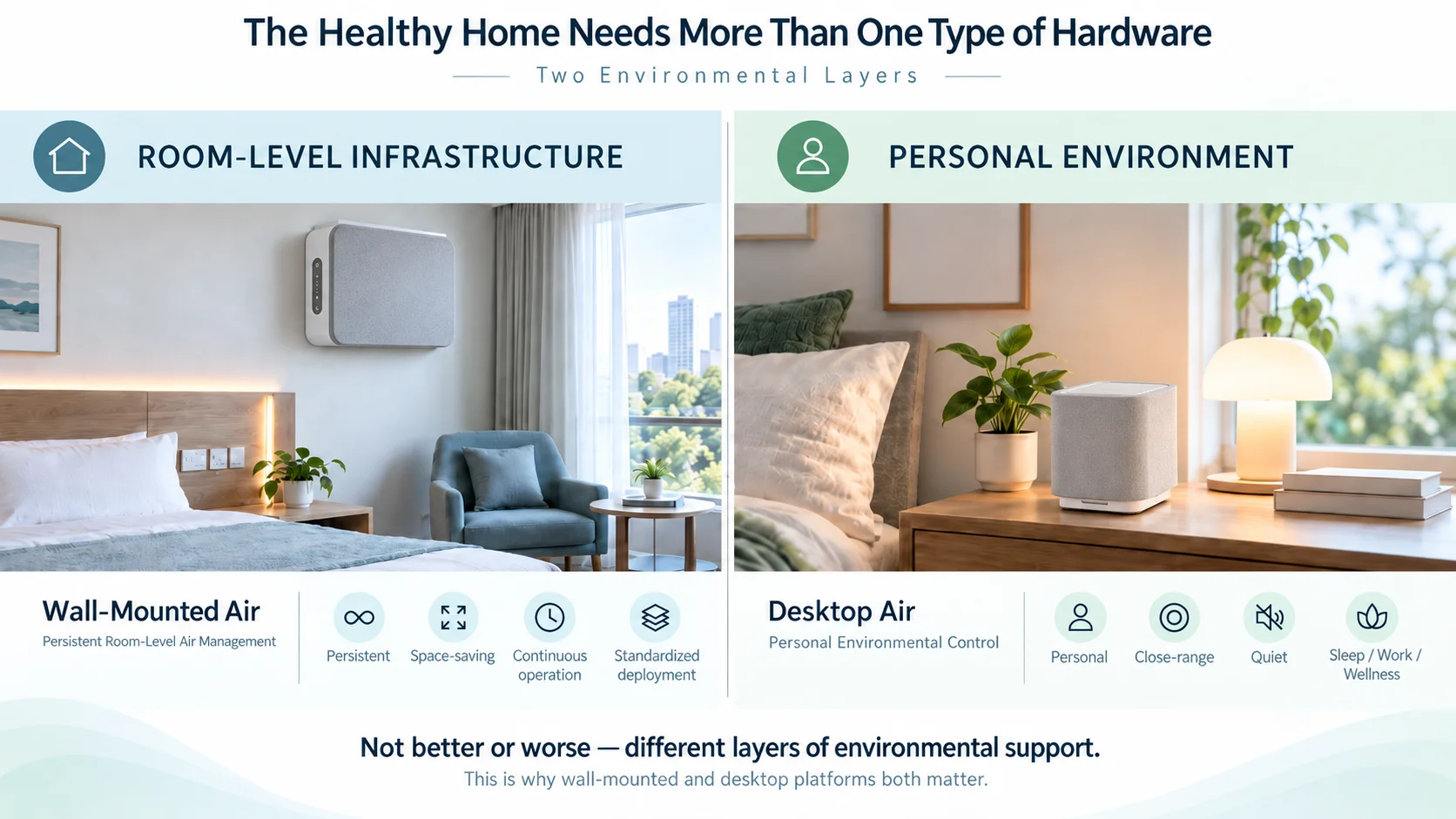
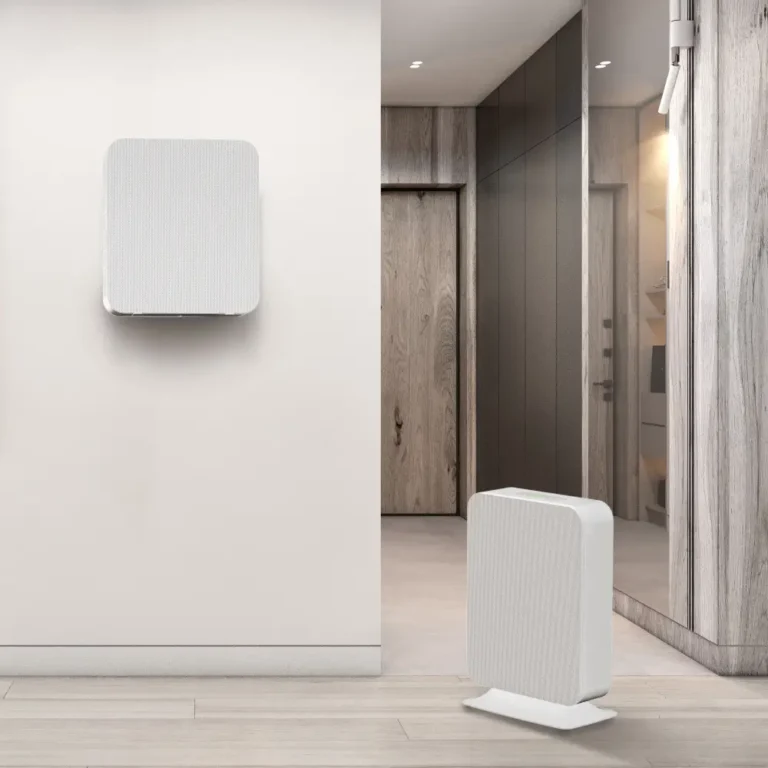
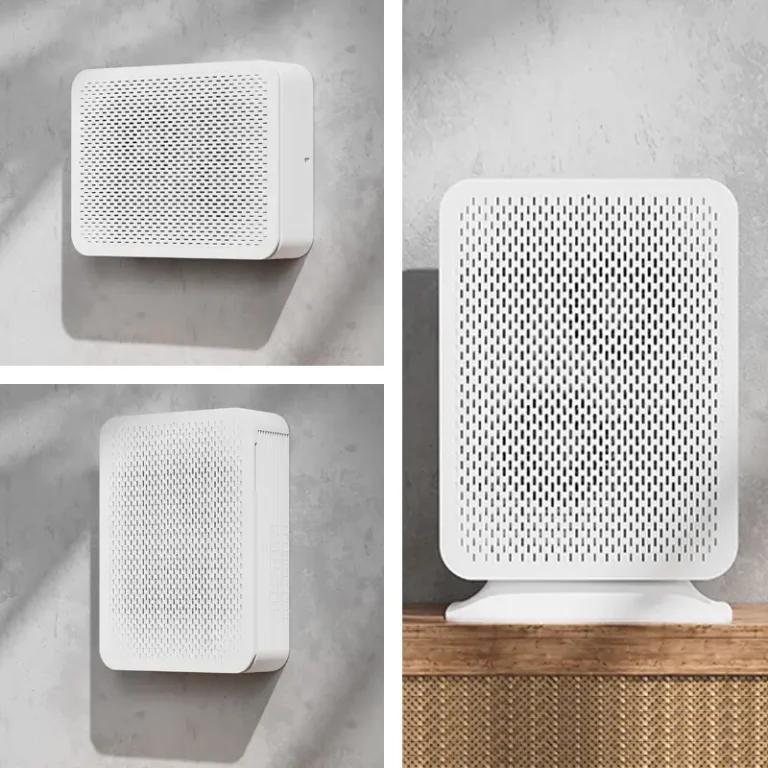
A wall-mounted air purifier and a desktop air purifier may use similar filtration principles, but they can play fundamentally different roles inside a healthy-home architecture.
Wall-Mounted Air as Room-Level Infrastructure
Wall-mounted systems can become part of the room itself.
They are especially relevant where floor space matters, operation needs to be continuous, installation is standardized, and facility managers may need to deploy and maintain large numbers of units.
That makes the format relevant not only to residential spaces, but also to applications such as hotel rooms, dormitories, offices, healthcare environments and other managed facilities.
In this context, the wall-mounted purifier is no longer simply another form factor.
It begins to function as persistent room-level air infrastructure.
This is one reason Hiso continues to develop wall-mounted air platforms alongside conventional portable products.
The design problem is different.
Installation, noise, airflow distribution, maintenance, filter life, sensing and system integration all become part of the product architecture.
Desktop Air as a Personal Environmental Layer
Desktop systems solve a different problem.
The environment immediately surrounding a person—in a bedroom, beside a bed, at a workstation or within a small living zone—does not always need the same hardware architecture as an entire room.
Here, compact dimensions, acoustic performance, local airflow, proximity to the user and personal comfort can become more important.
This creates another layer of healthy-home hardware:
personal environmental control.
As sleep technology, wearables and personal wellness products continue to develop, the boundary between a small air purifier and a broader personal-environment device may continue to narrow.
The important point is that wall-mounted and desktop systems are not necessarily competing versions of the same product.
One can serve the room.
The other can serve the individual.
Sensing Is Becoming the Bridge Between Products and Environments
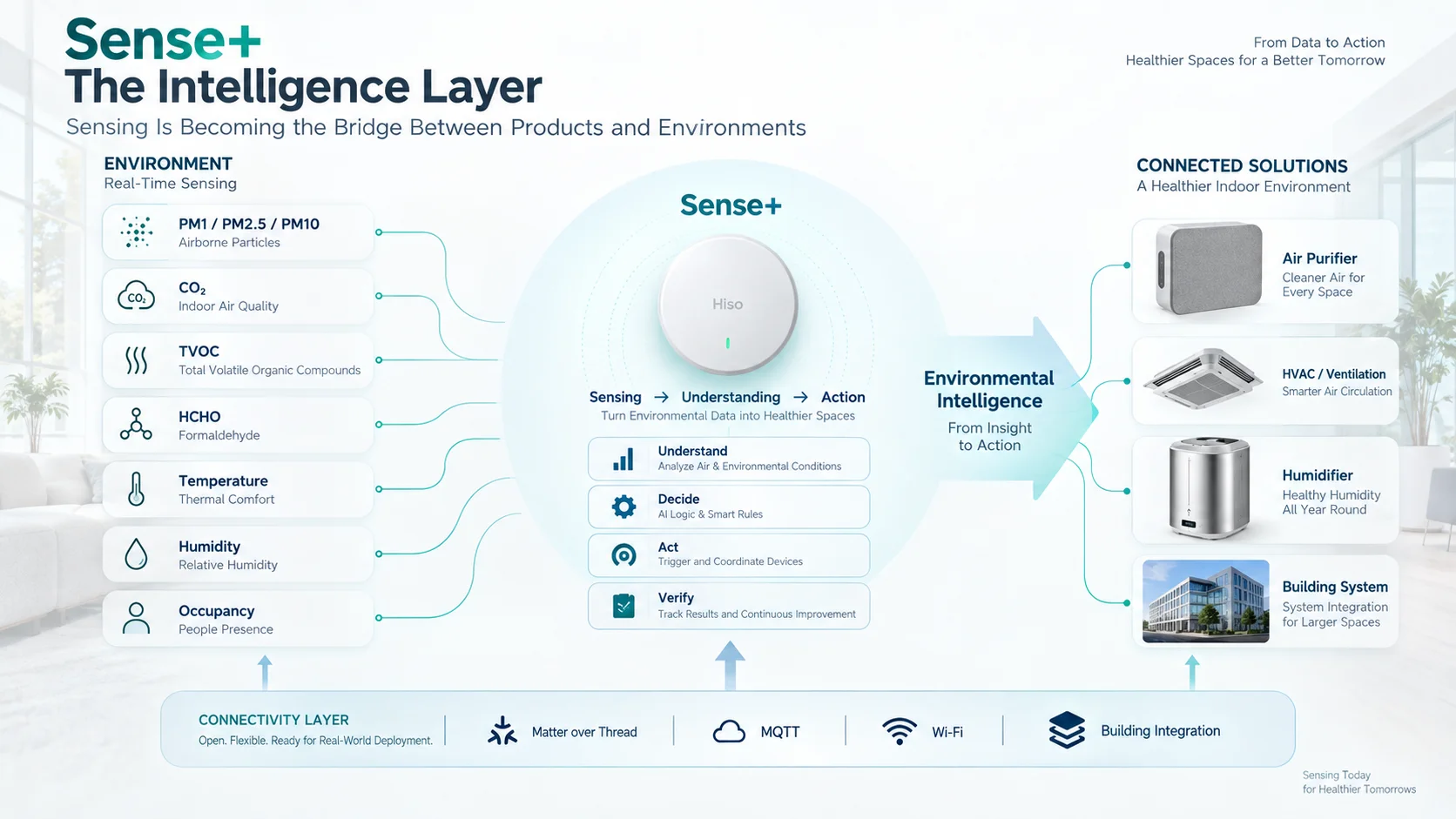
The biggest architectural change, however, may not be the purifier itself.
It may be sensing.
Traditional appliances generally understand only what is necessary for their own operation.
A purifier measures particles.
An air conditioner measures temperature.
A humidifier measures relative humidity.
Each product sees part of the environment.
A broader indoor environmental system needs a more complete picture.
That can include parameters such as particulate matter, CO₂, VOCs, temperature, humidity and, depending on the application, occupancy and other contextual signals.
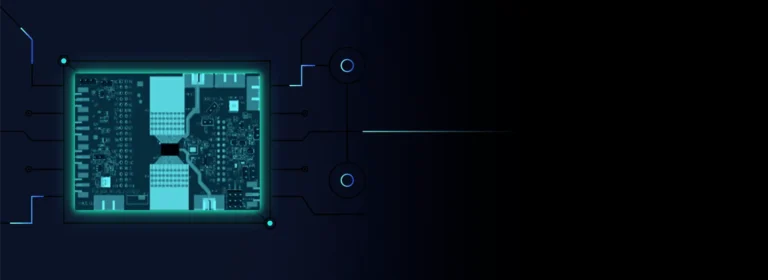
This is why environmental sensing has become an increasingly important part of Hiso's development roadmap through platforms such as Sense+.
The objective is not simply to create another indoor air quality monitor.
A monitor that only displays numbers remains an isolated product.
The larger opportunity is to create a sensing layer that can eventually help environmental systems answer four questions:
What is happening?
Does the space require intervention?
Which system should respond?
Did the environment actually improve?
This follows the same broader direction we discussed before IFA:
Sense → Understand → Act → Verify
But after IFA 2026, the commercial implication is becoming clearer.
Sensing is not just another product category.
It can become the intelligence layer connecting multiple product categories.
And Then There Is Water
At first glance, water filtration may seem separate from air purification and indoor environmental quality.
Technically, it is important to keep the distinction clear: traditional IEQ frameworks primarily focus on conditions such as indoor air quality, thermal comfort, lighting and acoustics.
Drinking-water quality belongs to a broader healthy-building and healthy-home discussion.
But from the occupant's perspective, the separation between appliance categories is much less important.
People do not experience their homes as product catalogs.
They experience air, temperature, humidity, sound, light and drinking water as parts of the same living environment.
This is why Hiso's expansion into water should not be viewed simply as adding another appliance category.
It reflects a broader product-development direction.
If the objective is healthier indoor living, clean air is a critical part of the equation—but it is not the entire equation.
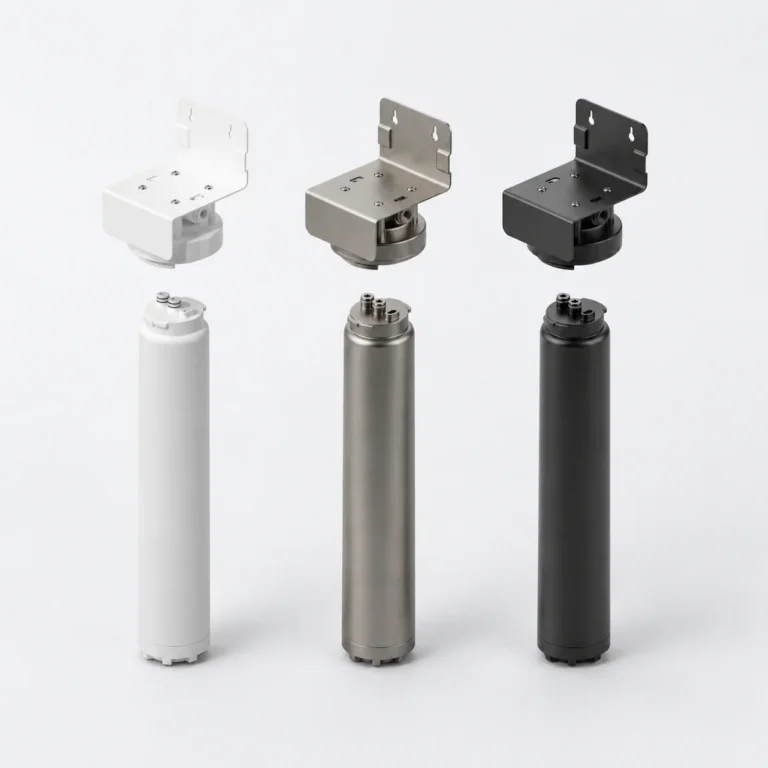
Water treatment therefore represents an adjacent layer of healthy-home infrastructure.
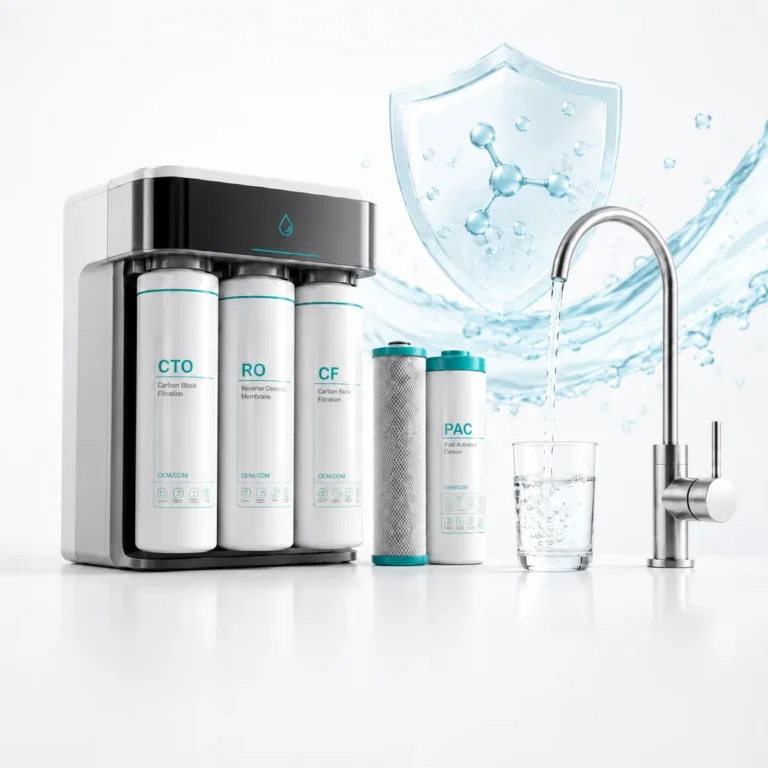
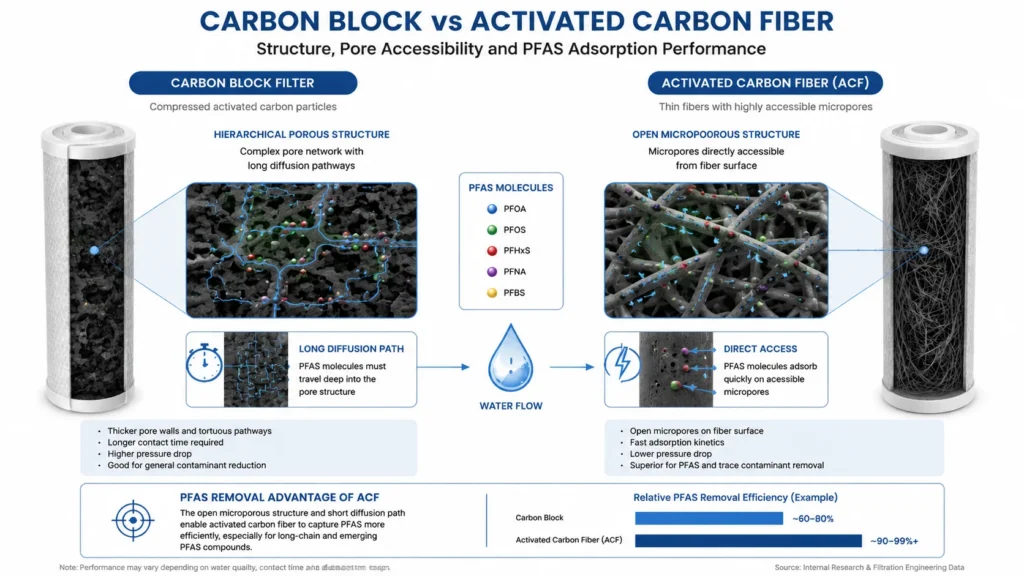
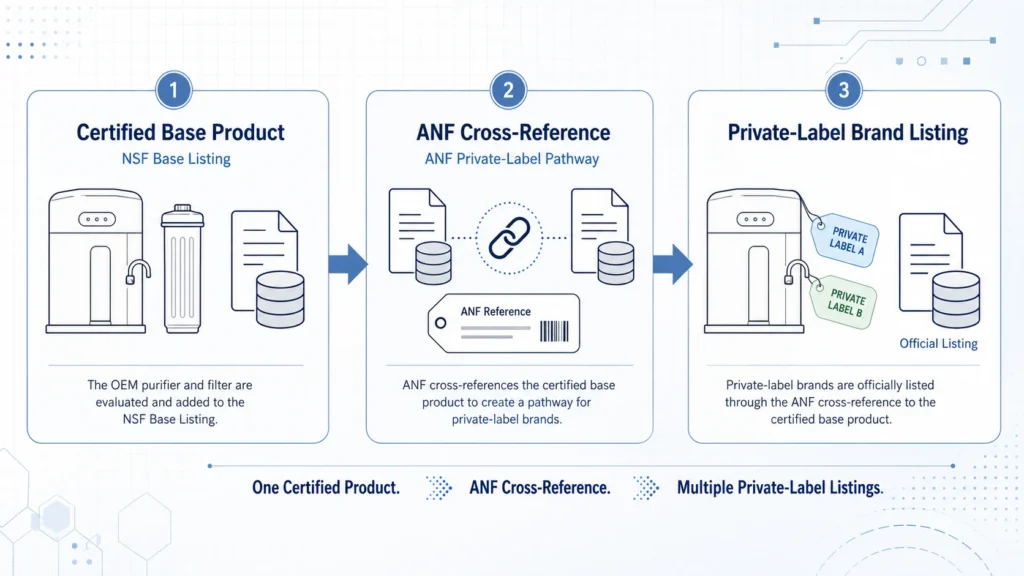
Depending on the application, that may mean point-of-use filtration, reverse osmosis, carbon filtration or systems developed around specific contaminant-reduction and certification requirements.
Air and water do not need to become one product.
They do not even need to use the same control architecture.
But they can belong to the same strategic question:
What hardware does a brand need to create a healthier indoor environment for its customers?
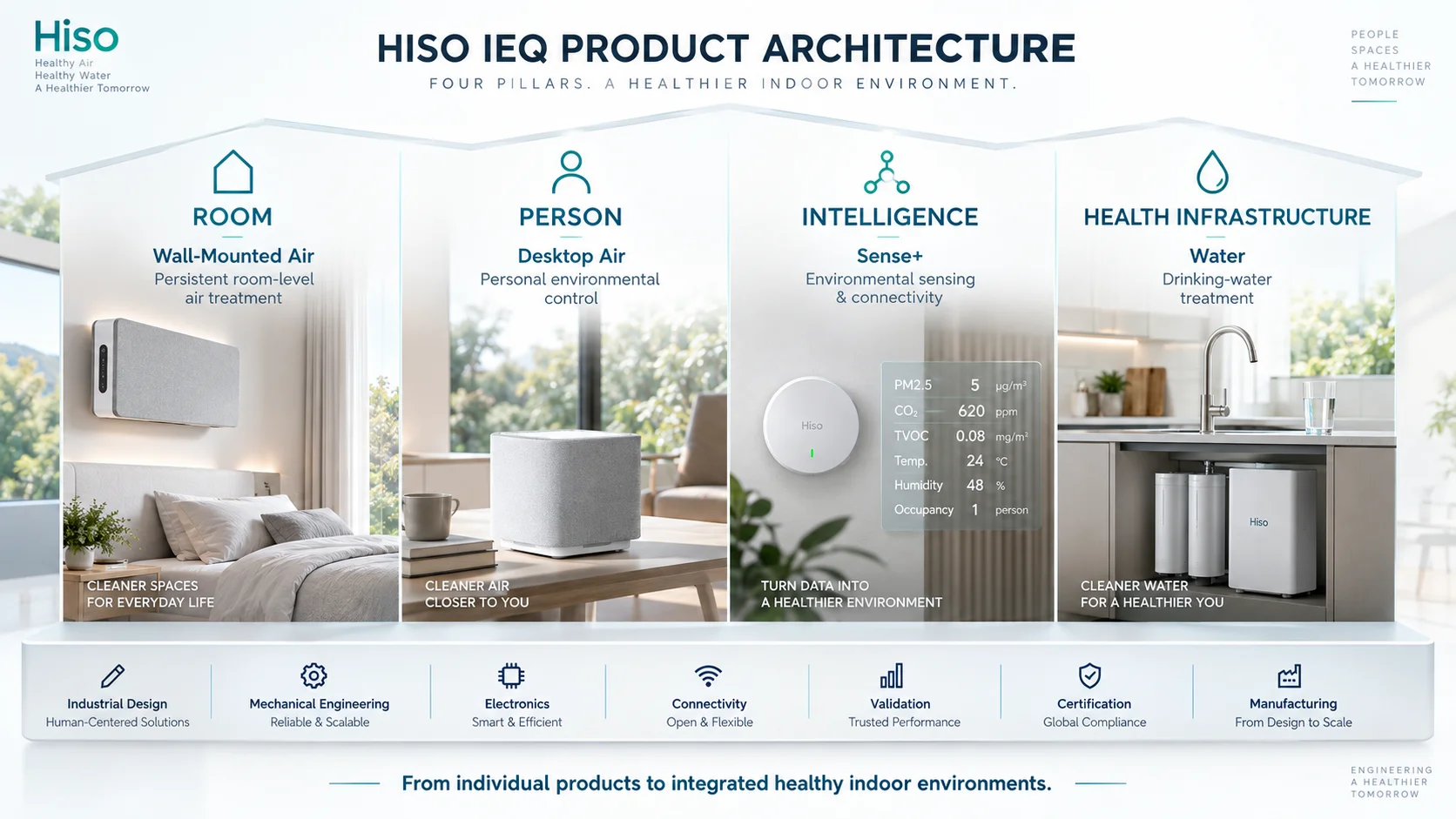
Seen individually, Hiso's current development direction can look broad.
Wall-mounted air purification.
Desktop air systems.
Sense+ environmental sensing.
Water filtration.
Viewed through the traditional OEM lens, these could appear to be four separate product categories.
Viewed through a healthy-environment architecture, however, they begin to make more sense.
Wall-mounted air provides persistent room-level environmental treatment.
Desktop air creates a more personal environmental layer.
Sense+ provides environmental awareness and the foundation for smarter system coordination.
L'eau extends the healthy-home strategy into another essential part of everyday indoor living.
The common thread is not the appliance category.
It is the environment.
That distinction is increasingly important to how we think about Hiso's future.
The Product-Development Question Is Changing
Traditional OEM development often begins after many of the important product decisions have already been made.
A brand defines the product.
Specifications are created.
The supplier is asked to quote tooling, components, certification and manufacturing.
The basic question is:
“Can you manufacture this product?”
There will always be a market for this model.
But many of the projects emerging around healthy homes and indoor environmental quality are becoming more complex.
They can involve airflow engineering, acoustics, filtration, environmental sensors, electronics, connectivity, firmware, industrial design, certification and ongoing software responsibilities.
In these projects, brands may not arrive with a fully defined product.
They may arrive with a problem.
A hotel group wants cleaner air without losing floor space.
A sleep technology company wants to improve the bedroom environment around the user.
An IAQ company wants sensing to trigger physical environmental equipment.
A home-wellness brand wants to extend from one healthy-home category into another.
A building-technology company wants environmental hardware that can participate in its existing ecosystem.
The starting question becomes:
“What environment are we trying to create?”
Only then should the product architecture be defined.
From OEM Manufacturer to IEQ Innovation Partner
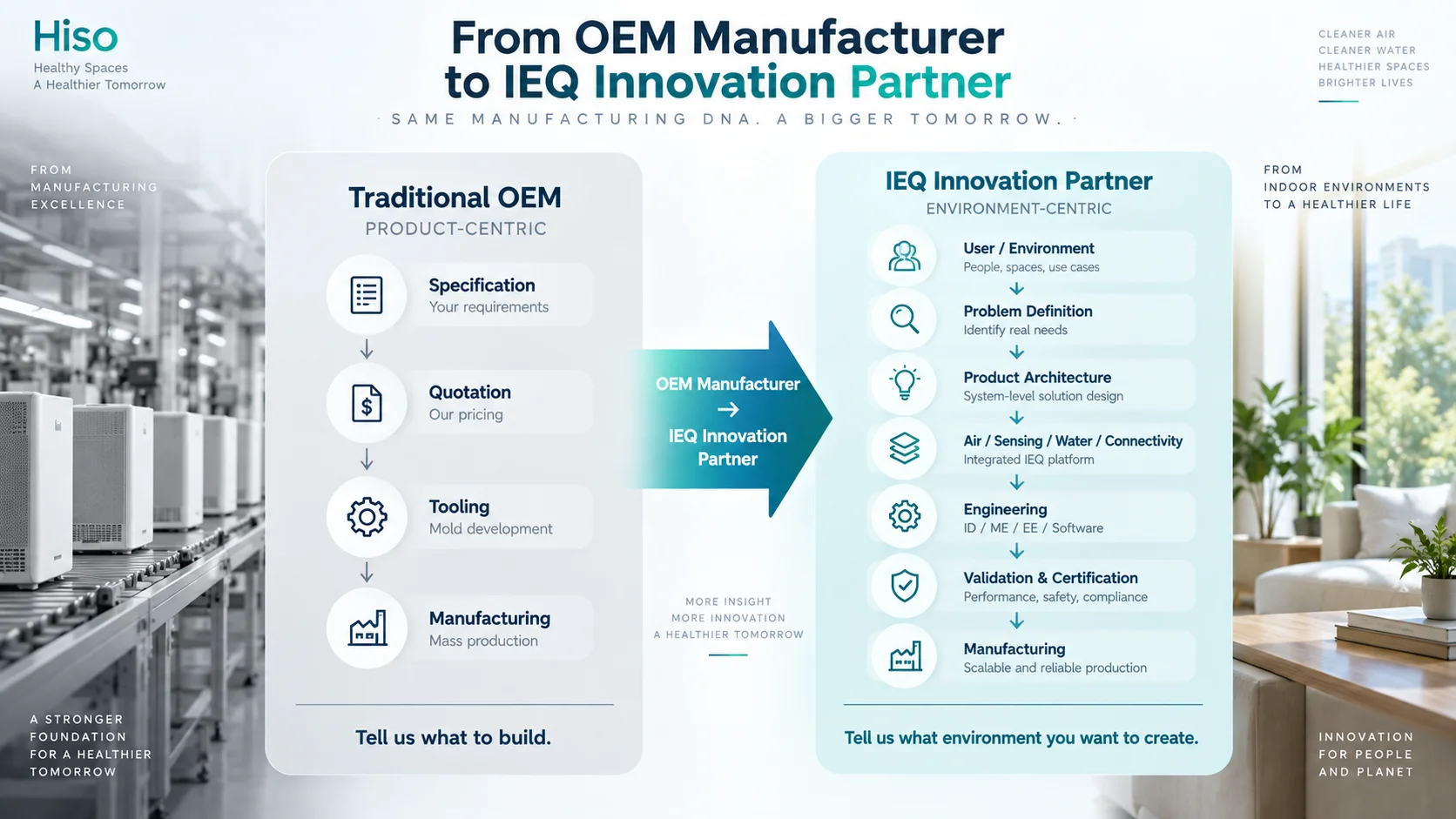
This is where Hiso's own role is evolving.
Manufacturing remains fundamental.
A product concept that cannot be engineered reliably, certified, produced at scale and maintained over its lifecycle has limited commercial value.
But manufacturing is increasingly the end of a much longer process rather than the beginning.
For the next generation of indoor-environment projects, Hiso is working toward a broader development model:
Understand the environment and user
↓
Define the problem
↓
Determine the right product architecture
↓
Integrate air treatment, sensing, connectivity or water where relevant
↓
Engineer and validate the system
↓
Prepare certification
↓
Move into scalable manufacturing
This is what we mean when we describe Hiso's direction as moving from a conventional OEM/ODM manufacturer toward an IEQ innovation partner.
It does not mean abandoning manufacturing.
It means moving further upstream in the product-development process.
Instead of only receiving a specification, we want to help brands determine what the specification should be.
Instead of only discussing an air purifier, we can discuss the space, user, environmental problem and the hardware architecture required to address it.
And instead of treating air, sensing and water as unrelated catalog categories, we can evaluate where each belongs within a broader healthy-environment strategy.
The Next Healthy Home Will Be Built as a System
IFA 2026 did not signal the end of the smart home.
It showed its next stage.
Connected devices will remain important.
AI will continue to become more capable.
Matter and other interoperability technologies will make it easier for products and ecosystems to communicate.
But none of these technologies is the final outcome.
The outcome is the environment people actually experience.
Cleaner air.
Better thermal comfort.
Appropriate humidity.
Useful environmental information.
Healthy drinking water.
Products that respond more intelligently to the space and the people inside it.
That is why the next healthy-home opportunity is larger than the next smart appliance.
And it is why Hiso's roadmap is expanding from individual air-purification products toward a broader architecture spanning room-level air treatment, personal environmental hardware, sensing and water.
These are not separate bets.
They are different parts of the same direction.
The smart home connected devices.
The healthy home will connect environmental conditions to human outcomes.
For Hiso, that also changes what kind of company we need to become.
Not simply a factory that builds the next device.
But an IEQ innovation partner that can help brands move from an environmental problem to a product architecture—and from that architecture to a product that can actually be engineered, validated and manufactured at scale.
Because the future of healthy indoor living will not be built one smart device at a time.
It will be built as a system.
Sources and Further Reading
This article builds on HisoAir's previous pre-IFA analysis, IFA 2026: Air Purification Is Becoming Part of the Healthy-Home Platform.
Additional industry references reviewed for this post include IFA Berlin's 2026 coverage of smart living and wellbeing; the IFA panel How Air, Connectivity and Intelligence Bridge the Last Mile of Home Wellness; and the Connectivity Standards Alliance's Matter 1.6 release covering multi-ecosystem experiences and context-driven control.


 English
  Français
  Español
  Italiano
  Deutsch
  Português
  Русский
  العربية
  日本語
日本語  한국어
한국어  Tiếng Việt

