

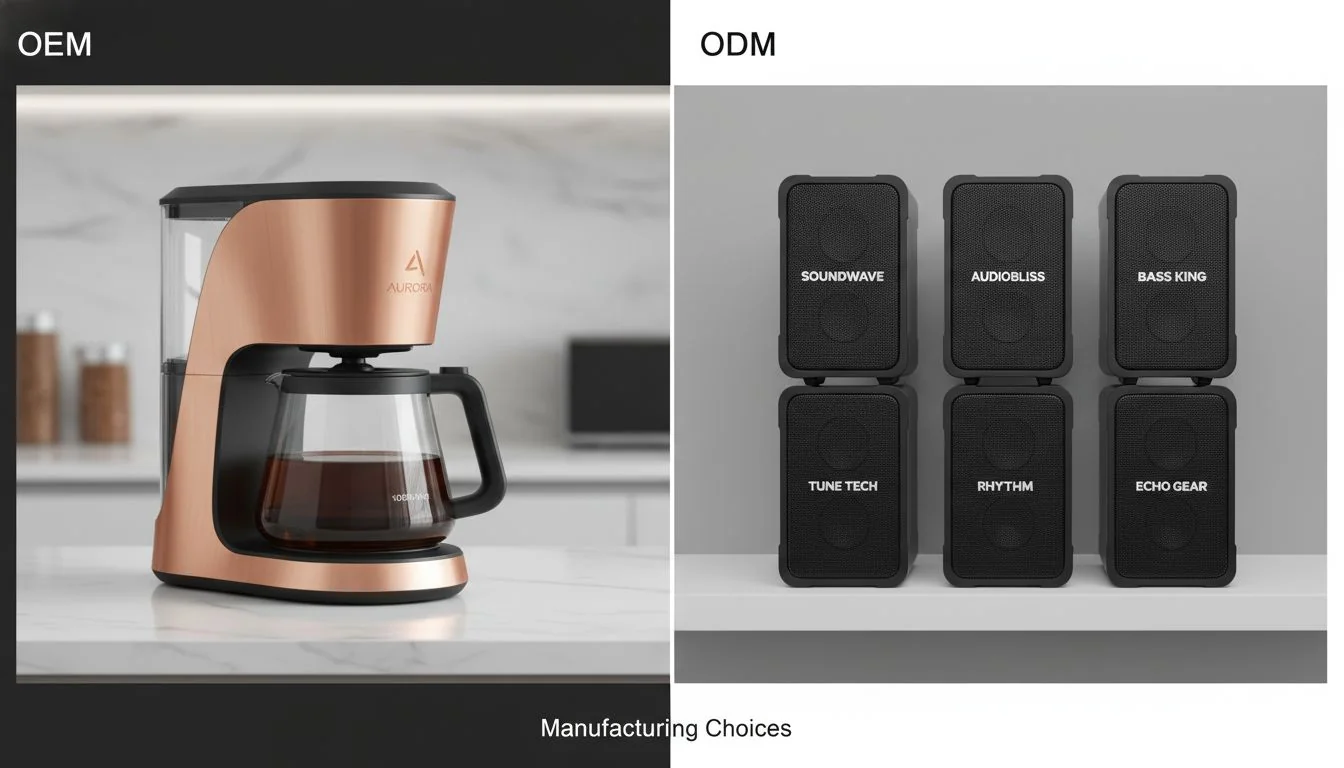
Launching a new product is a huge gamble. Choosing the wrong manufacturing path can sink your brand before it even starts, wasting time and money on a flawed strategy.
OEM (Original Equipment Manufacturer) is when a factory builds your unique design. ODM (Original Design Manufacturer) is when you put your brand on a factory's existing product. The right choice depends on your brand's goals for uniqueness, speed to market, and budget.
I've spent my entire career in the world of molds and manufacturing. I started on the factory floor and eventually built my own trading company. I’ve seen brilliant entrepreneurs with amazing product ideas face a single, paralyzing question that can make or break their entire business. It’s a question that seems simple on the surface, but the answer determines your budget, your timeline, your brand identity, and your ultimate chance of success.
This decision is the first, and most important, step in turning an idea into a physical product. Get it right, and you have a clear path forward. Get it wrong, and you could be caught in a trap that’s almost impossible to escape. Let's break down this critical choice, so you can make the right one for your brand.
The global D2C (Direct-to-Consumer) market is projected to reach over $790 billion by 2028.Vrai
According to market research reports, the D2C market is experiencing rapid growth, increasing competition and the pressure to launch products efficiently.
Choosing a manufacturing partner is a one-time decision.Faux
Businesses can and often do change manufacturing partners or strategies as they scale, but the initial choice has significant long-term impacts on cost, branding, and market position.
Introduction: The Billion-Dollar Question for D2C Brands?
You have a great product idea for a humidifier. But how do you actually get it made without losing your shirt or your unique vision? This is the big question.
This isn't just a manufacturing choice; it's a core business strategy. The path you choose—OEM or ODM—will define your speed to market, your costs, your brand's uniqueness, and your potential for success. It's the foundation of your entire D2C venture.
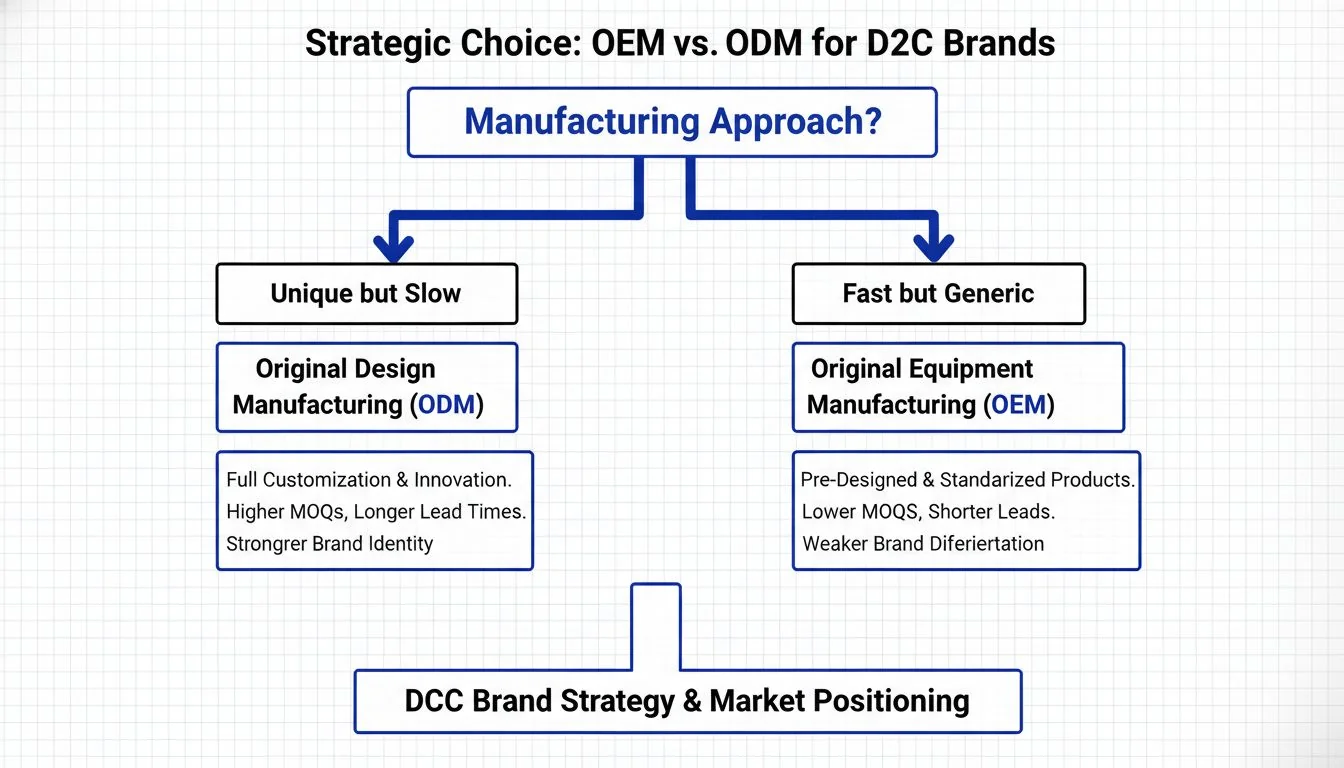
In my years of helping clients bring products to life, I’ve seen this decision cause more stress than any other. The D2C market is exploding. Everyone wants to launch the next big thing, and the pressure is immense. You need to be fast, but you also need to stand out. This creates a huge conflict right at the start. New brands often think they only have two roads to take, and both have serious potholes. One road promises a unique product but is long, expensive, and full of risk. The other is quick and cheap but leads to a generic product that gets lost in a sea of lookalikes. This is the billion-dollar question because the right answer can lead to a billion-dollar brand, while the wrong one can lead to bankruptcy.
Most D2C brands fail within their first three years.Vrai
Studies on startup failure rates often cite issues like lack of market differentiation and cash flow problems, both of which are directly impacted by the OEM/ODM decision.
The OEM/ODM choice only affects manufacturing costs.Faux
This decision impacts marketing (how you differentiate), branding (IP ownership), logistics (time to market), and overall business risk.
What is OEM? The "Total Control" (But Slow) Path?
You want Total Control1 over your unique design. But the long timelines and high costs of development are terrifying. You need to protect your vision without breaking the bank.
OEM stands for Original Equipment Manufacturer. In this model, you provide the factory with a complete, 100% finished product design. You own the intellectual property (IP). The factory’s only job is to build it exactly to your specifications. This gives you total control.
The OEM path is for visionaries who want to create something truly new. If you have a groundbreaking idea for a humidifier, with a unique shape, function, and technology, OEM is the traditional way to make it happen. You control every single detail, from the specific grade of plastic to the firmware that runs the device. I remember a client, a brilliant designer like you, Jacky, who was passionate about creating the perfect product. He spent two years and a massive budget on R&D. The final product was incredible. But by the time he launched, two other companies had already entered the market with "good enough" products and captured all the attention. His perfect product was too late. This is the risk of the OEM path.
OEM: A Breakdown
| Pour | Cons |
|---|---|
| Total Design Control | Extremely Slow Time-to-Market |
| Full IP Ownership | Very High R&D Costs |
| Unique, Differentiated Product | High Minimum Order Quantities (MOQs) |
| Potential for High Margins | Significant Financial Risk |
OEM projects typically take 12-24 months from concept to production.Vrai
This timeline accounts for extensive R&D, industrial design, mechanical engineering, prototyping, tooling creation, and testing phases required for a new product.
With OEM, the factory owns the mold.Faux
In a true OEM relationship, the brand pays for and owns the tooling (the molds). This is a major capital expense but ensures control over the physical assets.
What is ODM? The "Speed-to-Market" (But Generic) Path?
You need to launch your humidifier brand fast and on a tight budget. But selling a generic product means you're just competing on price, a brutal race to the bottom.
ODM stands for Original Design Manufacturer. Here, the factory has already designed and engineered a product. They offer this "white-label" product to many brands. You simply add your logo, choose a color, and design your packaging. It's incredibly fast and requires almost no R&D investment2.
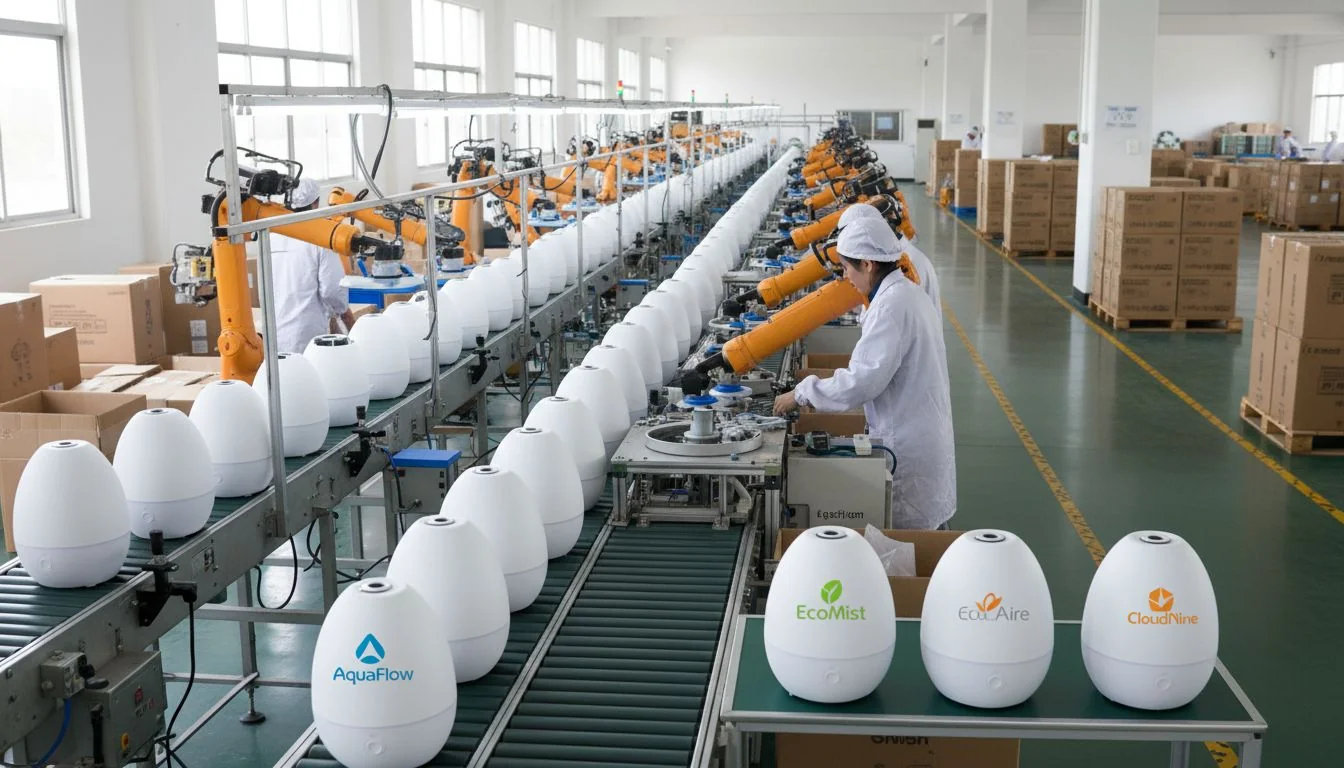
The ODM path is tempting, especially for startups. The appeal is obvious: you can have a product on the market in just a few months. I've seen countless brands on Amazon start this way. They find a popular ODM humidifier, put their name on it, and sales start rolling in. But then the trouble begins. Soon, ten, then twenty other brands are selling the exact same product. The only way to compete is to lower your price. Then your competitor lowers theirs. This continues until nobody is making any real profit. You don't have a brand; you have a commodity. You're trapped in a price war you can't win, selling a product you don't even own.
ODM: A Breakdown
| Pour | Cons |
|---|---|
| Very Fast Time-to-Market | No Real Product Differentiation |
| Low or No R&D Costs | Intense Price Competition |
| Proven, Tested Design | No IP Ownership |
| Low Minimum Order Quantities (MOQs) | Your Brand is Easily Replaceable |
ODM allows for deep product customization.Faux
ODM customization is typically superficial, limited to color, logo (silkscreening), and packaging. The core design, materials, and function cannot be changed.
The factory that provides an ODM product sells the same product to multiple brands.Vrai
This is the fundamental business model of ODM. The factory profits by selling the same pre-developed product to as many clients as possible.
The D2C "Startup Trap": Choosing Between Slow vs. Generic?
You feel stuck. Do you risk everything on a slow, expensive OEM project, or do you join the low-margin ODM race with a generic product? This choice feels like a trap.
The "Startup Trap3" is this false choice between two bad options. You're forced to pick between OEM (high risk, slow, expensive) and ODM (low risk, fast, generic). New D2C brands believe these are their only paths, forcing a major compromise from day one.
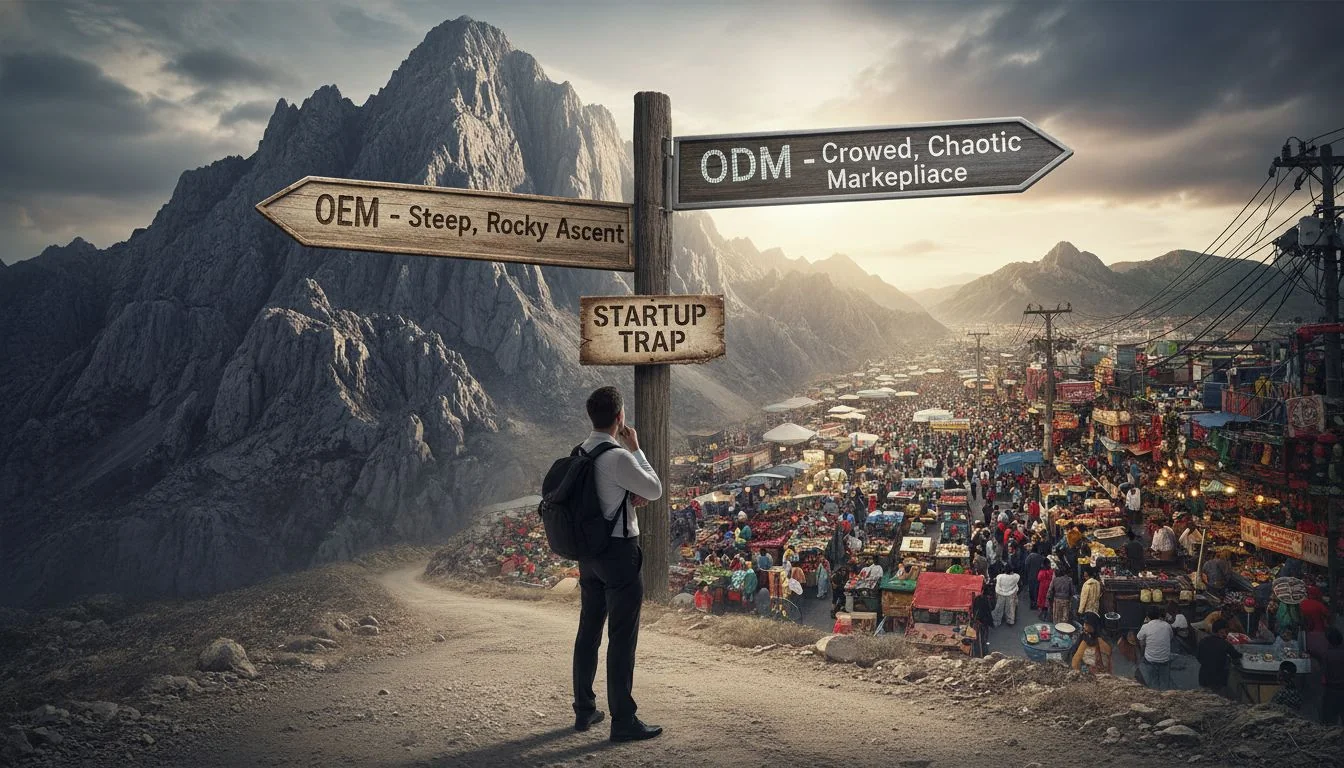
This is a dilemma I've seen crush the spirit of so many entrepreneurs and designers. As a product designer, Jacky, you know this pain intimately. The ODM path tells you to forget your creativity and just pick a color. The OEM path presents a mountain of financial risk and development time that your company might not be able to handle. It feels like a no-win situation. You are forced to sacrifice either your unique vision or your business's financial health. This is the trap. You're led to believe that you cannot have both a unique, high-quality product and a fast, low-risk launch. But what if that belief is wrong? What if there's another way?
All manufacturing fits into either OEM or ODM categories.Faux
Hybrid models and new partnership approaches are emerging that blend the benefits of both traditional models, creating a 'third way' for product development.
The 'Startup Trap' is unavoidable for new hardware brands.Faux
By seeking out innovative partners who have pre-developed unique product platforms, startups can bypass the traditional trap of choosing between a slow custom build and a fast generic product.
The "Third Way": The Rise of the "Unique ODM" Partner?
What if you could have speed and uniqueness? What if you could launch a premium, differentiated product without the massive risk and cost of full OEM? There is a third way.
The "Unique ODM4" model, sometimes called a Premium ODM, combines the best of both worlds. A forward-thinking partner invests their own R&D to create a premium, innovative product platform. You get a unique product with the speed of ODM, completely bypassing the startup trap.
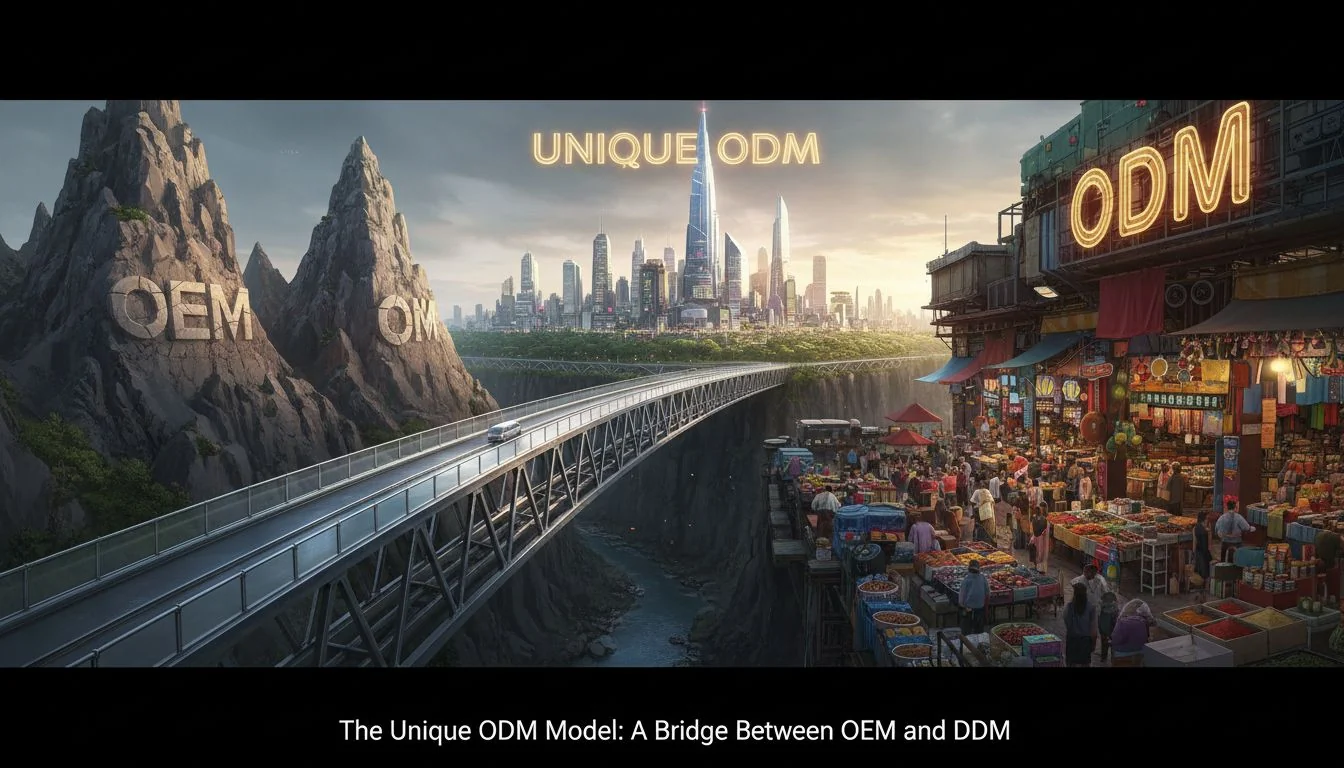
This is the solution I wish my clients had years ago. Instead of waiting for you to bring them a design (OEM) or offering you the same thing as everyone else (ODM), a "Unique ODM" partner comes to you with a breakthrough. They’ve already done the hard work. They saw a gap in the market for a truly better humidifier and invested their own money to build it. The core product is already premium and innovative. But it's designed as a platform, allowing for meaningful customization so you can make it your own. This partner isn't just a supplier; they are a strategic ally who has already solved the biggest problems for you. This isn't a factory with a catalog; it's an innovation partner with a solution.
What Defines a "Unique ODM" Partner?
- Proactive R&D: They invest in creating category-defining products, not just copying trends.
- Premium Base Product: The starting point is already superior (e.g., better materials, new tech).
- Platform for Customization: They offer more than just logo printing.
- Handles Heavy Lifting: They manage core certifications and compliance.
A 'Unique ODM' partner offers a finished product with no room for changes.Faux
A key trait of the 'Unique ODM' model is that the product is a 'platform' designed for significant customization, allowing brands to add their own unique features and branding.
This model reduces R&D risk for the brand to nearly zero.Vrai
Since the 'Unique ODM' partner has already invested in the research, development, and tooling for the core product, the brand's upfront financial risk is dramatically reduced.
Why Hisoair is Your "Unique ODM" Partner?
Finding a true "Unique ODM" partner seems impossible. You need proof, not just promises. You need a ready-to-go solution that is truly premium and fully de-risked for market entry.
Hisoair is the perfect example of the "Unique ODM" model in action. We invested our own R&D to create a market-ready, stainless steel humidifier. It's a premium, differentiated product that solves the OEM/ODM dilemma, and it comes with all major certifications.
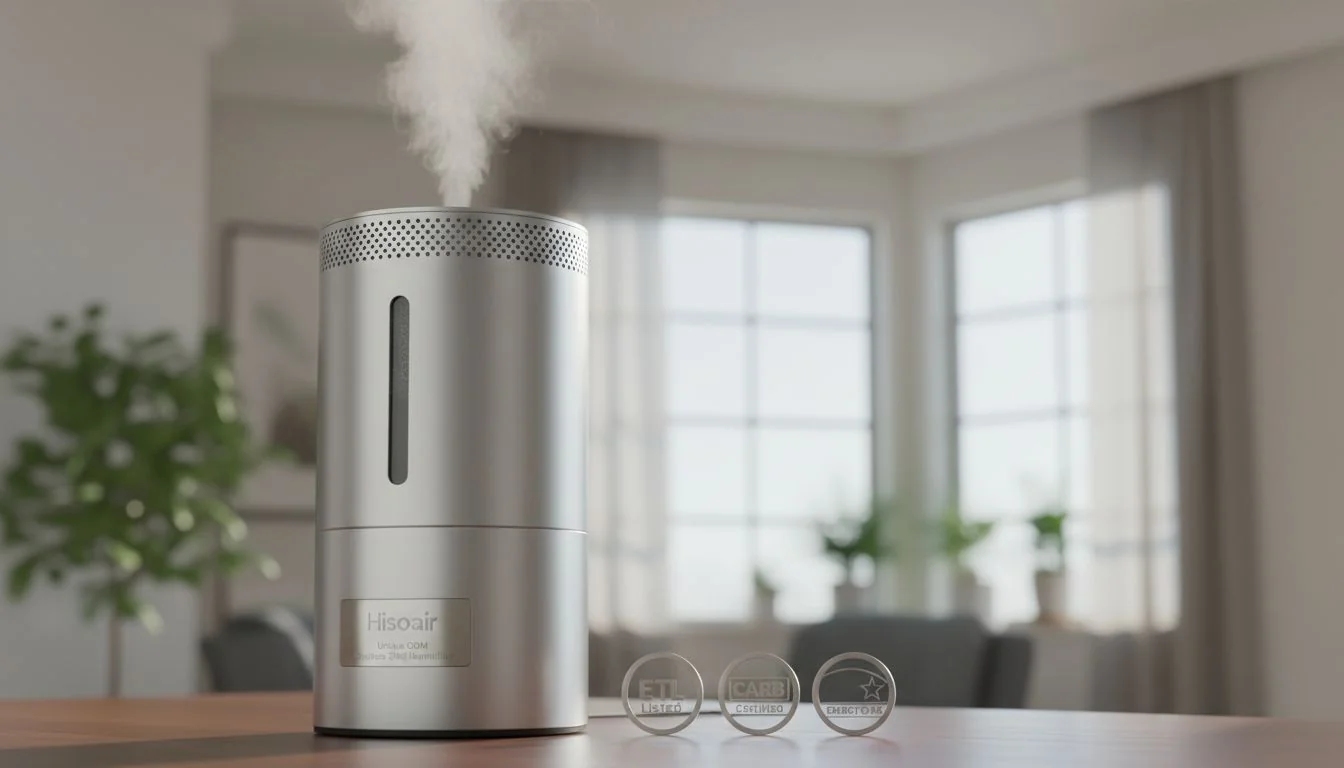
After seeing so many brands get stuck in the "Startup Trap," I knew there had to be a better way. We decided to build it. We looked at the humidifier market and saw a sea of cheap, hard-to-clean plastic. So we created the solution.
The Proof: A Stainless Steel Humidifier
Our product isn't just another plastic box. It's made from durable, hygienic, easy-to-clean stainless steel. This isn't a minor change; it's a fundamental upgrade that instantly sets your brand apart. It communicates quality and durability. This is the tangible proof of our "Unique ODM" model. We provide you with a product that is already in a class of its own.
The Final Proof: Pre-Certified and Ready
The biggest hurdle after design is Certification5. It's expensive, time-consuming, and complex. We've eliminated that risk for you. Our stainless steel humidifier is already ETL, CARB, and EPA certified. This means it's legally ready to sell in the North American market right now. You don't have to spend a year and tens of thousands of dollars on testing and applications. We've handed you the key, and the engine is already running.
All humidifiers are made from plastic.Faux
While the vast majority of consumer humidifiers are plastic, premium alternatives like Hisoair's stainless steel model exist, offering superior hygiene, durability, and aesthetic appeal.
ETL, CARB, and EPA certifications are easy to obtain.Faux
These certifications require rigorous testing, documentation, and significant financial investment, often taking many months to secure. A pre-certified product removes a massive barrier to market entry.
Conclusion
Don't fall into the OEM vs. ODM trap. Choose the third way: a "Unique ODM" partner who offers speed, uniqueness, and a de-risked path to market success.
References
-
Understanding total control in product design can help you make informed manufacturing decisions. ↩
-
Investigate the role of R&D investment in creating innovative products and reducing risks. ↩
-
Understanding the Startup Trap can help you navigate the challenges of launching a new product. ↩
-
Discover how a Unique ODM partner can provide a competitive edge in product development. ↩
-
Understanding product certifications can streamline your market entry and compliance. ↩










 English
  Français
  Español
  Italiano
  Deutsch
  Português
  Русский
  العربية
  日本語
日本語  한국어
한국어  Tiếng Việt

