
U.S. Water Industry Expert Enter Residential PFAS Filtration with a Low-MOQ Platform
TARGET AUDIENCE
Water Industry Experts, New Water Brands & Distributors
SOLUTION AREA
Low-MOQ Residential PFAS Filtration Market Entry
KEY TECH
Certified Total PFAS Reduction | Size 6 Carbon Block
PRODUCTION
Sample Evaluation & Low-MOQ Launch Planning
Our Involvement
PFAS Filtration Platform Selection
Carbon Block Cartridge Technical Evaluation
IAPMO R&T Certification Documentation Review
Under-Sink Installation & Replacement Assessment
Sample Supply & Product Validation
Low-MOQ Market Entry Support
OEM / Private-Label Cooperation Planning
Replacement Cartridge Supply Planning
Project Overview
Company
Headquarters
Market
Products
Background
Background
In June 2026, HisoAir began discussing a new residential drinking-water opportunity with a U.S. water treatment professional who had spent more than three decades working in the industry, with a particular focus on industrial applications.
The client had accumulated technical knowledge, professional credibility and an existing audience interested in water quality. He had also authored a book on water treatment. The project presented an opportunity to apply that background to a different customer group: homeowners looking for a practical solution to drinking-water contaminants.
The client saw PFAS as an important part of the market opportunity. But industrial water treatment expertise does not automatically translate into a consumer-ready product business. A residential offering also requires a compact installation format, clear documentation, replacement-filter support, inventory planning and effective communication of exactly what a product is certified to reduce.
The initial discussion therefore centered on identifying an established under-sink filtration platform that could support a carefully managed first step into the residential market, rather than committing immediately to the design and certification of an entirely new system.
The Idea
The idea was to turn decades of water treatment experience into a focused, evidence-led residential drinking-water offering—starting with one product that the client could evaluate and explain to his existing audience.
Rather than building a new filtration system from scratch, the client could begin with an established under-sink platform and use initial market feedback to determine how far to expand. The proposed offering needed to bring together six elements:
Verified PFAS reduction — a clearly identified product and cartridge combination with appropriate third-party certification documentation.
High-capacity carbon block filtration — meaningful rated capacity without an oversized residential system.
Accessible installation — a compact under-sink form factor compatible with typical home service workflows.
Convenient cartridge changes — a twist-lock replacement interface for a simpler ongoing customer experience.
Low-MOQ market entry — limited initial inventory while learning how homeowners respond to the product.
Repeat-purchase potential — replacement cartridges and ongoing service as possible foundations for long-term customer relationships.
HisoAir proposed using its existing Size 6 carbon block under-sink technology as the starting point. For public product communication, the relevant current platform is WP3000(US), subject to confirmation that the client’s evaluated HA-S6 configuration corresponds to the listed WP3000(US) system.
The initial commercial logic was straightforward: evaluate samples first, verify the product’s fit with the client’s target customers, then decide whether to proceed with a low-volume launch, private-label development or a wider distribution program.
The Challenge
Entering a New Customer Segment
The client’s experience was predominantly in industrial water treatment. Residential sales required different decisions about product positioning, packaging, installation, after-sales support and inventory. An established professional audience was an advantage, but consumer demand for this specific product still had to be tested.
Making PFAS Claims with Evidence
PFAS reduction was central to the proposed offering. The client needed more than broad statements about “removing forever chemicals.” Accurate communication requires the exact product configuration, the applicable contaminant-reduction claim and the corresponding third-party listing. The named certificate holder’s listing cannot automatically be extended to a new private-label version.
Balancing Capacity with Kitchen-Friendly Size
The client was interested in a Size 6 carbon block cartridge and substantial service capacity, but the system also had to fit beneath a residential sink and remain practical to install and maintain. Certification-rated capacity, predicted filter life and future higher-capacity concepts could not be treated as equivalent claims.
Managing Opening-Order Risk
A high MOQ would have tied up capital in inventory before the client had tested residential customer response. The initial cooperation therefore required a controlled purchasing approach with room to expand based on actual demand.
Creating an Ongoing Service Proposition
The client also needed to consider how replacement cartridges could support customer relationships beyond the first sale, including cartridge availability, replacement guidance, replenishment and future service planning.
The HisoAir Solution
A Ready Platform Instead of a New Development Program
HisoAir recommended an existing Size 6 twist-lock under-sink filtration platform to help the client move directly into product evaluation. The established architecture reduced the need to initiate a completely new product-design program before testing demand.
Certified PFAS Reduction for the Listed Configuration
The current WP3000(US) system with the WP3000(US)-RF cartridge is listed by IAPMO R&T for specified claims under NSF/ANSI 42, NSF/ANSI 53, NSF/ANSI 401 and NSF/ANSI/CAN 372. The NSF/ANSI 53 listing includes Total PFAS Reduction. Listed reduction categories include chlorine taste and odor, nominal particulate Class I, lead, asbestos, cysts, turbidity and microplastics as applicable to their respective standards.
This certification evidence enables a technically grounded sales discussion. It does not imply that every PFAS chemical is removed, nor that a modified or rebranded system automatically retains the same listing. For a client-owned brand, any applicable new listing or labeling requirements must be checked before publishing certified claims.
High-Capacity Size 6 Carbon Block Cartridge
The cited WP3000(US) configuration has an IAPMO-listed rated capacity of 3,000 gallons and a rated flow of 1.5 GPM. These numbers provide a defined basis for evaluating the platform alongside its size, flow and maintenance requirements.
The project brief also considered potential service-life differentiation beyond the current certified configuration through an appropriate monitoring or performance-indication concept. HisoAir treats such ideas as development possibilities, not as additional certified gallon-capacity claims, unless separately validated.
Compact Installation and Twist-Lock Maintenance
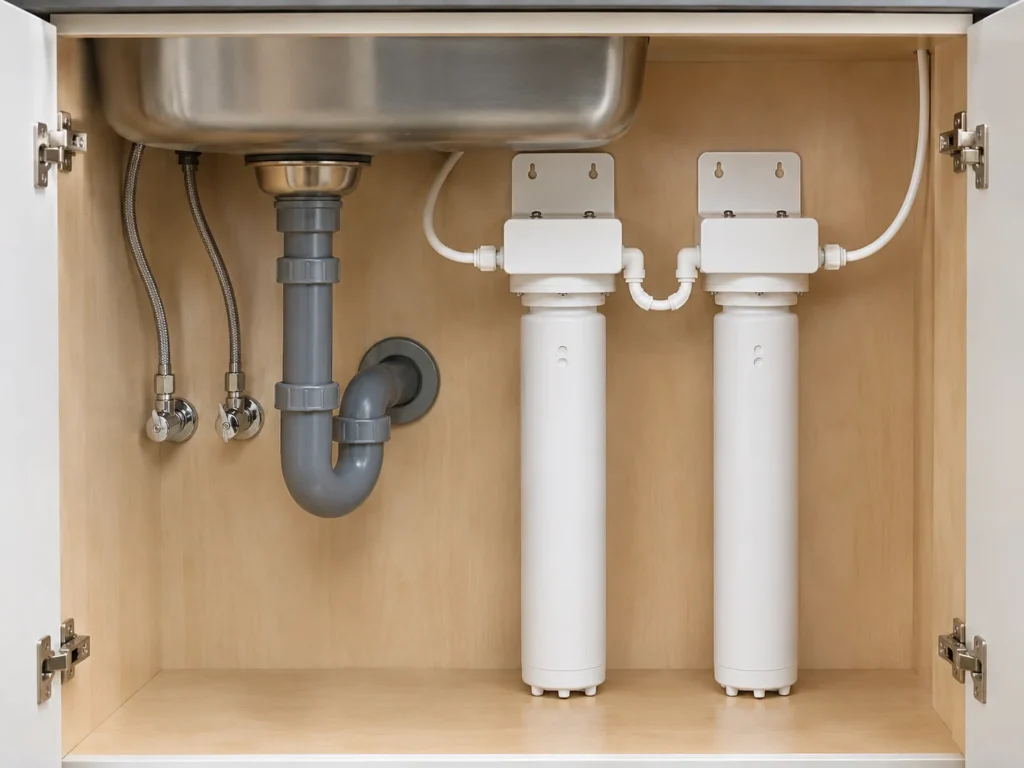
The product platform is designed for a compact under-sink installation with a replaceable keyed twist-lock cartridge. Its cartridge interface is intended to simplify routine replacement, giving the client a clearer after-sales proposition and a practical topic for homeowner education.
A Controlled Low-MOQ Starting Point
Because the client was new to residential product commercialization, HisoAir offered a low-MOQ cooperation approach. This supports sample evaluation and a potential small initial market introduction without requiring a large immediate inventory commitment. The source does not specify an agreed numeric MOQ, so no quantity is claimed here.
OEM / Private Label and Replacement Filter Planning
HisoAir also discussed potential private-label cooperation and replacement-cartridge supply. A branded program could develop after sample and market validation, while repeat cartridge orders may provide longer-term customer engagement. Both remain opportunities to evaluate, rather than completed commercial outcomes.
Samples as the First Decision Milestone
The client reviewed the platform’s filtration design, documented claims and cartridge approach, then ordered samples for further evaluation. The next phase depends on product assessment, target-customer response and subsequent commercial decisions.
The Results
The collaboration progressed from an initial market-entry concept to a concrete sample order.
After reviewing the Size 6 carbon block platform, certification information and fit with the proposed residential positioning, the client ordered samples for evaluation. He subsequently indicated that he intended to work toward a commercial order and introduce the product to his audience and prospective customers.
The documented outcomes at this stage are:
A product direction aligned with the client’s PFAS-focused residential market plans.
Access to an established under-sink filtration platform with defined product-specific certification documentation.
A 3,000-gallon certified capacity reference for the currently listed WP3000(US) configuration, subject to confirming that the evaluated sample matches that listing.
A low-MOQ cooperation approach to support more controlled initial purchasing.
A sample order enabling hands-on evaluation rather than relying solely on product descriptions.
A potential replacement-cartridge business model for future customer relationships.
Continued discussion of a possible commercial order and audience-based introduction.
The client has not yet been reported as having placed a confirmed mass-production order, launched a finalized private-label product or generated measured consumer sales. Those outcomes should not be implied.
Current Project Status: Samples Ordered; Commercial Launch Under Consideration.
Key Achievements Include:
Conclusion
This case illustrates how deep industry knowledge can be translated into a new residential water business through a disciplined product-selection and market-entry process.
The client brought more than 30 years of water treatment experience, industry credibility and an audience interested in water quality. HisoAir contributed an established under-sink filtration platform, product-specific PFAS certification documentation, a practical twist-lock cartridge design and a low-MOQ cooperation approach.
Rather than beginning with a fully custom system and a large opening order, the two parties focused first on sample evaluation and the commercial questions that would determine whether to proceed. The client’s sample order and stated interest in a later commercial order are meaningful progress, but commercial launch and sales performance remain unverified.
For water treatment consultants, industry experts, emerging brands and distributors, the wider lesson is that credible claims, serviceable product design and measured inventory commitments can provide a more manageable foundation for residential filtration market entry. HisoAir can support that process through water filtration technology, OEM/ODM coordination, certification-aware development and manufacturing planning.
Related Factory

Our Involvement
PFAS Filtration Platform Selection
Carbon Block Cartridge Technical Evaluation
IAPMO R&T Certification Documentation Review
Under-Sink Installation & Replacement Assessment
Sample Supply & Product Validation
Low-MOQ Market Entry Support
OEM / Private-Label Cooperation Planning
Replacement Cartridge Supply Planning
 English
 Français
 Español
 Italiano
 Deutsch
 Português
 Русский
 العربية
 日本語
 한국어
 Tiếng Việt