
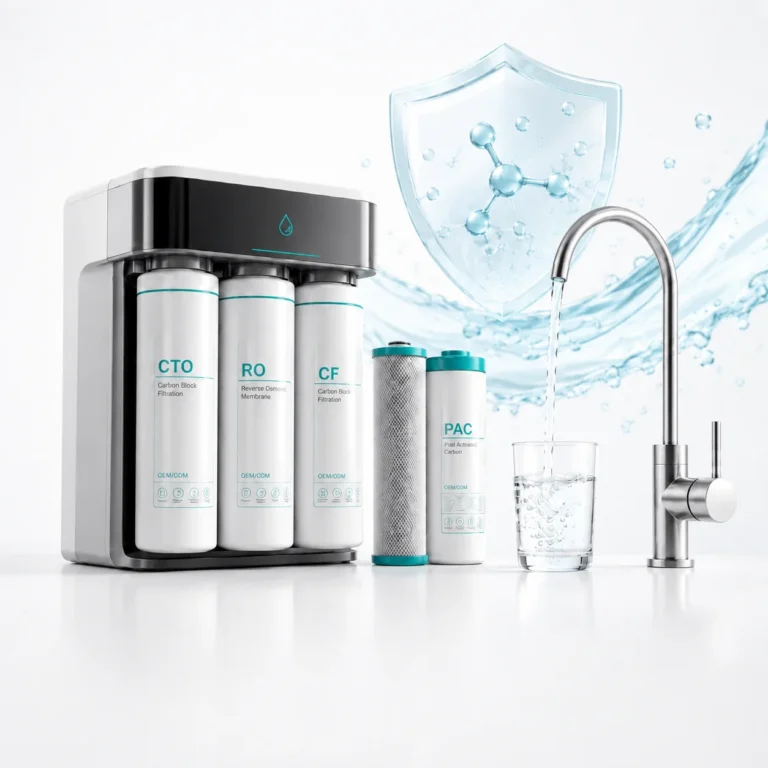
In May 2026, the U.S. Environmental Protection Agency put a quiet admission into a rulemaking about PFAS. Explaining what water systems could do while they work toward the federal limit, the agency noted that certified point-of-use filters are tested to reduce PFOA and PFOS to 20 or 70 parts per trillion, depending on the version of the standard. The legal limit for those two chemicals in American tap water is 4 ppt.
That gap is the story of the next five years in drinking water. The move to PFAS 4 ppt is not just a tighter number. It changes what a PFAS certification has to prove.
I have spent more than twenty years building purification products for other companies' brands. I have rarely seen a standards shift change the meaning of a label this fast. A "PFAS certified" claim that set a product apart in 2023 is turning into a baseline — and for many products already on shelves, a baseline they were never tested against.
Here is my view, and the evidence for it. From here on, filters will be held to 4 ppt on two sides at once: what they take out of the water, and what their own materials put back in. The hard part is no longer whether a filter can remove PFAS. It is whether you can prove, close to the limit of what laboratories can measure, that it removes enough and adds nothing. For the person filling a glass at the kitchen sink, that proof is the whole point.
From 70 to 20 to 4: How PFAS Filter Certification Got Here
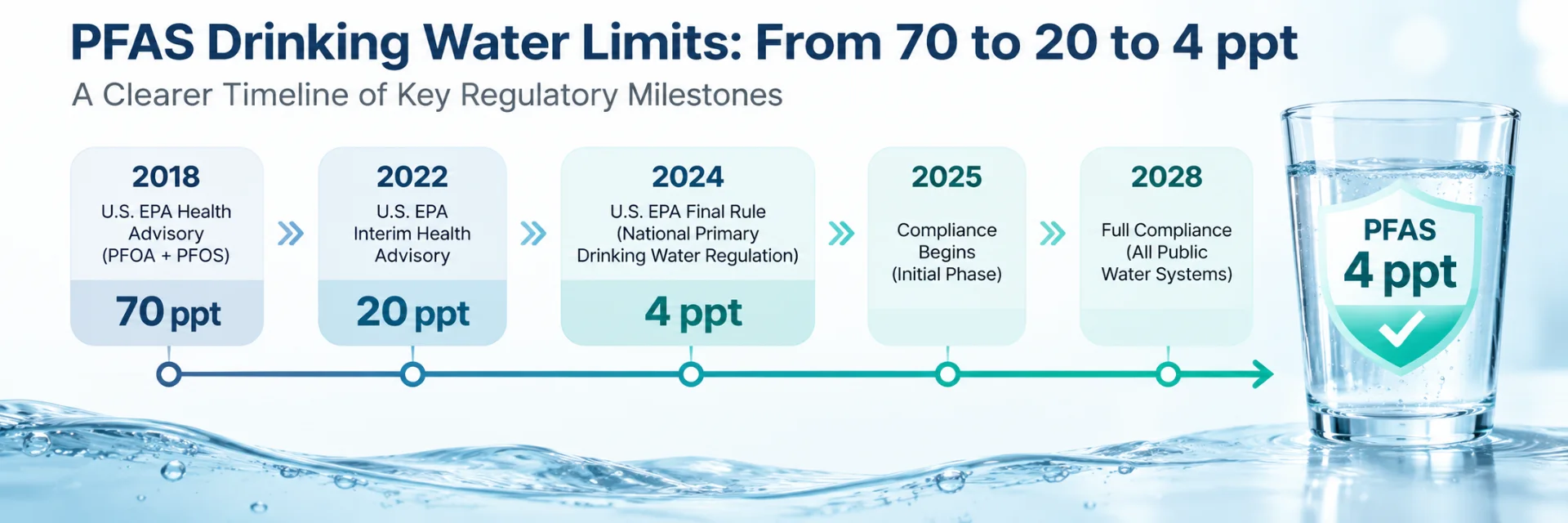
PFAS certification for home filters has tightened three times in eight years, and each step left older claims on the market. The benchmark most brands cite is NSF/ANSI 53, the U.S. health-effects standard for point-of-use and point-of-entry filters (NSF/ANSI 58 covers reverse osmosis). Here is the path, as of November 2026:
| Année | What changed | PFOA/PFOS target |
|---|---|---|
| 2018 | NSF/ANSI 53 adds a PFOA/PFOS reduction claim for activated carbon | 70 ppt combined, matching the EPA health advisory of the time |
| 2022 | A "Total PFAS" claim covering seven compounds is added (NSF) | 20 ppt combined |
| April 2024 | EPA sets enforceable drinking water limits for public water systems | 4.0 ppt each |
| 2025 | NSF/ANSI 53-2025 updates PFOA/PFOS effluent limits to align with the EPA limits | Aligned with 4.0 ppt |
| January 2028 | Material safety criteria for PFOA/PFOS released from filter materials tighten | 4 ng/L (= 4 ppt) |
Read the table from the bottom up and the direction is obvious. Read it from a buyer's side and the problem appears: certifications are snapshots. A product listing typically runs for years. A filter certified in 2026 to the 20 ppt claim can carry a valid mark well into the next decade, while the rule its customers care about says 4.
This is not hypothetical. A 2025 market review in Water Conditioning & Purification found that many certified devices still on sale carried the older 70 ppt PFOA/PFOS claim. The mark on the box was real. It simply measured something smaller than shoppers assumed.
The EPA Did Not Retreat on PFAS 4 ppt
The most common misreading of 2026 is that Washington walked back its PFAS rules. For PFOA and PFOS, it did the opposite. In May 2025 the EPA announced it would keep the 4.0 ppt limits. On May 18, 2026 it proposed two changes: let water systems apply for two extra years, moving the deadline from April 2029 to April 2031, and withdraw the separate limits for PFHxS, PFNA, GenX and the mixture hazard index.
The headlines said "rollback." The fine print says the two most studied PFAS stay at 4 ppt, and only the clock for utilities may move. As of November 2026 both proposals were still proposals; the 2024 rule remains the law, and litigation over it continues.
The extension buys utilities time. It buys filter brands none. If anything, it pulls demand forward. Under the proposal, a system that seeks extra time and has measured PFOA or PFOS at 12 ppt or above must take interim steps for its customers — and installing certified point-of-use or point-of-entry devices is one of the listed options.
Think about what that means for a procurement officer at a mid-sized utility in 2027. They need certified devices in volume, and they will read the listing, not the marketing. The first question will be: certified to what, and to which edition? Brands that can answer cleanly will win those programs. Brands that answer with a logo will not.
The Part Most Brands Miss: 4 ppt Also Applies to What a Filter Releases
Almost every article on PFAS filters talks about removal. The quieter change is that the same 4 ppt number is coming for what the filter itself sheds into the water.
Every certified filter goes through a material safety test before anyone measures its performance. The lab flushes the system, lets extraction water sit inside it, and analyzes what leaches out of the housing, seals, media and adhesives. PFAS matter here because fluoropolymers show up in plumbing parts: thread tape, O-rings, coatings.
Under the criteria now in use, PFOA and PFOS released from materials are judged against 70 ppt. From January 1, 2028, the acceptance criteria in NSF/ANSI/CAN 600 take over, and the threshold for each of PFOA and PFOS drops to 4 ng/L — the same 4 ppt. Other PFAS such as GenX, PFHxS and PFNA, reported for information today, will also be judged against their own limits.
Put those two changes side by side and you get the real shape of the 4 ppt era:

| What the filter removes | What the filter releases | |
|---|---|---|
| What is tested | Reduction of PFAS in challenge water (NSF/ANSI 53/58) | PFAS leaching from the filter's own materials (Section 4 extraction) |
| Before | 70 ppt, then 20 ppt combined | 70 ppt PFOA/PFOS |
| Suivant | Aligned with 4 ppt each (NSF/ANSI 53-2025) | 4 ng/L each from January 2028 |
| What it demands | Media capacity and contact time | Material and supplier control |
The second column is where supply chains get caught. A brand can buy better carbon. It cannot quickly re-qualify every gasket and fitting supplier.
Here is a receipt from our own work. In September 2026, the cartridge platform behind our WP3000(US) under-sink filter went through extraction testing to NSF/ANSI 42-2025, Section 4. All seven PFAS measured — PFOA, PFOS, PFHxS, PFNA, GenX (HFPO-DA), PFBS and PFHxA — were not detected at a reporting limit of 2 ng/L. That is half of the 2028 criterion, sixteen months before it takes effect. Nitrosamines and methanol were not detected either.
I share that number because it is the kind of evidence buyers should ask every supplier for. A filter that removes PFAS but cannot show clean extraction data is only half ready.
Why "PFAS Certified" Will Mean Less Each Year
The second misconception is that an NSF/ANSI 53 PFAS certification means a filter meets the EPA limit. Today, it usually does not, and nothing on the badge tells you so. Three details decide what a PFAS claim is actually worth:
- The claim type. A "PFOA/PFOS" claim covers two compounds. A "Total PFAS" claim covers a defined mix of seven. Neither covers the thousands of PFAS that exist.
- The target the test used. 70 ppt, 20 ppt combined, or the newer limits aligned with 4 ppt. The certificate names a standard; the listing and performance data sheet show the claim.
- The rated capacity. A claim holds for the gallons it was tested to, not for a cartridge left in place for two years.
I will use our own product as the example, because candor is the point of this article. Our WP3000(US) under-sink filter is listed by IAPMO R&T to NSF/ANSI 53 for Total PFAS, lead, cyst, asbestos and turbidity reduction, at 1.5 gpm and 3,000 gallons. It also carries NSF/ANSI 42 (chlorine, taste and odor), NSF/ANSI 401 (microplastics) and NSF/ANSI/CAN 372 (lead free) listings. You can check every one of them in the IAPMO R&T Product Listing Directory.
That Total PFAS claim was tested to the 20 ppt combined limit, not to 4 ppt. I would rather tell you that plainly than let a logo imply more. It is a strong claim by today's market standard. It is not the end state, and nobody selling filters in the United States should pretend otherwise.
The practical lesson for buyers: read the listing, not the badge. For brands: know exactly which line of the listing your marketing copy rests on.
When the Limit Meets the Lab: Proving PFAS 4 ppt
At 4 ppt, the bottleneck shifts from filtration to measurement. That is not a figure of speech. The EPA set the health goal for PFOA and PFOS at zero and the enforceable limit at 4.0 ppt because that is the lowest level it judged laboratories could reliably quantify. The legal limit sits on the edge of the ruler.
That has three consequences for anyone certifying a filter.
The removal has to be near-total and stay that way. Certification tests challenge filters with PFAS far above real tap water levels — roughly 1,500 ppt of PFOA plus PFOS in the 2022 protocol. If challenge levels stay in that range, holding each compound under 4 ppt means removing about 99.7% or more, at every sample point, through the full rated capacity. That is a question of media and contact time: how much carbon, how it is bonded, how fast the water moves through it. I explained earlier this year how filter size and structure drive contact time.
Short-chain PFAS break through first. Activated carbon holds long-chain compounds such as PFOS well. Shorter ones like PFBS and PFHxA move through sooner. A design that passes on PFOA and PFOS can still fail on a broader panel late in its life. For larger installations, that is one reason to weigh carbon block against RO for PFAS reduction.
The lab itself becomes a variable. To call a result under 4 ppt, a lab needs a reporting limit comfortably below it, and blanks free of background PFAS from tubing, seals and sampling gear. Our extraction work was reported at 2 ng/L. Ask any supplier what reporting limit sits behind their "non-detect." A non-detect at 10 ppt tells you nothing about a 4 ppt limit.
None of this makes 4 ppt impossible. It makes it expensive, slower to certify, and unforgiving of shortcuts. That is exactly why it will separate serious products from the rest.
A PFAS 4 ppt Readiness Checklist for Water Filter Brands
If you sell filters under your own brand in the U.S., these seven questions will tell you where you stand before a retailer, a utility or a regulator asks. Put them to your own team first, then to your manufacturing partner.
| # | Question | Why it matters | What "ready" looks like |
|---|---|---|---|
| 1 | Which edition of NSF/ANSI 53 or 58 is your PFAS claim tested to? | 70, 20 and 4 ppt claims all carry the same logo | You can name the edition and the effluent target in one sentence |
| 2 | Is it a PFOA/PFOS claim or a Total PFAS claim? | Buyers increasingly ask about compounds beyond PFOA and PFOS | Total PFAS, with the compound list on your data sheet |
| 3 | Does your extraction data hold PFOA and PFOS under 4 ng/L? | The materials criterion tightens on January 1, 2028 | Non-detects at a reporting limit below 4 ng/L, on file today |
| 4 | What reporting limit did the lab use? | A non-detect is only as good as the limit behind it | 2 ng/L or lower for PFOA and PFOS |
| 5 | Does the claim hold through full rated capacity? | Short-chain PFAS break through late | Capacity on the label matches the tested capacity |
| 6 | Do the brand and model on the listing match your label? | Mismatches are the first thing a buyer's QA team checks | Every SKU traceable to a listing line |
| 7 | Can your supplier re-test to the current edition, and how fast? | A 2026 listing can run to 2031 while the market moves on | A dated plan and budget for re-certification |
Two of these, the reporting limit and the capacity question, are also where monitoring is heading. Filters that track volume and flag replacement on time protect the claim in the field, which I covered in how data and sensors will change water appliances.
Where This Does Not Apply: Europe Uses a Different Yardstick
Everything above is about the United States, and it should not be copied into a European spec sheet. The EU Drinking Water Directive limits the sum of 20 PFAS to 100 ng/L from January 12, 2026. Germany adds a 20 ng/L limit for the sum of four PFAS (PFOA, PFOS, PFHxS, PFNA) from January 12, 2028, and Denmark has gone to 2 ng/L for the same four. Those are sum limits for utilities, measured differently, and Europe has no direct equivalent of the NSF/ANSI 53 claim that U.S. buyers ask for.
The U.S. is where the certification number on a home filter and the legal limit on tap water are converging fastest. That is why it is the market to design for first.
What Comes Next
A new chapter in water is coming, and it will not be written in marketing claims. It will be written in listing lines, extraction data and reporting limits. Over the next two years I expect three things: retailers and utilities asking for the standard edition by name, re-certification to the 2025 edition becoming a sourcing criterion, and material data under 4 ng/L moving from nice-to-have to required.
At HisoAir, we build water purification platforms for brands that want to be ready for that conversation rather than surprised by it. If you are planning a PFAS-rated filter for the U.S. market, start with our PFAS-ready water purifier platforms and send us the checklist above. We will answer it line by line for our side of the supply chain.
FAQ
What is the PFAS limit for drinking water in the U.S. in 2026?
PFOA and PFOS are each limited to 4.0 ppt under the EPA's April 2024 rule. In May 2026 the EPA proposed keeping both limits while letting water systems apply to delay compliance from 2029 to 2031. As of November 2026 the proposal is not final.
Does NSF/ANSI 53 PFAS certification mean a filter meets the 4 ppt limit?
Not necessarily. Most certified filters were tested to 70 ppt (PFOA/PFOS) or 20 ppt combined (Total PFAS). NSF/ANSI 53-2025 aligns PFOA/PFOS limits with the EPA's 4 ppt, so check which edition and claim appear on the product's listing.
Did the EPA roll back PFAS limits?
Partly. It proposed to withdraw limits for PFHxS, PFNA, GenX and the mixture hazard index, but to keep PFOA and PFOS at 4.0 ppt. Only the compliance deadline for utilities may move.
What is the difference between a PFOA/PFOS claim and a Total PFAS claim?
A PFOA/PFOS claim covers two compounds. A Total PFAS claim under NSF/ANSI 53 covers a set of seven, including PFHxS and PFNA, with a combined effluent limit of 20 ppt under the 2022 protocol.
Can a water filter add PFAS to water?
It can, through fluoropolymer parts such as seals and thread tape. Certification includes a material extraction test for this. From January 2028, PFOA and PFOS released from filter materials must stay under 4 ng/L each.




 English
 Français
 Español
 Italiano
 Deutsch
 Português
 Русский
 العربية
 日本語
 한국어
 Tiếng Việt


