
S’ouvre dans un nouvel onglet
Solutions innovantes pour la qualité de l'air
Water filtration · Certification evidence

Water Filtration Certifications & Verified Performance

Independent certification. Transparent documentation. Verifiable product-specific performance.

This page is for brand partners, product engineers and compliance teams who need to check what our water filtration products are certified for, who certified them, and how to confirm it themselves. Every claim on this page traces to an IAPMO R&T certificate of listing. Supplier figures and internal test data are not shown here.

Certification summary

Effective 23 Oct 2026
Certification body
IAPMO R&TIAPMO Research and Testing, Inc. — ANAB-accredited product certification body (ISO/IEC 17065)
Normes
NSF/ANSI 42 · NSF/ANSI 53 · NSF/ANSI 401 · NSF/ANSI/CAN 372
PFAS
Total PFAS reductionCertified to NSF/ANSI 53 by IAPMO R&T
Certified product
WP3000(US)with WP3000(US)-RF replacement cartridge

NSF/ANSI names the standards. IAPMO R&T is the body that issued these certifications. Certificate holder: Hiso Inc.

How we label evidence

The same four levels are used across hisoair.com. This page shows certified evidence only.

Certified

Listed by an accredited certification body for the exact model and cartridge.

Third-party tested

Tested by an independent laboratory. Not a certification listing.

Internal engineering validation

Measured by our engineering team under stated conditions.

Supplier specification

Data from a component supplier. Not independently tested.

WP3000(US) — Certified Under-Sink Water Filtration

The values below are copied from the Models table of each IAPMO R&T certificate. Flow and capacity are the same on the NSF/ANSI 42, 53 and 401 listings.
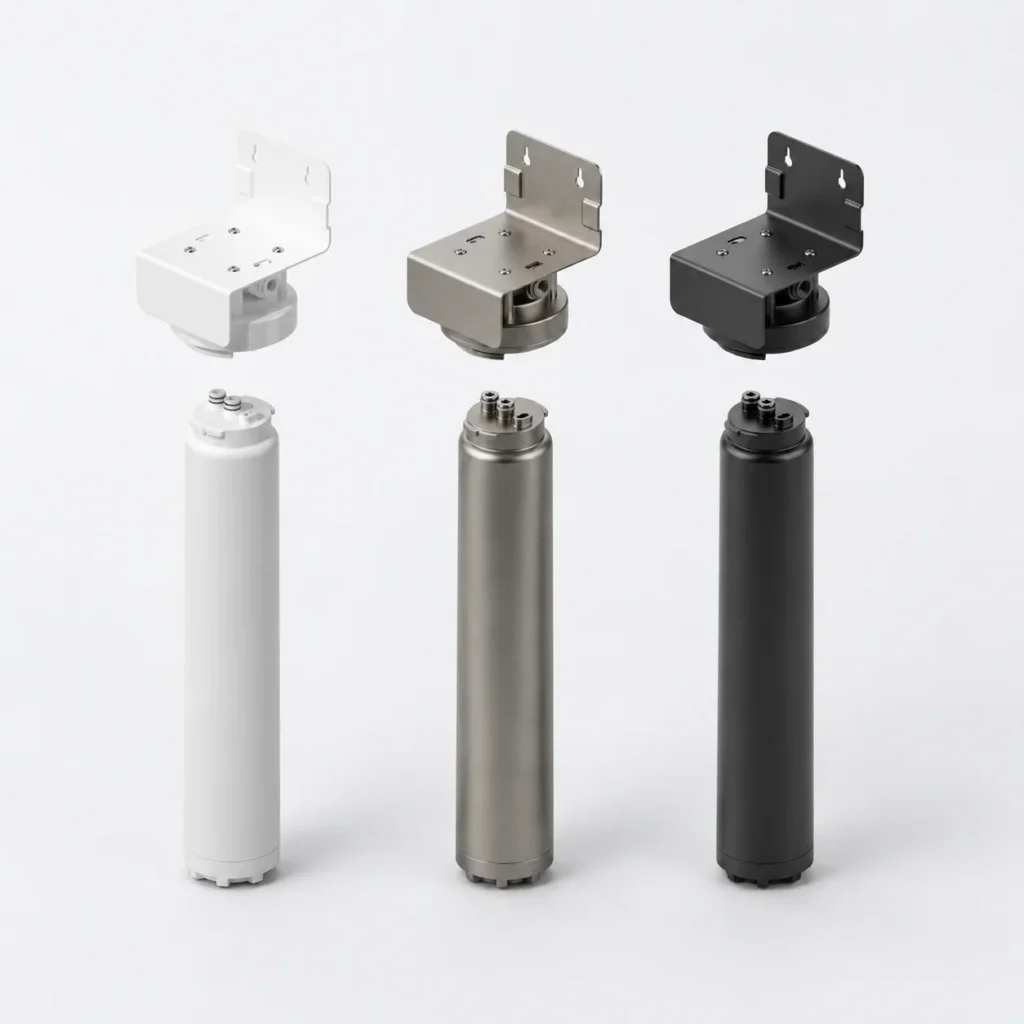
WP3000(US) twist-lock under-sink filter heads and cartridges in white, brushed stainless and black housing finishes

WP3000(US) platform shown in three housing finishes.

Confirm which finishes are covered by the listed model before launch.

Product model
WP3000(US)
Replacement cartridge
WP3000(US)-RFListed as “Replacement Component” on NSF/ANSI 42, 53 and 401
Product type
Plumbed in
Rated flow
1.5 GPM
Rated capacity
3,000 gallons
Certification body
IAPMO R&T
Certified standards
NSF/ANSI 42-2022, NSF/ANSI 53-2021, NSF/ANSI 401-2020, NSF/ANSI/CAN 372-2022
Code compliance
Uniform Plumbing Code (UPC®)Stated on the NSF/ANSI 42, 53 and 401 certificates
Certificate holder
Hiso Inc2180 S Wineville Ave, Ontario, California 91761, United States

The NSF/ANSI/CAN 372 listing names the WP3000(US) system model only. It does not list a replacement component, flow rate or capacity, because it covers material lead content rather than performance.

Official Certification Documents

Four certificates of listing, one per standard. File numbers and claims below were checked against each original certificate, not inferred from the number sequence.

NSF/ANSI 42

-2022
Aesthetic effects
Certification body
IAPMO R&T
File number
WP-31374
Certified model
WP3000(US) · WP3000(US)-RF
Listed claims
Chlorine, taste and odor
Nominal particulate Class I
Valid
23 Oct 2026 – Oct 2031

NSF/ANSI 53

-2021
Health effects
Certification body
IAPMO R&T
File number
WP-31375
Certified model
WP3000(US) · WP3000(US)-RF
Listed claims
Total PFAS
Lead
Cyst
Asbestos
Turbidity
Valid
23 Oct 2026 – Oct 2031

NSF/ANSI 401

-2020
Emerging compounds / incidental contaminants
Certification body
IAPMO R&T
File number
WP-31376
Certified model
WP3000(US) · WP3000(US)-RF
Listed claims
Microplastics
Valid
23 Oct 2026 – Oct 2031

NSF/ANSI/CAN 372

-2022
Lead-free materials
Certification body
IAPMO R&T
File number
WP-31377
Certified model
WP3000(US)
Scope
Weighted average lead content ≤0.25% in wetted materials; solder and flux ≤0.2%. Also certified to SDWA Section 1417(d) and California Health & Safety Code Section 116875.
Note
Materials requirement — not a contaminant-reduction claim
Valid
23 Oct 2026 – Oct 2031

Certified Contaminant-Reduction Performance

Eight reduction claims are listed across three standards. Each one applies to the WP3000(US) system with the WP3000(US)-RF cartridge at the rated flow and capacity shown.

Total PFAS reduction

Certified to NSF/ANSI 53 by IAPMO R&T · File WP-31375

“Total PFAS” is the claim exactly as it appears on the listing. It is certified at 1.5 GPM rated flow and 3,000 gallons rated capacity.

Results for individual compounds are in the laboratory test report. They will be added here compound by compound only after the report is cleared for publication. Until then we do not state a percentage or name individual compounds as certified.

Contaminant / claim
Standard
Certified configuration
Certified performance
Rated capacity
Evidence
Contaminant / claim
Total PFAS
Standard
NSF/ANSI 53
Certified configuration
WP3000(US) · WP3000(US)-RF · 1.5 GPM
Certified performance
Meets the standard’s reduction requirement
Rated capacity
3,000 gal
Evidence
Certified
WP-31375
Contaminant / claim
Lead
Standard
NSF/ANSI 53
Certified configuration
WP3000(US) · WP3000(US)-RF · 1.5 GPM
Certified performance
Meets the standard’s reduction requirement
Rated capacity
3,000 gal
Evidence
Certified
WP-31375
Contaminant / claim
Cyst
Standard
NSF/ANSI 53
Certified configuration
WP3000(US) · WP3000(US)-RF · 1.5 GPM
Certified performance
Meets the standard’s reduction requirement
Rated capacity
3,000 gal
Evidence
Certified
WP-31375
Contaminant / claim
Asbestos
Standard
NSF/ANSI 53
Certified configuration
WP3000(US) · WP3000(US)-RF · 1.5 GPM
Certified performance
Meets the standard’s reduction requirement
Rated capacity
3,000 gal
Evidence
Certified
WP-31375
Contaminant / claim
Turbidity
Standard
NSF/ANSI 53
Certified configuration
WP3000(US) · WP3000(US)-RF · 1.5 GPM
Certified performance
Meets the standard’s reduction requirement
Rated capacity
3,000 gal
Evidence
Certified
WP-31375
Contaminant / claim
Chlorine, taste and odor
Standard
NSF/ANSI 42
Certified configuration
WP3000(US) · WP3000(US)-RF · 1.5 GPM
Certified performance
Meets the standard’s reduction requirement
Rated capacity
3,000 gal
Evidence
Certified
WP-31374
Contaminant / claim
Nominal particulate Class I
Standard
NSF/ANSI 42
Certified configuration
WP3000(US) · WP3000(US)-RF · 1.5 GPM
Certified performance
Meets the Class I particulate requirement
Rated capacity
3,000 gal
Evidence
Certified
WP-31374
Contaminant / claim
Microplastics
Standard
NSF/ANSI 401
Certified configuration
WP3000(US) · WP3000(US)-RF · 1.5 GPM
Certified performance
Meets the standard’s reduction requirement
Rated capacity
3,000 gal
Evidence
Certified
WP-31376
Contaminant / claim
Standard
Certified configuration
Certified performance
Rated capacity
Evidence
Contaminant / claim
Chlorine, taste and odor
Standard
NSF/ANSI 42
Certified configuration
WP3000(US) · WP3000(US)-RF · 1.5 GPM
Certified performance
Meets the standard’s reduction requirement
Rated capacity
3,000 gal
Evidence
Certified
WP-31374
Contaminant / claim
Nominal particulate Class I
Standard
NSF/ANSI 42
Certified configuration
WP3000(US) · WP3000(US)-RF · 1.5 GPM
Certified performance
Meets the Class I particulate requirement
Rated capacity
3,000 gal
Evidence
Certified
WP-31374
Contaminant / claim
Standard
Certified configuration
Certified performance
Rated capacity
Evidence
Contaminant / claim
Total PFAS
Standard
NSF/ANSI 53
Certified configuration
WP3000(US) · WP3000(US)-RF · 1.5 GPM
Certified performance
Meets the standard’s reduction requirement
Rated capacity
3,000 gal
Evidence
Certified
WP-31375
Contaminant / claim
Lead
Standard
NSF/ANSI 53
Certified configuration
WP3000(US) · WP3000(US)-RF · 1.5 GPM
Certified performance
Meets the standard’s reduction requirement
Rated capacity
3,000 gal
Evidence
Certified
WP-31375
Contaminant / claim
Cyst
Standard
NSF/ANSI 53
Certified configuration
WP3000(US) · WP3000(US)-RF · 1.5 GPM
Certified performance
Meets the standard’s reduction requirement
Rated capacity
3,000 gal
Evidence
Certified
WP-31375
Contaminant / claim
Asbestos
Standard
NSF/ANSI 53
Certified configuration
WP3000(US) · WP3000(US)-RF · 1.5 GPM
Certified performance
Meets the standard’s reduction requirement
Rated capacity
3,000 gal
Evidence
Certified
WP-31375
Contaminant / claim
Turbidity
Standard
NSF/ANSI 53
Certified configuration
WP3000(US) · WP3000(US)-RF · 1.5 GPM
Certified performance
Meets the standard’s reduction requirement
Rated capacity
3,000 gal
Evidence
Certified
WP-31375
Contaminant / claim
Standard
Certified configuration
Certified performance
Rated capacity
Evidence
Contaminant / claim
Microplastics
Standard
NSF/ANSI 401
Certified configuration
WP3000(US) · WP3000(US)-RF · 1.5 GPM
Certified performance
Meets the standard’s reduction requirement
Rated capacity
3,000 gal
Evidence
Certified
WP-31376

Measured reduction percentages come from the laboratory test reports, not the certificates. They will be added as a column once the reports are cleared for publication. Status: Pending verification

What these listings do not cover

VOCs.

The NSF/ANSI 53 certificate reproduces the standard’s general description of the elective VOC claim and its compound list. VOC reduction is not one of the claims listed for WP3000(US).

Individual PFAS compounds.

The listed claim is Total PFAS. No individual compound is listed by name.

Other configurations.

Series, parallel or modified systems, and cartridges other than WP3000(US)-RF, are not covered.

Verify Our Certification Directly With IAPMO R&T

A certificate shows what was granted. The official directory shows whether it is still current. Each certificate says so itself: it is not evidence of current listing.

  1. 01

    Open the IAPMO R&T Product Listing Directory

    Go to pld.iapmo.org/rt . This is the official directory, not the IAPMO laboratory website.

  2. 02

    Search by certificate holder, file number or model

    Use any of these: Hiso Inc WP-31375 WP3000(US)

  3. 03

    Review the standards and product listing

    Confirm the listing shows the standard, model WP3000(US), replacement component WP3000(US)-RF, 1.5 GPM and 3,000 gallons, and the reduction claims.

  4. 04

    Compare the listing with the downloadable certificate

    The file number, standard edition and claims on the directory should match the certificate PDF on this page. If they do not, the directory is the current record.

Details to search with

Certificate holder
Hiso Inc
File numbers
WP-31374 · WP-31375 · WP-31376 · WP-31377
Listed model
WP3000(US)
Direct listing link
Pending — deep link to the directory record not yet confirmed
Directory record last checked:pending

Understanding Certification Scope for OEM/ODM Programs

A listing covers one defined product. When a brand partner changes the product or the name it is sold under, the certification has to be reviewed for that version before it carries a certified claim.

Covered by the current listings

✓

WP3000(US) system with the WP3000(US)-RF cartridge

✓

Single cartridge, plumbed-in installation

✓

1.5 GPM rated flow and 3,000-gallon rated capacity

✓

The eight reduction claims listed above, plus NSF/ANSI/CAN 372 lead content

✓

Certificate holder Hiso Inc

Needs evaluation before any certified claim

!

A different brand name or model number on the product

!

Changes to filter media, carbon formulation or cartridge dimensions

!

Changes to wetted materials, seals or the water path

!

A different flow rate or capacity rating

!

Series or parallel installation of more than one cartridge

!

New contaminant claims

OEM/ODM Certification FAQ

Answers to common questions about customized products, private-label branding and certification scope.

No. The listing covers the model, replacement component, flow rate and capacity shown on it. The certificates state that a change in material, manufacturing process, marking or design made without prior approval can be grounds for revoking the listing. We review each customized version against the listing before it is described as certified.

Not automatically. A certified product must carry the certified company name, the model number and the certification mark, as set out in the listing’s identification requirements. Selling under a different brand or model name normally means adding that name to a listing through IAPMO R&T. We prepare and coordinate the application; IAPMO R&T decides scope, timing and fees.

Yes. Media type, quantity and structure determine reduction performance, so a media change can require retesting for the affected claims, and a materials review. Treat any media change as a new evaluation until the certification body confirms otherwise.

No. The current listings cover one WP3000(US) system with one WP3000(US)-RF cartridge. Multi-cartridge layouts change the flow through each cartridge and the system capacity, so they need their own evaluation before any certified claim is made.

Often yes, when the product itself is unchanged. IAPMO R&T reviews the request and updates or issues a listing. Where the product also changes, the review covers those changes as well. We confirm the route with IAPMO R&T for each project before quoting a timeline.

Build Your Next Certified Water Filtration Product With HisoAir

We work with brand partners from platform selection to certified mass production: twenty-plus years of filtration engineering, a manufacturing network across China and Southeast Asia, and access to accredited third-party testing.

How We Support Your Program

✓

Product engineering and platform selection

✓

Filter media selection and cartridge configuration

✓

Prototypes and pre-compliance checks

✓

Certification coordination with IAPMO R&T

✓

Third-party test planning

✓

Production quality management

Certification Sources & Review Record

Sources

IAPMO R&T Certificates of Listing WP-31374 (NSF/ANSI 42-2022), WP-31375 (NSF/ANSI 53-2021), WP-31376 (NSF/ANSI 401-2020) and WP-31377 (NSF/ANSI/CAN 372-2022), issued to Hiso Inc, effective 23 October 2026, void after October 2031.

NSF/ANSI standards are developed by NSF and published as American National Standards. Certification was issued by IAPMO R&T, not by NSF International.

Certificates reviewed

3 November 2026

Directory listing checked

Pending

DEMANDER UN DEVIS

envoyez un message ci-dessous

Nous vous répondrons dans les plus brefs délais !

GARDER LE CONTACT

Informations sur le contact

Votre demande est importante pour nous.
Nous nous mettrons en contact rapidement et vos données resteront toujours sécurisées.
sales@hisoair.com
+86 138 0961 9940

Bureau des États-Unis2180 S WINEVILLE AVE ONTARIO, CA 91761

Bureau: Room 712~713, Building 1, No. 4, Second Road, Songshan Lake Park, Dongguan City, Guangdong Province, 523429.

Usine : Chine | Vietnam | Thaïlande | Malaisie

Contaminant Engineering•3 min read

PFAS Water Filtration Technologies Explained: Carbon, Resin & RO

Key Takeaway:

PFAS reduction depends on the specific compounds present, treatment media, contact time, water chemistry, and system design. Activated carbon, ion exchange, and Reverse Osmosis address PFAS through different mechanisms.

PFAS are a large family of persistent fluorinated compounds that can occur in drinking-water supplies. Their treatment behavior varies significantly by molecular structure, chain length, functional group, concentration, and the chemistry of the source water.

Granular Activated Carbon (GAC) removes PFAS primarily through adsorption. It is generally more effective for many longer-chain PFAS, while shorter-chain compounds tend to break through more quickly. Carbon performance depends on media properties, Empty Bed Contact Time (EBCT), competing organic matter, loading, and replacement frequency.

Ion-exchange resins use charged functional sites to capture many PFAS compounds. Properly selected anion-exchange media can provide high capacity and may perform better than conventional activated carbon for some shorter-chain PFAS, although performance still depends on water chemistry and competing ions.

Reverse Osmosis (RO) uses membrane separation rather than adsorption. Properly designed RO systems can provide broad reduction across many PFAS compounds as well as dissolved salts and other contaminants. Unlike carbon or resin, however, RO also produces a concentrate stream that must be managed.

No single technology should be selected from a PFAS label alone. System design should consider which PFAS compounds are present, their concentrations, required reduction targets, flow rate, media life, and the applicable third-party certification or validation requirements.

HisoAir Water Technical Series
Product Discovery•3 min read

How to Choose an Under-Sink Water Purifier for Modern Kitchens

Key Takeaway:

Match the treatment technology to your water quality first, then evaluate cabinet space, faucet configuration, flow rate, drain and power requirements, and filter replacement needs.

Choosing an under-sink water purifier starts with water chemistry. Carbon filtration is well suited to chlorine, taste, odor, and many organic contaminants, while Reverse Osmosis is more appropriate when dissolved salts, fluoride, nitrates, or broader dissolved contaminants need to be reduced.

For compact kitchens, tankless RO systems eliminate the conventional storage tank and can significantly reduce the space required under the sink. However, membrane capacity stated in GPD does not directly equal faucet flow. When comparing systems, check the actual dispensing flow rate, inlet-pressure requirement, recovery ratio, and whether a booster pump is required.

Installation architecture also matters. Many RO systems require a drain connection, electrical power, and either a dedicated drinking-water faucet or a compatible multi-function faucet. High-flow carbon systems can often connect directly to the existing cold-water line with a simpler installation, but pressure drop and available faucet flow should still be verified.

RO also removes much of the naturally occurring dissolved mineral content. Where taste or mineral balance is a priority, a post-RO remineralization stage can be added. Filter life should be evaluated by both rated capacity and local water quality rather than replacement time alone.

The right system is therefore not simply the smallest or highest-GPD model. It is the configuration that matches the target contaminants, available cabinet space, desired faucet setup, peak dispensing demand, and maintenance expectations.

HisoAir Water Technical Series
Water Quality•2 min read

What Does TDS Mean in Drinking Water? Measurement vs Contaminant Reality

Key Takeaway:

A TDS meter estimates the overall concentration of dissolved ionic substances from electrical conductivity. It cannot identify specific contaminants or determine whether water is chemically safe.

Total Dissolved Solids (TDS) refers to the combined concentration of dissolved substances in water. Most handheld TDS meters do not measure TDS directly. Instead, they measure electrical conductivity (EC) and convert that reading into an estimated parts-per-million (ppm) value.

This means a TDS reading can indicate how much dissolved ionic material is present, but not what that material actually is. Calcium, magnesium, sodium, nitrates, and other dissolved ions can all contribute to conductivity, yet a simple TDS meter cannot distinguish between them.

TDS meters are also not suitable for detecting trace contaminants such as PFAS, many VOCs, pesticides, pharmaceuticals, or disinfection byproducts. These substances may be present at concentrations far below the level needed to noticeably change electrical conductivity.

A low TDS reading therefore does not guarantee safe drinking water, and a higher TDS reading does not automatically indicate contamination. Water-treatment decisions should be based on laboratory testing for specific contaminants of concern rather than TDS alone.

HisoAir Water Technical Series
Technology Selection•2 min read

RO vs UF Water Filtration: Understanding Pore Sizes & Dissolved Minerals

Key Takeaway:

Ultrafiltration can reduce bacteria, turbidity, and suspended particles while retaining most naturally occurring dissolved minerals. Reverse Osmosis provides much broader reduction of dissolved salts and smaller contaminants.

Ultrafiltration (UF) typically uses hollow-fiber membranes with pore sizes in the approximate 0.01–0.1 micron range. These membranes physically retain turbidity, suspended solids, colloids, and many microorganisms while allowing dissolved minerals and salts to remain in the water.

Reverse Osmosis (RO) operates at a much finer separation level. Unlike UF, RO can substantially reduce dissolved ions such as sodium, calcium, fluoride, nitrates, and other contributors to total dissolved solids (TDS). This makes RO more suitable when dissolved-salt reduction is a primary treatment objective.

UF generally requires less system pressure and produces little or no continuous concentrate stream in many point-of-use configurations. RO typically requires greater pressure and produces a reject-water stream, but delivers broader contaminant reduction.

For water with acceptable TDS and mineral content, UF can be a simpler mineral-retaining treatment option. Where dissolved salts, fluoride, nitrates, or broader dissolved contaminants are a concern, RO is generally the more appropriate technology.

HisoAir Water Technical Series
Technology Selection•4 min read

Carbon Block vs Reverse Osmosis: Which Fits Your Need?

Key Takeaway:

Choose RO for dissolved inorganic salts and heavy metals; choose Carbon Block for chemical taste/odor, no wastewater, and high line-pressure flow.

Reverse Osmosis (RO) and Carbon Block filtration represent two fundamentally different treatment methods: membrane separation and adsorption. Understanding these differences helps determine which technology is better suited to a specific water-quality requirement.

Reverse Osmosis uses a semi-permeable membrane with pore sizes of approximately 0.0001 microns. It can significantly reduce dissolved inorganic contaminants such as TDS, fluoride, nitrates, and certain heavy metals. Because water must be forced through the membrane, RO systems require sufficient pressure or a booster pump and generate a concentrated wastewater stream.

Carbon Block filtration relies primarily on adsorption through compressed activated carbon, commonly with nominal pore sizes around 0.5–5 microns. It is highly effective for chlorine, chloramines, VOCs, taste, and odor, while allowing substantially higher direct-flow rates without producing wastewater.

From an operating perspective, Carbon Block systems are generally simpler, require less energy, and avoid the water loss associated with RO. RO involves higher system complexity and operating cost, but provides substantially broader reduction of dissolved contaminants that Carbon Block alone cannot address.

HisoAir Water Technical Series

DEMANDER UN DEVIS