S’ouvre dans un nouvel onglet
Solutions innovantes pour la qualité de l'air

Top 5 Humidifier Manufacturers in France

Winter heating can leave the air in our homes feeling dry and uncomfortable, leading to everything from scratchy throats and dry skin to aggravated allergies. Experts agree that maintaining an indoor humidity level between 40% and 60% is ideal for health and comfort. But with so many options on the market, how do you choose the right device?

To help you navigate the world of indoor air quality, we’ve compiled a list of the top 5 humidifier manufacturers making a significant impact in France. From industrial powerhouses serving critical environments to design-forward innovators for the modern home, these are the brands setting the standard.

Condair: The Industrial and Commercial Titan

While you might not find them on the shelves of your local electronics store, Condair is the undisputed global leader for commercial and industrial humidification. This Swiss-based giant provides mission-critical air quality control for environments where precision is non-negotiable. Think hospitals, laboratories, and even world-renowned museums like the Louvre, which relies on Condair systems to protect priceless works of art. Their strategy is to deliver comprehensive, engineered solutions backed by an extensive service network, making them the go-to choice for B2B applications.
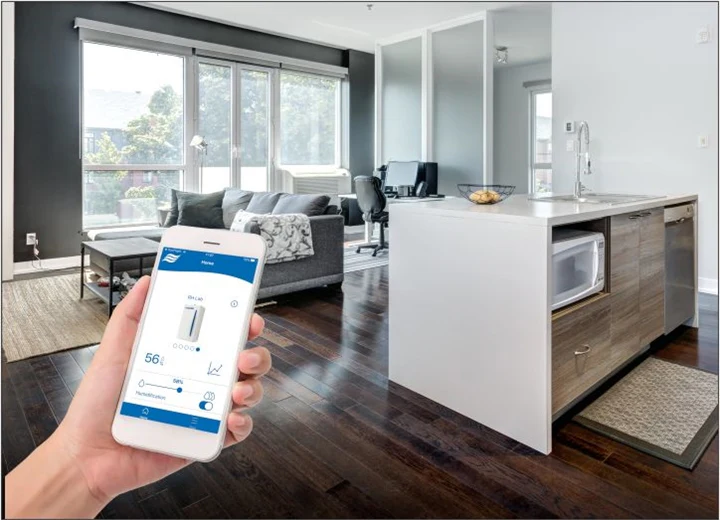
condair humilife website 520 720 rh app kitchen 900x

HisoAir: The Tech-Forward Innovator

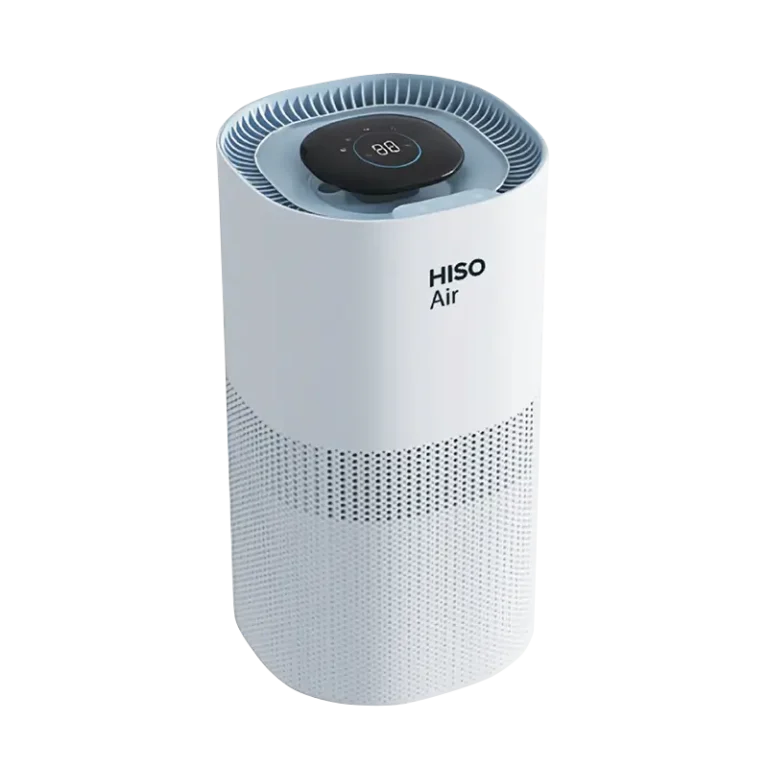
Making waves in the French market is HisoAir, a brand that positions itself at the intersection of engineering excellence and user-centric design. Unlike traditional appliance makers, HisoAir emphasizes research-driven innovation to create solutions that address the most common frustrations users face with humidifiers.

  • Technology Focus: HisoAir’s lineup spans ultrasonic, evaporative, and advanced steam models, with proprietary technologies like SteamPure™ sterilization et SmartDry™ filter-drying systems. These features are designed to combat bacterial growth, reduce mineral buildup, and keep maintenance simple. Many models also include Wi-Fi connectivity, app integration, and intelligent humidity sensors that automatically adjust output to maintain an ideal 40–60% indoor humidity level.

  • User Experience: What sets HisoAir apart is its commitment to convenience and hygiene. By incorporating self-cleaning cycles, low-noise operationet easy-to-replace filter systems, the brand reduces the day-to-day effort required to keep units running optimally. This makes HisoAir particularly appealing to busy professionals, families with young children, and anyone who values low-maintenance wellness appliances.

  • Market Position in France: In a market where consumers increasingly demand both performance and style, HisoAir positions itself as a premium yet accessible option. Its products combine sleek, modern aesthetics with robust engineering, targeting urban households and offices that want more than just a functional device—they want a reliable, tech-forward air quality partner.

You can explore their offerings at https://hisoair.com/.
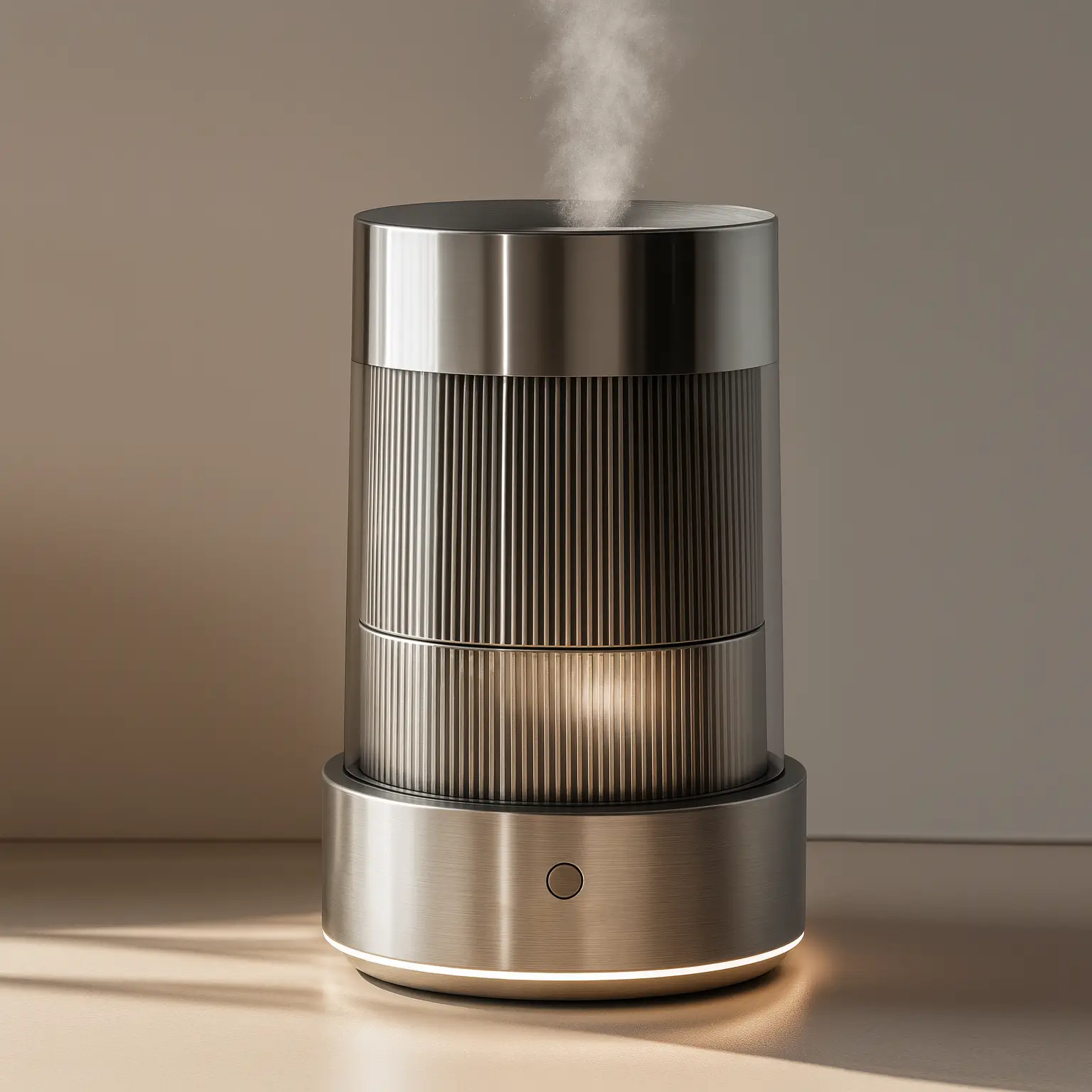
stainless humidifier 14

Levoit: The Online Fan-Favorite

A true digital-native success story, Levoit has captured a massive share of the online consumer market. By offering feature-packed, competitively priced smart humidifiers, Levoit has become a bestseller on platforms like Amazon. Their products, such as the popular Classic and LV series, are known for large water tanks, long runtimes, and seamless smart home integration. Controllable via the VeSync app and compatible with voice assistants like Alexa and Google Assistant, Levoit appeals to the tech-savvy user who values convenience, performance, and outstanding value.

Philips: The Health & Wellness Guardian

Leveraging its formidable reputation as a global leader in health technology, Philips positions its humidifiers as a superior choice for creating a healthier home environment. The cornerstone of their lineup is the proprietary NanoCloud technology, an evaporative system that the company markets as a more hygienic alternative to common ultrasonic models. Philips emphasizes that this natural process releases 99% fewer bacteria into the air and prevents the white mineral dust that can settle on furniture. For health-conscious families, the Philips brand offers a powerful promise of clean, healthy air.
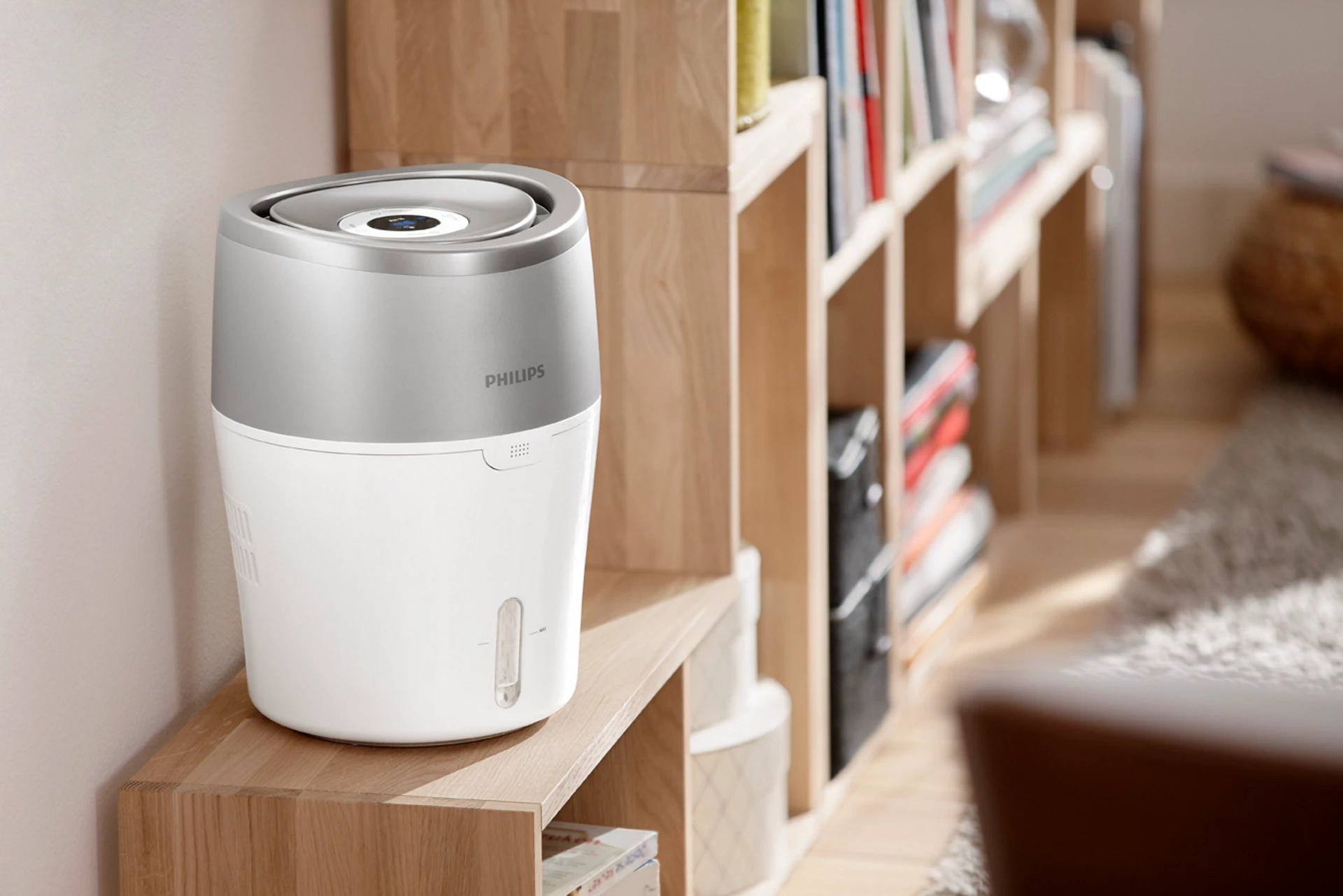
philips humidifier

Stadler Form: The Design Connoisseur's Choice

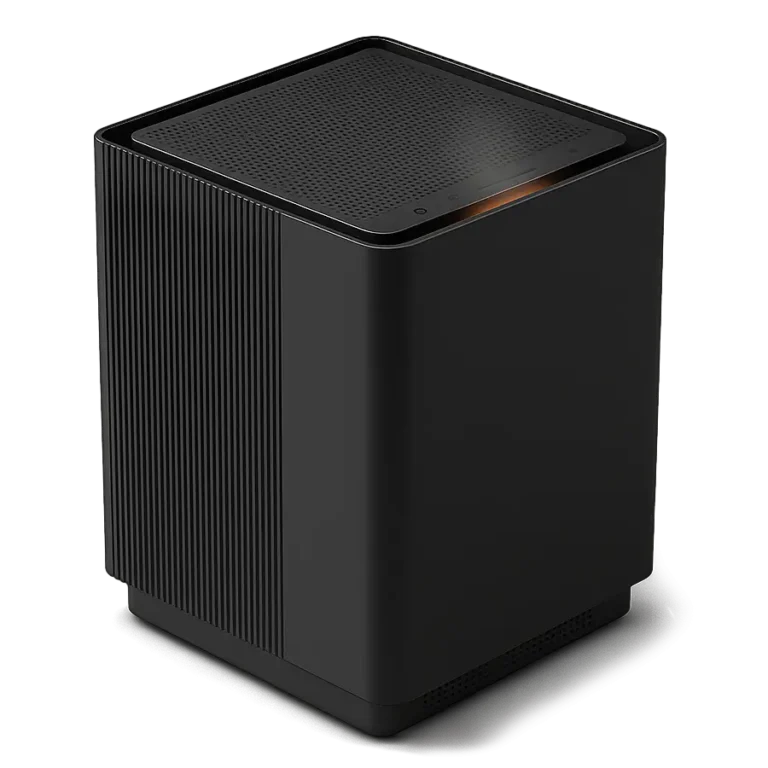
For those who believe home appliances should be as beautiful as they are functional, there is Stadler Form. This Swiss company operates on the philosophy of creating "functional sculptures for the home," and its products are celebrated for their sophisticated, award-winning designs. Stadler Form offers a technologically diverse portfolio, ensuring there is a stylish solution for every need. From the quiet, cube-like Oskar evaporator to the powerful, connected Eva ultrasonic model and the striking, tripod-legged Fred steam vaporizer, their products are designed for consumers who view their humidifier as a piece of interior décor and are willing to invest in superior aesthetics.

What's Next in Air Quality?

The humidifier market in France and globally is evolving rapidly, with several trends shaping what consumers and businesses can expect in the near future:

  • Smarter Homes, Smarter Devices: Wi-Fi connectivity, app control, and even AI-driven monitoring are moving from premium to mainstream, giving users greater oversight and personalization.
  • Sustainability & Energy Efficiency: With rising energy costs and growing environmental awareness, consumers are paying closer attention to devices that minimize power consumption, use eco-friendly materials, and reduce plastic waste from disposable filters.
  • Multi-Functional Living: All-in-one solutions that combine humidification with air purification, aromatherapy, or even heating are gaining traction, especially in urban apartments where space is limited.
  • A Focus on Hygiene & Safety: Expect to see more built-in sterilization systems—UV light, silver ion coatings, or self-cleaning mechanisms—that ensure a consistently clean mist while lowering maintenance hassles.
  • Design as Differentiator: Beyond performance, aesthetics are becoming a key purchase driver, with consumers seeking products that enhance, rather than clash with, their interiors.
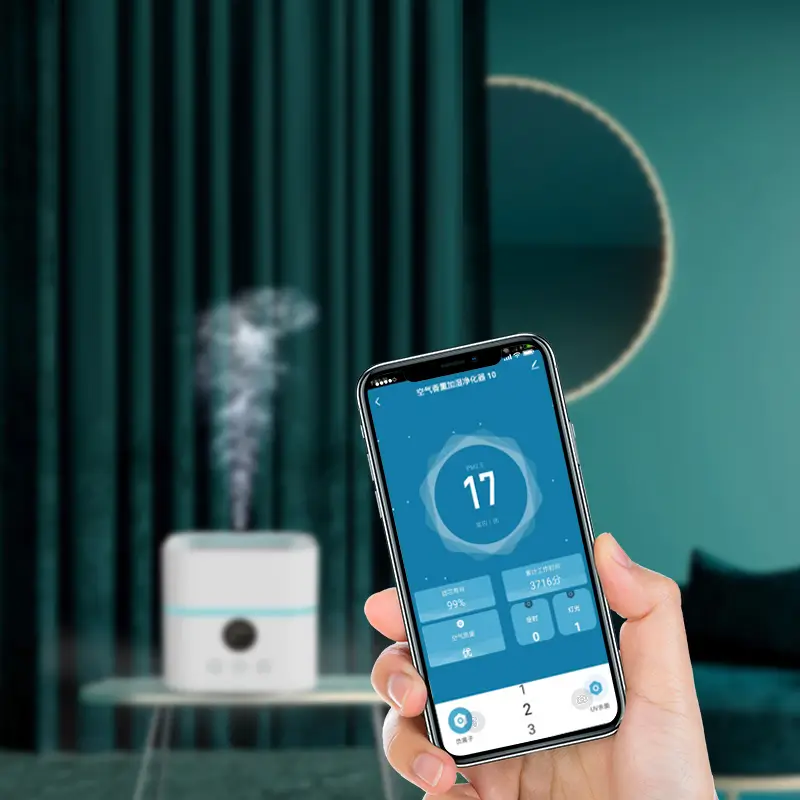
3 in 1 air purifier & humidifier & diffuser ha m18d

France-Specific Notes

When choosing a humidifier in France, there are a few local considerations worth keeping in mind:

  • Old Apartment Heating Systems: Many French homes, especially in Paris and older cities, rely on radiator heating, which can dry out the air significantly. Look for models that can handle larger rooms with consistent output.
  • Hard Water Concerns: Certain regions of France, such as Île-de-France and Provence, have high mineral content in their tap water, which can lead to “white dust” residue. Opting for evaporative or NanoCloud-style systems, or using demineralized water, helps prevent this.
  • Noise Sensitivity: Quiet operation is highly valued, especially for night use in smaller apartments. Ultrasonic and evaporative models with “sleep modes” are a practical choice.
  • After-Sales Service & Parts: Availability of replacement filters and reliable local service networks can vary by brand. It’s worth checking how easily consumables can be purchased in France, both online and in retail channels.

Conclusion

Healthy humidity levels make all the difference in comfort, sleep quality, and overall well-being—especially during the long French winter. From Condair’s industrial precision to HisoAir’s technology-driven solutions, Levoit’s online convenience, Philips’ health-first innovations, and Stadler Form’s design excellence, France offers options for every need and lifestyle.

The key is to match your priorities—whether it’s performance, hygiene, smart features, or aesthetics—with the right brand and model.

👉 Ready to improve your indoor air? Start by identifying your room size, water conditions, and maintenance preferences, then explore the brands that best fit your lifestyle. For a quick decision-making tool, you can create a simple checklist—or reach out to experts for tailored recommendations.

Partager :
fondateur de hisoair m. lee
Alwen Lee, an air purification expert with over 10 years of experience, is a devoted father of two and a passionate traveler, having explored more than 30 countries. With a love for public speaking and swimming, he has dedicated his life to the indoor air quality industry. His mission is to ensure that people around the world enjoy the freedom to breathe clean air and lead happy, healthy lives.

Envoyez-nous un message

Plus à lire

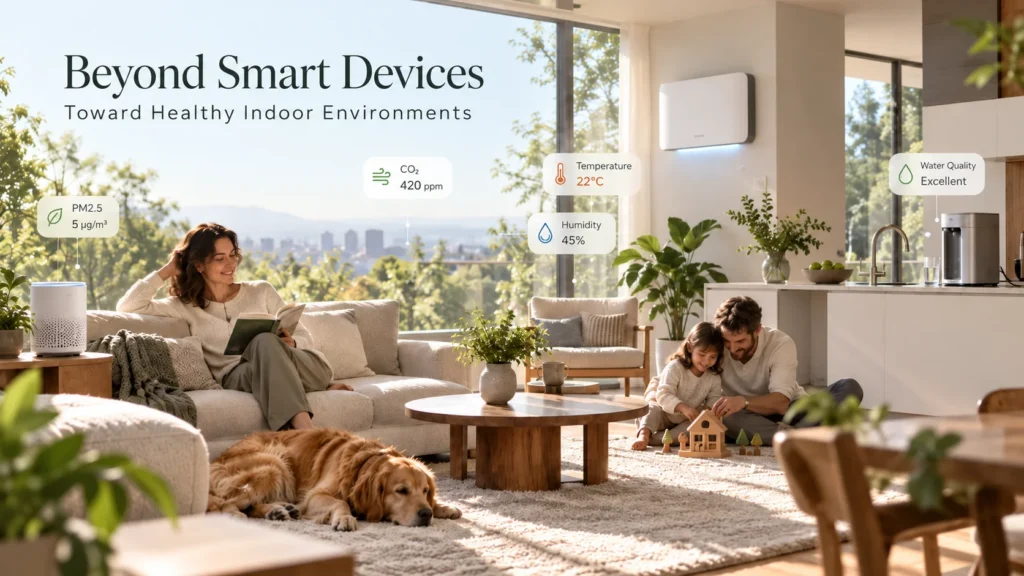
Modern living room with a family enjoying a healthy indoor environment monitored by smart devices, natural lighting, and greenery.

After IFA 2026: The Healthy Home Is Moving Beyond Smart Devices

In our previous IFA 2026 column, Air Purification Is Becoming Part of the Healthy-Home Platform, we argued that the next generation of indoor-health products would ...
Actualités
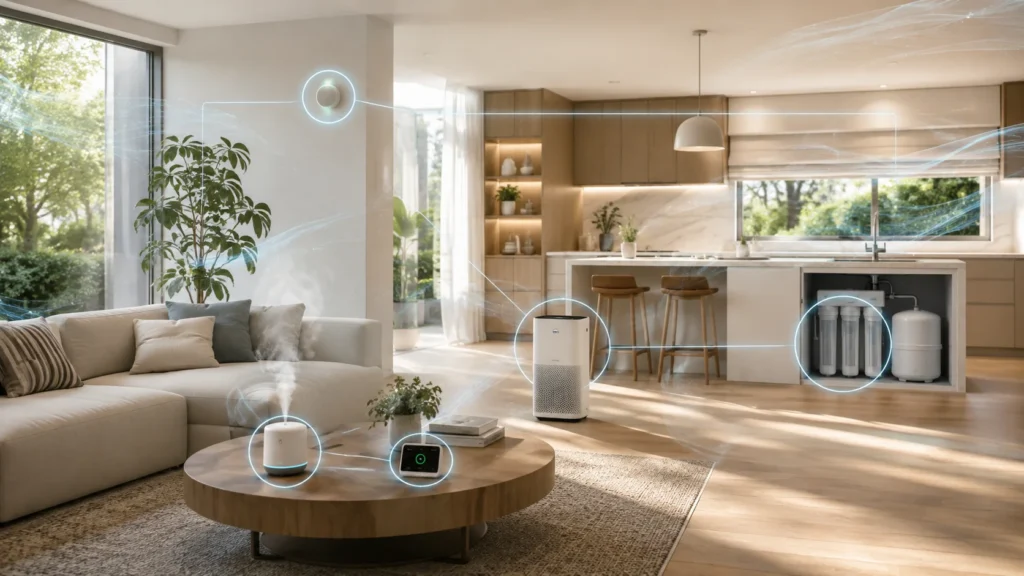
Modern living room and kitchen with smart home air quality devices including an air purifier, humidifier, and water filtration system, connected with visualized blue connectivity lines.

IFA 2026: Air Purification Is Becoming Part of the Healthy-Home Platform

Pre-IFA Industry Perspective | September 4, 2026 This article is based on official announcements and regulatory information available ahead of IFA 2026, which takes place ...
Actualités
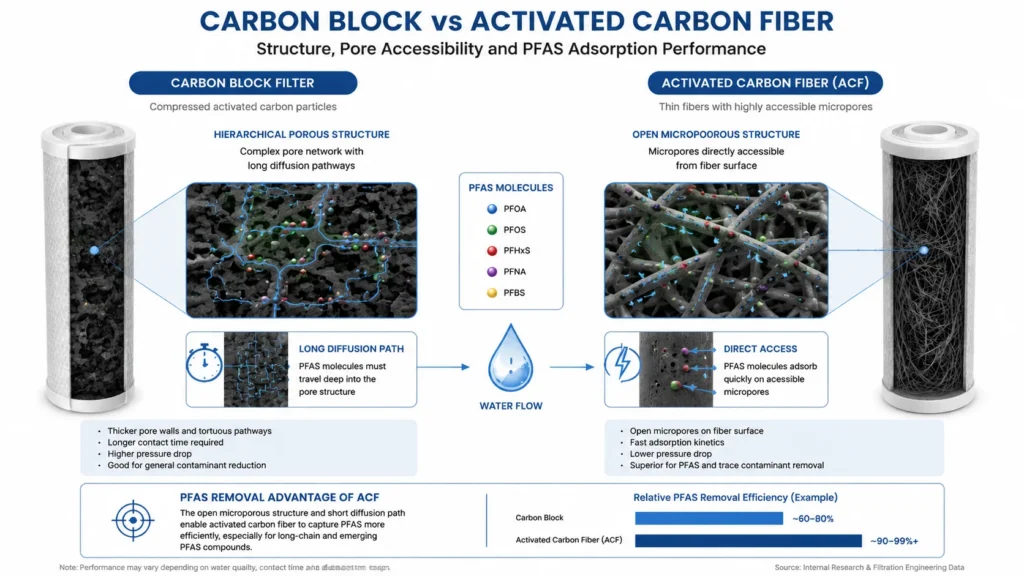
Comparison infographic showcasing the differences between carbon block filter and activated carbon fiber. Detailed diagrams illustrate the hierarchical porous structure of the carbon block with long diffusion paths and the open microporous structure of the activated carbon fiber with direct access for PFAS adsorption.

Carbon Block vs. Activated Carbon Fiber (ACF): Matching Media to Target Contaminants

Two carbon media. Same adsorption chemistry. Very different behaviour in a point-of-use cartridge. If you are specifying a water purifier platform for a PFAS-aware market, ...
Actualités
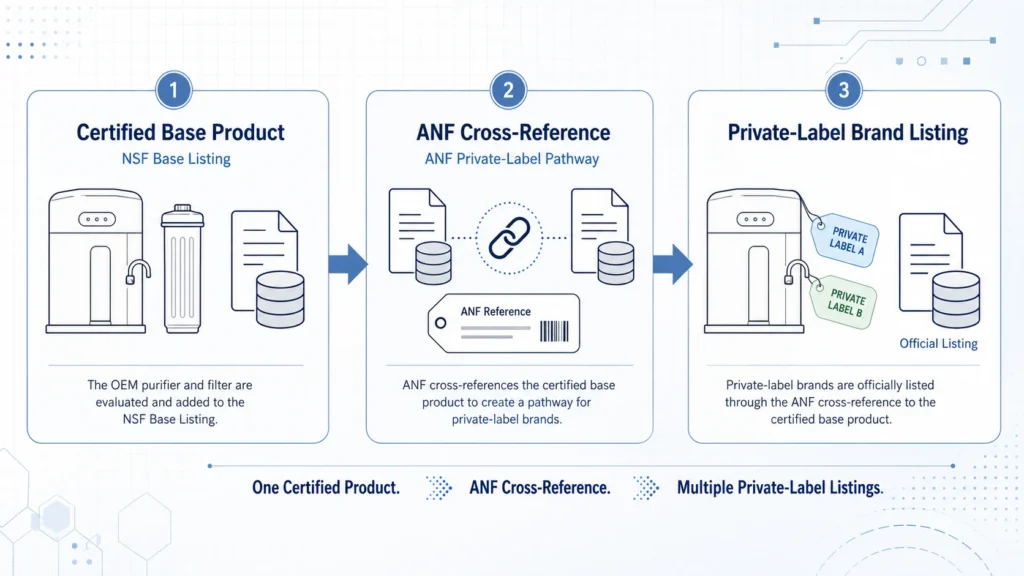
NSF base listing and ANF private-label certification pathway for OEM water filters

What Is an NSF Master Listing? A Guide to Base Listings, ANF Certification and OEM Water Filters

For a brand preparing to launch an OEM water purifier, one of the most common supplier claims is: “We already have an NSF master listing, ...
News, Water Purifiers
Healthy-home brand team reviewing PFAS water filter certification, test data and product engineering

Entering the Water Category Is Easy. Building a Credible PFAS Claim Is Much Harder

For air purification, appliance and healthy-home brands, entering the water category can look surprisingly easy. A company can select an existing undersink system, customize its ...
Actualités
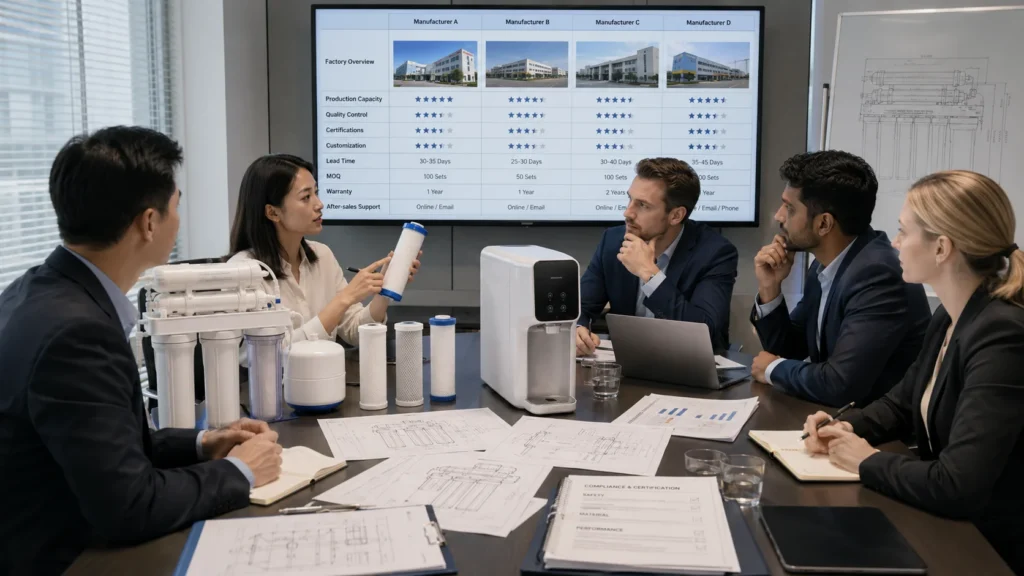
Team in a business meeting discussing a water filtration system with product components and a comparison table displayed on a screen.

5 Leading OEM Water Purifier Manufacturers in China for Private Label Brands

China has thousands of companies selling water filters, reverse osmosis systems and drinking-water appliances. However, only a portion of them are suitable for private-label, OEM ...
Actualités
Contaminant Engineering•3 min read

PFAS Water Filtration Technologies Explained: Carbon, Resin & RO

Key Takeaway:

PFAS reduction depends on the specific compounds present, treatment media, contact time, water chemistry, and system design. Activated carbon, ion exchange, and Reverse Osmosis address PFAS through different mechanisms.

PFAS are a large family of persistent fluorinated compounds that can occur in drinking-water supplies. Their treatment behavior varies significantly by molecular structure, chain length, functional group, concentration, and the chemistry of the source water.

Granular Activated Carbon (GAC) removes PFAS primarily through adsorption. It is generally more effective for many longer-chain PFAS, while shorter-chain compounds tend to break through more quickly. Carbon performance depends on media properties, Empty Bed Contact Time (EBCT), competing organic matter, loading, and replacement frequency.

Ion-exchange resins use charged functional sites to capture many PFAS compounds. Properly selected anion-exchange media can provide high capacity and may perform better than conventional activated carbon for some shorter-chain PFAS, although performance still depends on water chemistry and competing ions.

Reverse Osmosis (RO) uses membrane separation rather than adsorption. Properly designed RO systems can provide broad reduction across many PFAS compounds as well as dissolved salts and other contaminants. Unlike carbon or resin, however, RO also produces a concentrate stream that must be managed.

No single technology should be selected from a PFAS label alone. System design should consider which PFAS compounds are present, their concentrations, required reduction targets, flow rate, media life, and the applicable third-party certification or validation requirements.

HisoAir Water Technical Series
Product Discovery•3 min read

How to Choose an Under-Sink Water Purifier for Modern Kitchens

Key Takeaway:

Match the treatment technology to your water quality first, then evaluate cabinet space, faucet configuration, flow rate, drain and power requirements, and filter replacement needs.

Choosing an under-sink water purifier starts with water chemistry. Carbon filtration is well suited to chlorine, taste, odor, and many organic contaminants, while Reverse Osmosis is more appropriate when dissolved salts, fluoride, nitrates, or broader dissolved contaminants need to be reduced.

For compact kitchens, tankless RO systems eliminate the conventional storage tank and can significantly reduce the space required under the sink. However, membrane capacity stated in GPD does not directly equal faucet flow. When comparing systems, check the actual dispensing flow rate, inlet-pressure requirement, recovery ratio, and whether a booster pump is required.

Installation architecture also matters. Many RO systems require a drain connection, electrical power, and either a dedicated drinking-water faucet or a compatible multi-function faucet. High-flow carbon systems can often connect directly to the existing cold-water line with a simpler installation, but pressure drop and available faucet flow should still be verified.

RO also removes much of the naturally occurring dissolved mineral content. Where taste or mineral balance is a priority, a post-RO remineralization stage can be added. Filter life should be evaluated by both rated capacity and local water quality rather than replacement time alone.

The right system is therefore not simply the smallest or highest-GPD model. It is the configuration that matches the target contaminants, available cabinet space, desired faucet setup, peak dispensing demand, and maintenance expectations.

HisoAir Water Technical Series
Water Quality•2 min read

What Does TDS Mean in Drinking Water? Measurement vs Contaminant Reality

Key Takeaway:

A TDS meter estimates the overall concentration of dissolved ionic substances from electrical conductivity. It cannot identify specific contaminants or determine whether water is chemically safe.

Total Dissolved Solids (TDS) refers to the combined concentration of dissolved substances in water. Most handheld TDS meters do not measure TDS directly. Instead, they measure electrical conductivity (EC) and convert that reading into an estimated parts-per-million (ppm) value.

This means a TDS reading can indicate how much dissolved ionic material is present, but not what that material actually is. Calcium, magnesium, sodium, nitrates, and other dissolved ions can all contribute to conductivity, yet a simple TDS meter cannot distinguish between them.

TDS meters are also not suitable for detecting trace contaminants such as PFAS, many VOCs, pesticides, pharmaceuticals, or disinfection byproducts. These substances may be present at concentrations far below the level needed to noticeably change electrical conductivity.

A low TDS reading therefore does not guarantee safe drinking water, and a higher TDS reading does not automatically indicate contamination. Water-treatment decisions should be based on laboratory testing for specific contaminants of concern rather than TDS alone.

HisoAir Water Technical Series
Technology Selection•2 min read

RO vs UF Water Filtration: Understanding Pore Sizes & Dissolved Minerals

Key Takeaway:

Ultrafiltration can reduce bacteria, turbidity, and suspended particles while retaining most naturally occurring dissolved minerals. Reverse Osmosis provides much broader reduction of dissolved salts and smaller contaminants.

Ultrafiltration (UF) typically uses hollow-fiber membranes with pore sizes in the approximate 0.01–0.1 micron range. These membranes physically retain turbidity, suspended solids, colloids, and many microorganisms while allowing dissolved minerals and salts to remain in the water.

Reverse Osmosis (RO) operates at a much finer separation level. Unlike UF, RO can substantially reduce dissolved ions such as sodium, calcium, fluoride, nitrates, and other contributors to total dissolved solids (TDS). This makes RO more suitable when dissolved-salt reduction is a primary treatment objective.

UF generally requires less system pressure and produces little or no continuous concentrate stream in many point-of-use configurations. RO typically requires greater pressure and produces a reject-water stream, but delivers broader contaminant reduction.

For water with acceptable TDS and mineral content, UF can be a simpler mineral-retaining treatment option. Where dissolved salts, fluoride, nitrates, or broader dissolved contaminants are a concern, RO is generally the more appropriate technology.

HisoAir Water Technical Series
Technology Selection•4 min read

Carbon Block vs Reverse Osmosis: Which Fits Your Need?

Key Takeaway:

Choose RO for dissolved inorganic salts and heavy metals; choose Carbon Block for chemical taste/odor, no wastewater, and high line-pressure flow.

Reverse Osmosis (RO) and Carbon Block filtration represent two fundamentally different treatment methods: membrane separation and adsorption. Understanding these differences helps determine which technology is better suited to a specific water-quality requirement.

Reverse Osmosis uses a semi-permeable membrane with pore sizes of approximately 0.0001 microns. It can significantly reduce dissolved inorganic contaminants such as TDS, fluoride, nitrates, and certain heavy metals. Because water must be forced through the membrane, RO systems require sufficient pressure or a booster pump and generate a concentrated wastewater stream.

Carbon Block filtration relies primarily on adsorption through compressed activated carbon, commonly with nominal pore sizes around 0.5–5 microns. It is highly effective for chlorine, chloramines, VOCs, taste, and odor, while allowing substantially higher direct-flow rates without producing wastewater.

From an operating perspective, Carbon Block systems are generally simpler, require less energy, and avoid the water loss associated with RO. RO involves higher system complexity and operating cost, but provides substantially broader reduction of dissolved contaminants that Carbon Block alone cannot address.

HisoAir Water Technical Series

DEMANDER UN DEVIS