
In today's world, where air quality is more important than ever, finding the right air purifier manufacturer can make or break your brand. Whether you're a new entrant in the market or an established player looking to expand your product line, partnering with a reliable air purifier manufacturer ensures you deliver high-quality products that resonate with your customers.
This comprehensive guide will walk you through the key factors you need to consider when selecting an air purifier manufacturer for your brand, drawing on HisoAir's two decades of experience as a leader in OEM and ODM air purification solutions. From customization capabilities to quality control, scalability, and certifications, we’ll help you make an informed decision for your business.
Understanding Your Business Needs
1. Identify Your Target Market

Before selecting a manufacturer, it’s essential to understand who your customers are and what they need. Are you targeting residential consumers looking for compact, quiet air purifiers for their homes, or are you serving businesses, hospitals, or industrial sectors requiring robust, large-scale air purification systems?
For instance, residential customers may prioritize features like low noise levels, sleek design, and energy efficiency, while commercial clients might focus on high CADR (Clean Air Delivery Rate) values, HEPA filtration, and the ability to clean large spaces quickly.
2. Define Your Product Requirements
Once you've identified your target market, it's time to outline the features your air purifiers must have. Consider factors such as:
- Filtration system: HEPA, activated carbon, UV light, or water-based filters.
- Smart features: Wi-Fi connectivity, air quality sensors, and app integration.
- Noise levels: Especially for residential or hospital-grade products.
- Energy efficiency: An increasingly important factor for environmentally conscious consumers.
HisoAir offers a wide range of customization options, from state-of-the-art filtration technologies to quiet, energy-efficient fan systems. Our ability to tailor products to meet these diverse needs is one of the reasons we are a trusted partner for brands globally.
3. Establish Your Brand Identity
The manufacturer you choose will play a significant role in shaping your brand’s identity. Whether you’re positioning yourself as a premium luxury brand or a budget-friendly option, the quality, design, and performance of your air purifiers must align with your brand’s message.
By working with HisoAir, you can ensure consistent, high-quality manufacturing that reflects your brand values. We’ve helped clients such as Carrier and Delos achieve just that, developing custom air purifiers that resonate with their target markets.
Key Factors to Consider When Choosing a Manufacturer
1. Customization Capabilities
Customization is critical when launching a product that stands out from the competition. Your manufacturer should offer flexible options for design, features, and branding.
At HisoAir, we provide both OEM (Original Equipment Manufacturing) and ODM (Original Design Manufacturing) services, giving you full control over your product’s design or allowing you to rely on our innovative product development expertise.
For instance, HisoAir worked with Surgically Clean Air to develop air purifiers specifically designed for medical environments, offering advanced filtration systems that cater to their unique needs. This level of customization is what helps brands distinguish themselves in a crowded market.
2. Production Capacity and Scalability

The ability to scale production is crucial, especially as your brand grows or experiences seasonal demand spikes. Whether you need a small initial run or mass production, your manufacturer must be able to handle both without compromising on quality or delivery timelines.
HisoAir has a robust production infrastructure, including our Vietnam factory, which is part of our China +1 strategy. This additional production site mitigates risks associated with tariffs, political uncertainties, and supply chain disruptions, ensuring that we can meet high-volume demands efficiently.
Our successful partnerships with brands like 3M and Aflac demonstrate our ability to scale production while maintaining top-tier quality.
3. Technology and Innovation
As the air purifier industry evolves, new technologies like smart air purifiers, IoT connectivity, and AI-powered air quality monitoring are becoming standard. The manufacturer you choose should not only be capable of incorporating these innovations but should also be driving them.
HisoAir is at the forefront of technological advancements. Our products integrate IoT technology, allowing users to monitor and control air purifiers via mobile apps, making them ideal for smart home environments. By partnering with HisoAir, your brand will be equipped with the latest innovations in air purification technology.
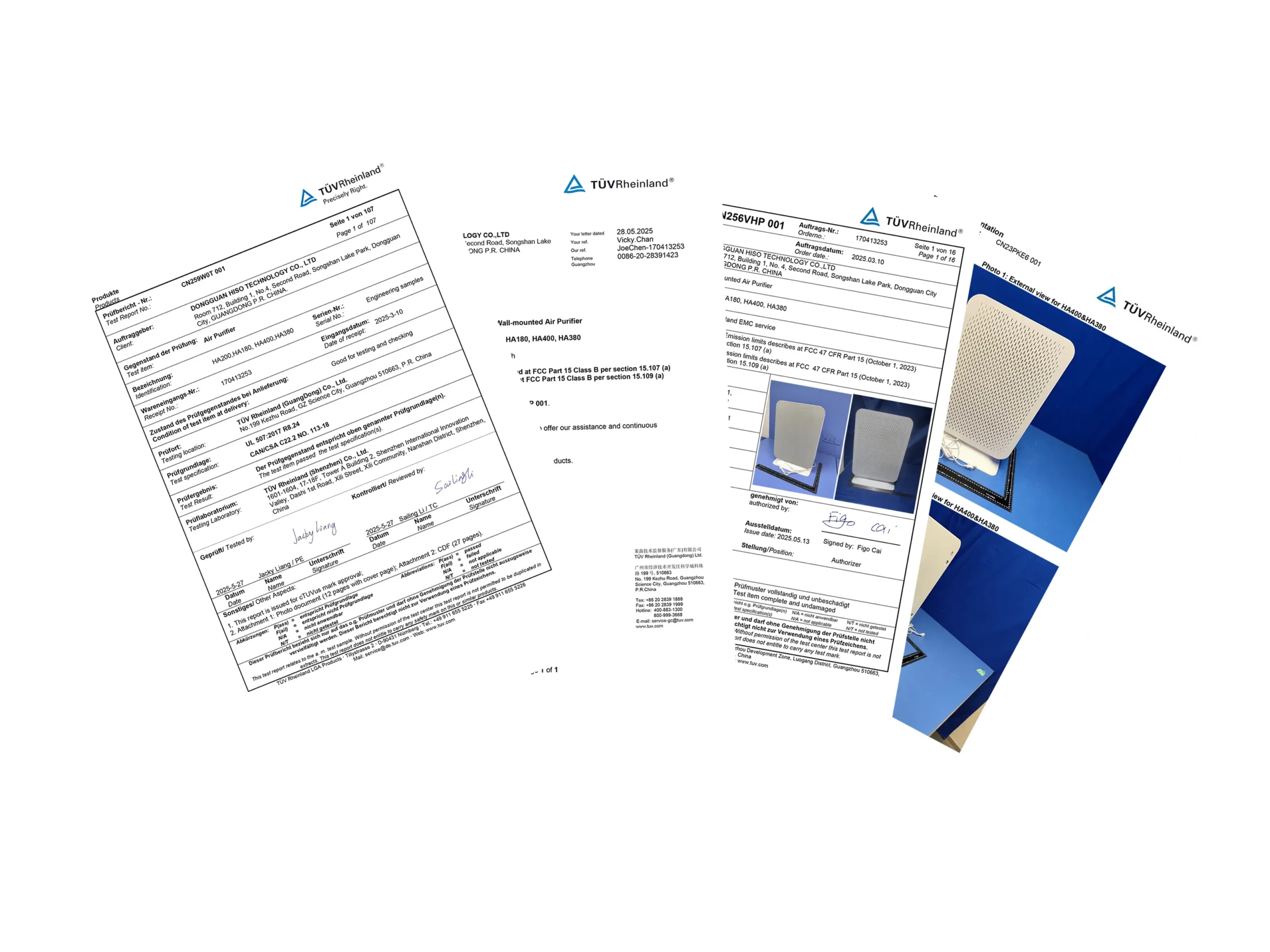
HisoAir | Certified to International Standards
4. Quality Control and Assurance
Ensuring consistent product quality is non-negotiable when building a successful brand. Manufacturers must have rigorous quality control (QC) protocols to detect defects early and maintain high performance across all units.
At HisoAir, we perform extensive quality assurance in our CNAS-certified lab, which includes testing for filter efficiency, noise levels, and safety. Our QC processes have been trusted by brands like Henry Schein and Carrier, who require the highest standards for their customers.
5. Certifications and Compliance
To ensure safety and market access, air purifiers must meet certain industry certifications such as:
- CE (European compliance)
- RoHS (Restriction of Hazardous Substances)
- UL (Underwriters Laboratories certification for safety)
- AHAM (Association of Home Appliance Manufacturers air purification standards)
These certifications provide assurance that your products are compliant with safety, environmental, and performance regulations. HisoAir meets all these standards, ensuring that your products are ready for global distribution.
Geographic Location and China +1 Strategy
1. Domestic vs. International Manufacturing
Manufacturing domestically might offer shorter lead times, but international manufacturers, especially in regions like China and Southeast Asia, provide significant cost advantages.
China remains the global leader in air purifier manufacturing, thanks to its well-established infrastructure, skilled labor, and access to raw materials. However, businesses today must also consider risks like political instability, tariffs, and supply chain disruptions.
2. The China +1 Strategy: Vietnam as a Key Location
To mitigate these risks, many businesses adopt a China +1 strategy, diversifying their production to another country, such as Vietnam or Thailand. HisoAir's Vietnam factory helps us offer seamless production capabilities, reducing tariff exposure and ensuring continuity in supply chains.
This strategy allows brands to benefit from China’s manufacturing excellence while mitigating geopolitical risks. Our partnership with brands like CBRE demonstrates how we leverage our Vietnam facility to meet global demand reliably and cost-effectively.
Evaluating the Manufacturer’s Experience and Expertise
1. Years in Business and Expertise
Experience matters. A manufacturer with a long history in the air purification industry is more likely to offer stability, reliability, and quality. HisoAir has over 20 years of experience in the air purifier sector, working with global brands like 3M, Aflac, and Carrier.
2. Specialization in Air Purifiers
A specialist manufacturer with deep expertise in air purification can provide tailored solutions that meet industry-specific standards. HisoAir has worked with diverse sectors, including healthcare, corporate offices, and military projects, delivering highly specialized air purification solutions.
3. Customer Support and After-Sales Service
Manufacturers that offer strong customer support and after-sales services contribute to the long-term success of your brand. At HisoAir, we offer comprehensive technical support and spare parts availability to ensure that your products continue to perform well in the market.
Case Studies: Success Stories with Leading Brands
- Surgically Clean Air: We developed custom medical-grade air purifiers tailored to their needs, providing advanced filtration to protect healthcare environments.
- Aflac: Created a robust commercial air purifier line to improve workplace air quality, contributing to employee health and satisfaction.
- Henry Schein: Delivered high-performance air purifiers for dental and medical clinics, ensuring clean, contaminant-free environments.
- JP Morgan and CBRE: Produced state-of-the-art air purification solutions for large corporate spaces, ensuring a safe and healthy workspace.
Conclusion
Choosing the right air purifier manufacturer is critical to your brand’s success. From customization to scalability, quality assurance, and global compliance, HisoAir offers the expertise, experience, and production capabilities to help your brand thrive.
Ready to take the next step? Contact HisoAir today to discuss how we can help you develop high-quality, custom air purifiers that meet your brand's unique needs.


 English
 Français
 Español
 Italiano
 Deutsch
 Português
 Русский
 العربية
 日本語
 한국어
 Tiếng Việt

