Abre num novo separador
Soluções inovadoras para a qualidade do ar

Os 5 principais fabricantes de purificadores de ar no Japão

Related Products

Limpar o ar de partículas contaminantes pode ajudar a reduzir o risco de doenças e enfermidades provocadas por produtos químicos, vírus, bactérias e muito mais. Listámos os melhores fabricantes japoneses de purificadores de ar de qualidade neste blogue.

É um facto que a atmosfera da Terra, nesta altura, está muito poluída. Obter ar fresco e limpo é raro, especialmente para aqueles que residem em locais altamente urbanizados. O ar pode conter vírus, bactérias, partículas químicas, alergénios e outras coisas que podem comprometer a saúde de muitas pessoas. Por outro lado, os purificadores de ar podem eliminar a referida matéria.

Tendo em conta a importância dos purificadores de ar nos cuidados de saúde, é razoável dizer que fazer negócios neste domínio pode dar bons resultados. Também pode ser necessário comprar purificadores de ar a granel se tenciona instalá-los em sua casa ou no seu escritório. Neste artigo, pode ficar a conhecer os cinco principais fabricantes de purificadores de ar com que pode trabalhar no Japão.

Lista dos 5 principais fabricantes de purificadores de ar no Japão

Segue-se um breve resumo das empresas que entraram na nossa lista. Pode clicar no nome da empresa em que está interessado se quiser saber mais informações diretamente sobre ela. Naturalmente, sugerimos vivamente que leia os detalhes de cada empresa para ter uma compreensão mais abrangente das seguintes empresas.

  1. Daikin Industries Ltd.
  2. Corporação Sharp
  3. Panasonic Corporation
  4. Corporação Daiohs
  5. Grupo Hitachi

Os 5 principais fabricantes de purificadores de ar no Japão

As seguintes empresas foram cuidadosamente selecionadas com base nas suas tecnologias em termos de produção de purificadores de ar, desempenho geral e reputação. Compilámos um breve perfil de cada fabricante que pode ser útil para si. Aqui estão os cinco melhores fabricantes de purificadores de ar do Japão.

1. Daikin Industries Ltd.
Logótipo da Daikin Singapura

Fonte da imagem: Daikin Industries Ltd.

Tipo de negócio: Fabricante
Sede social: Umeda Center Bldg., 2-4-12, Nakazaki-Nishi, Kita-ku, Osaka 530-8323, Japão
Principais mercados: Mundial
Anos de experiência: 98 anos
Certificados: ISO 14001, ISO 9001: 2015

A Daikin Industries Ltd. iniciou as suas operações em Osaka, no Japão, há quase um século, e é inegável que se tornou numa potência global atualmente. Possui mais de trezentas subsidiárias e tem um capital surpreendente de 699,7 milhões de dólares.

Esta empresa é mais conhecida pelos seus produtos de ar condicionado, sistemas de ventilação e frigoríficos, que constituem uma grande parte das suas receitas. Naturalmente, a Daikin Industries Ltd. também possui uma tecnologia robusta em termos de produção de purificadores de ar, com os seus 98 anos de experiência e 300 milhões de dólares de investimento em I&D.

Principais produtos

  • Purificadores de ar
  • Sistemas de ar condicionado
  • Refrigeração
  • FCU
  • Outros produtos de ar condicionado

2. Corporação Sharp
Logótipo da Sharp Corporation

Fonte da imagem: Sharp Corporation

Tipo de negócio: Fabricante
Sede social: 1 Takumi-cho, Sakai-ku, Cidade de Sakai, Osaka 590-8522, Japão
Principais mercados: Mundial
Anos de experiência: 110 anos
Certificados: ISO 9001

A Sharp Corporation é outra empresa de longa data originária do Japão. É mais conhecida pela produção de televisores e máquinas de lavar roupa, mas também está bem desenvolvida no fabrico de outros produtos, como purificadores de ar, monitores LCD e telemóveis. A partir de 2021, o seu capital ascende a mais de 41 milhões de dólares e tem onze bases de I&D em todo o mundo.

Principais produtos

  • Purificadores de ar
  • TVs AQUOS
  • Telemóveis
  • Calculadoras
  • Solar
  • Aglomerado de plasma

3. Corporação Panasonic
Logótipo da Panasonic Corporation

Fonte da imagem: Panasonic Corporation

Tipo de negócio: Fabricante
Sede social: 1006, Oaza Kadoma, Kadoma-shi, Osaka 571-8501, Japão
Principais mercados: Mundial
Anos de experiência: 104 anos
Certificados: ISO 9001, ISO 14001, ISO 45001, IATF 16949

A Panasonic Corporation teve início em 1918 e o seu extenso período de funcionamento reflecte-se bem nos seus sistemas rigorosos em termos de controlo de qualidade, segurança no trabalho e gestão ambiental que a tornam certificada pela ISO. Esta empresa tem um capital de 5,7 mil milhões de dólares e tem 522 subsidiárias em todo o mundo.

Principais produtos

  • Purificadores de ar
  • Tecnologia audiovisual
  • Computadores
  • Outros produtos electrónicos

4. Corporação Daiohs

Logótipo da Daiohs Malaysia Sdn. Bhd.

Fonte da imagem: Corporação Daiohs

Tipo de negócio: Fabricante
Sede social: Sapia Tower 14th FL. 1-7-12 Marunouchi, Chiyoda-ku, Tóquio 100-0005, Japão
Principais mercados: Global
Anos de experiência: 53 anos

A Daiohs Corporation é talvez a mais jovem entre as outras entidades incluídas nesta lista. No entanto, também tem grandes realizações na indústria transformadora. É mais conhecida pela produção de máquinas de fabrico de café para várias aplicações, mas também desenvolveu a sua própria abordagem à purificação do ar. Atualmente, esta empresa tem um capital de 8,65 milhões de dólares e expandiu-se para a América do Norte e para a Ásia.

Principais produtos

  • Máquinas de café
  • Máquinas de servir chá
  • Purificadores de ar

5. Hitachi Ltd.

Logótipo da Hitachi Ltd.

Fonte da imagem: Hitachi Ltd.

Tipo de negócio: Fabricante
Sede social: Nippon Seimei Marunouchi Building, 1-6-6, Marunouchi, Chiyoda-ku, Tóquio, 100-8280, Japão
Principais mercados: Mundial
Anos de experiência: 112 anos

A Hitachi Ltd. é outra potência empresarial global do Japão que começou há mais de um século. É mais conhecida pela produção de equipamento de telecomunicações e componentes estéreo, mas a sua carteira de produtos apresenta uma coleção verdadeiramente diversificada. A Hitachi Ltd. está envolvida em numerosas indústrias e os purificadores de ar constituem apenas uma pequena parte da sua gama de produtos. Atualmente, possui um capital de 3,79 mil milhões de dólares e estabeleceu a sua presença em todos os continentes.

Principais produtos

  • Equipamento médico
  • Purificadores de ar
  • Electrodomésticos
  • Outros

Fabricante de purificadores de ar de topo na China

A China é a potência manufactureira do mundo, fornecendo quase um terço dos produtos encontrados no globo. Se estiver interessado em estabelecer contacto com o principal fabricante de purificadores de ar do referido país, trabalhe com a HisoAir hoje mesmo!

HisoAir

Logótipo HisoAir
Logótipo HisoAir

Fonte da imagem: HisoAir

Tipo de negócio: OE/OD/JD Fabricante, fornecedor
Sede social: Room 712, Building 1, No. 4, Second Road, Songshan Lake Park, Dongguan City, Guangdong Province, China
Principais mercados: Mundial
Anos de experiência: 19 years
Certificados: CE, ROHS, EN1822

HisoAir specializes in manufacturing air purifiers that can be used in a medical setting. It was founded in 2003. It had achieved phenomenal success over its short eleven years in the industry with its more than a hundred accomplished projects all over the globe.

A empresa patenteou mais de 50 projectos e desenvolveu sistemas de purificação do ar que podem remover 99,99% das partículas presentes no ar. A SGS também verificou que os seus produtos podem filtrar 99,8% da família dos coronavírus, o que seria benéfico na sociedade atual, onde a pandemia de COVID-19 está a grassar.

Principais produtos

  • Purificadores de ar de qualidade médica

Conclusão

A qualidade do ar no mundo está a deteriorar-se continuamente, e uma forma de ter acesso a ar limpo é utilizar um purificador de ar. Os purificadores de ar são produtos verdadeiramente inovadores que podem preservar a saúde das pessoas, uma vez que removem os contaminantes da atmosfera. Atualmente, são muito procurados, especialmente por aqueles que sofrem de doenças relacionadas com o ar.
Listámos os cinco principais fabricantes de purificadores de ar no Japão neste artigo. Por outro lado, se estiver interessado em trabalhar com o melhor fabricante e exportador de purificadores de ar de qualidade médica da China, a HisoAir terá todo o prazer em ajudá-lo. Contactar a HisoAir hoje para obter o seu orçamento gratuito!
Os artigos seguintes podem também ser-lhe úteis:
Partilhar:
o fundador da hisoair, sr. lee
Alwen Lee, an air purification expert with over 10 years of experience, is a devoted father of two and a passionate traveler, having explored more than 30 countries. With a love for public speaking and swimming, he has dedicated his life to the indoor air quality industry. His mission is to ensure that people around the world enjoy the freedom to breathe clean air and lead happy, healthy lives.

Envie-nos uma mensagem

Related Products

Mais para ler

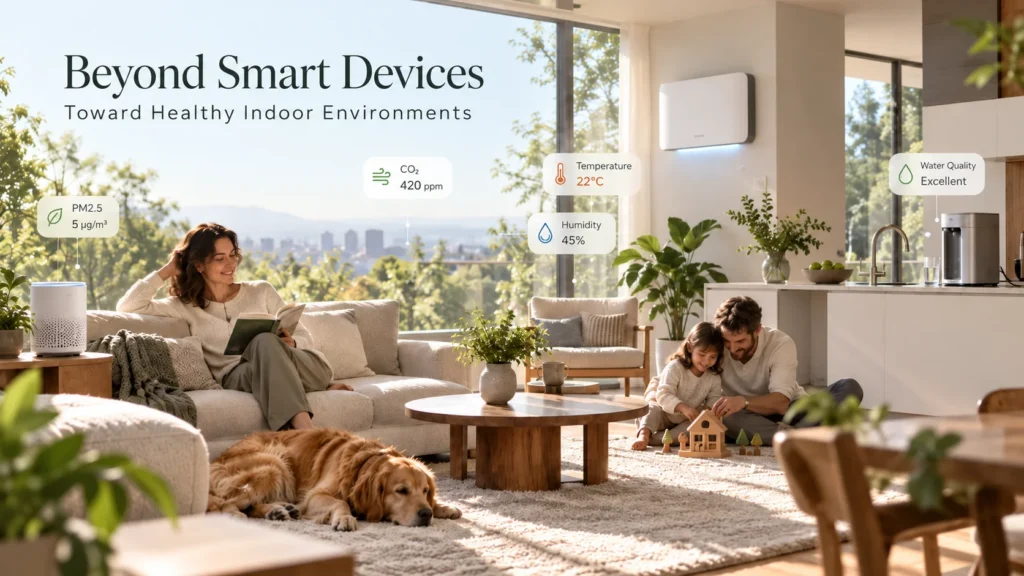
Modern living room with a family enjoying a healthy indoor environment monitored by smart devices, natural lighting, and greenery.

After IFA 2026: The Healthy Home Is Moving Beyond Smart Devices

In our previous IFA 2026 column, Air Purification Is Becoming Part of the Healthy-Home Platform, we argued that the next generation of indoor-health products would ...
Notícias
Modern living room and kitchen with smart home air quality devices including an air purifier, humidifier, and water filtration system, connected with visualized blue connectivity lines.

IFA 2026: Air Purification Is Becoming Part of the Healthy-Home Platform

Pre-IFA Industry Perspective | September 4, 2026 This article is based on official announcements and regulatory information available ahead of IFA 2026, which takes place ...
Notícias
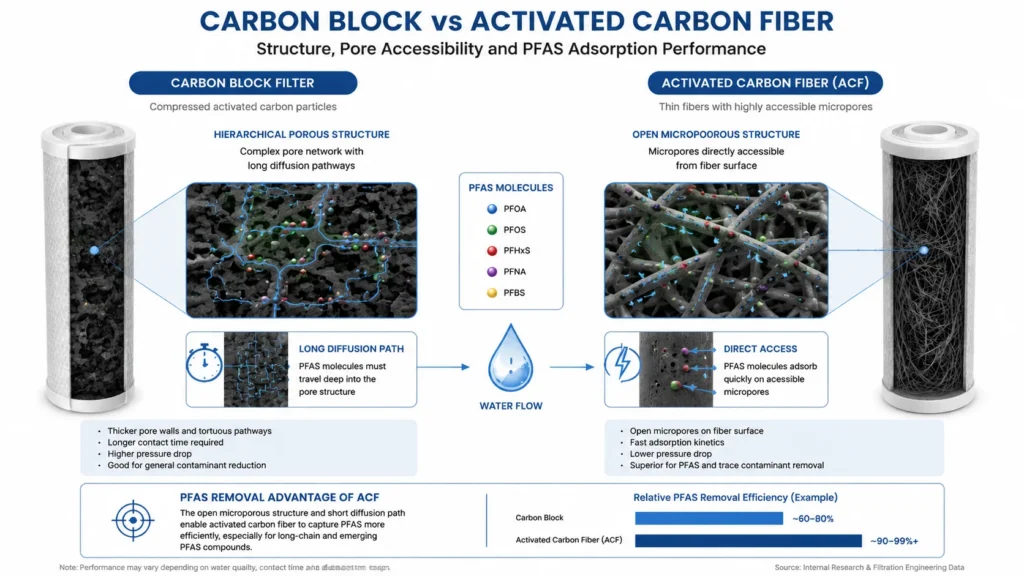
Comparison infographic showcasing the differences between carbon block filter and activated carbon fiber. Detailed diagrams illustrate the hierarchical porous structure of the carbon block with long diffusion paths and the open microporous structure of the activated carbon fiber with direct access for PFAS adsorption.

Carbon Block vs. Activated Carbon Fiber (ACF): Matching Media to Target Contaminants

Two carbon media. Same adsorption chemistry. Very different behaviour in a point-of-use cartridge. If you are specifying a water purifier platform for a PFAS-aware market, ...
Notícias
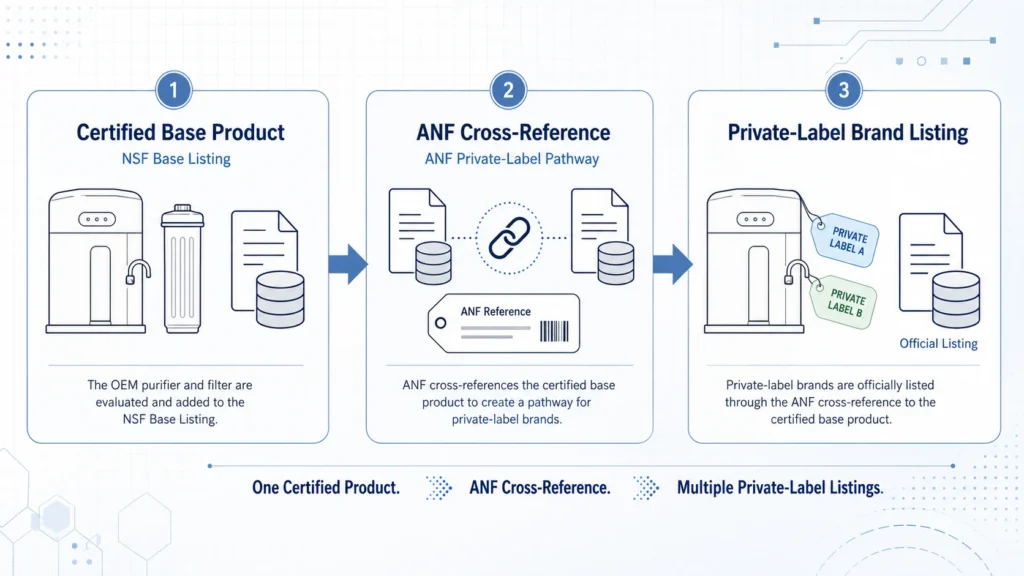
NSF base listing and ANF private-label certification pathway for OEM water filters

What Is an NSF Master Listing? A Guide to Base Listings, ANF Certification and OEM Water Filters

For a brand preparing to launch an OEM water purifier, one of the most common supplier claims is: “We already have an NSF master listing, ...
News, Water Purifiers
Healthy-home brand team reviewing PFAS water filter certification, test data and product engineering

Entering the Water Category Is Easy. Building a Credible PFAS Claim Is Much Harder

For air purification, appliance and healthy-home brands, entering the water category can look surprisingly easy. A company can select an existing undersink system, customize its ...
Notícias
Team in a business meeting discussing a water filtration system with product components and a comparison table displayed on a screen.

5 Leading OEM Water Purifier Manufacturers in China for Private Label Brands

China has thousands of companies selling water filters, reverse osmosis systems and drinking-water appliances. However, only a portion of them are suitable for private-label, OEM ...
Notícias
Contaminant Engineering•3 min read

PFAS Water Filtration Technologies Explained: Carbon, Resin & RO

Key Takeaway:

PFAS reduction depends on the specific compounds present, treatment media, contact time, water chemistry, and system design. Activated carbon, ion exchange, and Reverse Osmosis address PFAS through different mechanisms.

PFAS are a large family of persistent fluorinated compounds that can occur in drinking-water supplies. Their treatment behavior varies significantly by molecular structure, chain length, functional group, concentration, and the chemistry of the source water.

Granular Activated Carbon (GAC) removes PFAS primarily through adsorption. It is generally more effective for many longer-chain PFAS, while shorter-chain compounds tend to break through more quickly. Carbon performance depends on media properties, Empty Bed Contact Time (EBCT), competing organic matter, loading, and replacement frequency.

Ion-exchange resins use charged functional sites to capture many PFAS compounds. Properly selected anion-exchange media can provide high capacity and may perform better than conventional activated carbon for some shorter-chain PFAS, although performance still depends on water chemistry and competing ions.

Reverse Osmosis (RO) uses membrane separation rather than adsorption. Properly designed RO systems can provide broad reduction across many PFAS compounds as well as dissolved salts and other contaminants. Unlike carbon or resin, however, RO also produces a concentrate stream that must be managed.

No single technology should be selected from a PFAS label alone. System design should consider which PFAS compounds are present, their concentrations, required reduction targets, flow rate, media life, and the applicable third-party certification or validation requirements.

HisoAir Water Technical Series
Product Discovery•3 min read

How to Choose an Under-Sink Water Purifier for Modern Kitchens

Key Takeaway:

Match the treatment technology to your water quality first, then evaluate cabinet space, faucet configuration, flow rate, drain and power requirements, and filter replacement needs.

Choosing an under-sink water purifier starts with water chemistry. Carbon filtration is well suited to chlorine, taste, odor, and many organic contaminants, while Reverse Osmosis is more appropriate when dissolved salts, fluoride, nitrates, or broader dissolved contaminants need to be reduced.

For compact kitchens, tankless RO systems eliminate the conventional storage tank and can significantly reduce the space required under the sink. However, membrane capacity stated in GPD does not directly equal faucet flow. When comparing systems, check the actual dispensing flow rate, inlet-pressure requirement, recovery ratio, and whether a booster pump is required.

Installation architecture also matters. Many RO systems require a drain connection, electrical power, and either a dedicated drinking-water faucet or a compatible multi-function faucet. High-flow carbon systems can often connect directly to the existing cold-water line with a simpler installation, but pressure drop and available faucet flow should still be verified.

RO also removes much of the naturally occurring dissolved mineral content. Where taste or mineral balance is a priority, a post-RO remineralization stage can be added. Filter life should be evaluated by both rated capacity and local water quality rather than replacement time alone.

The right system is therefore not simply the smallest or highest-GPD model. It is the configuration that matches the target contaminants, available cabinet space, desired faucet setup, peak dispensing demand, and maintenance expectations.

HisoAir Water Technical Series
Water Quality•2 min read

What Does TDS Mean in Drinking Water? Measurement vs Contaminant Reality

Key Takeaway:

A TDS meter estimates the overall concentration of dissolved ionic substances from electrical conductivity. It cannot identify specific contaminants or determine whether water is chemically safe.

Total Dissolved Solids (TDS) refers to the combined concentration of dissolved substances in water. Most handheld TDS meters do not measure TDS directly. Instead, they measure electrical conductivity (EC) and convert that reading into an estimated parts-per-million (ppm) value.

This means a TDS reading can indicate how much dissolved ionic material is present, but not what that material actually is. Calcium, magnesium, sodium, nitrates, and other dissolved ions can all contribute to conductivity, yet a simple TDS meter cannot distinguish between them.

TDS meters are also not suitable for detecting trace contaminants such as PFAS, many VOCs, pesticides, pharmaceuticals, or disinfection byproducts. These substances may be present at concentrations far below the level needed to noticeably change electrical conductivity.

A low TDS reading therefore does not guarantee safe drinking water, and a higher TDS reading does not automatically indicate contamination. Water-treatment decisions should be based on laboratory testing for specific contaminants of concern rather than TDS alone.

HisoAir Water Technical Series
Technology Selection•2 min read

RO vs UF Water Filtration: Understanding Pore Sizes & Dissolved Minerals

Key Takeaway:

Ultrafiltration can reduce bacteria, turbidity, and suspended particles while retaining most naturally occurring dissolved minerals. Reverse Osmosis provides much broader reduction of dissolved salts and smaller contaminants.

Ultrafiltration (UF) typically uses hollow-fiber membranes with pore sizes in the approximate 0.01–0.1 micron range. These membranes physically retain turbidity, suspended solids, colloids, and many microorganisms while allowing dissolved minerals and salts to remain in the water.

Reverse Osmosis (RO) operates at a much finer separation level. Unlike UF, RO can substantially reduce dissolved ions such as sodium, calcium, fluoride, nitrates, and other contributors to total dissolved solids (TDS). This makes RO more suitable when dissolved-salt reduction is a primary treatment objective.

UF generally requires less system pressure and produces little or no continuous concentrate stream in many point-of-use configurations. RO typically requires greater pressure and produces a reject-water stream, but delivers broader contaminant reduction.

For water with acceptable TDS and mineral content, UF can be a simpler mineral-retaining treatment option. Where dissolved salts, fluoride, nitrates, or broader dissolved contaminants are a concern, RO is generally the more appropriate technology.

HisoAir Water Technical Series
Technology Selection•4 min read

Carbon Block vs Reverse Osmosis: Which Fits Your Need?

Key Takeaway:

Choose RO for dissolved inorganic salts and heavy metals; choose Carbon Block for chemical taste/odor, no wastewater, and high line-pressure flow.

Reverse Osmosis (RO) and Carbon Block filtration represent two fundamentally different treatment methods: membrane separation and adsorption. Understanding these differences helps determine which technology is better suited to a specific water-quality requirement.

Reverse Osmosis uses a semi-permeable membrane with pore sizes of approximately 0.0001 microns. It can significantly reduce dissolved inorganic contaminants such as TDS, fluoride, nitrates, and certain heavy metals. Because water must be forced through the membrane, RO systems require sufficient pressure or a booster pump and generate a concentrated wastewater stream.

Carbon Block filtration relies primarily on adsorption through compressed activated carbon, commonly with nominal pore sizes around 0.5–5 microns. It is highly effective for chlorine, chloramines, VOCs, taste, and odor, while allowing substantially higher direct-flow rates without producing wastewater.

From an operating perspective, Carbon Block systems are generally simpler, require less energy, and avoid the water loss associated with RO. RO involves higher system complexity and operating cost, but provides substantially broader reduction of dissolved contaminants that Carbon Block alone cannot address.

HisoAir Water Technical Series

SOLICITAR UM ORÇAMENTO