Sẽ mở trong thẻ mới
Innovative Air Quality Solutions

Top 5 Air Purifier Manufacturers in Japan

Related Products

Cleaning the air of particulate contaminants can help reduce the risk of diseases and illnesses brought about by chemicals, viruses, bacteria, and more. We listed Japan’s best manufacturers of quality air purifiers in this blog.

It’s a fact that the Earth’s atmosphere at this time is very polluted. Getting fresh and clean air is rare, especially for those who reside in highly urbanized places. The air can contain viruses, bacteria, chemical particles, allergens, and other stuff that may compromise the health of many people. On the other hand, air purifiers can remove the said matter.

Given how air purifiers are so important in healthcare, it’d be reasonable to say that doing business in this regard may yield good returns. You may also need to buy air purifiers in bulk if you plan to install them inside your home or office. In this article, you can learn about the top five air purifier manufacturers you can work with in Japan.

List of the Top 5 Air Purifier Manufacturers in Japan

Below is a brief overview of the companies that made it into our list. You can click on the name of the company that you’re interested in if you want to know about their information directly. Of course, we highly suggest that you reed every company’s details to have a more comprehensive understanding of the following companies.

  1. Daikin Industries Ltd.
  2. Sharp Corporation
  3. Panasonic Corporation
  4. Daiohs Corporation
  5. Hitachi Group

Top 5 Air Purifier Manufacturers in Japan

The following companies were carefully selected based on their technologies in terms of air purifier production, overall performances, and reputations. We have compiled a short profile for each manufacturer that may be of help to you. Here are the five best air purifier manufacturers in Japan.

1. Daikin Industries Ltd.
Daikin Singapore logo

Image Source: Daikin Industries Ltd.

Business Type: Manufacturer
Headquarters: Umeda Center Bldg., 2-4-12, Nakazaki-Nishi, Kita-ku, Osaka 530-8323, Japan
Main Markets: Global
Years of Experience: 98 years
Certificates: ISO 14001, ISO 9001: 2015

Daikin Industries Ltd. began its operations in Osaka, Japan almost a century ago, and it’s undeniable that it has become a global powerhouse today. It owns more than three hundred subsidiaries and has an astonishing capital of USD 699.7 million.

This company is best known for its airconditioning products, ventilation systems, and refrigerators, which make up a large portion of its revenue. Of course, Daikin Industries Ltd. also has robust technology in terms of air purifier production with its 98 years of experience and USD 300 million investment in R&D.

Key Products

  • Air purifiers
  • Airconditioning systems
  • Refrigeration
  • FCU
  • Other airconditioning products

2. Sharp Corporation
Sharp Corporation logo

Image Source: Sharp Corporation

Business Type: Manufacturer
Headquarters: 1 Takumi-cho, Sakai-ku, Sakai City, Osaka 590-8522, Japan
Main Markets: Global
Years of Experience: 110 years
Certificates: ISO 9001

Sharp Corporation is another long-standing enterprise that originated from Japan. It is best known for the production of televisions and washing machines, but it is also well-developed in the manufacturing of other products like air purifiers, LCD monitors, and mobile phones. As of 2021, its capital amounts to more than USD 41 million, and has eleven R&D bases all over the globe.

Key Products

  • Air purifiers
  • TVs AQUOS
  • Mobile phones
  • Calculators
  • Solar
  • Plasmacluster

3. Panasonic Corporation
Panasonic Corporation logo

Image Source: Panasonic Corporation

Business Type: Manufacturer
Headquarters: 1006, Oaza Kadoma, Kadoma-shi, Osaka 571-8501, Japan
Main Markets: Global
Years of Experience: 104 years
Certificates: ISO 9001, ISO 14001, ISO 45001, IATF 16949

Panasonic Corporation began in 1918, and its extensive period of operations reflects well in its strict systems in terms of quality control, occupational safety, and environmental management that makes it ISO-certified. This corporation has a capital of USD 5.7 billion and has 522 subsidiaries globally.

Key Products

  • Air purifiers
  • Audiovisual technology
  • Computers
  • Other electronic products

4. Daiohs Corporation

Daiohs Malaysia Sdn. Bhd. logo

Image Source: Daiohs Corporation

Business Type: Manufacturer
Headquarters: Sapia Tower 14th FL. 1-7-12 Marunouchi, Chiyoda-ku, Tokyo 100-0005, Japan
Main Markets: Global
Years of Experience: 53 years

Daiohs Corporation is perhaps the youngest among the other entities included in this list. However, it also has robust achievements in the manufacturing industry. It is best known for the production of coffe-making machines for various applications, but it has also developed its own take on air purification. Currently, this company has USD 8.65 million of capital, and has expanded to North America and Asia.

Key Products

  • Coffee machines
  • Tea serving machines
  • Air purifiers

5. Hitachi Ltd.

Hitachi Ltd. logo
Hitachi Ltd. logo

Image Source: Hitachi Ltd.

Business Type: Manufacturer
Headquarters: Nippon Seimei Marunouchi Building, 1-6-6, Marunouchi, Chiyoda-ku, Tokyo, 100-8280, Japan
Main Markets: Global
Years of Experience: 112 years

Hitachi Ltd. is another global business powerhouse from Japan that started more than a century ago. It is best known for producing telecom equipment and stereo components, but its product portfolio boasts a truly diversified collection. Hitachi Ltd. dabbles in numerous industries, and air purifiers only make up a small portion of its product range. It currently has a capital of USD 3.79 billion and has established its presence in all continents.

Key Products

  • Medical equipment
  • Air purifiers
  • Home appliances
  • Others

Top Air Purifier Manufacturer in China

China is the manufacturing powerhouse of the world, supplying almost a third of the products found on the globe. If you are interested in connecting with the top air purifier manufacturer in the said country, work with HisoAir today!

HisoAir

HisoAir logo
HisoAir logo

Image Source: HisoAir

Business Type: OE/OD/JD Manufacturer, Supplier
Headquarters: Room 712, Building 1, No. 4, Second Road, Songshan Lake Park, Dongguan City, Guangdong Province, China
Main Markets: Global
Years of Experience: 19 years
Certificates: CE, ROHS, EN1822

HisoAir specializes in manufacturing air purifiers that can be used in a medical setting. It was founded in 2003. It had achieved phenomenal success over its short eleven years in the industry with its more than a hundred accomplished projects all over the globe.

The company has patented more than 50 designs and developed air purification systems that can remove 99.99% of the particles present in the air. The SGS has also verified that its products can filter 99.8% of the coronavirus family, which would be beneficial in the current society where the COVID-19 pandemic is raging.

Key Products

  • Medical-grade air purifiers

Conclusion

The world’s air quality is continuously deteriorating, and one way to get access to clean air is to use an air purifier. Air purifiers are truly innovative products that can preserve people’s health as they remove contaminants in the atmosphere. They are in huge demand at today’s age, especially for those suffering from air-related illnesses.
We have listed the top five air purifier manufacturers in Japan in this article. On the other hand, if you’re interested to work with China’s best manufacturer and exporter of medical-grade air purifiers, HisoAir would gladly assist you. Contact HisoAir today to get your free quote!
The following articles may also be of help to you:
Share:
hisoair founder mr lee
Alwen Lee, an air purification expert with over 10 years of experience, is a devoted father of two and a passionate traveler, having explored more than 30 countries. With a love for public speaking and swimming, he has dedicated his life to the indoor air quality industry. His mission is to ensure that people around the world enjoy the freedom to breathe clean air and lead happy, healthy lives.

Send Us A Message

Related Products

More to Read

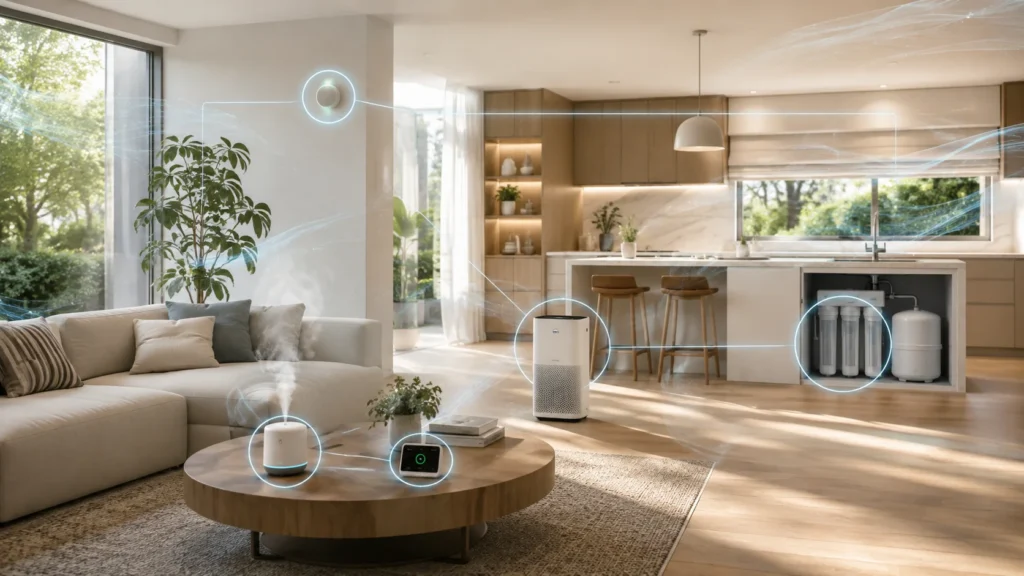
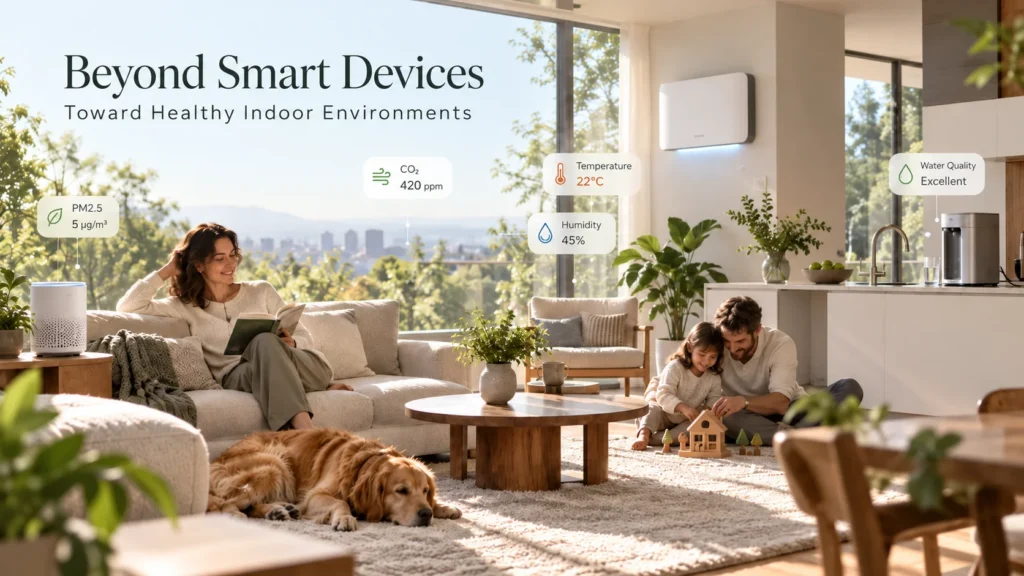
Modern living room with a family enjoying a healthy indoor environment monitored by smart devices, natural lighting, and greenery.

After IFA 2026: The Healthy Home Is Moving Beyond Smart Devices

In our previous IFA 2026 column, Air Purification Is Becoming Part of the Healthy-Home Platform, we argued that the next generation of indoor-health products would ...
News
Modern living room and kitchen with smart home air quality devices including an air purifier, humidifier, and water filtration system, connected with visualized blue connectivity lines.

IFA 2026: Air Purification Is Becoming Part of the Healthy-Home Platform

Pre-IFA Industry Perspective | September 4, 2026 This article is based on official announcements and regulatory information available ahead of IFA 2026, which takes place ...
News
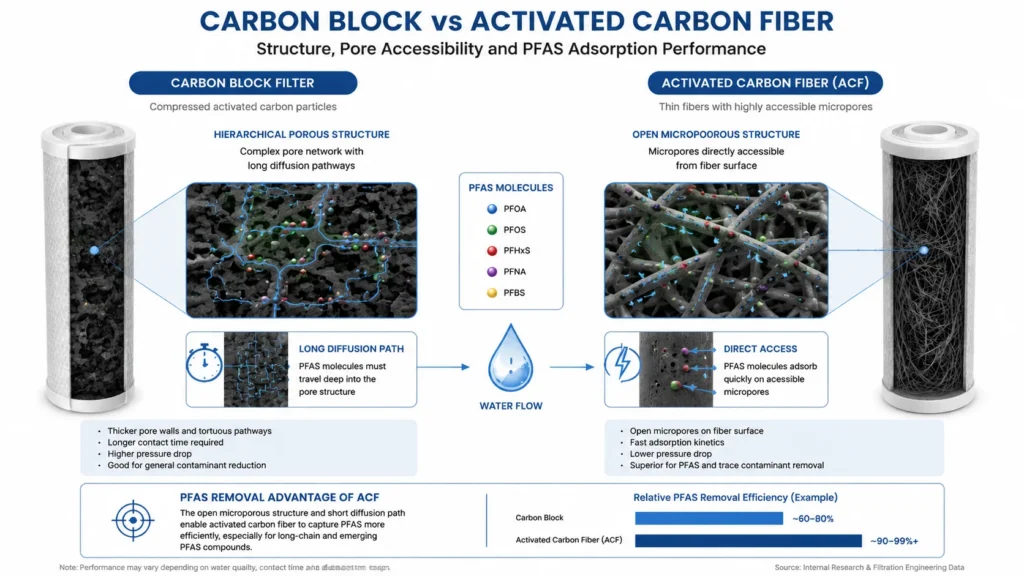
Comparison infographic showcasing the differences between carbon block filter and activated carbon fiber. Detailed diagrams illustrate the hierarchical porous structure of the carbon block with long diffusion paths and the open microporous structure of the activated carbon fiber with direct access for PFAS adsorption.

Carbon Block vs. Activated Carbon Fiber (ACF): Matching Media to Target Contaminants

Two carbon media. Same adsorption chemistry. Very different behaviour in a point-of-use cartridge. If you are specifying a water purifier platform for a PFAS-aware market, ...
News
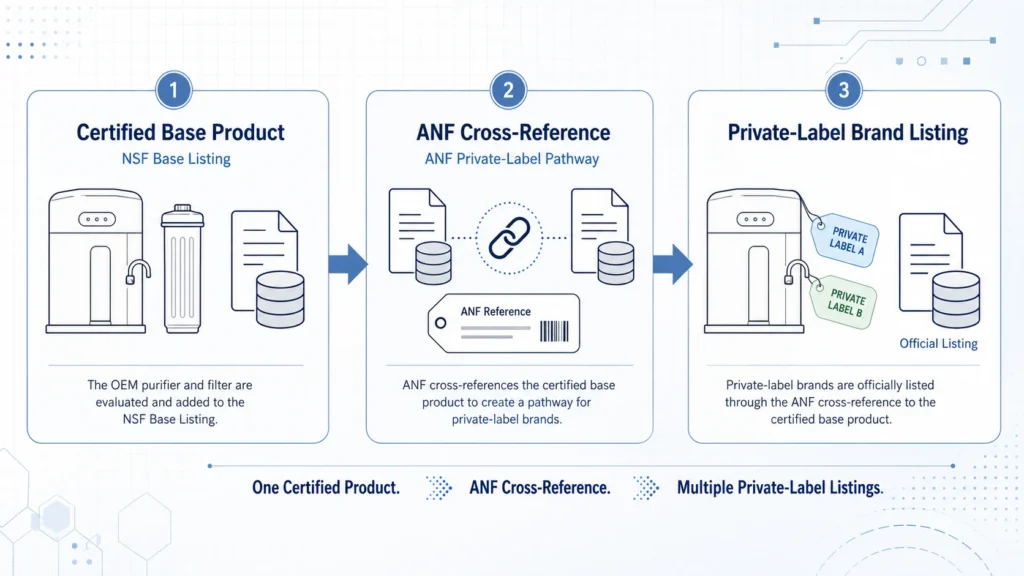
NSF base listing and ANF private-label certification pathway for OEM water filters

What Is an NSF Master Listing? A Guide to Base Listings, ANF Certification and OEM Water Filters

For a brand preparing to launch an OEM water purifier, one of the most common supplier claims is: “We already have an NSF master listing, ...
News, Water Purifiers
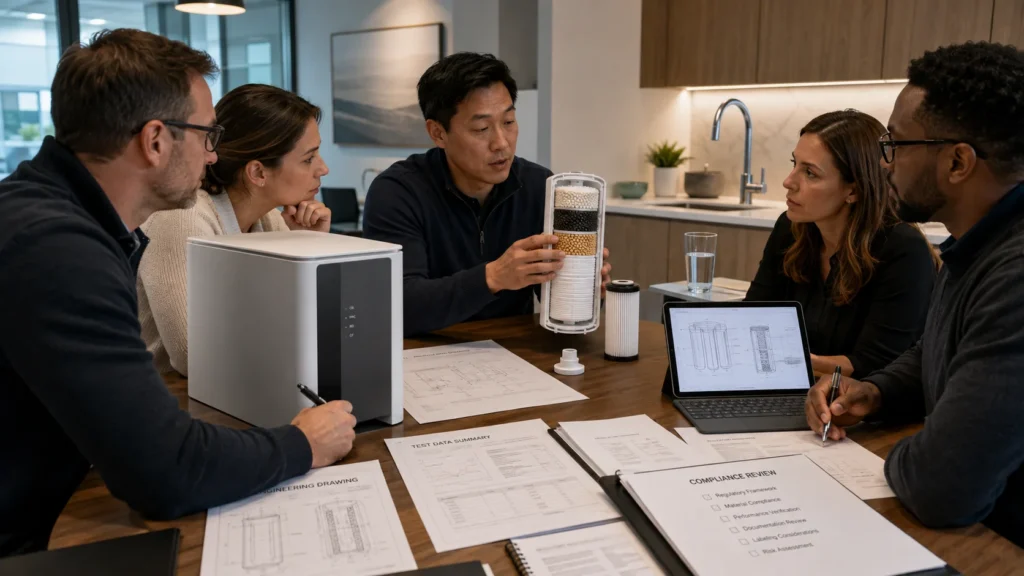
Healthy-home brand team reviewing PFAS water filter certification, test data and product engineering

Entering the Water Category Is Easy. Building a Credible PFAS Claim Is Much Harder

For air purification, appliance and healthy-home brands, entering the water category can look surprisingly easy. A company can select an existing undersink system, customize its ...
News
Team in a business meeting discussing a water filtration system with product components and a comparison table displayed on a screen.

5 Leading OEM Water Purifier Manufacturers in China for Private Label Brands

China has thousands of companies selling water filters, reverse osmosis systems and drinking-water appliances. However, only a portion of them are suitable for private-label, OEM ...
News
Contaminant Engineering•3 min read

PFAS Water Filtration Technologies Explained: Carbon, Resin & RO

Key Takeaway:

PFAS reduction depends on the specific compounds present, treatment media, contact time, water chemistry, and system design. Activated carbon, ion exchange, and Reverse Osmosis address PFAS through different mechanisms.

PFAS are a large family of persistent fluorinated compounds that can occur in drinking-water supplies. Their treatment behavior varies significantly by molecular structure, chain length, functional group, concentration, and the chemistry of the source water.

Granular Activated Carbon (GAC) removes PFAS primarily through adsorption. It is generally more effective for many longer-chain PFAS, while shorter-chain compounds tend to break through more quickly. Carbon performance depends on media properties, Empty Bed Contact Time (EBCT), competing organic matter, loading, and replacement frequency.

Ion-exchange resins use charged functional sites to capture many PFAS compounds. Properly selected anion-exchange media can provide high capacity and may perform better than conventional activated carbon for some shorter-chain PFAS, although performance still depends on water chemistry and competing ions.

Reverse Osmosis (RO) uses membrane separation rather than adsorption. Properly designed RO systems can provide broad reduction across many PFAS compounds as well as dissolved salts and other contaminants. Unlike carbon or resin, however, RO also produces a concentrate stream that must be managed.

No single technology should be selected from a PFAS label alone. System design should consider which PFAS compounds are present, their concentrations, required reduction targets, flow rate, media life, and the applicable third-party certification or validation requirements.

HisoAir Water Technical Series
Product Discovery•3 min read

How to Choose an Under-Sink Water Purifier for Modern Kitchens

Key Takeaway:

Match the treatment technology to your water quality first, then evaluate cabinet space, faucet configuration, flow rate, drain and power requirements, and filter replacement needs.

Choosing an under-sink water purifier starts with water chemistry. Carbon filtration is well suited to chlorine, taste, odor, and many organic contaminants, while Reverse Osmosis is more appropriate when dissolved salts, fluoride, nitrates, or broader dissolved contaminants need to be reduced.

For compact kitchens, tankless RO systems eliminate the conventional storage tank and can significantly reduce the space required under the sink. However, membrane capacity stated in GPD does not directly equal faucet flow. When comparing systems, check the actual dispensing flow rate, inlet-pressure requirement, recovery ratio, and whether a booster pump is required.

Installation architecture also matters. Many RO systems require a drain connection, electrical power, and either a dedicated drinking-water faucet or a compatible multi-function faucet. High-flow carbon systems can often connect directly to the existing cold-water line with a simpler installation, but pressure drop and available faucet flow should still be verified.

RO also removes much of the naturally occurring dissolved mineral content. Where taste or mineral balance is a priority, a post-RO remineralization stage can be added. Filter life should be evaluated by both rated capacity and local water quality rather than replacement time alone.

The right system is therefore not simply the smallest or highest-GPD model. It is the configuration that matches the target contaminants, available cabinet space, desired faucet setup, peak dispensing demand, and maintenance expectations.

HisoAir Water Technical Series
Water Quality•2 min read

What Does TDS Mean in Drinking Water? Measurement vs Contaminant Reality

Key Takeaway:

A TDS meter estimates the overall concentration of dissolved ionic substances from electrical conductivity. It cannot identify specific contaminants or determine whether water is chemically safe.

Total Dissolved Solids (TDS) refers to the combined concentration of dissolved substances in water. Most handheld TDS meters do not measure TDS directly. Instead, they measure electrical conductivity (EC) and convert that reading into an estimated parts-per-million (ppm) value.

This means a TDS reading can indicate how much dissolved ionic material is present, but not what that material actually is. Calcium, magnesium, sodium, nitrates, and other dissolved ions can all contribute to conductivity, yet a simple TDS meter cannot distinguish between them.

TDS meters are also not suitable for detecting trace contaminants such as PFAS, many VOCs, pesticides, pharmaceuticals, or disinfection byproducts. These substances may be present at concentrations far below the level needed to noticeably change electrical conductivity.

A low TDS reading therefore does not guarantee safe drinking water, and a higher TDS reading does not automatically indicate contamination. Water-treatment decisions should be based on laboratory testing for specific contaminants of concern rather than TDS alone.

HisoAir Water Technical Series
Technology Selection•2 min read

RO vs UF Water Filtration: Understanding Pore Sizes & Dissolved Minerals

Key Takeaway:

Ultrafiltration can reduce bacteria, turbidity, and suspended particles while retaining most naturally occurring dissolved minerals. Reverse Osmosis provides much broader reduction of dissolved salts and smaller contaminants.

Ultrafiltration (UF) typically uses hollow-fiber membranes with pore sizes in the approximate 0.01–0.1 micron range. These membranes physically retain turbidity, suspended solids, colloids, and many microorganisms while allowing dissolved minerals and salts to remain in the water.

Reverse Osmosis (RO) operates at a much finer separation level. Unlike UF, RO can substantially reduce dissolved ions such as sodium, calcium, fluoride, nitrates, and other contributors to total dissolved solids (TDS). This makes RO more suitable when dissolved-salt reduction is a primary treatment objective.

UF generally requires less system pressure and produces little or no continuous concentrate stream in many point-of-use configurations. RO typically requires greater pressure and produces a reject-water stream, but delivers broader contaminant reduction.

For water with acceptable TDS and mineral content, UF can be a simpler mineral-retaining treatment option. Where dissolved salts, fluoride, nitrates, or broader dissolved contaminants are a concern, RO is generally the more appropriate technology.

HisoAir Water Technical Series
Technology Selection•4 min read

Carbon Block vs Reverse Osmosis: Which Fits Your Need?

Key Takeaway:

Choose RO for dissolved inorganic salts and heavy metals; choose Carbon Block for chemical taste/odor, no wastewater, and high line-pressure flow.

Reverse Osmosis (RO) and Carbon Block filtration represent two fundamentally different treatment methods: membrane separation and adsorption. Understanding these differences helps determine which technology is better suited to a specific water-quality requirement.

Reverse Osmosis uses a semi-permeable membrane with pore sizes of approximately 0.0001 microns. It can significantly reduce dissolved inorganic contaminants such as TDS, fluoride, nitrates, and certain heavy metals. Because water must be forced through the membrane, RO systems require sufficient pressure or a booster pump and generate a concentrated wastewater stream.

Carbon Block filtration relies primarily on adsorption through compressed activated carbon, commonly with nominal pore sizes around 0.5–5 microns. It is highly effective for chlorine, chloramines, VOCs, taste, and odor, while allowing substantially higher direct-flow rates without producing wastewater.

From an operating perspective, Carbon Block systems are generally simpler, require less energy, and avoid the water loss associated with RO. RO involves higher system complexity and operating cost, but provides substantially broader reduction of dissolved contaminants that Carbon Block alone cannot address.

HisoAir Water Technical Series

REQUEST A QUOTE