S’ouvre dans un nouvel onglet
Solutions innovantes pour la qualité de l'air

Where Are Panasonic Water Purifiers Manufactured?

Related Products

For decades, the Panasonic name has been synonymous with quality, reliability, and innovative technology. When you invest in a Panasonic product, whether it's a television, an air conditioner, or a water purifier, you're buying into a legacy of Japanese engineering excellence. But in today's complex global economy, a simple "Made In" label often tells only part of the story. For B2B and D2C clients who rely on product integrity and supply chain transparency, understanding the full picture is not just interesting it's essential.

So, where exactly are Panasonic's highly-regarded water purifiers manufactured? The answer is not a single factory or even a single country. Instead, Panasonic employs a sophisticated and deliberate global manufacturing strategy, creating a network of specialized hubs that work in concert. This decentralized approach allows the company to leverage the unique strengths of different regions to produce specific types of purifiers, balancing technological leadership with market-specific solutions and logistical efficiency.

This article unpacks Panasonic's multi-pronged manufacturing footprint, exploring the distinct roles of its core production centers in Japan, Indonesia, and Malaysia, and demystifying its complex operations in the vast Indian market.

Japan: The Center of Excellence for Premium Technology

At the heart of Panasonic's global strategy lies its home country, Japan. This is the technological core of the operation, the hub responsible for producing the company's most advanced, highest-value water purification systems. The coveted "Made in Japan" label is more than just a country of origin; it's a strategic branding tool that signifies cutting-edge innovation, meticulous quality control, and superior performance.

Panasonic reserves its Japanese production lines for its top-tier products, particularly its advanced Alkaline Ionizers and sophisticated micro-filtration systems.

panasonic water purifier 3

Alkaline Ionizers: Complex devices like the TK-AS45, which use electrolysis to produce multiple types of pH-balanced water, are consistently marketed as being "Made in Japan". This reinforces their status as a premium, high-technology product for health-conscious consumers.

Advanced Micro-Filtration: High-performance faucet-mounted and under-the-sink models, including the TK-CJ300, TK-CS500, and the popular TK-CS10, are also proudly manufactured in Japan. These units often boast superior filtration capabilities, with models certified to remove up to 17 harmful substances and 99.999% of bacteria.

By concentrating the production of its most complex and highest-margin products in Japan, Panasonic leverages the powerful brand equity associated with Japanese manufacturing. This strategy anchors the company's reputation as a technology leader, justifies a premium price point, and creates a clear product hierarchy for consumers and distributors worldwide. It is a direct link between their most innovative products and the company's deep roots in research and development, likely centered around its corporate headquarters and development centers in Osaka and Shiga.

Indonesia: A Masterclass in Hyper-Local Solutions

While Japan represents technological leadership, Panasonic's operations in Indonesia showcase a commitment to deep market specialization. Instead of exporting a one-size-fits-all solution, the company has invested in local manufacturing to solve specific, pressing water quality challenges faced by Indonesian households.

In February 2020, Panasonic officially announced the establishment of a new business unit at Panasonic Gobel Life Solutions Manufacturing Indonesia, with production of a "central water purifier" commencing the following month. This was a strategic move built on decades of local experience, as Panasonic has been manufacturing water pumps in the country since 1988.

The products made here are purpose-built for the Indonesian market:

  • Iron Removal: Recognizing that many Indonesian homes rely on well water with high iron content, Panasonic developed a central purifier with a high-speed oxidation function specifically to tackle this issue, which was historically difficult to resolve with standard filters.
  • Water Softening: In March 2024, the company expanded its offerings with a new "Water Softener" designed to treat hard water—water with high concentrations of calcium and magnesium. This directly addresses common local problems like limescale buildup and stiffness in washed laundry.

This hyper-local strategy provides a powerful competitive advantage. For distributors and housing developers in Indonesia, it means offering a solution that is demonstrably more effective and relevant than generic imported alternatives. It shows a commitment to improving quality of life and builds immense brand trust, creating a formidable barrier for competitors who lack the same level of localized R\&D and production.

panasonic water purifier 2

Malaysia: The Strategic Hub for Regional Export

The third pillar of Panasonic's strategy is its manufacturing powerhouse in Malaysia, which is positioned as a cost-effective and logistically efficient platform for serving the broader Southeast Asian region.

In late 2023, Panasonic Manufacturing Malaysia Berhad (PMMA) launched its first-ever Reverse Osmosis Water Purifier (ROWP). This was a significant move for two key reasons:

  • Technology Choice: Reverse Osmosis (RO) is a highly effective and widely accepted purification technology, making it ideal for achieving mass-market penetration in the growing economies of Southeast Asia. It fills a crucial mid-tier segment that may find the high-end Japanese Alkaline Ionizers to be cost-prohibitive.
  • Export Focus: The company explicitly stated that the initial target market for these Malaysian-made purifiers is Vietnam. This frames the Malaysian facility not just as a domestic supplier, but as a regional export engine.

This strategy is incredibly astute. Panasonic already operates a massive manufacturing and R\&D ecosystem in Malaysia, particularly for its air conditioning division, which exports to over 120 countries. By adding water purifier production, the company capitalizes on existing infrastructure, established supply chains, and a skilled workforce. This allows Panasonic to achieve significant economies of scale, reduce shipping costs and lead times to neighboring markets, and respond with greater agility to shifts in regional demand. Malaysia serves as the workhorse of the regional supply strategy, perfectly complementing the high-tech innovation from Japan and the specialized problem-solving from Indonesia.

The Indian Puzzle: Reconciling Market Presence with Manufacturing Reality

India represents a high-priority market for Panasonic, which offers a comprehensive portfolio of water purifiers tailored to local needs, from advanced Alkaline+RO+UV models to basic non-electric purifiers. The central question, however, is where these units are made.

While some third-party retail and B2B platforms label certain models, like the TK-CS50, as "Made in India", there is a conspicuous absence of official corporate announcements from Panasonic confirming dedicated, end-to-end water purifier manufacturing in the country. This stands in stark contrast to the clear and proactive communications regarding its investments in Indonesia and Malaysia.

A closer look at Panasonic's established Indian manufacturing entities reveals a focus on other product categories:

  • Panasonic Life Solutions India Pvt. Ltd.: This entity, which grew from the acquisition of Anchor Electricals, operates seven factories and is a dominant force in electrical construction materials (ECM) like switches, sockets, and switchgear. Its major plants in Sri City, Daman, and Jhajjar are focused on these ECM products or, in the case of Jhajjar, other large appliances (though production of refrigerators and washing machines recently ceased there due to intense competition). Water purifiers are not mentioned in corporate disclosures about these facilities.
  • Panasonic Appliances India Company Ltd. (PAPIN): This company's factory in Sholavaram, Chennai, has a clear and long-standing focus on small kitchen appliances. It pioneered the manufacturing of electric rice cookers in India and later added mixer-grinders to its production lines. Again, water purifiers are absent from its list of locally manufactured goods.

This discrepancy strongly suggests that Panasonic employs a more flexible, asset-light supply chain strategy for water purifiers in the highly competitive Indian market. Rather than investing in a dedicated factory, it is highly probable that the "Made in India" label is achieved through:

  • Local Assembly: Importing Completely Knocked-Down (CKD) or Semi Knocked-Down (SKD) kits and performing final assembly within India.
  • Contract Manufacturing: Partnering with a third-party Original Equipment Manufacturer (OEM) to produce the purifiers to Panasonic's specifications.

This approach offers an optimal balance of benefits. It allows Panasonic to serve the crucial Indian market, reduce the impact of import tariffs, and leverage the "Made in India" label for consumer appeal, all while maintaining the operational flexibility to scale up or down without the immense capital risk of building and owning a dedicated factory.

panasonic water purifier 5

What This Global Strategy Means for You

For B2B and D2C clients, Panasonic's nuanced manufacturing strategy is a powerful indicator of its strength as a business partner. It demonstrates:

  • A Commitment to Quality: The top-of-the-line products are still rooted in the unmatched quality control of Japanese manufacturing.
  • Market Intelligence: The company doesn't force a single product on the world. It invests in understanding and building solutions for the unique needs of different markets, as seen in Indonesia.
  • Supply Chain Resilience: A diversified, multi-country manufacturing network is inherently more resilient to geopolitical, economic, or logistical disruptions than a centralized model. This means a more reliable and stable supply of products for your business.
  • Strategic Agility: The flexible approach in markets like India shows that Panasonic can adapt its business model to local competitive dynamics, ensuring its long-term viability and presence.

Ultimately, the question of where Panasonic water purifiers are made reveals more than just a list of locations. It unveils a sophisticated, resilient, and intelligent global strategy designed to deliver on the brand's promise of quality and innovation no matter where in the world its customers are.

Partager :
fondateur de hisoair m. lee
Alwen Lee, an air purification expert with over 10 years of experience, is a devoted father of two and a passionate traveler, having explored more than 30 countries. With a love for public speaking and swimming, he has dedicated his life to the indoor air quality industry. His mission is to ensure that people around the world enjoy the freedom to breathe clean air and lead happy, healthy lives.

Envoyez-nous un message

Plus à lire

Comparison between PFAS-ready and PFAS-certified water filters, showing internal filter components and certification steps.

PFAS-Ready vs. PFAS-Certified Water Filters: Engineering Differences for OEM Brands

For an appliance, wellness or healthy-home brand preparing to launch a water purifier, the phrase “PFAS-ready” can sound reassuring. The proposed system may use activated ...
Water Purifiers
NSF base listing and ANF private-label certification pathway for OEM water filters

What Is an NSF Master Listing? A Guide to Base Listings, ANF Certification and OEM Water Filters

For a brand preparing to launch an OEM water purifier, one of the most common supplier claims is: “We already have an NSF master listing, ...
News, Water Purifiers
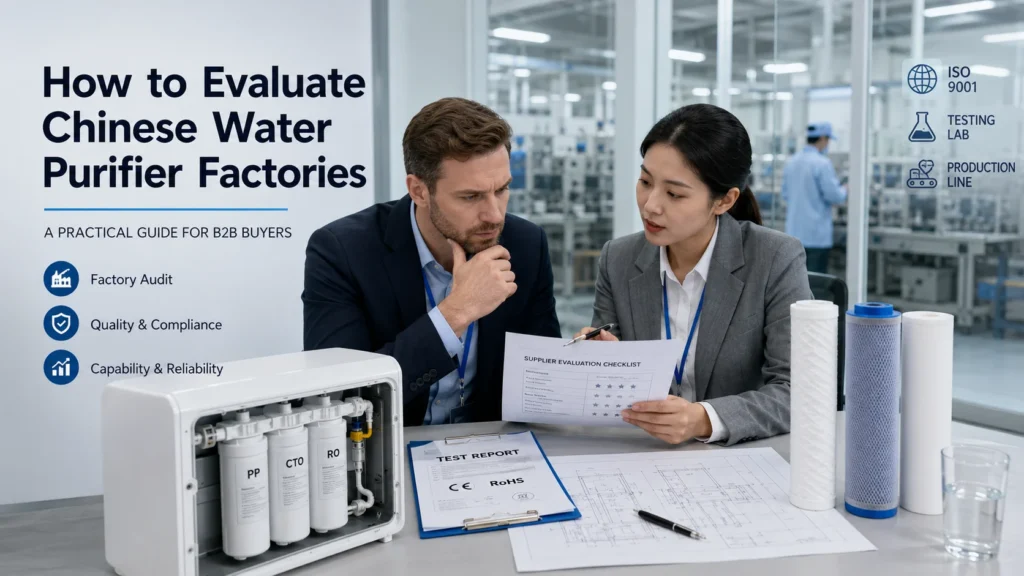
Two professionals discussing a supplier evaluation checklist at a table with water purifier parts, documents, and technical drawings in a factory setting.

Water Purifier Manufacturer in China: 12 Questions B2B Buyers Should Ask

Finding a water purifier manufacturer in China is easy. Finding a factory that can support your target contaminants, certification pathway, product positioning and long-term replacement-filter ...
News, Water Purifiers
Featured image for Why Stainless Steel Water Purifiers Are Becoming the Premium Choice for Wellness Brands

Why Stainless Steel Water Purifiers Are Becoming the Premium Choice for Wellness Brands

Choose stainless steel purifiers for purity, aesthetics, and sustainability. Elevate your wellness brand with premium quality today!
News, Water Purifiers
Featured image for What Biohacking & Longevity Consumers Want in a Water Purification System

What Biohacking & Longevity Consumers Want in a Water Purification System

Discover pure, re-mineralized water systems. No plastics, complete RO, perfect for biohacking longevity. Upgrade your hydration now!
News, Water Purifiers
Featured image for How Premium Water Appliances Improve Sleep, Skin, and Daily Energy

How Premium Water Appliances Improve Sleep, Skin, and Daily Energy

Unlock better sleep, radiant skin, and energy with mineral-rich water. Discover the power of premium appliances for your ultimate wellness boost.
News, Water Purifiers
Contaminant Engineering•3 min read

PFAS Water Filtration Technologies Explained: Carbon, Resin & RO

Key Takeaway:

PFAS reduction depends on the specific compounds present, treatment media, contact time, water chemistry, and system design. Activated carbon, ion exchange, and Reverse Osmosis address PFAS through different mechanisms.

PFAS are a large family of persistent fluorinated compounds that can occur in drinking-water supplies. Their treatment behavior varies significantly by molecular structure, chain length, functional group, concentration, and the chemistry of the source water.

Granular Activated Carbon (GAC) removes PFAS primarily through adsorption. It is generally more effective for many longer-chain PFAS, while shorter-chain compounds tend to break through more quickly. Carbon performance depends on media properties, Empty Bed Contact Time (EBCT), competing organic matter, loading, and replacement frequency.

Ion-exchange resins use charged functional sites to capture many PFAS compounds. Properly selected anion-exchange media can provide high capacity and may perform better than conventional activated carbon for some shorter-chain PFAS, although performance still depends on water chemistry and competing ions.

Reverse Osmosis (RO) uses membrane separation rather than adsorption. Properly designed RO systems can provide broad reduction across many PFAS compounds as well as dissolved salts and other contaminants. Unlike carbon or resin, however, RO also produces a concentrate stream that must be managed.

No single technology should be selected from a PFAS label alone. System design should consider which PFAS compounds are present, their concentrations, required reduction targets, flow rate, media life, and the applicable third-party certification or validation requirements.

HisoAir Water Technical Series
Product Discovery•3 min read

How to Choose an Under-Sink Water Purifier for Modern Kitchens

Key Takeaway:

Match the treatment technology to your water quality first, then evaluate cabinet space, faucet configuration, flow rate, drain and power requirements, and filter replacement needs.

Choosing an under-sink water purifier starts with water chemistry. Carbon filtration is well suited to chlorine, taste, odor, and many organic contaminants, while Reverse Osmosis is more appropriate when dissolved salts, fluoride, nitrates, or broader dissolved contaminants need to be reduced.

For compact kitchens, tankless RO systems eliminate the conventional storage tank and can significantly reduce the space required under the sink. However, membrane capacity stated in GPD does not directly equal faucet flow. When comparing systems, check the actual dispensing flow rate, inlet-pressure requirement, recovery ratio, and whether a booster pump is required.

Installation architecture also matters. Many RO systems require a drain connection, electrical power, and either a dedicated drinking-water faucet or a compatible multi-function faucet. High-flow carbon systems can often connect directly to the existing cold-water line with a simpler installation, but pressure drop and available faucet flow should still be verified.

RO also removes much of the naturally occurring dissolved mineral content. Where taste or mineral balance is a priority, a post-RO remineralization stage can be added. Filter life should be evaluated by both rated capacity and local water quality rather than replacement time alone.

The right system is therefore not simply the smallest or highest-GPD model. It is the configuration that matches the target contaminants, available cabinet space, desired faucet setup, peak dispensing demand, and maintenance expectations.

HisoAir Water Technical Series
Water Quality•2 min read

What Does TDS Mean in Drinking Water? Measurement vs Contaminant Reality

Key Takeaway:

A TDS meter estimates the overall concentration of dissolved ionic substances from electrical conductivity. It cannot identify specific contaminants or determine whether water is chemically safe.

Total Dissolved Solids (TDS) refers to the combined concentration of dissolved substances in water. Most handheld TDS meters do not measure TDS directly. Instead, they measure electrical conductivity (EC) and convert that reading into an estimated parts-per-million (ppm) value.

This means a TDS reading can indicate how much dissolved ionic material is present, but not what that material actually is. Calcium, magnesium, sodium, nitrates, and other dissolved ions can all contribute to conductivity, yet a simple TDS meter cannot distinguish between them.

TDS meters are also not suitable for detecting trace contaminants such as PFAS, many VOCs, pesticides, pharmaceuticals, or disinfection byproducts. These substances may be present at concentrations far below the level needed to noticeably change electrical conductivity.

A low TDS reading therefore does not guarantee safe drinking water, and a higher TDS reading does not automatically indicate contamination. Water-treatment decisions should be based on laboratory testing for specific contaminants of concern rather than TDS alone.

HisoAir Water Technical Series
Technology Selection•2 min read

RO vs UF Water Filtration: Understanding Pore Sizes & Dissolved Minerals

Key Takeaway:

Ultrafiltration can reduce bacteria, turbidity, and suspended particles while retaining most naturally occurring dissolved minerals. Reverse Osmosis provides much broader reduction of dissolved salts and smaller contaminants.

Ultrafiltration (UF) typically uses hollow-fiber membranes with pore sizes in the approximate 0.01–0.1 micron range. These membranes physically retain turbidity, suspended solids, colloids, and many microorganisms while allowing dissolved minerals and salts to remain in the water.

Reverse Osmosis (RO) operates at a much finer separation level. Unlike UF, RO can substantially reduce dissolved ions such as sodium, calcium, fluoride, nitrates, and other contributors to total dissolved solids (TDS). This makes RO more suitable when dissolved-salt reduction is a primary treatment objective.

UF generally requires less system pressure and produces little or no continuous concentrate stream in many point-of-use configurations. RO typically requires greater pressure and produces a reject-water stream, but delivers broader contaminant reduction.

For water with acceptable TDS and mineral content, UF can be a simpler mineral-retaining treatment option. Where dissolved salts, fluoride, nitrates, or broader dissolved contaminants are a concern, RO is generally the more appropriate technology.

HisoAir Water Technical Series
Technology Selection•4 min read

Carbon Block vs Reverse Osmosis: Which Fits Your Need?

Key Takeaway:

Choose RO for dissolved inorganic salts and heavy metals; choose Carbon Block for chemical taste/odor, no wastewater, and high line-pressure flow.

Reverse Osmosis (RO) and Carbon Block filtration represent two fundamentally different treatment methods: membrane separation and adsorption. Understanding these differences helps determine which technology is better suited to a specific water-quality requirement.

Reverse Osmosis uses a semi-permeable membrane with pore sizes of approximately 0.0001 microns. It can significantly reduce dissolved inorganic contaminants such as TDS, fluoride, nitrates, and certain heavy metals. Because water must be forced through the membrane, RO systems require sufficient pressure or a booster pump and generate a concentrated wastewater stream.

Carbon Block filtration relies primarily on adsorption through compressed activated carbon, commonly with nominal pore sizes around 0.5–5 microns. It is highly effective for chlorine, chloramines, VOCs, taste, and odor, while allowing substantially higher direct-flow rates without producing wastewater.

From an operating perspective, Carbon Block systems are generally simpler, require less energy, and avoid the water loss associated with RO. RO involves higher system complexity and operating cost, but provides substantially broader reduction of dissolved contaminants that Carbon Block alone cannot address.

HisoAir Water Technical Series

DEMANDER UN DEVIS