Opens in a new tab
Innovative Air Quality Solutions

How Long Should You Run an Air Purifier?

Running your air purifier 24/7 is ideal . A room can become recontaminated within 2-4 hours if you leave it off. But how long should you run an air purifier if you're often out of the house or if you're always in the house?

Most studies and air purifier manufacturers insist on running your commercial air purifier all day. But..

  • Are you worried about the cost on your bill if you run your fresh air machine too long in a day?
  • Are there any safety issues if you leave your house while the air sanitizer machine is still on?

In this post, you're going to find out how long you should run an air purifier and the safety, cost and air quality acquainted to it.
How Long Should You Run an Air Purifier?

How Long to Run an Air Purifier - Short Answer

You should run your air purifier 24 hours a day . The reason for this is that the air can become recontaminated with dust, allergens or pollen almost instantly.

how long to run an air purifier
Source: Old Almanac

I know, I know, you wouldn't want to waste away on electric bills or degrade early on its useful life. But portable air purifiers are smartly designed to operate continuously and some even have Energy Star ratings to conserve on electricity.

In the next section, we'll show you how energy efficient an air purifier can be.

Does the Air Purifier Use a Lot of Electricity?

The fact of the matter is, air purifiers conserve a bulk of electricity . We'll tell you why.

Does the Air Purifier Use a Lot of Electricity

Air cleaning machines have a maximum power consumption of 40W to 200W for its highest fan speed setting . When you choose to run it at the lower speeds , which most of us do, it will only consume 10W to 30W .

To visualize this, think of the light bulb you use at home. Light bulbs consume 60W. Your laptop typically consumes 50W, while a refrigerator is about 150 watts. And these devices usually run all day long. Running your commercial air sanitizer machine consumes less energy than these machines.

Typical Household Appliances

Average Wattage

Refrigerator

150 Watts

light bulb

60 Watts

Laptop

50 Watts

Air Purifier

40 Watts

Hence, air purifiers are more energy efficient than these appliances and it's not going to affect your bill enormously.

How Much Does It Cost to Run an Air Purifier All Day?

Typically, air purifiers average between $4 to $15 a month on your electric bill.

Below, we explain how to get the real monthly cost or running an air purifier all day. And let's compare with your other appliances' consumption.

Typically, what you can see in your bill is the kilowatt-hour consumption of your electric device. So let's take the air purifier power consumption. As mentioned, an air cleaning machine for home usually takes 10W to 30W on its lowest setting and 40W to 200W on its highest setting in one (1) hour.

Let's take a look at HisoAir's HA128 Air Purifier with a power consumption of 45W or 0.045KW.

Running it all day means switching it on for 24 hours for 30 days in a month .

To get the monthly power consumption, we do this:

Monthly power consumption (KW-hr) = air purifier wattage x 24 hours x 30 days

For this example, we get 0.045W x 24hours x 30days = 32.4 KW-hour

Electricity costs average around 13.11 cents per kilowatt-hour.

To get the monthly cost for an air purifier running 24/7, we do this:

Monthly Electric Cost ($) = Monthly Power Consumption x Cost per KW-Hr

For the example above, we get 32.4 KW-hour x 13.11 cents per kilowatt-hour = $4.2 per month .

How about for your refrigerator running 24 hours a day ? Applying the same principle, your fridge's monthly electric cost is: 0.150W x 24 hours x 30 days x 13.11 cents per kw-hr = $14.15 per month!

See the difference? So why worry about your air cleaning machine running all day when you can get more healthy and pay only a fraction of the cost?

Ways to Conserve on Air Purifier Electricity (if you're super thrifty)

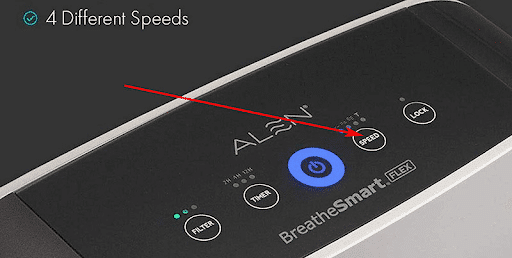
Tip #1 Schedule the Fan Speed ​​Modes

Schedule the Fan Speed ​​Modes 4 different speeds for alen unit

Air disinfection machines are designed with smart sensors and can run on auto mode to reduce fan power whenever the room is tidy. This way, it won't put much pressure on the bill. You can schedule it to run at high speeds only at limited hours in a day if you're being thrifty.

Nevertheless, it's a matter of choosing a good brand so you won't worry about running it all day. So selecting a good quality air clean air machine for home would do better in the long run, even with a higher initial cost.

For that, we recommend the HisoAir brand , offered in small to large air purifier units. If you're on budget but still want a high performance HEPA air purifier , this will cover you.

Tip #2 Run It at Low Speed ​​If You're Not Home

Run your air cleaning machine at Low Speed ​​If You're Not Home

Turn it to its lowest setting if you're not home or if you have indoor plants.

Tip #3 Vary the Speed ​​Settings According to the Time of the Year

Vary the Speed ​​Settings According to the Time of the Year

Adjust the speed setting according to the time of the year. For example, during summers, there is lots of dust and pollen, so you can run your air purifier at higher speeds than in winter.

How Often to Run an Air Purifier at Full Speed?
running an air purifier at full speed

Source: Pinterest

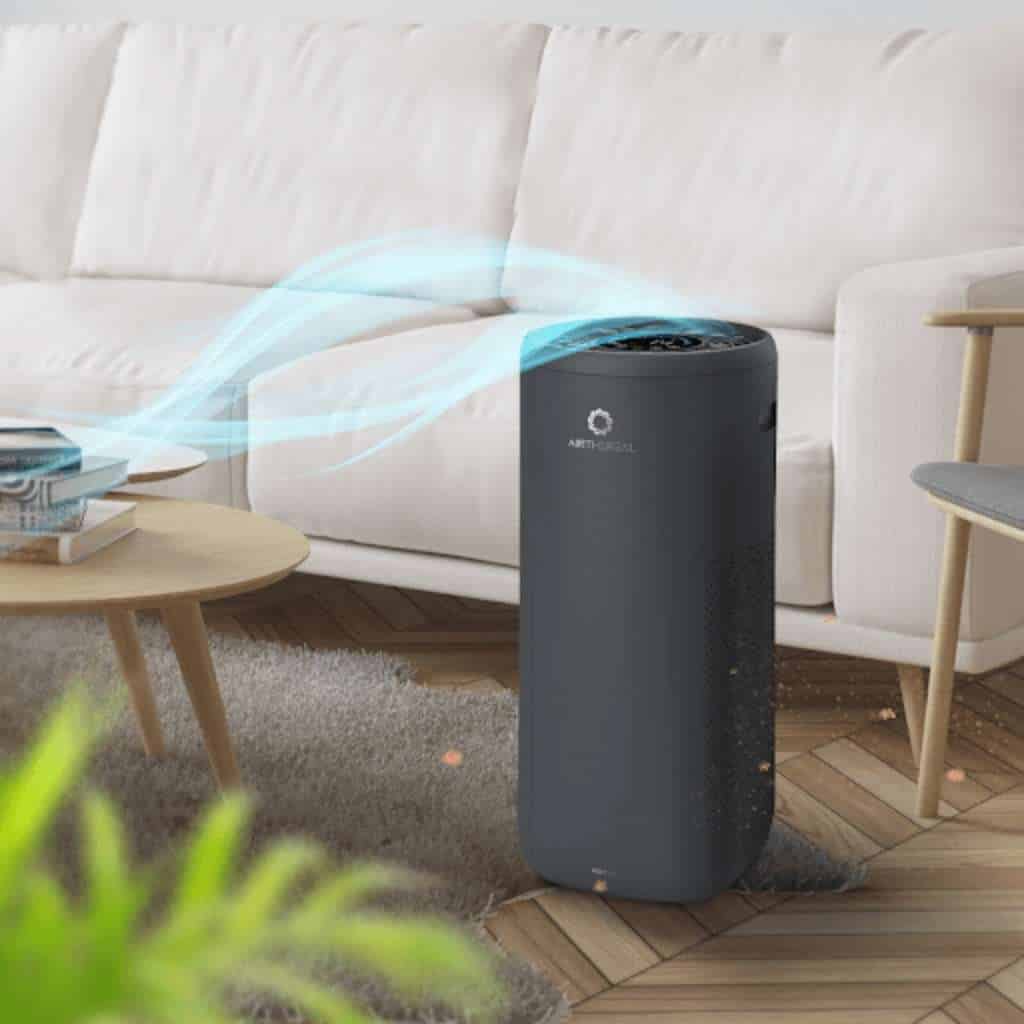
To better optimize its performance, only turn it on at full speed when you're at home. Then you can set it back to low speed whenever you're going out.

It's okay not to run the air cleaner machine for home at full speed all day long while optimizing its full performance. This brings us to the next question: How long does it take an air purifier to clean a room anyway?

How Long Does It Take An Air Purifier to Clean A Room?

In short, most air purifiers take 30 minutes to 2 hours to sanitize the air in your room. In just 20 minutes, there should be a noticeable difference in the air quality in your room.

For you to determine how long it takes for your air dust filter machine to purify the room, you should know your room size and the Clean Air Delivery Rate (CADR) of your air purifier. This is to know the air changes per hour (ACH ) the air purifier can perform. The ACH is the number of times a certain volume of air can be cleaned from the room in an hour.

For instance, a home air sanitizer machine has a CADR of 400 CFM and you have a 176 square feet room size. This means the air ionizer machine is running at 4 ACH or cleans the air 4 times in an hour (15 minutes per charge) .

Your weather, humidity and location can also play a role in how fast the commercial air sanitizer machine works. There are more dusts during summer which means it will take longer for the air purifier to clean the air.

Is It Safe to Leave an Air Purifier On All Day?

Yes, it is alright to leave the air purifier on 24/7 to maintain a clean indoor air environment. The only downside to this is that the electric consumption will be a little higher. However, air purifiers do not use a lot of electricity which means it doesn't put much cost on your bill.

Remember that dust can easily contaminate the air. So if you choose to turn off your dust purifier machine to save a little on electric costs, this would leave your home as dirty as before you turn it on.

Should I Sleep With an Air Purifier On?

should you sleep with an air purifier still on

Yes, you should turn your air cleaner machine on in your bedroom, especially if you suffer from asthma, allergies or other respiratory illnesses.

This is because each time you turn off your air purifier, air can become immediately polluted in just 15 minutes.

A study conducted by the Smart Air Filters showed how air can become 50% polluted in just 15 minutes. At 80 minutes, air can become 100% polluted.

graph showing how long does it take for a room to get dusty again after turning off air purifier

So when you turn off your air purifier while sleeping, you will end up breathing unclean air.

Wrapping Up

We hope this article helped you understand how long you should run your air purifier and how little can you spend running it 24/7.

If you want to know the top air purifier manufacturers in China, we've written a separate article for this. 5 Best Air Purifier Manufacturers in China (2021).

HisoAir is an air purifier supplier in China offering ODM/OEM services. We have a large variety of air purifiers for homes, industries, hospitals and hotels. Check out our other recommendations for air purifiers or you can contact us if you want a quotation for wholesale air purifiers.

Share:
hisoair founder mr lee
Alwen Lee, an air purification expert with over 10 years of experience, is a devoted father of two and a passionate traveler, having explored more than 30 countries. With a love for public speaking and swimming, he has dedicated his life to the indoor air quality industry. His mission is to ensure that people around the world enjoy the freedom to breathe clean air and lead happy, healthy lives.

Send Us A Message

More to Read

Modern living room with a family enjoying a healthy indoor environment monitored by smart devices, natural lighting, and greenery.

After IFA 2026: The Healthy Home Is Moving Beyond Smart Devices

In our previous IFA 2026 column, Air Purification Is Becoming Part of the Healthy-Home Platform, we argued that the next generation of indoor-health products would ...
News
Modern living room and kitchen with smart home air quality devices including an air purifier, humidifier, and water filtration system, connected with visualized blue connectivity lines.

IFA 2026: Air Purification Is Becoming Part of the Healthy-Home Platform

Pre-IFA Industry Perspective | September 4, 2026 This article is based on official announcements and regulatory information available ahead of IFA 2026, which takes place ...
News
A modern office room with a gray wall-mounted air purifier, large wooden desk, office chairs, indoor plants, and glass windows offering a city view.

Luftreiniger gegen Staub: HEPA-Luftreinigung für Büro, Gewerbe und Industrie

Kurz gesagt: Ein Luftreiniger entfernt Staub aus der Luft – nicht vom Schreibtisch. Er reduziert die Konzentration schwebender Partikel und damit auch die Menge an ...
Air purifier, Filter
Comparison infographic showcasing the differences between carbon block filter and activated carbon fiber. Detailed diagrams illustrate the hierarchical porous structure of the carbon block with long diffusion paths and the open microporous structure of the activated carbon fiber with direct access for PFAS adsorption.

Carbon Block vs. Activated Carbon Fiber (ACF): Matching Media to Target Contaminants

Two carbon media. Same adsorption chemistry. Very different behaviour in a point-of-use cartridge. If you are specifying a water purifier platform for a PFAS-aware market, ...
News
NSF base listing and ANF private-label certification pathway for OEM water filters

What Is an NSF Master Listing? A Guide to Base Listings, ANF Certification and OEM Water Filters

For a brand preparing to launch an OEM water purifier, one of the most common supplier claims is: “We already have an NSF master listing, ...
News, Water Purifiers
Healthy-home brand team reviewing PFAS water filter certification, test data and product engineering

Entering the Water Category Is Easy. Building a Credible PFAS Claim Is Much Harder

For air purification, appliance and healthy-home brands, entering the water category can look surprisingly easy. A company can select an existing undersink system, customize its ...
News
Contaminant Engineering•3 min read

PFAS Water Filtration Technologies Explained: Carbon, Resin & RO

Key Takeaway:

PFAS reduction depends on the specific compounds present, treatment media, contact time, water chemistry, and system design. Activated carbon, ion exchange, and Reverse Osmosis address PFAS through different mechanisms.

PFAS are a large family of persistent fluorinated compounds that can occur in drinking-water supplies. Their treatment behavior varies significantly by molecular structure, chain length, functional group, concentration, and the chemistry of the source water.

Granular Activated Carbon (GAC) removes PFAS primarily through adsorption. It is generally more effective for many longer-chain PFAS, while shorter-chain compounds tend to break through more quickly. Carbon performance depends on media properties, Empty Bed Contact Time (EBCT), competing organic matter, loading, and replacement frequency.

Ion-exchange resins use charged functional sites to capture many PFAS compounds. Properly selected anion-exchange media can provide high capacity and may perform better than conventional activated carbon for some shorter-chain PFAS, although performance still depends on water chemistry and competing ions.

Reverse Osmosis (RO) uses membrane separation rather than adsorption. Properly designed RO systems can provide broad reduction across many PFAS compounds as well as dissolved salts and other contaminants. Unlike carbon or resin, however, RO also produces a concentrate stream that must be managed.

No single technology should be selected from a PFAS label alone. System design should consider which PFAS compounds are present, their concentrations, required reduction targets, flow rate, media life, and the applicable third-party certification or validation requirements.

HisoAir Water Technical Series
Product Discovery•3 min read

How to Choose an Under-Sink Water Purifier for Modern Kitchens

Key Takeaway:

Match the treatment technology to your water quality first, then evaluate cabinet space, faucet configuration, flow rate, drain and power requirements, and filter replacement needs.

Choosing an under-sink water purifier starts with water chemistry. Carbon filtration is well suited to chlorine, taste, odor, and many organic contaminants, while Reverse Osmosis is more appropriate when dissolved salts, fluoride, nitrates, or broader dissolved contaminants need to be reduced.

For compact kitchens, tankless RO systems eliminate the conventional storage tank and can significantly reduce the space required under the sink. However, membrane capacity stated in GPD does not directly equal faucet flow. When comparing systems, check the actual dispensing flow rate, inlet-pressure requirement, recovery ratio, and whether a booster pump is required.

Installation architecture also matters. Many RO systems require a drain connection, electrical power, and either a dedicated drinking-water faucet or a compatible multi-function faucet. High-flow carbon systems can often connect directly to the existing cold-water line with a simpler installation, but pressure drop and available faucet flow should still be verified.

RO also removes much of the naturally occurring dissolved mineral content. Where taste or mineral balance is a priority, a post-RO remineralization stage can be added. Filter life should be evaluated by both rated capacity and local water quality rather than replacement time alone.

The right system is therefore not simply the smallest or highest-GPD model. It is the configuration that matches the target contaminants, available cabinet space, desired faucet setup, peak dispensing demand, and maintenance expectations.

HisoAir Water Technical Series
Water Quality•2 min read

What Does TDS Mean in Drinking Water? Measurement vs Contaminant Reality

Key Takeaway:

A TDS meter estimates the overall concentration of dissolved ionic substances from electrical conductivity. It cannot identify specific contaminants or determine whether water is chemically safe.

Total Dissolved Solids (TDS) refers to the combined concentration of dissolved substances in water. Most handheld TDS meters do not measure TDS directly. Instead, they measure electrical conductivity (EC) and convert that reading into an estimated parts-per-million (ppm) value.

This means a TDS reading can indicate how much dissolved ionic material is present, but not what that material actually is. Calcium, magnesium, sodium, nitrates, and other dissolved ions can all contribute to conductivity, yet a simple TDS meter cannot distinguish between them.

TDS meters are also not suitable for detecting trace contaminants such as PFAS, many VOCs, pesticides, pharmaceuticals, or disinfection byproducts. These substances may be present at concentrations far below the level needed to noticeably change electrical conductivity.

A low TDS reading therefore does not guarantee safe drinking water, and a higher TDS reading does not automatically indicate contamination. Water-treatment decisions should be based on laboratory testing for specific contaminants of concern rather than TDS alone.

HisoAir Water Technical Series
Technology Selection•2 min read

RO vs UF Water Filtration: Understanding Pore Sizes & Dissolved Minerals

Key Takeaway:

Ultrafiltration can reduce bacteria, turbidity, and suspended particles while retaining most naturally occurring dissolved minerals. Reverse Osmosis provides much broader reduction of dissolved salts and smaller contaminants.

Ultrafiltration (UF) typically uses hollow-fiber membranes with pore sizes in the approximate 0.01–0.1 micron range. These membranes physically retain turbidity, suspended solids, colloids, and many microorganisms while allowing dissolved minerals and salts to remain in the water.

Reverse Osmosis (RO) operates at a much finer separation level. Unlike UF, RO can substantially reduce dissolved ions such as sodium, calcium, fluoride, nitrates, and other contributors to total dissolved solids (TDS). This makes RO more suitable when dissolved-salt reduction is a primary treatment objective.

UF generally requires less system pressure and produces little or no continuous concentrate stream in many point-of-use configurations. RO typically requires greater pressure and produces a reject-water stream, but delivers broader contaminant reduction.

For water with acceptable TDS and mineral content, UF can be a simpler mineral-retaining treatment option. Where dissolved salts, fluoride, nitrates, or broader dissolved contaminants are a concern, RO is generally the more appropriate technology.

HisoAir Water Technical Series
Technology Selection•4 min read

Carbon Block vs Reverse Osmosis: Which Fits Your Need?

Key Takeaway:

Choose RO for dissolved inorganic salts and heavy metals; choose Carbon Block for chemical taste/odor, no wastewater, and high line-pressure flow.

Reverse Osmosis (RO) and Carbon Block filtration represent two fundamentally different treatment methods: membrane separation and adsorption. Understanding these differences helps determine which technology is better suited to a specific water-quality requirement.

Reverse Osmosis uses a semi-permeable membrane with pore sizes of approximately 0.0001 microns. It can significantly reduce dissolved inorganic contaminants such as TDS, fluoride, nitrates, and certain heavy metals. Because water must be forced through the membrane, RO systems require sufficient pressure or a booster pump and generate a concentrated wastewater stream.

Carbon Block filtration relies primarily on adsorption through compressed activated carbon, commonly with nominal pore sizes around 0.5–5 microns. It is highly effective for chlorine, chloramines, VOCs, taste, and odor, while allowing substantially higher direct-flow rates without producing wastewater.

From an operating perspective, Carbon Block systems are generally simpler, require less energy, and avoid the water loss associated with RO. RO involves higher system complexity and operating cost, but provides substantially broader reduction of dissolved contaminants that Carbon Block alone cannot address.

HisoAir Water Technical Series

REQUEST A QUOTE