
新しいタブで開きます
革新的な空気品質ソリューション

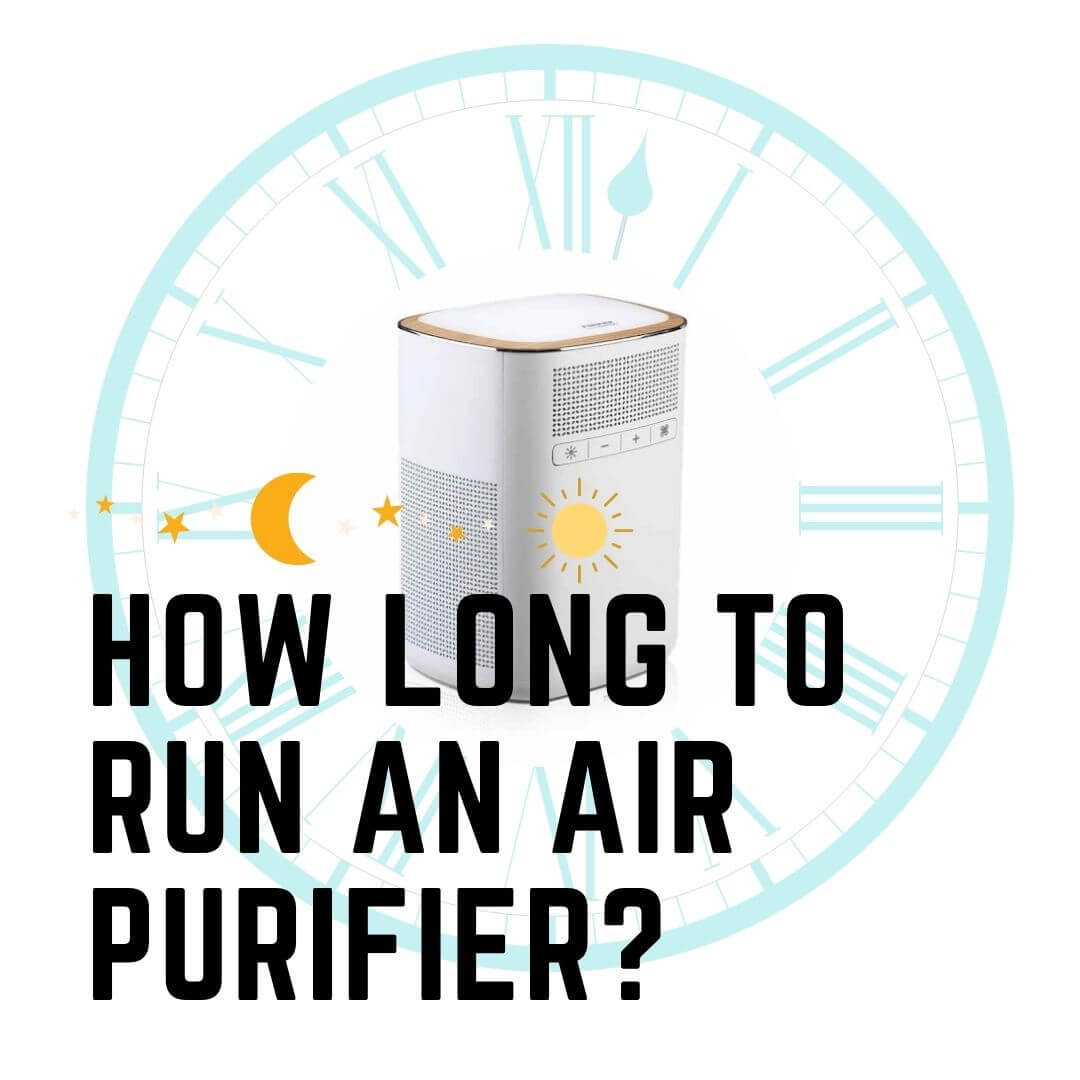
空気清浄機はどのくらいの期間稼働させるべきか?

空気清浄機を24時間365日稼働させるのが理想的 .電源を切ったままにしておくと、部屋は2~4時間で再汚染されてしまう。しかし、外出が多い人や常に家の中にいる人は、空気清浄機をどれくらいの時間稼働させればいいのだろうか?

ほとんどの研究と 空気清浄機メーカー 業務用空気清浄機を一日中稼働させろと主張する。しかし

  • 1日に新鮮空気清浄機を長時間稼働させると、電気代がかさむことを心配されていませんか?
  • 空気除菌機をつけたまま外出した場合、安全性に問題はありませんか?

この記事では、空気清浄機の運転期間、安全性、コスト、空気の質についてご紹介します。
空気清浄機はどのくらいの期間稼働させるべきか?

空気清浄機の運転時間 - 短い回答

空気清浄機は1日24時間稼働させるべし .その理由は、空気がほこりやアレルゲン、花粉でほとんど瞬時に再汚染される可能性があるからだ。

空気清浄機の運転時間
ソースオールド・アルマナック

電気代がもったいないし、耐用年数が早まるのも嫌ですよね。しかし、ポータブル空気清浄機は連続運転ができるようにスマートに設計されており、中には電気代を節約するためにエネルギースタークラスに格付けされているものさえある。

次のセクションでは、空気清浄機のエネルギー効率の高さを紹介しよう。

空気清浄機は電気をたくさん使いますか?

実際のところ、空気清浄機は 大量の電力を節約する .その理由を説明しよう。

空気清浄機は電気をたくさん使いますか?
空気清浄機は電気をたくさん使いますか?

空気清浄機の最大消費電力は 40W~200Wの最高ファンスピード設定 .で実行することを選択した場合 低速 私たちのほとんどがそうしているが、それはただ消費するだけである。 10W~30W .

これをイメージするために、家庭で使っている電球を思い浮かべてほしい。電球の消費電力は60W。ノートパソコンの消費電力は通常50W、冷蔵庫は約150Wだ。そしてこれらの機器は通常、一日中稼働している。業務用の空気除菌機を動かすと、これらの機械よりも少ないエネルギーしか消費しません。

代表的な家電製品

平均ワット数

冷蔵庫

150ワット

白熱電球

60ワット

ノートパソコン

50ワット

空気清浄機

40ワット

したがって、空気清浄機はこれらの電化製品よりもエネルギー効率が高く、電気代に莫大な影響を与えることはない。

空気清浄機を一日中稼働させた場合のコストは?

一般的に、空気清浄機は平均して 月額$4~$15 電気代に

以下では、空気清浄機を1日中稼働させた場合の実質的な月々のコストを知る方法を説明する。また、他の電化製品の消費量と比較してみよう。

通常、請求書に記載されているのは、電気機器の消費電力(キロワットアワー)である。では、空気清浄機の消費電力を見てみよう。前述したように、家庭用の空気清浄機は通常1時間に最低設定で10W~30W、最高設定で40W~200Wを消費する。

では、見てみよう。 ヒソエアの空気清浄機HA128 消費電力45Wまたは 0.045KW。

一日中稼動させるということは、次のような場合にスイッチを入れるということだ。 月30日24時間 .

毎月の消費電力を求めるには、次のようにする:

月間消費電力(KW・時)=空気清浄機ワット数×24時間×30日

この例では、0.045W x 24hours x 30days = 0.045Wとなる。 32.4キロワット時

電気代は平均約 1キロワット時あたり13.11セント。

空気清浄機を24時間365日稼働させた場合の月々のコストを求めるには、こうする:

月間電気代($)=月間電力消費量×1KW-Hrあたりのコスト

上記の例では、32.4キロワット時×1キロワット時あたり13.11セントとなる。 月額$4.2 .

あなたの 24時間稼動の冷蔵庫 ?同じ原理に当てはめると、冷蔵庫の1ヶ月の電気代は0.150W×24時間×30日×13.11セント/kw・hr=1kw・hr 月額$14.15!

この違いが分かるだろうか? 一日中、空気清浄機が稼動していることを心配する必要はない。

空気清浄機の電気代を節約する方法(超倹約家の場合)

ヒント#1 ファン速度モードのスケジュール
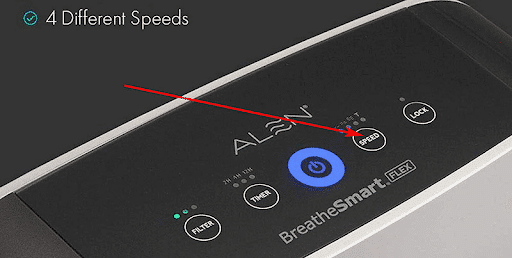
ファン速度モードのスケジュール アレンユニット用の4つの異なる速度

空気消毒機はスマートセンサーで設計されており、部屋が片付いているときはいつでもファンの電力を抑える自動モードで運転できる。こうすれば、電気代をあまり圧迫しない。倹約を心がけるのであれば、1日のうち限られた時間だけ高速で運転するようスケジュールすることもできる。

とはいえ、良いブランドを選べば、一日中稼働させても心配はない。そのため、家庭用空気清浄機は、初期費用が高くても、長い目で見れば、品質の良いものを選んだ方が良いだろう。

そのためには ヒソエアブランド 小型空気清浄機から大型空気清浄機まで取り揃えています。ご予算が限られていても 高性能HEPA空気清浄機 この保険でカバーできる。

ヒント#2 留守時は低速で運転する

不在時は空気清浄機を低速運転にする
不在時は空気清浄機を低速運転にする

留守のときや室内植物を育てている場合は、最低設定にしてください。

ヒント#3 時期によって速度設定を変える

時期によって速度設定を変える
時期によって速度設定を変える

速度設定は時期によって調整しましょう。例えば、夏場はホコリや花粉が多いので、冬場よりも空気清浄機の回転数を上げて運転します。

空気清浄機をフル回転させる頻度は?
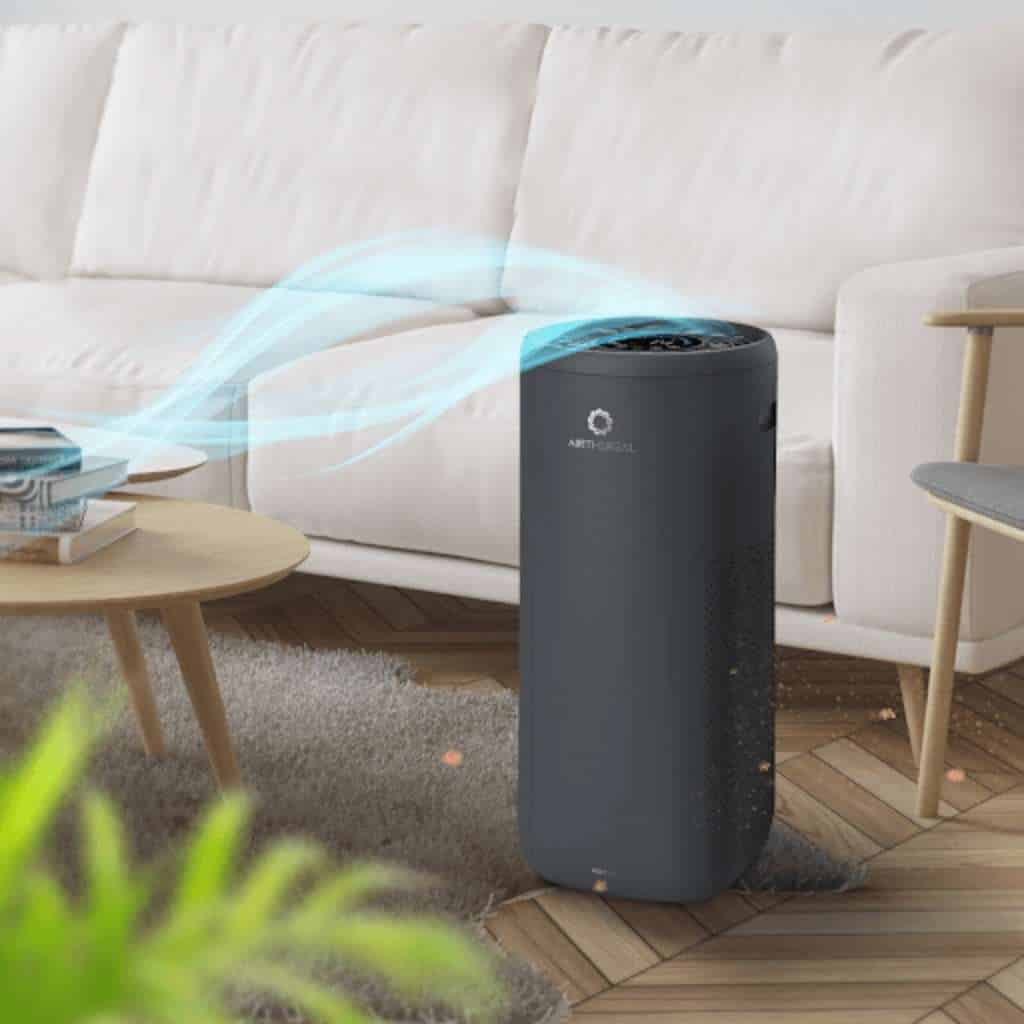
空気清浄機のフル回転
空気清浄機のフル回転

ソース ピンタレスト

パフォーマンスを最適化するには、家にいるときだけフル回転させる。外出するときは低速に戻せばいい。

家庭用空気清浄機の性能を最大限に発揮させながら、一日中フル回転させなくても大丈夫なのだ。ここで次の疑問が浮かぶ:空気清浄機が部屋をきれいにするのにかかる時間は?

空気清浄機が部屋をきれいにするのにかかる時間は?

要するに、ほとんどの空気清浄機は 30分~2時間 でお部屋の空気を除菌します。たった20分で、お部屋の空気の質が明らかに変わるはずです。

空気清浄機が部屋を浄化するのにかかる時間を知るには、部屋のサイズと空気清浄機のCADR(Clean Air Delivery Rate)を知る必要があります。これは、空気清浄機が実行できる1時間あたりの空気の入れ替え(ACH)を知るためです。ACHとは、1時間に一定量の空気を部屋から清浄できる回数のことです。

例えば、家庭用空気清浄機の CADR が 400 CFM で、部屋のサイズが 176 平方フィートだったとします。これは、空気イオナイザーマシンが4 ACHで動作している、または1時間に4回空気をきれいにすることを意味します(1回の充電に15分)。

天候、湿度、場所も業務用空気清浄機の速さに影響します。夏場はホコリが多く、空気清浄機が空気をきれいにするのに時間がかかります。

空気清浄機を一日中つけっぱなしにしても大丈夫?

そう、室内の空気環境をクリーンに保つために、空気清浄機を24時間365日つけっぱなしにしておいてもいいのだ。唯一の欠点は、消費電力が少し高くなることです。しかし、空気清浄機は電気をあまり使わないので、電気代はそれほどかかりません。

ホコリは空気を簡単に汚染することを忘れないでください。そのため、電気代を少しでも節約するために清浄機の電源を切っても、電源を入れる前と同じように汚れてしまいます。

空気清浄機をつけて寝るべきか?

空気清浄機をつけたまま寝るべきか?
空気清浄機をつけたまま寝るべきか?

特に喘息やアレルギー、その他の呼吸器系疾患を患っている場合は、寝室で空気清浄機のスイッチを入れるべきだ。

というのも、空気清浄機の電源を切るたびに、わずか15分で空気が一気に汚染されてしまうからだ。

が実施した調査 スマート・エア・フィルター は、わずか15分で空気が50%汚染されることを示した。80分後には100%の汚染となる。

空気清浄機を切った後、部屋が再び埃だらけになるまでの時間を示すグラフ

そのため、睡眠中に空気清浄機のスイッチを切ると、不潔な空気を吸うことになる。

まとめ

この記事で、空気清浄機の運転時間や、24時間365日運転できる時間についてご理解いただけただろうか。

中国のトップ空気清浄機メーカーをお知りになりたい方は、別記事でご紹介しています。 中国の空気清浄機メーカーベスト5(2021年)。

HisoAirは、ODM/OEMサービスを提供する中国の空気清浄機サプライヤーです。家庭用、産業用、病院用、ホテル用の空気清浄機を多数取り揃えております。私達の他を点検しなさい 空気清浄機に関する推奨事項 あるいは お問い合わせ 空気清浄機の卸売りのお見積もりをご希望の場合。

シェアする
ヒソエア創設者のリー氏
Alwen Lee, an air purification expert with over 10 years of experience, is a devoted father of two and a passionate traveler, having explored more than 30 countries. With a love for public speaking and swimming, he has dedicated his life to the indoor air quality industry. His mission is to ensure that people around the world enjoy the freedom to breathe clean air and lead happy, healthy lives.

メッセージを送る

もっと読む

Modern living room with a family enjoying a healthy indoor environment monitored by smart devices, natural lighting, and greenery.

After IFA 2026: The Healthy Home Is Moving Beyond Smart Devices

In our previous IFA 2026 column, Air Purification Is Becoming Part of the Healthy-Home Platform, we argued that the next generation of indoor-health products would ...
ニュース
Modern living room and kitchen with smart home air quality devices including an air purifier, humidifier, and water filtration system, connected with visualized blue connectivity lines.

IFA 2026: Air Purification Is Becoming Part of the Healthy-Home Platform

Pre-IFA Industry Perspective | September 4, 2026 This article is based on official announcements and regulatory information available ahead of IFA 2026, which takes place ...
ニュース
A modern office room with a gray wall-mounted air purifier, large wooden desk, office chairs, indoor plants, and glass windows offering a city view.

Luftreiniger gegen Staub: HEPA-Luftreinigung für Büro, Gewerbe und Industrie

Kurz gesagt: Ein Luftreiniger entfernt Staub aus der Luft – nicht vom Schreibtisch. Er reduziert die Konzentration schwebender Partikel und damit auch die Menge an ...
Air purifier, Filter
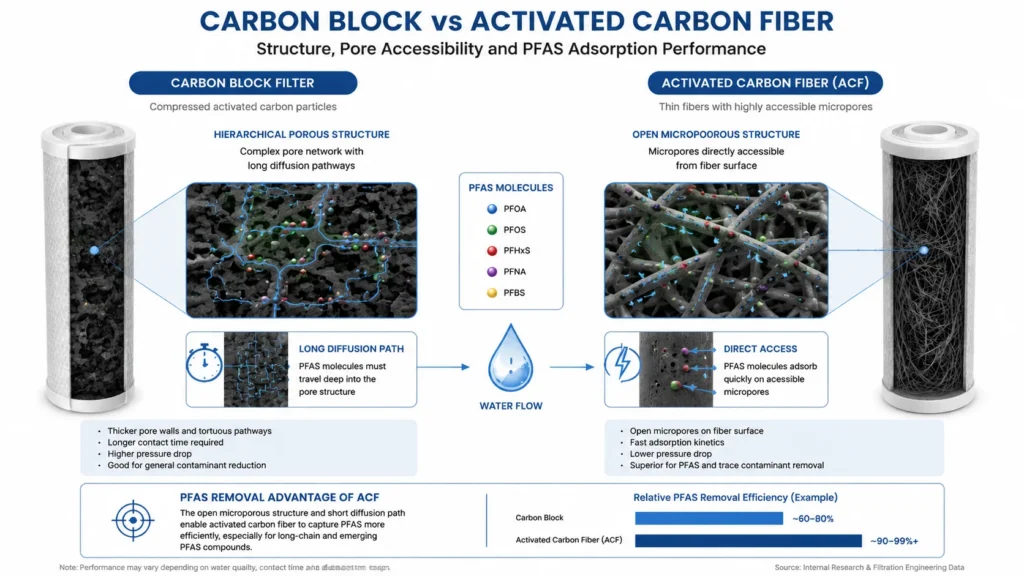
Comparison infographic showcasing the differences between carbon block filter and activated carbon fiber. Detailed diagrams illustrate the hierarchical porous structure of the carbon block with long diffusion paths and the open microporous structure of the activated carbon fiber with direct access for PFAS adsorption.

Carbon Block vs. Activated Carbon Fiber (ACF): Matching Media to Target Contaminants

Two carbon media. Same adsorption chemistry. Very different behaviour in a point-of-use cartridge. If you are specifying a water purifier platform for a PFAS-aware market, ...
ニュース
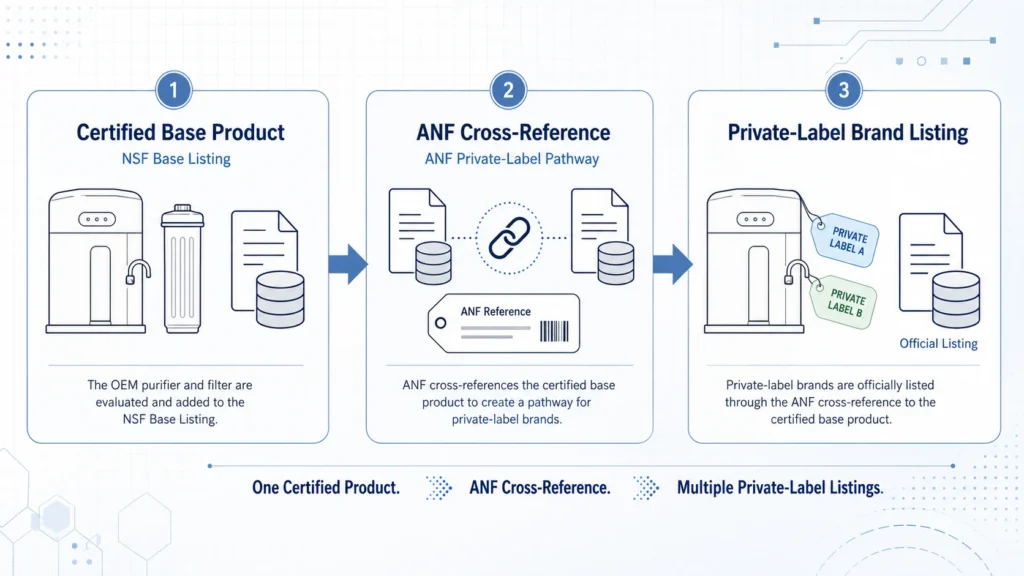
NSF base listing and ANF private-label certification pathway for OEM water filters

What Is an NSF Master Listing? A Guide to Base Listings, ANF Certification and OEM Water Filters

For a brand preparing to launch an OEM water purifier, one of the most common supplier claims is: “We already have an NSF master listing, ...
News, Water Purifiers
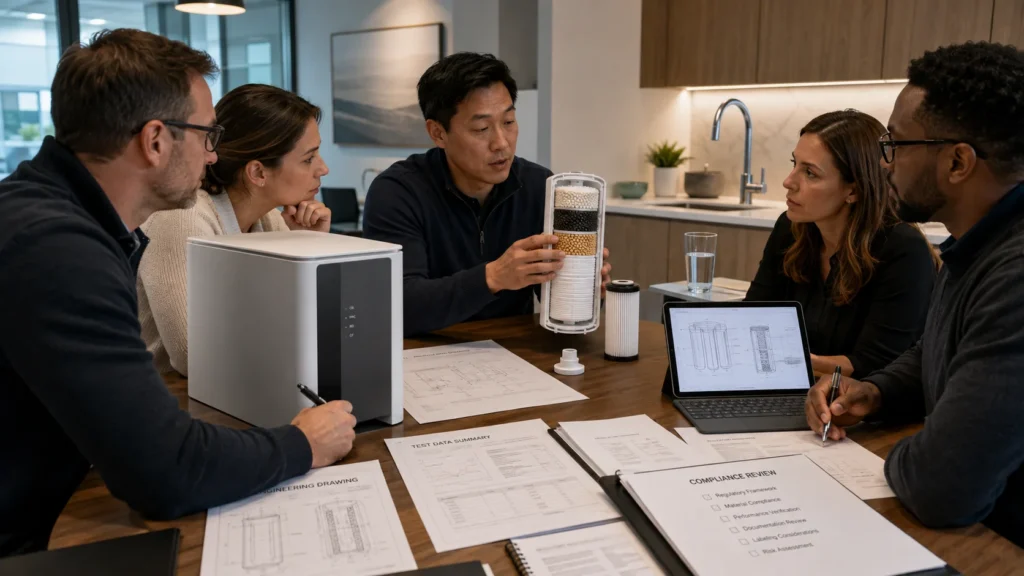
Healthy-home brand team reviewing PFAS water filter certification, test data and product engineering

Entering the Water Category Is Easy. Building a Credible PFAS Claim Is Much Harder

For air purification, appliance and healthy-home brands, entering the water category can look surprisingly easy. A company can select an existing undersink system, customize its ...
ニュース
Contaminant Engineering•3 min read

PFAS Water Filtration Technologies Explained: Carbon, Resin & RO

Key Takeaway:

PFAS reduction depends on the specific compounds present, treatment media, contact time, water chemistry, and system design. Activated carbon, ion exchange, and Reverse Osmosis address PFAS through different mechanisms.

PFAS are a large family of persistent fluorinated compounds that can occur in drinking-water supplies. Their treatment behavior varies significantly by molecular structure, chain length, functional group, concentration, and the chemistry of the source water.

Granular Activated Carbon (GAC) removes PFAS primarily through adsorption. It is generally more effective for many longer-chain PFAS, while shorter-chain compounds tend to break through more quickly. Carbon performance depends on media properties, Empty Bed Contact Time (EBCT), competing organic matter, loading, and replacement frequency.

Ion-exchange resins use charged functional sites to capture many PFAS compounds. Properly selected anion-exchange media can provide high capacity and may perform better than conventional activated carbon for some shorter-chain PFAS, although performance still depends on water chemistry and competing ions.

Reverse Osmosis (RO) uses membrane separation rather than adsorption. Properly designed RO systems can provide broad reduction across many PFAS compounds as well as dissolved salts and other contaminants. Unlike carbon or resin, however, RO also produces a concentrate stream that must be managed.

No single technology should be selected from a PFAS label alone. System design should consider which PFAS compounds are present, their concentrations, required reduction targets, flow rate, media life, and the applicable third-party certification or validation requirements.

HisoAir Water Technical Series
Product Discovery•3 min read

How to Choose an Under-Sink Water Purifier for Modern Kitchens

Key Takeaway:

Match the treatment technology to your water quality first, then evaluate cabinet space, faucet configuration, flow rate, drain and power requirements, and filter replacement needs.

Choosing an under-sink water purifier starts with water chemistry. Carbon filtration is well suited to chlorine, taste, odor, and many organic contaminants, while Reverse Osmosis is more appropriate when dissolved salts, fluoride, nitrates, or broader dissolved contaminants need to be reduced.

For compact kitchens, tankless RO systems eliminate the conventional storage tank and can significantly reduce the space required under the sink. However, membrane capacity stated in GPD does not directly equal faucet flow. When comparing systems, check the actual dispensing flow rate, inlet-pressure requirement, recovery ratio, and whether a booster pump is required.

Installation architecture also matters. Many RO systems require a drain connection, electrical power, and either a dedicated drinking-water faucet or a compatible multi-function faucet. High-flow carbon systems can often connect directly to the existing cold-water line with a simpler installation, but pressure drop and available faucet flow should still be verified.

RO also removes much of the naturally occurring dissolved mineral content. Where taste or mineral balance is a priority, a post-RO remineralization stage can be added. Filter life should be evaluated by both rated capacity and local water quality rather than replacement time alone.

The right system is therefore not simply the smallest or highest-GPD model. It is the configuration that matches the target contaminants, available cabinet space, desired faucet setup, peak dispensing demand, and maintenance expectations.

HisoAir Water Technical Series
Water Quality•2 min read

What Does TDS Mean in Drinking Water? Measurement vs Contaminant Reality

Key Takeaway:

A TDS meter estimates the overall concentration of dissolved ionic substances from electrical conductivity. It cannot identify specific contaminants or determine whether water is chemically safe.

Total Dissolved Solids (TDS) refers to the combined concentration of dissolved substances in water. Most handheld TDS meters do not measure TDS directly. Instead, they measure electrical conductivity (EC) and convert that reading into an estimated parts-per-million (ppm) value.

This means a TDS reading can indicate how much dissolved ionic material is present, but not what that material actually is. Calcium, magnesium, sodium, nitrates, and other dissolved ions can all contribute to conductivity, yet a simple TDS meter cannot distinguish between them.

TDS meters are also not suitable for detecting trace contaminants such as PFAS, many VOCs, pesticides, pharmaceuticals, or disinfection byproducts. These substances may be present at concentrations far below the level needed to noticeably change electrical conductivity.

A low TDS reading therefore does not guarantee safe drinking water, and a higher TDS reading does not automatically indicate contamination. Water-treatment decisions should be based on laboratory testing for specific contaminants of concern rather than TDS alone.

HisoAir Water Technical Series
Technology Selection•2 min read

RO vs UF Water Filtration: Understanding Pore Sizes & Dissolved Minerals

Key Takeaway:

Ultrafiltration can reduce bacteria, turbidity, and suspended particles while retaining most naturally occurring dissolved minerals. Reverse Osmosis provides much broader reduction of dissolved salts and smaller contaminants.

Ultrafiltration (UF) typically uses hollow-fiber membranes with pore sizes in the approximate 0.01–0.1 micron range. These membranes physically retain turbidity, suspended solids, colloids, and many microorganisms while allowing dissolved minerals and salts to remain in the water.

Reverse Osmosis (RO) operates at a much finer separation level. Unlike UF, RO can substantially reduce dissolved ions such as sodium, calcium, fluoride, nitrates, and other contributors to total dissolved solids (TDS). This makes RO more suitable when dissolved-salt reduction is a primary treatment objective.

UF generally requires less system pressure and produces little or no continuous concentrate stream in many point-of-use configurations. RO typically requires greater pressure and produces a reject-water stream, but delivers broader contaminant reduction.

For water with acceptable TDS and mineral content, UF can be a simpler mineral-retaining treatment option. Where dissolved salts, fluoride, nitrates, or broader dissolved contaminants are a concern, RO is generally the more appropriate technology.

HisoAir Water Technical Series
Technology Selection•4 min read

Carbon Block vs Reverse Osmosis: Which Fits Your Need?

Key Takeaway:

Choose RO for dissolved inorganic salts and heavy metals; choose Carbon Block for chemical taste/odor, no wastewater, and high line-pressure flow.

Reverse Osmosis (RO) and Carbon Block filtration represent two fundamentally different treatment methods: membrane separation and adsorption. Understanding these differences helps determine which technology is better suited to a specific water-quality requirement.

Reverse Osmosis uses a semi-permeable membrane with pore sizes of approximately 0.0001 microns. It can significantly reduce dissolved inorganic contaminants such as TDS, fluoride, nitrates, and certain heavy metals. Because water must be forced through the membrane, RO systems require sufficient pressure or a booster pump and generate a concentrated wastewater stream.

Carbon Block filtration relies primarily on adsorption through compressed activated carbon, commonly with nominal pore sizes around 0.5–5 microns. It is highly effective for chlorine, chloramines, VOCs, taste, and odor, while allowing substantially higher direct-flow rates without producing wastewater.

From an operating perspective, Carbon Block systems are generally simpler, require less energy, and avoid the water loss associated with RO. RO involves higher system complexity and operating cost, but provides substantially broader reduction of dissolved contaminants that Carbon Block alone cannot address.

HisoAir Water Technical Series

見積依頼