
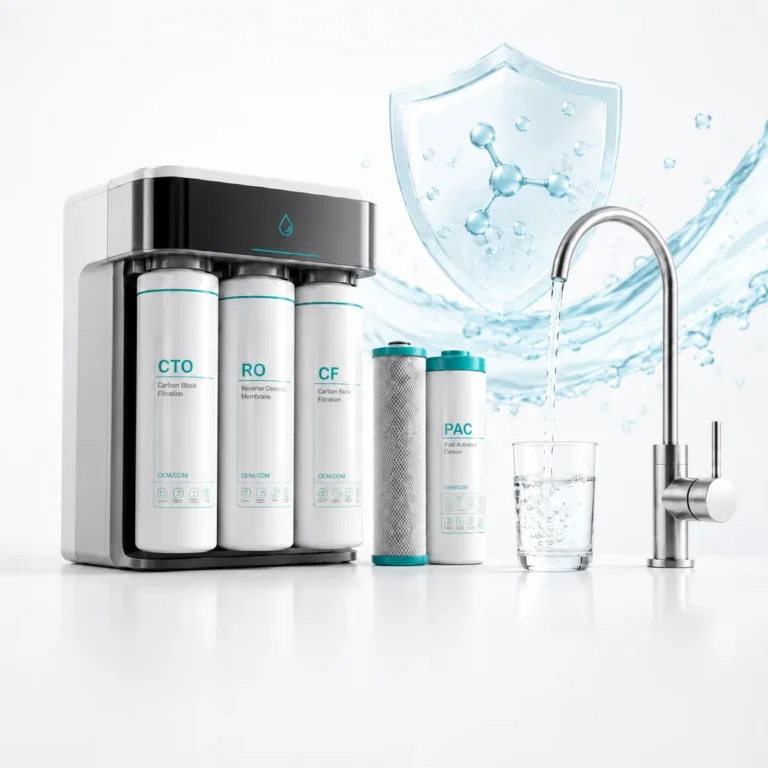

For air purification, appliance and healthy-home brands, entering the water category can look surprisingly easy.
A company can select an existing undersink system, customize its appearance, add a branded faucet and launch it as part of a broader home-wellness portfolio. But sourcing a water purifier is not the same as building a credible water-treatment solution.
The difference becomes particularly important when the product is marketed for PFAS reduction.
Quick answer
A credible PFAS claim must connect a clearly defined group of contaminants with the exact finished product, third-party testing or certification, rated capacity, flow conditions, replacement filter and mass-production configuration. Selecting activated carbon, ion exchange resin or an RO membrane is only the beginning.
A U.S. Geological Survey study estimated that at least one type of PFAS could be detected in approximately 45% of U.S. tap-water samples. The study tested 32 PFAS rather than every compound in this broad chemical family, but its findings help explain why PFAS has become a major concern for consumers, regulators and water-treatment brands.
This creates a genuine market opportunity. It also creates a much higher burden of proof.

What Makes a PFAS Claim Credible?
A credible PFAS solution is not defined by one filter material, one laboratory result or one certification logo.
It is an evidence chain connecting:
- The specific PFAS compounds covered by the claim
- The filtration technology and complete product configuration
- The test method and operating conditions
- The finished model and replacement cartridge
- The certified capacity and flow rate
- The production bill of materials
- The consumer-facing marketing language
- The public certification or performance documentation
If one link in this chain changes, the claim may need to be reassessed.
For example, changing the carbon supplier, resin formulation, RO membrane, filter dimensions, flow-control component or replacement interval may affect the evidence supporting the original claim.
The central principle: The marketing claim should never be broader than the evidence supporting the exact product sold to the customer.
Why Is PFAS More Complicated Than a Single Contaminant?
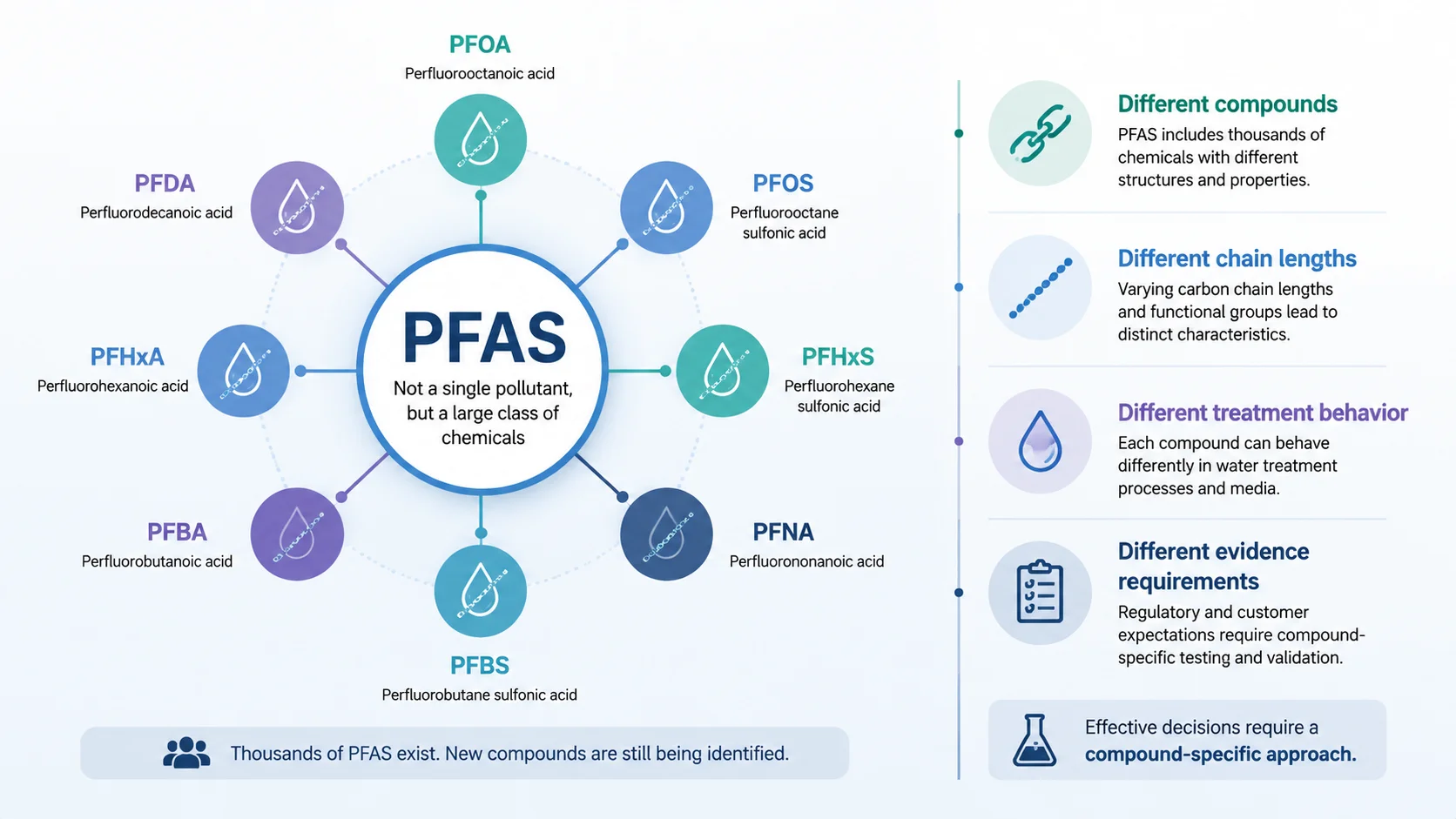
PFAS is not one chemical. It is a broad family of per- and polyfluoroalkyl substances with different molecular structures, chain lengths and filtration behavior.
A product that performs well against PFOA or PFOS may not deliver identical performance against shorter-chain PFAS or other compounds that were not included in its test protocol.
This creates an important distinction between several commonly used claims:
| Claim | What It May Mean | What Must Be Verified |
|---|---|---|
| Reduces PFOA and PFOS | The product has evidence covering these two compounds. | Test standard, model, capacity, flow and certification status. |
| Total PFAS Reduction | The product covers the defined PFAS mixture specified by the applicable standard or listing. | Which compounds are included and which edition of the standard applies. |
| PFAS tested | A laboratory conducted some form of PFAS testing. | Whether the test covered a full service cycle and followed a recognized standard. |
| PFAS certified | A certification body has listed the product for a defined PFAS claim. | Exact model, replacement element, standard, claim and public listing. |
| PFAS-free water | May imply that no PFAS remains in the treated water. | This is a very broad claim and should not be used without evidence supporting that interpretation. |
Does “Total PFAS Reduction” Mean Every PFAS?
No. “Total PFAS” within a certification program refers to a defined group of compounds included in the applicable test method. It should not be interpreted automatically as every compound that may be classified as PFAS.
Current NSF product listings can define Total PFAS as a mixture including seven named compounds:
- PFHpA
- PFHxS
- PFNA
- PFOA
- PFOS
- PFBS
- PFDA
The exact scope must always be checked against the current standard edition and the notes attached to the individual product listing. An official NSF product listing, for example, normally identifies the model, replacement element, service cycle, flow rate and approved reduction claims.
For this reason, the following two statements are not equivalent:
More precise: Certified for Total PFAS reduction as defined by the applicable NSF/ANSI standard and product listing.
Potentially misleading: Removes all forever chemicals.
The second statement is substantially broader than the first.
How Do EPA Limits Relate to Water-Filter Certification?
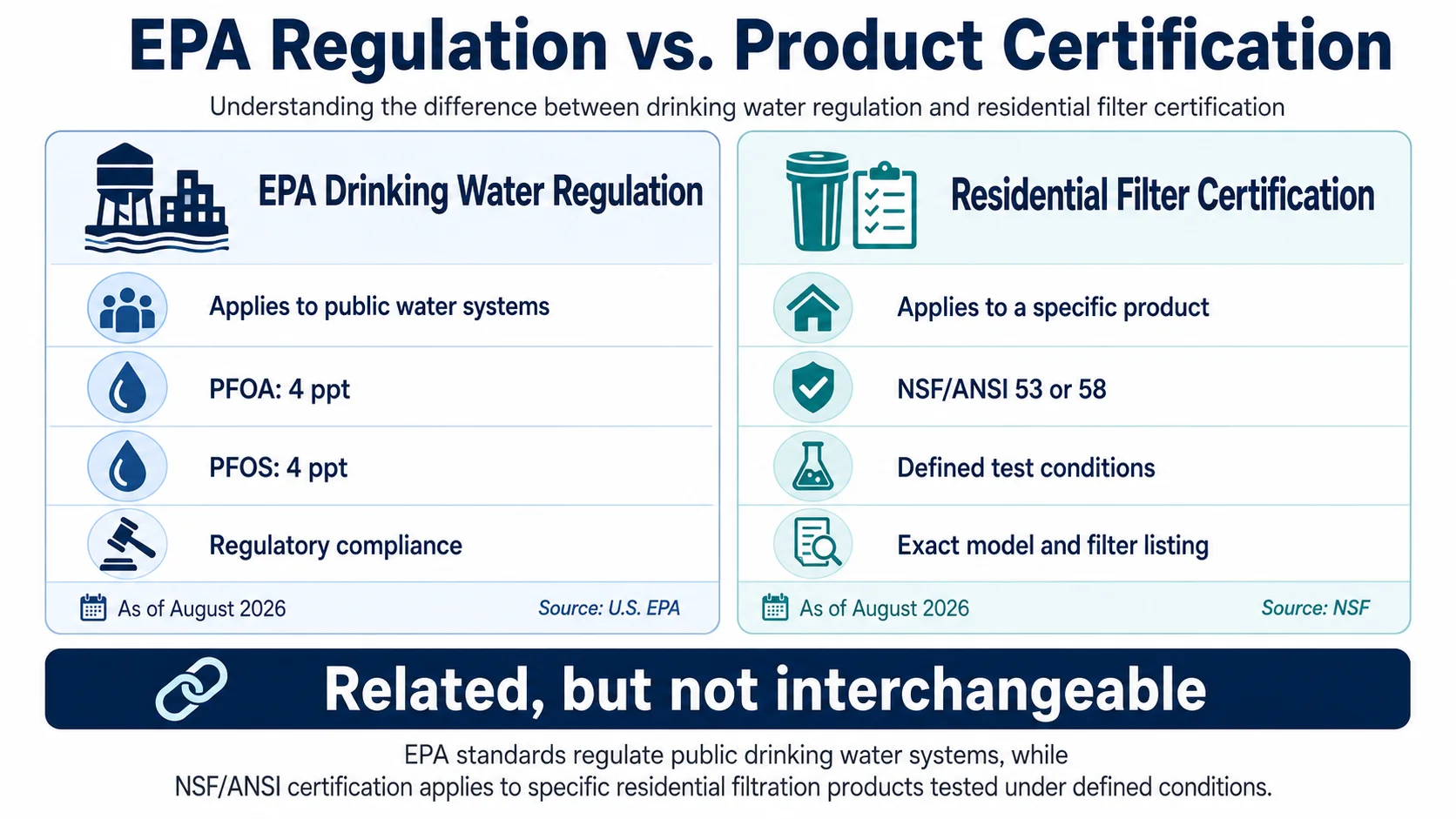
Regulation of public drinking-water systems and certification of residential water filters are related, but they are not the same system.
In 2024, the U.S. Environmental Protection Agency established Maximum Contaminant Levels of 4.0 parts per trillion for PFOA and 4.0 ppt for PFOS in public drinking-water systems.
As of August 2026, EPA has proposed retaining those two limits while allowing eligible public water systems to request additional compliance time, potentially until 2031. EPA has also proposed changes involving the federal requirements for several other PFAS. These proposals were not the same as a final withdrawal of the PFOA and PFOS limits.
Brands should therefore date regulatory statements and verify the latest status through the EPA PFAS drinking-water page before publishing packaging or sales materials.
Residential filter certification uses its own standardized test conditions. NSF currently explains that a water filter seeking a PFAS reduction claim must reduce the tested concentration to below 20 ppt under the applicable certification test.
This does not automatically prove that every certified product will produce water below the EPA public-water MCL of 4 ppt under every household condition.
What brands should communicate clearly
- EPA limits apply to regulated public water systems.
- Product certification applies to a specific treatment product under defined test conditions.
- A claim that a product “meets the EPA limit” requires evidence supporting that exact statement.
Is Using Activated Carbon or RO Enough to Make a PFAS Claim?
No. The presence of a recognized filtration technology does not by itself prove the performance of the finished system.
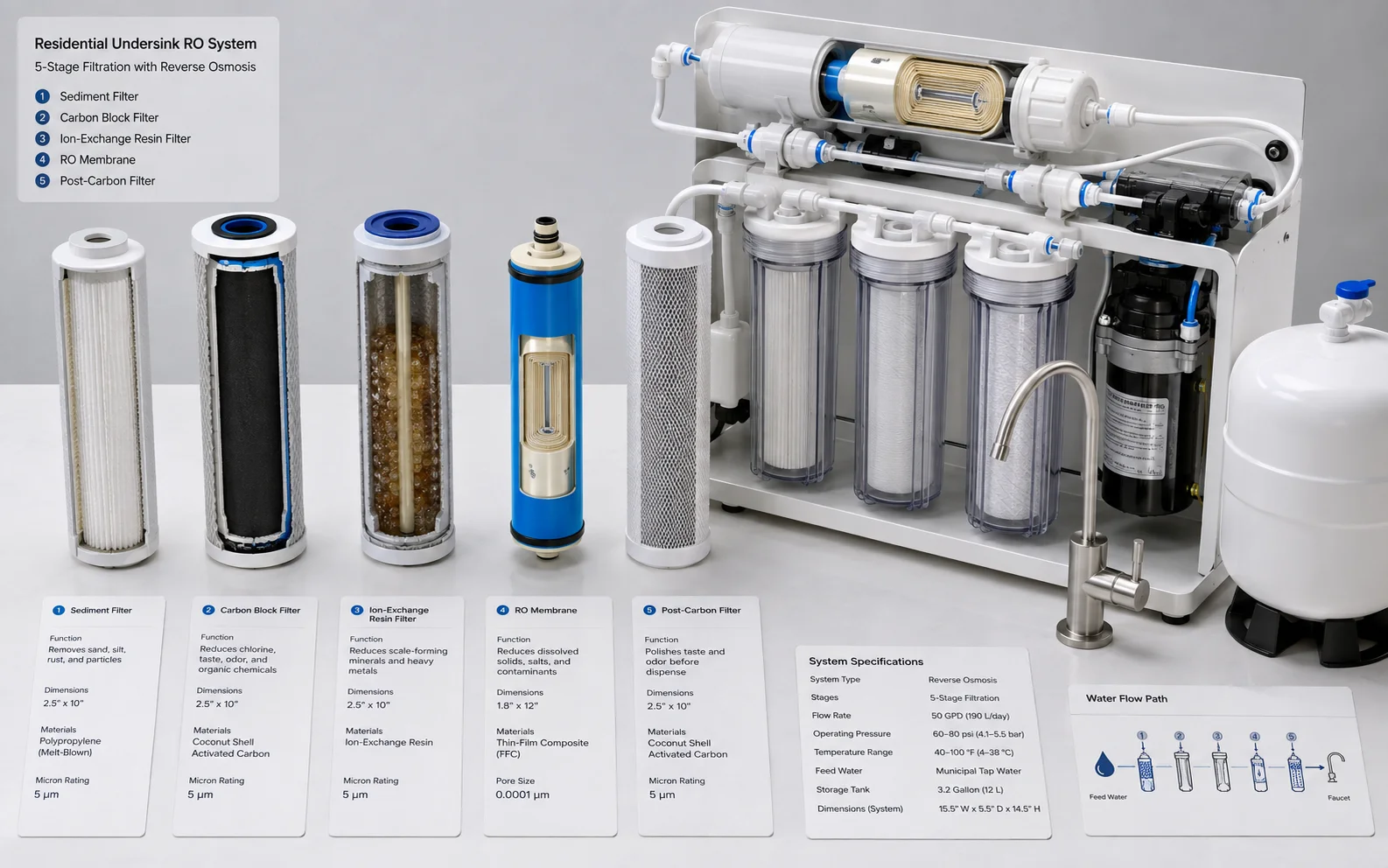
The most common technologies used for PFAS reduction include activated carbon, anion exchange resin and reverse osmosis. Each can be effective in the correct application, but performance depends on more than the material name.
| テクノロジー | Potential Role | Important Variables |
|---|---|---|
| Activated carbon | Adsorbs selected PFAS and other organic contaminants. | Carbon type, media weight, pore structure, contact time, bed depth, flow rate and competing contaminants. |
| Anion exchange resin | Can provide selective adsorption for certain PFAS. | Resin formulation, water chemistry, competing ions, flow and breakthrough capacity. |
| Reverse osmosis | Provides a membrane barrier and is often combined with carbon pretreatment. | Membrane selection, pressure, recovery rate, pretreatment, sealing, flow and maintenance. |
Statements such as “uses a PFAS-removal carbon block” or “contains an RO membrane” describe the proposed technology. They do not establish a certified contaminant-reduction claim for the complete appliance.
The correct development sequence is:
Why Must the Exact Finished Product Be Tested?
PFAS performance is affected by the complete water path. That includes the filter media, cartridge geometry, housing, seals, valves, flow restrictors, pumps and installation configuration.
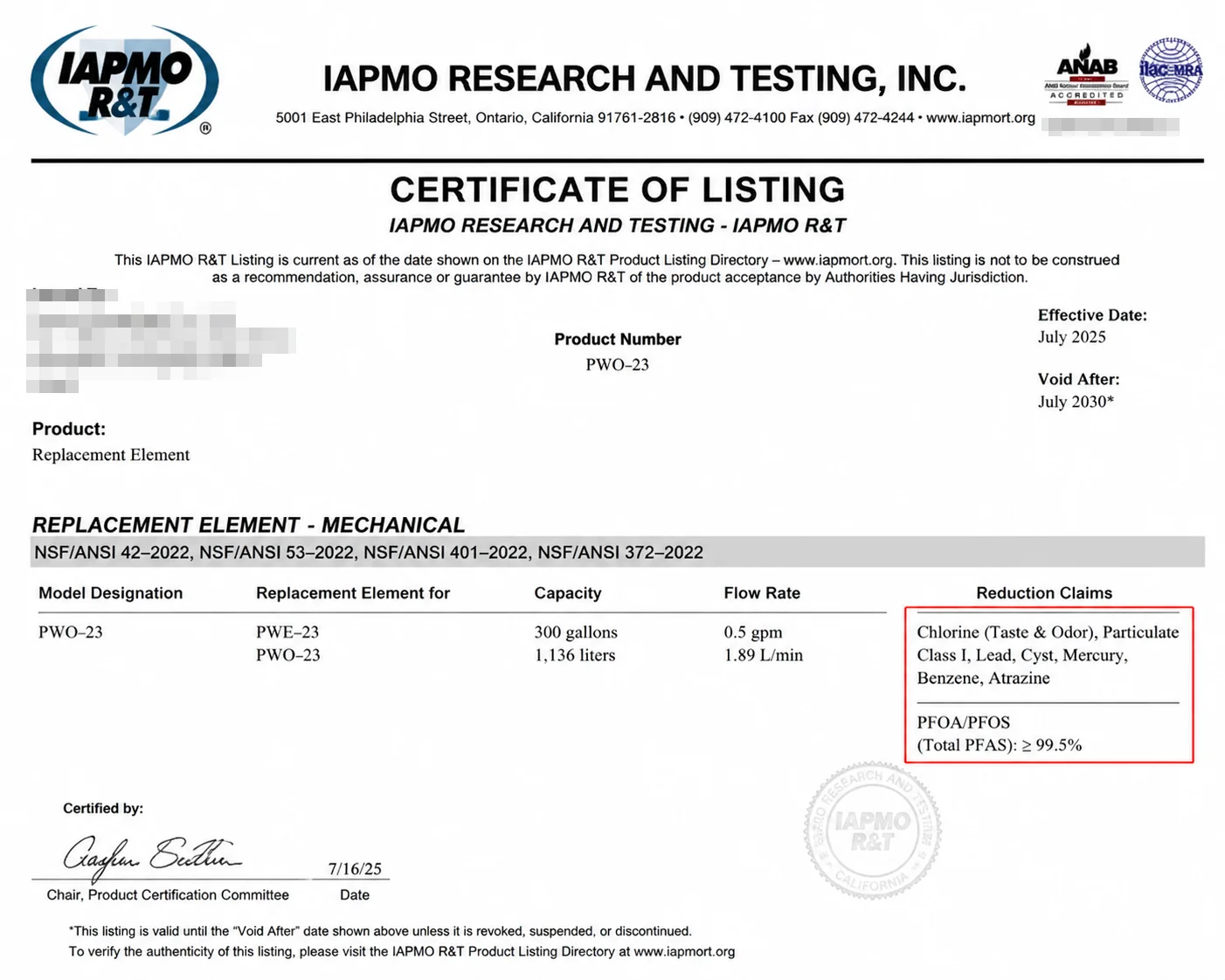
Certification listings commonly connect a claim to:
- A specific brand or trade name
- A specific model number
- A defined replacement element
- A rated service cycle or gallon capacity
- A specified flow rate
- A named contaminant-reduction claim
A certified component may be useful in product development, but it does not automatically make every finished system containing that component certified for the same claim.
Brands should also distinguish between the following levels of evidence:
- Supplier statement: The media supplier says the material is suitable for PFAS reduction.
- Internal test: The manufacturer has generated preliminary performance data.
- Third-party laboratory report: An independent laboratory has tested the product under stated conditions.
- Tested to a standard: Testing followed some or all requirements of a recognized standard.
- Third-party certification: An accredited certification body evaluated and listed the exact product for the stated claim.
These levels are not interchangeable. Product pages, quotations and packaging should describe the actual level accurately.
Why Is Filter Life Part of the PFAS Solution?
PFAS reduction is not only about initial performance.
Adsorptive filtration media have finite capacity. Over time, available adsorption sites are consumed and contaminant breakthrough can occur. RO membranes and their pretreatment cartridges also require maintenance and replacement.
A meaningful PFAS program must therefore define:
- The rated service cycle
- The validated gallon capacity
- The tested flow rate
- The replacement interval
- The method used to notify the consumer
- The availability of the correct replacement filter
- The controls preventing substitution with a different cartridge
Connected products can improve replacement management by measuring water consumption, operating time or filter pressure. However, a digital indicator is only credible when its algorithm is based on validated filter-life data.
A timer that simply counts six or twelve months does not prove that the filter remains effective for that period in every application.
How Should PFAS Performance Be Controlled in Mass Production?
A successful prototype does not guarantee that every production unit will deliver the same performance.
A credible OEM or ODM program should establish control over:
- Approved filter-media suppliers
- Carbon, resin and membrane specifications
- Media weight and cartridge dimensions
- Flow-control components
- Seal integrity and bypass prevention
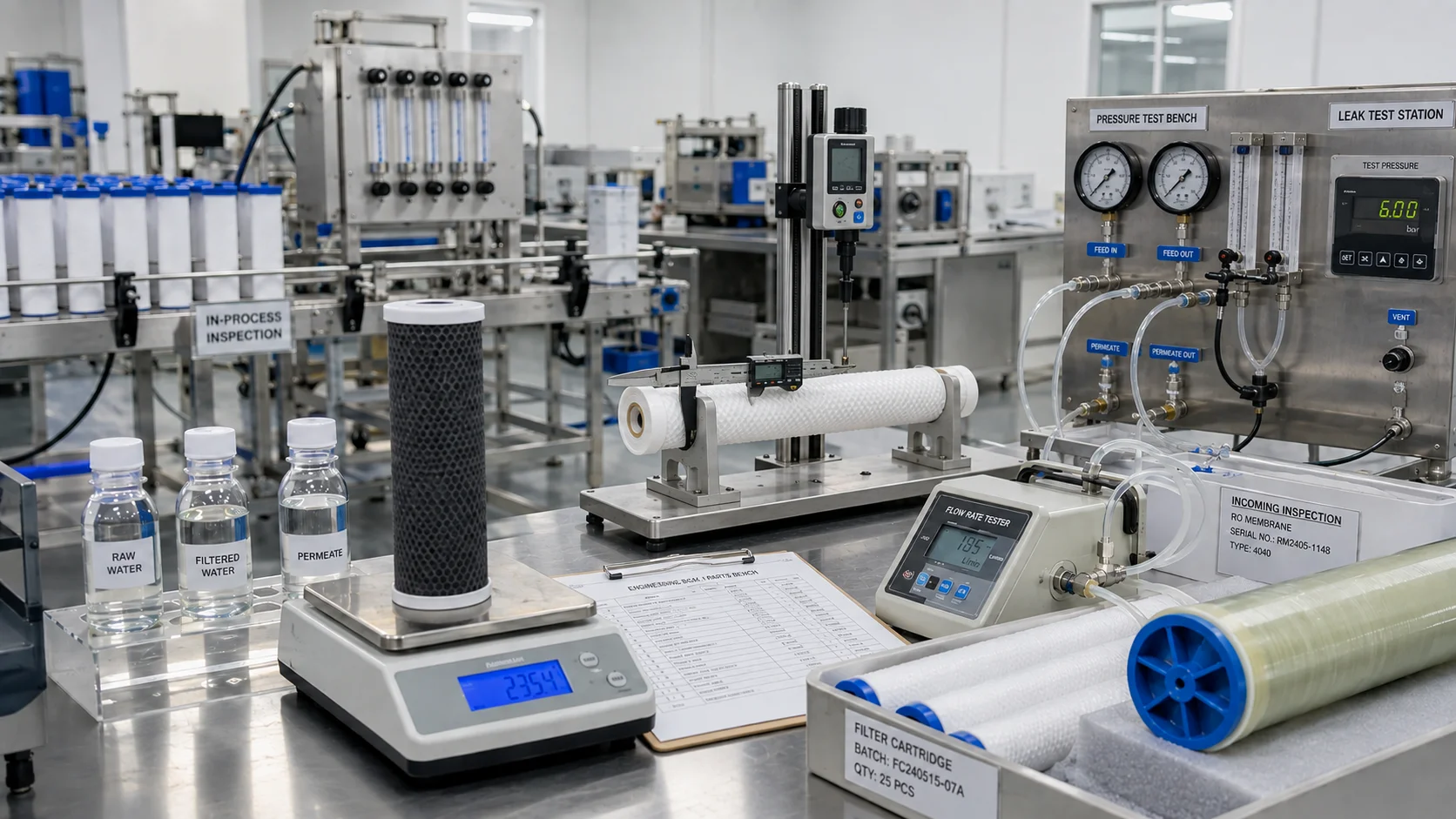
- Incoming-material inspection
- Batch traceability
- Engineering change management
- Replacement cartridge compatibility
- Production sampling and verification
NSF explains that certified products are periodically retested and manufacturing facilities are inspected to help confirm continued compliance. That continuing control is one reason certification provides more credibility than a one-time development test.
What Should Brands Ask a PFAS Water Purifier OEM?
Before selecting a product or manufacturing partner, brands should request specific answers rather than general promises.
- Which PFAS compounds are included in the proposed claim?
- Is the evidence based on media data, component testing or finished-system testing?
- Which version of NSF/ANSI 53 or NSF/ANSI 58 is being used?
- Which certification body will issue or maintain the listing?
- Will the brand, model and replacement cartridge appear in a public directory?
- What flow rate and gallon capacity will be certified?
- Has performance been evaluated at the end of the rated service cycle?
- Who owns the certification and technical file?
- Which production changes require approval or retesting?
- How will packaging, manuals, websites and distributor materials be reviewed for claim accuracy?
- How will replacement filters remain available throughout the product lifecycle?
- What evidence can be supplied to retailers, distributors and regulatory reviewers?
This claim-first process is more reliable than selecting an existing purifier and trying to add a PFAS message near the end of development.
For a broader supplier-evaluation framework, see our guide to choosing a water purifier OEM manufacturer.
Which PFAS Marketing Claims Create the Most Risk?
The U.S. Federal Trade Commission expects advertisers to possess a reasonable basis for objective product claims before those claims are published. The FTC pays particular attention to health, safety and performance claims that consumers cannot evaluate easily themselves.
Water-filter contaminant claims fall directly into this category.
| Risky Wording | Why It Is Risky | More Defensible Direction |
|---|---|---|
| Removes PFAS | Does not identify the compounds, conditions or performance level. | Identify the tested compounds, standard and model. |
| Eliminates forever chemicals | May imply complete removal of the entire PFAS family. | Use the precise reduction claim shown in the product listing. |
| PFAS-free water | May imply that no measurable or unmeasured PFAS remains. | Describe reduction under defined test conditions. |
| Meets EPA PFAS standards | May confuse public-water regulation with residential filter certification. | State the actual tested effluent level only when supported by appropriate evidence. |
| NSF filter | Does not explain whether the material, component or complete product is certified. | Name the standard, certification body, model and approved claim. |
A responsible claim might read:
Certified by [certification body] to NSF/ANSI [53 or 58] for reduction of the PFAS compounds identified in the product performance data sheet, at the rated capacity and flow shown in the official product listing.
This wording is less dramatic than “PFAS-free water,” but it is easier for consumers, retailers and business partners to verify.
How Can Healthy-Home Brands Differentiate in PFAS?
Air purification and healthy-home brands already understand the importance of verified performance. In air purification, credible products rely on defined CADR, filter efficiency, room-size conditions, noise data and safety certification.
Water requires the same discipline, but the evidence chain is different.
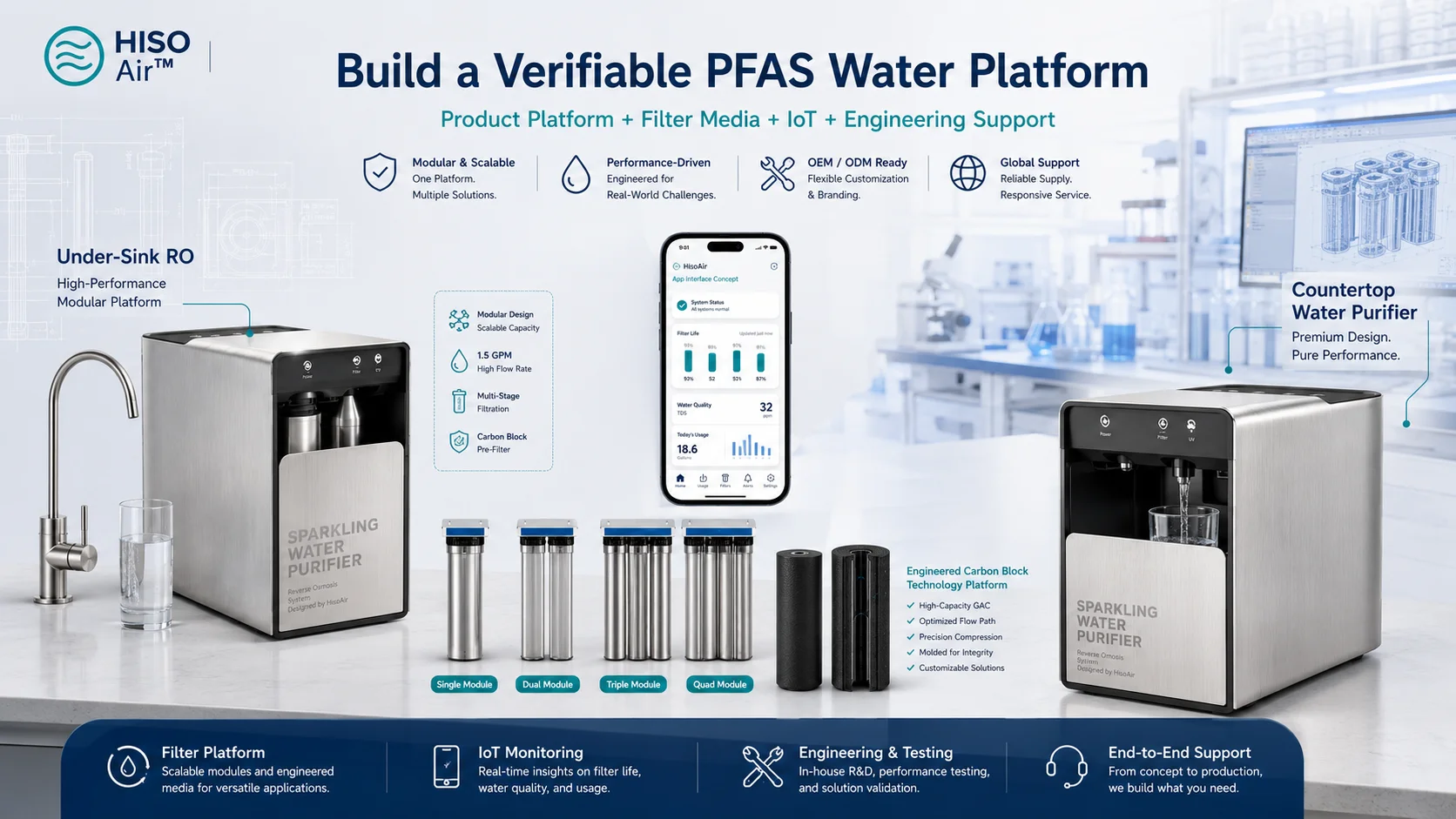
The strongest opportunity is not simply adding another appliance. It is creating a water platform that combines:
- Contaminant-specific filtration
- Transparent performance documentation
- Connected filter-life monitoring
- Reliable replacement-filter supply
- Leak detection and automatic water shutoff
- Quality-controlled OEM manufacturing
- Accurate certification and compliance language
This approach also gives brands a more credible path from indoor air quality toward a broader healthy-home proposition built around both air and water.
HisoAir’s role in this type of program is not to place a generic PFAS label on an existing purifier. It is to help B2B partners define the intended claim, select an appropriate filtration architecture, coordinate testing and certification, control the production configuration and build the replacement-filter platform around the product.
Any final PFAS claim must still correspond to the exact test results, certification status and commercial model being sold.
Learn more about our OEM/ODM water purifier and PFAS-oriented development platforms.
Conclusion: A Credible PFAS Claim Is an Operating System
Entering the water category may begin with sourcing a product. Establishing a defensible PFAS position requires much more.
A credible PFAS solution must connect:
- A precisely defined contaminant claim
- An appropriate treatment architecture
- The exact finished product
- A recognized test method
- Third-party verification or certification
- Rated capacity and flow conditions
- Controlled mass production
- Replacement-filter management
- Publicly accessible evidence
- Accurate marketing language
The brands that treat these elements as one integrated system will be better positioned to earn retailer confidence, reduce compliance risk and build long-term consumer trust.
Entering water is easy. Building a PFAS claim that remains credible from the laboratory to mass production—and from the first gallon to the final gallon—is much harder.
よくある質問
Does an RO membrane automatically support a PFAS reduction claim?
No. Reverse osmosis is a recognized treatment technology, but the finished system must be evaluated under defined operating conditions. Membrane type, pressure, pretreatment, flow, recovery rate and system sealing can all affect performance.
Is NSF/ANSI 42 a PFAS reduction certification?
NSF/ANSI 42 primarily covers aesthetic effects such as chlorine, taste and odor. Health-related PFAS reduction claims are generally associated with NSF/ANSI 53 for filtration systems or NSF/ANSI 58 for reverse-osmosis systems.
Is a laboratory report the same as product certification?
No. A laboratory report documents testing conducted under stated conditions. Certification normally also involves product review, an authorized claim, a public listing and ongoing production or facility controls.
Can a brand advertise “Total PFAS Reduction”?
Only when the claim is supported for the exact product and used in accordance with the applicable standard and listing. “Total PFAS” refers to a defined test mixture and does not automatically mean every PFAS compound.
Who should own the PFAS certification in an OEM project?
This should be agreed before development begins. Certification may be held by the manufacturer, component supplier or brand, but the parties must define listing rights, model naming, change control, annual costs and access to the technical documentation.
Sources and References
- U.S. Geological Survey: Tap Water Study Detects PFAS Across the United States
- U.S. EPA: PFAS in Drinking Water
- U.S. EPA: Proposed PFOA and PFOS Compliance Extension Rule
- U.S. EPA: Reducing PFAS in Drinking Water With a Home Filter
- U.S. EPA: PFAS Drinking-Water Treatment Technologies
- NSF: PFAS in Drinking Water
- NSF: PFAS and the Advancement of Filtration Standards
- NSF: NSF/ANSI 42, 53 and 401 Filtration Standards
- NSF: NSF/ANSI 58 Reverse-Osmosis Systems
- NSF Official Drinking Water Treatment Unit Listings
- U.S. Federal Trade Commission: Advertising Claims and Substantiation
Regulations, certification requirements and product listings may change. Brands should verify the current standard edition, regulatory status and certification directory before publishing product claims. Last reviewed: August 4, 2026.






 English
  Français
  Español
  Italiano
  Deutsch
  Português
  Русский
  العربية
  日本語
日本語  한국어
한국어  Tiếng Việt

