

新しいタブで開きます
革新的な空気品質ソリューション

Engineering a Mold-Free, Odor-Free Water Tank: What Premium Brands Must Know

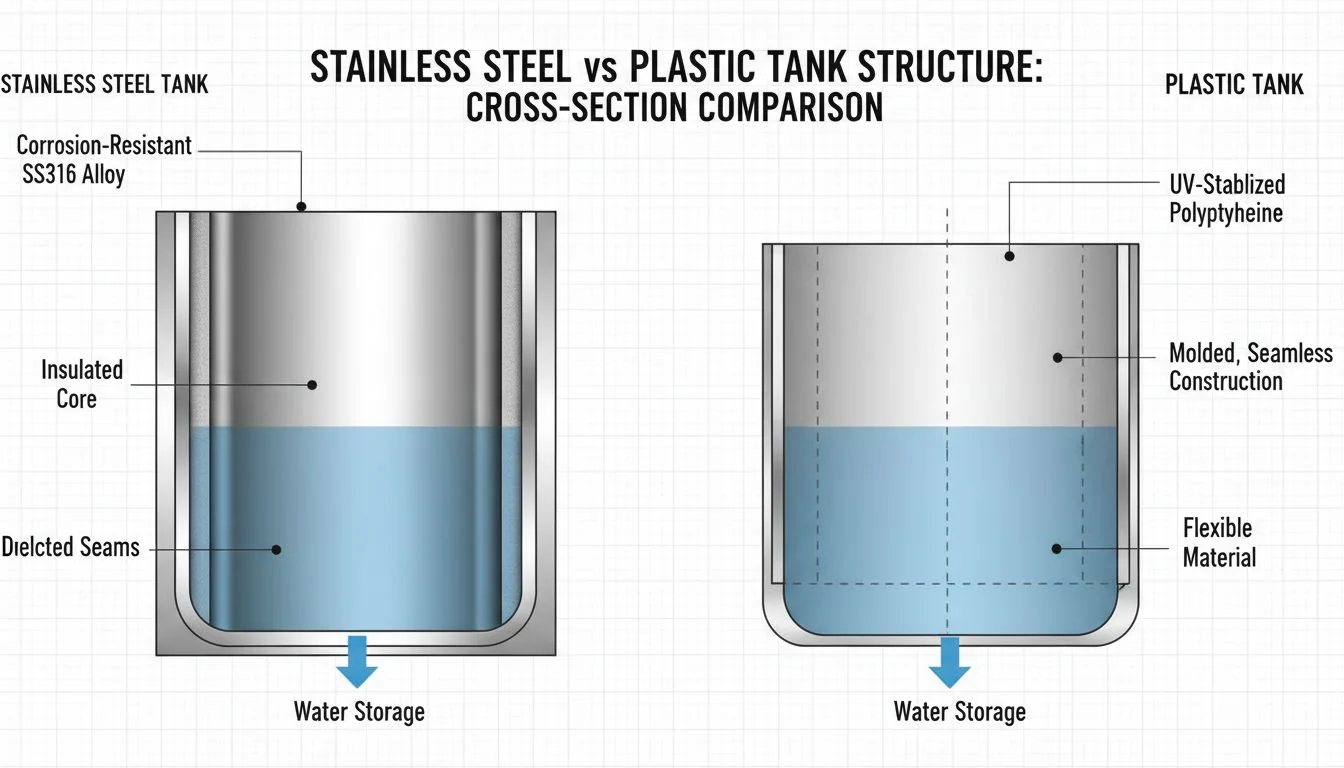
stainless steel water tank vs plastic tank cross section comparison

You design a sleek humidifier, but customers return it due to smell. That "slime" destroys brand trust. Here is how engineering surface topography solves the biofilm problem.

To engineer a mold-free tank1, designers must minimize surface roughness and eliminate corners where biofilm adheres. Replacing complex plastic ribs with seamless, deep-drawn stainless steel creates a bacteriostatic environment. This utilizes the material's passive chromium oxide layer to prevent odor without chemical coatings.
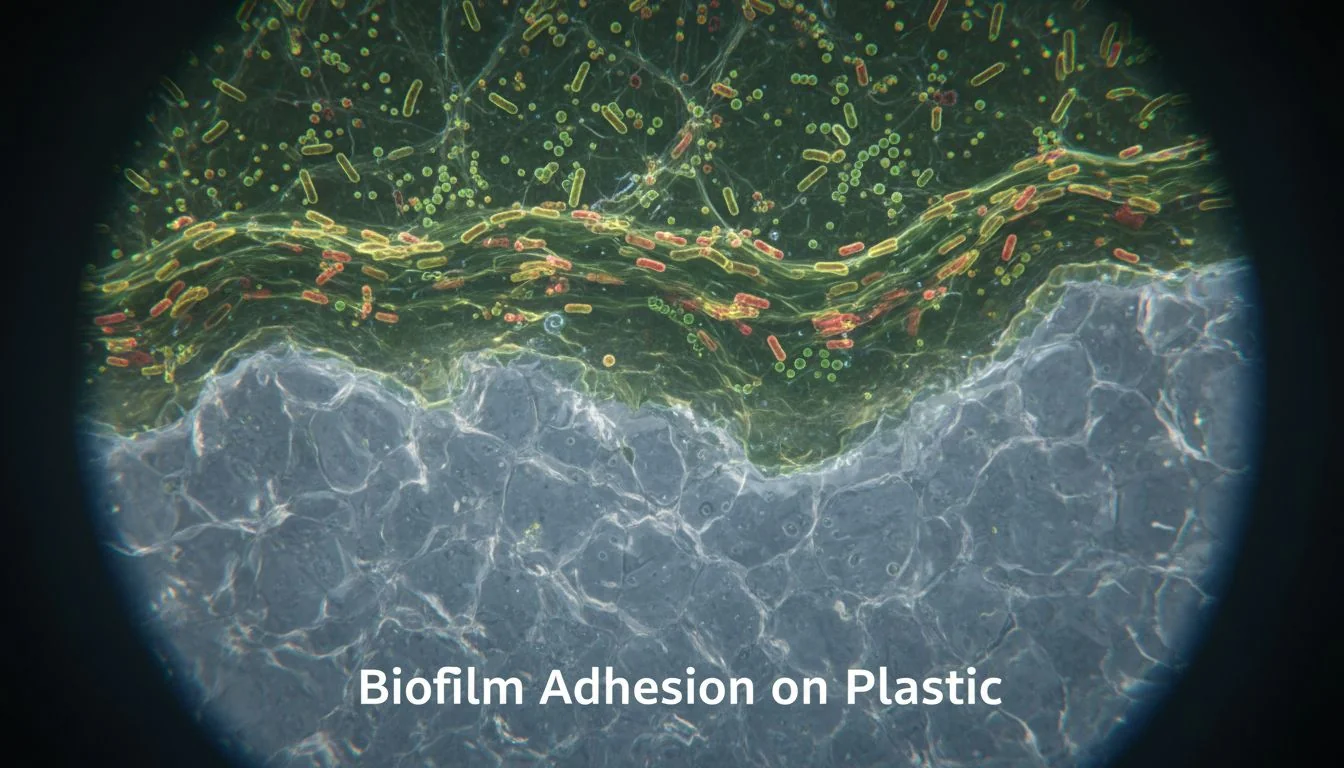
microscopic view of biofilm adhesion on rough plastic surface

Transition Paragraph:
Many designers overlook the tank's interior, focusing only on the exterior shell. However, the tank is where the biological battle happens. Let's explore why material choice defines premium quality2.

Plastic tanks are naturally porous and absorb odors over time.真

Polymers have molecular gaps that trap volatile organic compounds, leading to permanent odors.

Stainless steel actively kills bacteria like an antibiotic.偽

Stainless steel is bacteriostatic, meaning its smooth, passive surface prevents bacteria from anchoring and growing, but it does not chemically kill them like a biocide.

Why Is the Water Tank the Hidden Failure Point of Premium Devices?

High-end electronics often fail at the simplest component. A smelly tank ruins the user experience immediately. We need to look beyond the circuit board to the vessel itself.

The tank is the vessel for the user's primary interaction: the water. If the vessel degrades the water quality3 through odor or mold, the device fails its core purpose. Premium brands often neglect this, focusing on electronics while using cheap plastic reservoirs that harbor bacteria.
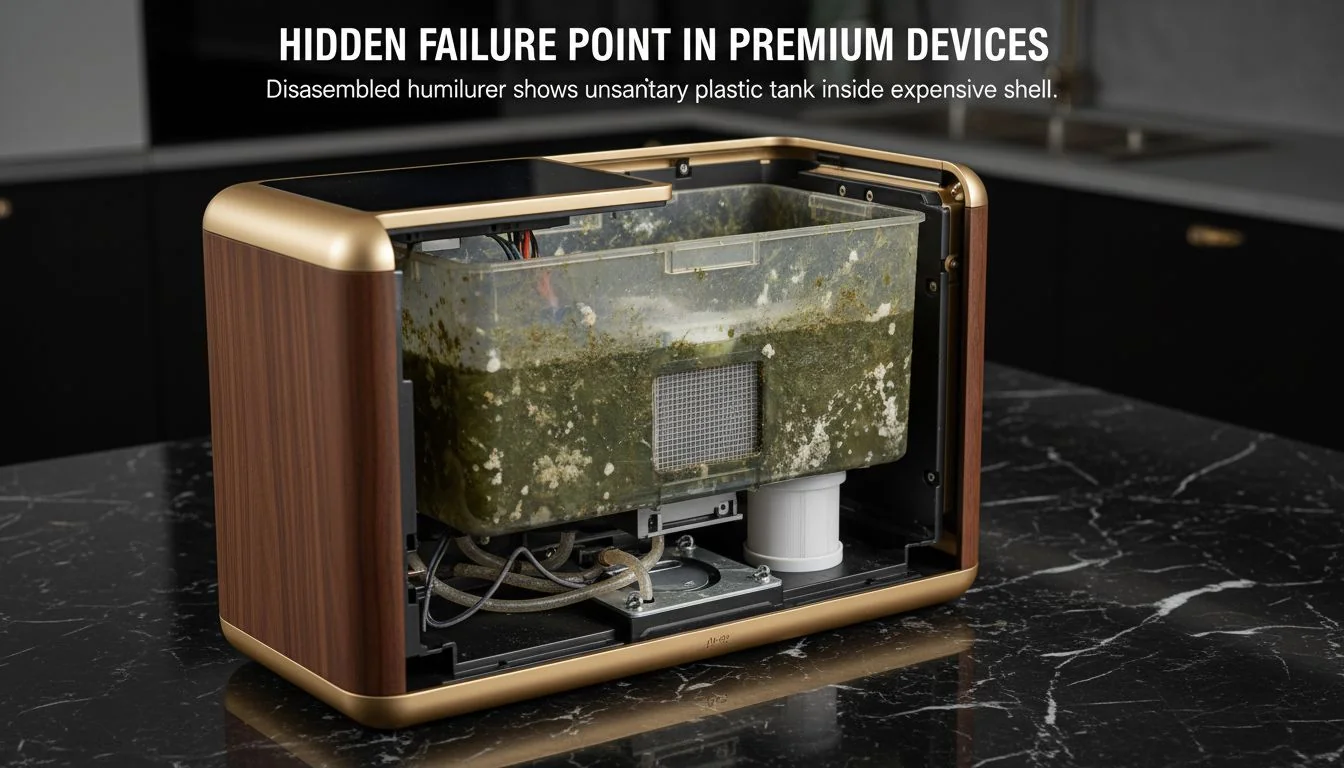
disassembled humidifier showing dirty plastic tank inside premium shell

I have seen many teardowns of $500 humidifiers and purifiers. The PCB layout is perfect. The injection molding on the outer shell is flawless with zero flash. But then I look at the water tank. It is often made of cheap ABS or AS plastic. This is a failure of prioritization. As designers, we know that water is a universal solvent. It interacts with the container it sits in. When we design molds for these plastic tanks, we often add internal ribs and sharp corners for structural integrity.

However, those ribs create "dead zones" for water flow. This is where the failure happens. It is not an electronic failure. It is a biological failure caused by mechanical design. We must stop treating the tank as just a bucket. It is a chemical reaction chamber. If the tank is hard to clean because of complex geometry, the user will fail to maintain it. When the user fails, the product smells. When the product smells, the brand dies. We need to elevate the tank from a simple storage part to a critical engineering component.

Complex internal ribs in plastic tanks improve hygiene.偽

Ribs create corners and dead zones that are difficult to clean, promoting bacterial growth.

Water acts as a solvent that interacts with its container.真

Water can leach chemicals from plastic or facilitate biofilm attachment on rough surfaces.

Is Biofilm Just Slime or a Surface Tension Challenge?

Users call it gross slime. Engineers must see it as a microscopic adhesion problem. We cannot scrub it away; we must design it away using physics.

Biofilm formation is determined by surface roughness4 and topography. Bacteria need anchor points to colonize. Standard plastic injection molding leaves microscopic peaks and valleys that encourage adhesion. To stop the smell, you must engineer a surface with tension properties that reject bacterial attachment.
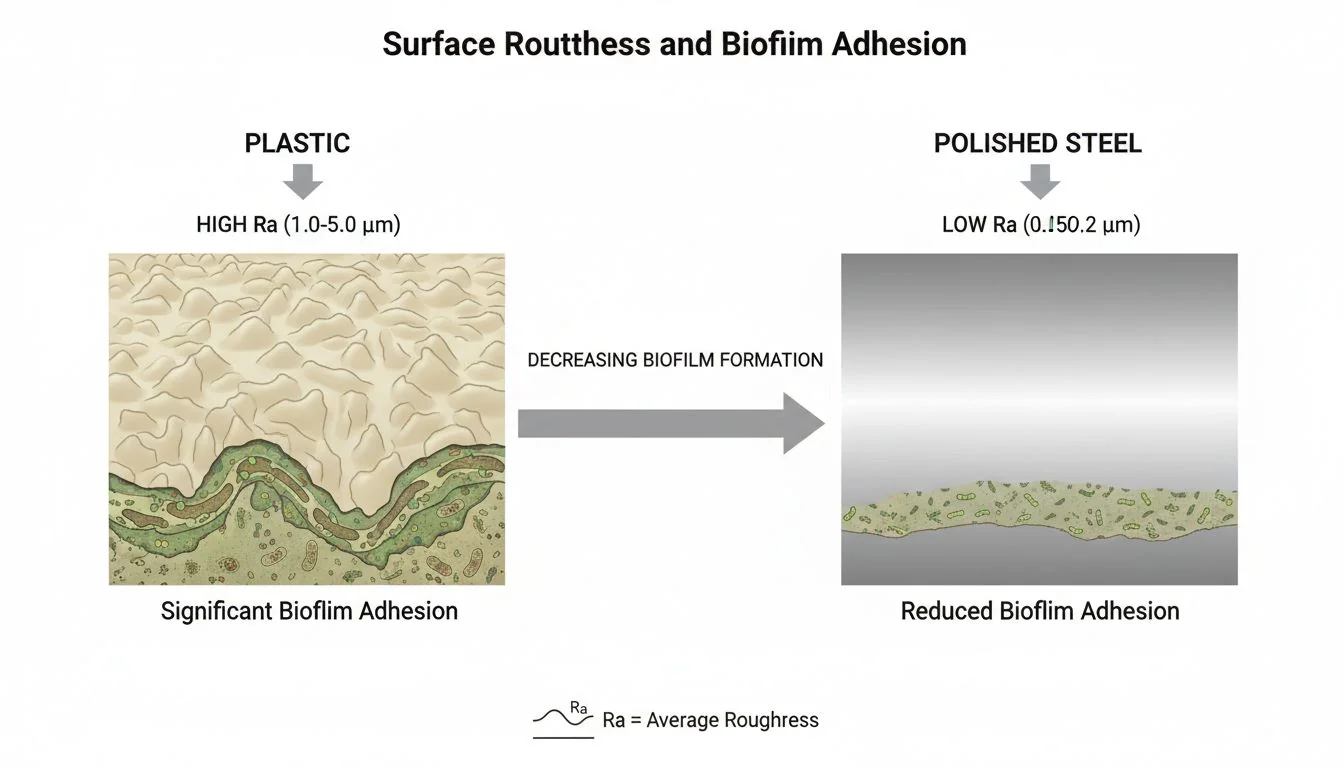
diagram of surface roughness Ra values plastic vs polished steel

Let's get technical about "slime." In my years in the mold industry, I learned that surface finish is everything. Biofilm is not just dirt; it is an aggregate of microorganisms. They stick to surfaces using a matrix of extracellular polymeric substances (EPS). If your mold surface has a high $R_a$ (roughness average), you are giving the EPS a perfect grip. Plastic surfaces, even when polished, degrade over time. They develop micro-scratches from cleaning brushes.

These scratches become cities for bacteria. We need to think about "biofilm adhesion5" as a physics problem. If we lower the surface energy and smooth out the topography, the biofilm cannot stick. It slides off. This is why we need to move away from materials that scratch easily. We need materials that maintain a low friction coefficient against biological matter. Don't treat slime as a user hygiene issue. Treat it as a surface topography failure. If the surface is engineered correctly, the water tension alone should prevent the slime from anchoring.

High surface roughness (Ra) prevents biofilm formation.偽

High roughness provides anchor points for bacteria to attach and grow.

Micro-scratches in plastic serve as breeding grounds for bacteria.真

Scratches protect bacteria from cleaning flow and provide surface area for adhesion.

How Does the Passive Surface of Stainless Steel Prevent Odors?

Antibacterial coatings wash off and scare consumers. You need a material that defends itself naturally. Stainless steel offers a permanent, chemical-free solution for hygiene.

Stainless steel (304 or 316L) possesses a self-repairing passive layer of chromium oxide. This atomic barrier prevents iron from reacting with water and creates a hygienic surface where bacteria struggle to survive. Unlike plastic, it does not absorb volatile organic compounds that cause odors.
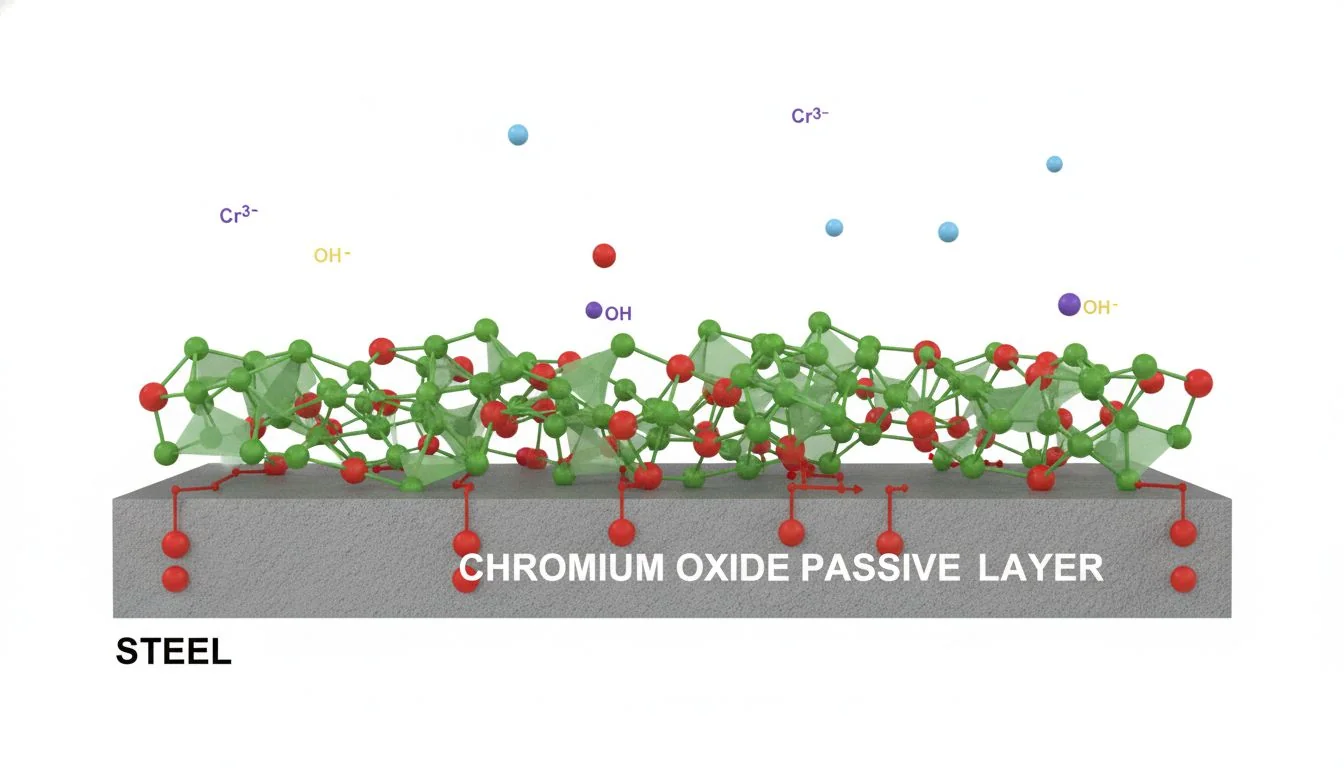
molecular diagram of chromium oxide passive layer on steel

I always tell my clients to look at the material science. Why do hospitals use stainless steel? It is not just because it looks shiny. It is the "Passive Layer." When chromium in the steel meets oxygen, it forms a thin film of chromium oxide. This film is invisible, but it is a shield. It is non-porous and self-healing. If you scratch it, the oxygen reforms the layer immediately.

Plastic is different. At a molecular level, polymers have gaps. Odor molecules lodge into these gaps. That is why an old plastic container smells like old food forever. You cannot wash it out because the smell is inside the material structure. With stainless steel, the odor stays on the surface. You rinse it, and it is gone. For a premium water device, this "Flavor/Scent Integrity" is non-negotiable. We are relying on the material's atomic structure, not a temporary chemical spray. This is the only way to guarantee an odor-free experience6 after five years of use.

The passive layer on stainless steel is made of iron oxide.偽

The passive layer is made of chromium oxide, which prevents rust and bacterial adhesion.

Stainless steel is non-porous to odor molecules.真

The dense atomic structure prevents volatile organic compounds from penetrating the material.

Why Is Seamless Deep-Draw Technology the Ultimate Manufacturing Moat?

Sharp corners are impossible to clean. Glued seams eventually leak. deep-draw technology7 creates a single, perfect geometry that competitors cannot easily copy.

Deep-drawing is a metal forming process that stretches a flat sheet of steel into a deep 3D shape without welding. This results in a seamless bowl with large internal radii. Without corners or weld lines, there are no crevices for mold to hide, making cleaning effortless.
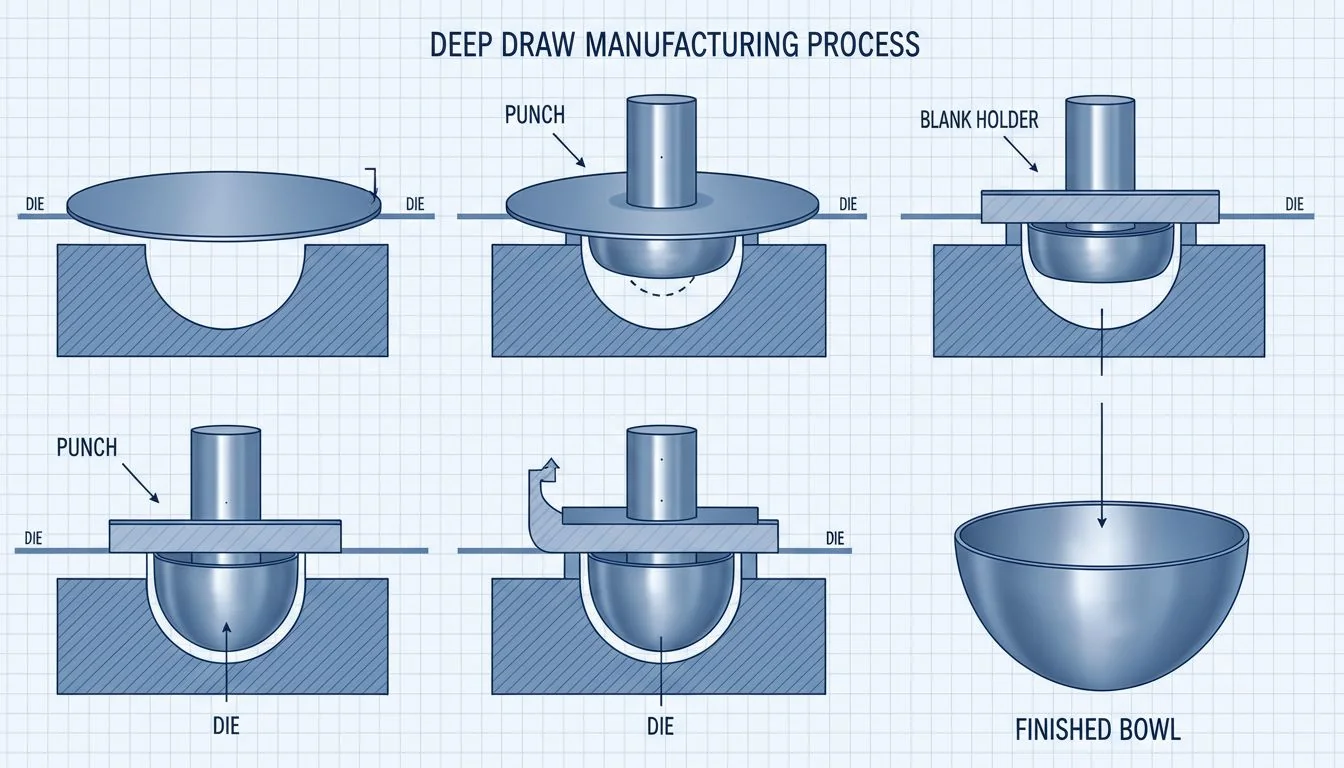
deep draw manufacturing process showing steel sheet becoming a bowl

As a mold guy, I respect deep-draw tooling. It is hard. You are taking a flat sheet and forcing it into a deep cup. You have to manage material flow, thinning, and wrinkling. It requires expensive, high-precision dies and powerful hydraulic presses. This is a barrier to entry. Any factory can buy a cheap injection mold for a plastic box. But setting up a deep-draw line takes serious capital and engineering skill.

This is your "Competitive Moat." When you achieve this, you get a tank with zero internal seams. Think about the corners. In plastic design, we have sharp corners or glued joints. In deep-draw, we have smooth radii. A cleaning cloth wipes the whole surface in one motion. There are no 90-degree traps. This geometry is superior for hygiene. "Seamless" equals "Mold-Free." If you can master this manufacturing process, you offer a product structure that cheap competitors physically cannot replicate.

Deep-drawing requires welding multiple pieces of metal together.偽

Deep-drawing stretches a single sheet of metal into a shape, eliminating the need for welds.

Seamless geometry eliminates hiding spots for mold.真

The lack of seams and sharp corners removes the physical crevices where biofilm accumulates.

Is Odor-Free Performance the Ultimate Premium Feature?

A beautiful device that smells bad gets returned. Scent integrity is the invisible metric of luxury. It proves you care about the user's health.

For premium appliances, "Odor-Free" is a proxy for trust. If a $300 purifier emits a sour smell, the brand equity collapses. Ensuring the water tank remains neutral and hygienic protects the user's sensory experience and justifies the higher price point against commodity competitors.
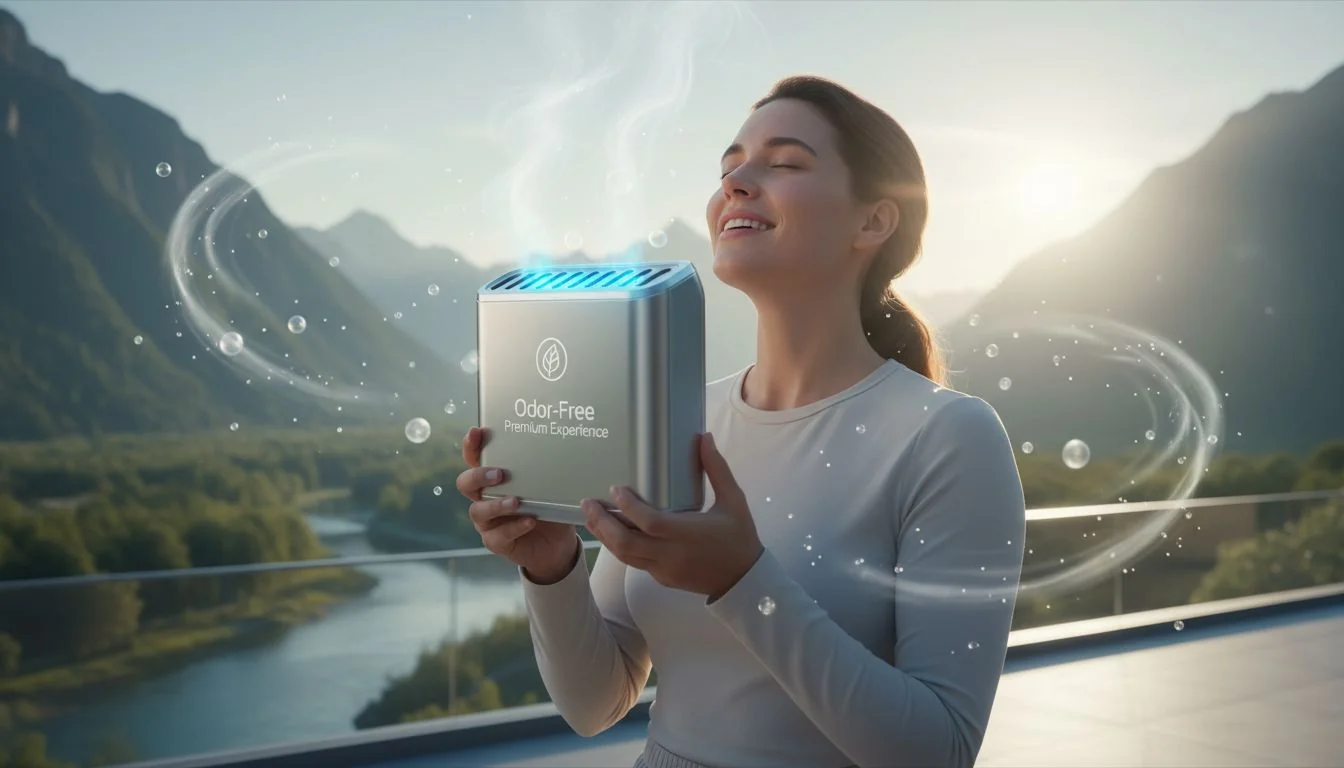
happy user smelling fresh air from premium device

I have built businesses by understanding value. Value is not just features; it is reliability. Imagine a user buys a high-end humidifier for their baby's room. They turn it on. It smells like wet dog or cheap plastic. That parent will never trust that brand again. The trust is broken. We are selling "Air Quality" or "Water Quality." If the tank adds a smell, we are polluting the product we promised to clean.

This is why the tank is not an accessory. It is the heart of the system. By using seamless steel, we guarantee that the water coming out is exactly the same as the water put in. That neutrality is luxury. It shows we engineered the product for the long term, not just for the showroom shelf. When a customer realizes the tank never smells, they become loyal for life. That is the power of solving the odor problem.

Odor is a primary driver of product returns in air quality devices.真

Bad smells directly contradict the promise of clean air or water, leading to immediate dissatisfaction.

Brand equity is unaffected by the smell of the product.偽

Sensory experience is critical to brand perception; a bad smell signals low quality and danger.

結論

Don't let a cheap tank ruin a premium product. By combining the passive science of stainless steel with seamless deep-draw engineering, we eliminate biofilm and secure brand trust.


References


  1. Understanding the advantages of mold-free tanks can enhance product design and user satisfaction. ↩

  2. Discovering the elements of premium quality can help brands differentiate their products. ↩

  3. Understanding the importance of water quality can help brands improve their product offerings. ↩

  4. Exploring the relationship between surface roughness and biofilm can lead to better material choices. ↩

  5. Understanding biofilm adhesion can inform better design practices to prevent contamination. ↩

  6. Understanding how to maintain an odor-free experience can enhance customer satisfaction and loyalty. ↩

  7. Learning about deep-draw technology can highlight its benefits for product durability and hygiene. ↩

シェアする
ヒソエア創設者のリー氏
Alwen Lee, an air purification expert with over 10 years of experience, is a devoted father of two and a passionate traveler, having explored more than 30 countries. With a love for public speaking and swimming, he has dedicated his life to the indoor air quality industry. His mission is to ensure that people around the world enjoy the freedom to breathe clean air and lead happy, healthy lives.

メッセージを送る

もっと読む

Modern living room with a family enjoying a healthy indoor environment monitored by smart devices, natural lighting, and greenery.

After IFA 2026: The Healthy Home Is Moving Beyond Smart Devices

In our previous IFA 2026 column, Air Purification Is Becoming Part of the Healthy-Home Platform, we argued that the next generation of indoor-health products would ...
ニュース
Modern living room and kitchen with smart home air quality devices including an air purifier, humidifier, and water filtration system, connected with visualized blue connectivity lines.

IFA 2026: Air Purification Is Becoming Part of the Healthy-Home Platform

Pre-IFA Industry Perspective | September 4, 2026 This article is based on official announcements and regulatory information available ahead of IFA 2026, which takes place ...
ニュース
Comparison infographic showcasing the differences between carbon block filter and activated carbon fiber. Detailed diagrams illustrate the hierarchical porous structure of the carbon block with long diffusion paths and the open microporous structure of the activated carbon fiber with direct access for PFAS adsorption.

Carbon Block vs. Activated Carbon Fiber (ACF): Matching Media to Target Contaminants

Two carbon media. Same adsorption chemistry. Very different behaviour in a point-of-use cartridge. If you are specifying a water purifier platform for a PFAS-aware market, ...
ニュース
Comparison between PFAS-ready and PFAS-certified water filters, showing internal filter components and certification steps.

PFAS-Ready vs. PFAS-Certified Water Filters: Engineering Differences for OEM Brands

For an appliance, wellness or healthy-home brand preparing to launch a water purifier, the phrase “PFAS-ready” can sound reassuring. The proposed system may use activated ...
Water Purifiers
NSF base listing and ANF private-label certification pathway for OEM water filters

What Is an NSF Master Listing? A Guide to Base Listings, ANF Certification and OEM Water Filters

For a brand preparing to launch an OEM water purifier, one of the most common supplier claims is: “We already have an NSF master listing, ...
News, Water Purifiers
Healthy-home brand team reviewing PFAS water filter certification, test data and product engineering

Entering the Water Category Is Easy. Building a Credible PFAS Claim Is Much Harder

For air purification, appliance and healthy-home brands, entering the water category can look surprisingly easy. A company can select an existing undersink system, customize its ...
ニュース
Contaminant Engineering•3 min read

PFAS Water Filtration Technologies Explained: Carbon, Resin & RO

Key Takeaway:

PFAS reduction depends on the specific compounds present, treatment media, contact time, water chemistry, and system design. Activated carbon, ion exchange, and Reverse Osmosis address PFAS through different mechanisms.

PFAS are a large family of persistent fluorinated compounds that can occur in drinking-water supplies. Their treatment behavior varies significantly by molecular structure, chain length, functional group, concentration, and the chemistry of the source water.

Granular Activated Carbon (GAC) removes PFAS primarily through adsorption. It is generally more effective for many longer-chain PFAS, while shorter-chain compounds tend to break through more quickly. Carbon performance depends on media properties, Empty Bed Contact Time (EBCT), competing organic matter, loading, and replacement frequency.

Ion-exchange resins use charged functional sites to capture many PFAS compounds. Properly selected anion-exchange media can provide high capacity and may perform better than conventional activated carbon for some shorter-chain PFAS, although performance still depends on water chemistry and competing ions.

Reverse Osmosis (RO) uses membrane separation rather than adsorption. Properly designed RO systems can provide broad reduction across many PFAS compounds as well as dissolved salts and other contaminants. Unlike carbon or resin, however, RO also produces a concentrate stream that must be managed.

No single technology should be selected from a PFAS label alone. System design should consider which PFAS compounds are present, their concentrations, required reduction targets, flow rate, media life, and the applicable third-party certification or validation requirements.

HisoAir Water Technical Series
Product Discovery•3 min read

How to Choose an Under-Sink Water Purifier for Modern Kitchens

Key Takeaway:

Match the treatment technology to your water quality first, then evaluate cabinet space, faucet configuration, flow rate, drain and power requirements, and filter replacement needs.

Choosing an under-sink water purifier starts with water chemistry. Carbon filtration is well suited to chlorine, taste, odor, and many organic contaminants, while Reverse Osmosis is more appropriate when dissolved salts, fluoride, nitrates, or broader dissolved contaminants need to be reduced.

For compact kitchens, tankless RO systems eliminate the conventional storage tank and can significantly reduce the space required under the sink. However, membrane capacity stated in GPD does not directly equal faucet flow. When comparing systems, check the actual dispensing flow rate, inlet-pressure requirement, recovery ratio, and whether a booster pump is required.

Installation architecture also matters. Many RO systems require a drain connection, electrical power, and either a dedicated drinking-water faucet or a compatible multi-function faucet. High-flow carbon systems can often connect directly to the existing cold-water line with a simpler installation, but pressure drop and available faucet flow should still be verified.

RO also removes much of the naturally occurring dissolved mineral content. Where taste or mineral balance is a priority, a post-RO remineralization stage can be added. Filter life should be evaluated by both rated capacity and local water quality rather than replacement time alone.

The right system is therefore not simply the smallest or highest-GPD model. It is the configuration that matches the target contaminants, available cabinet space, desired faucet setup, peak dispensing demand, and maintenance expectations.

HisoAir Water Technical Series
Water Quality•2 min read

What Does TDS Mean in Drinking Water? Measurement vs Contaminant Reality

Key Takeaway:

A TDS meter estimates the overall concentration of dissolved ionic substances from electrical conductivity. It cannot identify specific contaminants or determine whether water is chemically safe.

Total Dissolved Solids (TDS) refers to the combined concentration of dissolved substances in water. Most handheld TDS meters do not measure TDS directly. Instead, they measure electrical conductivity (EC) and convert that reading into an estimated parts-per-million (ppm) value.

This means a TDS reading can indicate how much dissolved ionic material is present, but not what that material actually is. Calcium, magnesium, sodium, nitrates, and other dissolved ions can all contribute to conductivity, yet a simple TDS meter cannot distinguish between them.

TDS meters are also not suitable for detecting trace contaminants such as PFAS, many VOCs, pesticides, pharmaceuticals, or disinfection byproducts. These substances may be present at concentrations far below the level needed to noticeably change electrical conductivity.

A low TDS reading therefore does not guarantee safe drinking water, and a higher TDS reading does not automatically indicate contamination. Water-treatment decisions should be based on laboratory testing for specific contaminants of concern rather than TDS alone.

HisoAir Water Technical Series
Technology Selection•2 min read

RO vs UF Water Filtration: Understanding Pore Sizes & Dissolved Minerals

Key Takeaway:

Ultrafiltration can reduce bacteria, turbidity, and suspended particles while retaining most naturally occurring dissolved minerals. Reverse Osmosis provides much broader reduction of dissolved salts and smaller contaminants.

Ultrafiltration (UF) typically uses hollow-fiber membranes with pore sizes in the approximate 0.01–0.1 micron range. These membranes physically retain turbidity, suspended solids, colloids, and many microorganisms while allowing dissolved minerals and salts to remain in the water.

Reverse Osmosis (RO) operates at a much finer separation level. Unlike UF, RO can substantially reduce dissolved ions such as sodium, calcium, fluoride, nitrates, and other contributors to total dissolved solids (TDS). This makes RO more suitable when dissolved-salt reduction is a primary treatment objective.

UF generally requires less system pressure and produces little or no continuous concentrate stream in many point-of-use configurations. RO typically requires greater pressure and produces a reject-water stream, but delivers broader contaminant reduction.

For water with acceptable TDS and mineral content, UF can be a simpler mineral-retaining treatment option. Where dissolved salts, fluoride, nitrates, or broader dissolved contaminants are a concern, RO is generally the more appropriate technology.

HisoAir Water Technical Series
Technology Selection•4 min read

Carbon Block vs Reverse Osmosis: Which Fits Your Need?

Key Takeaway:

Choose RO for dissolved inorganic salts and heavy metals; choose Carbon Block for chemical taste/odor, no wastewater, and high line-pressure flow.

Reverse Osmosis (RO) and Carbon Block filtration represent two fundamentally different treatment methods: membrane separation and adsorption. Understanding these differences helps determine which technology is better suited to a specific water-quality requirement.

Reverse Osmosis uses a semi-permeable membrane with pore sizes of approximately 0.0001 microns. It can significantly reduce dissolved inorganic contaminants such as TDS, fluoride, nitrates, and certain heavy metals. Because water must be forced through the membrane, RO systems require sufficient pressure or a booster pump and generate a concentrated wastewater stream.

Carbon Block filtration relies primarily on adsorption through compressed activated carbon, commonly with nominal pore sizes around 0.5–5 microns. It is highly effective for chlorine, chloramines, VOCs, taste, and odor, while allowing substantially higher direct-flow rates without producing wastewater.

From an operating perspective, Carbon Block systems are generally simpler, require less energy, and avoid the water loss associated with RO. RO involves higher system complexity and operating cost, but provides substantially broader reduction of dissolved contaminants that Carbon Block alone cannot address.

HisoAir Water Technical Series

見積依頼

















