
Launching a new product is slow and full of delays. These delays cost you sales and let competitors get ahead. Choosing the right country can dramatically speed up your time to market.
For the fastest product launch, China's complete manufacturing ecosystem1 is unmatched for complex, high-tech goods. For brands targeting North America, Mexico offers incredible speed through nearshoring. Emerging players like Vietnam provide cost-effective options for simpler products, creating a diverse landscape for D2C brands.
I've been through this exact challenge with ヒソエア more times than I can count. The pressure to get a new water purifier model from a sketch to a customer's hands is intense. Every week of delay feels like a missed opportunity. But over the years, I've learned that the "where" of manufacturing is just as important as the "what." The right location can be your secret weapon for a fast and successful launch. Let's break down what I've learned about each key region so you can make the best choice for your brand.
1. China – Speed Through Ecosystem and Automation?
Need to scale production fast but worried about finding all the right parts? China's integrated system solves this by putting everything you need in one place for incredible speed.
China is best for quick launches because of its complete supply chain ecosystem. You can find suppliers for every component, from raw materials to high-tech chips, and scale production rapidly with advanced automation.
When we developed our first HisoAir smart purifier, we needed to move fast. China was the obvious choice. The speed there isn't just about cheap labor; it's about the density and completeness of the supply chain.
The All-in-One Ecosystem
In a city like Shenzhen, you can find a supplier for any component imaginable within a few square miles. I remember needing a specific type of micro-pump for a new prototype. My team on the ground found three potential suppliers, got samples, and tested them all within 48 hours. That kind of speed is impossible almost anywhere else. This ecosystem allows for incredibly rapid iteration. You can get a new plastic mold tooled in a week, not a month.
The Power of Automation
Modern Chinese factories are not the workshops of the past. They are heavily invested in automation, which is key for scaling up. Once we finalized our purifier design, our partner factory could ramp up from producing 100 units to 10,000 units without a major hiccup. This ability to scale on demand is critical for a product launch where you're unsure of initial sales volume. It means you can meet unexpected demand without a long wait.
You can launch a brand new, complex electronic product from idea to mass production in China in just one week.偽
While China is incredibly fast, a realistic timeline for a complex product involves weeks or months for design, prototyping, tooling, and regulatory certification before mass production can begin.
Shenzhen is known as the 'Silicon Valley of Hardware' for its rapid prototyping capabilities.真
The city's dense concentration of factories, component markets, and engineering talent creates an environment where hardware prototypes can be built and iterated upon faster than anywhere else in the world.

2. Mexico – Nearshoring for Speed and Proximity?
Tired of long shipping times and supply chain uncertainty from Asia? nearshoring to Mexico2 brings your manufacturing closer, cutting down lead times and giving you more control.
Mexico is ideal for brands targeting North America. Its proximity means faster shipping, easier communication due to similar time zones, and benefits from trade agreements like the USMCA, which can simplify customs and reduce tariffs.
After a few years of relying solely on Asia, the long shipping times started to hurt our cash flow at HisoAir. A 30-day journey on the water is 30 days your money is tied up in inventory you can't sell. That's when we started seriously looking at Mexico.
The Nearshoring Advantage
The biggest win with Mexico is logistics. A truck can get from a factory in Monterrey to our warehouse in Texas in two days. This completely changes the inventory game. Instead of ordering huge batches months in advance, we can place smaller orders more frequently. This "lean inventory" approach means we are more agile, respond to sales trends faster, and have less cash tied up in stock. For a D2C brand, that agility is priceless. It also makes communication far easier. A quick call with the factory manager is simple when you're only dealing with a one-hour time difference.
Navigating the USMCA
The United States-Mexico-Canada Agreement (USMCA) is another huge plus. For many products, including some of our water purifier components, it means tariff-free importing into the US. This simplifies the paperwork and can save a significant amount of money, offsetting any potentially higher labor costs. It makes the total landed cost much more competitive than you might think.
Manufacturing in Mexico is always cheaper than in China.偽
While labor can be competitive, China's massive scale and integrated component ecosystem often result in a lower total production cost for complex electronics. Mexico's primary advantage is in logistics, speed-to-market, and reduced tariffs for North America.
The USMCA trade agreement provides tariff-free access for many goods manufactured in Mexico to the US and Canadian markets.真
This agreement, which replaced NAFTA, is a cornerstone of the nearshoring strategy. It eliminates tariffs on qualifying goods, making manufacturing in Mexico very attractive for brands serving the North American market.
3. Asia Beyond China – Emerging Agile Players?
Is relying only on China too risky for your supply chain? Diversifying your manufacturing to other Asian countries like Vietnam can build resilience and often lower your costs.
Countries like Vietnam, Thailand, and Malaysia are becoming strong alternatives to China. They offer lower labor costs and are developing their manufacturing capabilities, especially for simpler electronics, textiles, and final assembly tasks.
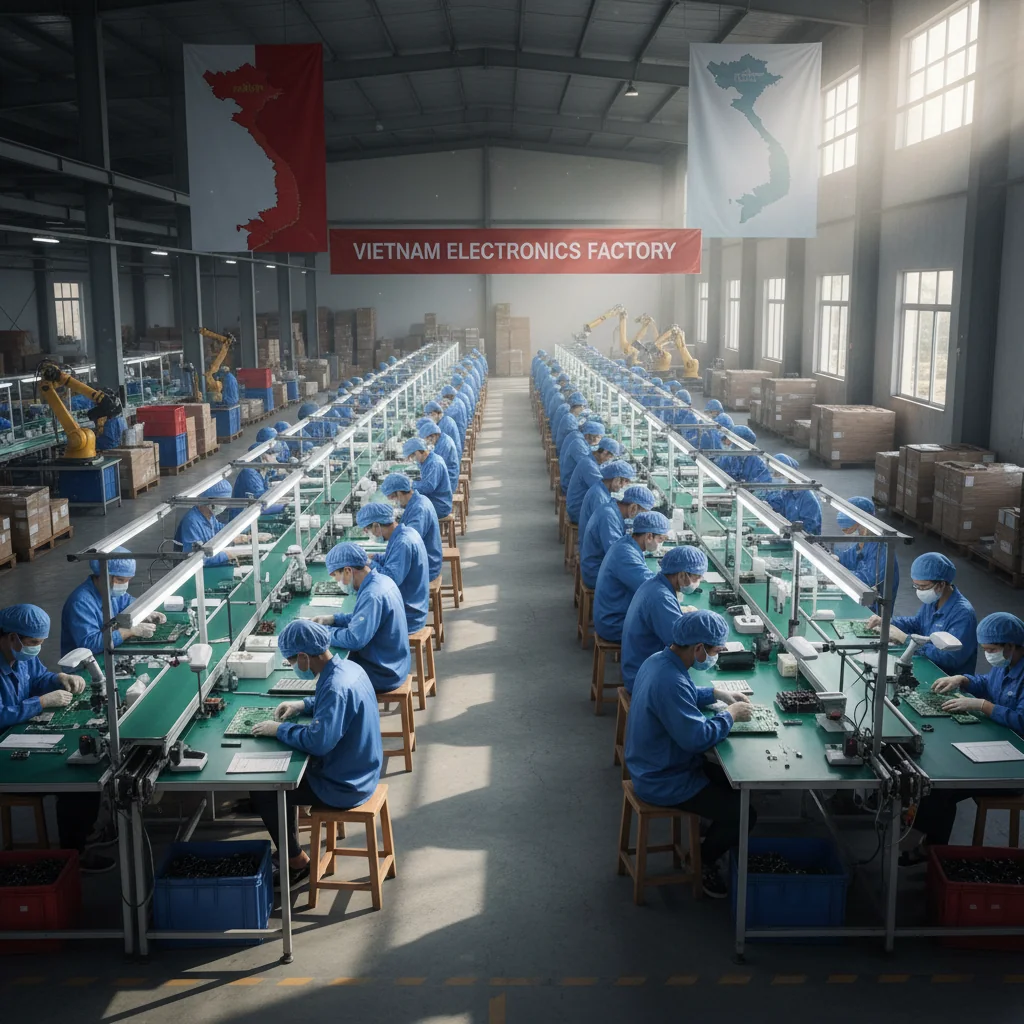
The pandemic taught every business owner a hard lesson about putting all their eggs in one basket. When lockdowns in one region can halt your entire business, you know you need a backup plan. For us, this meant seriously exploring the "China Plus One" strategy.
The 'China Plus One' Strategy
This strategy isn't about abandoning China. It's about adding a second manufacturing location to reduce risk. We looked to Vietnam for this. The idea was to have a parallel production line for one of our simpler, more established HisoAir models. If one country faced a disruption, we could ramp up production in the other. This builds resilience into your supply chain, which is crucial for long-term stability.
Strengths of Vietnam and Others
Vietnam has become a powerhouse for assembly. Labor costs are generally lower than in China, and the workforce is young and capable. For a product that doesn't require a complex, localized component ecosystem, it's a fantastic option. For example, if you are making a product where you can import the core components from China or Taiwan and just do the final assembly, Vietnam is very competitive. We found it was a great fit for testing and assembling some of our filter cartridges, which are less complex than our main purifier units. The learning curve can be steeper, but the cost and diversification benefits are real.
Vietnam's supply chain is as complete and mature as China's.偽
Vietnam is still developing its upstream supply chain. For complex products, manufacturers in Vietnam often need to import many key components from China, Taiwan, or South Korea, which can add logistical steps.
Many major tech companies have moved parts of their production to Vietnam to diversify their supply chains.真
Companies like Apple, Samsung, Google, and Dell have all expanded their manufacturing footprint in Vietnam to mitigate risks associated with over-concentration in China and to take advantage of a different labor market.
4. How Do These Regions Directly Compare for a Quick Launch?
Feeling overwhelmed by the options and unsure which trade-offs matter most? This direct comparison will clarify which region best fits your specific product and business goals.
China excels in speed and scale for complex products. Mexico wins on proximity and logistics for the North American market. Other Asian nations offer cost advantages for simpler goods. The best choice depends on your priority.
When we were developing our latest HisoAir model, we used a simple table to map out our options. It helped us cut through the noise and make a clear, strategic decision. Looking at the regions side-by-side makes the trade-offs obvious.

A Comparative Snapshot
Let's lay it out clearly. This is the exact kind of analysis we do internally.
| 地域 | 主な利点 | Best For… | Key Trade-Off |
|---|---|---|---|
| 中国 | Complete supply chain, automation, rapid scaling | Rapid prototyping, large-scale, high-tech | Higher costs, geopolitical risk |
| メキシコ | Nearshoring speed, trade access, lean inventory | Quick market entry into North America | Less mature component ecosystem |
| Vietnam & others | Lower labor costs, growing capabilities | Cost-sensitive, simple electronics & testing | Developing supply chain, logistics |
For our new smart sensor, we needed rapid prototyping and access to high-tech components, so we started in 中国. But for the US launch, we knew fast delivery and agile inventory were critical. So, we explored final assembly in メキシコ. For a basic, high-volume filter we sell, the cost savings in ベトナム were very attractive. Your "best" choice is never universal; it's about what's best for a specific product at a specific time.
You must choose only one country for your entire manufacturing process.偽
Many successful brands use a hybrid model. They might source high-tech components from China, manufacture plastic casings in Vietnam, and perform final assembly in Mexico for the US market. This leverages the strengths of each region.
Political and trade policies can rapidly change the attractiveness of a manufacturing region.真
Tariffs, trade agreements (like the USMCA), and domestic policies can significantly impact costs and logistics. Brands must stay informed and build flexible supply chains to adapt to these changes.
5. What's the Right Strategy for Your D2C Brand?
You know the options, but how do you build a practical plan? Let's outline a strategy that aligns your manufacturing choice with your brand's goals for growth and speed.
For a new D2C product, consider starting in China for rapid prototyping and your initial production run. As you scale and target North America, evolve to a "China + Mexico" model for resilience and logistical speed.

For a D2C or B2C brand like ヒソエア, speed and customer experience are everything. A long pre-order period or a stock-out can kill momentum. Your manufacturing strategy needs to support an agile, customer-focused business model. Here is a phased approach that has worked for us.
Phase 1: The Prototype and Launch
For a brand-new product, especially a technical one, start in China. The goal here is speed of iteration. You want to go from idea to a perfect, manufacturable product as fast as possible. Use the Shenzhen ecosystem to test, fail, and improve quickly. Your first production run can also be done here to get the product to market and validate demand.
Phase 2: Scaling and Diversifying
Once your product has proven itself and you have steady sales, especially in North America, it's time to de-risk and optimize. This is where you add your "Plus One." For a US-focused brand, Mexico is the perfect complement to China. You can continue to source complex components from China but shift final assembly to Mexico. This gives you the best of both worlds: China's component ecosystem and Mexico's logistical speed. This hybrid model is the holy grail for many D2C brands today.
A D2C brand should always choose the absolute cheapest manufacturing option available.偽
For D2C brands, factors like speed to market, product quality, and reliable logistics are often more critical to customer satisfaction and brand reputation than achieving the rock-bottom production cost.
A hybrid manufacturing strategy can provide both cost-efficiency and supply chain resilience.真
By leveraging the unique strengths of different regions (e.g., China for components, Mexico for assembly), brands can create a supply chain that is more robust, flexible, and cost-effective overall.
結論
Choosing the right country—China for speed, Mexico for proximity, or Vietnam for cost—is key. A smart, phased strategy will get your product to market faster and more reliably.







 English
  Français
  Español
  Italiano
  Deutsch
  Português
  Русский
  العربية
  日本語
日本語  한국어
한국어  Tiếng Việt

