Opens in a new tab
Innovative Air Quality Solutions

5 Best Air Purifier Manufacturers in India (2026) – HisoAir

Related Products

If you're looking for the best air purifier manufacturers in India , you've landed on the right page! In this post, we have gathered 5 of the top air cleaner factories and companies in India.
Having an air purifier at home or in public waiting areas can significantly lower the chances of letting bacteria stay indoors. With the increasing number of cases of COVID-19 patients, people are more aware of good hand hygiene and good air ventilation. Thus, The air purifier market has significantly increased in 2020 and is expected to reach $39 million by 2023.

If you're looking into taking advantage of this demanding opportunity and selling air purifiers, the best option is to look for qualified manufacturers. And we're going to discuss the top air purifier exporters, suppliers and factories in India in this article.

Note: This list of the top air purifier manufacturers in India is extracted based on the following criteria:

  • Suppliers and exporters with large manufacturing runs and produces millions of inventories per month
  • Research and development capabilities
  • Complete factory certification such as ISO and GMP
  • Produces humidifiers and HEPA air purifiers
  • Offers affordable wholesale options

Top 5 Air Purifier Manufacturers in India

In a hurry? Here are the best HEPA air purifiers made in India by qualified manufacturers:

  1. Elofic - Haryana, India
  2. Air Concept - Ahmedabad, Gujarat
  3. STULZCHSPL India - Mumbai
  4. Wardwizard Solutions India - Vadodara, Gujarat
  5. Hi Tech Sweet Water Technologies - Secunderabad, Telangana

5 Best Indian Manufacturers of Air Purifiers and Air Cleaners

Now, we will introduce you to more details of air purifier companies in india.

1. Elofic

Headquarters: Haryana, India
Years of experience: 67 years
Certificates: ISO: 9001

Elofic logo

Elofic Industries is one of the recognized companies manufacturing air purifiers in India. The company has a full range of filter systems and filtration units for fuels, air and oil. These equipment and filtration units are used for home, automotive and office areas.

Elofic supplies over 85 million filters per year with which it exports ⅓ of its products worldwide. They have over 67 years of experience in manufacturing and distribution of air purifiers and air filtration systems. Along with 3 ISO certified factories is a R&D facility in Faridabad. Elofic also offers OEM services.

2. Air Concept

Headquarters: 3rd Floor, Aalin, Opp.Gujarat Vidhyapith, Near Ajanta Commercial complex River front main gate, Ashram Rd, Ahmedabad, Gujarat 380014, India
Years of experience: 25 years
Certificates: ISO: 9001

Air Concept Logo
Air Concept Logo

Air Concept is a reliable manufacturer of high-end air purifiers in India. The company manufactures an innovative line of indoor air purifiers products that rose in popularity in India and worldwide. One of their biggest advantages is the cost effectiveness of products that still maintain its quality.

Air Concept's purifiers can identify air pollutants and smartly monitor air quality index in real time. It makes it easier for clients to monitor the actual quality of air in an intuitive manner. The company also has introduced WIFI air purifiers that you can monitor through mobile phones .

Aside from this, Air Concept has also developed several purifiers with pole kiosks for cleaning roads and streets.

3. STULZCHSPL India

Headquarters: A-173 & 173-1, TTC Industrial Area, Kopar Khairane, MIDC, Navi Mumbai-400 710
Years of experience: 21 years
Certificates: ISO 9001:2015

STULZCHSPL Logo
STULZCHSPL Logo

Stulzchspl has one of the largest air purifier factories in India covering 200,000 sq. ft of area. It has over 14 branches nationwide and a large distribution network worldwide.
The company manufactures several air conditioning equipment and accessories for home and industry uses. Aside from their popular air purifier line, the company also offers precision cooling units, air handling units, air distribution terminals and humidifiers.

4. Wardwizard Solutions India

Headquarters: Plot 222, Makarpura GIDC, Makarpura, Vadodara, Gujarat 390010
Years of experience: 4 years
Certificates: ISO 9001: 2015
Wardwizard logo
Wardwizard logo

Wardwizard Solutions is a listed company at the Bombay Stock Exchange (BSE) and Calcutta Stock Exchange Limited (CSE). The company not only supplies air purifiers but also a number of energy efficient equipment such as Electric Vehicles, LED TVs, Air Conditioners, Alkaline Water Maker, and hydrogen water cups. The company offers top-of-the-line air purifiers which are exported worldwide.

5. Hi Tech Sweet Water Technologies

Headquarters: EC Nagar Colony, Cherlapalli, Secunderabad, Telangana 500051, India
Years of experience: 25 years
Certificates: ISO : 9001:2008, 14001:2004, 18001:2007

Hi Tech Logo
Hi Tech Logo

Hitech is one of the trusted air purifier providers in India. The company specializes in the manufacture of water purification and purifying systems. They have developed several water purifiers, reverse osmosis systems, air purifiers and alkaline water systems. They also provide pumps, QC fittings , RO membranes, water filter cartridges and many more.

One of their best selling products is their air purifiers designed and manufactured from high-quality raw materials sourced from trusted suppliers. The company also claims to use the latest technologies sourced from the US for manufacturing both water and air purifiers.

Top Air Purifier Manufacturer in China

China is the manufacturing powerhouse of the world, supplying almost a third of the products found on the globe. If you are interested in connecting with the top air purifier manufacturer in the said country, work with HisoAir today!

HisoAir

HisoAir logo
HisoAir logo

Image Source: HisoAir

Business Type: OE/OD/JD Manufacturer, Supplier
Headquarters: Room 712, Building 1, No. 4, Second Road, Songshan Lake Park, Dongguan City, Guangdong Province, China
Main Markets: Global
Years of Experience: 18 years
Certificates: CE, ROHS, EN1822

HisoAir specializes in manufacturing air purifiers that can be used in a medical setting. It is formally recognized as Shenzhen HisoAir Co., Ltd., and it was founded in 2003. It had achieved phenomenal success over its short eleven years in the industry with its more than a hundred accomplished projects all over the globe.

The company has patented more than 50 designs and developed air purification systems that can remove 99.99% of the particles present in the air. The SGS has also verified that its products can filter 99.8% of the coronavirus family, which would be beneficial in the current society where the COVID-19 pandemic is raging.

Key Products

  • Medical-grade air purifiers

Wrapping Up

To thrive in a healthier and fresh environment, air purifiers help in filtering out the air from dusts, dirt and viruses. Air cleaners are one of the major products that rose in demand in 2020 and we're definitely seeing it to grow in 2021. So if you happen to be looking for trusted manufacturers and suppliers of air purifiers in India to resell, dropship or buy in bulk, we have listed the best manufacturers you can contact in India.

Want more options? How about sourcing air purifiers from China? Read our blog on the “ 5 Best Air Purifiers in China ”.
Share:
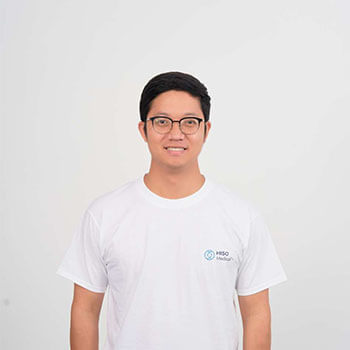
hisoair founder mr lee
Alwen Lee, an air purification expert with over 10 years of experience, is a devoted father of two and a passionate traveler, having explored more than 30 countries. With a love for public speaking and swimming, he has dedicated his life to the indoor air quality industry. His mission is to ensure that people around the world enjoy the freedom to breathe clean air and lead happy, healthy lives.

Send Us A Message

Related Products

More to Read

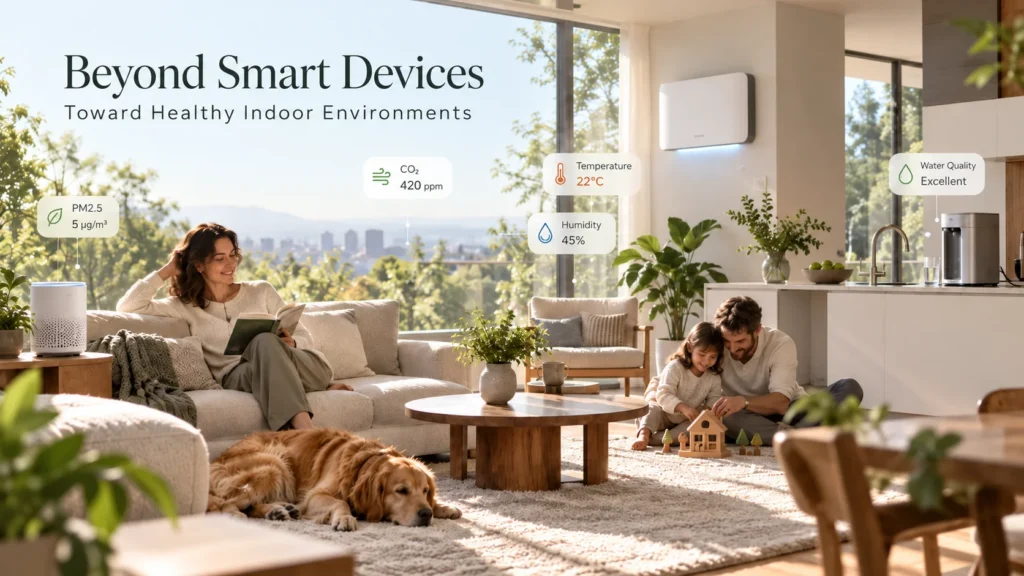
Modern living room with a family enjoying a healthy indoor environment monitored by smart devices, natural lighting, and greenery.

After IFA 2026: The Healthy Home Is Moving Beyond Smart Devices

In our previous IFA 2026 column, Air Purification Is Becoming Part of the Healthy-Home Platform, we argued that the next generation of indoor-health products would ...
News
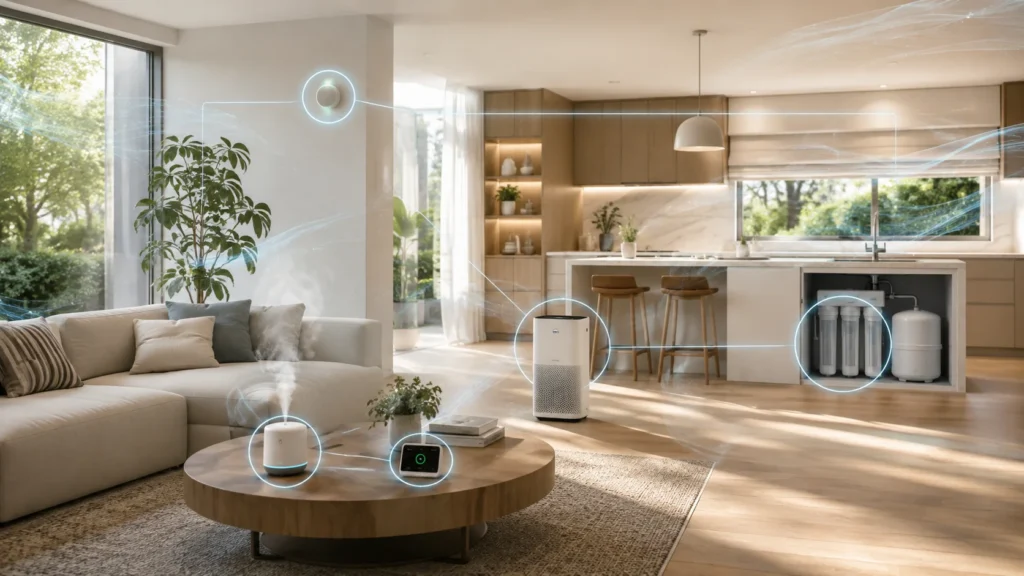
Modern living room and kitchen with smart home air quality devices including an air purifier, humidifier, and water filtration system, connected with visualized blue connectivity lines.

IFA 2026: Air Purification Is Becoming Part of the Healthy-Home Platform

Pre-IFA Industry Perspective | September 4, 2026 This article is based on official announcements and regulatory information available ahead of IFA 2026, which takes place ...
News
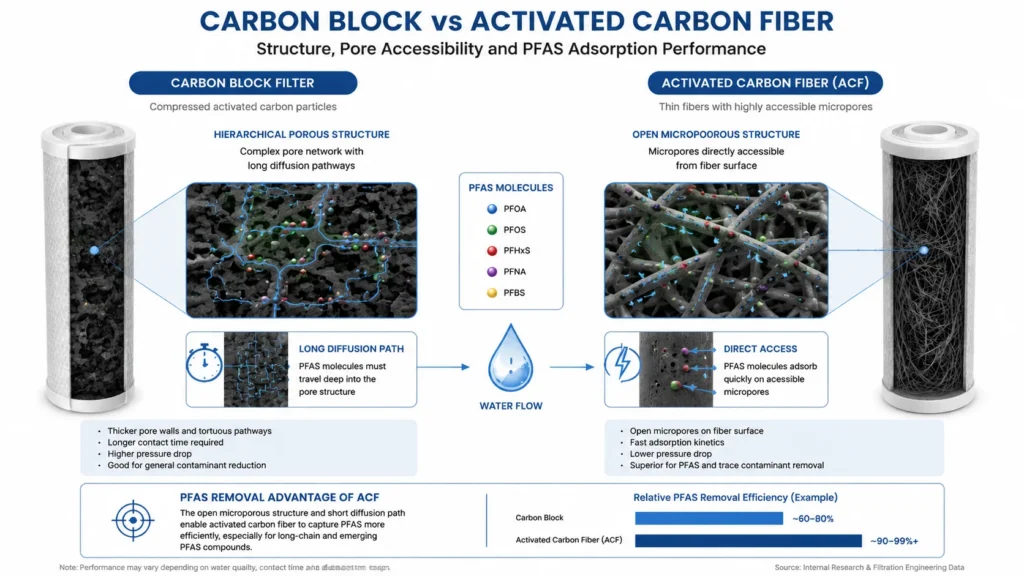
Comparison infographic showcasing the differences between carbon block filter and activated carbon fiber. Detailed diagrams illustrate the hierarchical porous structure of the carbon block with long diffusion paths and the open microporous structure of the activated carbon fiber with direct access for PFAS adsorption.

Carbon Block vs. Activated Carbon Fiber (ACF): Matching Media to Target Contaminants

Two carbon media. Same adsorption chemistry. Very different behaviour in a point-of-use cartridge. If you are specifying a water purifier platform for a PFAS-aware market, ...
News
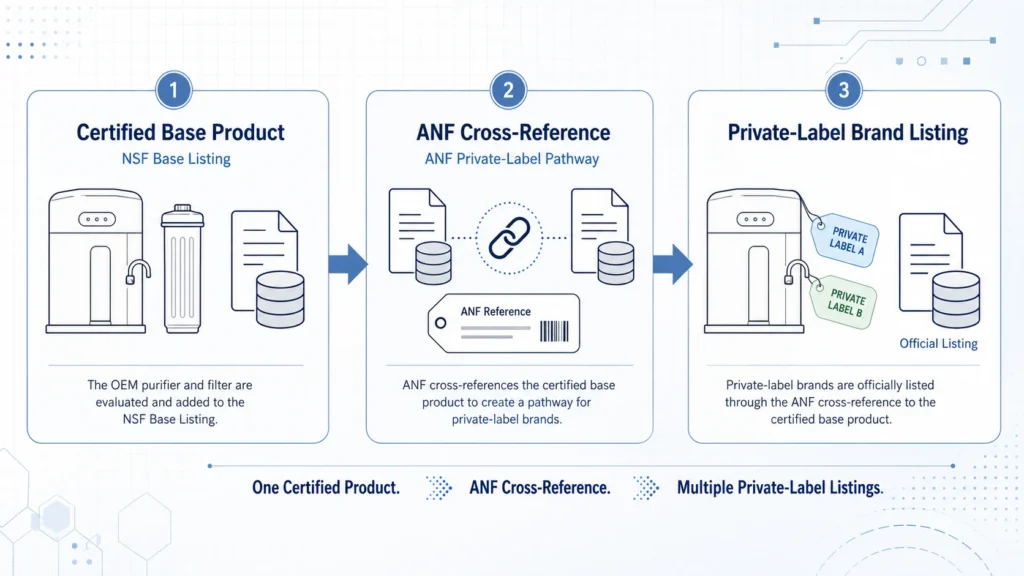
NSF base listing and ANF private-label certification pathway for OEM water filters

What Is an NSF Master Listing? A Guide to Base Listings, ANF Certification and OEM Water Filters

For a brand preparing to launch an OEM water purifier, one of the most common supplier claims is: “We already have an NSF master listing, ...
News, Water Purifiers
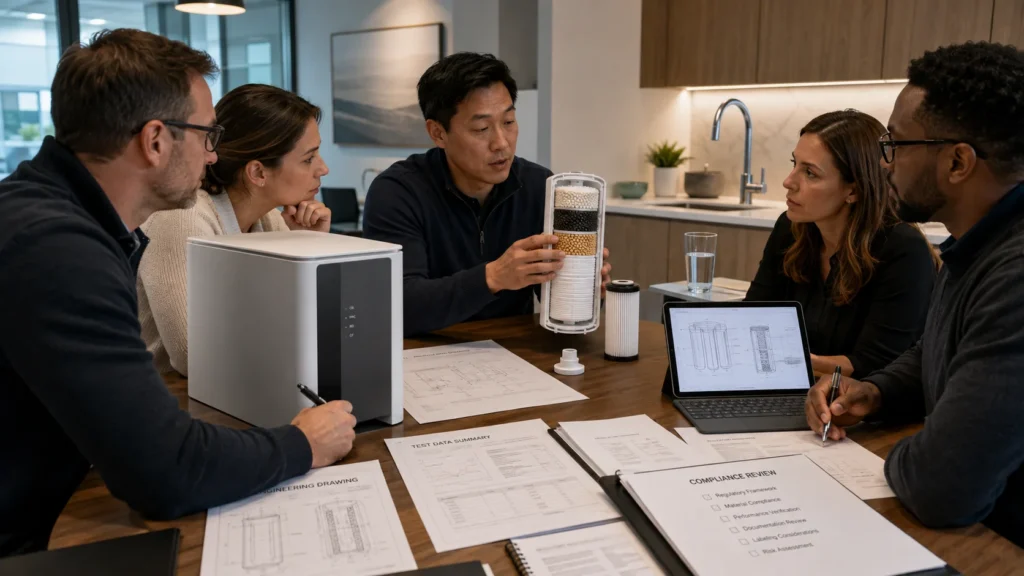
Healthy-home brand team reviewing PFAS water filter certification, test data and product engineering

Entering the Water Category Is Easy. Building a Credible PFAS Claim Is Much Harder

For air purification, appliance and healthy-home brands, entering the water category can look surprisingly easy. A company can select an existing undersink system, customize its ...
News
Team in a business meeting discussing a water filtration system with product components and a comparison table displayed on a screen.

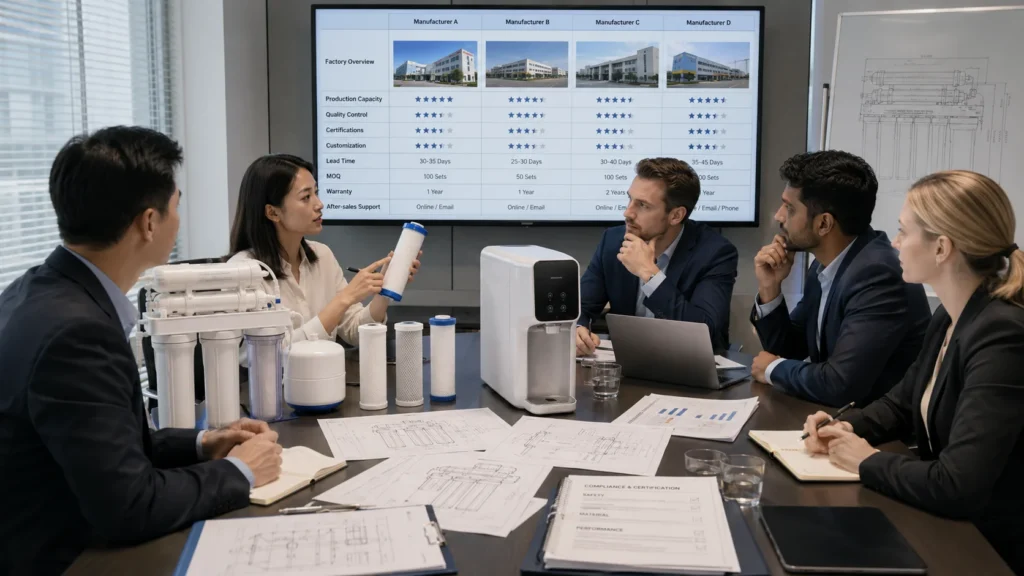
5 Leading OEM Water Purifier Manufacturers in China for Private Label Brands

China has thousands of companies selling water filters, reverse osmosis systems and drinking-water appliances. However, only a portion of them are suitable for private-label, OEM ...
News
Contaminant Engineering•3 min read

PFAS Water Filtration Technologies Explained: Carbon, Resin & RO

Key Takeaway:

PFAS reduction depends on the specific compounds present, treatment media, contact time, water chemistry, and system design. Activated carbon, ion exchange, and Reverse Osmosis address PFAS through different mechanisms.

PFAS are a large family of persistent fluorinated compounds that can occur in drinking-water supplies. Their treatment behavior varies significantly by molecular structure, chain length, functional group, concentration, and the chemistry of the source water.

Granular Activated Carbon (GAC) removes PFAS primarily through adsorption. It is generally more effective for many longer-chain PFAS, while shorter-chain compounds tend to break through more quickly. Carbon performance depends on media properties, Empty Bed Contact Time (EBCT), competing organic matter, loading, and replacement frequency.

Ion-exchange resins use charged functional sites to capture many PFAS compounds. Properly selected anion-exchange media can provide high capacity and may perform better than conventional activated carbon for some shorter-chain PFAS, although performance still depends on water chemistry and competing ions.

Reverse Osmosis (RO) uses membrane separation rather than adsorption. Properly designed RO systems can provide broad reduction across many PFAS compounds as well as dissolved salts and other contaminants. Unlike carbon or resin, however, RO also produces a concentrate stream that must be managed.

No single technology should be selected from a PFAS label alone. System design should consider which PFAS compounds are present, their concentrations, required reduction targets, flow rate, media life, and the applicable third-party certification or validation requirements.

HisoAir Water Technical Series
Product Discovery•3 min read

How to Choose an Under-Sink Water Purifier for Modern Kitchens

Key Takeaway:

Match the treatment technology to your water quality first, then evaluate cabinet space, faucet configuration, flow rate, drain and power requirements, and filter replacement needs.

Choosing an under-sink water purifier starts with water chemistry. Carbon filtration is well suited to chlorine, taste, odor, and many organic contaminants, while Reverse Osmosis is more appropriate when dissolved salts, fluoride, nitrates, or broader dissolved contaminants need to be reduced.

For compact kitchens, tankless RO systems eliminate the conventional storage tank and can significantly reduce the space required under the sink. However, membrane capacity stated in GPD does not directly equal faucet flow. When comparing systems, check the actual dispensing flow rate, inlet-pressure requirement, recovery ratio, and whether a booster pump is required.

Installation architecture also matters. Many RO systems require a drain connection, electrical power, and either a dedicated drinking-water faucet or a compatible multi-function faucet. High-flow carbon systems can often connect directly to the existing cold-water line with a simpler installation, but pressure drop and available faucet flow should still be verified.

RO also removes much of the naturally occurring dissolved mineral content. Where taste or mineral balance is a priority, a post-RO remineralization stage can be added. Filter life should be evaluated by both rated capacity and local water quality rather than replacement time alone.

The right system is therefore not simply the smallest or highest-GPD model. It is the configuration that matches the target contaminants, available cabinet space, desired faucet setup, peak dispensing demand, and maintenance expectations.

HisoAir Water Technical Series
Water Quality•2 min read

What Does TDS Mean in Drinking Water? Measurement vs Contaminant Reality

Key Takeaway:

A TDS meter estimates the overall concentration of dissolved ionic substances from electrical conductivity. It cannot identify specific contaminants or determine whether water is chemically safe.

Total Dissolved Solids (TDS) refers to the combined concentration of dissolved substances in water. Most handheld TDS meters do not measure TDS directly. Instead, they measure electrical conductivity (EC) and convert that reading into an estimated parts-per-million (ppm) value.

This means a TDS reading can indicate how much dissolved ionic material is present, but not what that material actually is. Calcium, magnesium, sodium, nitrates, and other dissolved ions can all contribute to conductivity, yet a simple TDS meter cannot distinguish between them.

TDS meters are also not suitable for detecting trace contaminants such as PFAS, many VOCs, pesticides, pharmaceuticals, or disinfection byproducts. These substances may be present at concentrations far below the level needed to noticeably change electrical conductivity.

A low TDS reading therefore does not guarantee safe drinking water, and a higher TDS reading does not automatically indicate contamination. Water-treatment decisions should be based on laboratory testing for specific contaminants of concern rather than TDS alone.

HisoAir Water Technical Series
Technology Selection•2 min read

RO vs UF Water Filtration: Understanding Pore Sizes & Dissolved Minerals

Key Takeaway:

Ultrafiltration can reduce bacteria, turbidity, and suspended particles while retaining most naturally occurring dissolved minerals. Reverse Osmosis provides much broader reduction of dissolved salts and smaller contaminants.

Ultrafiltration (UF) typically uses hollow-fiber membranes with pore sizes in the approximate 0.01–0.1 micron range. These membranes physically retain turbidity, suspended solids, colloids, and many microorganisms while allowing dissolved minerals and salts to remain in the water.

Reverse Osmosis (RO) operates at a much finer separation level. Unlike UF, RO can substantially reduce dissolved ions such as sodium, calcium, fluoride, nitrates, and other contributors to total dissolved solids (TDS). This makes RO more suitable when dissolved-salt reduction is a primary treatment objective.

UF generally requires less system pressure and produces little or no continuous concentrate stream in many point-of-use configurations. RO typically requires greater pressure and produces a reject-water stream, but delivers broader contaminant reduction.

For water with acceptable TDS and mineral content, UF can be a simpler mineral-retaining treatment option. Where dissolved salts, fluoride, nitrates, or broader dissolved contaminants are a concern, RO is generally the more appropriate technology.

HisoAir Water Technical Series
Technology Selection•4 min read

Carbon Block vs Reverse Osmosis: Which Fits Your Need?

Key Takeaway:

Choose RO for dissolved inorganic salts and heavy metals; choose Carbon Block for chemical taste/odor, no wastewater, and high line-pressure flow.

Reverse Osmosis (RO) and Carbon Block filtration represent two fundamentally different treatment methods: membrane separation and adsorption. Understanding these differences helps determine which technology is better suited to a specific water-quality requirement.

Reverse Osmosis uses a semi-permeable membrane with pore sizes of approximately 0.0001 microns. It can significantly reduce dissolved inorganic contaminants such as TDS, fluoride, nitrates, and certain heavy metals. Because water must be forced through the membrane, RO systems require sufficient pressure or a booster pump and generate a concentrated wastewater stream.

Carbon Block filtration relies primarily on adsorption through compressed activated carbon, commonly with nominal pore sizes around 0.5–5 microns. It is highly effective for chlorine, chloramines, VOCs, taste, and odor, while allowing substantially higher direct-flow rates without producing wastewater.

From an operating perspective, Carbon Block systems are generally simpler, require less energy, and avoid the water loss associated with RO. RO involves higher system complexity and operating cost, but provides substantially broader reduction of dissolved contaminants that Carbon Block alone cannot address.

HisoAir Water Technical Series

REQUEST A QUOTE