S’ouvre dans un nouvel onglet
Solutions innovantes pour la qualité de l'air

Les 4 premiers fabricants de purificateurs d'air en Chine

Related Products

Si vous avez besoin d'un grand nombre de purificateurs d'air de haute qualité, il est dans votre intérêt d'entrer en contact avec les différentes entreprises qui les produisent. Dans ce blog, nous avons répertorié les 4 principaux fabricants de ce type de produits en Chine.

La qualité de l'air que nous respirons devient de plus en plus trouble au fil du temps, au point de présenter des risques pour la santé. L'air contaminé que les gens inhalent peut entraîner des maladies et des troubles, car il peut contenir des produits chimiques, voire des bactéries et des virus. L'utilisation de purificateurs d'air qui ont des systèmes de filtration exceptionnels devient assez nécessaire dans un tel cas.

Pour conquérir une part de marché dans ce secteur ou installer des systèmes de purification de l'air à grande échelle, il faut commencer par trouver d'excellents fabricants et fournisseurs de machines de purification de l'air fiables. Dans cet article, nous avons dressé une liste des producteurs chinois les plus performants en termes de qualité de leur production, de capacité de production, de certifications et d'autres facteurs similaires. Consultez-les ci-dessous.

Liste des 4 principaux fabricants de purificateurs d'air en Chine

Vous trouverez ci-dessous les quatre principaux fabricants de purificateurs d'air en Chine qui ont répondu à nos exigences. Nous avons examiné les informations relatives à leur entreprise et dressé un profil bref mais complet dans leurs sections respectives. Vous pouvez cliquer sur l'entreprise que vous souhaitez consulter si vous êtes pressé de la connaître en détail.

  1. HisoAir
  2. HOKO
  3. Olansi
  4. Junkai

Les 4 premiers fabricants de purificateurs d'air en Chine

Nous avons pris en considération la capacité de production et les certifications des entreprises suivantes qui figurent sur cette liste. Nous avons également pris en compte leurs performances globales dans le secteur de la purification de l'air. Poursuivez votre lecture pour découvrir leurs meilleurs aspects et ce qu'ils peuvent vous offrir.

1. HisoAir

Logo HisoAir
Logo HisoAir

Source de l'image : HisoAir

Type d'entreprise: Fabricant et fournisseur OE/OD/JD
Siège social : Room 712, Building 1, No. 4, Second Road, Songshan Lake Park, Dongguan City, Guangdong Province, China
Principaux marchés: Global
Années d'expérience: 19 years
Certificats : CE, ROHS, EN1822
If you’re particularly looking for air purifiers that are as effective as those used in medical environments, HisoAir would be worth working with. It was established in 2003. It has, by far, completed more than a hundred projects globally throughout its years of establishment.
HisoAir a exporté ses produits dans plus de 100 pays et compte plus de 50 modèles brevetés. L'entreprise fabrique des purificateurs d'air dont le taux d'élimination des particules est supérieur à 99,99%. Comme dans le cas de la pandémie actuelle de COVID-19, il convient de noter que les produits HisoAir ont été vérifié par la SGS pour éliminer 99,8% de la famille des coronavirus.

Produits clés

  • Purificateurs d'air de qualité médicale

2. HOKO
Logo HOKO
Logo HOKO

Source de l'image : HOKO

Type d'entreprise : Fabricant OE/OD
Siège social : No.613 Tainan Rd, Dongchong Town, Nansha District, Guangzhou, Chine
Principaux marchés: Chine
Années d'expérience : 17 ans
Certificats : ISO 9001 : 2015, ISO 14001 : 2015, CE, ROHS
HOKO, anciennement connu sous le nom de Guangzhou Haike Electronics Technology Co., Ltd, peut être un partenaire approprié pour vous si vous souhaitez avoir accès à une large gamme de purificateurs d'air. Cette société n'est pas seulement réputée pour ses diverses variantes de purificateurs d'air, mais elle est également bien implantée sur les marchés d'autres produits ménagers.
En se concentrant sur ses purificateurs d'air, HOKO a réussi à se faire une place dans cette liste grâce à ses diverses certifications internationales en termes de contrôle de la qualité et d'impact sur l'environnement. La société possède également une longue expérience dans la conception et la fabrication de purificateurs d'air, puisqu'elle exerce ses activités depuis 2005. Le taux d'élimination des particules de 99,971 TTP3T qu'elle a atteint avec ses produits en est la preuve.

Produits clés

  • Purificateur d'air
  • Humidificateur d'air
  • Broyeur de déchets alimentaires
  • Thermomètre frontal
  • Autres produits ménagers

3. Olansi

Logo Olansi
Logo Olansi

Source de l'image : Olansi

Type d'entreprise : Fabricant OE/OD
Siège social : Building 1, No. 1, Haiyi Street, Lanhe Town, Nansha District, Guangzhou, Chine
Principaux marchés: Chine, Europe, Amérique du Sud, Asie du Sud-Est
Années d'expérience : 13 ans
Certificats : ISO 9001 : 2008, CE, CB, ROHS, SASO, CQC, CCC
Olansi Healthcare Co., Ltd, plus connue sous le nom d'Olansi, est une entreprise qui s'enorgueillit d'une énorme installation de production de plus de 60 000 mètres carrés. Elle propose un grand nombre de modèles de purificateurs d'air et on peut dire qu'elle dispose d'un vaste catalogue puisqu'elle fabrique également d'autres produits de soins de santé.
Olansi a obtenu en 2017 le titre d'entreprise de haute technologie dans la province de Guangdong, en Chine. Cette entreprise est également reconnue la même année comme l'un des dix premiers fabricants d'appareils électriques écologiques du pays. En outre, elle adhère à des systèmes de contrôle de la qualité internationalement reconnus pour la fabrication de ses produits.

Produits clés

  • Purificateur d'air
  • Purificateur d'eau
  • Nettoyeur de fruits et légumes
  • Produits de beauté

4. Junkai

Logo Junkai
Logo Junkai

Source de l'image : Junkai

Type d'entreprise : Fabricant
Siège social : No. 303, Changhong Road, Shanghai City, Chine
Principaux marchés : Chine, Japon, Corée, France, Allemagne, Espagne, Italie, EAU, Russie
Années d'expérience : 15 ans
Certificats : ISO 9001 : 2008, ISO 14000
Junkai est un groupe d'entreprises qui intervient sur de multiples marchés tels que la fabrication de purificateurs d'air, la construction, le traitement des eaux et des gaz au niveau industriel, et bien d'autres encore. Bien entendu, nous nous concentrerons sur Junkai Environmental Engineering Co., Ltd, qui est responsable de ses produits de filtration et de purification de l'air.
Créée en 2007, la société Junkai Environmental Engineering Co. a mené des activités intensives de recherche et de développement dans le domaine de la production de filtres à air, ce qui se traduit par une large gamme de filtres différents. Cela a sans aucun doute contribué à la fabrication de purificateurs d'air conformes aux normes de certification du système de contrôle de la qualité ISO 9001 : 2008.

Produits clés

  • Filtre à air
  • Purificateur d'air

Conclusion

Bien que la société mondiale ait fait progresser sa technologie à pas de géant, les répercussions sous forme de pollution posent également des risques importants pour la santé des personnes. Les purificateurs d'air sont d'excellentes solutions pour assainir l'air et filtrer les contaminants susceptibles de provoquer des maladies et des troubles.

Nous avons répertorié dans cet article les différents fabricants chinois les plus performants et nous pensons que, compte tenu des préoccupations médicales croissantes à l'époque, HisoAir serait l'un de vos meilleurs partenaires grâce à ses produits de qualité médicale. Visitez HisoAir aujourd'hui et discutez avec ses experts pour obtenir un devis gratuit.

Les articles suivants peuvent également vous intéresser :

Partager :
fondateur de hisoair m. lee
Alwen Lee, an air purification expert with over 10 years of experience, is a devoted father of two and a passionate traveler, having explored more than 30 countries. With a love for public speaking and swimming, he has dedicated his life to the indoor air quality industry. His mission is to ensure that people around the world enjoy the freedom to breathe clean air and lead happy, healthy lives.

Envoyez-nous un message

Related Products

Plus à lire

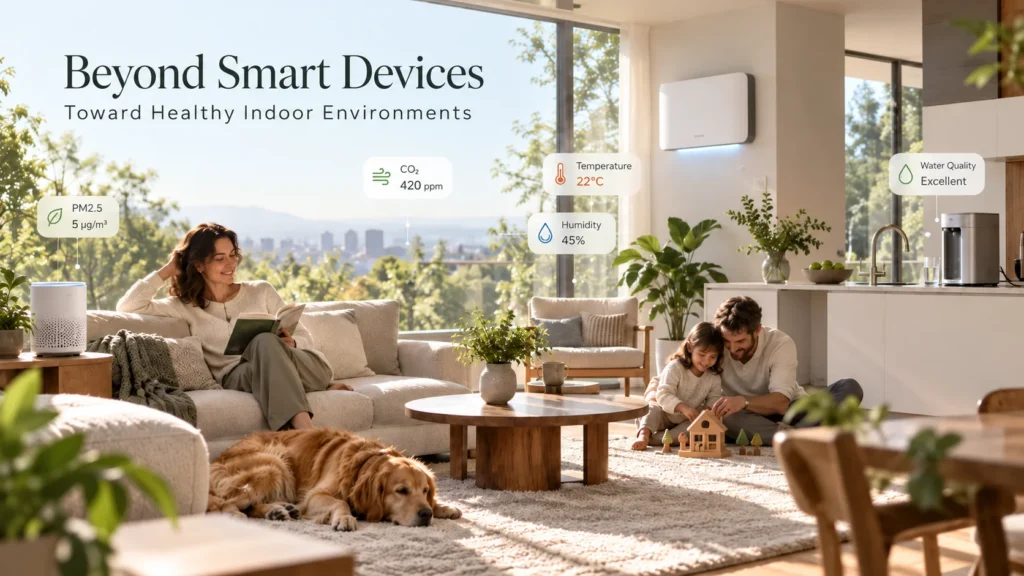
Modern living room with a family enjoying a healthy indoor environment monitored by smart devices, natural lighting, and greenery.

After IFA 2026: The Healthy Home Is Moving Beyond Smart Devices

In our previous IFA 2026 column, Air Purification Is Becoming Part of the Healthy-Home Platform, we argued that the next generation of indoor-health products would ...
Actualités
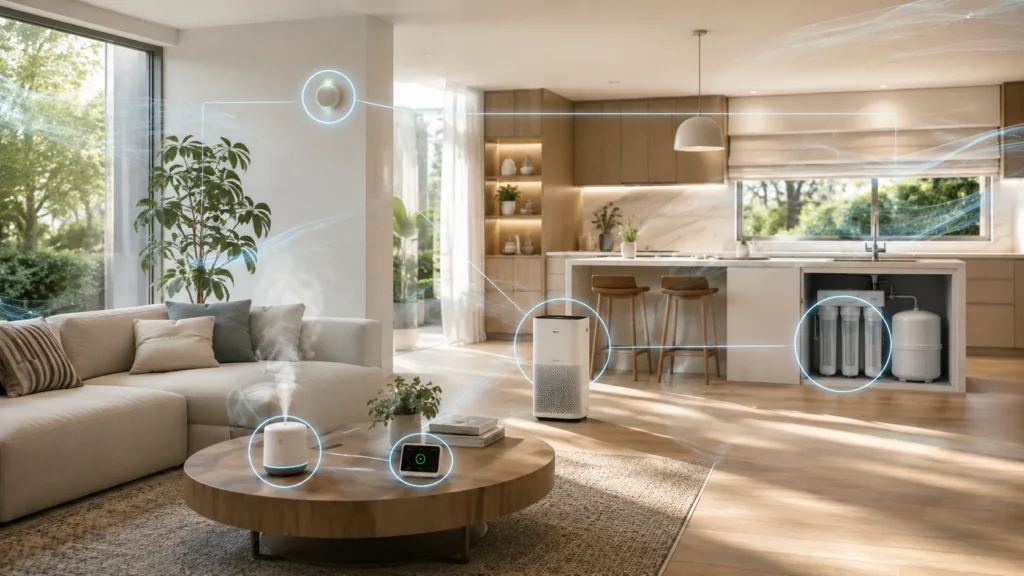
Modern living room and kitchen with smart home air quality devices including an air purifier, humidifier, and water filtration system, connected with visualized blue connectivity lines.

IFA 2026: Air Purification Is Becoming Part of the Healthy-Home Platform

Pre-IFA Industry Perspective | September 4, 2026 This article is based on official announcements and regulatory information available ahead of IFA 2026, which takes place ...
Actualités
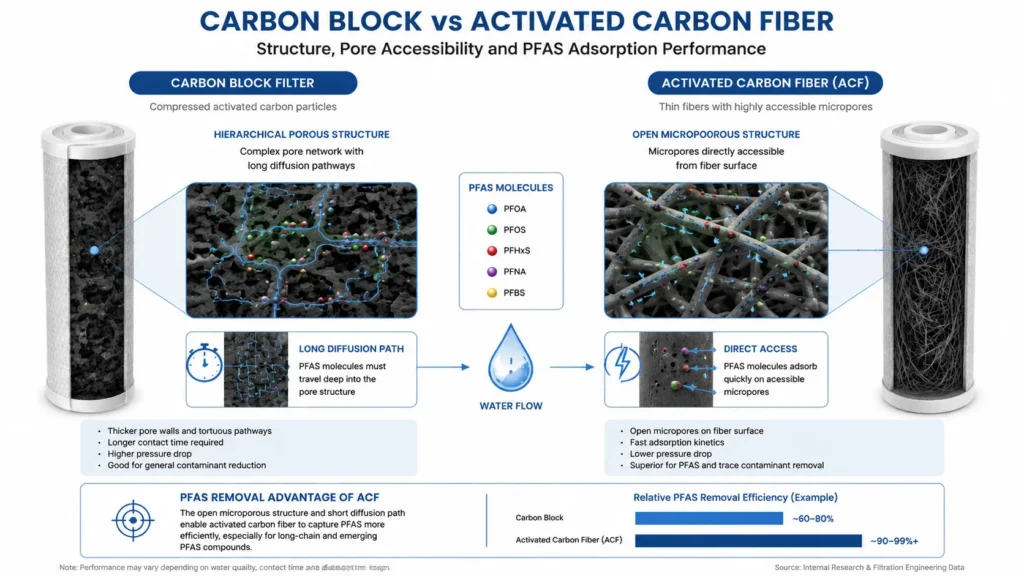
Comparison infographic showcasing the differences between carbon block filter and activated carbon fiber. Detailed diagrams illustrate the hierarchical porous structure of the carbon block with long diffusion paths and the open microporous structure of the activated carbon fiber with direct access for PFAS adsorption.

Carbon Block vs. Activated Carbon Fiber (ACF): Matching Media to Target Contaminants

Two carbon media. Same adsorption chemistry. Very different behaviour in a point-of-use cartridge. If you are specifying a water purifier platform for a PFAS-aware market, ...
Actualités
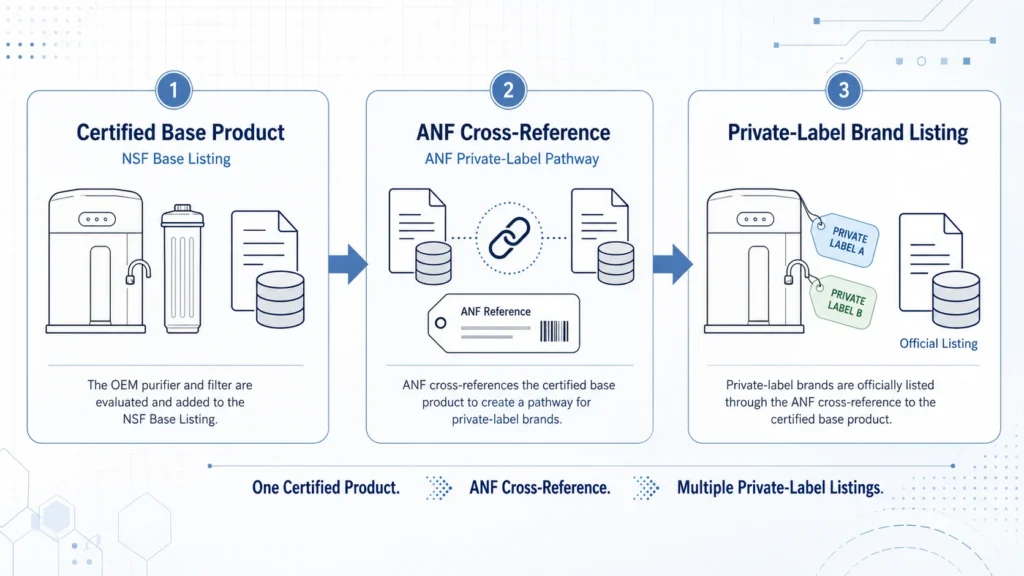
NSF base listing and ANF private-label certification pathway for OEM water filters

What Is an NSF Master Listing? A Guide to Base Listings, ANF Certification and OEM Water Filters

For a brand preparing to launch an OEM water purifier, one of the most common supplier claims is: “We already have an NSF master listing, ...
News, Water Purifiers
Healthy-home brand team reviewing PFAS water filter certification, test data and product engineering

Entering the Water Category Is Easy. Building a Credible PFAS Claim Is Much Harder

For air purification, appliance and healthy-home brands, entering the water category can look surprisingly easy. A company can select an existing undersink system, customize its ...
Actualités
Team in a business meeting discussing a water filtration system with product components and a comparison table displayed on a screen.

5 Leading OEM Water Purifier Manufacturers in China for Private Label Brands

China has thousands of companies selling water filters, reverse osmosis systems and drinking-water appliances. However, only a portion of them are suitable for private-label, OEM ...
Actualités
Contaminant Engineering•3 min read

PFAS Water Filtration Technologies Explained: Carbon, Resin & RO

Key Takeaway:

PFAS reduction depends on the specific compounds present, treatment media, contact time, water chemistry, and system design. Activated carbon, ion exchange, and Reverse Osmosis address PFAS through different mechanisms.

PFAS are a large family of persistent fluorinated compounds that can occur in drinking-water supplies. Their treatment behavior varies significantly by molecular structure, chain length, functional group, concentration, and the chemistry of the source water.

Granular Activated Carbon (GAC) removes PFAS primarily through adsorption. It is generally more effective for many longer-chain PFAS, while shorter-chain compounds tend to break through more quickly. Carbon performance depends on media properties, Empty Bed Contact Time (EBCT), competing organic matter, loading, and replacement frequency.

Ion-exchange resins use charged functional sites to capture many PFAS compounds. Properly selected anion-exchange media can provide high capacity and may perform better than conventional activated carbon for some shorter-chain PFAS, although performance still depends on water chemistry and competing ions.

Reverse Osmosis (RO) uses membrane separation rather than adsorption. Properly designed RO systems can provide broad reduction across many PFAS compounds as well as dissolved salts and other contaminants. Unlike carbon or resin, however, RO also produces a concentrate stream that must be managed.

No single technology should be selected from a PFAS label alone. System design should consider which PFAS compounds are present, their concentrations, required reduction targets, flow rate, media life, and the applicable third-party certification or validation requirements.

HisoAir Water Technical Series
Product Discovery•3 min read

How to Choose an Under-Sink Water Purifier for Modern Kitchens

Key Takeaway:

Match the treatment technology to your water quality first, then evaluate cabinet space, faucet configuration, flow rate, drain and power requirements, and filter replacement needs.

Choosing an under-sink water purifier starts with water chemistry. Carbon filtration is well suited to chlorine, taste, odor, and many organic contaminants, while Reverse Osmosis is more appropriate when dissolved salts, fluoride, nitrates, or broader dissolved contaminants need to be reduced.

For compact kitchens, tankless RO systems eliminate the conventional storage tank and can significantly reduce the space required under the sink. However, membrane capacity stated in GPD does not directly equal faucet flow. When comparing systems, check the actual dispensing flow rate, inlet-pressure requirement, recovery ratio, and whether a booster pump is required.

Installation architecture also matters. Many RO systems require a drain connection, electrical power, and either a dedicated drinking-water faucet or a compatible multi-function faucet. High-flow carbon systems can often connect directly to the existing cold-water line with a simpler installation, but pressure drop and available faucet flow should still be verified.

RO also removes much of the naturally occurring dissolved mineral content. Where taste or mineral balance is a priority, a post-RO remineralization stage can be added. Filter life should be evaluated by both rated capacity and local water quality rather than replacement time alone.

The right system is therefore not simply the smallest or highest-GPD model. It is the configuration that matches the target contaminants, available cabinet space, desired faucet setup, peak dispensing demand, and maintenance expectations.

HisoAir Water Technical Series
Water Quality•2 min read

What Does TDS Mean in Drinking Water? Measurement vs Contaminant Reality

Key Takeaway:

A TDS meter estimates the overall concentration of dissolved ionic substances from electrical conductivity. It cannot identify specific contaminants or determine whether water is chemically safe.

Total Dissolved Solids (TDS) refers to the combined concentration of dissolved substances in water. Most handheld TDS meters do not measure TDS directly. Instead, they measure electrical conductivity (EC) and convert that reading into an estimated parts-per-million (ppm) value.

This means a TDS reading can indicate how much dissolved ionic material is present, but not what that material actually is. Calcium, magnesium, sodium, nitrates, and other dissolved ions can all contribute to conductivity, yet a simple TDS meter cannot distinguish between them.

TDS meters are also not suitable for detecting trace contaminants such as PFAS, many VOCs, pesticides, pharmaceuticals, or disinfection byproducts. These substances may be present at concentrations far below the level needed to noticeably change electrical conductivity.

A low TDS reading therefore does not guarantee safe drinking water, and a higher TDS reading does not automatically indicate contamination. Water-treatment decisions should be based on laboratory testing for specific contaminants of concern rather than TDS alone.

HisoAir Water Technical Series
Technology Selection•2 min read

RO vs UF Water Filtration: Understanding Pore Sizes & Dissolved Minerals

Key Takeaway:

Ultrafiltration can reduce bacteria, turbidity, and suspended particles while retaining most naturally occurring dissolved minerals. Reverse Osmosis provides much broader reduction of dissolved salts and smaller contaminants.

Ultrafiltration (UF) typically uses hollow-fiber membranes with pore sizes in the approximate 0.01–0.1 micron range. These membranes physically retain turbidity, suspended solids, colloids, and many microorganisms while allowing dissolved minerals and salts to remain in the water.

Reverse Osmosis (RO) operates at a much finer separation level. Unlike UF, RO can substantially reduce dissolved ions such as sodium, calcium, fluoride, nitrates, and other contributors to total dissolved solids (TDS). This makes RO more suitable when dissolved-salt reduction is a primary treatment objective.

UF generally requires less system pressure and produces little or no continuous concentrate stream in many point-of-use configurations. RO typically requires greater pressure and produces a reject-water stream, but delivers broader contaminant reduction.

For water with acceptable TDS and mineral content, UF can be a simpler mineral-retaining treatment option. Where dissolved salts, fluoride, nitrates, or broader dissolved contaminants are a concern, RO is generally the more appropriate technology.

HisoAir Water Technical Series
Technology Selection•4 min read

Carbon Block vs Reverse Osmosis: Which Fits Your Need?

Key Takeaway:

Choose RO for dissolved inorganic salts and heavy metals; choose Carbon Block for chemical taste/odor, no wastewater, and high line-pressure flow.

Reverse Osmosis (RO) and Carbon Block filtration represent two fundamentally different treatment methods: membrane separation and adsorption. Understanding these differences helps determine which technology is better suited to a specific water-quality requirement.

Reverse Osmosis uses a semi-permeable membrane with pore sizes of approximately 0.0001 microns. It can significantly reduce dissolved inorganic contaminants such as TDS, fluoride, nitrates, and certain heavy metals. Because water must be forced through the membrane, RO systems require sufficient pressure or a booster pump and generate a concentrated wastewater stream.

Carbon Block filtration relies primarily on adsorption through compressed activated carbon, commonly with nominal pore sizes around 0.5–5 microns. It is highly effective for chlorine, chloramines, VOCs, taste, and odor, while allowing substantially higher direct-flow rates without producing wastewater.

From an operating perspective, Carbon Block systems are generally simpler, require less energy, and avoid the water loss associated with RO. RO involves higher system complexity and operating cost, but provides substantially broader reduction of dissolved contaminants that Carbon Block alone cannot address.

HisoAir Water Technical Series

DEMANDER UN DEVIS