
新しいタブで開きます
革新的な空気品質ソリューション

ドイツのエアフィルター会社ベスト6

空気中のほこりやその他の粒子を取り除くことは、病気を遠ざけるために必要である。エアフィルターは 空気清浄機 HVACシステムに直接取り付けることもできる。このブログでは、ドイツのベスト・エアフィルター会社6社についてご紹介します!

通常、目にすることはないが、小さな 人体に有害な粒子 は、私たちが呼吸するものの中に間違いなく存在する。最近の報告によると、少なくとも10人中9人が汚染された空気を吸っているという。汚染物質を取り除くには 空気清浄機とエアフィルターの入手.そのため、特に医療に関連する製品に大きな需要がある。
ドイツでエアフィルターを大量に供給できるメーカーやサプライヤーをお探しですか!このページでは、空気ろ過製品の生産に携わっている同国の優良企業6社をリストアップしました。下記をご覧ください。

ドイツのエアフィルター会社ベスト6リスト

以下は、リストに掲載されたドイツの様々なエアフィルター会社の簡単な概要です。すぐにチェックしたい企業名をクリックすると、その関連情報に直接移動できます。もちろん、各企業の強みをより包括的に理解するために、各企業のプロフィールを読むことを強くお勧めします。

  1. マン+ヒュンメル
  2. AFPROフィルター
  3. EMW filtertechnik GmbH
  4. アエロフィル・インターナショナル社
  5. HS-Luftfilterbau GmbH
  6. ノルディック・エア・フィルトレーション

ドイツのエアフィルター会社ベスト6

以下の企業は、空気ろ過技術、品質管理システム、そして業界における総合的なパフォーマンスにおいて、多くのものを提供している企業である。各社の入手可能な情報を慎重に検討し、それぞれのセクションで短いながらも包括的なプロフィールをまとめました。

1.マン+ヒュンメル

MANN+HUMMEL ロゴ
MANN+HUMMEL ロゴ

画像ソースMANN+HUMMEL

ビジネスタイプ:メーカー
本社 シュヴィーバディンガー通り126、71636ルートヴィヒスブルク、ドイツ
主要市場:グローバル
経験年数 81年
証明書 ISO9001:2015、ISO14001:2015、ISO45001:2018、IATF16949:2016

MANN+HUMMELはドイツ発祥の世界的大企業であり、堅牢なろ過技術を開発したことで知られている。エアフィルターだけでなく、水処理システムやその他の産業用のろ過製品の製造にも着手している。

この会社は42億9000万米ドル以上の資本金を誇り、世界中の80以上の地域で確固たる評判を得ている。最近、OurAirを昨年2020年に発表した。 空気浄化製品.

[fl_builder_insert_layout id=3805]

主要製品

  • エアフィルター
  • 空気清浄機
  • その他大勢

2.AFPROフィルター

AFPROフィルターのロゴ
AFPROフィルターのロゴ

画像ソースAFPRO フィルター

ビジネスタイプ メーカー
本社:ジーメンス通り42、D-59199ベーネン、ドイツ
主な市場 オランダ、ベルギー、ドイツ、フランス、フィンランド、スイス、ポーランド、オーストラリア、中国
経験年数 43年
証明書 ISO14001、ISO16890、ユーロベント

AFPRO Filtersはもともとオランダに本拠を置くエアフィルター会社だが、現在は他のヨーロッパ諸国、オーストラリア、中国にもその範囲を広げている。以前の濾過企業とは異なり、同社は空気濾過に関連する製品のみを製造しており、それは複数の異なるデザインのエアフィルターを見れば明らかだ。
AFPRO FiltersがISO 14001(環境管理)およびISO 14001の認証を取得していることは注目に値する。 ISO 16890 (空気ろ過製品の実験室試験で)。同社製品の用途は、建築物だけでなく、航空、食品産業、製薬など多岐にわたる。

[fl_builder_insert_layout id=3805]

主要製品

  • HEPAフィルター
  • 活性炭フィルター
  • 頑丈なフィルター
  • メディカルアクセサリー
  • 空気清浄機

3.EMW filtertechnik GmbH

EMW filtertechnik GmbH ロゴ

画像ソースEMW filtertechnik GmbH

ビジネスタイプ:メーカー
本社 ヴェルナー・フォン・シーメンス通り9番地、65582ディーツ、ドイツ
主な市場 インターナショナル
経験年数 68年
証明書ISO 9001:2015、ISO 16890、EN 779
EMW filtertechnik GmbHは、さまざまな空気ろ過製品や廃水処理システム用フィルターの製造を専門としている。また、ガスタービン、排気、水族館、その他多くの用途に使用できる製品も製造している。同社は世界60カ国以上に製品を供給しており、人材育成のための実習を行っていることでも知られている。

[fl_builder_insert_layout id=3805]

主要製品

  • コンパクトフィルター
  • HEPAフィルター
  • ポケットフィルター
  • パネルフィルター
  • その他

4.アエロフィル・インターナショナル社

アエロフィル・インターナショナル社のロゴ

画像ソースアエロフィル・インターナショナル社

ビジネスタイプ OEメーカー
本社 Industriestrasse 1, 91610 Dombühl, ドイツ
主な市場 ドイツ、UAE、ポルトガル、インド
経験年数:13年

アエロフィル・インターナショナルGmbHは、今回リストアップした中ではおそらく最も若い会社である。しかし、ドイツ以外の3カ国に市場を拡大していることから、意外にもかなりの実力を持っている。Aerofil International GmbHは、OEMエアフィルターの提供で最もよく知られている。

[fl_builder_insert_layout id=3805]

主要製品

  • プレフィルター
  • ファインフィルター
  • HEPAフィルター
  • カーボンフィルター

5.HS-Luftfilterbau GmbH

HS-Luftfilterbau GmbH ロゴ

画像ソースHS-Lufefilterbau社

ビジネスタイプ メーカー
本社 ブンゼン通り31、D-24145キール、ドイツ
主な市場 ドイツ、ロシア、インド、タイ、東南アジア
経験年数 49年
証明書 ISO9001:2015、ISO14001:2015、ISO16890、EN779:2002、EN779:2012

品質管理の面で数多くの認証を取得している企業をお探しなら、HS-Lufefilterbau GmbHは良い候補となるでしょう。この会社はISO9001だけでなく、国際的に認められているその他の規格にも準拠している。また、空気ろ過製品以外にも、食品製造に関わるかなり多様な製品群を持っている。

[fl_builder_insert_layout id=3805]

主要製品

  • フィルターパッド
  • グリースフィルター
  • パネルフィルター
  • バッグフィルター
  • コンパクトフィルター
  • HEPA/ULPAフィルター

6.北欧式空気ろ過

ノルディック・エア・フィルトレーションのロゴ

画像ソースノルディック・エア・フィルトレーション

ビジネスタイプ OEメーカー
本社 ベルゲンヴェイ 1, DK-4900 ナクスコフ, ドイツ
主な市場 ドイツ、ヨーロッパ、アメリカ、中国、アラブ首長国連邦
経験年数 31年
証明書 ISO9001:2015、ISO16890、EN779:2012、EN1822

ノルディック・エア・フィルトレーション社は、世界的な大企業ヘングスト社の一部門である。工業用空気濾過製品、オフィスや学校に適用可能なHVACフィルターの生産で最もよく知られている。ノルディック・エア・フィルトレーションは、検査やメンテナンスなど、製品に関するサービスも提供している。

[fl_builder_insert_layout id=3805]

主要製品

  • フィルターシート
  • 活性炭
  • ポケットフィルター
  • パネルフィルター
  • コンパクトフィルター
  • HEPAフィルター

中国のトップ空気清浄機メーカー

中国は世界の製造大国であり、世界中の製品のほぼ3分の1を供給しています。この国のトップ空気清浄機メーカーとお知り合いになりたいとお考えなら、今すぐヒソエアにご相談ください!

ヒソエア

ヒソエアのロゴ
ヒソエアのロゴ

画像ソース ヒソエア

ビジネスタイプ OE/OD/JDメーカー、サプライヤー
本社 新世代インフォ.テック中国深圳市宝安区工業園区
主な市場 グローバル
経験年数 11年
証明書 ce、ros、en1822

ヒソエアは医療現場で使用される空気清浄機の製造に特化している。正式名称はShenzhen HisoAir Co.Ltd.で、2011年に設立されました。設立から11年という短期間で、世界中で100を超えるプロジェクトを達成し、驚異的な成功を収めています。

同社は50以上の設計特許を取得し、空気中に存在する粒子の99.99%を除去できる空気浄化システムを開発した。SGSはまた、同社の製品がコロナウイルス・ファミリーの99.8%を除去できることを検証しており、これはCOVID-19パンデミックが猛威を振るっている現在の社会では有益であろう。

[fl_builder_insert_layout id=3805]

主要製品

  • 医療用空気清浄機

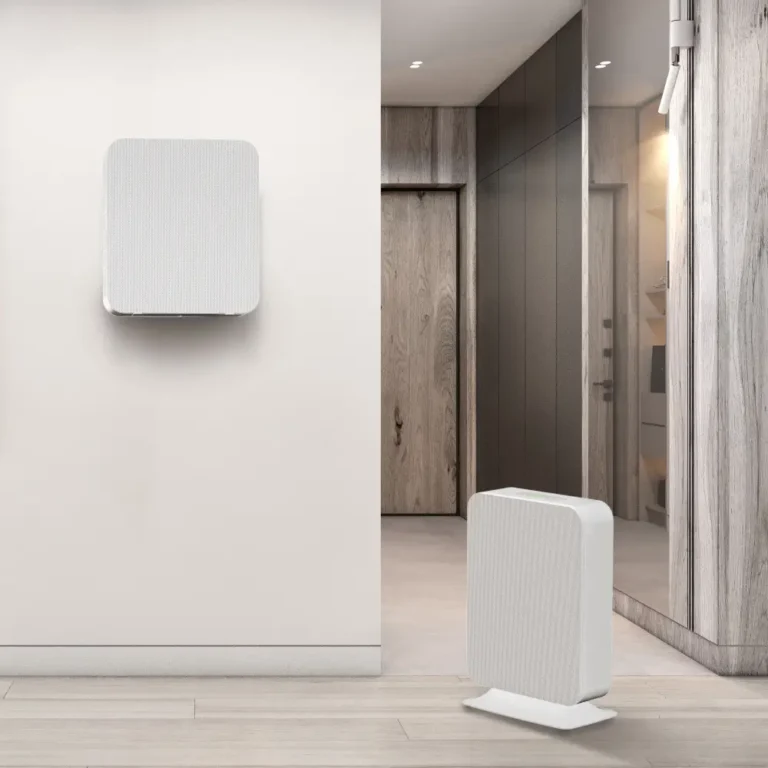
空気清浄機の適切なサイズは、この表を参考にしてください。


結論

現在、大気中の汚染物質の量は増加の一途をたどっており、きれいな空気を手に入れることは難しい。空気清浄機は、そのような作業を助けることができる優れた製品であり、病気や疾患の原因となる粒子を捕捉するために高品質のエアフィルターが必要です。
このブログでは、エアフィルターの生産を専門とするドイツの優良企業をリストアップした。なお、エアフィルターは空気清浄機製品に利用されており、呼吸する空気をきれいにする効果がより高いものです。中国トップクラスの空気清浄機製造・輸出企業との提携にご興味がございましたら、今すぐHisoAirまでご連絡ください。
以下のブログも参考になるだろう:
シェアする
ヒソエア創設者のリー氏
Alwen Lee, an air purification expert with over 10 years of experience, is a devoted father of two and a passionate traveler, having explored more than 30 countries. With a love for public speaking and swimming, he has dedicated his life to the indoor air quality industry. His mission is to ensure that people around the world enjoy the freedom to breathe clean air and lead happy, healthy lives.

メッセージを送る

もっと読む

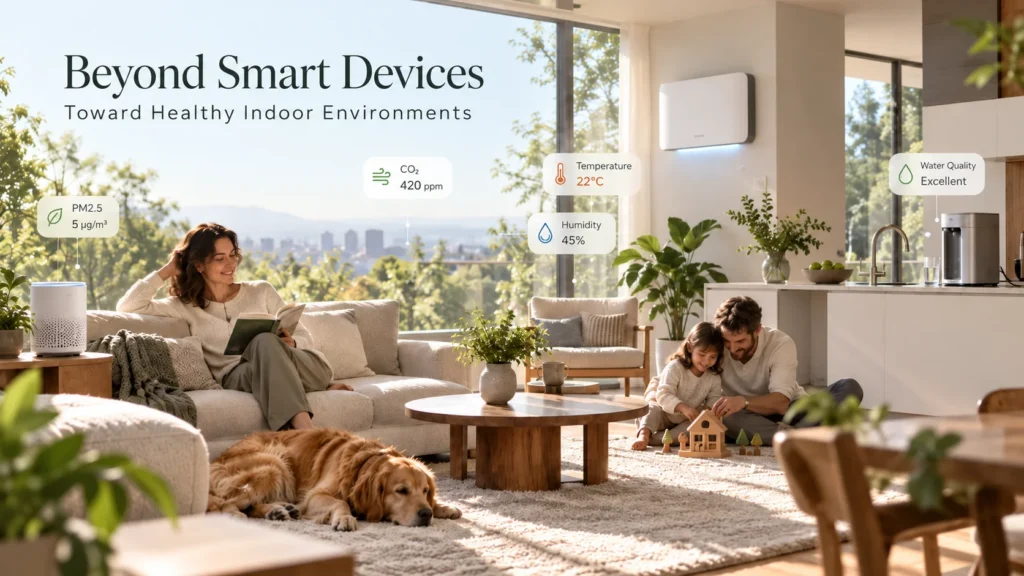
Modern living room with a family enjoying a healthy indoor environment monitored by smart devices, natural lighting, and greenery.

After IFA 2026: The Healthy Home Is Moving Beyond Smart Devices

In our previous IFA 2026 column, Air Purification Is Becoming Part of the Healthy-Home Platform, we argued that the next generation of indoor-health products would ...
ニュース
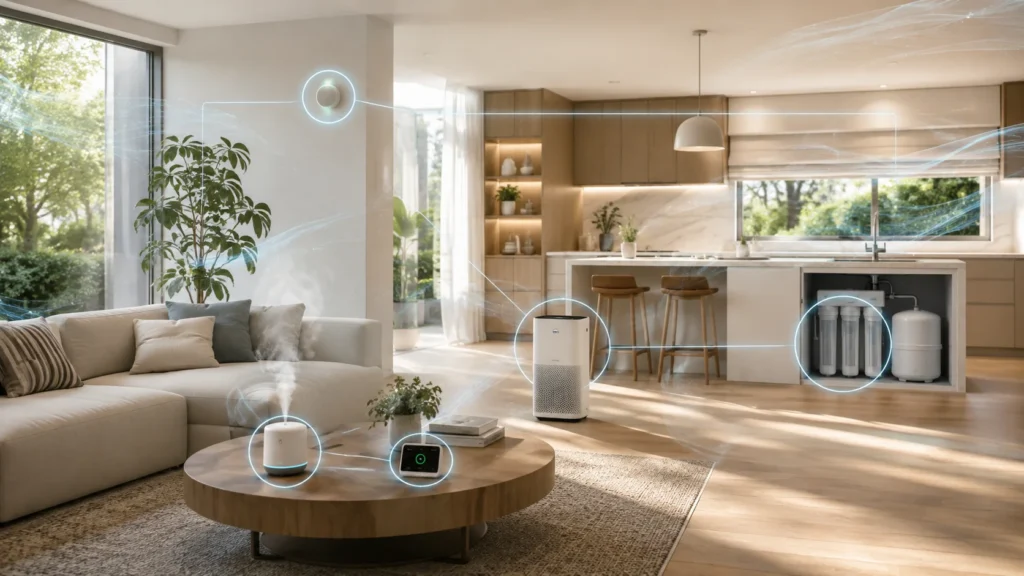
Modern living room and kitchen with smart home air quality devices including an air purifier, humidifier, and water filtration system, connected with visualized blue connectivity lines.

IFA 2026: Air Purification Is Becoming Part of the Healthy-Home Platform

Pre-IFA Industry Perspective | September 4, 2026 This article is based on official announcements and regulatory information available ahead of IFA 2026, which takes place ...
ニュース
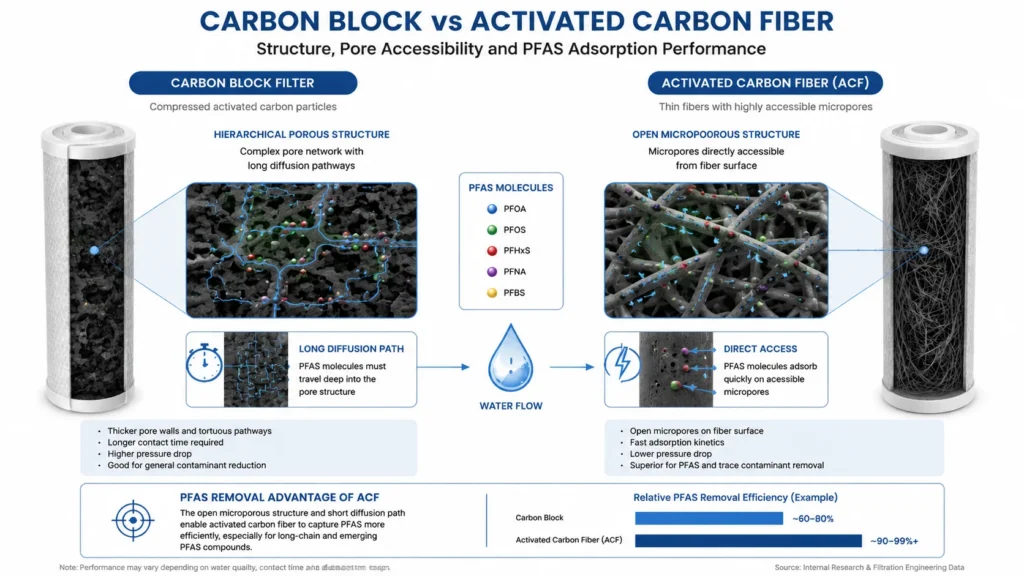
Comparison infographic showcasing the differences between carbon block filter and activated carbon fiber. Detailed diagrams illustrate the hierarchical porous structure of the carbon block with long diffusion paths and the open microporous structure of the activated carbon fiber with direct access for PFAS adsorption.

Carbon Block vs. Activated Carbon Fiber (ACF): Matching Media to Target Contaminants

Two carbon media. Same adsorption chemistry. Very different behaviour in a point-of-use cartridge. If you are specifying a water purifier platform for a PFAS-aware market, ...
ニュース
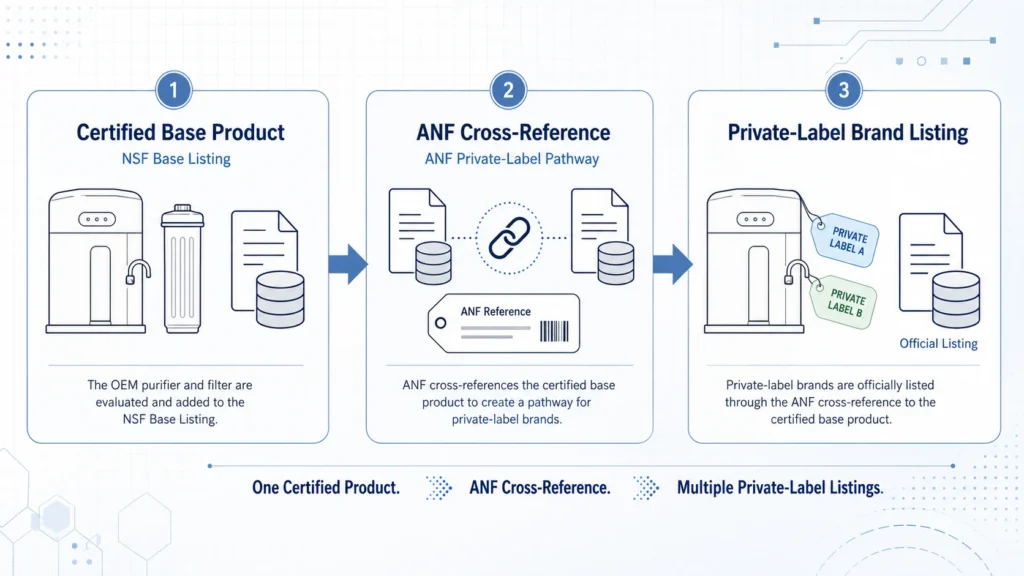
NSF base listing and ANF private-label certification pathway for OEM water filters

What Is an NSF Master Listing? A Guide to Base Listings, ANF Certification and OEM Water Filters

For a brand preparing to launch an OEM water purifier, one of the most common supplier claims is: “We already have an NSF master listing, ...
News, Water Purifiers
Healthy-home brand team reviewing PFAS water filter certification, test data and product engineering

Entering the Water Category Is Easy. Building a Credible PFAS Claim Is Much Harder

For air purification, appliance and healthy-home brands, entering the water category can look surprisingly easy. A company can select an existing undersink system, customize its ...
ニュース
Team in a business meeting discussing a water filtration system with product components and a comparison table displayed on a screen.

5 Leading OEM Water Purifier Manufacturers in China for Private Label Brands

China has thousands of companies selling water filters, reverse osmosis systems and drinking-water appliances. However, only a portion of them are suitable for private-label, OEM ...
ニュース
Contaminant Engineering•3 min read

PFAS Water Filtration Technologies Explained: Carbon, Resin & RO

Key Takeaway:

PFAS reduction depends on the specific compounds present, treatment media, contact time, water chemistry, and system design. Activated carbon, ion exchange, and Reverse Osmosis address PFAS through different mechanisms.

PFAS are a large family of persistent fluorinated compounds that can occur in drinking-water supplies. Their treatment behavior varies significantly by molecular structure, chain length, functional group, concentration, and the chemistry of the source water.

Granular Activated Carbon (GAC) removes PFAS primarily through adsorption. It is generally more effective for many longer-chain PFAS, while shorter-chain compounds tend to break through more quickly. Carbon performance depends on media properties, Empty Bed Contact Time (EBCT), competing organic matter, loading, and replacement frequency.

Ion-exchange resins use charged functional sites to capture many PFAS compounds. Properly selected anion-exchange media can provide high capacity and may perform better than conventional activated carbon for some shorter-chain PFAS, although performance still depends on water chemistry and competing ions.

Reverse Osmosis (RO) uses membrane separation rather than adsorption. Properly designed RO systems can provide broad reduction across many PFAS compounds as well as dissolved salts and other contaminants. Unlike carbon or resin, however, RO also produces a concentrate stream that must be managed.

No single technology should be selected from a PFAS label alone. System design should consider which PFAS compounds are present, their concentrations, required reduction targets, flow rate, media life, and the applicable third-party certification or validation requirements.

HisoAir Water Technical Series
Product Discovery•3 min read

How to Choose an Under-Sink Water Purifier for Modern Kitchens

Key Takeaway:

Match the treatment technology to your water quality first, then evaluate cabinet space, faucet configuration, flow rate, drain and power requirements, and filter replacement needs.

Choosing an under-sink water purifier starts with water chemistry. Carbon filtration is well suited to chlorine, taste, odor, and many organic contaminants, while Reverse Osmosis is more appropriate when dissolved salts, fluoride, nitrates, or broader dissolved contaminants need to be reduced.

For compact kitchens, tankless RO systems eliminate the conventional storage tank and can significantly reduce the space required under the sink. However, membrane capacity stated in GPD does not directly equal faucet flow. When comparing systems, check the actual dispensing flow rate, inlet-pressure requirement, recovery ratio, and whether a booster pump is required.

Installation architecture also matters. Many RO systems require a drain connection, electrical power, and either a dedicated drinking-water faucet or a compatible multi-function faucet. High-flow carbon systems can often connect directly to the existing cold-water line with a simpler installation, but pressure drop and available faucet flow should still be verified.

RO also removes much of the naturally occurring dissolved mineral content. Where taste or mineral balance is a priority, a post-RO remineralization stage can be added. Filter life should be evaluated by both rated capacity and local water quality rather than replacement time alone.

The right system is therefore not simply the smallest or highest-GPD model. It is the configuration that matches the target contaminants, available cabinet space, desired faucet setup, peak dispensing demand, and maintenance expectations.

HisoAir Water Technical Series
Water Quality•2 min read

What Does TDS Mean in Drinking Water? Measurement vs Contaminant Reality

Key Takeaway:

A TDS meter estimates the overall concentration of dissolved ionic substances from electrical conductivity. It cannot identify specific contaminants or determine whether water is chemically safe.

Total Dissolved Solids (TDS) refers to the combined concentration of dissolved substances in water. Most handheld TDS meters do not measure TDS directly. Instead, they measure electrical conductivity (EC) and convert that reading into an estimated parts-per-million (ppm) value.

This means a TDS reading can indicate how much dissolved ionic material is present, but not what that material actually is. Calcium, magnesium, sodium, nitrates, and other dissolved ions can all contribute to conductivity, yet a simple TDS meter cannot distinguish between them.

TDS meters are also not suitable for detecting trace contaminants such as PFAS, many VOCs, pesticides, pharmaceuticals, or disinfection byproducts. These substances may be present at concentrations far below the level needed to noticeably change electrical conductivity.

A low TDS reading therefore does not guarantee safe drinking water, and a higher TDS reading does not automatically indicate contamination. Water-treatment decisions should be based on laboratory testing for specific contaminants of concern rather than TDS alone.

HisoAir Water Technical Series
Technology Selection•2 min read

RO vs UF Water Filtration: Understanding Pore Sizes & Dissolved Minerals

Key Takeaway:

Ultrafiltration can reduce bacteria, turbidity, and suspended particles while retaining most naturally occurring dissolved minerals. Reverse Osmosis provides much broader reduction of dissolved salts and smaller contaminants.

Ultrafiltration (UF) typically uses hollow-fiber membranes with pore sizes in the approximate 0.01–0.1 micron range. These membranes physically retain turbidity, suspended solids, colloids, and many microorganisms while allowing dissolved minerals and salts to remain in the water.

Reverse Osmosis (RO) operates at a much finer separation level. Unlike UF, RO can substantially reduce dissolved ions such as sodium, calcium, fluoride, nitrates, and other contributors to total dissolved solids (TDS). This makes RO more suitable when dissolved-salt reduction is a primary treatment objective.

UF generally requires less system pressure and produces little or no continuous concentrate stream in many point-of-use configurations. RO typically requires greater pressure and produces a reject-water stream, but delivers broader contaminant reduction.

For water with acceptable TDS and mineral content, UF can be a simpler mineral-retaining treatment option. Where dissolved salts, fluoride, nitrates, or broader dissolved contaminants are a concern, RO is generally the more appropriate technology.

HisoAir Water Technical Series
Technology Selection•4 min read

Carbon Block vs Reverse Osmosis: Which Fits Your Need?

Key Takeaway:

Choose RO for dissolved inorganic salts and heavy metals; choose Carbon Block for chemical taste/odor, no wastewater, and high line-pressure flow.

Reverse Osmosis (RO) and Carbon Block filtration represent two fundamentally different treatment methods: membrane separation and adsorption. Understanding these differences helps determine which technology is better suited to a specific water-quality requirement.

Reverse Osmosis uses a semi-permeable membrane with pore sizes of approximately 0.0001 microns. It can significantly reduce dissolved inorganic contaminants such as TDS, fluoride, nitrates, and certain heavy metals. Because water must be forced through the membrane, RO systems require sufficient pressure or a booster pump and generate a concentrated wastewater stream.

Carbon Block filtration relies primarily on adsorption through compressed activated carbon, commonly with nominal pore sizes around 0.5–5 microns. It is highly effective for chlorine, chloramines, VOCs, taste, and odor, while allowing substantially higher direct-flow rates without producing wastewater.

From an operating perspective, Carbon Block systems are generally simpler, require less energy, and avoid the water loss associated with RO. RO involves higher system complexity and operating cost, but provides substantially broader reduction of dissolved contaminants that Carbon Block alone cannot address.

HisoAir Water Technical Series

見積依頼