新しいタブで開きます
革新的な空気品質ソリューション

米国の空気清浄機メーカー トップ5

Related Products

空気清浄機でビジネスを計画中ですか?最も賢い方法は、メーカーから直接製品を購入することです。この記事では、トップ5をリストアップした。 空気清浄機メーカー アメリカで

室内の空気環境を改善することで、COVID-19菌を地域から取り除くことができるのには、それなりの理由がある。によれば エイコサペンタエン酸 洗浄・消毒中に窓を開けるだけで、浮遊汚染物質や副産物を除去することができる。

人々が家で過ごす時間が長くなると、特に狭いスペースでは、間違いなく良好な換気が必要になる。したがって、私たちは 米国の空気清浄機市場 2021年初頭には、冬に屋内で過ごす時間が増えるため、気温が急上昇すると予想されている。

を見つける手助けをする。 米国製ベストルーム空気清浄機 私たちは、そのトップメーカーと工場のリストをコンパイルしました。大量注文や卸売注文、またはあなたのビジネスへの供給など、どのような場合にも対応できます!

注: このアメリカの空気清浄機メーカーのベストリストは、以下の基準に基づいている:

  • 卸売り機能を持ち、空気清浄機を月産数百万台規模で大量生産できるメーカー。
  • 研究開発能力
  • ISOやGMPなどの適切な工場認証を取得している。
  • 高品質の加湿器とHEPAエアフィルターを製造
  • 価格に見合った価値を提供

米国の空気清浄機メーカートップ5

お急ぎですか?米国製HEPA空気清浄機の中で、適格なメーカーが製造した製品をご紹介します:

  1. アレン・エア - テキサス州オースティン
  2. ハネウェル・インターナショナル - カリフォルニア州サンタアナ。
  3. ワールプール・コーポレーション - ミシガン州
  4. ハミルトンビーチ - グレンアレン、バージニア州
  5. ガーディアン・テクノロジーズ - オハイオ州メンター

アメリカのHEPA空気清浄機メーカーベスト5

以下のコンテンツでは、最高のUSA HEPA空気清浄機会社について、一つ一つ詳しくご紹介します。

1. アレン・エア

本社 テキサス州オースティン
経験年数 16年
アレン・ロゴ
アレン・ロゴ

アレン・エアはHEPA空気清浄機の最も信頼できる供給元です。同社は、0.1ミクロンまでの浮遊粒子を99.99%以上除去できる高品質の清浄機を提供しています。これらの粒子には、アレルゲン、カビ、ホコリ、バクテリア、ウイルスを運ぶエアロゾルなどが含まれます。

同社は、大気汚染物質に効果的な各種HEPAフィルターに特別な追加層を開発した。

アレン・エアは、HEPAとイオナイザーの技術を組み合わせた製品を提供している。さらに、顧客の空気品質要件に応じて、HEPAフィルターのカスタマイズが可能です。同社の空気清浄機では、細菌、カビ、煙、ホコリ、アレルゲン、化学物質、調理中の臭いやペットの臭いまでフィルターする追加パワーを選ぶことができる。

さらに、アレン・エアはお客様のお好みに合わせて、様々なデザインや色のカスタムフロントパネルを提供します。また、アレンではすべての空気清浄機に生涯保証をお付けしています。

2. ハネウェル・インターナショナル

本社 カリフォルニア州サンタアナ
経験年数 114年以上

ハネウェル
ハネウェル

ハネウェルは 卓上型空気清浄機、携帯型空気清浄機、UV処理システムなど、さまざまな空気清浄機がある。

同社の製品は低予算層向けで、空気清浄機のトップセラーとして知られている。ハネウェルは、HEPAフィルター、UV-Cライト、カーボンフィルター、イオナイザーを含むデバイスのための大規模な製品範囲を持っています。さらに、これらの機能は、いくつかの組み合わせで利用可能なハネウェルの製品に含まれています。

3. ワールプール・コーポレーション

本社 アメリカ合衆国ミシガン州ベントン・チャーター・タウンシップ
経験年数 110年
ワールプール
ワールプール

家電製品の多国籍ブランドであるワールプールは、世界をリードするキッチン・ランドリー家電メーカーである。同社の家電製品ラインの中には、家庭用およびオフィス用の多種多様な空気清浄機がある。

同社は、空気中の粒子を99.97%浄化すると謳う自社ブランドのHEPAフィルターを搭載した空気清浄機を製造している。

ワールプールの空気清浄機は、煙などの空気汚染物質や、ホコリや花粉などのアレルゲンに効果的だ。さらに、同社の製品には、循環する空気中の臭いの原因となる蒸気を捕らえるカーボンフィルターが含まれている。

年間売上高約$200億円のワールプールは、ワールプール、キッチンエイド、コンシュル、メイタグ、ブラステンプ、バウクネヒト、アマナ、インデシット、ジェンエアーなど、世界中で複数のブランド名で販売している。2019年現在、同社には59の製造センターと技術研究施設で働く77,000人の従業員がいる。

4. ハミルトンビーチ

本社 米国バージニア州グレン・アレン
経験年数 111年
ハミルトン・ビーチ
ハミルトン・ビーチ

家電の分野でよく知られるハミルトン・ビーチ社は、トゥルー空気清浄機ブランドを扱う会社である。同社のブランドは、市場の低予算層にも焦点を当てており、大衆市場へのアピールを生み出している。

バージニア州に本社を置くハミルトン・ビーチ社は、長年にわたり家電製品で有名である。同社のTrueAir空気清浄機は、HEPAグレードのフィルターで、カビの胞子、花粉、ほこり、煙、その他の粒子を捕らえることができる。さらに、同社のTrueAir空気清浄機は、縦置きでも横置きでも機能する。この機能により、どの部屋にも簡単に設置することができる。

予算面では、ハミルトン・ビーチが家庭や小さなスペース向けの素晴らしい品質の空気清浄機を製造している。

5. ガーディアン・テクノロジーズ

本社 米国オハイオ州メンター
経験年数 23年

ガーディアン・テクノロジーズ ロゴ
ガーディアン・テクノロジーズ ロゴ

オハイオ州に本社を置くガーディアン・テクノロジーズは、ピュアガーディアンとジャームガーディアンという空気清浄機のメーカーである。

ピュアガーディアン製品は、HEPAフィルターとカーボンフィルターを含むように設計されています。ピュアガーディアンは、花粉などの一般的なアレルゲンの捕獲に特化しています、 ダニペットのフケ カビの胞子.

一方、ジャームガーディアンの空気清浄機には次のような特徴がある。 紫外線技術(UV-C) が含まれています。UV-Cは、空気中のウイルスやバクテリアを99.9%致死させる安全な放射線です。

ジャームガーディアンUV-Cは、細菌のDNA構造を変化させ、細菌の繁殖を停止させる。

中国のトップ空気清浄機メーカー

中国は世界の製造大国であり、世界中の製品のほぼ3分の1を供給しています。この国のトップ空気清浄機メーカーとお知り合いになりたいとお考えなら、今すぐヒソエアにご相談ください!

ヒソエア

ヒソエアのロゴ
ヒソエアのロゴ

ビジネスタイプ OE/OD/JDメーカー、サプライヤー
本社 Room 712, Building 1, No. 4, Second Road, Songshan Lake Park, Dongguan City, Guangdong Province, China
主な市場 グローバル
経験年数: 18 years
証明書:CE, ROHS, EN1822

HisoAir specializes in manufacturing air purifiers that can be used in a medical setting. It was founded in 2003. It had achieved phenomenal success over its short eleven years in the industry with its more than a hundred accomplished projects all over the globe.

同社は50以上の設計特許を取得し、空気中に存在する粒子の99.99%を除去できる空気浄化システムを開発した。SGSはまた、同社の製品がコロナウイルス・ファミリーの99.8%を除去できることを検証しており、これはCOVID-19パンデミックが猛威を振るっている現在の社会では有益であろう。

主要製品

医療用空気清浄機

まとめ

どうぞ!このリストから空気清浄機サプライヤーを選択できることを願っています。なお、中国の空気清浄機、加湿器、空気清浄機をより安価で高品質に調達したい場合は、別の記事をご覧ください。

シェアする
ヒソエア創設者のリー氏
Alwen Lee, an air purification expert with over 10 years of experience, is a devoted father of two and a passionate traveler, having explored more than 30 countries. With a love for public speaking and swimming, he has dedicated his life to the indoor air quality industry. His mission is to ensure that people around the world enjoy the freedom to breathe clean air and lead happy, healthy lives.

メッセージを送る

Related Products

もっと読む

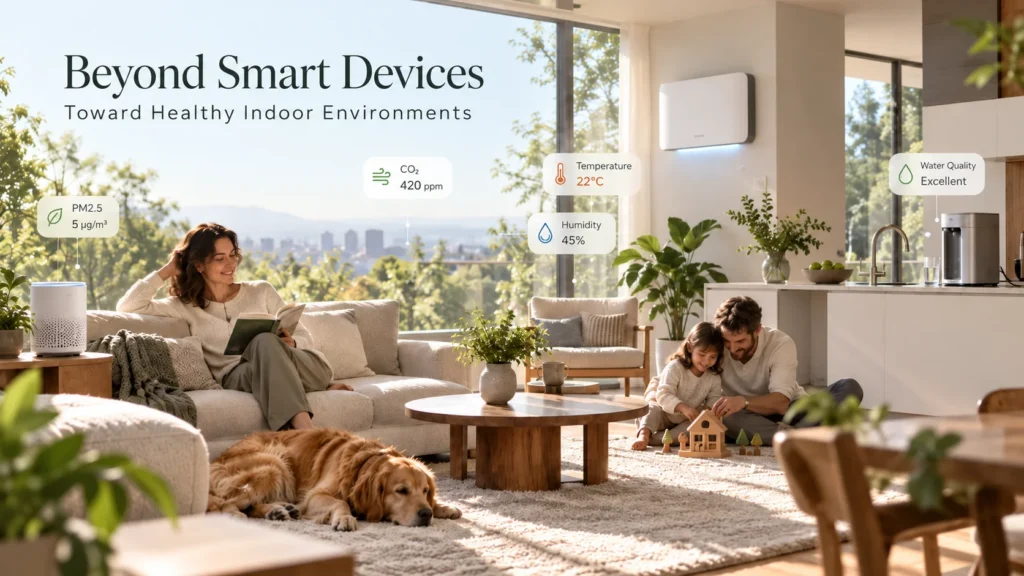
Modern living room with a family enjoying a healthy indoor environment monitored by smart devices, natural lighting, and greenery.

After IFA 2026: The Healthy Home Is Moving Beyond Smart Devices

In our previous IFA 2026 column, Air Purification Is Becoming Part of the Healthy-Home Platform, we argued that the next generation of indoor-health products would ...
ニュース
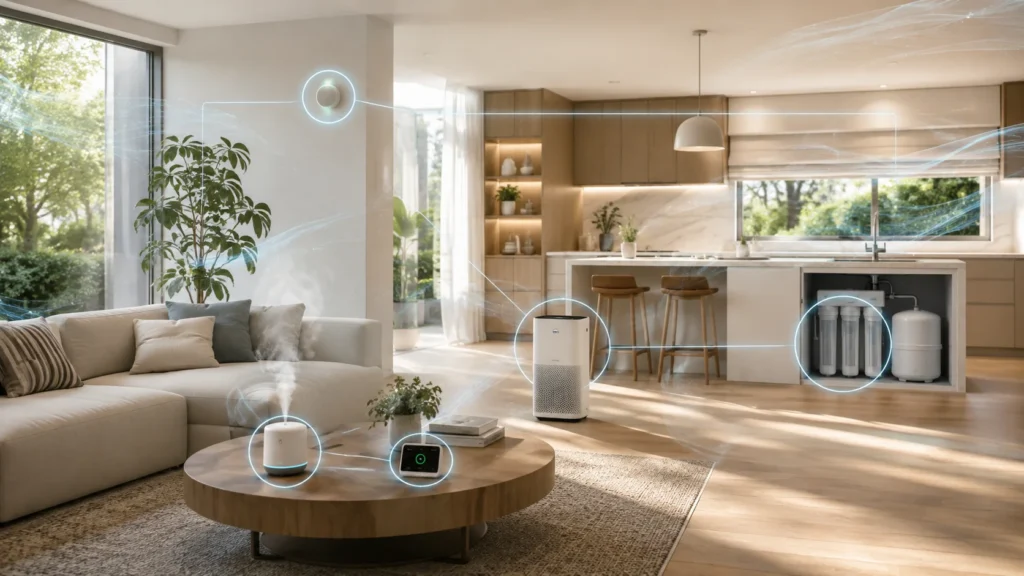
Modern living room and kitchen with smart home air quality devices including an air purifier, humidifier, and water filtration system, connected with visualized blue connectivity lines.

IFA 2026: Air Purification Is Becoming Part of the Healthy-Home Platform

Pre-IFA Industry Perspective | September 4, 2026 This article is based on official announcements and regulatory information available ahead of IFA 2026, which takes place ...
ニュース
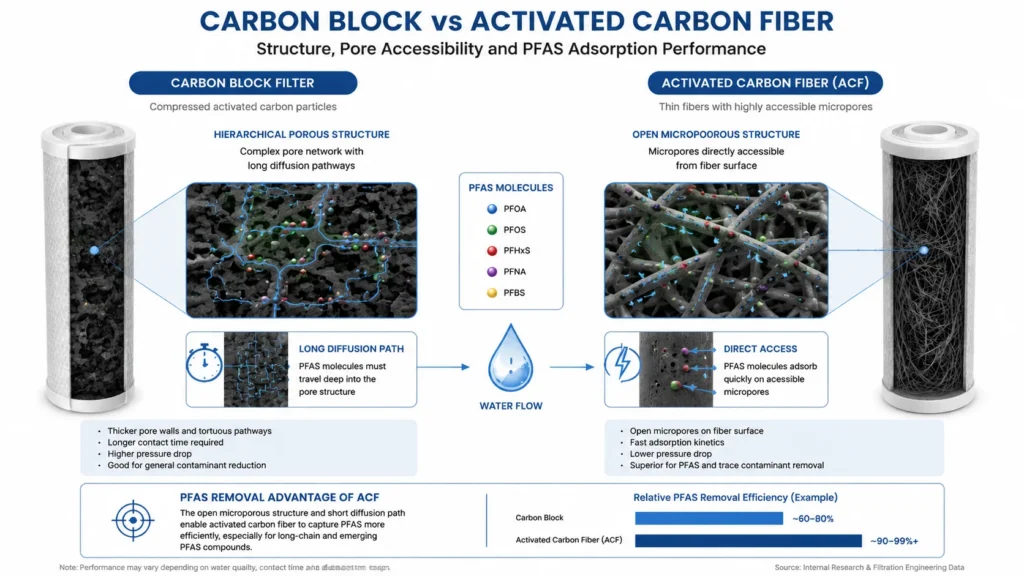
Comparison infographic showcasing the differences between carbon block filter and activated carbon fiber. Detailed diagrams illustrate the hierarchical porous structure of the carbon block with long diffusion paths and the open microporous structure of the activated carbon fiber with direct access for PFAS adsorption.

Carbon Block vs. Activated Carbon Fiber (ACF): Matching Media to Target Contaminants

Two carbon media. Same adsorption chemistry. Very different behaviour in a point-of-use cartridge. If you are specifying a water purifier platform for a PFAS-aware market, ...
ニュース
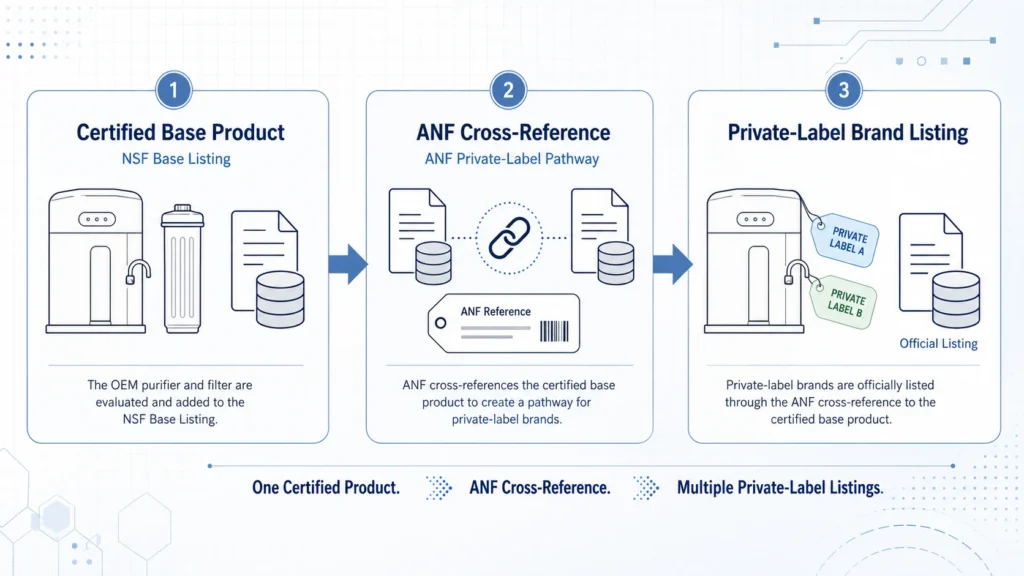
NSF base listing and ANF private-label certification pathway for OEM water filters

What Is an NSF Master Listing? A Guide to Base Listings, ANF Certification and OEM Water Filters

For a brand preparing to launch an OEM water purifier, one of the most common supplier claims is: “We already have an NSF master listing, ...
News, Water Purifiers
Healthy-home brand team reviewing PFAS water filter certification, test data and product engineering

Entering the Water Category Is Easy. Building a Credible PFAS Claim Is Much Harder

For air purification, appliance and healthy-home brands, entering the water category can look surprisingly easy. A company can select an existing undersink system, customize its ...
ニュース
Team in a business meeting discussing a water filtration system with product components and a comparison table displayed on a screen.

5 Leading OEM Water Purifier Manufacturers in China for Private Label Brands

China has thousands of companies selling water filters, reverse osmosis systems and drinking-water appliances. However, only a portion of them are suitable for private-label, OEM ...
ニュース
Contaminant Engineering•3 min read

PFAS Water Filtration Technologies Explained: Carbon, Resin & RO

Key Takeaway:

PFAS reduction depends on the specific compounds present, treatment media, contact time, water chemistry, and system design. Activated carbon, ion exchange, and Reverse Osmosis address PFAS through different mechanisms.

PFAS are a large family of persistent fluorinated compounds that can occur in drinking-water supplies. Their treatment behavior varies significantly by molecular structure, chain length, functional group, concentration, and the chemistry of the source water.

Granular Activated Carbon (GAC) removes PFAS primarily through adsorption. It is generally more effective for many longer-chain PFAS, while shorter-chain compounds tend to break through more quickly. Carbon performance depends on media properties, Empty Bed Contact Time (EBCT), competing organic matter, loading, and replacement frequency.

Ion-exchange resins use charged functional sites to capture many PFAS compounds. Properly selected anion-exchange media can provide high capacity and may perform better than conventional activated carbon for some shorter-chain PFAS, although performance still depends on water chemistry and competing ions.

Reverse Osmosis (RO) uses membrane separation rather than adsorption. Properly designed RO systems can provide broad reduction across many PFAS compounds as well as dissolved salts and other contaminants. Unlike carbon or resin, however, RO also produces a concentrate stream that must be managed.

No single technology should be selected from a PFAS label alone. System design should consider which PFAS compounds are present, their concentrations, required reduction targets, flow rate, media life, and the applicable third-party certification or validation requirements.

HisoAir Water Technical Series
Product Discovery•3 min read

How to Choose an Under-Sink Water Purifier for Modern Kitchens

Key Takeaway:

Match the treatment technology to your water quality first, then evaluate cabinet space, faucet configuration, flow rate, drain and power requirements, and filter replacement needs.

Choosing an under-sink water purifier starts with water chemistry. Carbon filtration is well suited to chlorine, taste, odor, and many organic contaminants, while Reverse Osmosis is more appropriate when dissolved salts, fluoride, nitrates, or broader dissolved contaminants need to be reduced.

For compact kitchens, tankless RO systems eliminate the conventional storage tank and can significantly reduce the space required under the sink. However, membrane capacity stated in GPD does not directly equal faucet flow. When comparing systems, check the actual dispensing flow rate, inlet-pressure requirement, recovery ratio, and whether a booster pump is required.

Installation architecture also matters. Many RO systems require a drain connection, electrical power, and either a dedicated drinking-water faucet or a compatible multi-function faucet. High-flow carbon systems can often connect directly to the existing cold-water line with a simpler installation, but pressure drop and available faucet flow should still be verified.

RO also removes much of the naturally occurring dissolved mineral content. Where taste or mineral balance is a priority, a post-RO remineralization stage can be added. Filter life should be evaluated by both rated capacity and local water quality rather than replacement time alone.

The right system is therefore not simply the smallest or highest-GPD model. It is the configuration that matches the target contaminants, available cabinet space, desired faucet setup, peak dispensing demand, and maintenance expectations.

HisoAir Water Technical Series
Water Quality•2 min read

What Does TDS Mean in Drinking Water? Measurement vs Contaminant Reality

Key Takeaway:

A TDS meter estimates the overall concentration of dissolved ionic substances from electrical conductivity. It cannot identify specific contaminants or determine whether water is chemically safe.

Total Dissolved Solids (TDS) refers to the combined concentration of dissolved substances in water. Most handheld TDS meters do not measure TDS directly. Instead, they measure electrical conductivity (EC) and convert that reading into an estimated parts-per-million (ppm) value.

This means a TDS reading can indicate how much dissolved ionic material is present, but not what that material actually is. Calcium, magnesium, sodium, nitrates, and other dissolved ions can all contribute to conductivity, yet a simple TDS meter cannot distinguish between them.

TDS meters are also not suitable for detecting trace contaminants such as PFAS, many VOCs, pesticides, pharmaceuticals, or disinfection byproducts. These substances may be present at concentrations far below the level needed to noticeably change electrical conductivity.

A low TDS reading therefore does not guarantee safe drinking water, and a higher TDS reading does not automatically indicate contamination. Water-treatment decisions should be based on laboratory testing for specific contaminants of concern rather than TDS alone.

HisoAir Water Technical Series
Technology Selection•2 min read

RO vs UF Water Filtration: Understanding Pore Sizes & Dissolved Minerals

Key Takeaway:

Ultrafiltration can reduce bacteria, turbidity, and suspended particles while retaining most naturally occurring dissolved minerals. Reverse Osmosis provides much broader reduction of dissolved salts and smaller contaminants.

Ultrafiltration (UF) typically uses hollow-fiber membranes with pore sizes in the approximate 0.01–0.1 micron range. These membranes physically retain turbidity, suspended solids, colloids, and many microorganisms while allowing dissolved minerals and salts to remain in the water.

Reverse Osmosis (RO) operates at a much finer separation level. Unlike UF, RO can substantially reduce dissolved ions such as sodium, calcium, fluoride, nitrates, and other contributors to total dissolved solids (TDS). This makes RO more suitable when dissolved-salt reduction is a primary treatment objective.

UF generally requires less system pressure and produces little or no continuous concentrate stream in many point-of-use configurations. RO typically requires greater pressure and produces a reject-water stream, but delivers broader contaminant reduction.

For water with acceptable TDS and mineral content, UF can be a simpler mineral-retaining treatment option. Where dissolved salts, fluoride, nitrates, or broader dissolved contaminants are a concern, RO is generally the more appropriate technology.

HisoAir Water Technical Series
Technology Selection•4 min read

Carbon Block vs Reverse Osmosis: Which Fits Your Need?

Key Takeaway:

Choose RO for dissolved inorganic salts and heavy metals; choose Carbon Block for chemical taste/odor, no wastewater, and high line-pressure flow.

Reverse Osmosis (RO) and Carbon Block filtration represent two fundamentally different treatment methods: membrane separation and adsorption. Understanding these differences helps determine which technology is better suited to a specific water-quality requirement.

Reverse Osmosis uses a semi-permeable membrane with pore sizes of approximately 0.0001 microns. It can significantly reduce dissolved inorganic contaminants such as TDS, fluoride, nitrates, and certain heavy metals. Because water must be forced through the membrane, RO systems require sufficient pressure or a booster pump and generate a concentrated wastewater stream.

Carbon Block filtration relies primarily on adsorption through compressed activated carbon, commonly with nominal pore sizes around 0.5–5 microns. It is highly effective for chlorine, chloramines, VOCs, taste, and odor, while allowing substantially higher direct-flow rates without producing wastewater.

From an operating perspective, Carbon Block systems are generally simpler, require less energy, and avoid the water loss associated with RO. RO involves higher system complexity and operating cost, but provides substantially broader reduction of dissolved contaminants that Carbon Block alone cannot address.

HisoAir Water Technical Series

見積依頼