
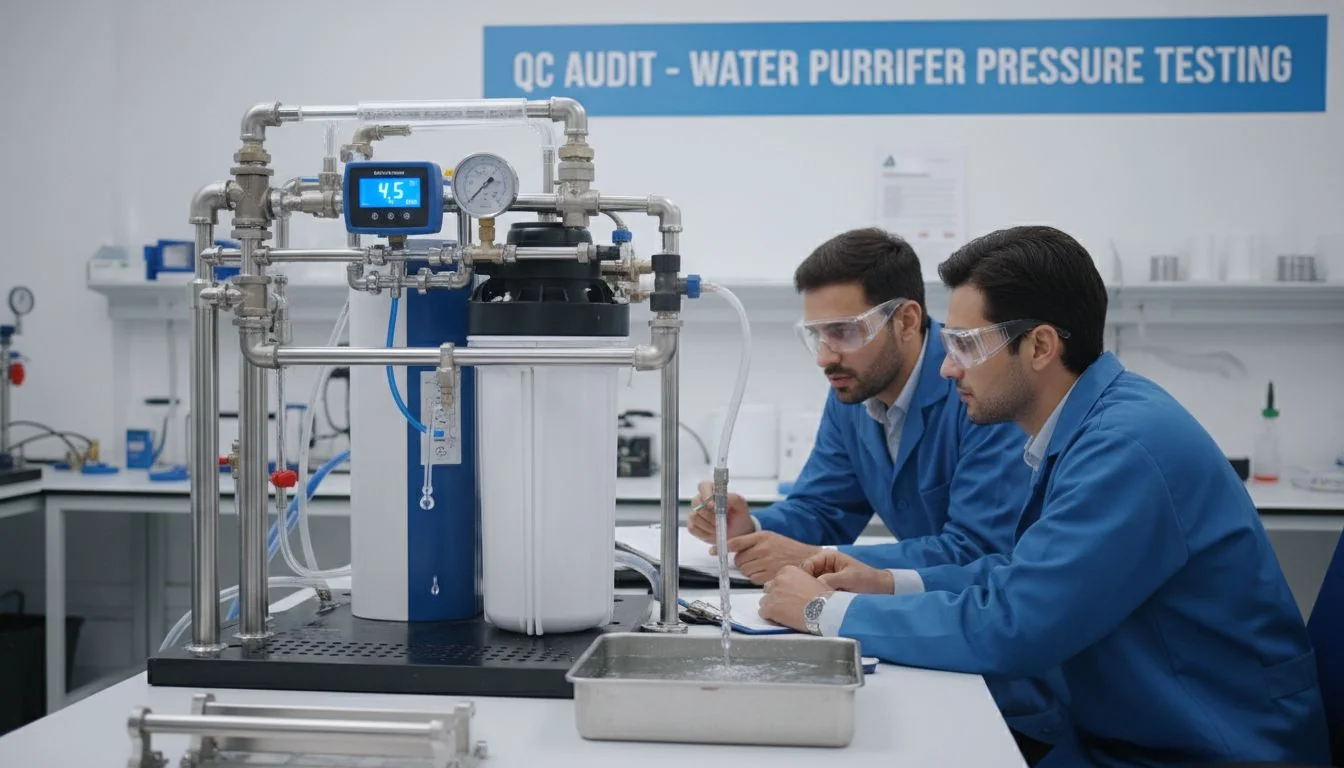
Cheap OEM quotes often hide weak pressure performance. A failed water purifier causes floods, property damage, and recalls. You must lock pressure specs early to protect your brand.
pressure testing1 is the most underspecified dimension in water purifier contracts. To audit QC effectively, buyers must enforce four checkpoints: quote-stage spec lock, sample-stage validation, production-stage QC, and field-correlation review. This prevents low-cost manufacturers from cutting corners on housing thickness and component grades.

I learned this the hard way during my early days in the mold industry. Let me show you exactly how to stop these hidden failures before they ruin your product line.
A housing molded 0.4mm thinner than spec will always fail a static pressure test.偽
A thinner housing can pass a static test but will fail pressure-cycle fatigue testing much earlier.
Rigorous pressure testing typically adds 1-3% to the cost of goods.真
This small cost covers testing infrastructure, properly rated components, and adequate housing wall thickness.
What Are the Static and Burst Pressure Benchmarks for Different Water Purifier Tiers?
Guessing pressure benchmarks2 leads to disaster. Under-spec, and the product floods a home. Over-spec, and you waste money on parts. You need exact numbers for your target tier.
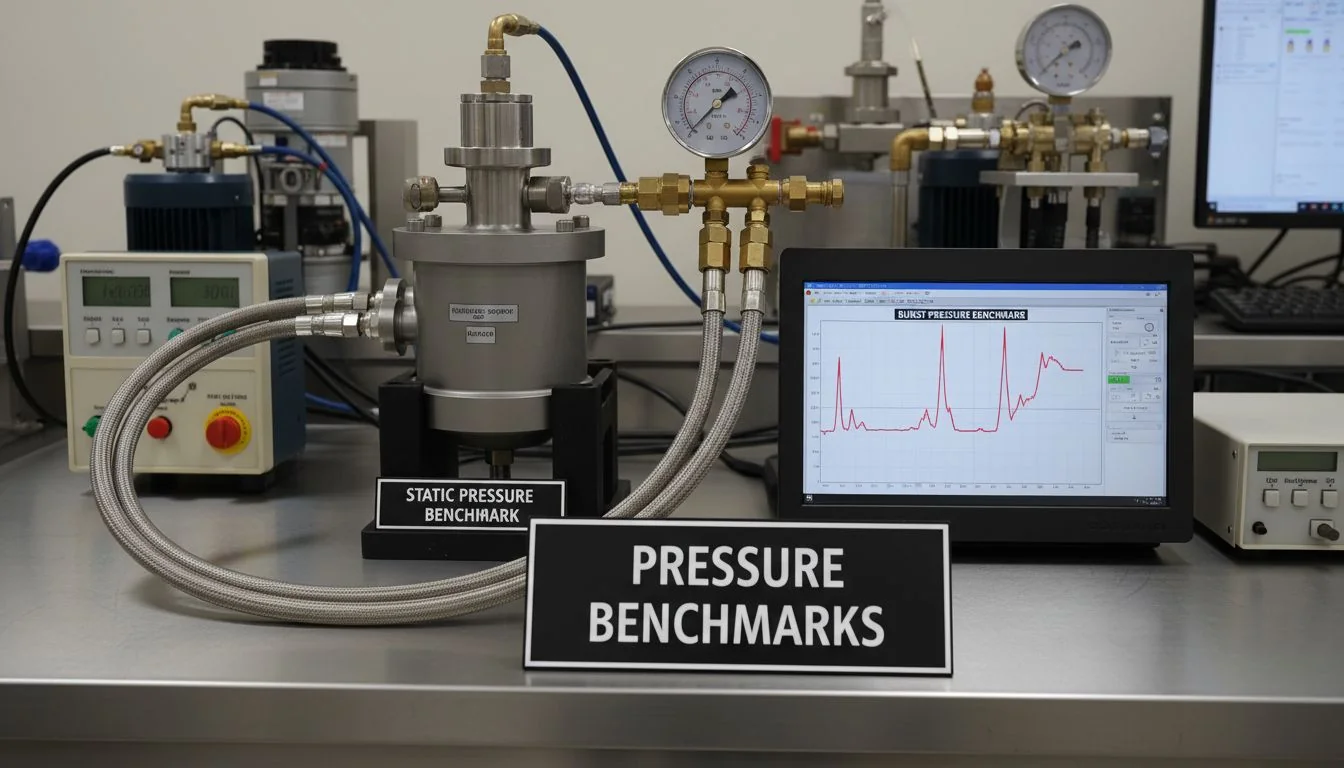
Static testing holds the system at 1.5 to 2 times the operating pressure to check for leaks. burst testing3 pressurizes the unit until it breaks. Residential systems need a 200-300 psi burst benchmark, while commercial systems require 500-800 psi.
The Weak-Component Principle
Burst testing often shows a surprising truth. The main housing is rarely the weakest link. Usually, a fitting, an O-ring, or a quick-connect breaks first. The burst pressure of your entire system equals the burst pressure of its weakest part. If you have a strong housing but a cheap quick-connect, the system fails at the quick-connect's limit. This is why you must control component-level pressure ratings just as strictly as your housing design.
Benchmark Ranges by Tier
You must specify the right benchmark in your RFQ. If a manufacturer cannot provide burst test data on sample units, they are hiding something. Do not accept a calculated design burst. You need actual destructive test results. Here is a breakdown of the benchmarks you should demand:
| Purifier Tier | Operating Pressure | Static Test Pressure | Burst Benchmark |
|---|---|---|---|
| レジデンシャル | 35–80 psi | 120–150 psi | 200–300 psi |
| Light Commercial | 100–150 psi | 180–250 psi | 350–500 psi |
| コマーシャル | 150–250 psi | 1.5x Operating | 500–800+ psi |
Always lock these numbers at the quote stage. This separates a reliable product from a cheap, risky one.
The burst pressure of a water purifier system is determined by its strongest component.偽
The burst pressure of a system is determined by its weakest component, such as a fitting or O-ring.
Residential water purifiers typically require a burst pressure benchmark of 200-300 psi.真
This provides a 2.5 to 3 times safety margin above the high end of normal operating pressure.
Why Does Pressure-Cycle Fatigue Testing Predict 5-Year Reliability Better Than Burst Testing?
A great burst number looks good on paper. But real-world water purifiers face thousands of pressure cycles, not one big spike. Skipping fatigue tests guarantees field failures later.
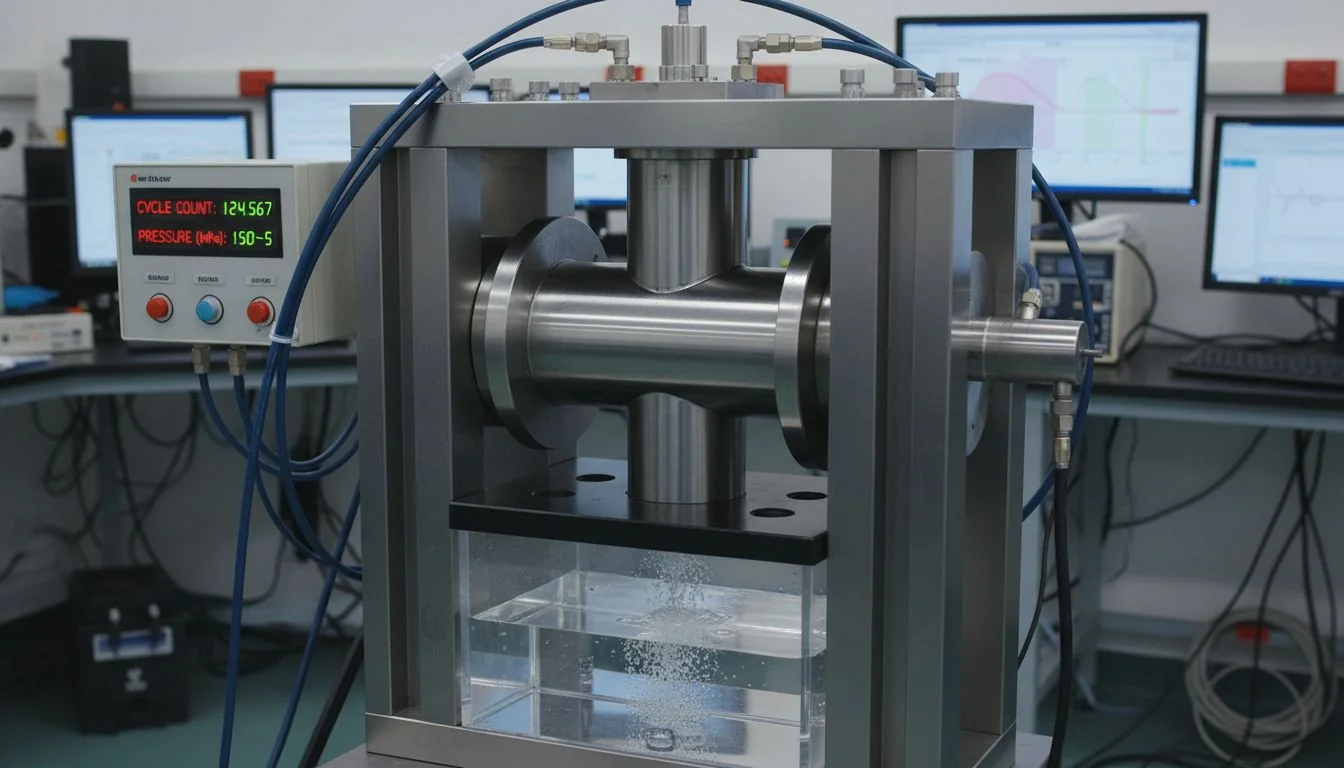
Burst tests only show how much pressure breaks a system once. Pressure-cycle fatigue testing4 simulates real-world use by pressurizing and depressurizing the system thousands of times. A product claiming a 5-year life must survive at least 10,000 cycles to prove its reliability.
The Hidden Failures Cycle Testing Reveals
Cycle fatigue testing exposes problems that static and burst tests miss completely. For example, a thin weld line in a molded housing might survive one static test. But after thousands of cycles, that same weld line will crack. O-rings that hold steady under static pressure will slowly degrade and leak under constant cycling. Quick-connects will loosen. Threaded fittings will crack. These are fatigue failures. They happen at pressures far below the single-event burst limit.
Setting the Cycle Benchmark
You must tie your cycle benchmark to the claimed life of the product. A residential RO system cycles multiple times a day. Over five to seven years, that adds up fast.
| Claimed Service Life | Daily Cycles | Minimum Cycle Benchmark | Recommended Margin |
|---|---|---|---|
| 3 Years | 5 | 5,475 cycles | 10,000 cycles |
| 5 Years | 5 | 9,125 cycles | 15,000 cycles |
| 7 Years | 5 | 12,775 cycles | 20,000+ cycles |
Your quality agreement must demand this test. Ask your OEM partner to show you cycle fatigue data on a real product. If they only offer a burst number and a promise, walk away. The cost of this test is tiny compared to a massive recall in year two.
Static testing easily detects weld line fatigue cracking in molded housings.偽
Static testing misses fatigue cracking. Only pressure-cycle fatigue testing reveals these long-term material failures.
A water purifier claiming a 5-year service life should validate to at least 10,000 pressure cycles.真
10,000 cycles covers the expected daily pressure changes over a 5-year period with a small safety margin.
Why Can a Passing System-Level Test Hide a Failing Component?
Testing the whole assembled system feels safe. But it creates a massive blind spot. A passing system test can easily hide one weak part that will fail in the field.
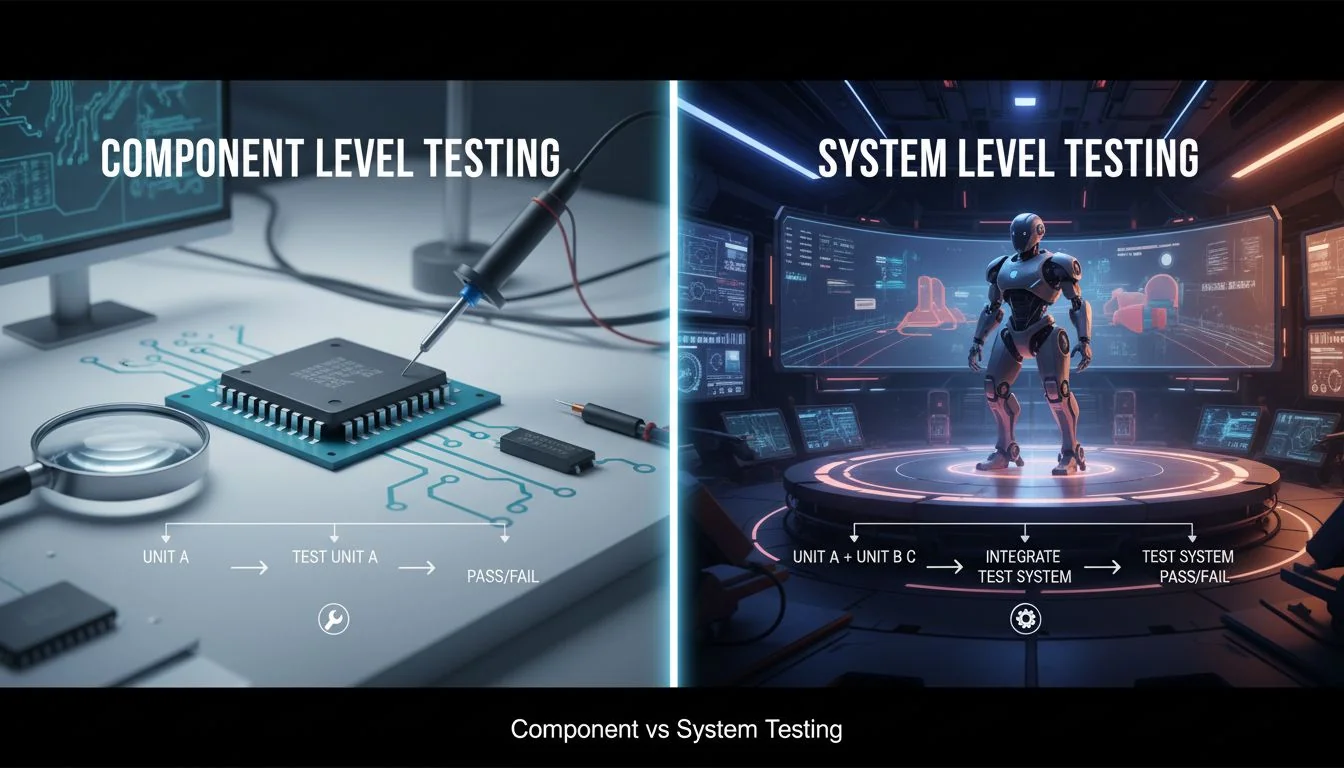
System-level tests confirm the assembled product survives, but they do not show the margin of each part. A system might pass at 250 psi, but a quick-connect inside might be on the edge of breaking at 255 psi. component-level testing5 isolates and measures the true strength of every part.
The Danger of the Blind Spot
A system-level test only reports the performance of the weakest link. It does not tell you which part that is. It also does not tell you how much safety margin the other parts have. If your system passes a 250 psi test, you might feel good. But if your quick-connect fails at 255 psi, you have almost zero margin. A slight change in production quality will cause that part to fail in a customer's home.
The Combined Testing Strategy
Smart buyers use both methods. You must use component-level testing during the design phase. This helps you balance the pressure path. No single part should be much weaker than the rest. Then, you use system-level testing6 during production to check assembly quality.
| Test Type | When to Use It | What It Validates |
|---|---|---|
| Component-Level | Design & Qualification | Individual part margins and weak points |
| System-Level | Production QC | Overall assembly quality and integration |
| Interface-Level | Qualification | Specific seal and joint reliability |
Leakage is an assembly problem. You must run system-level leak tests on 100% of your production units. Never accept a single system-level pass as proof of a good design. Demand the component-level margin profile.
System-level testing identifies exactly which component has the lowest safety margin.偽
System-level testing only shows the failure point of the whole assembly. It does not isolate or identify the margins of individual components.
System-level leak testing should be performed on 100% of production units.真
Leakage is highly sensitive to the assembly process, so every single unit must be checked.
What Are the Test Report Red Flags B2B Buyers Must Catch Before Issuing a PO?
Bad suppliers use tricky test reports to hide weak products. If you cannot read these documents, you will buy a bad product. You must spot the red flags early.
Before issuing a PO, check the test report for calculated burst numbers instead of physical tests. Look for missing cycle fatigue data, sample sizes of one, and tests run too close to normal operating pressure. A missing failure mode description is also a major warning sign.

Spotting Fake Confidence
A test report is a technical document. Many low-cost factories make them look official to trick you. The biggest red flag is a calculated burst pressure. This is just an engineering guess based on material thickness. Real parts have flaws. You need a destructive test on a real physical unit. Another huge red flag is a sample size of one. One unit does not prove the factory can make ten thousand good units.
The Red Flag Checklist
When you review a test report, use this checklist. If you see these issues, ask hard questions before you pay.
| Red Flag | What It Means | What You Should Demand |
|---|---|---|
| Calculated Burst | No physical test was done | Actual destructive test data |
| No Cycle Data | Long-term reliability is unknown | 10,000+ cycle fatigue results |
| Sample Size of 1 | Process consistency is unproven | Larger sample size across lots |
| No Failure Mode | Factory treats it as a checkbox | Exact location and type of break |
| No 3rd Party | Factory might be hiding bad data | Independent lab verification |
Do not walk away immediately when you see a red flag. Ask for the missing data. A good partner will give it to you. A bad partner will make excuses.
A calculated design burst pressure is just as reliable as a physical destructive burst test.偽
Calculated numbers ignore real-world manufacturing variations like wall thickness changes and weld line quality.
A test report should always document the exact location and mode of the failure.真
Knowing how and where a part failed helps engineers improve the design and fix weak points.
結論
Pressure testing is not just a checkbox. By locking specs early, demanding cycle fatigue data, and spotting report red flags, you ensure your water purifiers survive the real world.
References
-
Understanding pressure testing is crucial for ensuring the reliability and safety of water purifiers. ↩
-
Knowing the correct pressure benchmarks is vital for ensuring product safety and compliance. ↩
-
Burst testing is essential for determining the maximum pressure a water purifier can withstand before failure. ↩
-
Cycle fatigue testing simulates real-world conditions, revealing potential long-term failures in water purifiers. ↩
-
Component-level testing helps identify weaknesses in individual parts, ensuring overall product reliability. ↩
-
System-level testing assesses the performance of the entire assembly, crucial for quality control. ↩



 English
  Français
  Español
  Italiano
  Deutsch
  Português
  Русский
  العربية
  日本語
日本語  한국어
한국어  Tiếng Việt
